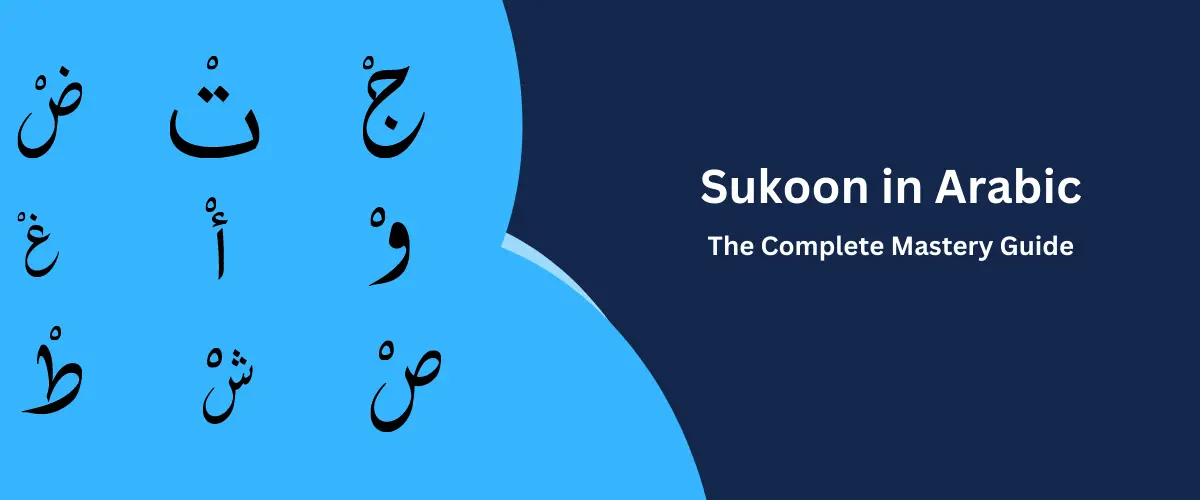
Sukoon is rooted in the concept of tranquility, mastering sukoon is essential for both language learners and those who appreciate the elegance of the Arabic script. Sukoon is a small diacritical mark in Arabic, symbolizes stillness and marks the absence of a vowel after a consonant.
Sukoon played an important role in the linguistic study of the Arabs. They dealt with it and discussed many of its problems on various linguistic levels. They were interested in studying it in calligraphy and writing as well. They put a distinctive diacritical mark on it, which has become part of the written system of the Arabic language.
However, we note that everything that the Arabs left in the past about explaining the sukoon is full of turmoil and sometimes even far from the right path, which prompted us to discuss the topic again, in an attempt to carry out a full linguistic discussion from the different angles of the research: phonetically, morphologically and grammatically.
Sukoon Meaning:
In Arabic, “sukoon” refers to tranquility or stillness. In linguistic terms, it indicates the lack of a vowel following a consonant, shown by a small mark placed above the letter. Sukoon isn’t a phonetic sound but signifies a pause or break in vocalization, where the consonant is pronounced without any vowel.
Sukoon plays a key role in Arabic grammar and pronunciation, particularly in Quranic recitation, as it helps clarify word forms and ensure accurate expression. Its correct use is essential for understanding and maintaining the language’s structure.
What is sukoon in Arabic?
What is Sukoon literally? In Arabic, Sukoon means still, rest, calmness, or relief. Sukoon is an optional prefix that can be placed above a letter to indicate that it lacks a vowel. It can also be used at the middle or end of a word. It is written above the letter in the shape of a circle (ــْـ).
Is Sukoon a linguistic sound? Or, to put it more closely to the topic: Is Sukoon a haraka? The answer to this question, in all its forms, is easy and affordable for everyone who is familiar with the meaning of the linguistic sound or who has the slightest experience in phonemic studies, so all of them will immediately say that:
- The sukoon is not a linguistic sound,
- Sukoon is neither pronounced nor heard,
- Sukoon has no phonetic realization or any audible effect,
- Sukoon does not belong to the Consonant sounds or vowels in terms of pronunciation,
- Sukoon does not come at the word beginning.
Application and Role of Sukoon in Arabic Language
The Sukoon is used to indicate that a letter lacks a vowel. Therefore, we emphasize the letter by pausing while we pronounce it. We will have to join letters to do this. We will use some words to show you how to utilize the Sukoon.
Importance of Sukoon in Understanding Arabic
Sukoon, which means, as we said above, (zero vowel, displays and symbolizes the lack of a vowel after the consonant letter. Using the method of consonant-vowel-consonant syllables is frequent in Arabic. This method requires the use of this sukoon to stop on the consonant letter.
Arabic Letters With Sukoon
The following table shows the form of the sukoon on the letters:
| خْ | حْ | جْ | ثْ | تْ | بْ | ءْ |
| صْ | شْ | سْ | زْ | رْ | ذْ | دْ |
| قْ | فْ | غْ | عْ | ظْ | طْ | ضْ |
| يْ | وْ | هْـ | نْ | مْ | لْ | كْ |
- Visual Representation of Sukoon
Let’s choose the letter (meem م ) to pronounce it with motion and Sukoon. أمْ مَ ـ مِ ـ مُ
We notice that the meem with Sukoon was pronounced by the collision between the upper lip and the lower lip without accompanying the opening or joining of the lips or the lowering of the lower jaw.
- The maftooh meem: We pronounce it with the distance between the lips and jaws, and that is accompanied by the opening of the mouth, i.e. the exit of the alif ا and the fatha.
- The madmoom meem: We have pronounced it with the distance between the lips, and this is accompanied by joining the lips, i.e. the exit of the wawو and the dammah.
- The maksoor meem: We may pronounce it with the distance between the lips, and this is accompanied by a lowering of the lower jaw, i.e. the exit of the ya’ي and the kasrah
So, the Sukoon comes out by colliding between the two ends of the articulation organ.
- Where Sukoon Appears in a Word
The sukoon sign must be shown when writing, especially for non-Arabs. As for the vowels ا,و,ي, the matter differs according to their position in the word
- The alifا, the wawو, and the yaaي occurring after a homonymous vowel are considered to be the letters of a mudd, and the sukoon does not appear on them, and these examples of that
“فَأَيْنَمَا تُوَلُّوا”
“وَاللَّهُ يُؤْتِي مُلْكَهُ مَنْ يَشَاءُ”
- As for if the alif and the ya’ or the waw occurred in one of them after a fatha, then the sukoon appears on it like his saying: “فَقَدِ اهْتَدَوا”.
read more: WHAT IS TANWEEN IN ARABIC? – FULL GUIDE
Pronunciation Guide for Sukoon
- The Sound of Silence: Pronouncing Sukoon
The letter with sukoon is read with a vowel before it, and a stop is made at the letter with sukoon.
- Effect of Sukoon on Preceding and Succeeding Letters
When we want to pronounce a letter with sukoon, we notice that this letter sticks to the letter that preceded it with strength and intensity, such as يَلْعَبُ, so we cannot pronounce the letter “lamل” alone without affixing it to the letter “yaaي”, so we must say: يَلْ/عَ/بُ
Experience Kalimah Center Classes
Watch real excerpts from our live sessions at Kalimah Center and see how we bring learning to life. These clips highlight our interactive, student-centered teaching approach across all our courses—designed to keep learners engaged, motivated, and actively involved every step of the way.
Grammatical Role of Sukoon in the Arabic Language
With regard to the grammatical role of sukoon in Arabic, the word does not begin with a sukoon at all. This means that the first letter of the word must be a vowel. If a word exceeds three letters, it must be followed by a consonant or more. That is: we do not find in the Arabic word four vowels, except for a reason, or as a matter of anomaly according to the rule of dividing the Arabic word into syllables.
- Sukoon in Verbs: Understanding the Static Consonant
Sukoon is the original affirmative sign. Jazm is concerned with the present tense verb only, and the Sukoon replaces the deletion of the vowel and also the deletion of the letter Noon in cases that we will not mention here so that there is no confusion between the Sukoon and the other signs of Jasm. Cases of Jasm the present verb with Sukoon can be illustrated in the following examples:
- يرسم = لم يرسمْ.
- يقبل = لم يقبلْ.
- ينظف = لم ينظفْ
Sukoon in Practice
Let’s practice more examples of Sukoon to increase our understanding of it.
- Examples of Sukoon in Common Arabic Words
| Day | Yaw’m | يَوْمِ |
| Cup | Ka’s | كَأْس |
| About him | Ean’hw | عَنْهُ |
| They | Hum’ | هُمْ |
| How | Kay’fa | كَيْفَ |
| Duck | Bat’ | بَطْ |
- Pronunciation Practice with Sukoon
- When pronouncing letters with Sukoon, keep your tongue in a neutral posture.
- After you’ve said the letter in Sukoon, pause. When a consonant is followed by a Sakin letter (a non-vowel character), the pause should be shorter.
- After a brief pause, take a few deep breaths before moving on to the letter that comes after Sukoon. This keeps the reading pace consistent.
- The reciters who have mastered the skill of Tajweed should be carefully listened to. Watch how Sukoon is said; the goal is to mimic the mannerisms.
- Practice and repetition will help you become more fluent in your Arabic speakingHow to Speak Arabic Quickly and Fluently? Fast Experience-Based Guidance!. To become familiar with the verses of the Qur’an that include Sukoon, read them again.
Sukoon and Arabic Calligraphy
Despite the difference in civilizations and the diversity of writing methods among mankind, Arabic writing and the arts of calligraphy remain the focus of attention of researchers and thinkers in general, and connoisseurs of fine art in particular.
The great development of the Arabic letter in plastic art, whether with its symbolic or expressive use, did not affect the magic of Arabic calligraphy within the word and sentence. It still tempts many artists and calligraphers to use it to reach artistic glimpses that delight the viewer and enrich his visual vision.
- Sukoon in the Art of Arabic Calligraphy
Sukoon is considered one of the indispensable decorative elements because it completes the formation and decoration attached to the letters and fills in the spaces in addition to adjusting the words and correcting their reading.
- The Aesthetic Appeal of Sukoon in Script
There are two types of stillness in writing:
- The apparent sukoon is a small circle, but in the Quran, it is in the form of the head of Haa, which is placed above the letter. أبْ بَ ـ أتْ تَ ـ أثْ ثَ.
- The inconspicuous sukoon [non-decree] is usually found in the Holy Qur’an. It means that the letter is devoid of sukoon or the vowels, such as the three vowel letters ا,و,ي, such as (ya ي – الْيتيم), or the letters of the Arabic alphabet after which comes a ruling, such as diphthongs, for example, the nunن in (من يعمل).
The Difference Between Long Vowels and Diphthongs in Arabic
The main difference between long vowels and diphthongs in Arabic lies in their pronunciation and how they are structurally formed.
Pronunciation Difference
Long Vowels (مُدُود – Mudūd): These are single, sustained vowel sounds. They are essentially elongated versions of the three short vowels and maintain a consistent sound quality throughout their duration.
They are monophthongs (single sound).
Diphthongs (مَقَاعِيد – Maqā’īd or semi-vowels): These are complex vowel sounds that involve a glide or movement from one vowel position to another within the same syllable.
They are a sequence of two distinct vocalic positions.
Structural and Contextual Difference
| Feature | Long Vowels (e.g., /ā/, /ū/, /ī/) | Diphthongs (e.g., /aw/, /ay/) |
| Number | Three long vowels: /ā/, /ū/, /ī/ | Two diphthongs: /aw/, /ay/ |
| Spelling | Represented by an alif (ا), wāw (و), or yāʼ (ي). | Also use wāw (و) and yāʼ (ي). |
| Vowel Combination | Consist of a short vowel followed by its corresponding long vowel letter: Fathah (ــَ) + Alif (ا), Ḍammah (ــُ) + Wāw (و), Kasrah (ــِ) + Yāʼ (ي). | Consist of the short vowel Fathah (ــَ) followed by either Wāw (و) or Yāʼ (ي). |
| Diacritics | The long vowel letter (alif, wāw, yāʼ) has no diacritic (no ḥarakah or sukūn). The letter before it has the corresponding short vowel (Fathah, Ḍammah, or Kasrah). | The wāw or yāʼ must have a Sukūn (ـْ) above it, and the letter before it must have a Fathah (ــَ). |
| Examples | كِتَاب (kitāb) /iː/, نُور (nūr) /uː/, كَبِير (kabīr) /iː/ | بَيْت (bayt – house) /aj/, نَوْم (nawm – sleep) /aw/ |
Key Distinction in Letter Use
The letters Wāw (و) and Yāʼ (ي) can act as both a long vowel or a diphthong, and the surrounding short vowels are the key to telling them apart:
If the preceding short vowel is a Fathah (ـَ), and the Wāw/Yāʼ has a Sukūn (ـْ), it is a Diphthong:
{ـَ} + {وْ} = {/aw/} (as in بَوْل /bawl/ – urine)
{ـَ} + {يْ} = {/ay/} (as in بَيْت /bayt/ – house)
If the preceding short vowel is a Ḍammah (ـُ) for Wāw or Kasrah (ـِ) for Yāʼ, it is a Long Vowel:
{ـُ} + {و} = {/ū/} (as in نُور /nuːr/ – light)
{ـِ} + {ي} = {/ī/} (as in عَصِير /ʕasiːr/ – juice)
Understanding this difference is critical because changing a word’s vowel length or glide can often change its meaning (e.g., short vowel kataba means “he wrote,” while long vowel kātaba means “he corresponded with”).
Learning Tips for Mastering Sukoon
- Methods for Practicing Sukoon Pronunciation
- Let’s practice any vowel on the required set of letters; For example (أَبْ – أَتْ – أَثْ – أَجْ…), then he spells each letter more than once; to be enabled
- Let’s repeat some words that are preferred to include these letters; For example: (تَبْصِرَةً – فَتْحًا – أَثْمَرَ – أَجْرًا – أَحْسَنُ – يُخْرِجُ) and these words are spelled
- The words are read final and repeated more than once (تَبْصِرَةً – فَتْحًا – أَثْمَرَ – أَجْرًا – أَحْسَنُ – يُخْرِجُ)
- Mistakes to Avoid When Learning Sukoon
One of the common mistakes is learning the sukoon at the same time as learning the harakat (aldamah, alfatahah, and alkasrah) , as this new skill must be postponed until the movements are mastered in the Arabic language, as this should cause confusion in learning and confusion between sounds.
🌟 Unlock Your Potential in Arabic with Kalimah Center! 🌟
Ready to deepen your connection with the Quran and enhance your understanding of Arabic? Join Kalimah Center today and embark on a transformative journey of learning and growth! Our professional, handpicked Online Arabic and Quran Tutors are dedicated to helping you master these essential skills with ease and expertise.
📚 Explore Our Courses:
Online Arabic Course: Tailored to your level, our comprehensive Arabic program includes 16 teaching levels and 400+ hours of personalized sessions.
Online Arabic Course For Kids: Nurture your child’s love for Arabic with our engaging and structured program, available in 24 levels for primary, intermediate, and secondary stages.

What Is the Difference Between Sukoon and Jazm?
The Sukoon is the jazm sigh. In the same way as Kasrah and Jarr, Fatehh and Nasb, and Dammah and Raf differ from one another, Sukoon and Jazm also do. We can explain the difference between Jazm and sukoon in the following points:
- Jazm is mostly used in Arabic grammar, whereas Sukoon is an Arabic word used in tajwid.
- Both the Sukoon and Jazm symbols follow the same letter-based rules.
- Both of them signify a letter’s vowel being missing.
Jazm literally translates as to chop off. Only verbs in the Arabic present tense are affected by this grammatical case, which can be represented by adding a sukoon at the end, deleting the last noon letter, or missing the long imperfect vowel in weak verbs. While Sukoon is only a vowel-free diacritical mark or symbol. It might appear at the beginning or end of a word and is not always used to convey grammar. To show that a letter lacks a vowel, it may optionally be placed above the letter.
Frequently Asked Questions
Let’s review some of the questions that may come to mind with their answers.
Can I pronounce an Arabic word correctly without knowing Sukoon?
Observing standing in the pronunciation of Sukoon in reading the Quran is obliged by the agreement of reciters; otherwise, it is considered a forbidden tune because Sukoon is the origin of the moratorium and stopping. But this may not be forbidden in the reading of books other than the Quran.
How different is Sukoon from other Arabic diacritics?
Sukoon takes a small circular shape (ْ) above the letter, and often stop your voice a little while facing a consonant letter, while other diacritics give movement to the letter, such as vowels.
Is Sukoon Essential for Arabic Calligraphy?
No one disagrees with the importance of teaching calligraphy in the Arabic language. The clearer the calligraphy, the easier it is to read it. Placing the diacritics and stillness movements on the letters in an appropriate manner improves written performance and writing skills.
Why is Sukoon often referred to as a symbol of peace or tranquility?
Because sukoon سِكُوْن is derived from the word سَكَنَ, which means calm, peace and tranquility. The concept of (Sakinah سَّكِينَةُ) is also derived from Sakinah which means is a phrase used only in the context of religion that means “peace,” or “tranquilly,” and that connotes an inner serene sensation and a serenity brought down by Allah on the believers’ hearts who were terrified or stressed to deepen their faith and steadfastness.
What are some resources to practice the pronunciation of Sukoon?
There are some books, places, and websites through which one can master sukoon in the Arabic language,
- Master the Arabic Alphabet: This is a handwriting practice workbook to improve your calligraphy abilities and master the modern standard Arabic script,
- The Egyptian Centre for Teaching Arabic Language for non-Native speakers: One of the important places to learn Arabic.
- Kalimah Center for Teaching Arabic to non-Arabic speakers: The center aims to prepare students who aren’t proficient in classical Arabic language skills – listening, speaking, reading, and writing. You can try a free lesson through the following link, https://kalimah-center.com/trial/
- Hearing the Holy Quran and reading it to learn the correct pronunciation of diacritical formations. We can rely heavily on the linguistic dictionary, and we read the words in it and note how the diacritical formation is distributed among the words.
The first thing responsible in the Arabic language for proper linguistic proofreading is the diacritics, which greatly help in understanding every word in the language and maintain all the controls of the Arabic language.
Diacritics is the only determinant of the strength of the vowels and the correct places of Sukoon in the Arabic language, as the Arabic language is one of the basic languages of the world and there are a huge number of different words with abundant meanings.

Summary and Conclusion
Sukoon is a diacritical mark in the Arabic language used to indicate the absence of a vowel sound following a consonant. It plays a critical role in Arabic pronunciation, grammar, and Quranic recitation by signaling a pause or rest in vocalization. Though sukoon itself is not a phonetic sound, it is essential for correctly joining consonants and enhancing the clarity of Arabic text. Historically, sukoon has been deeply analyzed in various linguistic aspects, including its phonetic, grammatical, and morphological implications.
In addition to its linguistic importance, sukoon is also used in Arabic calligraphy as a decorative element. It helps in adjusting and beautifying script while maintaining the readability and structure of words. Sukoon also carries symbolic meanings of peace and tranquility, derived from its literal meaning of stillness or calmness. Correct usage of sukoon is fundamental for learners, as it ensures accurate pronunciation and grammatical integrity in Arabic.
Therefore, sukoon is one of the basic concepts that foreign students must master when studying Arabic. It is advised to practice a lot of grammatical and spelling exercises that use sukoon to ensure that they understand this important part of the Arabic language.
Anyone who wishes to learn Arabic through the Quran particularly must be able to pronounce Sukoon correctly. We may enhance our reading and strengthen our relationship with the almighty message of the Quran by comprehending the significance of Sukoon and employing the proper strategies. Blessings on all of our efforts to make reading better.