Have you ever seen a shop sign in Kabul and thought it was written in Arabic? The main difference between Dari and Arabic is that Dari is an Indo-European language from the Persian family, while Arabic is Semitic. Even so, Dari uses Arabic’s script and many of its words.
That overlap is why so many learners ask: is Dari similar to Arabic, or do the two only look alike on paper? The answer changes depending on what you compare: the alphabet, the vocabulary, or the way sentences are built.
At Kalimah Centre, we often teach Afghan students and heritage speakers who expect Arabic to feel familiar from the very first lesson. Some of it does and some of it surprises them, and knowing which is which early saves real time and frustration.
In this guide, you’ll see both alphabets side by side, explore the Arabic words hiding in everyday Dari, and find out where grammar and pronunciation part ways. By the end, you’ll know what carries over and what you’ll need to learn fresh.
What you will learn in this article:
- Why Dari and Arabic belong to two separate language families.
- How the 32-letter Dari alphabet builds on the 28 Arabic letters.
- Which Arabic loanwords Dari uses daily, and which ones changed meaning.
- Where grammar and pronunciation split between the two languages.
- How a Dari background can speed up your Arabic learning.
Is Dari Similar To Arabic?
Dari is similar to Arabic in its script and borrowed vocabulary, but not in its origins, grammar or core everyday words. So is Dari similar to Arabic in a way that lets you understand one from the other? Not really. The resemblance is mostly visual and in vocabulary, not in structure.
Dari is the Afghan variety of Persian and one of Afghanistan’s two official languages, alongside Pashto. According to Encyclopaedia Britannica’s reference entry on Dari, it belongs to the Iranian branch of languages and carries many Arabic loanwords, which explains why so many people mix the two up.
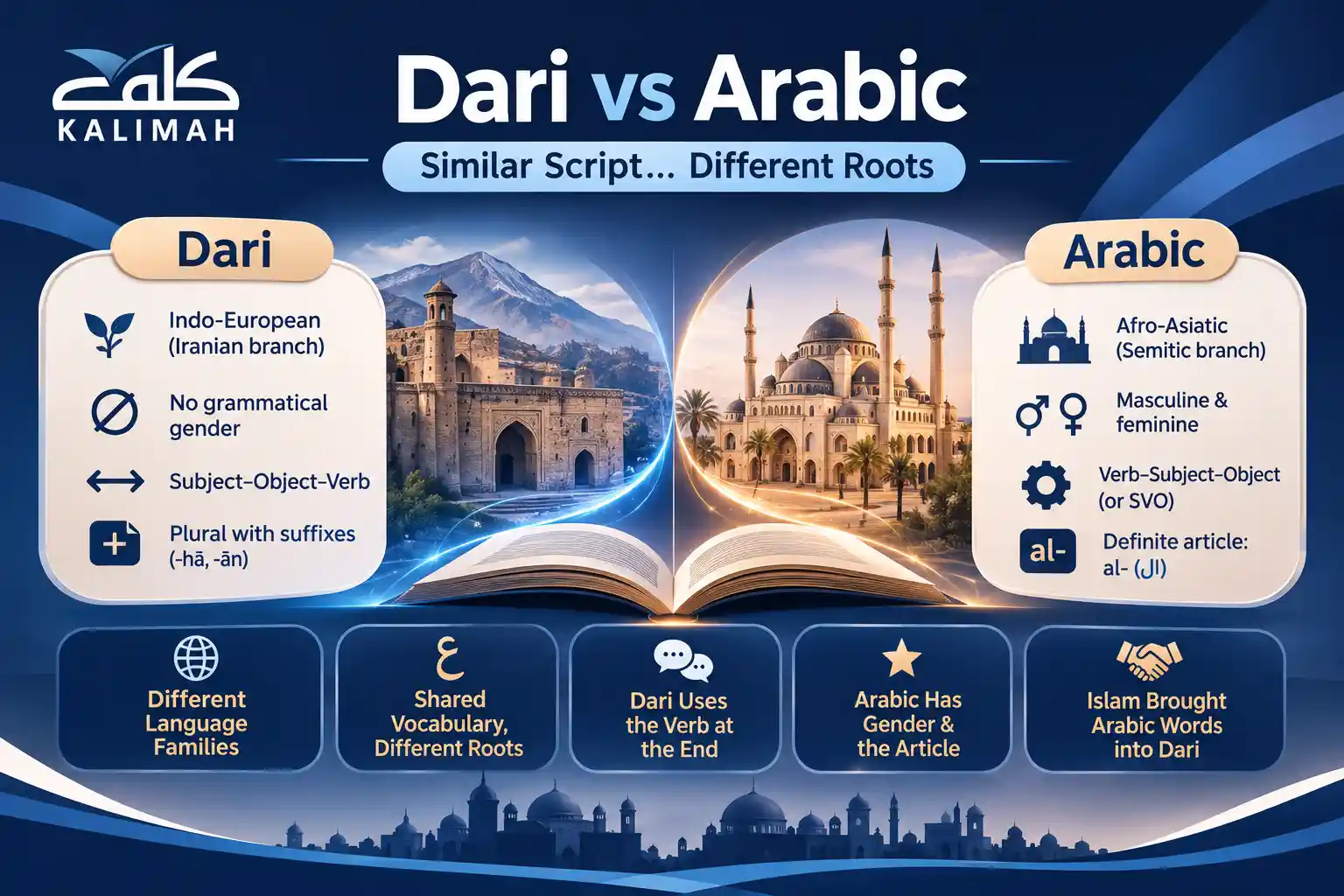
Before getting into the details, here’s a quick side-by-side snapshot of how the two languages compare on family, script, grammar and vocabulary. Use it as a reference while you read the sections that follow, which explain each difference with real examples.
| Feature | Dari | Arabic |
| Language family | Indo-European (Iranian branch) | Afro-Asiatic (Semitic branch) |
| Closest relatives | Iranian Persian (Farsi), Tajik | Hebrew, Aramaic |
| Official status | Afghanistan (with Pashto) | Over 20 countries in the Middle East and North Africa |
| Alphabet | 32 letters (28 Arabic + 4 added) | 28 letters |
| Writing direction | Right to left | Right to left |
| Grammatical gender | None | Masculine and feminine |
| Typical word order | Subject–Object–Verb | Verb–Subject–Object or Subject–Verb–Object |
| Definite article | None | al- (ال) |
| Plurals | Mostly suffixes (-hā, -ān) | Sound plurals and broken plurals |
| Dual form | No | Yes |
| Shared vocabulary | Many Arabic loanwords | Very few Persian loanwords |
| Numeral shapes | ۴ ۵ ۶ | ٤ ٥ ٦ |
Why Dari And Arabic Belong To Different Language Families
Dari belongs to the Indo-European family, the same huge family that includes English, Hindi and Kurdish. Arabic belongs to the Semitic branch of the Afro-Asiatic family, alongside Hebrew and Aramaic. That one fact explains why their deepest layers, grammar and basic words, look nothing alike.
You can see the Indo-European link in surprising places. In Dari, mother is mādar, father is padar and brother is barādar, all distant cousins of the English words. Arabic uses umm, ab and akh instead, which share no history with the Dari forms.
Dari’s real sibling is Iranian Persian, or Farsi. A cultural orientation guide from the Defense Language Institute Foreign Language Center compares the gap between them to the difference between European and Canadian French. Arabic speakers, by contrast, can’t follow Dari conversations without study.
How Islam And History Brought Arabic Into Dari
Arabic reached the Persian-speaking world with the Islamic conquests of the 7th century. Over the next two centuries, Persian writers dropped the older Pahlavi script and adopted the Arabic alphabet, adding a few letters for sounds Arabic lacked. That choice still shapes how Dari is written today.
Religion, law, science and government then brought in thousands of Arabic terms. Words for prayer, justice, knowledge and the state passed into Persian through scholars and royal courts. Many became so natural that Afghan speakers no longer think of them as foreign words at all.
Because Islamic texts are written in Arabic, many Dari speakers want to read the Quran and classical works in the original. Kalimah Centre’s Classical Arabic Course Online takes you from grammar and word forms to reading classical texts, turning the religious words you already recognize into real understanding.
Is Dari Similar To Arabic Language Structure?
No. Grammar is where the two languages differ most. Many learners search “is Dari similar to Arabic language” expecting a yes, but Dari puts the verb at the end of the sentence. “I read the book” becomes man kitāb rā mēkhānam, literally “I the book read.”
Formal Arabic usually starts with the verb, as in qara’a al-walad al-kitāb, literally “read the boy the book.” Arabic also gives every noun a masculine or feminine gender and changes verbs to match. Dari has no grammatical gender at all, and it uses the same word, u, for “he” and “she.”
Arabic builds words from three-letter roots, so k-t-b gives kataba (wrote), kitāb (book) and maktab (office). Dari borrowed the finished words but not the system behind them. Instead, it pairs Arabic nouns with Persian verbs, giving forms like fikr kardan (to think) and qabūl kardan (to accept).
Read Also: Farsi vs Arabic: Key Differences, Which Is Harder, and Which to Learn
Experience Kalimah Center Classes
Watch real excerpts from our live sessions at Kalimah Center and see how we bring learning to life. These clips highlight our interactive, student-centered teaching approach across all our courses—designed to keep learners engaged, motivated, and actively involved every step of the way.
Master Arabic with Kalimah Center
Join our expert-led online classes and start your journey toward Arabic fluency today.
Book Your Free TrialIs Dari Similar To Arabic Letters? Comparing The Two Scripts
If you’re asking whether Dari is similar to Arabic letters, this is where the answer comes closest to a clear yes. Both scripts run right to left, join letters in a cursive style and share the same 28 basic shapes, so a Dari reader already knows most of the Arabic alphabet.
Still, a few added letters, some spelling habits and very different pronunciation set the two systems apart in practice. The three sections below cover what carries over straight from Dari, what Arabic doesn’t have, and which familiar letters you’ll need to relearn.
1. The 28 Arabic Letters Dari Already Uses
Every letter of the Arabic alphabet appears in Dari, from alif (ا) to yā (ي). Both follow the same joining rules, so letters change shape at the start, middle and end of a word. Even the six letters that never join to the next one, ا د ذ ر ز و, behave the same way in both scripts.
To explore the shapes and sounds, check out Omniglot’s Persian script page, which covers the alphabet’s history with audio. You’ll spot small spelling differences: Dari writes the final yā without dots (ی) and uses a slightly different kāf (ک) instead of Arabic’s ك.
Dari also rarely uses tā’ marbūṭa (ة). Arabic raḥma (mercy) becomes raḥmat (رحمت), and dawla (state) becomes dawlat (دولت). Numbers differ too: Dari writes ۴, ۵ and ۶ differently from Arabic ٤, ٥ and ٦. You can compare the Arabic forms on Omniglot’s Arabic alphabet chart.
2. The Four Extra Letters Dari Adds To The Alphabet
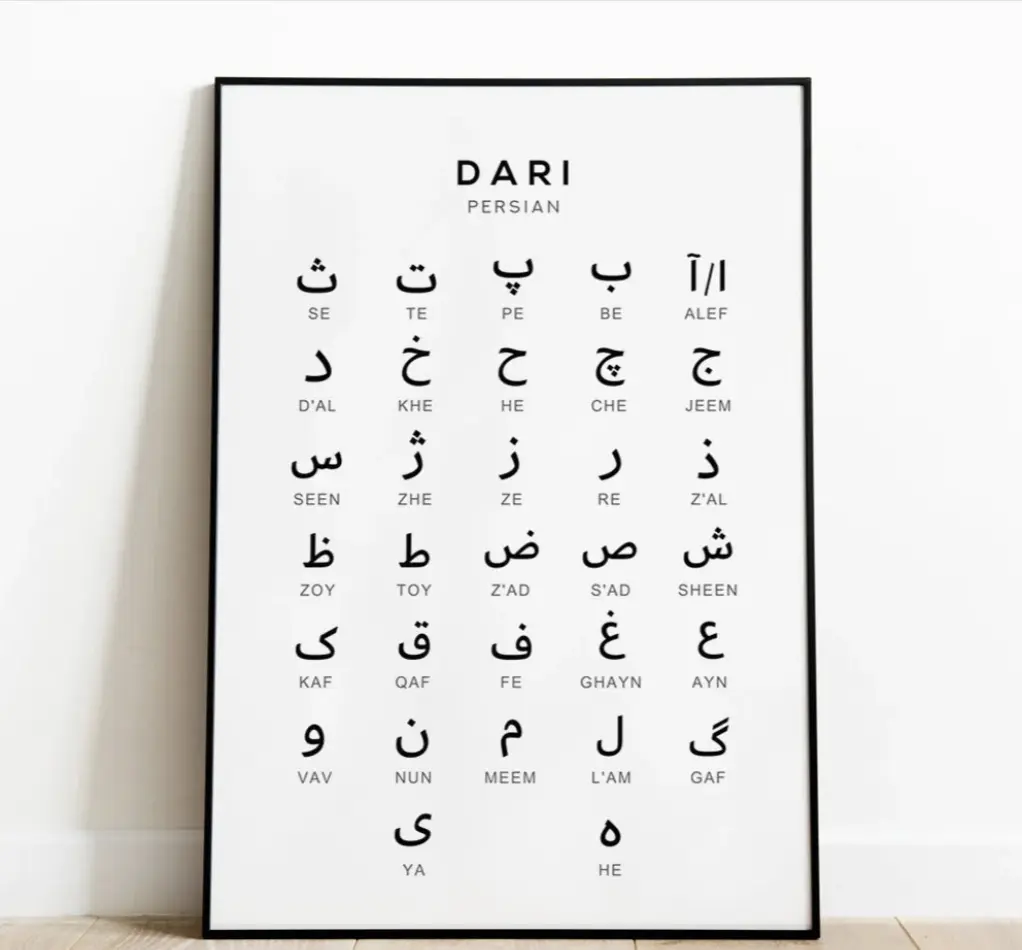
Dari adds four letters for sounds Arabic doesn’t have: پ (p), چ (ch), ژ (zh) and گ (g). They show up in some of the most common Dari words, such as panj (five), chashm (eye) and gul (flower), so a Dari reader sees them all the time.
Arabic speakers usually replace these sounds with the closest Arabic match. That’s why “Pakistan” is spelled باكستان in Arabic, with b instead of p. When you move from Dari to Arabic, you simply stop using these four letters, so Arabic spelling can feel a little narrower at first.
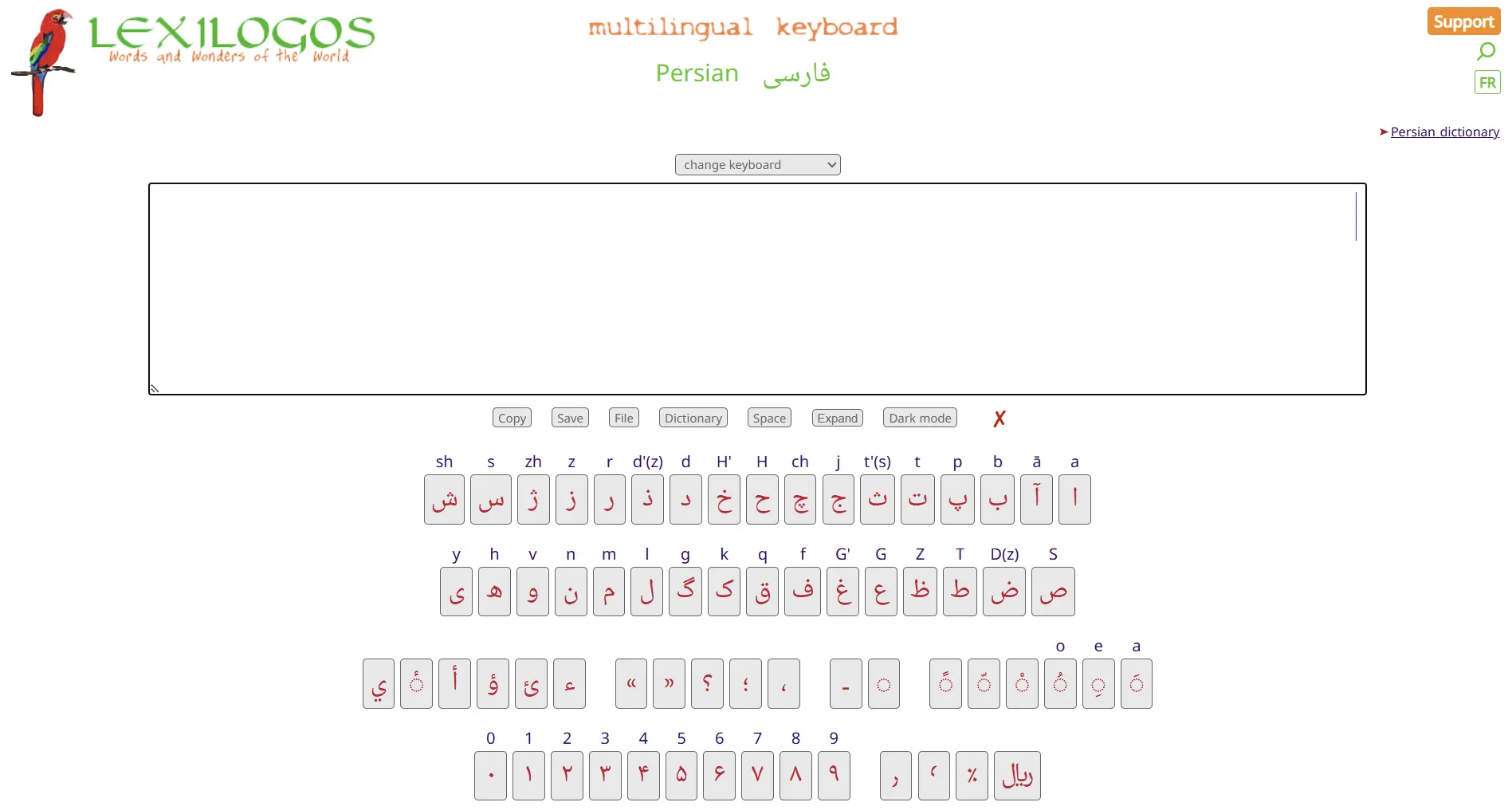
You can practice typing both letter sets with the free Persian online keyboard from Lexilogos, which lets you click letters and copy text instantly. Switching between Persian and Arabic layouts helps you see which keys disappear in Arabic and which shapes change slightly.
Already reading Dari? You’re most of the way through the Arabic alphabet. Kalimah Centre’s Arabic Reading Course takes you the rest of the way, from letter sounds to fluent reading of real Arabic texts, step by step with native instructors.
3. Letters That Look The Same But Sound Different
This is where Dari readers stumble most. Arabic keeps apart several sounds that Dari merges. ث, س and ص all sound like s in Dari; ذ, ز, ض and ظ all become z; ت and ط both become t. In Arabic, each of these letters has its own distinct sound.
You can hear this in familiar words. The month Arabs call Ramaḍān is Ramazān in Dari, and the Arabic qāḍī (judge) becomes qāzī. To train your ear on real Afghan pronunciation, the VOA Dari YouTube channel has free news videos you can replay as often as you like.
Then switch to Arabic and listen for the difference. The free BBC News Arabic channel on YouTube lets you hear emphatic sounds like ṣ, ḍ and ṭ in natural speech. One advantage you already have: Dari keeps q (ق) and gh (غ) separate, so these two Arabic sounds will feel familiar.
Hear the difference, then say it right. Kalimah Centre’s Arabic Speaking Course pairs you with native tutors who correct your ḍ, ṣ and ʿayn as you speak, so Dari habits don’t slip into your Arabic conversations.

Recommended reading: How to Write in Arabic: Step-by-Step Guide for Beginners
Here Are The Reviews On Our Courses:
Our students frequently commend the excellence of our courses and the commitment shown by our instructors. You can read their complete reviews on Trustpilot.
Read more reviews on Trustpilot

Is Dari Similar To Arabic Words? Shared Vocabulary Explained
Yes, Dari shares a large number of Arabic words, especially in religion, education, law and formal speech. If you’re wondering whether Dari is similar to Arabic words in daily conversation too, the overlap is real but smaller, and some shared words don’t mean the same thing.
The key is knowing which borrowed words keep their Arabic meaning, which ones shifted, and which basic words have no Arabic link at all. The three sections below sort them into clear groups you can use while studying.
1. Common Arabic Loanwords In Everyday Dari
Many words Dari speakers use every day come straight from Arabic. They cover time, knowledge, faith and polite conversation, and most keep the same core meaning in both languages. Here are some you’ll recognize right away in an Arabic class:
- kitāb: book (Arabic kitāb)
- waqt: time (Arabic waqt)
- ʿilm: knowledge (Arabic ʿilm)
- dunyā: world (Arabic dunyā)
- tashakkur: thank you (Arabic tashakkur, “thanking”)
Some Dari expressions even mix both languages. Khudā hāfiz (goodbye) joins Persian khudā (God) with Arabic ḥāfiẓ (protector). Romanized spellings can make the same word look different, so the free Library of Congress romanization tables are a handy way to compare spellings accurately.
The best way to use this overlap is to build your own list of shared words. Anki, a free flashcard app for desktop and Android, uses spaced repetition to show each word just before you’d forget it. That way your Dari–Arabic word pairs stay with you long term.
2. Arabic Words That Changed Meaning In Dari
Not every borrowed word kept its original meaning. In Dari, maktab means school, while in Arabic it usually means office or desk. In the same way, daftar means office in Dari but notebook in Arabic, so asking for a daftar in Cairo will get you stationery, not a workplace.
Other shifts are smaller. Hawā means weather in Dari, but in Arabic it means air and, in poetry, desire or passion. Mamnūn is a common way to say thank you in Dari, while in Arabic it describes someone who is grateful or obliged, which is a more formal meaning.
These false friends are easiest to catch in context. Reading short stories on the VOA Dari news website and comparing the same topics in Arabic media helps you spot words used differently. When a familiar word feels slightly off, check it in an Arabic dictionary before you assume it means the same thing.
3. Everyday Dari Words With No Arabic Connection
The most basic layer of Dari is purely Persian, and this is where Arabic will feel completely new. Pronouns, numbers and family words share nothing. “I” is man in Dari but anā in Arabic, “water” is āb versus māʾ, and “bread” is nān versus khubz.
Numbers make the gap obvious. Dari counts yak, du, se, chahār, panj, while Arabic counts wāḥid, ithnān, thalātha, arbaʿa, khamsa. Common verbs differ too: “to go” is raftan in Dari and dhahaba in Arabic, so everyday Arabic conversation means learning a new core vocabulary.
To build up both sides, see the Interagency Language Roundtable’s Dari webliography, which lists free dictionaries, keyboards and media sources. Use the shared Arabic words as your base, then spend most of your study time on the everyday words Arabic doesn’t share with Dari.
Turn the Arabic words you already know into full sentences. Kalimah Centre’s Online Arabic Course builds on the vocabulary you already have through 16 structured levels, starting with a free placement test that puts you at the right point.
Further reading: Is Arabic Hard to Learn? What Are the Hardest Parts?
Kalimah Centre Turns Your Dari Background Into An Arabic Advantage
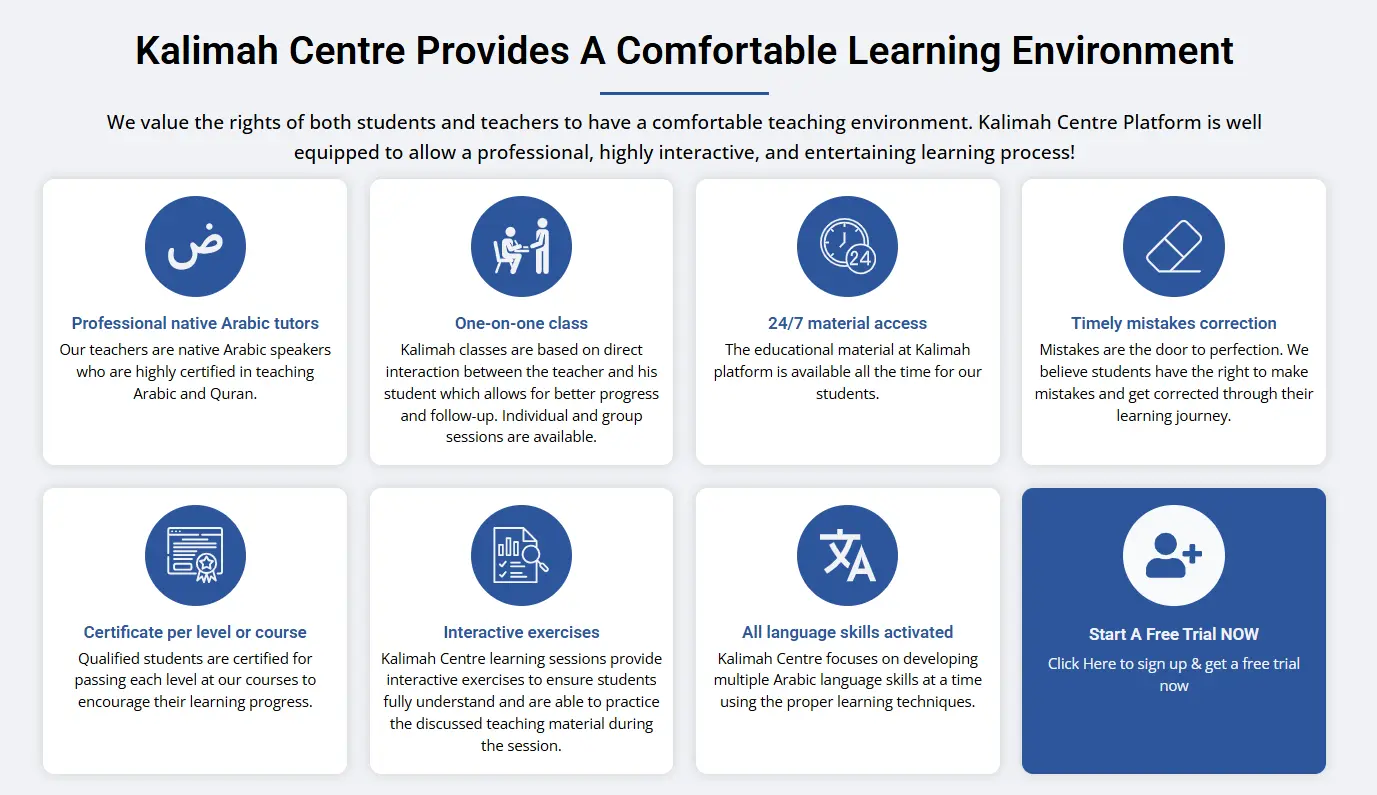
Learning Arabic as a Dari speaker isn’t like starting from zero, and your lessons shouldn’t treat it that way. Kalimah Centre starts with a free placement test, so you don’t spend weeks reviewing letters you already read fluently. Your teacher begins right where your real gaps are.
Our one-on-one sessions with native Arabic tutors are well suited to the specific traps covered in this guide. Your tutor can catch the moment you say Ramazān instead of Ramaḍān, flag false friends like maktab and daftar, and drill the emphatic sounds Dari merges, one lesson at a time.
Flexibility matters too. You choose your tutor, including male or female teachers, and book classes around your own schedule. If you want faster results, Kalimah Centre’s Intensive Arabic Course Online offers daily live lessons with native instructors, ideal for students, professionals or anyone preparing to travel.
Behind every lesson are more than 14 years of teaching experience, a curriculum and books developed in-house, and a certificate for every level you complete. So if you’ve ever wondered whether Dari is similar to Arabic enough to give you a head start, Kalimah Centre is where that head start becomes fluency.
Inside Kalimah Center: Moments from Our Courses
Get a glimpse into the vibrant learning experience at Kalimah Center. These snapshots capture real moments from our live classes—where students engage deeply, connect with passionate instructors, and grow in a welcoming, supportive environment.
Master Arabic with Kalimah Center
Join our expert-led online classes and start your journey toward Arabic fluency today.
Book Your Free TrialBook Your Free Arabic Trial Lesson At Kalimah Centre!
You already have a real advantage: an alphabet you can read, and hundreds of Arabic words tucked inside your everyday Dari. The only question is whether you leave that advantage unused or turn it into real Arabic reading, speaking and understanding.
Book your free Arabic trial class with Kalimah Centre today and meet a native Arabic tutor who will assess your level, plan your path, and show you how far your Dari background can carry you. There’s no pressure and no long commitment, just one class to see the difference.
Explore Our Courses:
Online Arabic Course: Tailored to your level, our comprehensive Arabic program includes 16 teaching levels and 400+ hours of personalized sessions.
Online Quran With Tajweed Course: Perfect for non-Arabic speakers, our course spans 13 levels and equips you with Tajweed mastery from beginner to advanced.
Online Arabic Course For Kids: Nurture your child’s love for Arabic with our engaging and structured program, available in 24 levels for primary, intermediate, and secondary stages.
Choose your teacher, pick a time that fits your week, and reserve your session in a few minutes. Your Arabic journey can start this week, with a tutor who understands where Dari speakers need support and how to build on what you already know.

Master Arabic with Kalimah Center
Join our expert-led online classes and start your journey toward Arabic fluency today.
Book Your Free TrialSummary
Dari and Arabic share a script, a writing direction and a large pool of vocabulary, thanks to more than a thousand years of Islamic history and scholarship. Yet they come from different families. Dari is Indo-European and Persian at its core, while Arabic is Semitic, with its own root system, gender rules, dual forms and typical sentence order that Dari doesn’t use.
The letters carry over almost entirely, apart from Dari’s four extra letters and the Arabic sounds Dari merges into one. Shared words give you a strong head start, but false friends like maktab and daftar, plus a completely different core vocabulary, mean you’ll still need focused practice in pronunciation, grammar and everyday Arabic expressions to speak naturally.
So, is Dari similar to Arabic? On the page, often yes; in grammar and daily speech, much less. The key takeaway is simple: treat your Dari as a launchpad, not a shortcut. Lean on the alphabet and loanwords you already know, then put real effort into the sounds, structures and basic words Arabic adds, ideally with a teacher who knows exactly where Dari speakers struggle.