| Key Takeaways |
| Shukran (شكرًا) is the safest way to say thank you in Arabic, and it works in every Arabic-speaking country, in formal and casual settings. |
| Most thank you phrases change with gender and number, so use shukran laka for a man, shukran laki for a woman, and shukran lakum for a group. |
| Dialects add natural alternatives such as teslam eedak in Egypt, yislamu ideek in the Levant, and ma gassart in the Gulf. |
| Every thank you has a matching reply: afwan answers shukran, wa iyyak answers jazak Allahu khayran, and Allah y’aafeek answers ya’teek al-‘afya. |
Learning how to say thank you in Arabic starts with shukran, but that word is only the beginning. Visiting Cairo, joining a family dinner in Amman, or working with Gulf colleagues each calls for thanks that sounds natural.
Arabic speakers choose from dozens of thank you phrases depending on gender, formality, region, and faith. A man hears shukran laka, a woman hears shukran laki, and a host hears yislamu ideek after a meal.
This guide walks you through twelve steps, from pronunciation and gender forms to dialect phrases, religious thanks, replies, and etiquette. Each step includes examples you can use today. The steps are as follows.
1. Learn How to Say Thank You in Arabic With Shukran
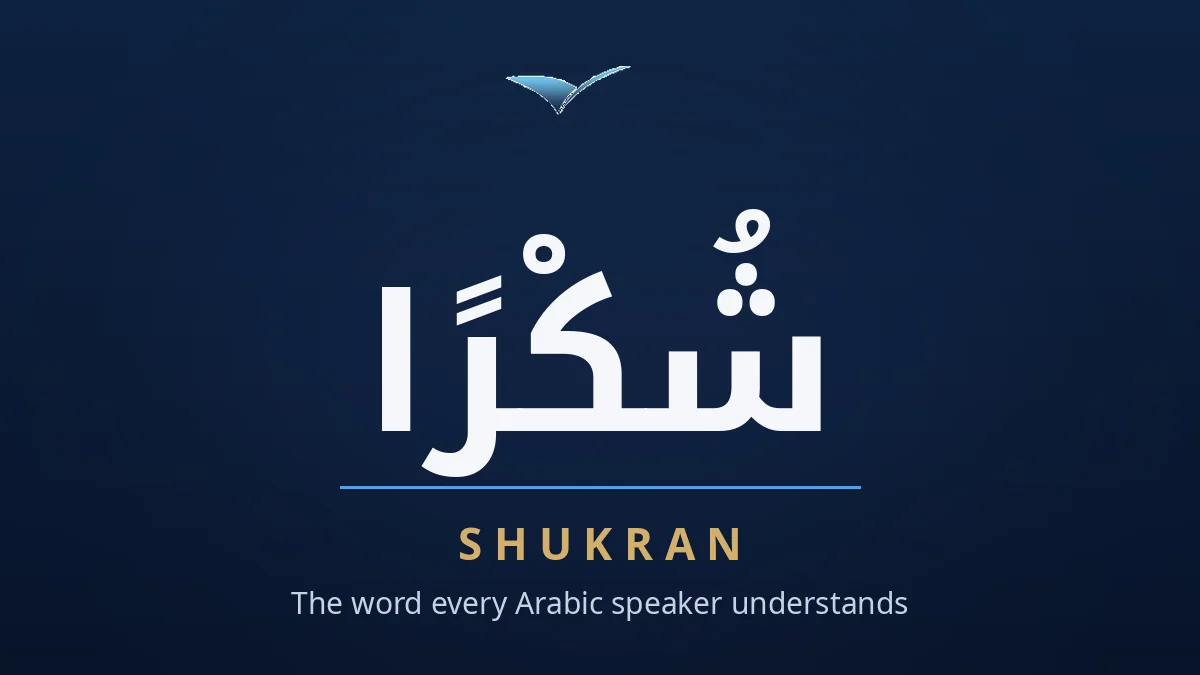
The standard way to say thank you in Arabic is shukran (شكرًا), a word understood in every Arabic-speaking country and suitable for formal and casual situations alike.
Learn where the word comes from, how to pronounce it, and how to write it. Each detail takes under a minute and prevents common beginner errors.
Shukran Meaning and Root Letters
Shukran means “thank you,” and it comes from the three letter root ش ك ر (sh k r), which carries the idea of gratitude. The same root produces several everyday words, shown below.
| Arabic | Transliteration | Meaning |
| شَكَرَ | Shakara | He thanked |
| شُكْر | Shukr | Gratitude |
| شاكِر | Shaakir | Grateful |
| مَشْكُور | Mashkoor | Thanked or appreciated |
| أَشْكُرُكَ | Ashkuruka | I thank you |
| شَكُور | Shakoor | Very grateful |
Recognizing this root helps you decode new words faster. When you hear mashkoor in a shop or shukr in a sermon, you already know the core meaning is gratitude.
Shukran Pronunciation Syllable by Syllable
Shukran is pronounced SHUK-ran, with the stress on the first syllable. Four details separate a learner accent from natural speech, and each one takes seconds to practice.
- The ش is a clear “sh” sound, like the “sh” in “share.”
- The short u after it is brief, so move straight to the ك.
- The ر is a light tap of the tongue tip, not the English “r.”
- The final “an” comes from tanween and stays short and unstressed.
Record yourself saying shukran three times and compare it with a native speaker. Your thank you in Arabic pronunciation improves fastest when the ر sounds like a tap rather than a roll.
How to Write Thank You in Arabic
In writing, shukran appears as شكرًا, or شُكْرًا with full vowel marks. The two small diagonal marks above the final alif are tanween, and they create the closing “an” sound.
Native speakers often drop the marks in text messages and write شكرا instead. A common learner error is spelling the word شكرن, which is never correct.
2. Say Thank You in Arabic to a Man, a Woman, or a Group
Arabic changes verb endings and pronouns based on who you address, so every thank you phrase has a masculine, feminine, and plural form. Using the right ending signals that you respect the language.
The table below lists the most useful phrases in masculine, feminine, and plural forms. Learn the first row before the others, since shukran laka and shukran laki cover most daily moments.
| Phrase | To a Man | To a Woman | To a Group |
| Thank you | شكرًا لكَ (shukran laka) | شكرًا لكِ (shukran laki) | شكرًا لكم (shukran lakum) |
| I thank you | أشكرُكَ (ashkuruka) | أشكرُكِ (ashkuruki) | أشكرُكم (ashkurukum) |
| You are appreciated | مشكور (mashkoor) | مشكورة (mashkoora) | مشكورين (mashkooreen) |
| Bless your hands (Levantine) | يسلمو إيديك (yislamu ideek) | يسلمو إيديكِ (yislamu ideeki) | يسلمو إيديكم (yislamu ideekum) |
| May God give you health | يعطيكَ العافية (ya’teek al-‘afya) | يعطيكِ العافية (ya’teeki al-‘afya) | يعطيكم العافية (ya’teekum al-‘afya) |
Thank you in Arabic to a woman is shukran laki (شكرًا لكِ), and it differs from the masculine shukran laka by one short vowel. Mixing them up is the most common beginner slip.
The speaker’s gender matters too. A man says ana mamnoun (أنا ممنون) and a woman says ana mamnouna (أنا ممنونة), and both mean “I am grateful.”
Kalimah Center offers an Online Arabic Course that builds correct gender forms into full conversations through structured levels and live correction from native Arabic teachers.
Start Your Free Arabic Trial Lesson Today
3. Raise Your Gratitude With Shukran Jazeelan and Alf Shukr
To say thank you very much in Arabic, use shukran jazeelan (شكرًا جزيلًا), where jazeelan means “abundant.” The full phrase translates as “abundant thanks” and suits favors that deserve more than a quick shukran.
Imagine a colleague stays late to help you finish a report. Adding lak (لك) for a man or laki (لكِ) for a woman makes the thanks more personal.
- You: “I really appreciate you staying to help me finish this.”
- Colleague: “No problem, we are a team.”
- You: “شكرًا جزيلًا لك (shukran jazeelan lak). I could not have done it without you.”
Alf Shukr for Warm Gratitude
Alf shukr (ألف شكر) means “a thousand thanks.” It is warm and slightly playful, so it suits friends, family, and colleagues more than formal settings. Use it when someone brings you something you were craving.
Heartfelt Phrases for Big Favors
Some favors need more than a quick thanks. These three phrases carry real emotion, so save them for moments such as emotional support, a major favor, or help during a difficult time.
- Ashkuruka min kull qalbi (أشكرك من كل قلبي) means “I thank you with all my heart,” and changes to ashkuruki for a woman and ashkurukum for a group.
- La a’rif kayfa ashkuruk (لا أعرف كيف أشكرك) means “I don’t know how to thank you,” for favors too large for ordinary words.
- Mamnoun (ممنون) means “I am obliged,” a quiet and sincere way to show you feel indebted in a good way.
Formal Thank You Phrases for Emails and Letters
Written thanks use full verbs instead of short spoken forms. In professional emails, Arabic speakers typically write ashkurukum ‘ala ta’aawunikum (أشكركم على تعاونكم), meaning “thank you for your cooperation,” or shukran li-htimaamikum (شكرًا لاهتمامكم), meaning “thank you for your interest.”
Closing a letter with مع خالص التقدير (ma’a khaalis at-taqdeer), meaning “with sincere appreciation,” is the standard professional sign-off. For an official thank you, ممتن لك (mumtann lak) works well in speech and writing.
4. Thank Someone for a Specific Favor With Shukran Ala
To thank someone for a particular thing, add ‘ala (على) followed by what they did. This single pattern builds precise sentences for almost any situation without memorizing a separate phrase for each one.
| Arabic | Transliteration | English |
| شكرًا على مساعدتك. | Shukran ‘ala musaa’adatik. | Thank you for your help. |
| شكرًا على الهدية. | Shukran ‘ala al-hadiyya. | Thank you for the gift. |
| شكرًا على وقتك. | Shukran ‘ala waqtik. | Thank you for your time. |
| شكرًا على الدعوة. | Shukran ‘ala ad-da’wa. | Thank you for the invitation. |
| شكرًا على الأكل اللذيذ. | Shukran ‘ala al-akl al-ladheedh. | Thank you for the delicious food. |
| شكرًا على حسن الضيافة. | Shukran ‘ala husn ad-diyaafa. | Thank you for your hospitality. |
| شكرًا على كل شيء. | Shukran ‘ala kull shay’. | Thank you for everything. |
Add a warm word of address, such as shukran ya sadiqi (شكرًا يا صديقي), meaning “thank you, my friend.” Thanks usually follows a greeting, so read how to say hi in Arabic to open the conversation.
Quick exercise: Choose three favors from your last week and build each sentence with shukran ‘ala. Say them aloud, then replace the noun to practice another favor.
Kalimah Center offers Arabic Group Classes where you practice these sentences with classmates in live speaking activities at an affordable price.

Reserve Your Free Group Class Trial
5. Match Each Thank You Phrase to the Right Situation
Choosing the right phrase depends on the setting, the relationship, and the effort someone made. This reference table matches eight common moments with the most natural expression.
| Situation | Best Phrase | Why It Fits |
| A shopkeeper hands you change | شكرًا (shukran) | Short, polite, and universal. |
| A colleague helps you meet a deadline | شكرًا جزيلًا (shukran jazeelan) | Shows stronger appreciation. |
| A waiter or worker is busy serving you | يعطيك العافية (ya’teek al-‘afya) | Acknowledges their effort. |
| Someone hands you home-cooked food | يسلمو إيديك (yislamu ideek) | Praises the hands that prepared it. |
| Someone compliments your clothes or home | تسلم (tislam) | The natural reply instead of shukran. |
| A formal email or official letter | أشكركم على تعاونكم (ashkurukum ‘ala ta’aawunikum) | Respectful and professional. |
| A big favor that words cannot cover | لا أعرف كيف أشكرك (la a’rif kayfa ashkuruk) | Expresses deep, sincere gratitude. |
| Someone does something kind after a loss | جزاك الله خيرًا (jazak Allahu khayran) | Sincere and respectful, suits sensitive moments. |
Knowing how to say thank you in Arabic well means choosing the right phrase for the moment. Use shukran with strangers, shukran jazeelan for real effort, and a dialect phrase with friends.
See Us in Action!
Curious about what our online classrooms look like? Watch the short clip below to see how our interactive, one-on-one sessions bring learning to life with real-time feedback and engaging teaching methods.
Master Arabic with Kalimah Center
Join our expert-led online classes and start your journey toward Arabic fluency today.
Book Your Free Trial6. Learn Thank You Phrases Across Four Arabic Dialects
Shukran works everywhere, but each region adds its own daily expressions. Learning one or two local phrases shows respect and signals effort beyond the classroom. Pick the dialect that matches the people you meet most often.
Thank You in Egyptian Arabic
Egyptians blend standard phrases with warm everyday expressions that you hear constantly in Cairo and Alexandria, so these four are worth learning first if you plan to visit.
- Motashakker (متشكر) for a man and motashakkera (متشكرة) for a woman mean “I am thankful.”
- Mersi (ميرسي), borrowed from French, is a casual thanks between friends and colleagues.
- Teslam eedak (تسلم إيدك) means “bless your hand,” said after someone cooks or hands you something.
- Rabbena ykhallik (ربنا يخليك) means “may God keep you,” a warm reply used with friends and elders.
Thank You in Levantine Arabic
Levantine Arabic, spoken in Syria, Lebanon, Jordan, and Palestine, is known for warmth and rich politeness. These five phrases appear in daily life from Amman to Beirut.
- Yislamu ideek (يسلمو إيديك) means “bless your hands,” used after someone cooks, makes coffee, or serves you.
- Kattar kheirak (كتّر خيرك) means “may your goodness increase,” a heartfelt thanks for real kindness.
- Ya’teek al-‘afya (يعطيك العافية) acknowledges effort, so say it to a waiter, driver, or anyone working hard.
- Ma qassart (ما قصّرت) means “you did not fall short,” praising a job done perfectly.
- Kollak zo’ (كلّك ذوق) means “you are all kindness,” often said in reply to a compliment.
Thank You in Gulf Arabic
In Saudi Arabia, the UAE, Kuwait, and Qatar, gratitude often carries a respectful and generous tone. These four phrases cover most daily exchanges with shopkeepers, colleagues, and hosts.
- Mashkoor (مشكور) is the everyday thanks for small favors and services.
- Alf shukr (ألف شكر) is common in shops, offices, and homes across the Gulf.
- Ma gassart (ما قصّرت), pronounced with a hard “g,” thanks someone for doing their best.
- Ya’teek al-‘afya (يعطيك العافية) thanks workers and hosts, and the reply is Allah y’aafeek.
Thank You in Maghrebi Arabic
North African dialects differ sharply from Middle Eastern Arabic. Keep these notes in mind before you travel to Morocco, Algeria, or Tunisia, where French influence shapes everyday speech.
- Shukran bezzaf (شكرًا بزاف) means “thank you very much” in Moroccan and Algerian Darija.
- Mersi (ميرسي) is very common across the region because of strong French influence.
- Barak Allahu feek (بارك الله فيك) fits everyday situations across North Africa.
- Khedma (خدمة) means “at your service,” a short reply used in the Maghreb.
- Skip ya’teek al-‘afya in Morocco, where al-‘afya can also mean “fire” in Darija and may confuse listeners.
7. Say Jazak Allahu Khayran for Religious Gratitude
Jazak Allahu khayran (جزاك الله خيرًا) means “may Allah reward you with goodness,” and it is the Sunnah way to thank someone. Muslims use it alongside shukran, especially after help, advice, or generosity.
The Prophet ﷺ taught this phrase directly, and he linked gratitude toward people with gratitude toward Allah. Two hadiths show how seriously Islam treats thanking others.
Jami at-Tirmidhi 2035 on Saying Jazak Allahu Khayran
Usamah ibn Zayd reported a direct teaching from the Prophet ﷺ about how to thank a benefactor. The hadith is graded hasan and gives the exact wording to use.
مَنْ صُنِعَ إِلَيْهِ مَعْرُوفٌ فَقَالَ لِفَاعِلِهِ جَزَاكَ اللَّهُ خَيْرًا فَقَدْ أَبْلَغَ فِي الثَّنَاءِ
(Man suni’a ilayhi ma’roofun faqala lifa’ilihi jazaka Allahu khayran faqad ablagha fith-thana’)
(“Whoever some good was done to him, and he says: ‘May Allah reward you in goodness’ then he has done the most that he can of praise.”)
Sunan Abi Dawud 4811 on Gratitude Toward People
Abu Hurayrah reported a second hadith that connects everyday thanks with faith. Saying shukran sincerely is therefore more than good manners, because it reflects gratitude toward Allah.
لاَ يَشْكُرُ اللَّهَ مَنْ لاَ يَشْكُرُ النَّاسَ
(La yashkurullaha man la yashkurun-nas)
(“He who does not thank the people is not thankful to Allah.”)
Surah Ibrahim Verse 7 on Gratitude and Increase
The Quran places gratitude at the center of faith and promises increase for those who thank Allah. Muslims who learn Arabic thank people and Allah with the same root, shukr.
وَإِذْ تَأَذَّنَ رَبُّكُمْ لَئِن شَكَرْتُمْ لَأَزِيدَنَّكُمْ ۖ وَلَئِن كَفَرْتُمْ إِنَّ عَذَابِي لَشَدِيدٌ
(Wa idh ta’adhdhana rabbukum la’in shakartum la’azeedannakum wa la’in kafartum inna ‘adhabee lashadeed)
(“And [remember] when your Lord proclaimed, ‘If you are grateful, I will surely increase you [in favor]; but if you deny, indeed, My punishment is severe.'”)
When thanking a woman, say jazaki Allahu khayran, and for a group say jazakumu Allahu khayran. A common reply is wa iyyak (وإياك), meaning “and you as well.”
Kalimah Center offers an Online Quran Course that teaches correct Arabic pronunciation and meaning together, so you can recite prophetic supplications and verses with confidence under a qualified teacher.
Book Your Free Quran Trial Lesson
8. Reply Correctly When Someone Thanks You in Arabic
The standard reply to thank you in Arabic is afwan (عفوًا), which means “you’re welcome” or “don’t mention it.” Knowing how to respond to thank you in Arabic makes your conversation feel complete and natural.
Each thank you phrase also has its own matching reply. The table below pairs six common phrases with the answer native speakers expect, including the right you’re welcome in Arabic for religious and casual thanks.
| When Someone Says | Reply With | Meaning |
| شكرًا (shukran) | عفوًا (afwan) | You’re welcome. |
| جزاك الله خيرًا (jazak Allahu khayran) | وإياك (wa iyyak) | And you as well. |
| بارك الله فيك (barak Allahu feek) | وفيك بارك الله (wa feek barak Allah) | And may Allah bless you too. |
| تسلم (tislam) | الله يسلمك (Allah ysallimak) | May God keep you safe too. |
| يعطيك العافية (ya’teek al-‘afya) | الله يعافيك (Allah y’aafeek) | May God give you health too. |
| يسلمو إيديك (yislamu ideek) | بالهنا والشفا (bil-hana wash-shifa) | Enjoy it in good health. |
Other replies add warmth and humility, and each fits a slightly different moment. Choose the one that matches how close you are to the person.
- Al-‘afw (العفو) is a slightly more formal version of afwan, suited to teachers, customers, and older people.
- La shukr ‘ala waajib (لا شكر على واجب) means “no thanks are needed for a duty,” a humble reply after real help.
- Ahlan wa sahlan (أهلاً وسهلاً) works as a warm reply when someone thanks you for hospitality.
- Wala yhemmak (ولا يهمك) means “don’t worry about it,” a relaxed reply in Egyptian and Levantine Arabic.
- ‘Ala ar-rahb was-sa’a (على الرحب والسعة) means “with pleasure,” a generous reply across the Arab world.
9. Follow Gratitude Etiquette in Arab Culture
In Arab culture, thanks rarely end with a single word, because gratitude is part of hospitality, family life, and everyday courtesy. A small favor can easily lead to several blessings exchanged in both directions.
A few cultural customs are worth knowing before you use these phrases, because they explain why Arabic thanks often sound longer and warmer than English ones.
- Phrases that mention Allah are normal everyday speech, so learners who use them are appreciated rather than seen as presumptuous.
- Hosts often insist on serving more food or tea, and warm thanks before a polite decline is the expected exchange.
- Older people may answer thanks with Allah yirda ‘aleik (الله يرضى عليك), meaning “may God be pleased with you,” a sign of genuine affection toward a younger person.
- Yislamu ideek (يسلمو إيديك) is reserved for someone who served you with their hands, such as a cook or someone who made tea.
Thanks also appears at the end of a visit, so pair your gratitude with the right farewell. Our guide on how to say goodbye in Arabic covers natural phrases for leaving a home, a meeting, or a phone call.
10. Teach Children Thank You Phrases in Arabic
Children in Arab families learn shukran and afwan from a very early age, because gratitude is treated as part of good character and respect. Teaching the same habit at home builds both vocabulary and manners.
Three small routines help children use thank you phrases without prompting, and each one takes only a minute a day, so families can fit them into meals, car rides, and bedtime.
- Say shukran and afwan at every meal, so children hear both sides of the exchange.
- Practice shukran laka for father and shukran laki for mother during play.
- Praise your child whenever they thank someone in Arabic without being asked.
Kalimah Center offers Arabic Classes for Kids that teach everyday courtesy phrases through games, stories, and structured lessons across 24 levels for primary, intermediate, and secondary stages.
Book Your Child’s Free Arabic Trial
11. Avoid Common Thank You Mistakes in Arabic
Most learners make the same few errors, and knowing them in advance keeps your Arabic natural even when your vocabulary is limited. Check yourself against this list before your next conversation.
- Using the masculine form with everyone, such as saying shukran laka to a woman instead of shukran laki.
- Replying afwan to jazak Allahu khayran, when the expected reply is wa iyyak.
- Saying shukran after a compliment, when tislam or kollak zo’ sounds far more natural.
- Pronouncing ر like the English “r” instead of a light tongue tip tap.
- Writing shukran as شكرن instead of the correct spelling شكرًا.
- Using ya’teek al-‘afya in Morocco, where the phrase can cause confusion.
In our experience at Kalimah Center, students who practice these phrases in short role plays with a native teacher stop making these errors within a few lessons, because correction happens in real time.
12. Practice Daily With a Seven Day Phrase Plan
Small daily habits beat one long study session, so this plan adds one phrase per day. By the end of the week you will have a working set for most everyday situations.
| Day | Phrase | Practice Task |
| Day 1 | Shukran (شكرًا) | Say it aloud ten times with the correct stress. |
| Day 2 | Shukran laka and shukran laki | Practice both forms with a family member or a recording. |
| Day 3 | Shukran jazeelan | Use it once in a real message today. |
| Day 4 | Afwan | Reply aloud to every thank you you hear or imagine. |
| Day 5 | One dialect phrase | Learn teslam eedak or yislamu ideek and use it after a meal. |
| Day 6 | Jazak Allahu khayran and wa iyyak | Say both sides of the exchange with correct pronunciation. |
| Day 7 | Full review | Record a thirty second conversation that uses four phrases. |
Finish the week by recording yourself and sending the clip to a native teacher. Correction on tone and stress is the fastest way to turn what you know about how to say thank you in Arabic into automatic speech.
Inside Our Virtual Classrooms
We believe in full transparency and proven quality. Take a look at this actual snippet from our live classes to experience our modern learning platform, patient instructors, and interactive student participation.
Master Arabic with Kalimah Center
Join our expert-led online classes and start your journey toward Arabic fluency today.
Book Your Free TrialStart Speaking Arabic With Kalimah Center Expert Instructors
Reading phrase lists is a useful first step, but real confidence comes from speaking with a teacher who corrects you instantly. Kalimah Center gives you live practice with native Arabic teachers, flexible scheduling, and structured levels.
What sets Kalimah Center apart:
- Native Arabic teachers with years of experience teaching non-Arabic speakers.
- One-on-one and small group sessions with flexible scheduling for any time zone.
- Sixteen structured curriculum levels that build greetings, courtesy phrases, and full conversations naturally.
Our Courses
- Online Arabic Course.
- Arabic Group Classes.
- Arabic Classes for Kids.
- Online Quran Course.
- Group Classes Calendar.
- Interactive Arabic Courses.
Conclusion
Knowing how to say thank you in Arabic starts with shukran, but it grows through gender forms, stronger phrases, dialect expressions, and the right reply. Each step adds a layer of respect to your speech.
Religious thanks such as jazak Allahu khayran connect everyday courtesy with faith, while phrases like teslam eedak and yislamu ideek show you understand local culture. Replies such as afwan and wa iyyak complete every exchange.
Start with the seven day plan this week and choose three or four phrases you will genuinely use. Practicing them with a native speaker is the fastest way to make Arabic gratitude feel natural instead of memorized.