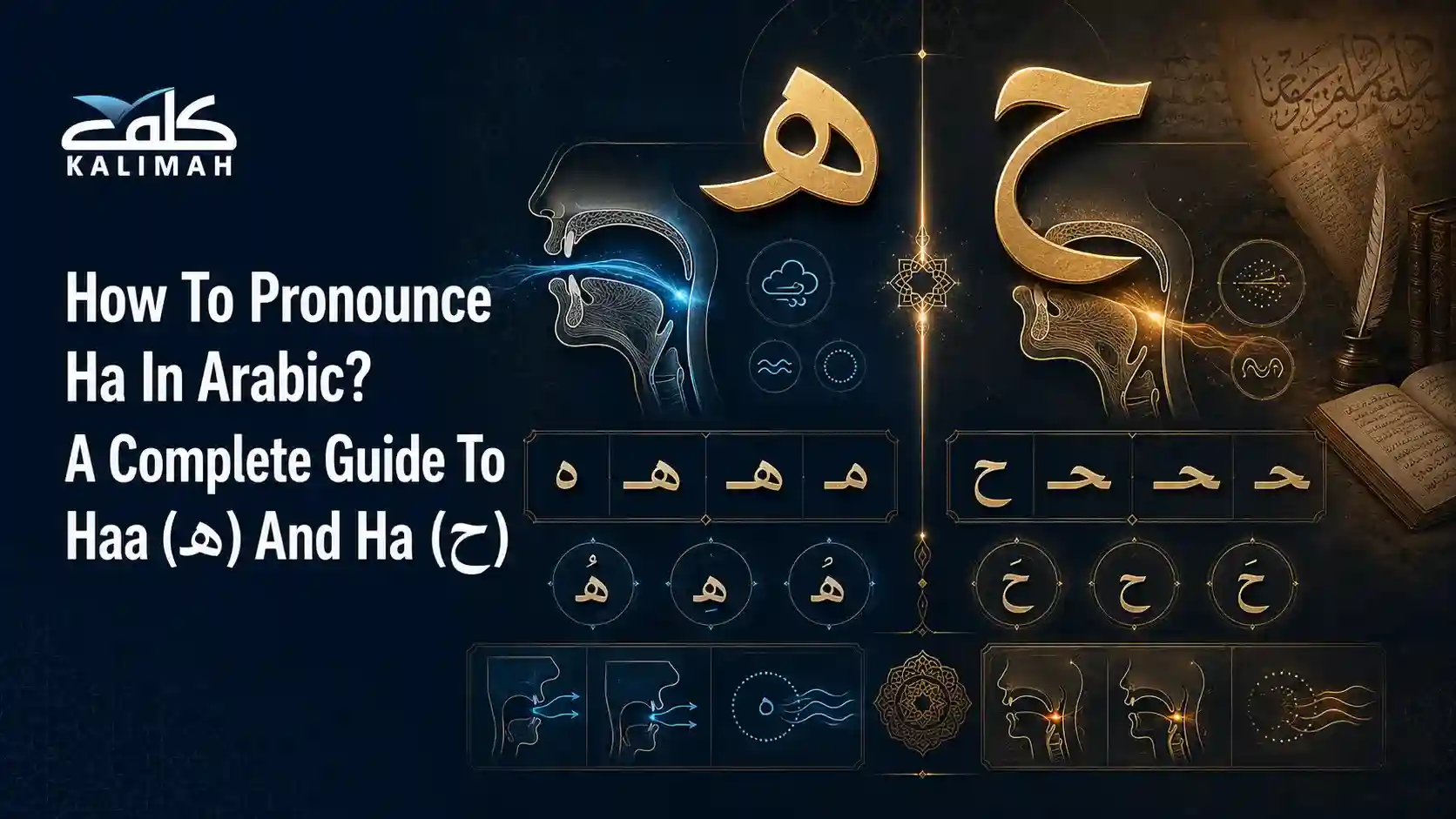
If you’ve ever mixed up two Arabic words that sound almost identical but mean completely different things, there’s a good chance the letters هـ and ح were the culprits.
Learning how to pronounce ha in Arabic correctly means learning two separate sounds, not one — and mastering the difference is one of the first real tests of Arabic pronunciation for any new student.
Both letters get written as “h” or “ha” in English transliteration, which is exactly why so many learners struggle with them.
But in Arabic, هـ (Haa) and ح (Ha) come from different parts of the throat, sound different, and change the meaning of a word if you swap one for the other. This guide breaks down exactly how to pronounce ha in Arabic for both letters, how each one is written in its four shapes, and the mistakes that trip up even intermediate learners.
A. What Are The Two “Ha” Sounds In Arabic?
Arabic has two letters that English speakers usually flatten into a single “h” sound: هـ (Haa) and ح (Ha). They are not interchangeable.
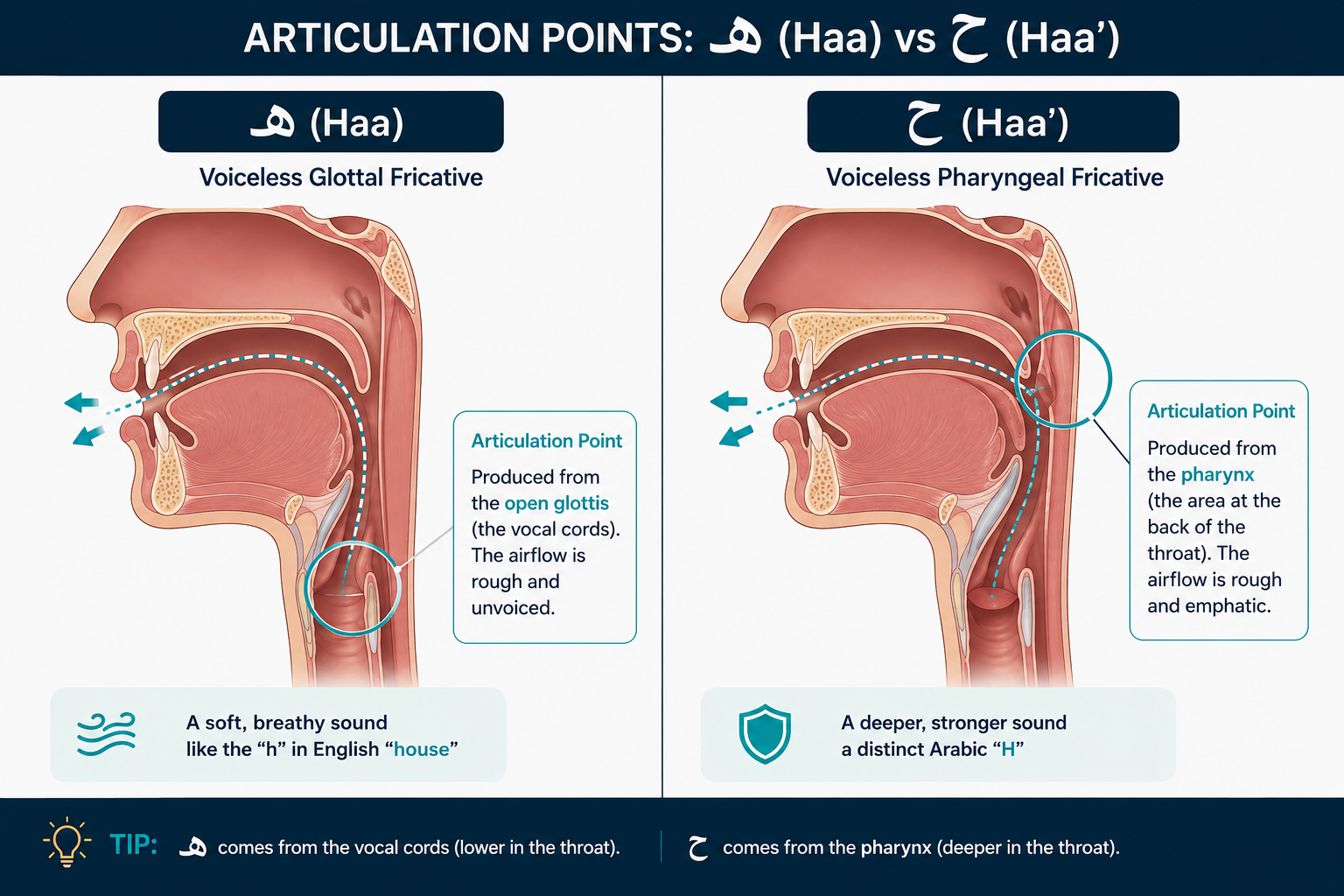
هـ is a light, breathy sound produced near the top of the throat, close to where English speakers make their own “h” in words like “hat.” ح is a deeper, more constricted sound produced in the pharynx — the part of the throat behind the mouth — and has no real equivalent in English.
Knowing how to pronounce ha in Arabic starts with accepting that these are two distinct phonemes, not two spellings of the same sound. Confusing them is one of the most common errors non-native speakers make, and it’s an easy one to fix once you understand where each sound comes from.
The Letter Haa (هـ)
Haa (هـ) is the twenty-sixth letter of the Arabic alphabet. It’s a voiceless glottal fricative — technical language for a soft, breathy “h,” produced without any vocal cord vibration.
The articulation point is at the very top of the throat, nearest the mouth, which is why it feels almost identical to the English “h” in “house.” Words like هدية (hadiya, “gift”) and هواء (hawa, “air”) use this lighter version of the sound.
The Letter Ha (ح)
Ha (ح) is the sixth letter of the alphabet and works very differently. It’s a voiceless pharyngeal fricative, meaning the sound is squeezed out from deep in the throat, with the pharyngeal muscles constricted and no vocal cord vibration.
It has a raspy, textured quality — closer to the sound of fogging up a mirror with your breath than to any letter in English. Words like حَب (hab, “love”) and حِصان (hisaan, “horse”) rely on this deeper articulation.
At Kalimah Center, this distinction is one of the first pronunciation drills taught in beginner lessons, precisely because getting it wrong early on tends to create habits that are harder to correct later.
Read Also: The Arabic Letter (Ha) “ه” With Its Forms
B. How to Pronounce Ha in Arabic Step-by-Step?
Getting the mechanics right matters more than mimicking what you hear, especially at the start. Here’s how to approach each letter on its own.
1. Producing Haa (هـ) Correctly
This sound is the easier of the two to pick up, since it sits close to a sound English speakers already make naturally. The goal is simply to keep the throat loose and let the air move freely near the top of it.
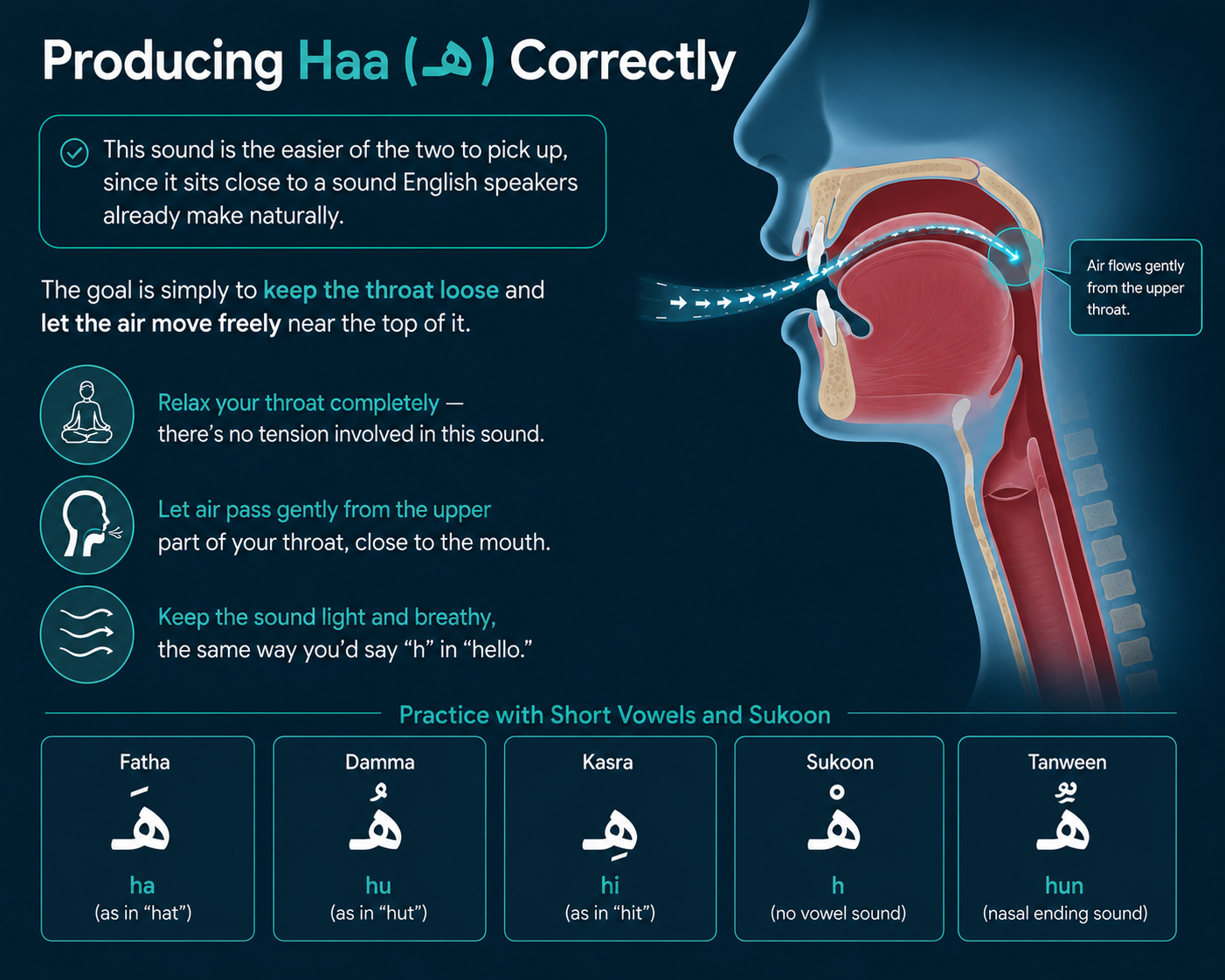
- Relax your throat completely — there’s no tension involved in this sound.
- Let air pass gently from the upper part of your throat, close to the mouth.
- Keep the sound light and breathy, the same way you’d say “h” in “hello.”
- Practice it attached to short vowels: هَ (ha), هُ (hu), هِ (hi), and with sukoon: هْ.
2. Producing Ha (ح) Correctly
This one takes more deliberate effort, since it comes from a part of the throat that isn’t used in everyday English speech. Slowing down and isolating the throat movement before adding vowels makes the sound much easier to control.
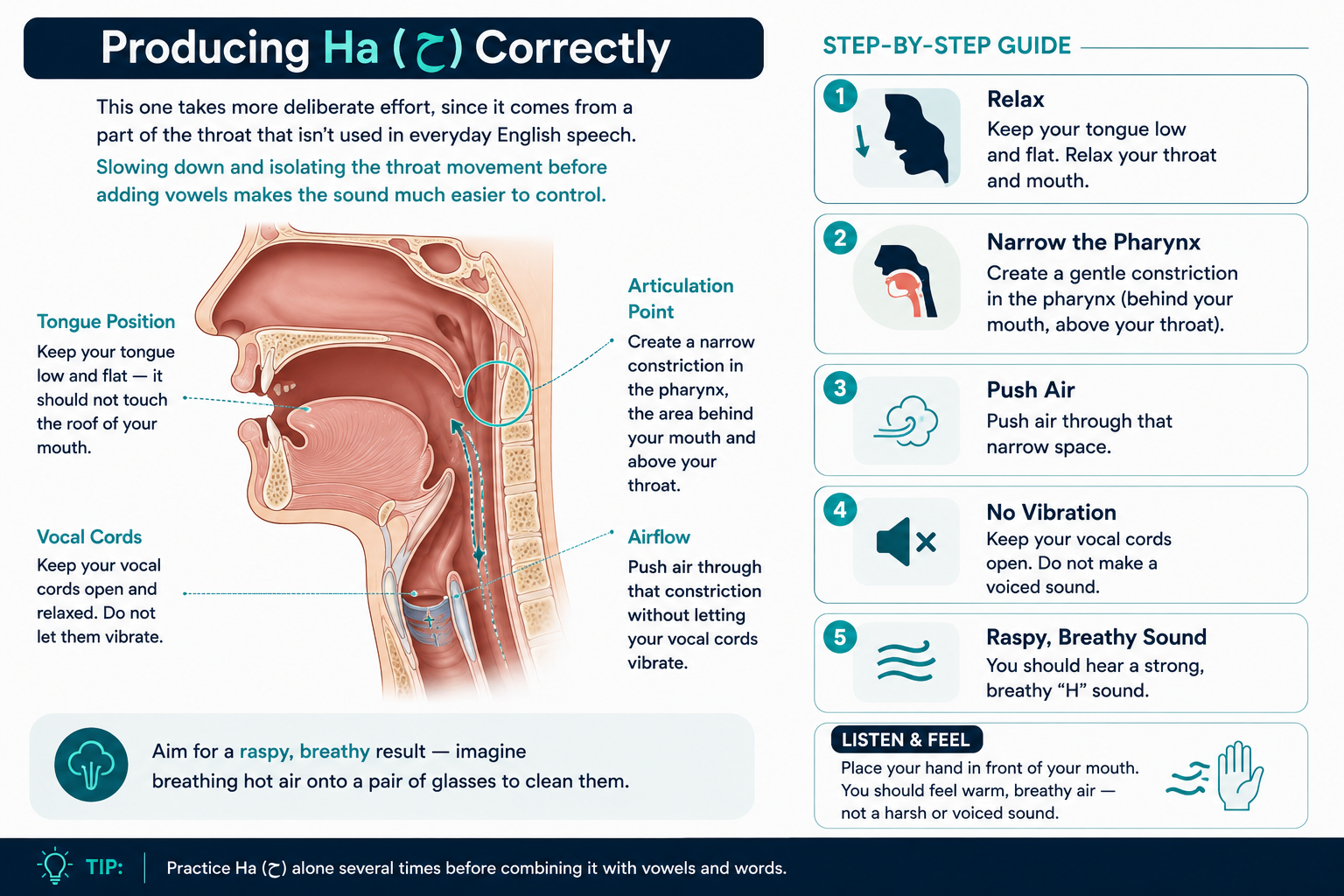
- Keep your tongue low and flat — it should not touch the roof of your mouth.
- Create a narrow constriction in the pharynx, the area behind your mouth and above your throat.
- Push air through that constriction without letting your vocal cords vibrate.
- Aim for a raspy, breathy result — imagine breathing hot air onto a pair of glasses to clean them.
Practicing both sounds side by side, rather than in isolation, is what actually builds the muscle memory to tell them apart in real speech.
This is a core part of how Arabic pronunciation is taught in structured lessons, where an instructor can correct your throat position in real time — something that’s difficult to self-check from an app or a video alone.
Read Also: How to Pronounce ح in Arabic
Experience Kalimah Center Classes
Watch real excerpts from our live sessions at Kalimah Center and see how we bring learning to life. These clips highlight our interactive, student-centered teaching approach across all our courses—designed to keep learners engaged, motivated, and actively involved every step of the way.
Master Arabic with Kalimah Center
Join our expert-led online classes and start your journey toward Arabic fluency today.
Book Your Free TrialC. The Four Written Shapes of Haa (هـ)
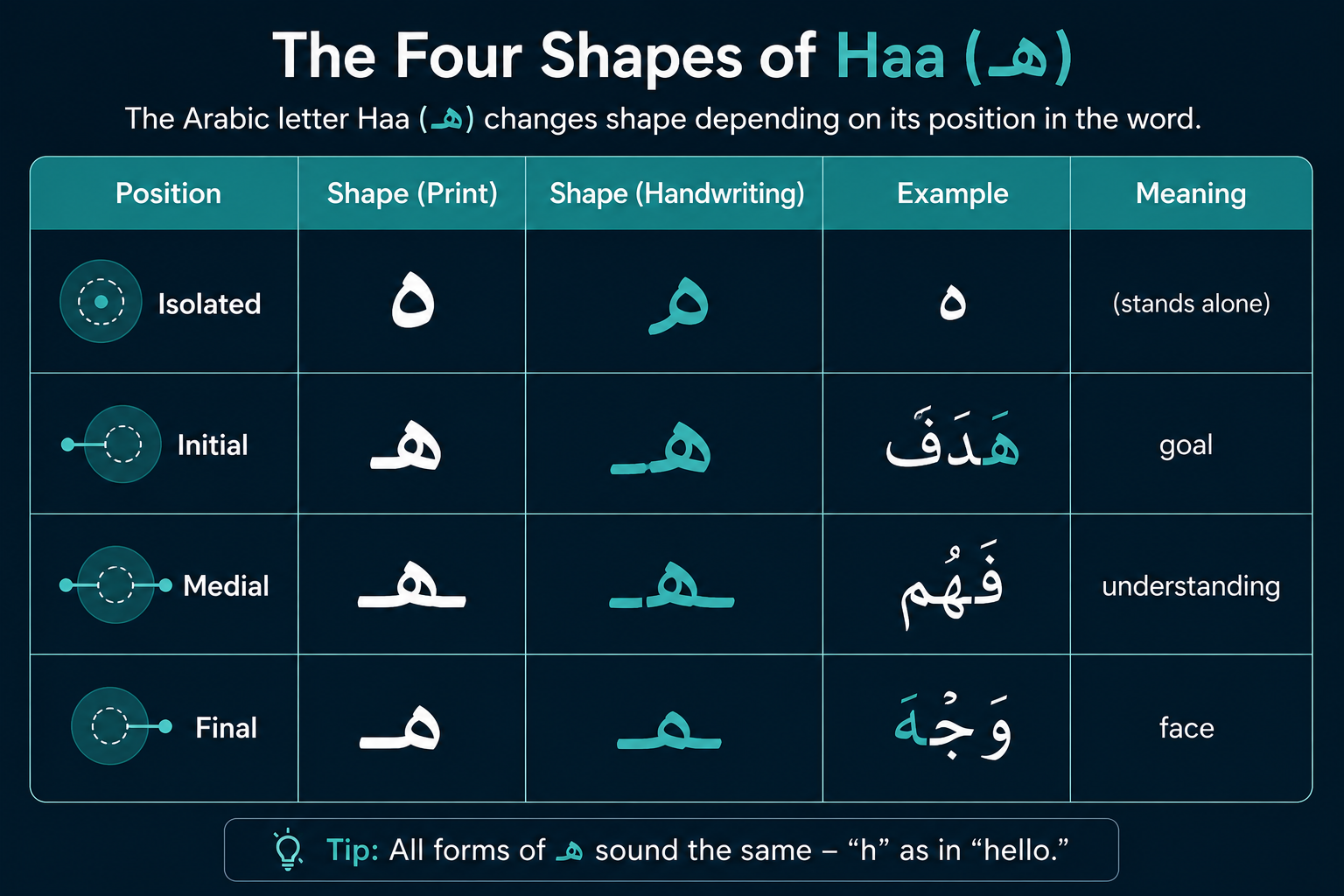
Haa (هـ) is a “dual-joining” letter, meaning it connects to the letters on both sides of it. Because of that, its shape shifts depending on where it falls in a word — at the start, in the middle, at the end, or standing alone.
| Position | Shape | Example | Meaning |
| Isolated | ه | ه | (stands alone) |
| Initial | هـ | هَدَف | goal |
| Medial | ـهـ | فَهْم | understanding |
| Final | ـه | وَجْه | face |
Recognizing these four shapes is just as important as pronouncing the sound correctly. A learner who can say هـ perfectly but doesn’t recognize ـهـ in the middle of a word will still stumble while reading.
Handwritten and printed Arabic sometimes render the medial form slightly differently too — printed text often shows two vertical loops, while handwriting compresses it into a single dip below the line.
Haa is also classified as a moon letter, which means the definite article “al” (اَل) is pronounced fully in front of it and doesn’t assimilate — for example, هُدْب (hudb, “eyelash”) becomes اَلْهُدْب (al-hudb), not “ahhudb.”
Read Also: How to Pronounce Arabic R
D. Common Mistakes When Pronouncing Ha in Arabic
Even learners who’ve studied for months make these three mistakes regularly.
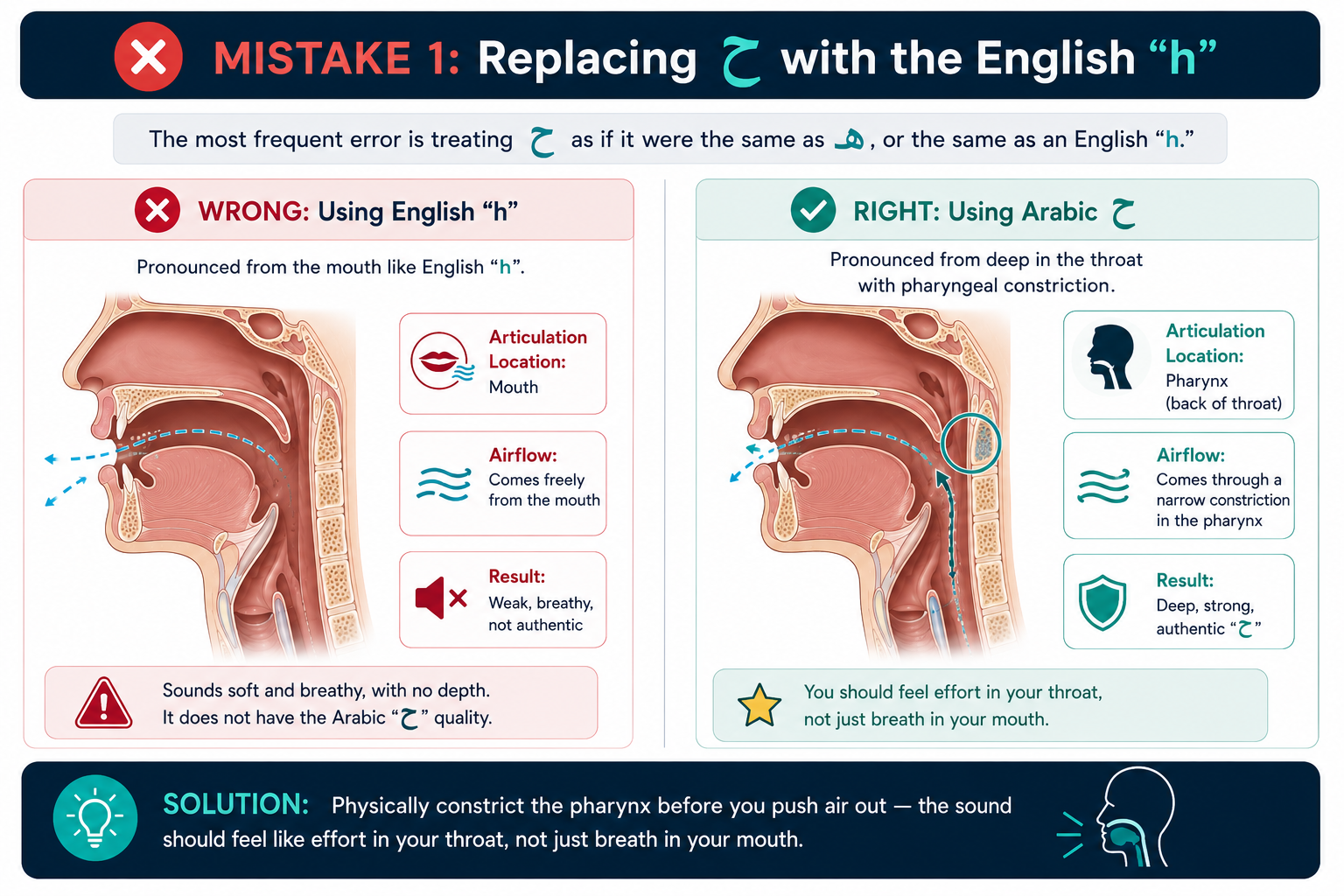
Mistake 1: Replacing ح with the English “h”
The most frequent error is treating ح as if it were the same as هـ, or the same as an English “h.” Solution: physically constrict the pharynx before you push air out — the sound should feel like effort in your throat, not just breath in your mouth.
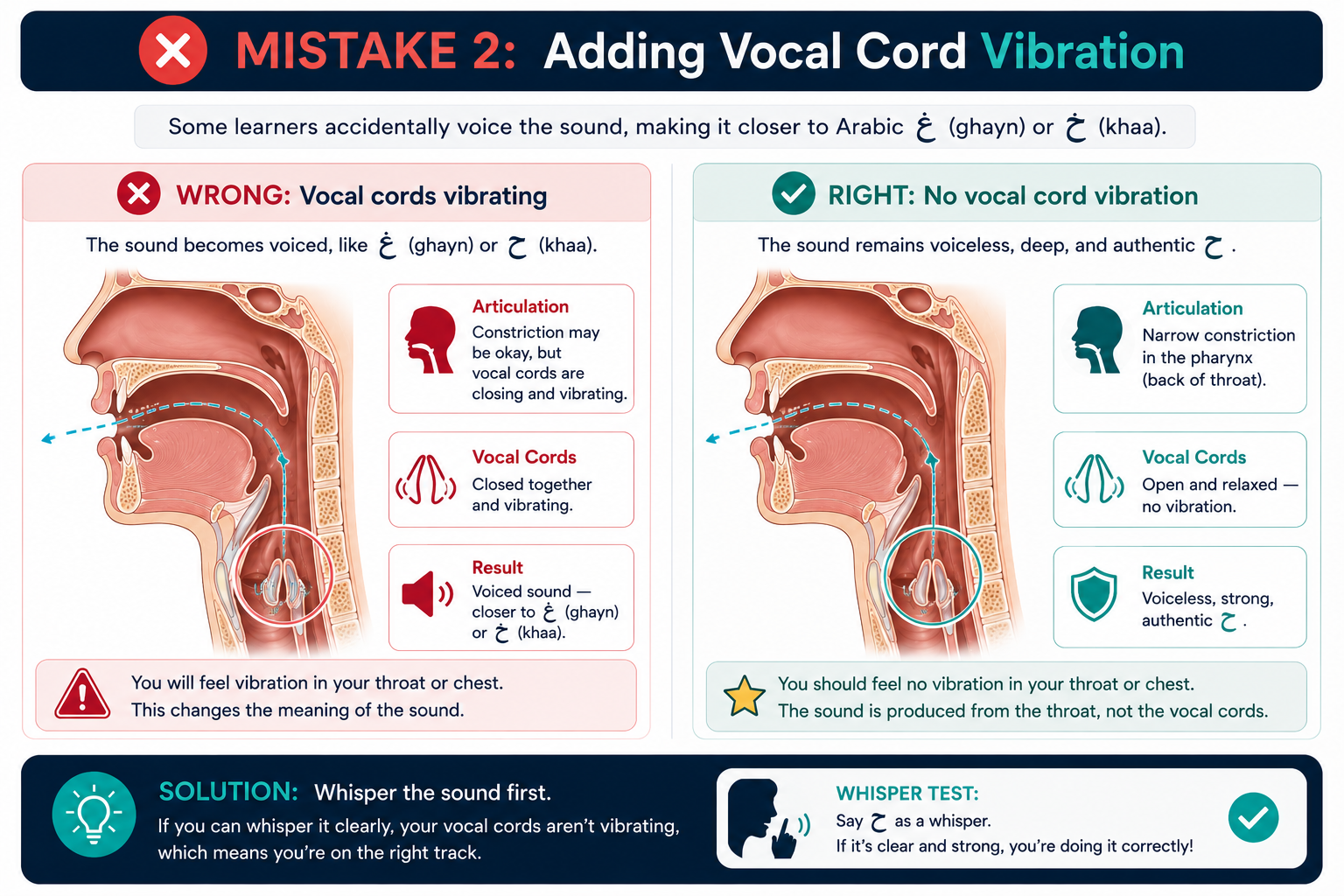
Mistake 2: Adding Vocal Cord Vibration
Some learners accidentally voice the sound, making it closer to Arabic غ (ghayn) or خ (khaa). Solution: whisper the sound first.
If you can whisper it clearly, your vocal cords aren’t vibrating, which means you’re on the right track.
Mistake 3: Mixing Up هـ and ح in Real Words
This is where meaning breaks down. حَال (haal, “condition”) and هَال (haal, “frightened, startled”) are different words entirely. Getting this wrong in conversation doesn’t just sound off — it can genuinely confuse the listener.
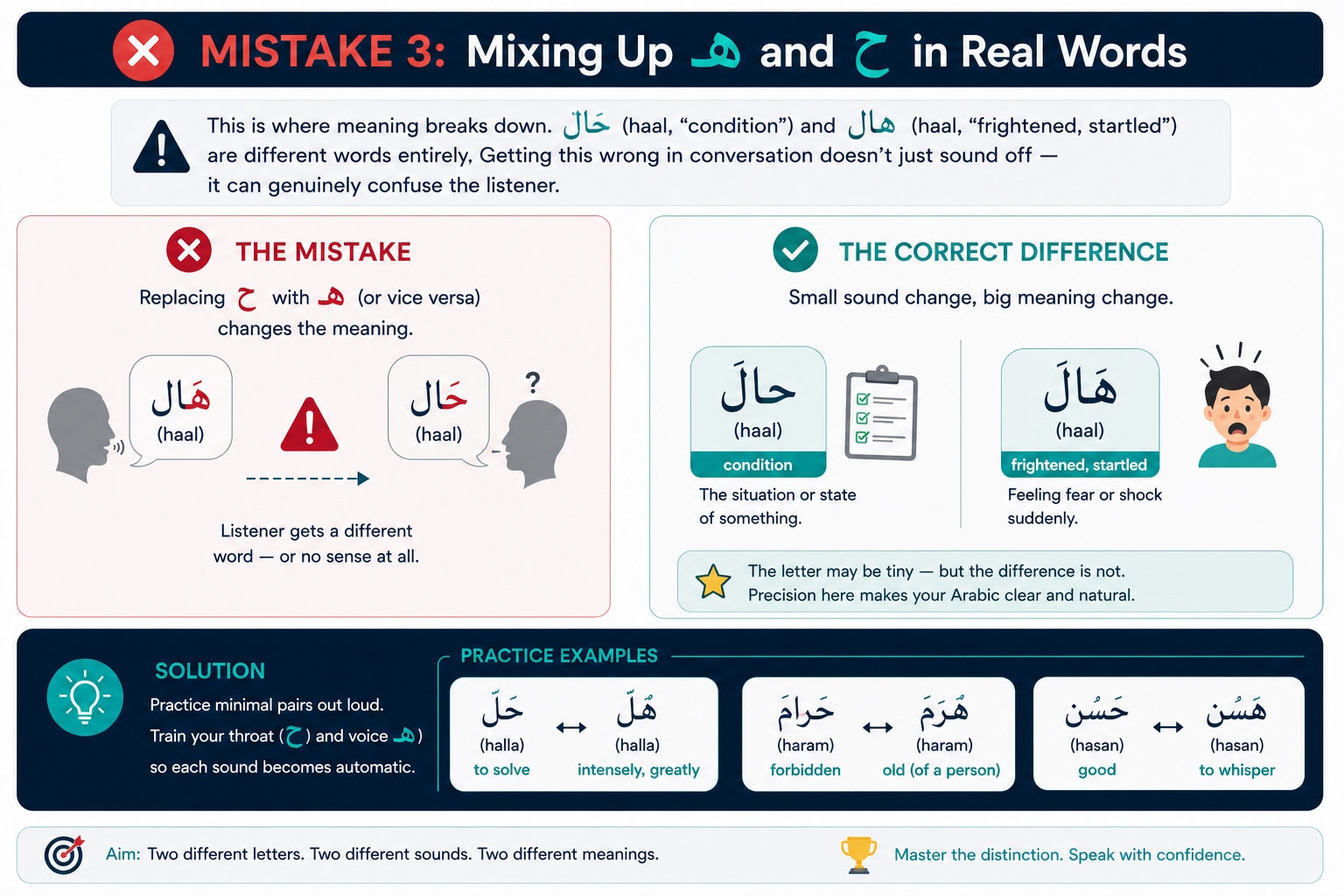
Group practice tends to catch these mistakes faster than solo study, because a teacher or classmate hears the substitution instantly.
That’s part of the reasoning behind Intensive Arabic Group Classes With Cheap Fees — regular peer correction speeds up exactly this kind of muscle-memory fix.
Inside Kalimah Center: Moments from Our Courses
Get a glimpse into the vibrant learning experience at Kalimah Center. These snapshots capture real moments from our live classes—where students engage deeply, connect with passionate instructors, and grow in a welcoming, supportive environment.
Master Arabic with Kalimah Center
Join our expert-led online classes and start your journey toward Arabic fluency today.
Book Your Free TrialE. Why Correct Pronunciation Changes Meaning?
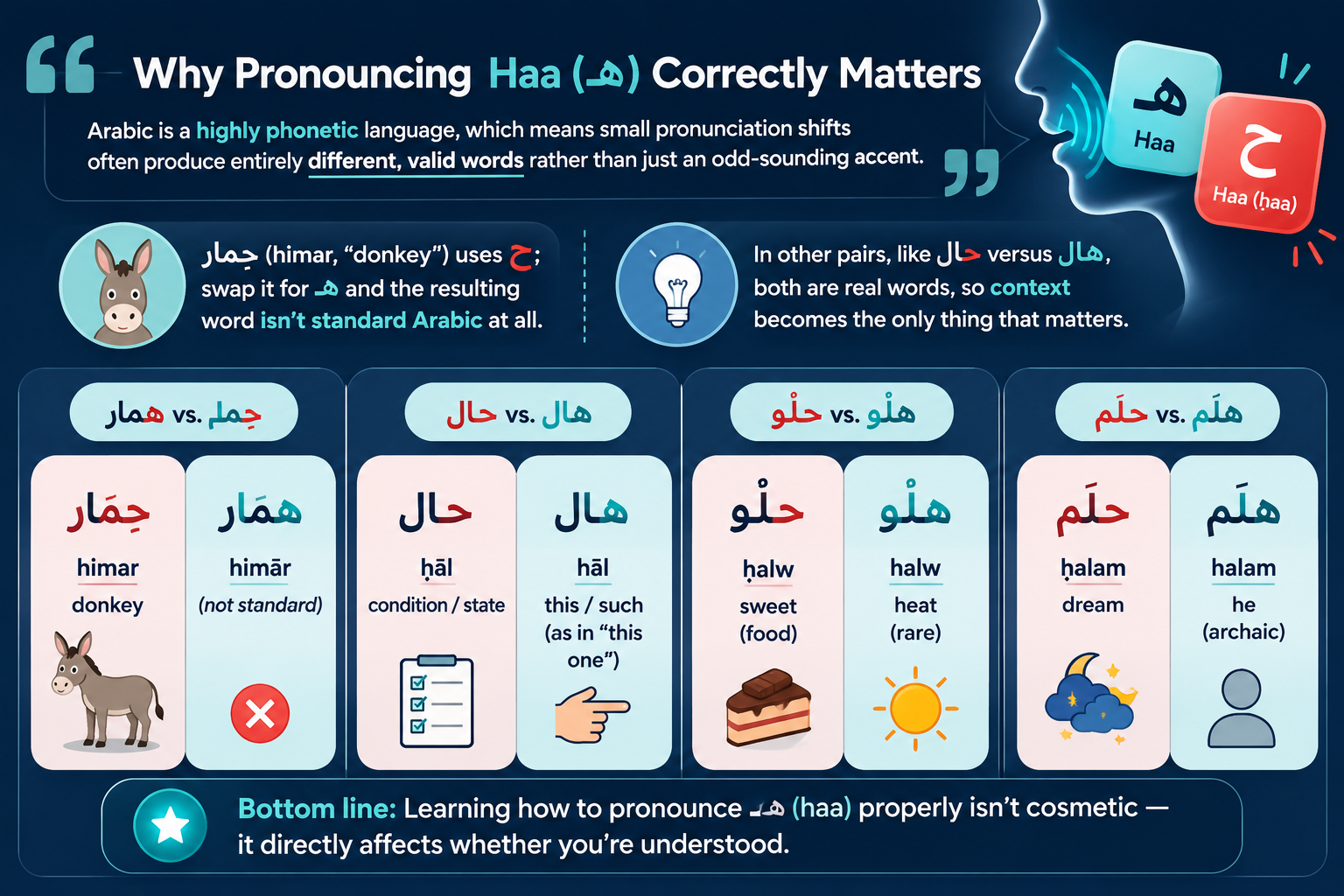
Arabic is a highly phonetic language, which means small pronunciation shifts often produce entirely different, valid words rather than just an odd-sounding accent.
حِمار (himar, “donkey”) uses ح; swap it for هـ and the resulting word isn’t standard Arabic at all, which immediately signals to a native speaker that something was mispronounced.
In other pairs, like حال versus هال, both are real words, so context becomes the only thing separating a completed sentence from a confusing one.
This is exactly why learning how to pronounce ha in Arabic properly isn’t a cosmetic detail — it directly affects whether you’re understood.
Read Also: How to Pronounce ظ in Arabic
Start Practicing Ha Pronunciation With Real Feedback
Reading about throat placement and airflow only goes so far — the fastest way to fix your pronunciation of هـ and ح is to say them out loud to someone who can correct you immediately.
Kalimah Center’s instructors work through exactly this kind of letter-by-letter drilling in live sessions, adjusting your throat position and breath control in real time instead of leaving you to guess whether you got it right.
Whether you’re starting from zero or refining an accent you’ve had for years, structured practice with a live teacher closes the gap between knowing the theory and actually being understood in Arabic.

Depending on how you like to learn, a few course paths fit this kind of pronunciation work:
- Best Online Arabic Classes For Adults: one-on-one or small-group sessions built around exactly this kind of live correction, ideal if you want focused attention on your own pronunciation habits.
- Intensive Arabic Group Classes With Cheap Fees: a more affordable option where peer practice and group drilling help you catch هـ/ح mix-ups faster, since a teacher or classmate hears the slip immediately.
- Learn Arabic Online For Kids: the same core sounds and shapes, taught at a pace and style suited to younger learners.

Whether you’re starting from zero or refining an accent you’ve had for years, structured practice with a live teacher closes the gap between knowing the theory and actually being understood in Arabic.
Inside Kalimah Center: Moments from Our Courses
Get a glimpse into the vibrant learning experience at Kalimah Center. These snapshots capture real moments from our live classes—where students engage deeply, connect with passionate instructors, and grow in a welcoming, supportive environment.
Here Are The Reviews On Our Courses:
Our students frequently commend the excellence of our courses and the commitment shown by our instructors. You can read their complete reviews on Trustpilot.
Read more reviews on Trustpilot

🚀 Start Your Free Trial Today! 🚀
Don’t miss out on this life-changing opportunity to deepen your faith and knowledge. Sign up now for your free trial and take the first step towards becoming a better practicing Muslim with Kalimah Center!
Master Arabic with Kalimah Center
Join our expert-led online classes and start your journey toward Arabic fluency today.
Book Your Free TrialConclusion
Learning how to pronounce ha in Arabic comes down to recognizing that هـ and ح are two separate letters with two separate articulation points — one light and breathy near the top of the throat, one deep and constricted in the pharynx.
Mixing them up doesn’t just affect your accent; it can change or invalidate the word you’re trying to say.
Practicing each sound in isolation, learning the four written shapes of هـ, and getting live correction on your throat placement are the three things that turn this from a persistent stumbling block into a sound you produce automatically.
With consistent practice — ideally with feedback from a teacher — most learners notice a clear improvement within a few weeks. If you’re building your Arabic from the ground up, Learn Arabic Online with Kalimah Center’s structured courses covers pronunciation fundamentals like this alongside reading, writing, and conversation.
And if you’re guiding a child through the same letters, Learn Arabic Online For Kids is built around the same core sounds, taught at a pace suited to younger learners.
Frequently Asked Questions
The questions below cover what learners most often search for after struggling with هـ and ح, along with a few points this guide hasn’t fully addressed yet.
1. What is the difference between Ha (ح) and Haa (هـ) in Arabic?
Ha (ح) is a deep, pharyngeal sound produced by constricting the throat, while Haa (هـ) is a light, breathy sound produced near the top of the throat, close to the English “h.” They are separate letters with separate meanings, not variants of the same sound.
2. Is the Arabic ح sound found in English?
No. There is no equivalent to ح in English or most European languages, which is why it’s consistently one of the hardest sounds for new Arabic learners to produce. Practicing the pharyngeal constriction directly, rather than substituting a familiar sound, is the only way to learn it properly.
3. How many written shapes does the letter هـ have?
The letter هـ has four shapes: isolated (ه), initial (هـ), medial (ـهـ), and final (ـه). Which shape appears depends on the letter’s position in the word and whether the surrounding letters connect to it.
4. Why do I keep mixing up هـ and ح when speaking?
This usually happens because both letters get simplified to “h” in English transliteration, so learners never build a separate mental sound for each one. Deliberately practicing minimal pairs — words that differ by only this one letter — is the fastest way to train your ear and throat to tell them apart.
5. Can mispronouncing ح or هـ actually change a word’s meaning?
Yes. Arabic is highly phonetic, so swapping these letters often produces a different, valid word rather than just an accented version of the one you intended — for example, حال (condition) versus هال (frightened). In some cases the swap produces a word that doesn’t exist at all, which immediately signals the mispronunciation to a native listener.