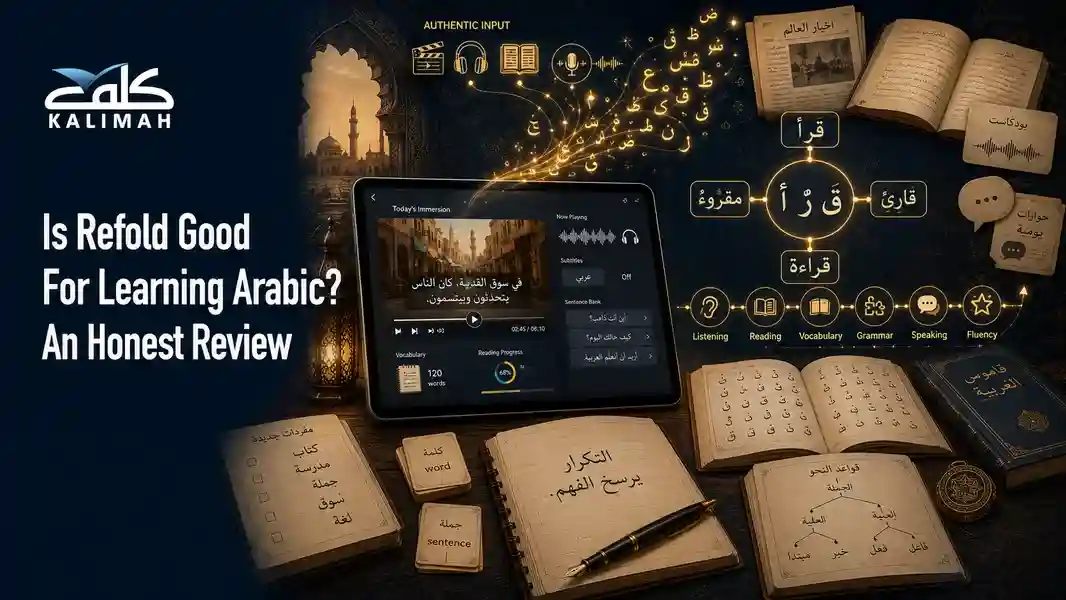
If you’ve spent any time in Arabic-learning communities online, you’ve probably seen Refold mentioned as a method that can take you to fluency purely through immersion — no textbooks, no grammar drills, just content. It sounds liberating.
But is Refold actually good for learning Arabic specifically, or is it a better fit for languages like Japanese or Spanish?
The short answer: Refold works for Arabic, but it comes with real structural challenges that most reviews don’t warn you about clearly.
This article breaks down exactly what Refold does well, where it genuinely falls short for Arabic learners, and what a more structured alternative looks like for people who want measurable progress.
What you’ll learn in this article:
- What Refold is and how its method works
- Whether Refold is good for learning Arabic — honestly assessed
- The three specific drawbacks of Refold that Arabic learners face most
- How Refold compares to structured Arabic programs
- Which type of learner is best suited for each approach
Refold is a language-learning methodology built around Comprehensible Input (CI) — the idea, derived from linguist Stephen Krashen’s research, that you acquire language by understanding content slightly above your current level, not by memorizing rules.
In practice, this means spending hundreds of hours watching Arabic TV, listening to podcasts, reading native-level text, and using Anki flashcard decks to build vocabulary — before you ever attempt to speak or write.
For Arabic, this approach can build strong passive comprehension and natural-sounding pronunciation instincts over time. Learners who commit to it fully often report reading and listening skills that feel more organic than those developed through classroom drilling.
However, is Refold good for learning Arabic at a practical level depends almost entirely on your learning style, your Arabic goal, and your tolerance for self-directed study without a structured curriculum.
A. What Refold Does Well for Arabic Learners
The immersion-first approach has genuine advantages for Arabic, particularly at intermediate and advanced levels. Listening to authentic Arabic content — Egyptian drama series, Levantine news programs, Gulf cooking channels — trains your ear to process natural speech rhythms, colloquial contractions, and regional vocabulary that no textbook captures.
Refold also encourages sentence mining: extracting real sentences from native content and building Anki cards around them. For Arabic, this means your vocabulary grows from actual usage contexts rather than frequency lists, which produces more transferable recall.
For learners targeting Modern Standard Arabic (MSA), immersion through Al Jazeera broadcasts, Arabic literature, and formal lectures provides exposure to the register they need. This is where Refold’s approach is strongest — when your target variety is consistent and well-represented in available media.
Read Also: Is Memrise Good for Learning Arabic?
B. The Drawbacks Of Refold For Arabic
The drawbacks of Refold for Arabic learners are real, structural, and not always acknowledged fairly in immersion-learning communities. Here are the three that matter most.
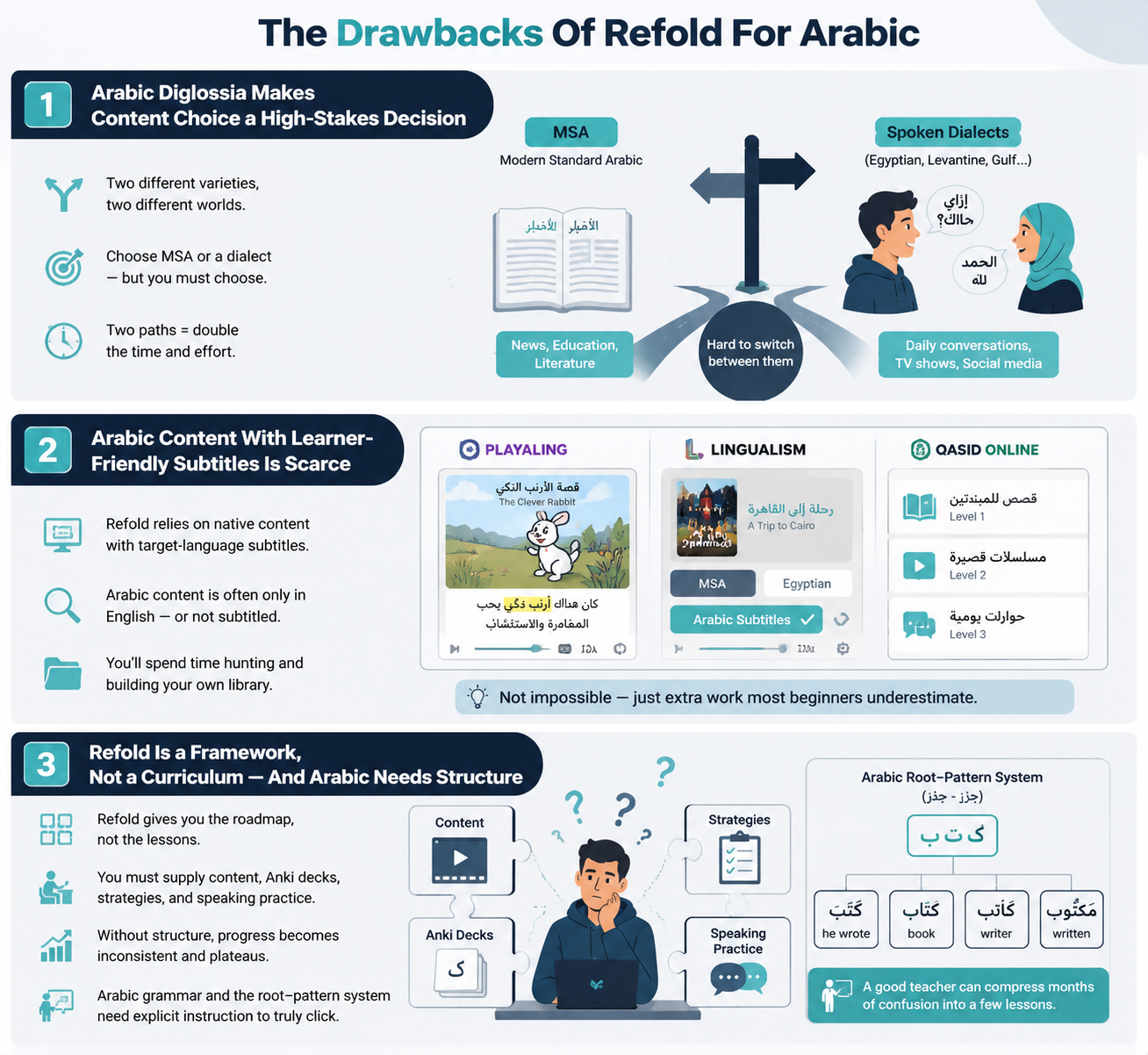
Understanding these limitations is not an argument against immersion — it’s an argument for knowing what you’re committing to before you start.
1. Arabic Diglossia Makes Content Choice a High-Stakes Decision
Arabic has a structural feature that makes it fundamentally different from every other major language on Refold’s roadmap: diglossia.
Modern Standard Arabic — the written, formal register used in news, education, and literature — and spoken dialects (Egyptian, Levantine, Gulf, Moroccan) are sufficiently different that content in one provides limited comprehensible input for the other.
A learner who spends six months immersed in Egyptian Arabic drama series will struggle to follow an MSA lecture, and vice versa.
Refold’s framework asks you to choose your target variety early and immerse consistently within it — sensible advice, but it means you effectively commit to a fork in the road at the very beginning, before you have enough knowledge to make that decision confidently.
Most Refold guides for other languages don’t require this decision at all. For Arabic learners using Refold, the practical consequence is that you may need to run two parallel immersion tracks — one for MSA comprehension and one for spoken dialect — which significantly increases the time investment and the complexity of sourcing appropriate content.
2. Arabic Content With Learner-Friendly Subtitles Is Scarce
One of Refold’s core mechanisms is watching native-language content with target-language subtitles — you hear and read simultaneously, which accelerates comprehension development.
This works well for Japanese (Netflix has extensive Japanese-subtitled anime and drama) and for Spanish (similarly well-resourced). Arabic is a different situation.
Arabic content on major streaming platforms is often subtitled only in English or not at all. Learner-focused graded content — the kind that sits at the “i+1” comprehensible level — requires active hunting through platforms like Playaling, Qasid Online, or Lingualism.
This is not an insurmountable problem, but it adds a sourcing burden that self-directed learners underestimate. Many Refold Arabic learners report spending significant early time building a content library before real immersion can begin.
3. Refold Is a Framework, Not a Curriculum — And Arabic Needs Structure
This is the drawback that matters most for most learners, and it’s the one Refold is most transparent about: it is a methodology, not a course. Refold does not teach you Arabic. It gives you a philosophy and a general roadmap, and you supply everything else — the content, the Anki decks, the comprehension strategies, the speaking practice schedule.
For learners with strong self-direction and a high tolerance for ambiguity, this is manageable. For the majority of adult Arabic learners — people with jobs, families, and limited study hours per week — the absence of a structured curriculum is a significant obstacle.
The result is often an enthusiastic start followed by inconsistent immersion sessions, vocabulary decks that grow without a grammar foundation to hang them on, and speaking skills that plateau because output practice never gets systematically introduced.
Arabic grammar, specifically, benefits from explicit instruction in a way that Refold’s input-only early stages don’t fully address.
The root-and-pattern morphology system (وزن, جذر) — where كَتَبَ, كِتَاب, كَاتِب, and مَكْتُوب all derive from one root — is not something most learners abstract from immersion alone in a reasonable timeframe.
A teacher who explains the pattern system directly can compress months of confusion into a few structured lessons.
Read Also: Numbers in Egyptian Arabic
Experience Kalimah Center Classes
Watch real excerpts from our live sessions at Kalimah Center and see how we bring learning to life. These clips highlight our interactive, student-centered teaching approach across all our courses—designed to keep learners engaged, motivated, and actively involved every step of the way.
Master Arabic with Kalimah Center
Join our expert-led online classes and start your journey toward Arabic fluency today.
Book Your Free TrialC. Refold vs. Structured Arabic Learning: Which Is Right for You?
The honest assessment is that Refold and structured Arabic programs are not competing for the same learner — they serve different needs.
| Factor | Refold | Structured Arabic Program |
| Curriculum provided | No — you build it | Yes — lesson-by-lesson progression |
| Grammar instruction | Delayed / incidental | Explicit and systematic |
| Speaking practice | Delayed until advanced | Integrated from early stages |
| Teacher feedback | None | Regular and personalized |
| Diglossia guidance | Self-directed | Instructor-guided |
| Suitable for beginners | Difficult | Yes |
| Time to first conversation | Long (months to years) | Weeks to months |
| Best for | Intermediate+ with strong self-discipline | Beginners, working adults, kids |
Refold works best as a supplementary immersion layer for learners who already have a grammar foundation — not as a standalone system for starting from zero in Arabic.
If you already know the Arabic alphabet, have a working understanding of verb conjugation patterns, and can follow simple audio at 50–60% comprehension, Refold’s immersion framework can accelerate your progress significantly.
If you’re starting from scratch, or if you’ve been studying for a while and feel stuck, a structured program with a qualified teacher closes gaps faster than immersion alone.
If you’re looking to learn Arabic online with a proper curriculum and live instruction, Kalimah Center offers structured courses designed specifically for non-native speakers — with teacher guidance, systematic grammar coverage, and a clear progression from beginner to conversational fluency.
Read Also: Arabic Immersion Programs
Start Learning Arabic The Right Way With Kalimah Center
Stop spending months hunting for comprehensible content and hoping exposure alone will build your Arabic. Learn Arabic with a structured curriculum, qualified teachers, and a clear path from your first lesson to confident conversation.
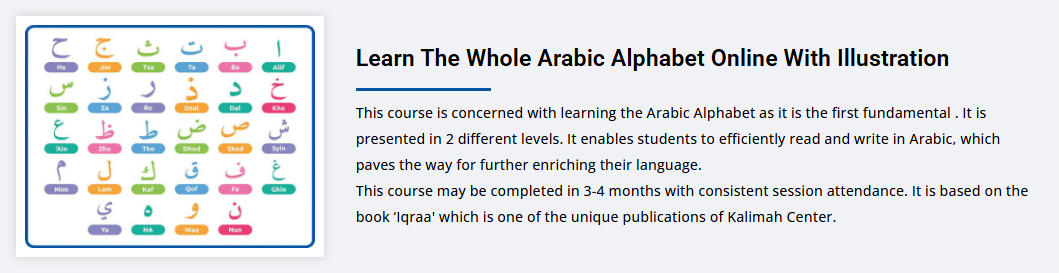
Kalimah Center provides personalized online Arabic courses for adults, kids, and group learners — taught by specialist instructors who understand exactly where English-speaking students get stuck and how to move them past it fast.
Explore Our Courses:
- Best Online Arabic Classes for Adults: for adults who want intensive, structured progress.
- Intensive Arabic Group Classes: for learners who want affordable group learning.
- Learn Arabic Online for Kids: for children beginning their Arabic journey.
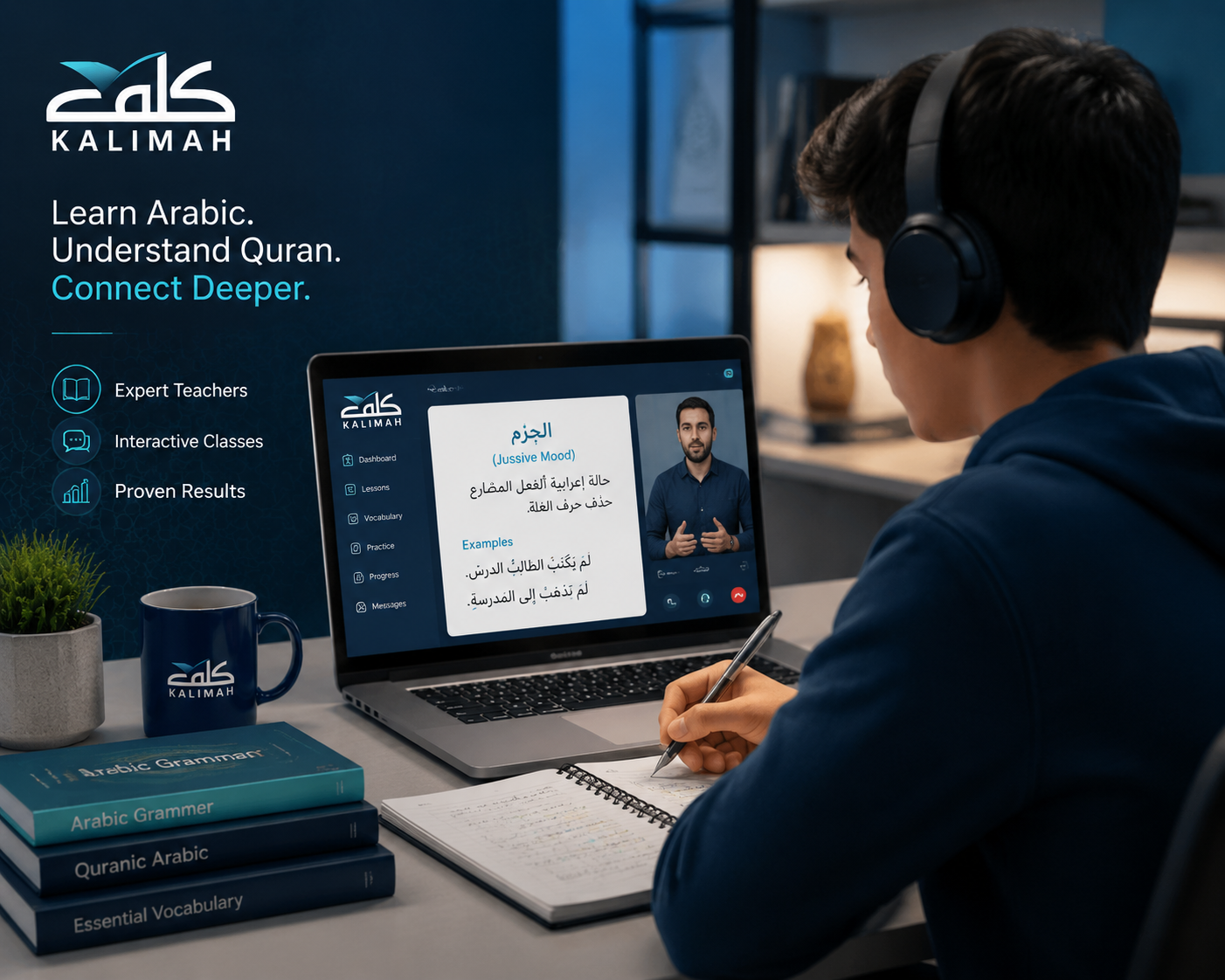
Inside Kalimah Center: Moments from Our Courses
Get a glimpse into the vibrant learning experience at Kalimah Center. These snapshots capture real moments from our live classes—where students engage deeply, connect with passionate instructors, and grow in a welcoming, supportive environment.
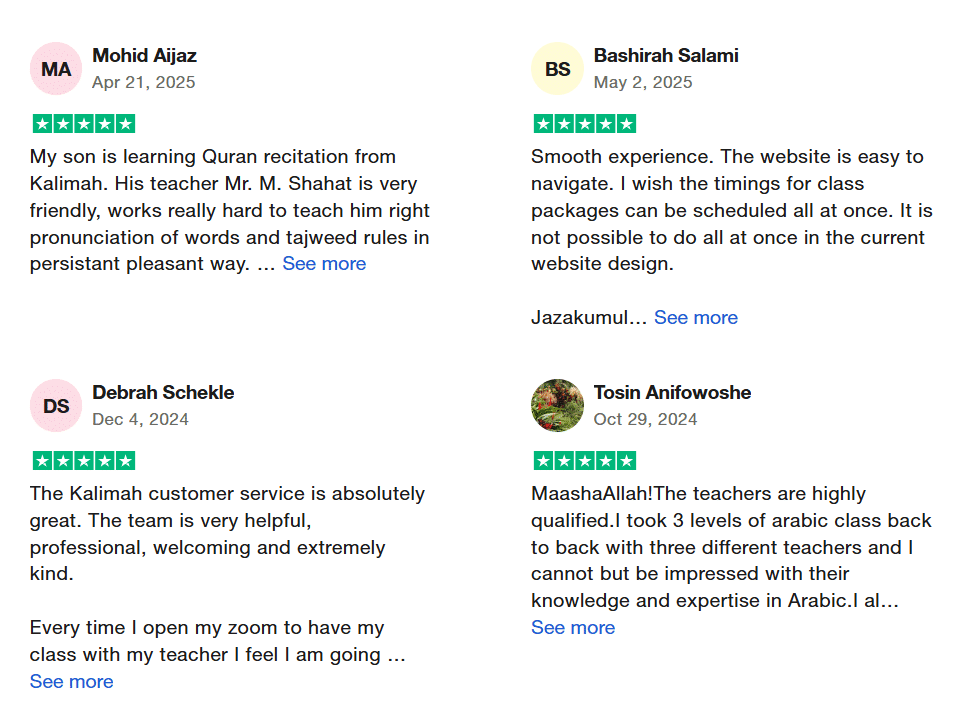
Here Are The Reviews On Our Courses:
Our students frequently commend the excellence of our courses and the commitment shown by our instructors. You can read their complete reviews on Trustpilot.
Read more reviews on Trustpilot
🚀 Start Your Free Trial Today! 🚀
Don’t miss out on this life-changing opportunity to deepen your faith and knowledge. Sign up now for your free trial and take the first step towards becoming a better practicing Muslim with Kalimah Center!
Master Arabic with Kalimah Center
Join our expert-led online classes and start your journey toward Arabic fluency today.
Book Your Free TrialConclusion
Refold is a legitimate methodology — its immersion principles are grounded in real acquisition research, and it has produced fluent Arabic speakers. But is Refold good for learning Arabic for most people? The honest answer is: not as a standalone starting point.
The three structural drawbacks — diglossia complexity, content scarcity, and the absence of a built-in curriculum — create real obstacles that a tool-based framework cannot resolve on its own.
Refold is best understood as a powerful immersion supplement, most effective after you’ve built a grammar foundation and can follow native content at a basic level.
The difference between Refold and a structured Arabic program like Kalimah Center is not about which method is philosophically better — it’s about what you need right now.
If you need someone to map the path, correct your errors, explain the root system, and give you speaking practice with real feedback, a structured program gets you there faster and with less frustration. Use immersion to accelerate. Use a curriculum to build the foundation.
Frequently Asked Questions About Refold And Learning Arabic
Here are answers to the most common questions learners ask about using Refold for Arabic — covering method, timeline, and practical alternatives.
1. Is Refold effective for Arabic beginners?
Refold is not well-suited for absolute Arabic beginners. The method assumes enough comprehension to extract meaning from native content, which beginners lack. Most Arabic learners report that Refold becomes genuinely useful after reaching a basic grammar foundation — roughly A2–B1 level — where they can follow simplified native content at 50% or more comprehension.
2. How long does Refold take to reach Arabic fluency?
Refold advocates estimate 1,500–2,000 hours of immersion to reach conversational fluency in Arabic — considerably more than for European languages, due to script complexity and diglossia. This timeline assumes consistent daily immersion, which most working adults cannot sustain. Structured instruction compresses this by providing explicit grammar shortcuts that immersion alone cannot replicate efficiently.
3. What are the main drawbacks of Refold for Arabic?
The three main drawbacks of Refold for Arabic are: first, the diglossia problem — MSA and dialects are different enough that you must choose one early and immerse in it exclusively; second, Arabic learner-appropriate content with target-language subtitles is scarce compared to Japanese or Spanish; third, Refold provides no curriculum or teacher, which means grammar gaps and speaking skills are not systematically addressed.
4. Can I combine Refold with structured Arabic classes?
Yes — and this is the approach most serious Arabic learners find most effective. Use structured classes at Kalimah Center to build your grammar foundation, learn the alphabet, and develop early speaking skills. Then layer Refold immersion on top by watching Arabic content, sentence mining with Anki, and building listening hours. The two approaches address different gaps and reinforce each other. You can explore best online Arabic classes for adults and intensive Arabic group classes to find the right starting point.
5. Is Refold good for learning Arabic for kids?
Refold is not designed for children, and its self-directed structure is unsuitable for young learners. Kids need structured instruction, short sessions, and interactive feedback. Kalimah Center’s Arabic courses for kids are built specifically for children — with visual learning, age-appropriate pacing, and teachers trained to keep young students engaged.
6. Does Refold work for Quranic Arabic?
Refold’s immersion approach is not optimized for Quranic Arabic, which requires understanding Classical Arabic morphology, specific vocabulary, and Tajweed rules for recitation. A curriculum-based course with a qualified teacher is a more direct path for Quranic Arabic goals.