If you’ve been searching for a way to learn Arabic on your own, chances are Assimil has come up.
The “Arabic With Ease” course has been used by self-studiers for decades, and it genuinely has strengths worth knowing about. But the real question — is Assimil good for learning Arabic specifically, given how demanding this language is — deserves a straight, detailed answer.
Arabic is classified by the Foreign Service Institute as a Category IV language: the hardest tier for English speakers, requiring roughly 2,200 hours to reach professional proficiency. That context matters when evaluating any self-study tool.
Assimil can take you somewhere real. The question is where, exactly, and whether that destination matches what you actually need.
This review covers how Assimil works, what it does well, where it falls short, who it’s truly suited for — and what a structured Arabic program adds that no self-study tool can replicate.
What You’ll Learn in This Article
- Exactly how Assimil Arabic is structured and how the two-phase method works
- What Assimil genuinely delivers — and what it overpromises
- The specific limitations that matter most for Arabic learners
- Whether Assimil alone can make you fluent
- How to decide if it’s the right tool for your goal
Is Assimil Good For Learning Arabic?
Assimil is a good tool for learning Arabic as a self-study supplement — especially for building Modern Standard Arabic (MSA) reading and listening foundations. It is not a complete Arabic education, and it will not bring you to conversational fluency on its own.
The “Arabic With Ease” course — authored by Dominique Halbout and Jean-Jacques Schmidt, both affiliated with INALCO, Europe’s leading institution for Oriental languages — is well-crafted.
The method is communicative rather than purely theoretical, which is a meaningful advantage over many Arabic textbooks that drown beginners in grammar drills before they’ve heard a sentence of natural Arabic.
That said, Assimil is a self-study tool, not an academy. It doesn’t correct your pronunciation in real time, doesn’t adapt to your specific weak points, and doesn’t build the speaking confidence that comes from live interaction. For Arabic — a language where mispronouncing a single letter can change a word’s meaning entirely — those gaps are significant.
How Does Assimil Arabic Work?
The Assimil method is built around two phases, each approximately 50 lessons long.
1. Phase One: The Passive Wave
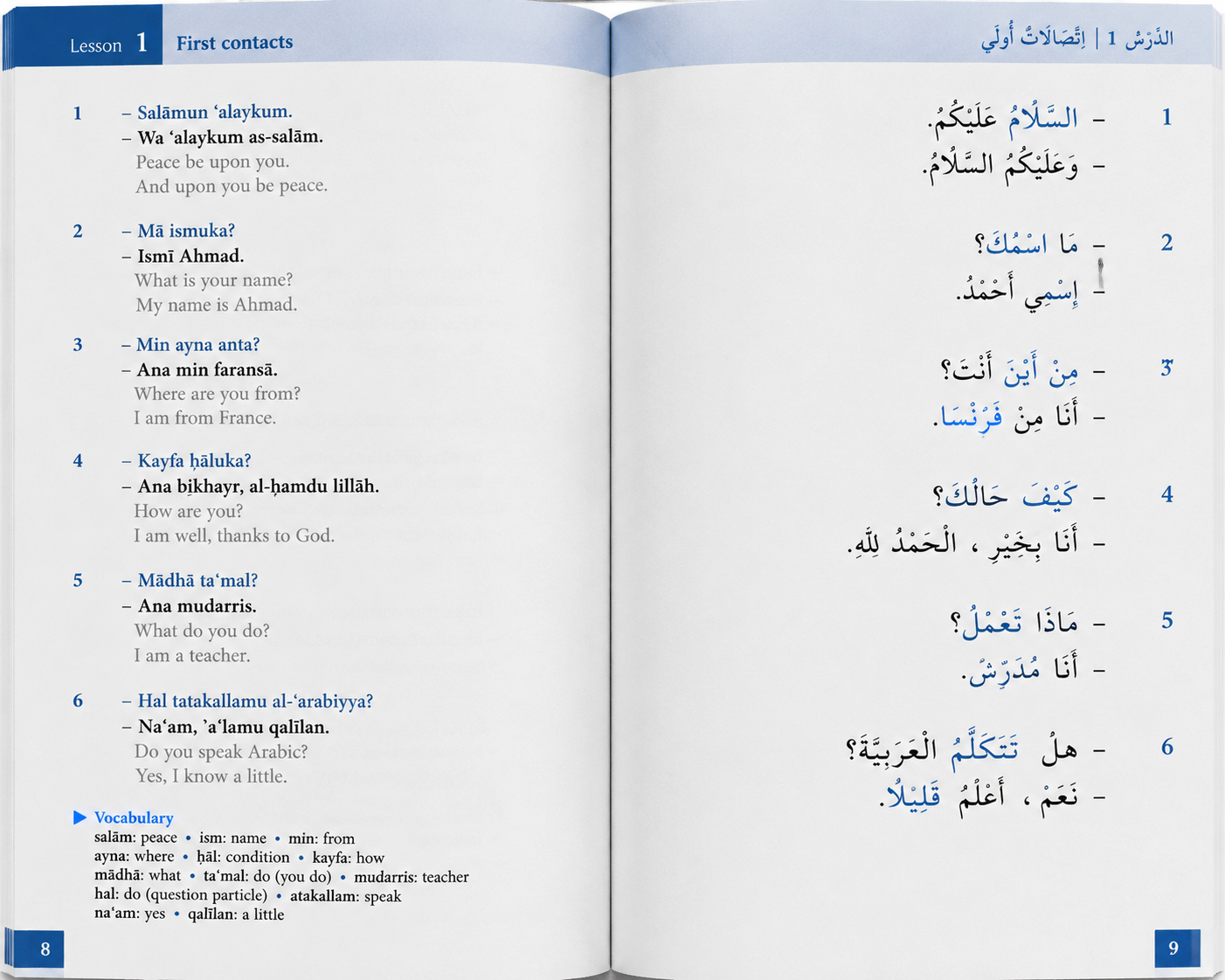
In the passive phase, you listen and read without forcing yourself to memorize. Each lesson is a short dialogue or story, presented in Arabic script on the right page with a phonetic spelling, a literal translation, and a natural English translation on the left.
You absorb the language through repeated exposure — the same principle that governs how children acquire their first language.
The audio recordings, available on CD or as MP3 files, are high-quality and use Modern Standard Arabic speakers. For a language where short vowels are frequently omitted in written text, listening is not optional — it’s the foundation. Assimil handles this well.
2. Phase Two: The Active Wave
From lesson 50 onward, you begin going back to earlier lessons and producing the language: translating from English into Arabic, reciting unvoweled text, and working through the exercises. This is where retention solidifies.
Every six lessons, a review unit (المراجعة, al-murāja’a) revisits difficult points. The total course runs 77 lessons across 611 pages, plus 160 pages of alphabet explanations, conjugation tables, and grammar reference.
At one lesson per day, you’re looking at a minimum of three months of active work — and longer if you’re also doing the review cycles properly.
Read Also: Is Memrise Good for Learning Arabic?
What Assimil Arabic Does Well
Assimil Arabic has genuine strengths — and understanding them clearly helps you decide whether it belongs in your learning plan. The three areas below are where the course consistently delivers, based on its design philosophy and how the material is structured across all 77 lessons.
1. The Communicative Approach Reduces Early Overwhelm
The most common reason Arabic beginners quit is that traditional textbooks front-load grammar: you spend weeks learning the dual form and broken plurals before you’ve heard a single coherent sentence.
Assimil flips this. You encounter grammar in context first and absorb rules inductively — which builds linguistic intuition faster than memorizing paradigm tables.
2. The Audio Quality Is Genuinely Excellent
The recordings are produced at a clear, educational pace using MSA — the variety used by Al Jazeera, Arabic literature, and formal education across the Arab world.
For learners targeting Quranic Arabic or formal written Arabic, this is exactly the register you need to train your ear on. Assimil’s audio gives you roughly 77 sessions of guided listening practice, which builds pronunciation intuition that text alone cannot.
3. The Layout Rewards Consistency
Assimil’s design enforces a discipline that self-studiers often struggle to create for themselves: one lesson per day, review every six lessons, two waves of engagement with the same material.
If you follow the system, the repetition is built in. You’re not just reading each page once — you’re returning to it weeks later with more comprehension. That’s genuine spaced repetition applied to a full Arabic course.
Kalimah Center’s instructors note a consistent pattern: students who arrive having used Assimil beforehand have stronger reading intuition and better tolerance for Arabic’s grammatical complexity — but they still require live correction before they can produce accurate spoken Arabic.
Read Also: Is Preply Good for Learning Arabic
Where Assimil Falls Short for Arabic Learners
No self-study tool is without limitations — and with Arabic, those limitations carry more weight than they would with an easier language.
The gaps below are not minor inconveniences; for some learners, they are the deciding factor between making real progress and plateauing after a few months.
1. It Will Not Teach You a Dialect
Assimil Arabic covers MSA exclusively. If your goal is to speak with people in Egypt, Morocco, the Gulf, or the Levant, the Arabic of daily conversation — Egyptian Arabic, Darija, Gulf dialect, Levantine — is a different register from what Assimil teaches.
You will be able to read a newspaper but not necessarily follow a street conversation in Cairo.
This is not a flaw unique to Assimil; it’s an honest limitation of any MSA-focused course. But it’s worth knowing before you invest three months in the method and then discover the dialect gap.
2. The Claimed Level Is Unrealistic
Assimil markets the “With Ease” series as taking learners to B2. For Arabic, this is not achievable through any single tool — including Assimil.
A B2 Arabic speaker can work, study, and navigate complex everyday situations independently. Getting there requires thousands of hours of speaking practice, reading, live correction, and cultural immersion that no textbook provides.
Treat Assimil as a strong A1–A2 foundation builder, with some B1 vocabulary exposure by the final lessons. That’s valuable — just don’t plan your life around the B2 claim.
3. There Is No C1 Material in English
Assimil’s advanced Arabic series (“Perfectionnement Arabe”) was only produced in French — and is now out of print.
If you’re a serious learner who completes “Arabic With Ease” and wants to continue with Assimil, you have no English-language continuation. That’s a real gap in the product line.
4. No Live Feedback on Pronunciation
This is the most consequential limitation for Arabic specifically. Arabic phonetics include sounds — ع (Ayn), غ (Ghayn), ح (Haa), خ (Khaa) — that have no equivalents in English.
Learners who spend months with only audio recordings frequently develop subtle pronunciation habits they cannot hear or correct themselves. Without a teacher listening and correcting in real time, errors calcify.
Inside Kalimah Center: Moments from Our Courses
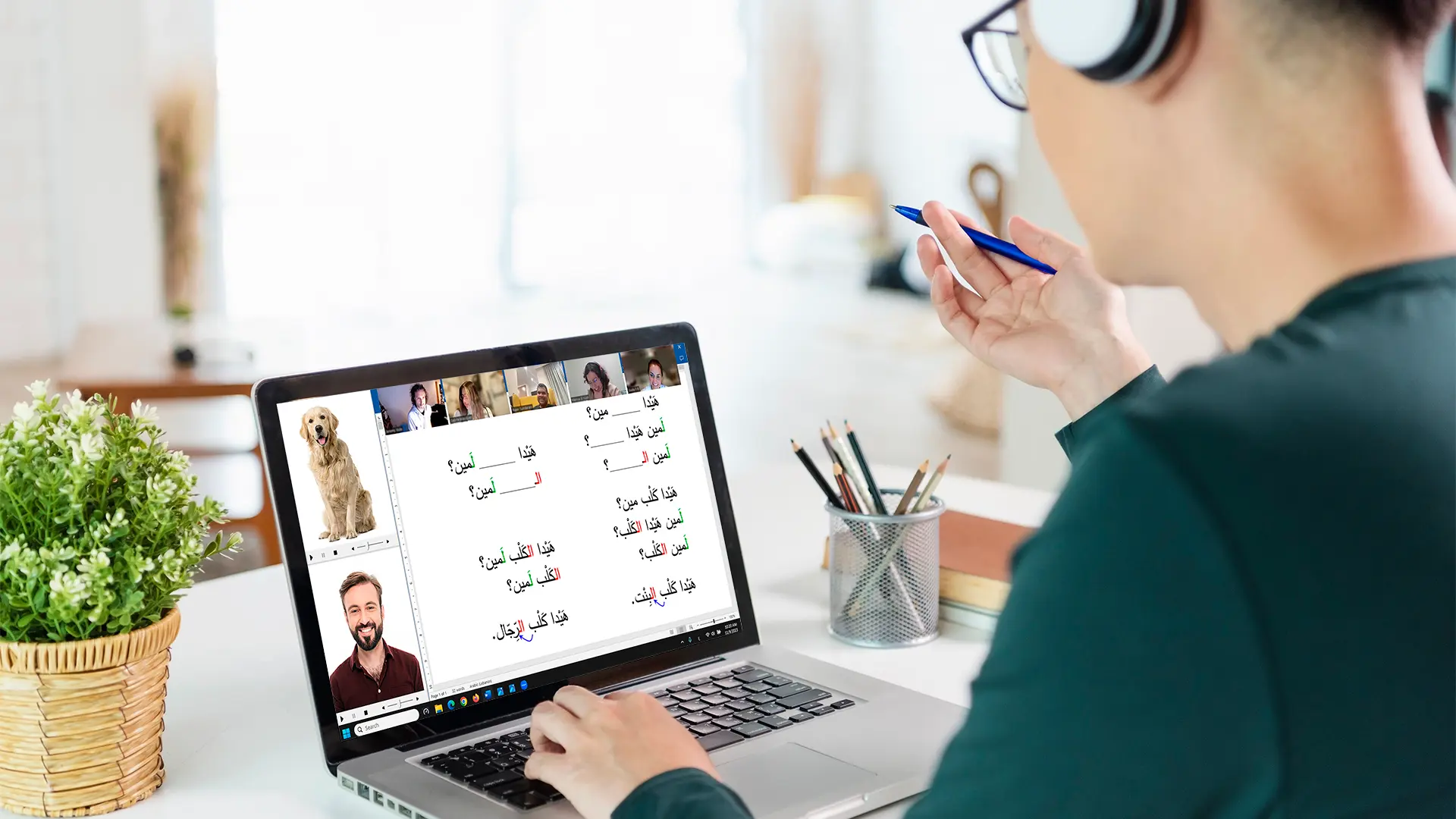
Get a glimpse into the vibrant learning experience at Kalimah Center. These snapshots capture real moments from our live classes—where students engage deeply, connect with passionate instructors, and grow in a welcoming, supportive environment.
Master Arabic with Kalimah Center
Join our expert-led online classes and start your journey toward Arabic fluency today.
Book Your Free TrialCan Assimil Make You Fluent in Arabic?
No, and this applies to every self-study Arabic tool, not just Assimil.
Fluency in Arabic requires live conversation practice, real-time error correction, dialect exposure, reading across different text types, and sustained engagement over years.
Assimil can build a meaningful foundation — reading familiarity with Arabic script, a working knowledge of MSA grammar patterns, and a trained ear for MSA pronunciation. That foundation is worth having.
But a tool that gives you guided reading and listening cannot develop the thing fluency actually requires: the ability to construct and deliver accurate Arabic under the pressure of real conversation.
The learners who get the most from Assimil are those who use it as a structured entry point and then continue with live instruction.
At Kalimah Center, we regularly work with students who have Assimil backgrounds — and the pattern is consistent: they progress faster in structured lessons because Assimil gave them a genuine starting point. But the live instruction is what actually moves the needle on speaking and accuracy.
Read Also: Does Bayyinah TV teach Arabic?
Who Is Assimil Arabic Actually Right For?
Assimil suits a specific type of learner well:
- Self-directed learners: who can maintain a daily habit without external accountability
- Learners targeting MSA or Quranic Arabic: rather than a specific spoken dialect
- Beginners who find traditional grammar-heavy textbooks discouraging
- Supplementary learners: who are already in a structured Arabic program and want additional daily exposure
- People with limited budget: who need an entry point before enrolling in a full course
It is less suited for learners who need speaking ability quickly, who are targeting a specific dialect, or who don’t have the self-discipline to follow a three-month daily schedule without external structure.
Read Also: Is the Drops App Good for Learning Arabic?
Start Learning Arabic With Expert Guidance At Kalimah Center
Assimil is a useful tool. But it was designed to be a starting point, not a destination.
Kalimah Center offers structured, live online Arabic classes taught by specialist instructors — for adults who want to actually speak Arabic, for children building a Quranic foundation, and for learners at every level who need more than a textbook can give them.

Unlike generic language apps, Kalimah Center focuses exclusively on Arabic, with curriculum designed around your specific goal: MSA, Quranic Arabic, or conversational skills.
Whether you’ve already worked through Assimil and want to take your Arabic further, or you’re starting from zero and want to get it right the first time — Kalimah Center builds what self-study cannot.
Explore Our Courses:
- Best Online Arabic Classes for Adults: for adults who want intensive, structured progress.
- Intensive Arabic Group Classes: for learners who want affordable group learning.
- Learn Arabic Online for Kids: for children beginning their Arabic journey.
Experience Kalimah Center Classes
Watch real excerpts from our live sessions at Kalimah Center and see how we bring learning to life. These clips highlight our interactive, student-centered teaching approach across all our courses—designed to keep learners engaged, motivated, and actively involved every step of the way.
Here Are The Reviews On Our Courses:
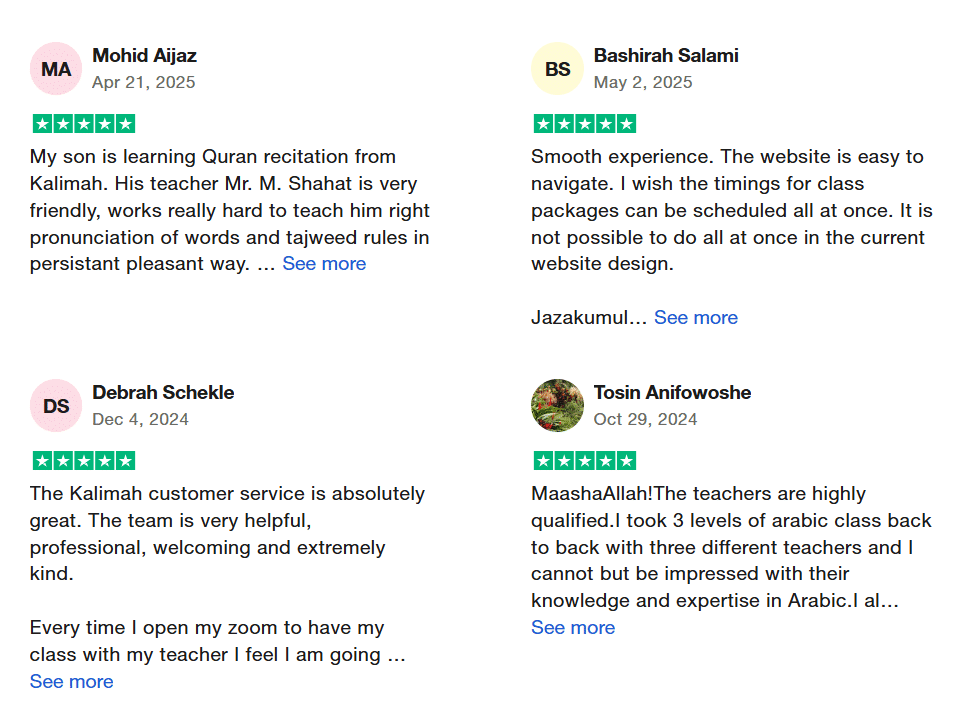
Our students frequently commend the excellence of our courses and the commitment shown by our instructors. You can read their complete reviews on Trustpilot.
Read more reviews on Trustpilot
🚀 Start Your Free Trial Today! 🚀
Don’t miss out on this life-changing opportunity to deepen your faith and knowledge. Sign up now for your free trial and take the first step towards becoming a better practicing Muslim with Kalimah Center!
Master Arabic with Kalimah Center
Join our expert-led online classes and start your journey toward Arabic fluency today.
Book Your Free TrialConclusion
Is Assimil good for learning Arabic? Yes — within clear limits. It’s one of the best-structured self-study tools available for MSA, its audio recordings are high quality, and its communicative approach is easier on beginners than most Arabic textbooks.
For a learner who commits to the daily lesson schedule and follows both phases properly, Assimil can build a solid A1–A2 foundation and genuine familiarity with Arabic script.
But is Assimil good for learning Arabic to the point of fluency, real conversation, or dialect competence? No. The B2 claim is unrealistic, there is no live pronunciation correction, and there is no path beyond the beginner course in English.
Arabic is simply too demanding a language for any single self-study tool to carry you to fluency.
The most successful Arabic learners use Assimil as one layer — then add live instruction, speaking practice, and specialist guidance. Kalimah Center is where that next layer begins.
Frequently Asked Questions About Assimil Arabic
Here are answers to the most common questions learners ask before starting Assimil Arabic.
Is Assimil Arabic good for complete beginners?
Assimil Arabic is well-suited for complete beginners because it introduces grammar inductively through dialogues rather than front-loading rules. The course includes a 160-page alphabet and pronunciation guide before the main lessons begin. However, beginners should be prepared for the genuine difficulty of Arabic — Assimil makes the process manageable, not easy.
How long does it take to finish Assimil Arabic?
Following Assimil’s recommended schedule of one lesson per day, the passive phase takes approximately 50 days and the full course 77 days. In practice, most learners take 3–6 months because review cycles and the active phase add significant time. Rushing through lessons without completing the review structure significantly reduces retention.
Can Assimil Arabic replace a teacher?
No. Assimil provides structured reading, listening, and grammar exposure, but it cannot correct your pronunciation, answer your specific questions, or adapt to your individual weak points. For Arabic specifically — where pronunciation errors change word meanings — live teacher feedback is essential at some stage of learning.
What level does Assimil Arabic reach?
Assimil markets the course as reaching B2, but this is unrealistic for Arabic. In practice, consistent learners who complete both phases reach a solid A2 level with some B1 vocabulary exposure. Reaching B2 in Arabic requires thousands of additional hours of practice beyond any self-study course.
Is Assimil Arabic good for learning Quranic Arabic?
Assimil teaches Modern Standard Arabic (MSA), which shares the grammar, script, and much of the vocabulary of classical Quranic Arabic. It is a useful foundation for Quranic study — but Quranic Arabic has specific vocabulary, structures, and recitation rules that MSA-focused courses do not cover. Pairing Assimil with a specialist Quranic Arabic course gives you the strongest base.
How does Assimil compare to taking Arabic classes online?
Assimil offers structured exposure at low cost and flexible timing — its main advantages. Online Arabic classes with a qualified instructor add real-time correction, speaking practice, personalized pacing, and live accountability — none of which Assimil provides. The two approaches are complementary rather than competing. Learn Arabic Online with Kalimah Center if you want structured instruction alongside or after Assimil.