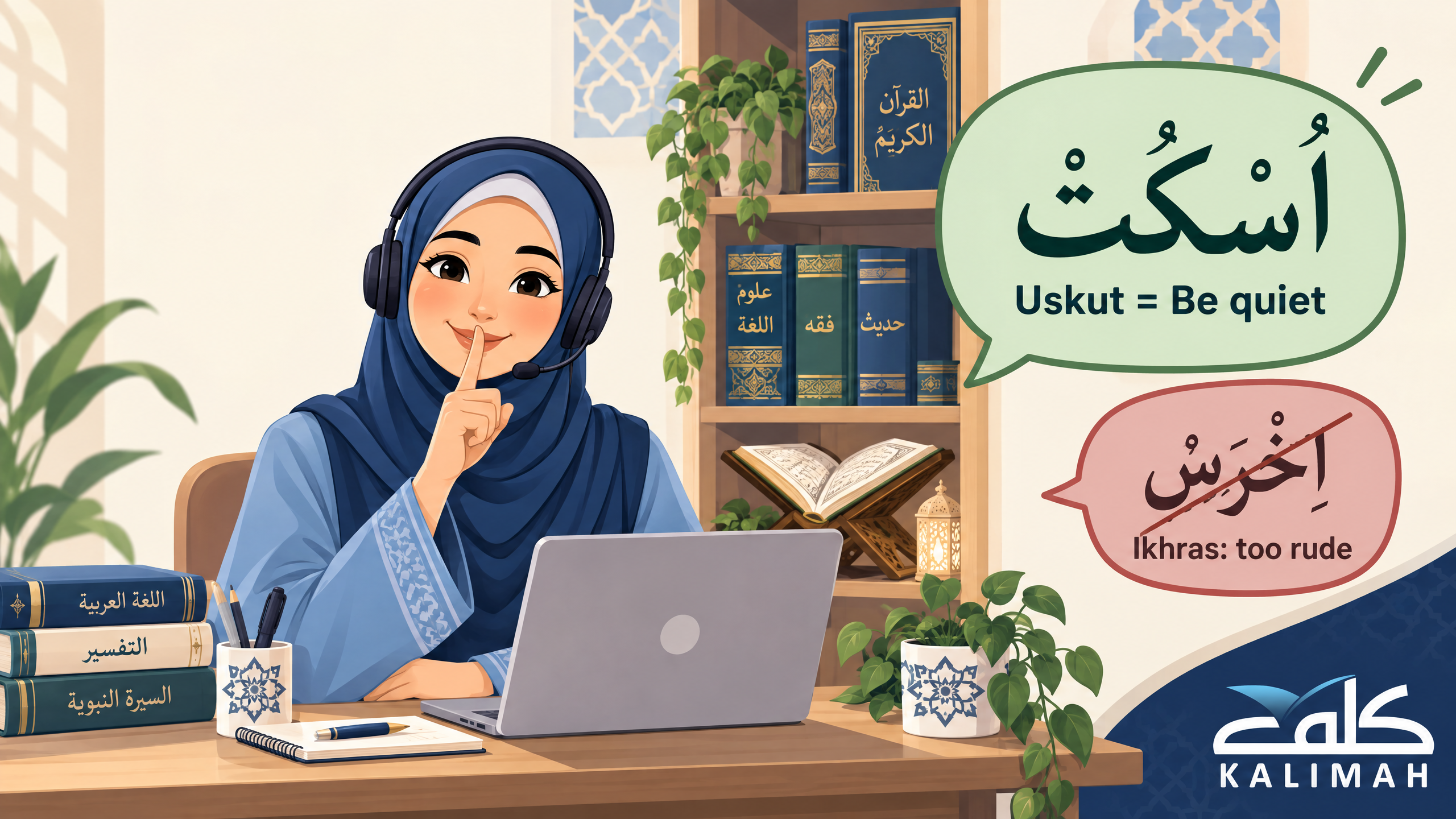
Have you watched an Egyptian movie and heard a character snap “Iskut!” or “Ekhras!” and wondered what just happened? Knowing how to say shut up in Arabic is one of the first “real-life” phrases learners get curious about.
The answer depends on three things: whether you use Modern Standard Arabic (MSA) or Egyptian Arabic, whether you speak to a male or a female, and how harsh you want to sound. One wrong ending, and your sentence is grammatically off.
In this guide, you’ll learn every common way to express shut up in Arabic, with Arabic script, transliteration, gender forms, polite alternatives, and the Quranic words for silence you’ll meet in your recitation.
Key Takeaways: What You Will Learn
- The three core MSA verbs: Uskut, Ikhras, and Usmut, and how strong each one is.
- How do you say shut up in Arabic to a man, a woman, and a group?
- Everyday Egyptian Arabic expressions like Iskut ba’a and E’fel bo’ak.
- Softer, respectful alternatives you can use with parents, teachers, and kids.
- Quranic words linked to silence, such as ansitu and bukm.
Shut Up in Arabic: The Core Words You Need
Arabic doesn’t have a single phrase for shut up in Arabic. Instead, it uses command verbs (fi’l al-amr) built from roots that carry the meaning of silence. Each root has a different emotional weight.
1. Uskut (اُسْكُتْ): The Everyday “Be Quiet”
Uskut comes from the root س ك ت (s-k-t), meaning to stop speaking. It is the most common and neutral form of shut up in Arabic, and it can sound firm or casual depending on your tone.
You’ll hear Uskut in classrooms, at home, and even in Arabic storybooks for children. Because it carries no insult, it is the safest way for learners to say shut up in Arabic, especially when paired with a calm voice and a softening word like min fadlak (please).
2. Ikhras (اِخْرَسْ): The Harsh “Shut Up”
Ikhras comes from خ ر س (kh-r-s), the root of the word akhras, meaning “mute.” Telling someone ikhras literally means “be mute,” so it is rude and aggressive. Avoid it unless you are quoting a movie.
In Arab culture, ikhras is usually heard in heated arguments, angry drama scenes, or when someone has completely lost their temper. Saying it to a parent, teacher, or elder is considered deeply disrespectful, so treat it as a word to understand, not one to repeat.
3. Usmut (اُصْمُتْ): The Formal “Be Silent”
Usmut comes from ص م ت (s-m-t), the root of samt (silence). It sounds formal and is common in books, news, and classroom Arabic. It is the most polished way to express shut up in Arabic in MSA.
The same root appears in the famous hadith about speaking good or staying silent, which gives the word a dignified, almost spiritual feel. That’s why usmut suits a lecture hall or a formal instruction, but may sound stiff in a casual chat with friends.
Experience Kalimah Center Classes
Watch real excerpts from our live sessions at Kalimah Center and see how we bring learning to life. These clips highlight our interactive, student-centered teaching approach across all our courses—designed to keep learners engaged, motivated, and actively involved every step of the way.
Master Arabic with Kalimah Center
Join our expert-led online classes and start your journey toward Arabic fluency today.
Book Your Free TrialHow Do You Say Shut Up in Arabic?
You say “Uskut” (اُسْكُتْ) to a male and “Uskuti” (اُسْكُتِي) to a female. For a harsher tone, use “Ikhras” (اِخْرَسْ), and for a formal tone, use “Usmut” (اُصْمُتْ). The ending of the verb always changes with gender and number.
Gender and Number Forms
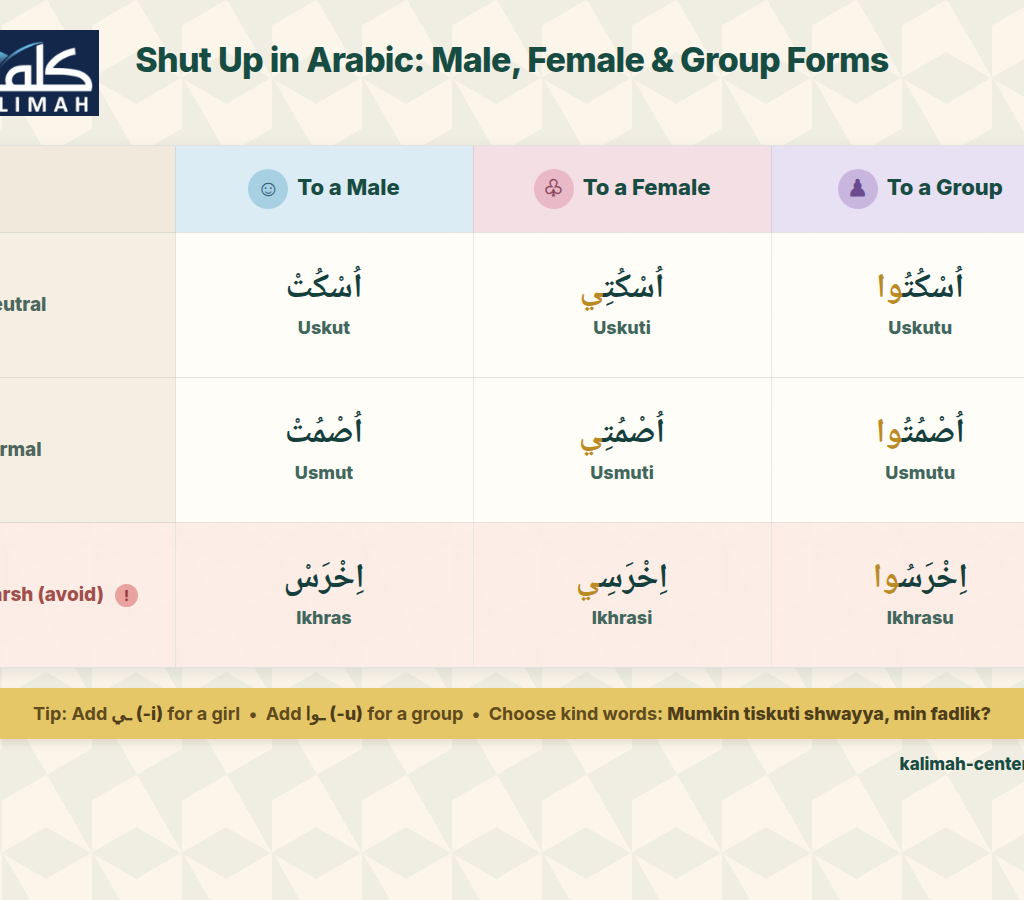
Arabic commands change their endings depending on who you’re talking to. Here is how shut up in Arabic changes across masculine, feminine, and plural forms:
| Meaning | To a male | To a female | To a group |
| Be quiet (neutral) | اُسْكُتْ Uskut | اُسْكُتِي Uskuti | اُسْكُتُوا Uskutu |
| Shut up (harsh) | اِخْرَسْ Ikhras | اِخْرَسِي Ikhrasi | اِخْرَسُوا Ikhrasu |
| Be silent (formal) | اُصْمُتْ Usmut | اُصْمُتِي Usmuti | اُصْمُتُوا Usmutu |
| Enough! | كَفَى Kafa | كَفَى Kafa | كَفَى Kafa |
Why Pronunciation Matters
Letters like ص (heavy S) and خ (throaty kh) don’t exist in English. When you say shut up in Arabic as Usmut but pronounce ص as a light س, a native speaker may still understand you, but your Arabic will sound unnatural.
This is exactly where Tajweed training helps. Learners in our Learn Quran Online course master these sounds through Tajweed-based recitation, and the same skill makes everyday Arabic sound clear and correct.
How to Say Shut Up in Arabic Politely
Most of the time, you don’t want to be rude; you just need some quiet. Knowing how to say shut up in Arabic politely protects your relationships, especially with elders, teachers, and children.
a. Respectful MSA Alternatives
Formal Arabic offers several respectful ways to ask for quiet without sounding bossy or rude. These phrases are ideal for classrooms, mosques, and conversations with elders, where good manners (adab) matter just as much as the words you choose:
- Min fadlak, ihda’ (مِنْ فَضْلِكَ، اِهْدَأْ): Please, calm down.
- Ansit (أَنْصِتْ): Listen attentively.
- Khaffid sawtak (خَفِّضْ صَوْتَكَ): Lower your voice.
b. Silence in the Quran and Sunnah
The Quran teaches believers to watch not only what they say, but also how they say it. In Surah Luqman, the wise Luqman gives his son a lasting lesson in gentle speech, advising him to lower his voice Surah Luqman 31:19.
وَٱغْضُضْ مِن صَوْتِكَ ۚ
‘’ And lower your voice’’
The Sunnah builds on this lesson by linking our speech directly to our faith. In a well-known narration, the Prophet ﷺ gave a simple rule for deciding when to speak and when to stay quiet:
” وَمَنْ كَانَ يُؤْمِنُ بِاللَّهِ وَالْيَوْمِ الآخِرِ فَلْيَقُلْ خَيْرًا أَوْ لِيَصْمُتْ ”.
“Whoever believes in Allah and the Last Day should say what is good or keep silent.” Sahih al-Bukhari 6018.
Notice the verb liyasmut (لِيَصْمُتْ), from the same root as usmut. Here, silence is a noble choice a believer makes, not a harsh order shouted at others, which is why Islamic etiquette favors calm silence over rude commands.
Recognizing words like these is how vocabulary turns into understanding. Our Learn Arabic Online course builds exactly this skill through Classical Arabic, Fusha grammar, and guided conversation with native tutors.
Inside Kalimah Center: Moments from Our Courses
Get a glimpse into the vibrant learning experience at Kalimah Center. These snapshots capture real moments from our live classes—where students engage deeply, connect with passionate instructors, and grow in a welcoming, supportive environment.
Master Arabic with Kalimah Center
Join our expert-led online classes and start your journey toward Arabic fluency today.
Book Your Free TrialHow to Say Shut Up in Egyptian Arabic
In daily life, shut up in Arabic usually sounds Egyptian. Egyptian Arabic is the most widely understood dialect in the Arab world, thanks to its films and music. If you want to know how to say shut up in Egyptian Arabic, these are the phrases you’ll actually hear on the street.
1. Iskut and Iskuti (اسكت / اسكتي)
Iskut (to a male) and Iskuti (to a female) are the most common Egyptian forms. They are less harsh than ekhras and are used by parents, friends, and siblings every day.
Egyptians usually start the word with an “i” sound instead of the MSA “u,” which is an easy way to spot the dialect. A mother might say “Iskut ya habibi” (be quiet, my dear) to her child, showing how tone can make the word sound affectionate.
2. Iskut Ba’a (اسكت بقى): “Give It a Rest”
Adding ba’a (بقى, “already”) shows frustration: “Be quiet already!” Say Iskuti ba’a to a woman. It’s informal, so keep it for family and close friends.
Ba’a is one of the most flexible fillers in Egyptian Arabic, adding impatience or urgency to almost any command. You’ll hear “Yalla ba’a” (come on already) and “Khalas ba’a” (that’s enough already) used in the same spirit.
3. Ekhras (اخرس): The Rude Option
In Egypt, Ekhras (male) and Ekhrasi (female) carry the same harsh meaning as in MSA. It’s a real insult in most situations, so learners should recognize it, not use it.
Egyptian films often use ekhras at the peak of a family fight or a dramatic showdown, which is why learners pick it up so quickly. In real life, it usually signals genuine anger, so the wisest response is to stay calm rather than reply in kind.
4. E’fel Bo’ak (اقفل بقك): “Close Your Mouth”
E’fel bo’ak literally means “close your mouth.” To a woman, it becomes E’fli bo’ik (اقفلي بقك). It’s slangy and blunt, similar to “zip it” in English.
The word bo’ (بق) is the Egyptian way of saying “mouth,” while MSA uses fam (فم). Friends sometimes use this phrase jokingly with each other, but with strangers or elders it sounds rude, so keep it in your listening vocabulary only.
5. Softer Egyptian Expressions
Not every situation calls for a sharp command. Egyptians also have gentler phrases that ask for quiet while keeping the conversation friendly, and these are the ones learners should practice and use most in daily life:
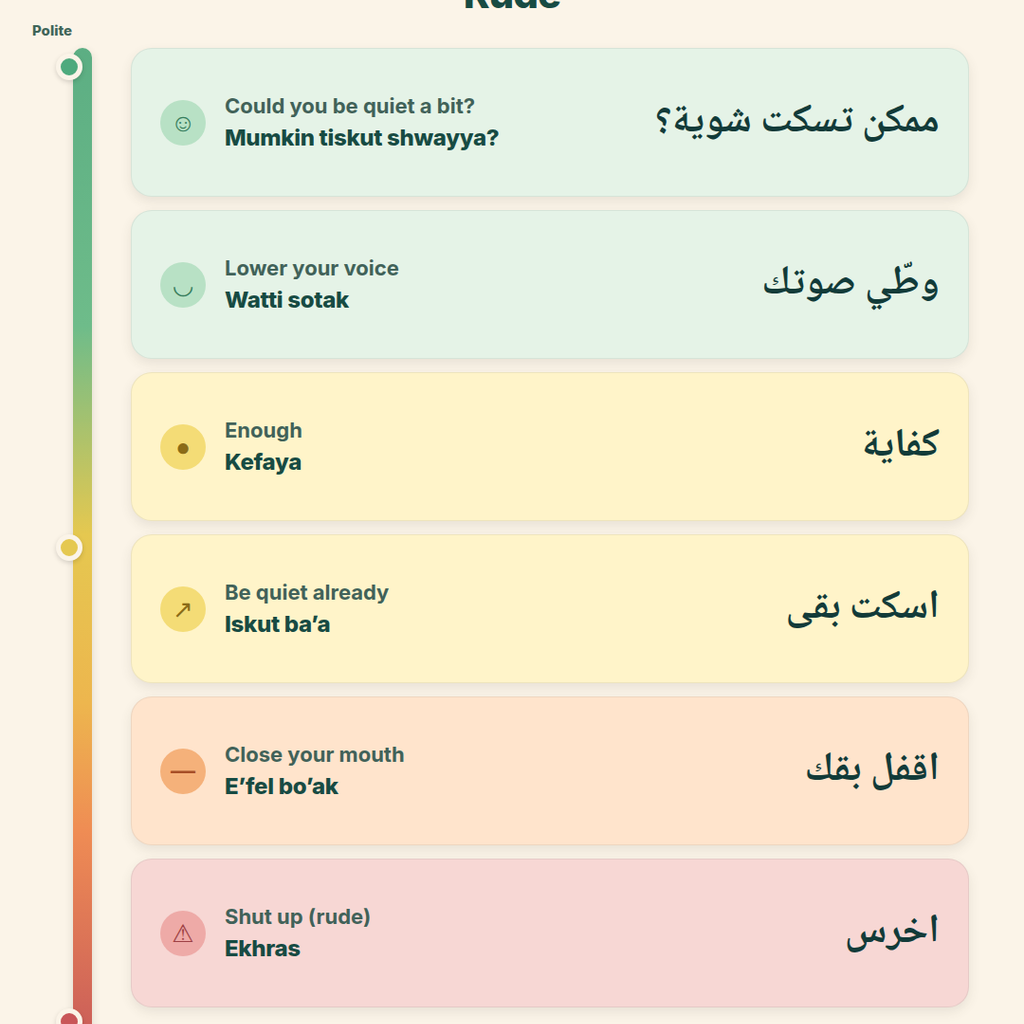
- Kefaya (كفاية): Enough.
- Watti sotak (وطّي صوتك): Lower your voice.
- Mumkin tiskut shwayya? (ممكن تسكت شوية؟): Could you be quiet for a bit?
Adding shwayya (a little) or min fadlak (please) instantly softens any request. When speaking to a woman, switch to tiskuti, sotik, and min fadlik to keep your grammar correct.
Shut Up in Arabic to a Girl
To say shut up in Arabic to a girl, add the feminine -i sound (ي) to the end of the command. Uskut becomes Uskuti, Ikhras becomes Ikhrasi, and Usmut becomes Usmuti.
Feminine Forms at a Glance
The same rule works in Egyptian: Iskuti, Iskuti ba’a, Ekhrasi, and E’fli bo’ik. Forgetting the -i is one of the most common beginner mistakes, and native speakers notice it immediately.
The plural follows a similar pattern: add -u (وا) when speaking to a group, as in Iskutu or Usmutu. For a group of only females, classical Arabic uses the ending -na (اُسْكُتْنَ Uskutna), though Egyptians rarely use it in everyday speech.
A helpful trick is to listen for the final vowel in Arabic films and Quran recitation. Once your ear catches the difference between Uskut and Uskuti, you’ll notice the same feminine ending in many other commands, like isma’/isma’i (listen) and ijlis/ijlisi (sit).
A Gentle Note on Manners
In Arab and Muslim culture, speaking harshly to women and girls is seen as poor manners. A softer phrase like Mumkin tiskuti shwayya min fadlak? keeps the request respectful while still getting your point across.
This value comes straight from the Prophetic example. The Prophet ﷺ was known for his gentleness with women and girls, and he taught that the best of believers are those who are best to their families, so a kind word is always closer to the Sunnah.
For kids and adults learning Arabic, this is a valuable lesson. Knowing how to say shut up in Arabic to a girl helps you understand real conversations, but choosing a respectful phrase is what shows true fluency, because language and manners grow together.
Tips for Kids Learning These Words
Children love “real” phrases like shut up in Arabic, so turn them into a grammar game: switch between Uskut and Uskuti to practice gender endings. Pair it with a lesson on kind speech from the hadith above, so kids learn the word and the manners together.
If your child is just starting, our Learn Arabic for Kids course builds the letter-sound foundation through fun, interactive lessons, taught by caring female teachers who specialize in young learners.
Start Speaking and Reciting Arabic Correctly
Learning how to say shut up in Arabic is fun, but real progress comes from structured lessons with a qualified teacher. At Kalamullah Academy, certified tutors guide kids and adults step by step through Arabic, Tajweed, and Quran recitation.
Our one-on-one live classes fit your schedule and your level, and you can choose between male teachers for brothers and female teachers for sisters and kids. Prefer learning with others? Join our group classes.
Explore Our Courses:
Online Arabic Course: Tailored to your level, our comprehensive Arabic program includes 16 teaching levels and 400+ hours of personalized sessions.
Online Quran With Tajweed Course: Perfect for non-Arabic speakers, our course spans 13 levels and equips you with Tajweed mastery from beginner to advanced.
Online Arabic Course For Kids: Nurture your child’s love for Arabic with our engaging and structured program, available in 24 levels for primary, intermediate, and secondary stages.
From your very first lesson, you’ll practice real vocabulary, correct pronunciation, and Quranic phrases side by side. Kids enjoy interactive sessions, while adults get focused lessons that connect everyday Arabic to the words they recite in prayer.
Join families who’ve turned confusion into confident reading. Book your free trial lesson today, or explore our flexible plans, and take your first real step toward understanding the words of Allah.
Master Arabic with Kalimah Center
Join our expert-led online classes and start your journey toward Arabic fluency today.
Book Your Free TrialConclusion
The most common way to say shut up in Arabic is Uskut to a male and Uskuti to a female. Usmut is the formal choice, while Ikhras is harsh and best avoided in everyday speech.
In Egyptian Arabic, shut up in Arabic is usually Iskut, and you’ll also hear Iskut ba’a, E’fel bo’ak, and Kefaya. Softer phrases like Watti sotak and Mumkin tiskut shwayya? Let you ask for quiet without offending.
Behind every form of shut up in Arabic lies a bigger lesson from the Quran and Sunnah: lower your voice, speak good, or stay silent. Understanding words like ughdud and liyasmut turns a simple vocabulary list into a lesson in character.
The take-away message: learn every form of shut up in Arabic so you understand it, but choose gentle words when you speak. That balance of knowledge and good manners is what the Quran and Sunnah teach.
FAQs
Here are quick answers to the questions learners ask most often about this phrase.
What is the rudest way to say shut up in Arabic?
Ikhras (اِخْرَسْ), or Ekhras in Egyptian, is the rudest common form. It comes from the word for “mute,” so it implies the person should lose the ability to speak.
Is there a polite way to say shut up in Arabic?
Yes. Say Min fadlak, uskut in MSA, or Mumkin tiskut shwayya? In Egyptian Arabic. Both mean “please be quiet” and sound respectful.
What is the difference between Uskut and Usmut?
Both mean “be silent.” Uskut is everyday and used in both MSA and dialects, while Usmut is more formal and common in written Arabic.
How do you say “shut your mouth” in Arabic?
In Egyptian Arabic, say E’fel bo’ak (اقفل بقك) to a male or E’fli bo’ik to a female. It’s slang and fairly blunt.
What does “Iskut ba’a” mean?
Iskut ba’a means “be quiet already” or “give it a rest” in Egyptian Arabic. It expresses annoyance after someone keeps talking.