Have you ever watched a cat stroll into a masjid and wondered what the children were calling it? For anyone learning the language of the Quran, small everyday words are where fluency begins.
Learning how to say cat in Arabic is a friendly first step into vocabulary, grammar, and even Tajweed sounds. The answer is not one word: Arabic has formal terms plus colorful dialect words heard from Cairo to Baghdad to Casablanca.
This guide covers the Modern Standard Arabic words, how to pronounce and spell them, the feminine and diminutive forms, and the main dialect versions, with examples to practice today.
How to Say Cat in Arabic
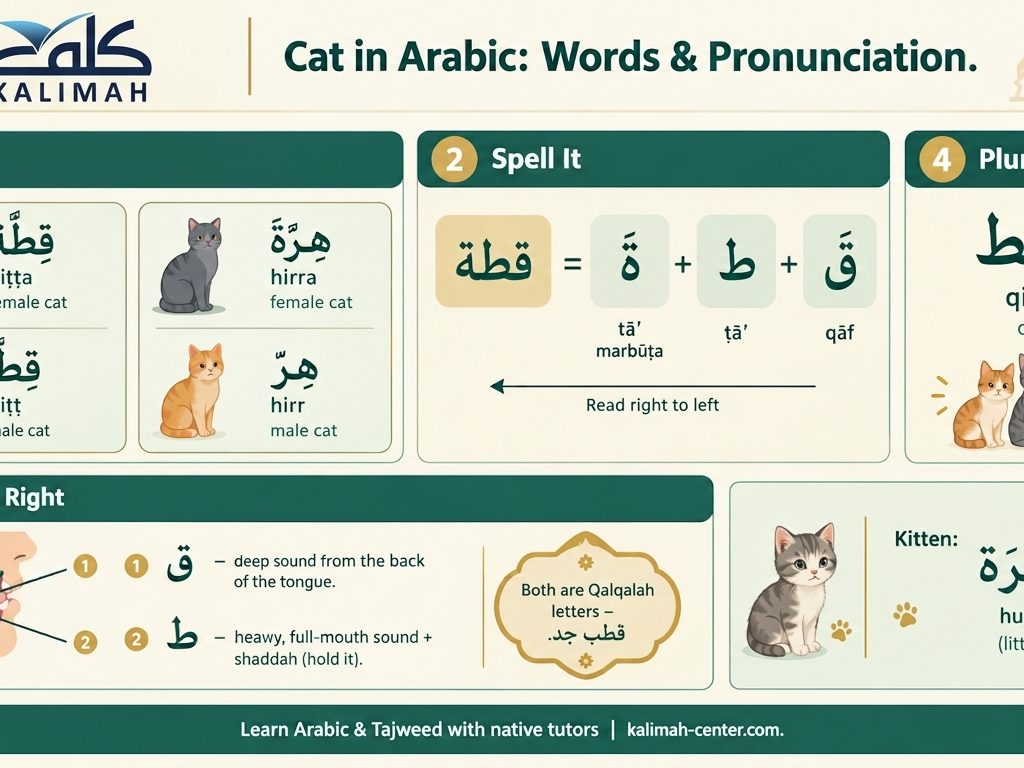
In Modern Standard Arabic, the direct answer to how to say cat in Arabic is قِطَّة (qiṭṭa) for a female cat and قِطّ (qiṭṭ) for a male. A second, more classical word is هِرَّة (hirra), with the male form هِرّ (hirr). Both words are correct in Fusha, but each has its own flavor.
a. Qiṭṭa (قِطَّة): The Everyday Word
قِطَّة is the word every Arabic speaker recognizes instantly, from children’s books to the news. Example: أُرِيدُ أَنْ أُرَبِّيَ قِطَّةً (Urīdu an urabbiya qiṭṭatan) — “I want to raise a cat.”
The male form قِطّ appears in common phrases like قِطٌّ شَارِدٌ (qiṭṭun shārid), “a stray cat.” Because it is used across every Arab country, قِطَّة is the best word to learn first if you want to be understood anywhere.
b. Hirra (هِرَّة): The Classical Word
هِرَّة has a classical feel. It appears in authentic hadith and older texts, so Sunnah students meet it often. Example: لَدَيَّ هِرَّةٌ بَيْضَاءُ (Ladayya hirratun bayḍāʾ) — “I have a white cat.”
This word also forms the sweet diminutive هُرَيْرَة, which gave the Companion Abu Hurayrah his famous name. When you read Sahih al-Bukhari or Sunan Abi Dawud in Arabic, هِرَّة is the word you’ll find, so learning it pays off quickly.
c. Sinnawr (سِنَّوْر): A Rare Synonym
Classical dictionaries also list سِنَّوْر (sinnawr). It is rare in speech but appears in poetry and lexicons. Its plural is سَنَانِير (sanānīr), and early Arabic writers used it when describing animals.
You won’t need it in conversation, but spotting it in a classical text shows how rich Arabic is, with several words for a single animal.
d. Plural Forms
The plural of قِطّ and قِطَّة is قِطَط (qiṭaṭ), as in القِطَطُ نَائِمَةٌ (al-qiṭaṭu nāʾima) — “The cats are sleeping.” The plural of هِرَّة is هِرَر (hirar). Notice that قِطَط is a broken plural: the word changes its inner shape instead of adding an ending.
For exactly two cats, use the dual قِطَّتَانِ (qiṭṭatān), which becomes قِطَّتَيْنِ as an object, as in رَأَيْتُ قِطَّتَيْنِ — “I saw two cats.”
Experience Kalimah Center Classes
Watch real excerpts from our live sessions at Kalimah Center and see how we bring learning to life. These clips highlight our interactive, student-centered teaching approach across all our courses—designed to keep learners engaged, motivated, and actively involved every step of the way.
Master Arabic with Kalimah Center
Join our expert-led online classes and start your journey toward Arabic fluency today.
Book Your Free TrialHow to Say Cat in Arabic Pronunciation
The trickiest part of how to say cat in Arabic is the pronunciation, because قِطَّة uses two letters English lacks. Happily, these are the same letters you practice in Tajweed.
The Deep Qāf (ق)
ق is pronounced from the very back of the tongue against the soft palate, deeper than an English “k.” Say “k” while pulling your tongue backward, and you are close.
A common mistake is replacing ق with a plain “k,” which turns قَلْب (qalb, heart) into كَلْب (kalb, dog). In Tajweed, ق comes from the deepest part of the tongue, so practice slowly with words like قِطّ and قُرْآن.
The Heavy Ṭāʾ (ط) With Shaddah
ط is a full-mouth, heavy letter, like a thick “t” with the back of the tongue raised. The shaddah (ّ) doubles it, so hold it briefly: qiṭ-ṭa, not qi-ta.
Compare it with the light ت: تِين (tīn, figs) sounds thin, while طِين (ṭīn, clay) sounds full and deep. Say both words aloud several times, and once the difference feels natural, قِطَّة will come out correctly.
Why This Matters for Tajweed
Both ق and ط are qalqalah letters (قُطْبُ جَدٍّ) and heavy letters of istiʿlāʾ. A student who masters قِطَّة is already training the mouth for correct recitation, and in هِرَّة, the rāʾ with fatḥah is also pronounced heavy.
A live teacher can correct these sounds in seconds. Kalimah Center’s Learn Arabic Online course trains these exact articulation points across 13 Tajweed levels, taught by Ijazah-certified teachers.
How to Spell Cat in Arabic
Once you know how to say cat in Arabic, spelling it takes only three letters, written from right to left. Arabic letters change shape depending on their position in a word, so a letter at the start looks slightly different from the same letter standing alone. Both قطة and هرة are short, which makes them perfect practice words for kids and beginners.
Spelling قِطَّة Letter by Letter
قِطَّة is spelled ق (qāf) + ط (ṭāʾ) + ة (tāʾ marbūṭa) = قطة. Fully vowelled, it carries a kasrah under ق and a shaddah with fatḥah on ط: قِطَّة. In writing, ق takes its initial form (قـ) and joins smoothly to ط, which then links to the final ـة. The two dots of ق and the tall stroke of ط are easy to spot, so beginners recognize this word quickly.
Spelling هِرَّة Letter by Letter
هِرَّة is spelled ه (hāʾ) + ر (rāʾ) + ة (tāʾ marbūṭa) = هرة, vowelled as هِرَّة. In writing, ه takes its initial form (هـ) and joins the ر, but ر never connects to the letter after it. That is why a small gap appears before the ة, which is written in its standalone form.
Saying “My Cat,” “Your Cat,” and More
Arabic attaches possessive endings directly to the noun. The ة turns into a regular ت before the ending:
| Arabic | Transliteration | Meaning |
| قِطَّتِي | qiṭṭatī | my cat |
| قِطَّتُكَ / قِطَّتُكِ | qiṭṭatuka / qiṭṭatuki | your cat (m. / f.) |
| قِطَّتُهُ | qiṭṭatuhu | his cat |
| قِطَّتُهَا | qiṭṭatuhā | her cat |
| قِطَّتُنَا | qiṭṭatunā | our cat |
| قِطَّتُكُمْ / قِطَّتُكُنَّ | qiṭṭatukum / qiṭṭatukunna | your cat (pl. m. / f.) |
| قِطَّتُهُمْ / قِطَّتُهُنَّ | qiṭṭatuhum / qiṭṭatuhunna | their cat (m. / f.) |
The same endings work with هِرَّة: هِرَّتِي (hirratī), هِرَّتُهَا (hirratuhā). If reading connected letters feels slow, the Learn Arabic Online course builds that skill step by step. Younger learners can start with the Arabic for Children course.
How to Say Cat in Arabic Female
For a female cat, you say قِطَّة (qiṭṭa) or هِرَّة (hirra). The final ة (tāʾ marbūṭa) is the main feminine marker in Arabic, so dropping it gives the male forms قِطّ and هِرّ.
Adjectives must match: قِطٌّ أَسْوَدُ (a black male cat) but قِطَّةٌ سَوْدَاءُ (a black female cat). In daily speech, قِطَّة often covers any cat.
The same pattern works for many animals: كَلْب (dog) becomes كَلْبَة, and ذِئْب (wolf) becomes ذِئْبَة. Because هِرَّة is feminine, the hadith refers to the cat with إِنَّهَا (“indeed, she”), a small detail that grammar students will notice.
How to Say Kitty in Arabic
To say kitty or kitten, use the diminutive هُرَيْرَة (hurayra), meaning “little cat,” or قُطَيْطَة (quṭayṭa). Many speakers simply say قِطَّة صَغِيرَة (qiṭṭa ṣaghīra), “a small cat.”
Part of learning how to say cat in Arabic is knowing this cute form, and it has a beautiful story. The Companion Abu Hurayrah (may Allah be pleased with him) earned his nickname, “father of the little cat,” because of a small cat he cared for.
To call a kitty, people say “bss bss” (بِسْ بِسْ), and Egyptians lovingly call a kitten قُطْقُوطَة (ʾoṭʾūṭa).
How to Say Cat in Egyptian Arabic
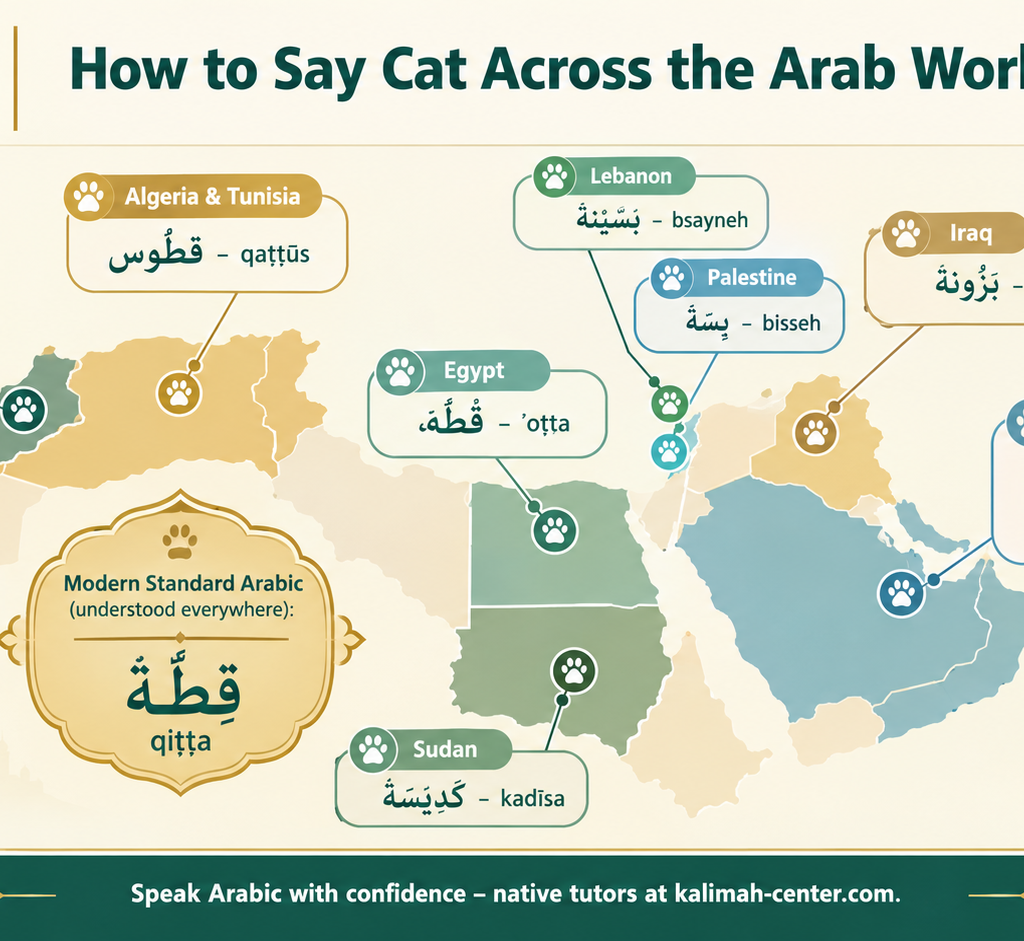
In Egyptian Arabic, cat is قُطَّة, pronounced ʾoṭṭa for a female, and قُطّ (ʾoṭṭ) for a male. Cairenes usually replace the qāf with a glottal stop, the short catch you hear in “uh-oh.”
Because Egyptian films reach every Arab home, this is often the first answer learners hear to how to say cat in Arabic outside class. You will also hear بِسَّة (bissa), and the plural is قُطَط (ʾoṭaṭ). Example: القُطَّة دِي حِلْوَة أَوِي (il-ʾoṭṭa di ḥilwa awi) — “This cat is really cute.”
Egyptians also use the word playfully: calling someone قُطَّة means they are sweet and gentle, much like “kitten” in English. Egyptian cartoons and children’s songs are a fun way to hear these words in natural speech.
How to Say Cat in Lebanese Arabic
In Lebanese Arabic, cat is بْسَيْنِة (bsayneh) for a female and بْسَيْن (bsein) for a male. Lebanese speakers also use بِسِّة (bisseh), which sounds soft and affectionate.
So, if someone asks you how to say cat in Lebanese Arabic, bsayneh is the answer that will make a Beiruti smile. Example: عِنْدِي بْسَيْنِة زْغِيرِة (ʿindi bsayneh zghīreh) — “I have a little cat.”
Notice two Lebanese habits here: words often start with two consonants, as in bsayneh, and feminine words end with an “eh” sound instead of “a.” Copying this ending makes your Lebanese sound much more natural.
How to Say Cat in Palestinian Arabic
In Palestinian Arabic, cat is usually بِسِّة (bisseh) for a female and بِسّ (biss) for a male. City speakers also say قُطَّة (ʾuṭṭa), with the same glottal stop heard in Egypt.
Learning how to say cat in Palestinian Arabic shows how close it is to other Levantine dialects. Example: البِسِّة نَايْمِة عَ الكَنَبِة (il-bisseh nāymeh ʿal-kanabeh) — “The cat is sleeping on the sofa.”
Like Lebanese, Palestinian Arabic softens the feminine ending to “eh,” so you hear bisseh rather than bissa. Pronunciation also shifts between cities and villages, so expect small variations as you meet different speakers.
Inside Kalimah Center: Moments from Our Courses
Get a glimpse into the vibrant learning experience at Kalimah Center. These snapshots capture real moments from our live classes—where students engage deeply, connect with passionate instructors, and grow in a welcoming, supportive environment.
Master Arabic with Kalimah Center
Join our expert-led online classes and start your journey toward Arabic fluency today.
Book Your Free TrialHow to Say Cat in Iraqi Arabic
In Iraqi Arabic, cat is بَزُّونَة (bazzūna) for a female and بَزُّون (bazzūn) for a male. The plural is بَزَازِين (bazāzīn).
This word is distinctly Iraqi, so knowing how to say cat in Iraqi Arabic instantly signals familiarity with the dialect. Most Iraqis also understand قِطَّة, thanks to Fusha in schools and media.
You’ll hear بَزُّونَة everywhere from Baghdad to Basra, in children’s stories, songs, and everyday chat. If you’re learning Iraqi Arabic, picking up this word early helps you sound local rather than textbook-perfect.
Cat in Other Arabic Dialects
The answer to how to say cat in Arabic keeps changing as you travel south and west. Here is a quick tour.
- Gulf Arabic (Khaleeji): In Saudi Arabia, Kuwait, the UAE, and neighboring countries, you’ll hear قَطْو (qaṭw) for a male cat, قَطْوَة (qaṭwa) for a female, and بِسَّة (bissa) for both.
- Sudanese Arabic: Sudanese speakers say كَدِيسَة (kadīsa) for a female cat and كَدِيس (kadīs) for a male.
- Maghrebi Arabic (Darija): In Algeria and Tunisia, cat is قَطُّوس (qaṭṭūs), with the female قَطُّوسَة (qaṭṭūsa). In Morocco, you will also hear مَشّ (mashsh) and the female مَشَّة (mashsha).
Cats in Islamic Tradition
For Quran learners, the cat is more than a vocabulary word. Islam teaches kindness to every creature, and the Companion Abu Qatadah once tilted a water vessel so a cat could drink from it. When people were surprised, he explained that the Prophet ﷺ had said of the cat:
«إِنَّهَا لَيْسَتْ بِنَجَسٍ، إِنَّهَا مِنَ الطَّوَّافِينَ عَلَيْكُمْ»
“It is not impure; it is one of those who go round among you” (Sunan Abi Dawud 75).
He ﷺ also told of a woman who entered Hell because she locked up a cat, neither feeding it nor letting it eat (Sahih al-Bukhari 3318). Both narrations use the word هِرَّة, so knowing how to say cat in Arabic helps you read them directly.
Learning words in context like this is how Kalimah Center’s native Arabic tutors build vocabulary that serves your worship. You can study one-on-one or join group classes to practice with other learners.
Start Learning Arabic and Tajweed With Kalamullah Today
Knowing how to say cat in Arabic is a great start, but real progress comes when a qualified teacher hears you speak. At Kalimah Center, live classes correct your pronunciation in real time, from the qāf in قِطَّة to the rules of qalqalah.
Our native Arabic teachers, including Azhari and Ijazah-certified tutors, bring over 14 years of experience teaching kids and adults. You can also choose from our female teachers, and you earn a certificate as you pass each level.
Explore Our Courses:
- Online Arabic Course: Tailored to your level, our comprehensive Arabic program includes 16 teaching levels and 400+ hours of personalized sessions.
- Online Quran With Tajweed Course: Perfect for non-Arabic speakers, our course spans 13 levels and equips you with Tajweed mastery from beginner to advanced.
- Online Arabic Course For Kids: Nurture your child’s love for Arabic with our engaging and structured program, available in 24 levels for primary, intermediate, and secondary stages.
Whether you want to master Quran with Tajweed, learn Arabic as an adult, or help your child with Arabic for Children, there is a path for you. Compare our plans and book your free trial today.
Master Arabic with Kalimah Center
Join our expert-led online classes and start your journey toward Arabic fluency today.
Book Your Free TrialConclusion
Now you know how to say cat in Arabic in both formal and everyday speech: قِطَّة (qiṭṭa) and هِرَّة (hirra) in Fusha, with قِطّ and هِرّ for males and قِطَط for the plural. You also learned how to spell these words and add possessive endings.
Across the Arab world, the cat changes its name: ʾoṭṭa in Egypt, bsayneh and bisseh in the Levant, bazzūna in Iraq, kadīsa in Sudan, and qaṭṭūs in North Africa. Fusha remains your safest choice, because every Arabic speaker understands it.
Start with قِطَّة and هِرَّة, practice the deep ق and the heavy ط every day, then add one dialect word at a time. With a qualified teacher guiding you, these small steps grow into confident reading, speaking, and Quran recitation.
The key takeaway: whether you are teaching a child how to say cat in Arabic or polishing your own recitation, one small word connects you to Tajweed, grammar, and the mercy of the Sunnah. Let a teacher guide your pronunciation so each new word brings you closer to the Quran.
FAQs
Here are quick answers to the questions learners ask most about cats in Arabic.
What is the most common word for cat in Arabic?
The simplest answer to how to say cat in Arabic is قِطَّة (qiṭṭa) for a female and قِطّ (qiṭṭ) for a male. It is understood in every Arab country.
What is the difference between قطة and هرة?
Both mean cat in Modern Standard Arabic. قِطَّة is more common in modern speech, while هِرَّة is more classical and appears often in hadith and older Arabic literature.
What is the plural of cat in Arabic?
The plural of قِطّ and قِطَّة is قِطَط (qiṭaṭ). For هِرَّة, the plural is هِرَر (hirar).
How do you say “I love cats” in Arabic?
In Fusha, you say أُحِبُّ القِطَط (uḥibbu al-qiṭaṭ). In Egyptian Arabic, it becomes بَحِبّ القُطَط (baḥibb il-ʾoṭaṭ).
Is the word cat mentioned in the Quran?
No, the word for cat does not appear in the Quran. However, cats are mentioned in authentic hadith, and the name Abu Hurayrah comes from هُرَيْرَة, meaning “little cat.”
What does Abu Hurayrah mean?
Abu Hurayrah means “father of the little cat.” The Companion received this nickname because of a small cat he used to look after, as reported in Jami’ at-Tirmidhi 3840.