Have you ever watched a Syrian drama, then chatted with a colleague from Dubai, and felt like you were hearing two different languages? You are not imagining it. Both are Arabic, but the sounds, the everyday words and even the rhythm change a lot from one region to the other.
That is why so many learners search for Gulf Arabic vs Levantine Arabic before they commit to a course. The choice shapes the words you memorize, the people you can talk to, and how easily you move on to reading the Quran.
In this guide, we compare the two dialects side by side: where they are spoken, how they sound, which words differ, and which one suits your goals. We also cover something most dialect guides skip: how each dialect affects your Quran recitation and Tajweed.
Key Takeaways: What You Will Learn
- The real Gulf Arabic vs Levantine Arabic differences in sound, vocabulary, and grammar.
- Why Gulf Arabic keeps several Quranic sounds that city Levantine speech drops.
- A simple way to choose a dialect based on your family, work, or faith goals.
- Why Quranic Arabic (Fusha) belongs alongside any dialect you learn, for kids and adults.
Gulf Arabic vs Levantine Arabic: The Core Differences
Both dialects grew from the same Arabic roots, so they share most of their grammar and a large core of words. The differences come from geography, history, and contact with other languages. Here is how they break down.
Where Each Dialect Is Spoken
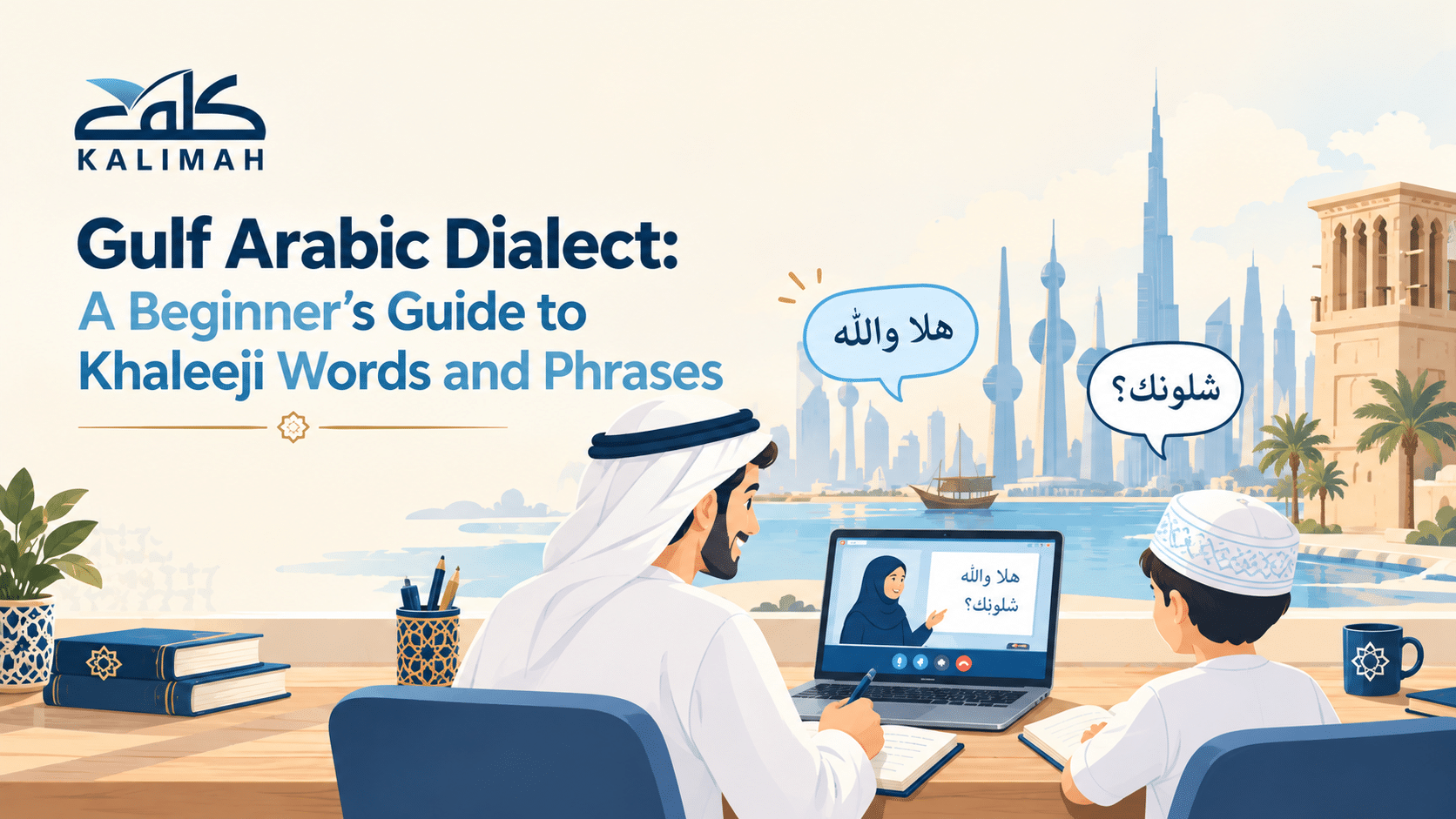
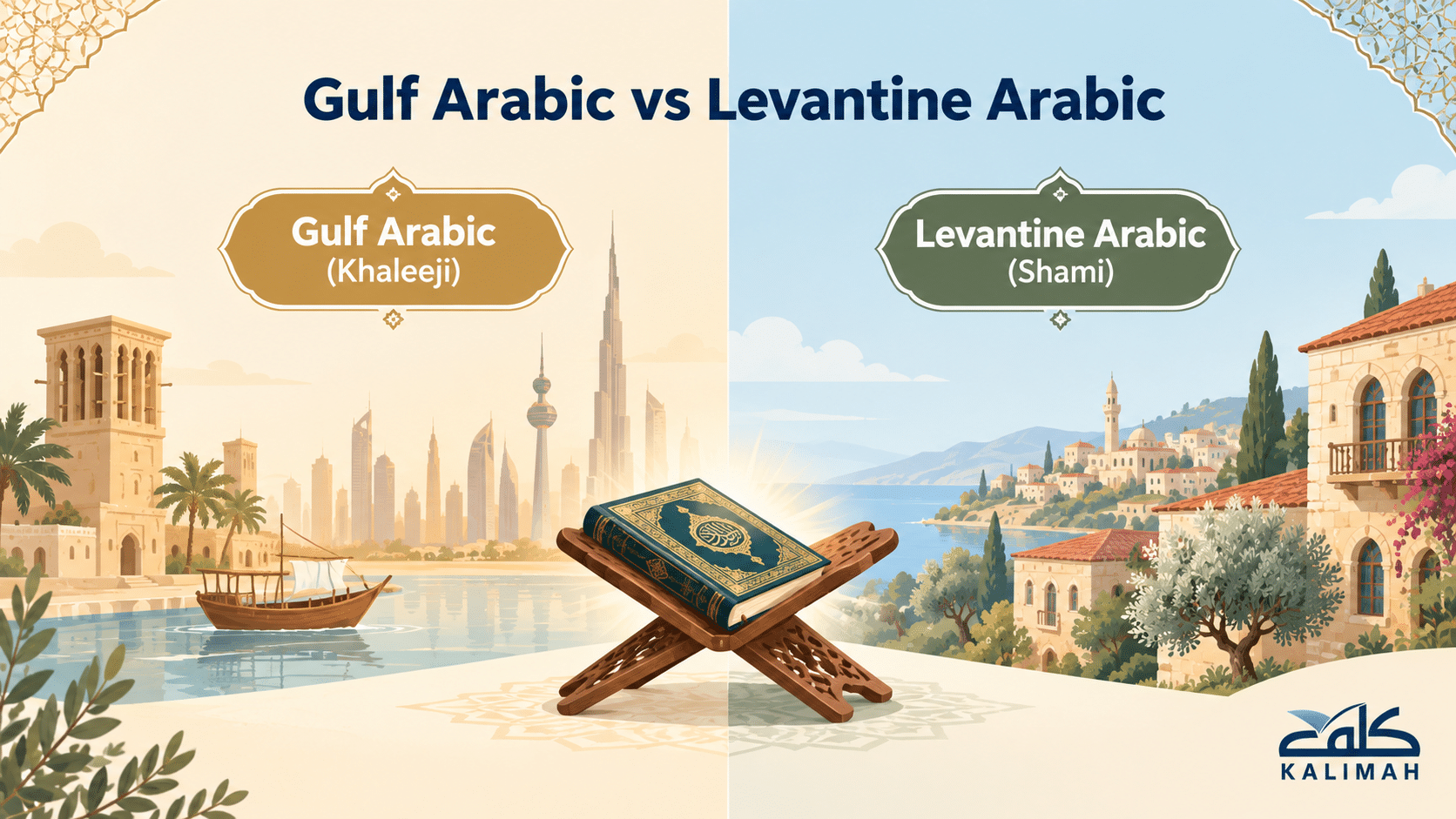
Geography is the simplest part of Gulf Arabic vs Levantine Arabic. Gulf Arabic, or Khaleeji, is spoken in Saudi Arabia, the UAE, Qatar, Kuwait, Bahrain, and Oman. It covers both city speech and older Bedouin varieties.
Levantine Arabic is spoken in Lebanon, Syria, Jordan, and Palestine. According to Levantine Arabic dilect’s entry on it, it has around 58 million native speakers, and speakers of its local accents understand each other easily.
Pronunciation: How They Sound
When people compare Gulf Arabic vs Levantine Arabic, pronunciation is the first thing they notice. Levantine sounds soft and musical. Gulf Arabic sounds steadier, with fuller consonants and longer vowels.
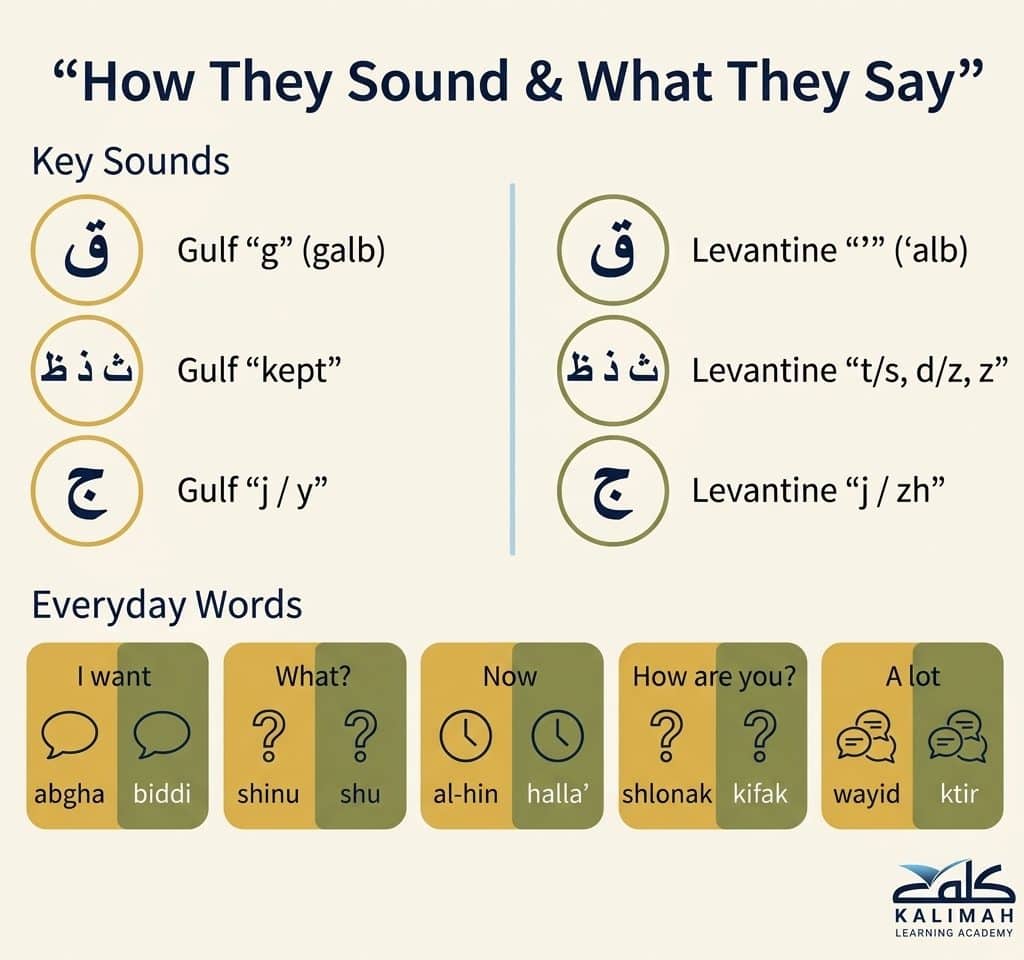
The letter ق (qaf) is the clearest marker. In Beirut, Damascus, and other Levantine cities, it usually becomes a glottal stop, so qalb (heart) sounds like ‘alb. In most Gulf speech it becomes a “g”, so you hear galb.
The letters ث, ذ and ظ are another key difference. Gulf Arabic keeps these “th” sounds, while city Levantine often turns them into “t/s”, “d/z” and “z”. We come back to this below because it matters a lot for Tajweed.
Some Gulf varieties also shift ك to “ch” or ج to “y” in certain words. In Lebanon, speakers often soften ج into a “zh” sound, like the “s” in pleasure.
Vocabulary: Everyday Words Compared
The Gulf Arabic vs Levantine Arabic vocabulary gap shows up in the most common daily words. Much of it comes from local history. Aramaic, Turkish and French left their marks on Levantine. Bedouin, maritime, Persian and English contact shaped Khaleeji speech.
| English | Gulf Arabic | Levantine Arabic |
| I want | abgha / abi | biddi |
| What? | shinu / esh | shu |
| Now | al-hin | halla’ |
| How are you? (m) | shlonak | kifak |
| A lot / very | wayid | ktir |
| Good / fine | zain | mnih |
| Where? | wein | wein |
Some words match exactly and others share nothing. Once you know one dialect well, its patterns make the second one much easier. To see how a single word changes across regions, our guide on how to say cat in Arabic across dialects is a fun example.
Grammar: Small Shifts, Same Foundation
Grammar differences in Gulf Arabic vs Levantine Arabic are smaller than the differences in sound and words. Levantine adds a “b-” prefix to present-tense verbs (bḥibb, I love) and uses raḥ for the future.
Gulf Arabic often uses a “ba-” prefix for the future (barūḥ, I will go). Many Gulf varieties also keep separate feminine plural forms that Levantine has mostly dropped, which keeps them slightly closer to classical patterns.
Experience Kalimah Center Classes
Watch real excerpts from our live sessions at Kalimah Center and see how we bring learning to life. These clips highlight our interactive, student-centered teaching approach across all our courses—designed to keep learners engaged, motivated, and actively involved every step of the way.
Master Arabic with Kalimah Center
Join our expert-led online classes and start your journey toward Arabic fluency today.
Book Your Free TrialGulf Arabic vs Levantine Arabic for Quran and Tajweed Learners
If your main goal is reading the Quran, start with this fact: neither dialect is the language of the Quran. The Quran is recited in Classical Arabic with Tajweed rules. Still, your dialect affects how easily you produce the correct sounds.
Which Dialect Is Closer to Quranic Sounds?
Gulf Arabic keeps more Quranic sounds in daily speech. Its speakers already pronounce ث, ذ and ظ correctly, and each of these letters has an exact articulation point in Tajweed.
This is one reason the Gulf Arabic vs Levantine Arabic question matters for Muslim families. A learner who says thalatha (three) at home has less to correct when reciting verses that use the same letter.
Sounds Levantine Learners Need to Retrain
Levantine speakers often need extra practice with ق, because the everyday glottal stop can slip into recitation. Reading qul as ‘ul changes the sound of the verse.
The same applies to ث and ذ. Saying tharwa as sarwa is normal in Damascus speech, but in recitation every letter must come from its correct articulation point. A good teacher catches these habits early. Our Tajweed for beginners guide explains this correction step by step.
Should Kids Learn a Dialect Before the Quran?
Kids do not need to settle Gulf Arabic vs Levantine Arabic before starting the Quran. Most children do best when they learn the Arabic alphabet and Quran reading early, then add spoken Arabic through stories and conversation.
All dialects share the same letters, as our article on whether the Arabic alphabet is the same for all dialects explains. That shared base lets a child move between Quran class and family conversation with confidence. Our online Arabic course for kids builds both skills together.
Inside Kalimah Center: Moments from Our Courses
Get a glimpse into the vibrant learning experience at Kalimah Center. These snapshots capture real moments from our live classes—where students engage deeply, connect with passionate instructors, and grow in a welcoming, supportive environment.
Master Arabic with Kalimah Center
Join our expert-led online classes and start your journey toward Arabic fluency today.
Book Your Free TrialWhich Dialect Should You Learn: Gulf or Levantine?
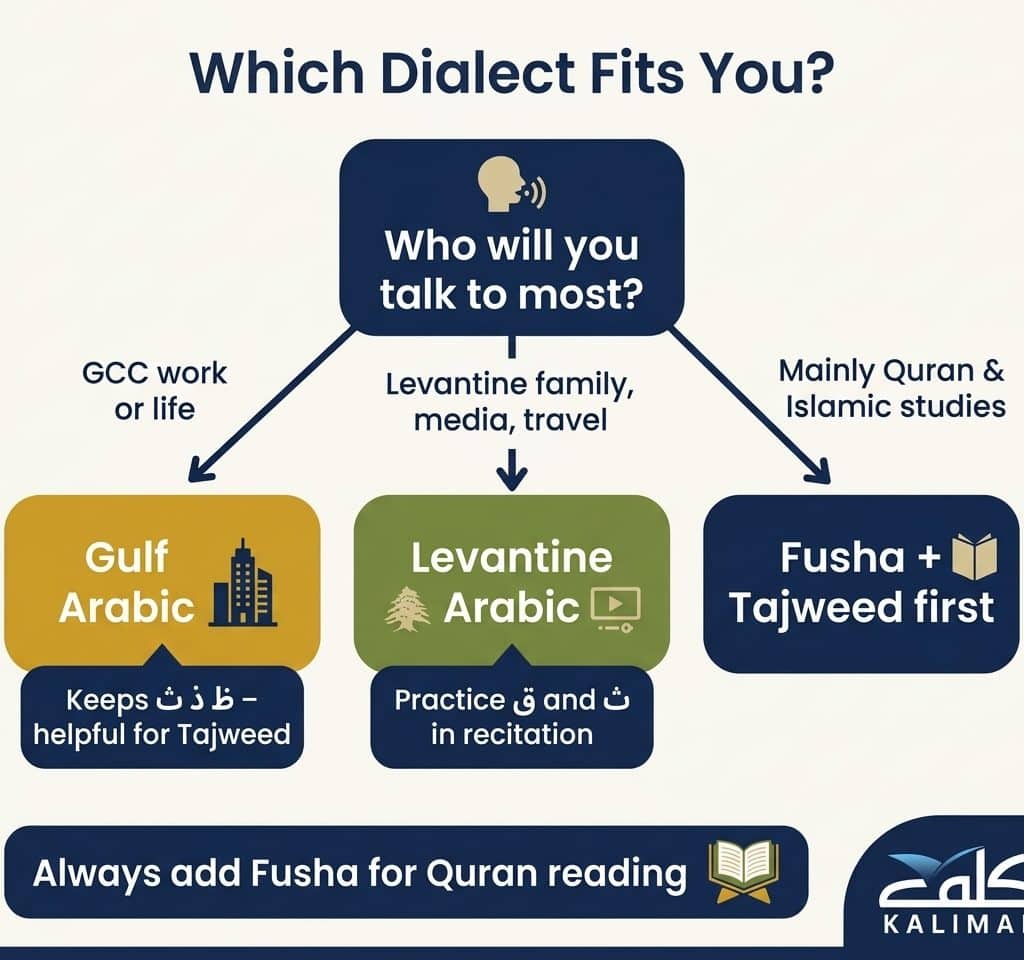
Learn the dialect of the people you will speak with most. Choose Gulf Arabic for life or work in the GCC. Choose Levantine Arabic for family, friends, or travel in Lebanon, Syria, Jordan, or Palestine.
Choose Gulf Arabic If…
Choose Gulf Arabic if you live or work in the Gulf, or plan to move there. It is also a strong choice if you want everyday speech that supports your Quran pronunciation, because it keeps those consonants.
It also fits families whose children attend school in Dubai, Doha, Riyadh or Kuwait. Speaking Gulf Arabic helps kids make friends, follow their Arabic class, and feel at home in their community.
Gulf Arabic also suits learners who like a slower, clearer listening pace. Gulf TV shows, podcasts and Khaleeji poetry give you a growing supply of real material to practice with every week.
Choose Levantine Arabic If…
Choose Levantine if you have Levantine family or friends, or if you love Levantine TV dramas and music. It has plenty of learning materials, and its soft sound makes listening practice enjoyable.
Levantine also works well if you learn best through watching and listening. Syrian and Lebanese series, many of them subtitled, can turn your daily screen time into easy, enjoyable listening practice.
It is also a good pick if you want a dialect many Arabs recognize. Levantine dramas are popular across the Arab world, so many people from other regions understand it without much effort.
Add Fusha Either Way
However you settle Gulf Arabic vs Levantine Arabic, add Fusha (Modern Standard and Classical Arabic). It lets you read the Quran, follow the Friday sermon, and understand the news. If you want a structured start, our online Arabic course combines Fusha with speaking practice.
Fusha also keeps your options open. If your plans change later, a solid Fusha base makes moving between Gulf and Levantine Arabic much faster, for kids and adults alike.
Gulf Arabic vs Levantine Arabic: Comparison Table
This table sums up the Gulf Arabic vs Levantine Arabic comparison for busy readers.
| Aspect | Gulf Arabic (Khaleeji) | Levantine Arabic (Shami) |
| Main countries | Saudi Arabia, UAE, Qatar, Kuwait, Bahrain, Oman | Lebanon, Syria, Jordan, Palestine |
| Overall sound | Steady, fuller consonants | Soft, melodic |
| ق (qaf) | Usually “g” | Usually a glottal stop in cities |
| ث / ذ / ظ | Mostly kept | Often become t/s, d/z, z |
| “I want” | abgha | biddi |
| Learning materials | Growing | Plentiful |
| Help for Tajweed | More Quranic sounds kept | More sounds to retrain |
| Best for | Work and life in the GCC | Levantine family, media, travel |
Start Learning Arabic and the Quran With Kalimah Center Today
Whatever you decide on Gulf Arabic vs Levantine Arabic, a qualified teacher makes the journey much easier. At Kalimah Center, native Arab tutors teach Arabic and the Quran to kids and adults in live, one-on-one online classes.
Our Quran with Tajweed course corrects dialect habits early, so every letter comes from its correct articulation point. You can choose a male or female teacher and pick times that fit your family’s schedule.
Explore Our Courses:
- Online Arabic Course: Tailored to your level, our comprehensive Arabic program includes 16 teaching levels and 400+ hours of personalized sessions.
- Online Quran With Tajweed Course: Perfect for non-Arabic speakers, our course spans 13 levels and equips you with Tajweed mastery from beginner to advanced.
- Online Arabic Course For Kids: Nurture your child’s love for Arabic with our engaging and structured program, available in 24 levels for primary, intermediate, and secondary stages.
Not sure where to start? Book a free trial lesson. Your teacher will assess your level, listen to your goals, and build a clear plan for Quran, Fusha, and spoken Arabic.
Master Arabic with Kalimah Center
Join our expert-led online classes and start your journey toward Arabic fluency today.
Book Your Free TrialConclusion
Gulf Arabic vs Levantine Arabic is not a contest between two languages. Both share the same roots, the same alphabet and most of their grammar. They differ in sound, in everyday words and in where you will hear them. Gulf Arabic sounds steadier and serves the GCC, while Levantine sounds softer and serves the Levant.
For Quran learners, the comparison has an extra layer. Gulf speech keeps Quranic sounds like ث, ذ and ظ, while city Levantine drops some of them. Neither dialect replaces Tajweed, but knowing these habits helps you and your children recite accurately.
Start small and stay consistent. Fifteen minutes a day of listening to your chosen dialect, plus a weekly Quran lesson with a qualified teacher, builds steady progress for both kids and adults.
The takeaway is simple: when choosing between Gulf Arabic vs Levantine Arabic, pick the dialect of the people you will actually talk to, and always pair it with Quranic Arabic. With a good teacher and steady practice, both paths lead to real conversations and confident recitation.
FAQs
These are the questions learners ask most often about the two dialects.
Is Gulf Arabic closer to Modern Standard Arabic than Levantine?
Yes. Gulf Arabic keeps sounds like ث and ذ along with some classical grammar patterns. Levantine vocabulary also overlaps heavily with MSA, though, so each dialect is close to the standard language in different areas.
Can Gulf and Levantine Arabic speakers understand each other?
Yes, in most everyday conversations. The Gulf Arabic vs Levantine Arabic gap is real but manageable because speakers adjust their words, and wide exposure to Levantine TV helps. Fast slang or rural accents may still cause some confusion at first.
Which is easier for beginners: Gulf or Levantine Arabic?
On difficulty, Gulf Arabic vs Levantine Arabic comes out close to even. Levantine has more learning materials, and Gulf Arabic is often spoken at a steadier pace. Your motivation and daily exposure matter more than the dialect itself.
Does my dialect affect my Quran recitation?
Yes, it can, whichever side of Gulf Arabic vs Levantine Arabic you come from. Dialect habits, such as saying ق as a glottal stop or ث as “s”, can slip into recitation. A qualified Tajweed teacher helps you correct them early.
Should I learn a dialect or Fusha first for the Quran?
For Quran reading, start with the Arabic alphabet, Fusha basics and Tajweed. You can add a spoken dialect alongside them to talk with family and friends.