Arabic grammar (النحو — An-Nahw) is the study of how Arabic words function and change within sentences — covering nouns (ism), verbs (fi’l), particles (harf), and the system of case endings (I’rab) that indicate each word’s grammatical role.
An online Arabic grammar course teaches these rules systematically, from basic sentence structure to advanced Quranic and classical Arabic analysis. Kalimah Center’s grammar course spans beginner to advanced levels using classical texts including Al-Ajurrumiyyah, with live native instruction.
Key Takeaway Table:
| Level | Topics Covered | Core Texts | Duration |
|---|---|---|---|
| Beginner | Nouns, pronouns, basic verbs, sentence types, prepositions | Iqraa, Al-Tamheedi | 2–3 months |
| Intermediate | Verb conjugations, Kana & sisters, Inna & sisters, objects (Maf’aeel) | Al-Arabiyya Bayna Yadayk, Duroos Nahwiyya | 4–6 months |
| Advanced | Diptotes, exceptions (Mustathna), numerals, Balagha (rhetoric) | Al-Ajurrumiyyah, Quranic texts | 6–12 months |
Arabic grammar — Nahw (النحو) — is the system that gives the Arabic language its precision, elegance, and logical structure. It determines why the word “al-kitab” (كتاب) ends differently when it’s the subject of a sentence versus the object. It explains how a single harakah (vowel mark) can change the entire meaning of a Quranic verse. And it is the key that unlocks classical Arabic texts that have shaped Islamic civilization for over a thousand years.
This article explains what Arabic grammar is, how a structured online grammar course works, and why learning Nahw is one of the most valuable investments a serious Arabic learner can make — whether your goal is Quranic understanding, academic Arabic, or deep cultural literacy.
What is Arabic Grammar? (Nahw, in Arabic)
Arabic grammar, or as we call it, “Nahw” (النحو), is the study of Arabic words and how they relate to each other in a sentence. For example, we learn about “ism” (اسم), which is a noun, “fi’al” (فعل), which is a verb, and “harf” (حرف), which is a particle. Each of these plays a specific role in a sentence.
Nahw is a study of words, and the conditions in which they occur, according to the way in which it is customary to speak among the Arabs.
For example:
- Al-kitab(u) jamil(un). ( الكتابُ جميلٌ ) (The book is beautiful).
- Qara’a Ahmad(u) al-kitab(a). ( قرأ أحمدُ الكتابَ) (Ahmed read the book).
As you can see here, the ending of the word “Al-kitab” changes in the two sentences depending on its role in the sentence. This is only a small part of the system that is Arabic grammar.
What to Expect in a Structured Arabic Grammar Course
A well-designed Arabic grammar course does more than present rules — it builds a systematic understanding of how Arabic sentences work, from the ground up.
What a structured course covers:
| Stage | Content | Outcome |
|---|---|---|
| Foundations | Parts of speech (ism/fi’l/harf), basic sentence types | Read and understand simple Arabic sentences |
| Core Grammar | I’rab case endings, verb conjugations, Kana/Inna families | Parse sentences grammatically, write correctly |
| Intermediate | Objects (Maf’aeel), relative clauses, conditional sentences | Understand complex Arabic prose |
| Advanced | Diptotes, exceptions, rhetoric (Balaagha), classical texts | Read Quranic and classical Arabic independently |
What distinguishes a good grammar course from a poor one:
- Native instruction from teachers who internalized Arabic grammar as their first language — not translated explanations
- Classical text integration — grammar taught through real Quranic examples, not artificial practice sentences
- I’rab practice — parsing sentences aloud and in writing, not just memorizing rules
- Progressive difficulty — each concept builds on the previous one in a logical sequence
- Spoken grammar — applying Nahw rules in conversation, not only in written exercises
7 Reasons to Learn Arabic Grammar (Nahw)
Learning Arabic grammar (النحو – An-Naḥw) is highly beneficial for several crucial reasons, especially for non-native speakers. It provides the framework necessary for deep comprehension and accurate communication.
Here are the key benefits:
1. Unlocking the Quran and Religious Texts:
Arabic grammar is essential for correctly understanding Classical Arabic (Fusha), the language of the Quran and the Hadith. A change in a single vowel mark (harakah), dictated by grammar, can completely alter the meaning of a religious text.
2. Improving Speaking Fluency and Accuracy:
Grammar teaches you the rules of I’rāb (الإعراب), which is the system of case endings (vowel marks) that indicate a word’s function (subject, object, etc.) in a sentence. Using I’rāb correctly makes your speech sound educated and coherent.
3. Mastering Writing Skills:
It enables you to construct structurally sound and complex sentences. Understanding sentence structure (nominal vs. verbal) and proper word order is necessary for effective written communication in formal settings.
4. Deepening Vocabulary Acquisition (Root System):
Arabic is a root-based language. Knowing grammar allows you to recognize the triliteral root of a word (e.g., ك-ت-ب / K-T-B), helping you deduce the meaning of dozens of related words (e.g., kitāb, kātib, maktabah, yaktubu) and rapidly expand your vocabulary.
5. Avoiding Misunderstandings:
As mentioned with I’rāb, improper case endings or confusing similar word patterns can lead to misinterpretation. Grammar ensures you convey your intended meaning precisely, preventing confusion in communication.
6. Accessing Arabic Heritage and Culture:
Grammar is the key to accessing the vast body of Arabic literature, poetry, and classical science written over centuries, providing a deeper connection to the culture and history.
7. Facilitating Further Study:
For anyone wishing to pursue advanced academic study in Islamic studies, Middle Eastern history, or linguistics, a solid foundation in Arabic grammar is a mandatory prerequisite.
Curriculum of Arabic Grammar Course Online at Kalimah Center
In our Arabic Grammar Course, we don’t just teach you rules from a book. We make you understand how the rules work in real sentences. We use a step-by-step approach, starting from the very basics and gradually moving to more advanced topics.
1. Beginner Level in our Arabic Grammar Course
At the beginner level in our Arabic grammar course, we focus on:
A. Arabic Noun Forms
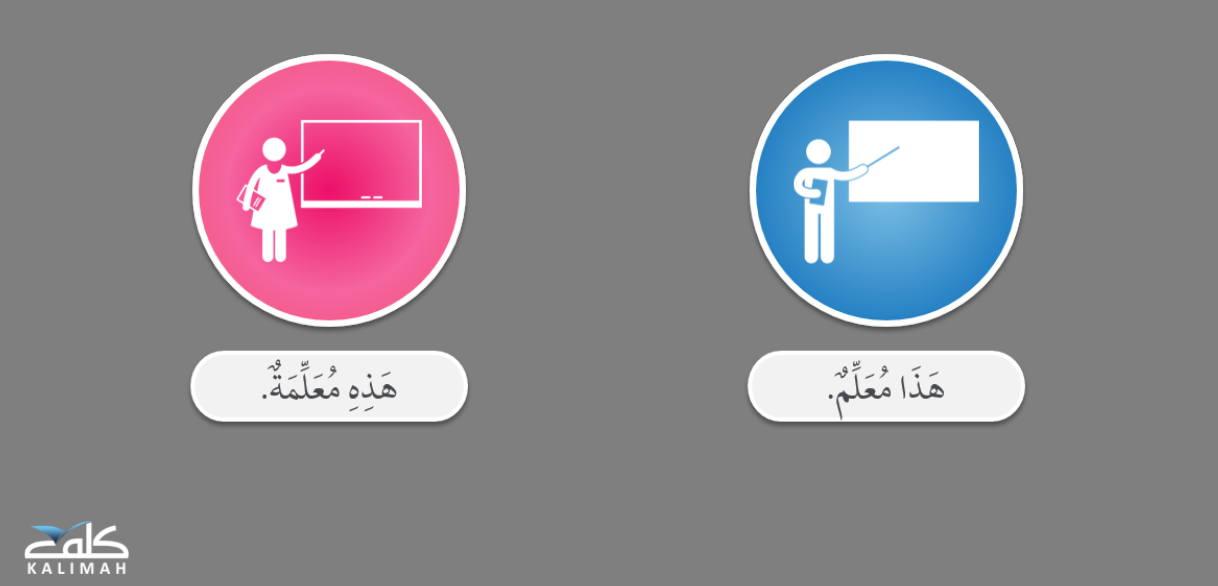
At the beginner level of our Arabic grammar course, we’ll focus on noun forms. we’ll highlight the distinctions between singular, dual, and plural nouns, as well as masculine and feminine forms.
| Category | Subcategory | Example Arabic | Example English |
| Nouns | Singular (المُفْرَد) | كِتاب | kitab (book) |
| Dual (المُثَنّى) | كِتابانِ | kitabani (two books) | |
| Plural (الجَمْع) | كُتُب | kutub (books) | |
| Nouns | Masculine (المُذَكَّر) | مُعَلِّم | mu’allim (male teacher) |
| Feminine (المُؤَنَّث) | مُعَلِّمَة | mu’allimah (female teacher) |
B. Arabic Pronouns
At the beginner level of our Arabic grammar course, we’ll also focus on pronouns. We’ll explore the different forms of personal pronouns, including those for singular and some of the plural forms.
| Category | Subcategory | Example Arabic | Example English |
| Pronouns | I | أنا | ana (I) |
| You (masculine singular) | أنتَ | anta (you, masculine singular) | |
| You (feminine singular) | أنتِ | anti (you, feminine singular) | |
| He | هُوَ | huwa (he) | |
| She | هِيَ | hiya (she) |
C. Arabic Prepositions
we’ll also focus on pronouns: “في” (fi – in), “على” (ala – on), “مِنْ” (min – from), “إلى” (ila – to), and so on.
D. Arabic Verb Forms
At the beginner level of our Arabic grammar course, we’ll introduce basic verb forms. We’ll explore the past, present, and imperative tenses.
| Category | Subcategory | Example Arabic | Example English |
| Verbs | Past Tense (الماضي) | قَرَأَ | qara’a (he read) |
| Present Tense (المُضارِع) | يَقْرَأُ | yaqra’u (he reads) | |
| Imperative (الأمْر) | اِقْرَأْ | iqra’ (read!) |
E. Basic Arabic Sentence Structure
At the beginner level of our Arabic grammar course, we’ll introduce the two main types of sentences: nominal and verbal.
| Category | Example Arabic | Example English |
| Nominal Sentence (الاِسْمِيَّة) | الطّالِبُ مُجْتَهِدٌ | At-talibu mujtahidun (The student is hardworking) |
| Verbal Sentence (الفِعْلِيَّة) | ذَهَبَ الطّالِبُ إلى المَدْرَسَةِ | Dhahaba at-talibu ila al-madrasati (The student went to the school) |
F. “الصِّفات” (as-Sifat – adjectives) and “الحال” (al-Hal – adverbs)
At the intermediate level of our Arabic grammar course, we’ll also learn how to describe nouns and verbs in more detail.
For example,
- “جاءَ الوَلَدُ السَّعيدُ” (Ja’a al-waladu as-sa’idu) – The happy boy came.
(“as-sa’idu” is an adjective describing “al-waladu”). - “جاءَ الوَلَدُ مَسْرورًا” (Ja’a al-waladu masruran) – The boy came happily.
(“masruran” is an adverb describing how the boy came).
And More…
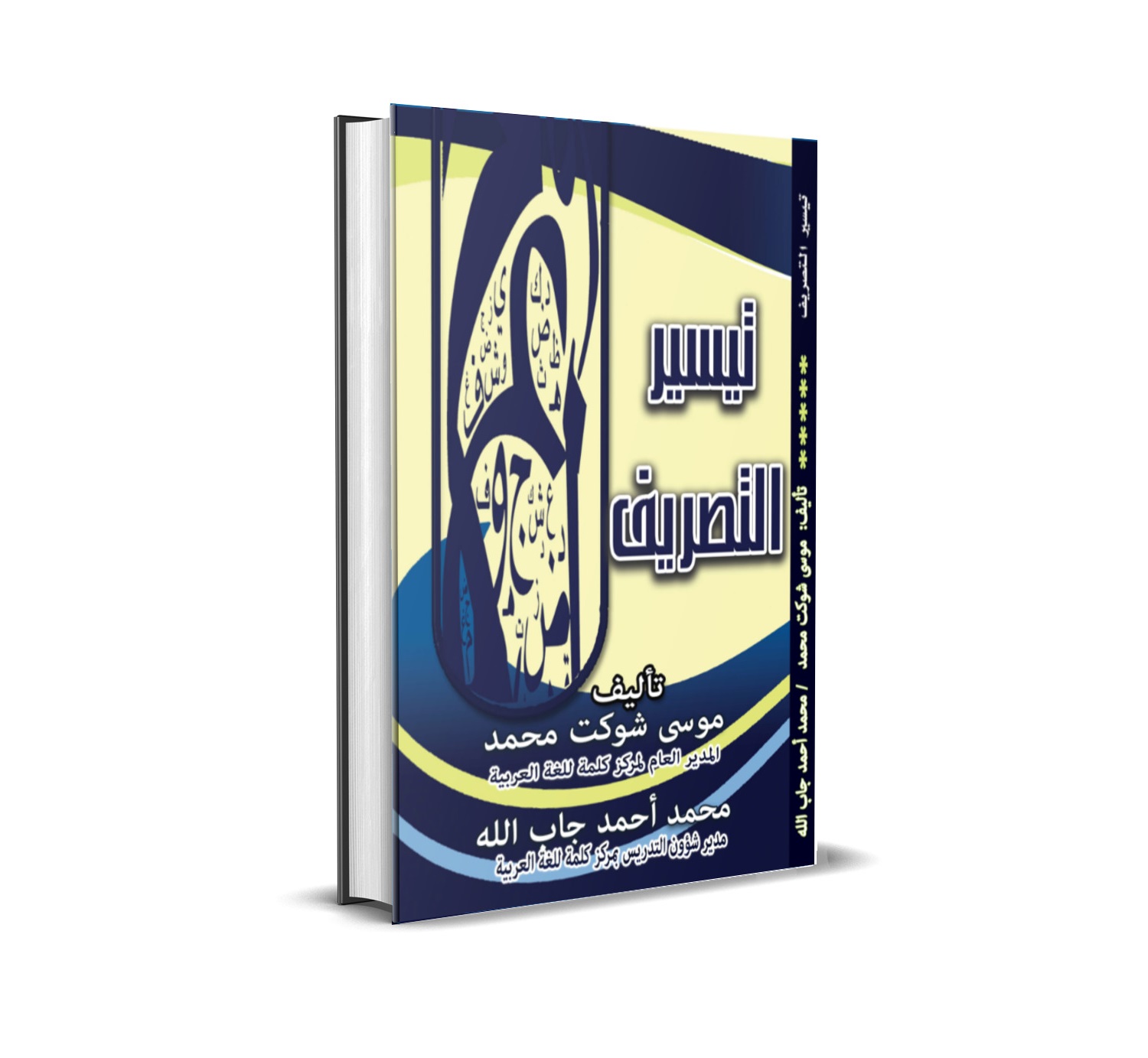
We use many examples from the Quran and everyday life to make these concepts clear. We also use our special book, “Al-Tamheedi” (التمهيد للعربية) which is designed specifically for this level.

Experience Kalimah Center Classes
Watch real excerpts from our live sessions at Kalimah Center and see how we bring learning to life. These clips highlight our interactive, student-centered teaching approach across all our courses—designed to keep learners engaged, motivated, and actively involved every step of the way.
Master Arabic with Kalimah Center
Join our expert-led online classes and start your journey toward Arabic fluency today.
Book Your Free TrialRead also: Arabic grammar books
2. Intermediate Level in our Arabic Grammar Online Course
At the intermediate level, we build on the foundation laid in the beginner level and introduce more complex topics, such as:
A. Detailed Arabic Verb Conjugations
All forms of the past, present, and imperative tenses for different pronouns.
- “الصَّحيح” (as-Sahih – regular verbs) and
- “المُعْتَلّ” (al-Mu’tall – weak verbs).

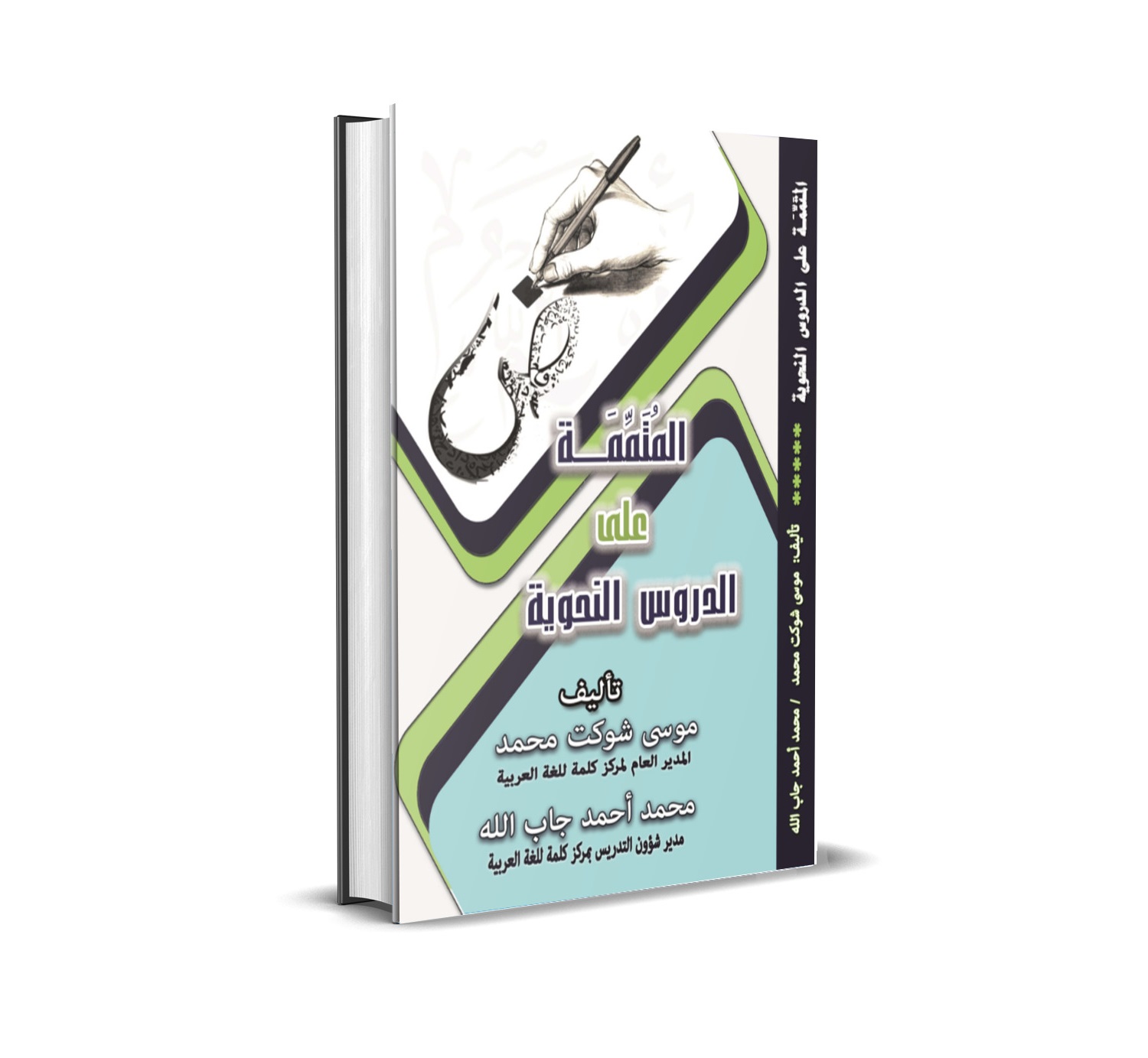
The above picture is derived from the book that we authored at Kalimah Center “Droos nahwiyah mena Al Moqaddemah Al AAjourromiyah”, which is based on of the revered “Al-Ajurrumiyyah” (الآجرومية) for grammar (Nahw). .

B. “كانَ وأخَواتُها” (Kana and Her Sisters)
Verbs like “كانَ” (kana – was) that have a special effect on the sentence.
For example, “كانَ الجَوُّ جَميلًا” (Kana al-jawwu jamilan) – The weather was beautiful.
C. “إنَّ وأخَواتُها” (Inna and Her Sisters)
Particles like “إنَّ” (inna – indeed) that also change the sentence structure.
For example, “إنَّ اللهَ غَفورٌ رَحيمٌ” (Inna Allaha ghafurun rahimun) – Indeed, Allah is forgiving and merciful.
D. Arabic Objects (المَفاعيل)
At the intermediate level of our Arabic grammar course, we’ll also introduce the concept of objects (al-Maf’aeel), such as:
- “المَفْعول بِهِ” (al-Maf’ul bihi – direct object).
For example, in the sentence “قَرَأَ مُحَمَّدٌ الكِتابَ” (Qara’a Muhammadun al-kitaba) – Muhammad read the book, “al-kitaba” is the direct object. - “المَفْعول المُطْلَق” (al-Maf’ul al-mutlaq – absolute object).
For example, in the sentence “ضَرَبْتُهُ ضَرْبًا” (Darabtuhu darban) – I hit him (a hitting), “darban” is the absolute object used for emphasis.
And more…
We use examples from MSA and classical Arabic literature to illustrate these concepts.
3. Advanced Level in our Arabic Grammar Course
At the advanced level, we delve deeper into the intricacies of Arabic grammar, covering topics such as:
- “المَمْنوع مِن الصَّرْف” (al-Mamnu’ min as-Sarf – diptotes): Nouns that do not take the usual case endings.
- “المُسْتَثْنى” (al-Mustathna – exceptions): How to use particles like “إلّا” (illa – except) to make exceptions.
- “العَدَد والمَعْدود” (al-‘Adad wal-Ma’dud – numerals and counted nouns): The complex rules governing the agreement between numbers and the things they count.
- Advanced Sarf: In-depth study of verb forms and derivations.
- “البَلاغَة” (al-Balagha – rhetoric): The art of using language effectively and eloquently.
We analyze verses from the Quran, Hadith, and classical Arabic poetry to understand how these advanced grammatical concepts are used in practice.
How Our Arabic Grammar Course Develops All Four Language Skills
Grammar is the backbone of all four language skills. Here is how Nahw study directly improves each:
1. Reading — Grammar Unlocks Unvowelled Arabic Text
Most Arabic text outside the Quran and children’s books is written without harakāt (vowel marks). A reader with strong Nahw knowledge supplies the correct vowels from grammatical context — enabling fluent reading of newspapers, classical texts, and academic Arabic. In our course, you progress from vowelled practice texts to unvowelled authentic Arabic passages as your I’rab confidence grows.
2. Writing — Grammar Produces Correct, Precise Arabic
Arabic writing errors — wrong case endings, incorrect gender agreement, misplaced verb forms — are all grammar errors. Our writing exercises require students to compose sentences using each new grammar concept, then receive teacher feedback on accuracy. This builds the habit of grammatical precision that separates competent Arabic writers from fluent ones.
3. Speaking — Grammar Makes Your Arabic Sound Educated
In formal Arabic speech (khutbas, lectures, presentations, academic discussions), correct I’rab case endings are pronounced aloud. Using the wrong case ending is immediately noticeable to educated Arabic speakers. Our speaking exercises include reading passages aloud with full I’rab, discussing grammatical concepts in Arabic, and practicing dialogue that demonstrates correct grammatical forms.
4. Listening — Grammar Helps You Parse What You Hear
When listening to formal Arabic — news broadcasts, Islamic lectures, university instruction — a grammar-trained ear catches the structure of sentences even at native speed. We use recordings of classical Arabic lectures, Quranic recitation with parsing discussion, and MSA news audio to develop this analytical listening skill.
Read also: Arabic grammar for kids
Inside Kalimah Center: Moments from Our Courses
Get a glimpse into the vibrant learning experience at Kalimah Center. These snapshots capture real moments from our live classes—where students engage deeply, connect with passionate instructors, and grow in a welcoming, supportive environment.
What Makes an Effective Arabic Grammar Course: Kalimah’s Approach
With over a decade of experience in teaching Arabic to non-native speakers, Kalimah Center has helped thousands of students achieve fluency and confidence in Arabic.
1. Kalimah’s “Building Block” Approach to Arabic Grammar
Our Arabic Grammar Course follows a carefully structured curriculum that builds your knowledge step-by-step.
We start with the foundational concepts, like the different types of words (parts of speech) and basic sentence structure.
Then, we gradually introduce more complex topics, like cases (إعراب – i’rab), and sentence clauses.
2. Kalimah’s Practical Arabic Grammar Application
We believe grammar is a tool for communication. At Kalimah, our courses integrate grammar instruction with opportunities for practical usage.
3. Kalimah’s Expert Grammar Guidance
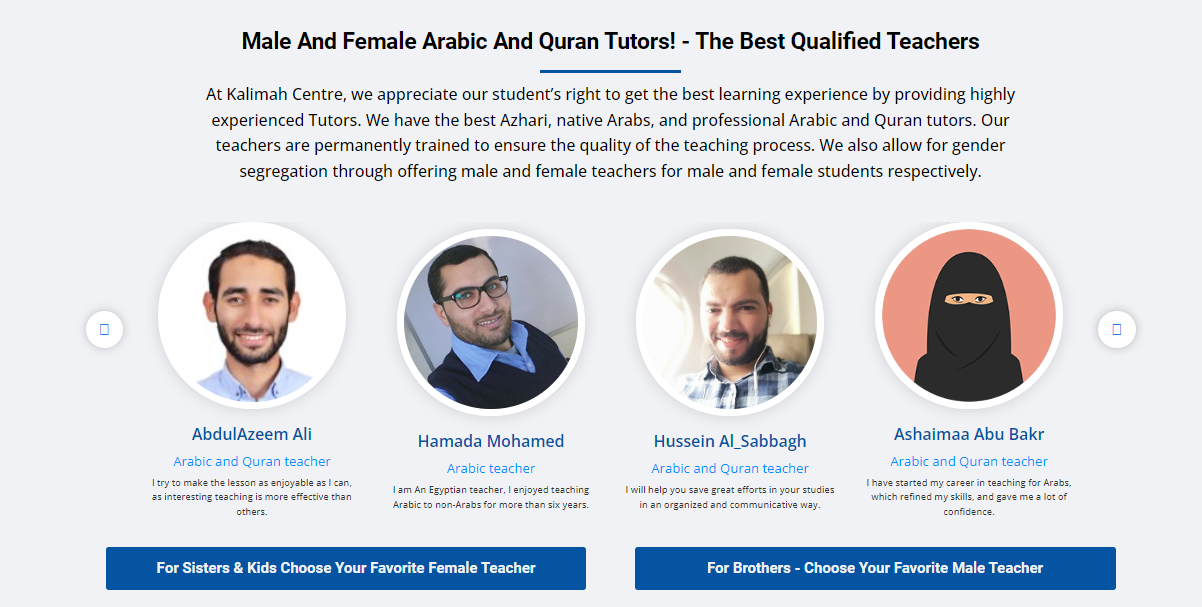
Our instructors are native Arabic teachers with a deep understanding of the Arabic Grammar.
4. Pinpointing Your Arabic Grammar Strengths and Weaknesses
At Kalimah, you’ll receive individualized feedback from your instructor, focusing on your specific grammatical strengths and areas for improvement. This tailored guidance helps you refine your understanding and accelerate your progress.
5. Customized Arabic Grammar Learning Plans
We understand that every student is unique. You have your own strengths, weaknesses, and learning style. That is why we offer customized learning plans. We will assess your level, identify your needs, and create a plan that is tailored specifically to you.
6. Flexible and Accessible Pricing
We believe Arabic grammar should be accessible to every serious learner regardless of financial situation. Our course options include:
- One-on-one sessions — personalized attention with full curriculum customization
- Group classes — 4x cheaper than private lessons, with small class sizes that still allow individual feedback
- Free placement test — identifies exactly where you should begin, ensuring you never pay for level you’ve already mastered
- Free trial class — experience our teaching methodology before committing
Contact us for current pricing — we also offer discounts for students with financial need.
Master Arabic with Kalimah Center
Join our expert-led online classes and start your journey toward Arabic fluency today.
Book Your Free TrialStudents Share Their Kalimah Experience
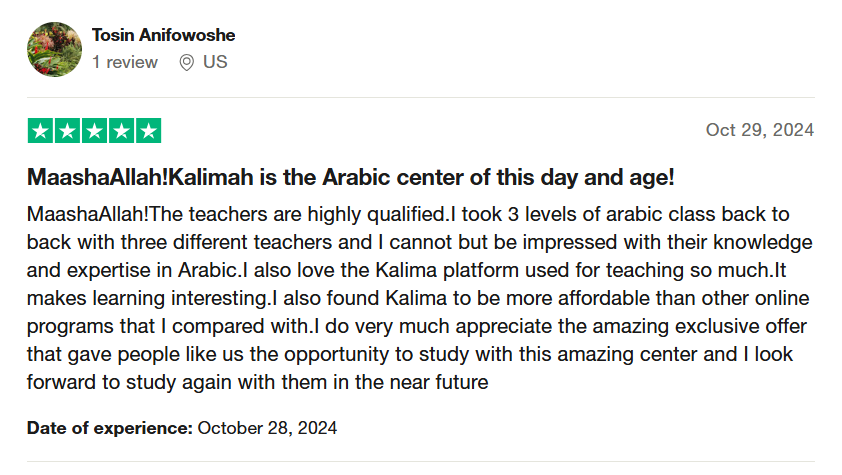
Get honest, unedited feedback directly from those who have experienced Kalimah on our page at Trustpilot.


Begin Your Arabic Grammar Course: Free Trial and Placement Test
So, what are you waiting for? Come and experience the Kalimah Center difference for yourself. See how our expert teachers, our unique method, and our supportive environment can help you understand Arabic grammar.
Sign up for a free trial lesson today!
We look forward to welcoming you to the Kalimah Center family!

And if you are looking for a more affordable way to learn Arabic grammar? Our group classes let you:
- Talk with other students from around the world.
- Get help from our friendly native Arabic teachers.
- Practice more in small groups.
- They’re 4 times cheaper than private lessons!
Pick a class time that fits your life.

Conclusion:
Arabic grammar, or Nahw, is the study of how Arabic words function within sentences. It focuses on key elements like nouns (ism), verbs (fi’al), and particles (harf), which each serve specific roles in the structure of a sentence.
Understanding how these words change depending on their position is central to mastering the language. For example, the word “Al-kitab” (book) changes its ending based on its function, as seen in different sentences.
Kalimah Center offers a comprehensive Arabic Grammar course that begins with foundational concepts, progressing through beginner, intermediate, and advanced levels. The course covers topics from noun forms and pronouns to verb tenses, sentence structures, and more. Students learn through real-world examples, including Quranic texts, to reinforce grammar rules.
Emphasizing practical application, the course integrates reading, writing, speaking, and listening skills, with personalized guidance and a step-by-step approach to mastering Arabic grammar.
FAQs about Online Arabic Grammar Course
Q1: What is the difference between Nahw and Sarf in Arabic?
Nahw (النحو) and Sarf (الصرف) are the two foundational branches of Arabic linguistics, and they are almost always studied together. Nahw — Arabic syntax — studies how words function within sentences: their grammatical roles, case endings (I’rab), and relationships to other words. Sarf — Arabic morphology — studies how words are formed and transformed internally: verb conjugations, noun derivations, and the root-pattern system. Nahw asks “what role does this word play in the sentence?” Sarf asks “how is this word formed?” Both are essential for mastering Classical and Quranic Arabic.
Q2: Is there a free Arabic grammar course online?
Several free Arabic grammar resources exist online: Al-Ajurrumiyyah text with explanations is available in multiple languages at no cost. Riwaq Al-Azhar (learn.azhar.eg) offers free Arabic grammar content. YouTube channels by various Arab scholars provide free Nahw lessons. However, free resources lack live instruction, personalized feedback, and structured progression — the elements that make the biggest difference in actually mastering Arabic grammar. Kalimah Center offers a free trial class so you can experience live Azhari-trained instruction before committing.
Q3: How long does it take to learn Arabic grammar (Nahw)?
Basic Arabic grammar foundations — enough to understand simple sentences and Quranic text — typically takes 3–6 months of structured study (3–5 hours per week). Intermediate grammar covering verb systems, Kana/Inna families, and objects takes an additional 4–8 months. Advanced grammar enabling independent Quranic and classical text analysis typically requires 1–2 years of total dedicated study. The Azhari tradition recognizes that grammar is a lifelong discipline — even advanced scholars continue refining their I’rab (parsing) skills.
Q4: Do I need to know Arabic before taking an Arabic grammar course?
It depends on the course level. Kalimah Center’s Beginner Grammar Level starts from foundational concepts — you do not need prior grammar knowledge, but basic Arabic alphabet literacy is beneficial. If you cannot yet read Arabic script, we recommend starting with our alphabet course first, then progressing to grammar. Our placement test identifies exactly where to begin so you never waste time on material you already know or struggle with material above your current level.
Q5: Is Arabic grammar (Nahw) necessary for reading the Quran?
Yes — I’rab (grammatical parsing) is essential for correctly understanding Quranic meaning. A single case ending change can completely alter a Quranic sentence’s meaning. For example, the case ending on a noun determines whether it is the doer or recipient of an action. Traditional Islamic scholarship considers Nahw a fard kifaya (communal obligation) — enough Muslims must know it to preserve correct Quranic understanding. For anyone wishing to study Tafsir, Hadith, or Fiqh in Arabic, Nahw is not optional — it is the foundational prerequisite.