Many beginners ask the same question before starting Arabic: is Duolingo good to learn Arabic? The answer is not simply yes or no.
Duolingo can be a helpful starting point if you are completely new to Arabic. It can introduce you to the Arabic alphabet, basic sounds, simple words, and short practice exercises. It is also free, easy to use, and motivating for learners who enjoy gamified lessons.
But Arabic is not a language you can master through quick app exercises alone. It has a different script, unique sounds, grammar patterns, dialects, and pronunciation rules that need clear explanation and real correction.
So, if your goal is only to explore Arabic, Duolingo can help you begin. But if your goal is to speak Arabic confidently, understand real conversations, read Arabic properly, or study Quranic Arabic, Duolingo alone is not enough.
This honest review explains what Duolingo Arabic does well, where it falls short, what real learners commonly say about it, and why a specialized Arabic learning platform is usually a better choice for serious students.
Is Duolingo Good for Learning Arabic?
Yes, Duolingo is good for learning the basics of Arabic, especially for complete beginners. It can help you recognize Arabic letters, practice simple sounds, learn basic vocabulary, build a daily learning habit, and get comfortable with the Arabic script in a low-pressure way.
However, Duolingo is not enough for learners who want to speak Arabic naturally, understand real conversations, learn grammar in depth, or receive pronunciation correction. It also does not provide a personalized learning path or prepare learners for Arabic in real-life contexts such as travel, work, or Quranic study.
So, Duolingo is useful as a starting tool for beginners, but it is not a complete solution for learning Arabic.
The Main Limitations of Duolingo Arabic
The biggest problem is that Duolingo does not take most learners far enough Arabic needs more than short app exercises. It needs explanation, correction, guided practice, and real speaking.
Many learners can finish a large part of the Arabic course and still feel unable to hold a real conversation. This is because recognizing words in an app is not the same as speaking with a real person.
Duolingo also does not explain Arabic grammar deeply enough. Arabic grammar has patterns that need clear teaching, such as verb forms, gender, sentence structure, plurals, possessive constructions, and word order.
Another limitation is pronunciation. Arabic has sounds that are difficult for English speakers, such as ع, ح, خ, غ, ق, ص, ض, ط, and ظ. These sounds often need direct correction from a teacher. An app can play audio, but it cannot always tell you exactly how to fix your mouth or throat position.
That’s why it is more effective to rely on a specialized Arabic learning platform like Kalimah Center, where you get a structured curriculum, personalized support, and step-by-step guidance designed to match your level and goals.
Start your Arabic learning journey today — join Kalimah Center and learn with a clear path, expert guidance, and real progress you can build on.
What Does Duolingo Arabic Teach?
Duolingo Arabic is designed as a beginner-friendly course. It uses short exercises, repetition, listening, matching, and translation-style activities.
For many learners, the first useful part is the Arabic script. Arabic letters look very different from English letters, and they also connect inside words. Duolingo can help beginners become familiar with this new writing system.
The course also introduces basic words and simple sentence patterns. It gives learners small daily lessons that feel manageable and easy to complete.
This makes Duolingo helpful for people who want a light introduction before joining a more structured Arabic course.
What Duolingo Does Well?
Duolingo has some real strengths, especially for beginners.
It makes Arabic feel less intimidating. Instead of starting with a heavy grammar book, learners begin with short interactive lessons. This can reduce fear and help people take the first step.
It also encourages consistency. The app uses streaks, reminders, points, and progress bars to keep learners coming back every day. For beginners, this daily habit can be valuable.
Duolingo is also accessible. Many learners like it because they can start for free and practice from their phone whenever they have a few minutes.
For Arabic specifically, Duolingo can be helpful for recognizing letters and getting used to some basic sounds. This is useful because Arabic script is one of the first major challenges for English-speaking learners.
What Learners Like About Duolingo Arabic?
Many learners enjoy Duolingo because it feels simple and low-pressure. They can open the app, finish a lesson in a few minutes, and feel like they made progress.
Some learners say Duolingo is useful for starting Arabic because it introduces the alphabet and basic pronunciation in a fun way. This is important because the Arabic script can feel difficult at the beginning.
Learners also like that Duolingo gives them repeated exposure. Seeing letters and words again and again can make Arabic feel more familiar.
For someone who is nervous about Arabic, this can be a good first step.
Real Learner Feedback on Duolingo Arabic
Learner feedback about Duolingo Arabic is mixed, and this is exactly why the app should be viewed as a starting tool rather than a complete Arabic course.
Many learners say Duolingo Arabic is helpful at the beginning. Some users mention that it helped them learn the Arabic script, recognize letters, practice pronunciation, and remember basic vocabulary. This makes sense because Duolingo is strong at short, repeated exercises and beginner-friendly exposure.
However, many learners also point out the same limitation: Duolingo Arabic does not take them far enough.
Some users describe the course as a very basic introduction to Arabic sounds and the alphabet. Others say it is useful as a first step, but they needed a teacher, textbook, language exchange, or dialect-focused lessons after finishing the basics.
A common complaint is that Duolingo does not prepare learners for real Arabic conversation. Learners may recognize words inside the app but still struggle to speak naturally with native speakers.
Other reviews mention that the course feels short, focuses heavily on letters, and does not explain Arabic grammar deeply enough. Some learners also say they needed another resource to understand sentence structure, real usage, and speaking.
This feedback leads to a balanced conclusion:
Duolingo Arabic can help you start, but it should not be your full Arabic learning plan If your goal is to speak Arabic confidently, understand grammar, improve pronunciation, or learn Quranic Arabic or a specific dialect, you will need a more guided and specialized approach.
Is Duolingo Good for Arabic Speaking?
Duolingo is not the best tool for Arabic speaking It may expose you to words and phrases, but speaking requires more than recognition. To speak Arabic, you need to produce sentences, respond naturally, pronounce difficult sounds, and get feedback.
For example, a learner may know that أنا أريد ماء means “I want water.” But in real conversation, they also need to say it smoothly, pronounce the sounds correctly, and understand the reply.
Duolingo does not give enough real conversation practice for this If your main goal is speaking, you need live lessons, conversation practice, pronunciation correction, and a teacher who can guide you.
Is Duolingo Good for Arabic Pronunciation?
Duolingo can help you hear Arabic sounds, but it is not enough to master pronunciation.
Arabic pronunciation is one of the hardest parts for many learners. Some letters have no direct English equivalent. For example, the letter ع needs throat control, and ق is deeper than the English “k.”
Listening to audio is helpful, but pronunciation improves faster when someone corrects you directly.
A specialized Arabic teacher can tell you:
- Where the sound should come from
- What mistake you are making
- How to adjust your pronunciation
- Which words to practice
- Whether your sound is clear enough
This kind of feedback is difficult to get from Duolingo alone.
Is Duolingo Good for Arabic Grammar?
Duolingo introduces some grammar patterns, but it does not explain Arabic grammar deeply enough for serious learners.
Arabic grammar is not impossible, but it needs structure. Learners need to understand how nouns, verbs, particles, pronouns, adjectives, and sentence patterns work together.
For example, Arabic has masculine and feminine forms. It also has singular, dual, and plural forms. Verbs change depending on tense, gender, number, and subject. These ideas need clear explanation and repeated practice.
Duolingo may show examples, but many learners need a teacher or structured course to understand why the sentence works that way Without explanation, students may memorize phrases without being able to build their own sentences.
Is Duolingo Good for Quranic Arabic?
Duolingo is not the best choice for Quranic Arabic Quranic Arabic requires careful pronunciation, tajweed awareness, vocabulary from the Qur’an, grammar, and understanding of classical structures.
Duolingo Arabic is not designed specifically for Quranic study. It may help you recognize some letters and basic words, but it will not teach Quranic Arabic in a complete or guided way.
If your goal is to read the Qur’an correctly or understand Quranic vocabulary, it is better to study with a specialized Quranic Arabic teacher or platform.
Read also: Is Mondly Good For Learning Arabic?
Master Arabic Online with a Structured Learning Path from Kalimah Center
Learning Arabic online has become much easier and more accessible, especially for students who want flexibility without losing structure. An online Arabic course is ideal for beginners and intermediate learners because it combines guided lessons, interactive practice, and step-by-step progression that helps you build real skills in reading, writing, listening, and speaking.
Unlike self-study methods, a structured online course gives you a clear learning path and helps you avoid confusion or random learning. You follow a curriculum designed by experienced teachers, which ensures that each stage of your progress is connected and builds naturally on what you learned before. This makes it much easier to move from basic understanding to real communication in Arabic.
A strong example of this is the Online Arabic Course offered by Kalimah Center Online Arabic Course, where students learn through a well-designed program that includes multiple levels, one-on-one sessions, and professional guidance from qualified Arabic teachers.
Start your Arabic journey today with a structured online course that gives you clarity, support, and real progress step by step.
Is Duolingo Good for Arabic Dialects?
Duolingo Arabic is not ideal if your main goal is to speak a specific Arabic dialect Arabic has many dialects, such as Egyptian Arabic, Levantine Arabic, Gulf Arabic, Moroccan Arabic, and others. These dialects differ in pronunciation, vocabulary, and daily expressions Duolingo mainly introduces a standard form of Arabic. This can be useful as a foundation, but it may not teach you how people speak naturally in a specific country.
For example, if you want to speak with Egyptians, you need Egyptian Arabic conversation. If you want to speak with people from Jordan, Lebanon, Palestine, or Syria, you may need Levantine Arabic A specialized Arabic platform can guide you toward the right dialect based on your goals.
Experience Kalimah Center Classes
Watch real excerpts from our live sessions at Kalimah Center and see how we bring learning to life. These clips highlight our interactive, student-centered teaching approach across all our courses—designed to keep learners engaged, motivated, and actively involved every step of the way.
Master Arabic with Kalimah Center
Join our expert-led online classes and start your journey toward Arabic fluency today.
Book Your Free TrialWho Should Use Duolingo Arabic?
Duolingo Arabic may be useful for certain learners.
It can be a good option if you:
- Are completely new to Arabic
- Want a free introduction
- Want to learn the alphabet slowly
- Like gamified learning
- Need a daily habit
- Want to test whether Arabic interests you
In this case, Duolingo can be a light and friendly first step But if you are serious about Arabic, you should not stop there.
Who Should Not Rely on Duolingo Alone?
Duolingo alone is not enough if you want real progress.
You should not rely only on Duolingo if you want to:
- Speak Arabic confidently
- Learn Arabic for work or travel
- Understand Arabic conversations
- Study Quranic Arabic
- Learn Arabic grammar properly
- Improve pronunciation seriously
- Follow a clear learning plan
- Get personal feedback
- Learn a specific Arabic dialect
These goals need a deeper and more personalized approach.
Read Also: Is Preply Good for Learning Arabic
Why a Specialized Arabic Platform Is Better for Serious Learners?
Arabic needs more than app-based repetition. It needs guidance, correction, structure, and real speaking practice.
A specialized Arabic platform gives learners what Duolingo usually cannot provide: a clear curriculum, qualified Arabic teachers, live support, pronunciation correction, and lessons customized around the learner’s goal.
This matters because every Arabic learner is different. Some students want to speak Arabic for travel. Others want to understand the Qur’an. Some want Modern Standard Arabic, while others need Egyptian, Levantine, or Gulf Arabic. A general app cannot always guide learners through these different paths.
With a specialized Arabic platform, students can receive:
- A structured Arabic learning plan
- Teacher support when they feel stuck
- Correction for pronunciation mistakes
- Speaking practice from the beginning
- Grammar explained clearly
- A curriculum matched to their level
- Lessons adapted to their purpose
- Support for Quranic Arabic, MSA, or dialect learning
This is why Duolingo can be useful as a warm-up or daily review tool, but a specialized Arabic platform is better for real progress.
If you want to move beyond tapping answers on an app, you need a learning environment where someone listens to you, corrects you, and guides you step by step.
Best Way to Use Duolingo If You Still Like It
Duolingo can still be useful if you use it correctly Use it for 5 to 10 minutes a day as a warm-up or review tool. Let it help you practice letters, simple vocabulary, and basic repetition But do not make it your only Arabic method.
A better plan is:
- Use Duolingo for daily light practice.
- Use a specialized Arabic course for real lessons.
- Practice speaking with a teacher.
- Review vocabulary outside the app.
- Listen to real Arabic audio.
- Read simple Arabic texts.
This way, Duolingo becomes a helper, not the whole system.
What Students Really Need to Learn Arabic?
Students do not only need more exercises. They need a clear path To learn Arabic properly, students need to know what to study first, what to practice next, and how to measure progress.
A strong Arabic learning plan should include:
- Arabic alphabet and reading
- Correct pronunciation
- Essential vocabulary
- Sentence building
- Grammar made simple
- Listening practice
- Speaking practice
- Reading practice
- Review and correction
- Real-life usage
This is why a specialized platform is more effective. It does not just give you random practice. It gives you direction.
Read also: Arabic Food Vocabulary
Inside Kalimah Center: Moments from Our Courses
Get a glimpse into the vibrant learning experience at Kalimah Center. These snapshots capture real moments from our live classes—where students engage deeply, connect with passionate instructors, and grow in a welcoming, supportive environment.
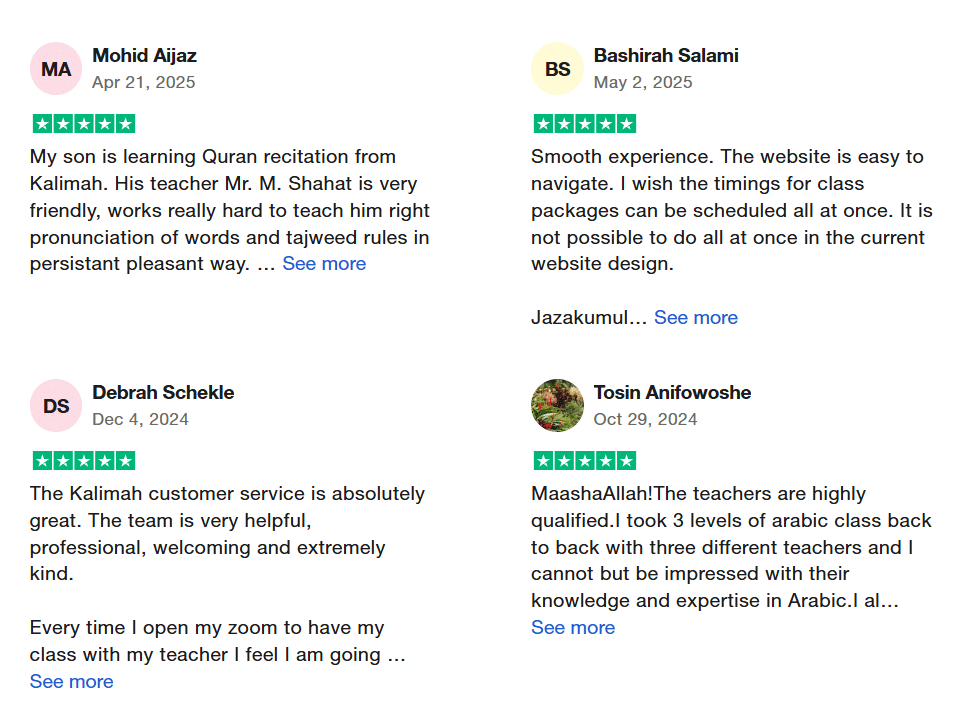
Here Are The Reviews On Our Courses:
Our students frequently commend the excellence of our courses and the commitment shown by our instructors. You can read their complete reviews on Trustpilot.
Read more reviews on Trustpilot
Learn Arabic the Right Way with Structured Guidance from Kalimah Center
Many learners begin their Arabic journey using apps and self-study tools because they are easy, flexible, and give a quick sense of progress. They can help you get familiar with the Arabic alphabet, basic vocabulary, and simple sentence patterns. This makes them useful at the very beginning stage when everything feels new.
However, Arabic is not a language that can be mastered through short exercises alone. To truly develop fluency, you need a clear learning path, proper explanation of grammar, consistent speaking practice, and correction from qualified teachers. Without structure and guidance, learners often struggle to move beyond the basics or use Arabic confidently in real-life situations.
That’s why it is more effective to rely on a specialized Arabic learning platform like Kalimah Center, where you get a structured curriculum, personalized support, and step-by-step guidance designed to match your level and goals.
Start your Arabic learning journey today — join Kalimah Center and learn with a clear path, expert guidance, and real progress you can build on.
📚 Explore Our Courses:
Online Arabic Course: Tailored to your level, our comprehensive Arabic program includes 16 teaching levels and 400+ hours of personalized sessions.
Online Quran With Tajweed Course: Perfect for non-Arabic speakers, our course spans 13 levels and equips you with Tajweed mastery from beginner to advanced.
Online Arabic Course For Kids: Nurture your child’s love for Arabic with our engaging and structured program, available in 24 levels for primary, intermediate, and secondary stages.
🚀 Start Your Free Trial Today! 🚀
Don’t miss out on this life-changing opportunity to deepen your faith and knowledge. Sign up now for your free trial and take the first step towards becoming a better practicing Muslim with Kalimah Center!
Master Arabic with Kalimah Center
Join our expert-led online classes and start your journey toward Arabic fluency today.
Book Your Free TrialConclusion
Duolingo can be a helpful first step for Arabic learners. It is free, simple, fun, and useful for practicing the alphabet and basic vocabulary.
But Arabic is a deep language. To speak it, understand it, and use it confidently, learners need more than an app.
They need a structured method, clear explanations, real speaking practice, pronunciation correction, and support from teachers who understand Arabic deeply.
So, use Duolingo if you enjoy it. Let it help you build a habit. But if you want real Arabic progress, do not stop there.
Choose a specialized Arabic learning platform that gives you a complete path, personal guidance, and practical speaking practice from the beginning.
FAQ About Duolingo Arabic
Is Duolingo good to learn Arabic?
Duolingo is good for starting Arabic, especially for learning the alphabet, basic sounds, and simple vocabulary. However, it is not enough for speaking fluently or understanding Arabic deeply.
Is Duolingo good for learning Arabic as a beginner?
Yes, Duolingo can be useful for beginners because it makes Arabic feel simple and accessible. But beginners should move to structured lessons if they want real progress.
Can Duolingo make me fluent in Arabic?
No. Duolingo alone will not make you fluent in Arabic. Fluency requires speaking practice, listening, grammar, reading, writing, and feedback from a teacher.
Is Duolingo Arabic good for pronunciation?
It can help you hear Arabic sounds, but it cannot replace direct pronunciation correction from a qualified Arabic teacher.
Is Duolingo Arabic good for grammar?
Duolingo introduces some sentence patterns, but it does not explain Arabic grammar deeply enough for serious learners.
Is Duolingo good for Quranic Arabic?
No, Duolingo is not designed for Quranic Arabic. If your goal is Qur’an reading or understanding, choose a specialized Quranic Arabic course.
What is better than Duolingo for Arabic?
A specialized Arabic platform with a structured curriculum, native teachers, speaking practice, pronunciation correction, and personalized support is usually better for serious learners.