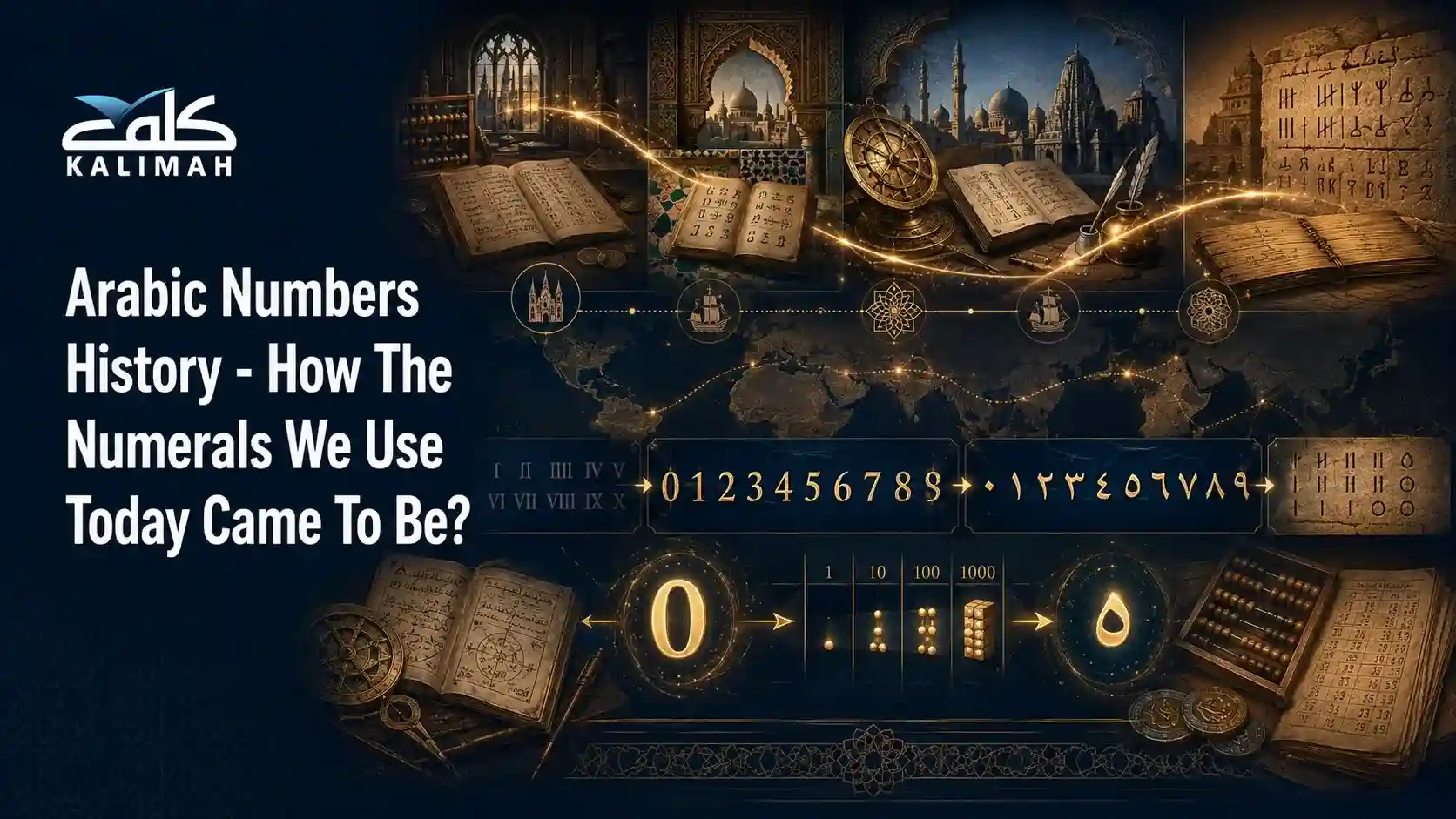
Every time you write a phone number, a price tag, or a date, you use symbols that took over a thousand years and three continents to reach their final form.
The Arabic numbers history behind 0-9 is not a single invention — it is a relay race between Indian mathematicians, Arab scholars, and European traders. Understanding this history explains why these digits are called “Arabic” even though they were not created by Arabs alone.
This article traces the full Arabic numbers history from its origins in India to its adoption across Europe, and explains why it eventually replaced Roman numerals as the standard counting system worldwide.
Who Invented Arabic Numerals?
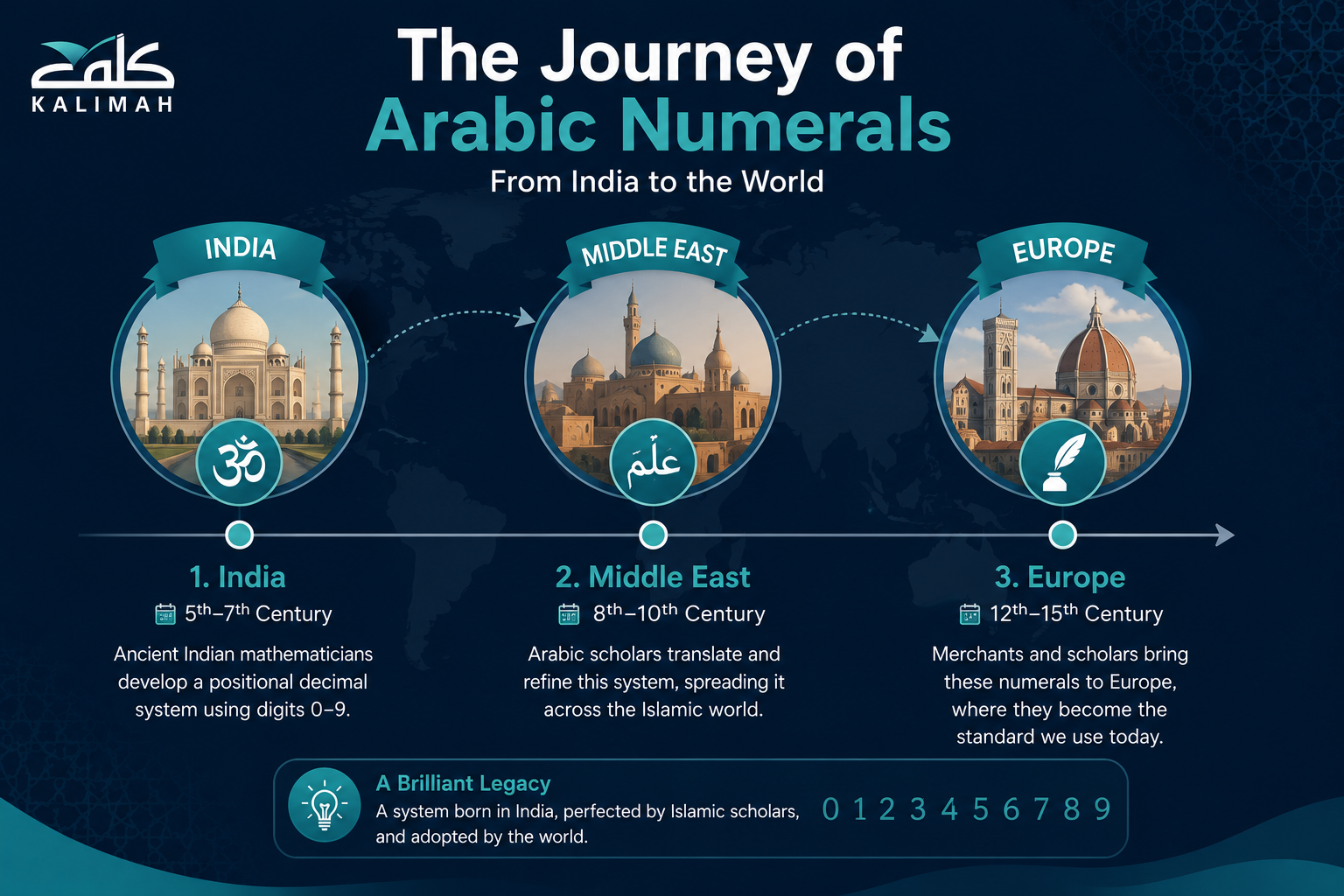
Arabic numerals were not invented by Arabs. The base symbols for 1 through 9 originated with Hindu mathematicians in India, with the earliest confirmed numeral forms appearing on stone columns built under King Ashoka around 250 BCE.
These early inscriptions show symbols for 1, 2, 4, 6, 50, and 200, but they contain no zero and no evidence of place value yet.
The system kept developing inside India for centuries. Records from the Nana Ghat caves (around 100 BCE) and the Nasik caves (around 200 CE) show numeral use expanding, though still without zero or positional value.
Zero and the positional system — where the position of a digit determines its value, not just the symbol itself — were introduced in India sometime before 800 CE. Brahmagupta, an Indian mathematician active in the 7th century, is credited with writing the first known rules for calculating with zero.
The earliest fully developed Hindu numeral system with zero is documented in an Indian text from 876 CE.
How the System Left India?
Before Arab scholars ever saw these numerals, a Syriac bishop had already noticed them. Severus Sebokht, a philosopher living at a monastery on the Euphrates, wrote in 662 CE that Indian numerals were superior to Greek ones because they could express any number using only nine symbols.
This is the earliest confirmed reference to Hindu numerals outside India, and it shows the numerals were reaching the Middle East decades before the Arab world formally adopted them.
Read Also: Read and Write Arabic Numbers
When Were Arabic Numerals Invented and Adopted by Arab Scholars?
The numerals were likely known in Baghdad by the mid-8th century, and were certainly in use there by 825 CE.
Muhammad ibn Musa al-Khwarizmi, a mathematician working during the reign of Caliph al-Ma’mun in Baghdad, wrote a book explaining how to calculate using the Hindu numeral system.
This text became the main channel through which the numerals became known first in the Islamic world, and later in the West.
Al-Khwarizmi did not simply copy the Indian forms. Arab scholars in Baghdad developed their own numeral shapes, possibly influenced by numeral traditions from Kabul in Afghanistan.
This is a detail most articles on arabic numbers history skip entirely: the numerals used in Baghdad were already a distinct regional variant, not a direct copy of Indian symbols.
The East-West Split Within the Arab World
As the numeral system spread through the Islamic world, it split into two regional forms — a detail that explains a common point of confusion today.
- Eastern Arabic numerals (٠ ١ ٢ ٣ ٤ ٥ ٦ ٧ ٨ ٩): used in Baghdad and the eastern Islamic world, still used today across much of the Middle East.
- Western Arabic numerals (0 1 2 3 4 5 6 7 8 9): developed in the Maghreb and Al-Andalus (Islamic Spain), refined from earlier Indian forms, and eventually became the global standard.
Arab scholars in the West kept the older numeral shapes deliberately, in part to distinguish their written mathematics from the Eastern Abbasid court.
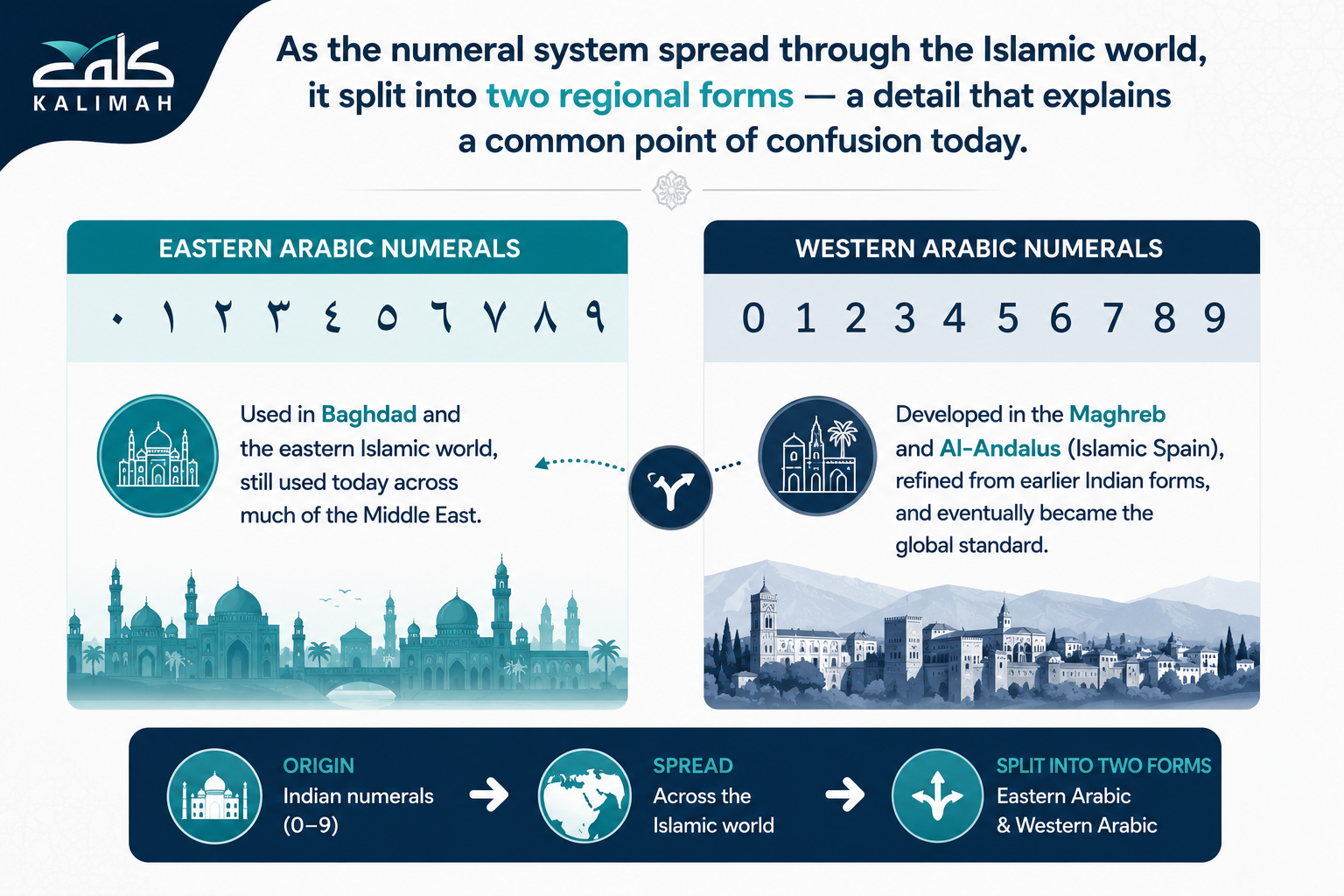
This regional divergence is why the digits used in Cairo differ visually from the digits used in Casablanca or London today, even though both trace back to the same Indian source.
Read Also: How to pronounce ha in Arabic
Al-Khwarizmi’s Method for Combining Digits
Al-Khwarizmi also described the mechanical rule for reading multi-digit numbers: when letters or digits are placed together, the larger value is written first and the smaller value follows — so twelve is written with the “ten” symbol before the “two,” and one hundred twenty-three follows the same descending order.
This ordering rule is the direct ancestor of how we still read multi-digit numbers today, largest place value first.
understanding this transmission history is not just trivia — it is one of the fastest ways to understand why Arabic script itself has a numeral logic built into it, which is one reason structured Arabic study pays off early.
If you are working through the alphabet and numerals side by side, a guided course removes a lot of the guesswork learners run into on their own — see Best Online Arabic Classes For Adults for a structured path.
Inside Kalimah Center: Moments from Our Courses
Get a glimpse into the vibrant learning experience at Kalimah Center. These snapshots capture real moments from our live classes—where students engage deeply, connect with passionate instructors, and grow in a welcoming, supportive environment.
Master Arabic with Kalimah Center
Join our expert-led online classes and start your journey toward Arabic fluency today.
Book Your Free TrialWho Brought Arabic Numerals to Europe?
The numerals reached Europe through two main channels: translation and trade. Al-Khwarizmi’s book on Hindu numerals was translated into Latin, likely by the English mathematician Adelard of Bath around 1100 CE, under the title Algoritmi de numero Indorum.
This translation is also the origin of the word “algorithm,” taken directly from al-Khwarizmi’s Latinized name.
The second, more decisive channel was Leonardo of Pisa, known as Fibonacci. Fibonacci learned the Arabic numeral system firsthand while traveling and studying in North Africa as a young man.
In 1202, he published Liber Abaci (“Book of Calculation”), a text that demonstrated how much faster Arabic numerals were for trade calculations, bookkeeping, and interest computation compared to Roman numerals.
Early Dated Evidence in Europe
Physical evidence confirms the numerals arrived in Europe earlier than Fibonacci but spread slowly.
The Codex Vigilanus, written at the Albelda monastery in Spain in 976 CE, is the oldest definitively dated European manuscript containing Hindu-Arabic numerals. A Vatican Library manuscript from 1077 also shows numeral forms close to the modern shapes.
English manuscripts using the numerals do not appear until the 13th century — showing that adoption in Europe took roughly 300 years from first contact to general use.
If you’re studying this period of exchange between Arab and European scholars, it helps to read the original terms in Arabic rather than translation.
Kalimah Center’s Intensive Arabic Group Classes With Cheap Fees are built around exactly this kind of primary-source reading practice, without requiring you to already be fluent.

Read Also: Arabic Numbers 1 to 1000
Why Did Arabic Numerals Replace Roman Numerals?
Arabic numerals replaced Roman numerals because of one structural advantage: place value. In the Roman system, a symbol’s value never changes — X is always ten, whether it appears alone or next to other symbols.
In the Arabic system, the same digit means something different depending on its position: the “3” in 30 is not the same value as the “3” in 300.
This made three practical tasks far easier, which is exactly why merchants, bankers, and scholars adopted it first:
- Addition and subtraction: column-based arithmetic with place value is mechanical; the same operations in Roman numerals require converting symbols back and forth.
- Multiplication and division: Roman numerals have no efficient method for these operations at all; the Arabic system does.
- Recording large numbers: a number like 4,872 takes four Arabic digits; the Roman equivalent (MMMMDCCCLXXII) takes thirteen symbols.
Zero was the other missing piece Roman numerals never had. Without a zero, there is no way to mark an empty place value, which is why Roman numerals cannot easily represent something like “developer notation” for 1,005 without spelling out each unit. The Hindu-Arabic zero solved that gap directly.
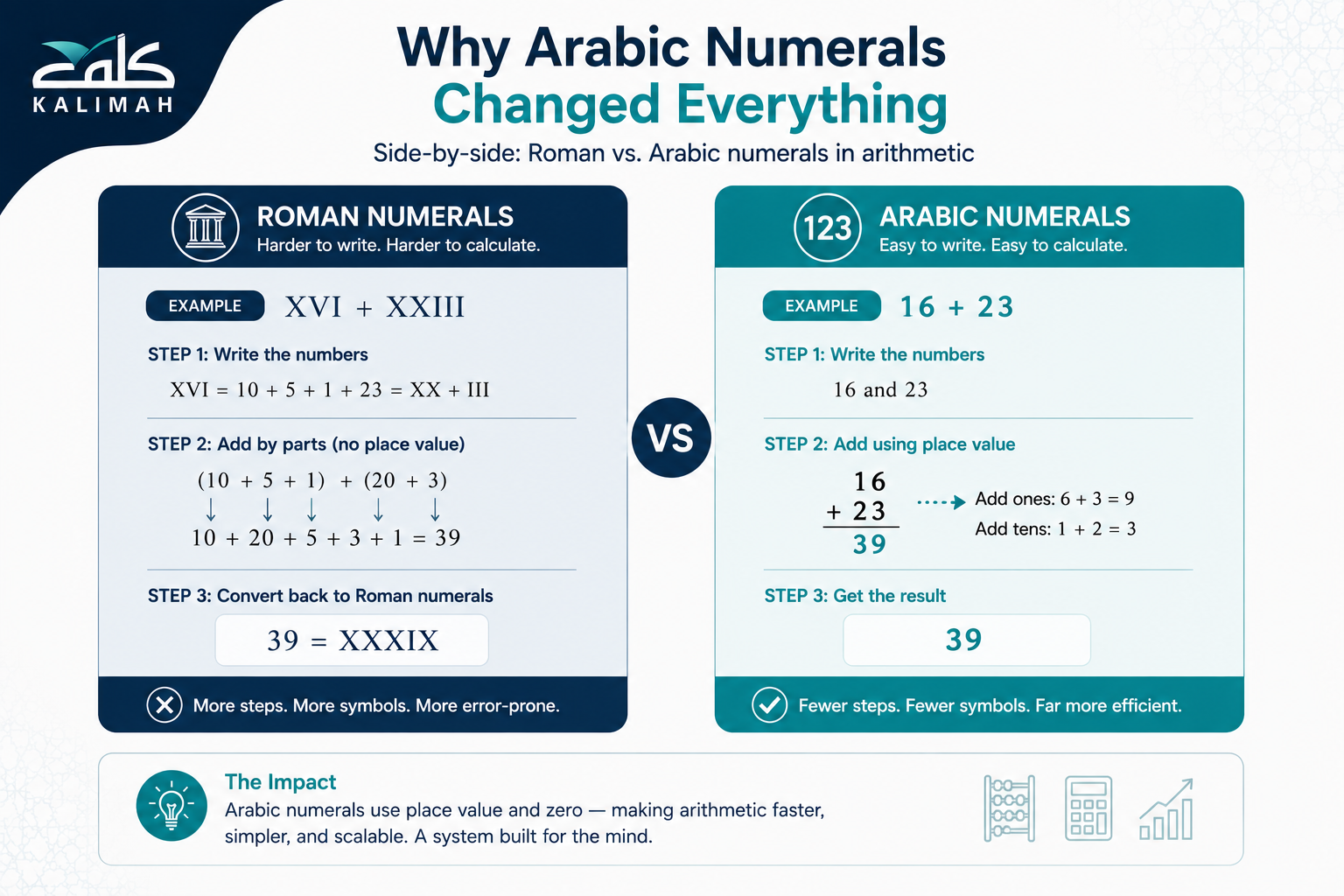
Arabic numerals did not replace Roman numerals overnight once Fibonacci published Liber Abaci.
European merchants and monasteries used both systems side by side for roughly two centuries afterward, since guilds and universities were slow to abandon Roman numerals for record-keeping. Full replacement in everyday European commerce was closer to the 15th century than the 13th.
For learners trying to connect this numeral history to actual Arabic literacy, Kalimah Center also runs Learn Arabic Online For Kids, which introduces script and number systems together from an early age rather than treating them as separate subjects.
Read Also: How to Pronounce Arabic R
Start Learning the Language Behind the Numbers
Understanding arabic numbers history is one thing — reading, writing, and speaking the language that shaped this system is another.
Kalimah Center offers structured, teacher-led Arabic courses for adults, children, and groups, so you can go from recognizing where these numerals came from to actually understanding the language and script behind them.

Whether you want to read classical texts, follow a full curriculum, or get your kids started early, there’s a course built for where you are:
- Best Online Arabic Classes For Adults: for learners who want to read and understand the script and grammar behind this history, not just the numerals.
- Intensive Arabic Group Classes With Cheap Fees: for learners who want faster progress with a study group, at a lower cost per class.
- Learn Arabic Online For Kids: for parents who want children to learn the language and number system together from an early age.
Register today and start your first class with a qualified Kalimah Center instructor.

Inside Kalimah Center: Moments from Our Courses
Get a glimpse into the vibrant learning experience at Kalimah Center. These snapshots capture real moments from our live classes—where students engage deeply, connect with passionate instructors, and grow in a welcoming, supportive environment.
Here Are The Reviews On Our Courses:
Our students frequently commend the excellence of our courses and the commitment shown by our instructors. You can read their complete reviews on Trustpilot.
Read more reviews on Trustpilot

🚀 Start Your Free Trial Today! 🚀
Don’t miss out on this life-changing opportunity to deepen your faith and knowledge. Sign up now for your free trial and take the first step towards becoming a better practicing Muslim with Kalimah Center!
Master Arabic with Kalimah Center
Join our expert-led online classes and start your journey toward Arabic fluency today.
Book Your Free TrialConclusion
The Arabic numbers history is a chain of contributions, not a single invention. Indian mathematicians created the base-10 positional system and the concept of zero.
Arab scholars, led by al-Khwarizmi in Baghdad, refined and documented the system, and split it into the Eastern and Western Arabic forms still visible today.
European scholars — first through Latin translation, then decisively through Fibonacci’s Liber Abaci — brought the numerals into everyday European use, where their place-value structure eventually made Roman numerals obsolete for calculation.
The takeaway is simple: the ten digits on your keyboard are the result of centuries of exchange across India, the Islamic world, and Europe.
Learning Arabic numbers history is also a small entry point into the wider Arabic-Islamic intellectual tradition — one that Kalimah Center’s courses are built to make accessible to learners of every level.
Frequently Asked Questions
Below are direct answers to the most common questions people ask about arabic numbers history, covering their origin, transmission, and adoption in Europe.
1. Who invented Arabic numerals?
No single person invented Arabic numerals. Hindu mathematicians in India developed the original base-10 digits and zero between roughly the 3rd century BCE and the 7th century CE. Arab scholars, most notably al-Khwarizmi, later adopted, refined, and documented the system in Baghdad.
2. When were Arabic numerals invented?
The individual digit symbols developed in India over many centuries, with the earliest forms dated to around 250 BCE. The complete system, including zero and place value, was fully documented by 876 CE, and was in confirmed use in Baghdad by 825 CE.
3. Who brought Arabic numerals to Europe?
Adelard of Bath is credited with an early Latin translation of al-Khwarizmi’s work around 1100 CE. The numerals gained wide use in Europe after Leonardo Fibonacci published Liber Abaci in 1202, having learned the system in North Africa.
4. When did Europeans start using Arabic numerals?
Isolated European manuscripts contain Arabic numerals as early as 976 CE in Spain. Broader adoption across Europe took hold gradually after 1202, with full replacement of Roman numerals in commerce and record-keeping largely complete by the 15th century.
5. Why did Arabic numerals replace Roman numerals?
Arabic numerals replaced Roman numerals because they use place value and a zero symbol, which makes addition, multiplication, and division far more efficient than Roman numeral arithmetic, which has no equivalent method for these operations.
6. Are Eastern and Western Arabic numerals the same?
No. Western Arabic numerals (0–9) are used globally and evolved in the Maghreb and Al-Andalus. Eastern Arabic numerals (٠–٩) are still used across much of the Middle East today. Both descend from the same original Indian system.