Have you ever heard a Muslim friend answer “How are you?” with a soft “Alhamdulillah” and wondered what it really means? It’s one of the first phrases every Muslim child learns. It’s also the opening line of the Quran, right after the Basmalah.
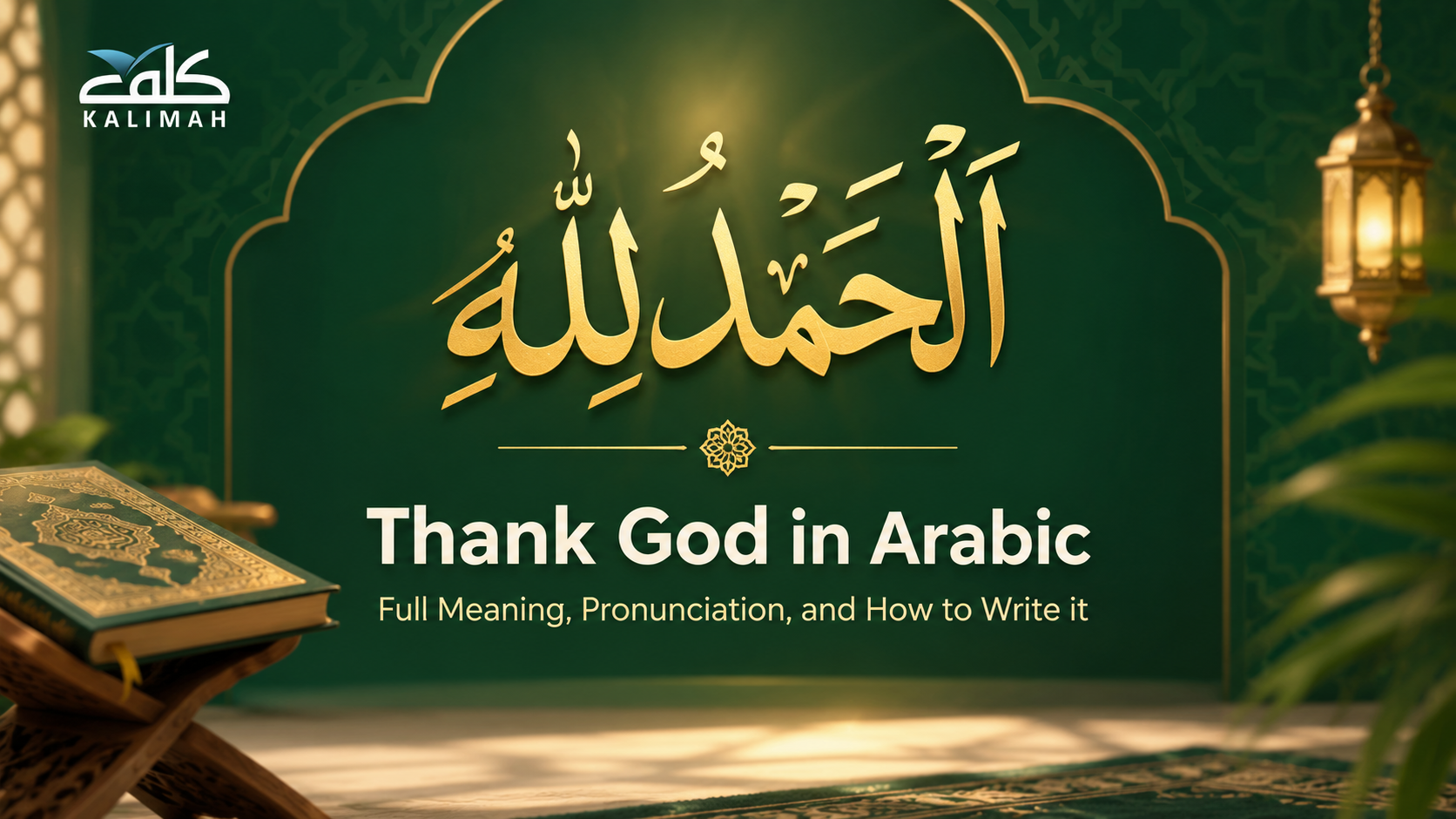
The most common way to say thank God in Arabic is الْحَمْدُ لِلَّهِ (Alhamdulillah). This short phrase carries far more than a simple “thanks.” It means that all praise, given with love and reverence, belongs to Allah alone.
This guide to thanking God in Arabic covers the word-by-word meaning, the correct spelling with and without harakat, the right pronunciation, and how to reply when someone says it to you.
What You’ll Learn
- The exact meaning of thank God in Arabic (Alhamdulillah), word by word
- How hamd differs from shukr (thanks) and madh (praise)
- How to write and spell Alhamdulillah in Arabic, with and without diacritics
- Correct pronunciation, including the tricky ḥā’ sound
- The right replies and occasions to say it
Thank God in Arabic
To say thank God in Arabic, Muslims say Alhamdulillah (الحمد لله), which literally means “All praise is for Allah.” They say it when they’re grateful, during hardship, after meals, and in daily conversation.
The Arabic phrase goes deeper than the English “thank God.” It praises Allah for who He is, not only for what He gives.
What Does Alhamdulillah Mean Word by Word?
Grammatically, Alhamdulillah is a complete nominal sentence (jumla ismiyya). Scholars explain that this structure signals permanence: Allah’s praise is constant, not tied to one moment.
Knowing each word helps you feel what you mean when you say thank God in Arabic. The phrase has three parts, and each one adds a layer of meaning:
- Al (ال): the definite article. Here it means all praise, of every kind.
- Ḥamd (حمد): praise of someone’s perfect qualities, joined with love and reverence. Arabic dictionaries define it as the opposite of blame (dhamm).
- Li-llāh (لله): “for Allah.” The lām shows that all praise belongs to Allah alone and that only He deserves it.
Ibn al-Qayyim explained that hamd is “mentioning the good qualities of the one praised, together with loving, honoring, and glorifying Him.” So when you say thank God in Arabic, you’re doing more than being polite. You’re affirming Allah’s perfection.
What Is the Difference Between Hamd, Shukr, and Madh?
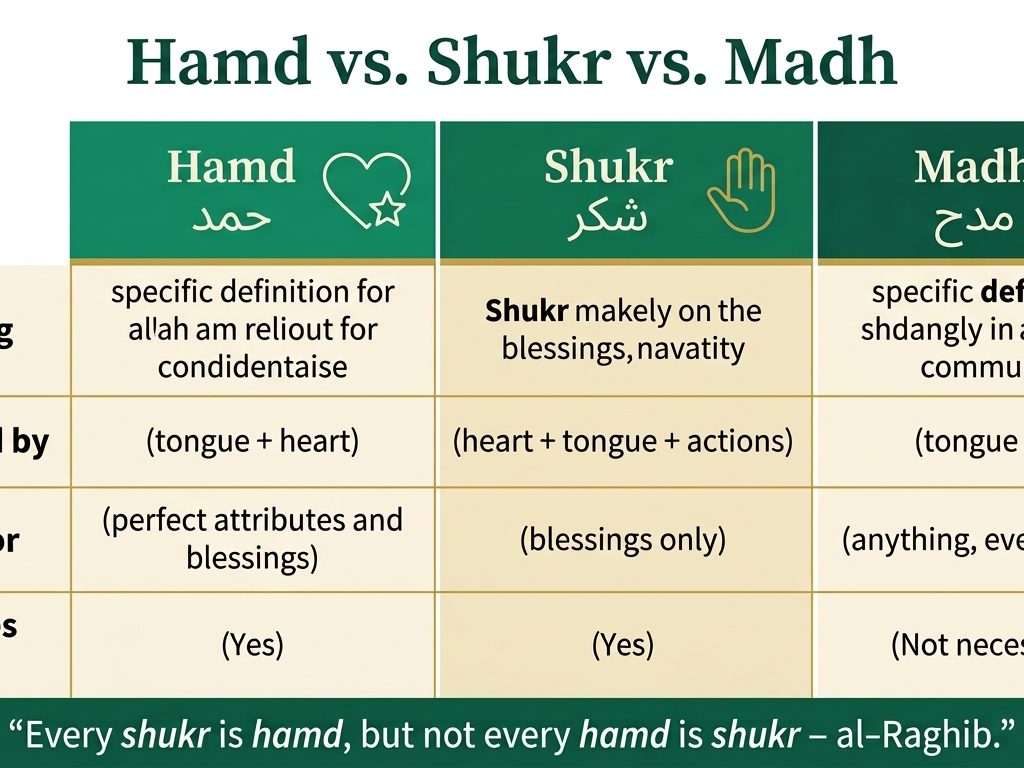
Hamd is praise of Allah’s perfect attributes, given freely and with love, whether or not you received a favor. Shukr (gratitude) is a response to a blessing, and it shows in the heart, the tongue, and your actions.
Madh (commendation) is the broadest term. You can commend a person, a gemstone, or a place, with or without love. As Imam al-Raghib put it: “Every shukr is hamd, but not every hamd is shukr; and every hamd is madh, but not every madh is hamd.”
Knowing this helps you use thank God in Arabic with its full meaning. Ibn Kathir described hamd and shukr as overlapping terms, each one wider than the other in a different respect.
Alhamdulillah in Arabic
With full harakat, Alhamdulillah is written الْحَمْدُ لِلَّهِ. This is the form you’ll find in the Mushaf, and it’s the safest form for beginners to read.
The harakat tell you exactly how to voice each letter: a fatḥa on the ḥā’, a ḍamma on the dāl, a kasra under the first lām, and a shaddah on the second. Reading these marks is the first step to saying thank God in Arabic correctly and reciting the Quran fluently.
Where Does Alhamdulillah Appear in the Quran?
Alhamdulillah is the first verse after the Basmalah in Surah Al-Fatiha, the chapter Muslims recite in every unit of prayer. Allah says:
ٱلْحَمْدُ لِلَّهِ رَبِّ ٱلْعَـٰلَمِينَ
“Al-ḥamdu lillāhi Rabbil-‘ālamīn” (“All praise is for Allah, Lord of all the worlds” (Al-Fatiha 1:2).
Because Al-Fatiha is recited in every rak’ah, a Muslim who prays the five daily prayers says thank God in Arabic at least 17 times a day. Four other surahs also open with the same praise: Al-An’am, Al-Kahf, Saba’, and Fatir.
It’s also the final call of the people of Paradise: “And the last of their call will be: All praise is for Allah, Lord of the worlds” (Yunus 10:10). Reciting these verses correctly is a key goal in our Online Quran With Tajweed Course.
Why Is It Called the Phrase That Fills the Scale?
The reward for praising Allah is far greater than the effort it takes to say it. In a long hadith about purity and faith, the Prophet ﷺ described how heavy these words will be on the Day of Judgment. The Prophet ﷺ said:
وَالْحَمْدُ لِلَّهِ تَمْلأُ الْمِيزَانَ
“Al-ḥamdu lillāh fills the scale” (Sahih Muslim 223).
Scholars explain that the “scale” (mīzān) is where deeds are weighed on the Day of Judgment. A phrase you can say in two seconds can fill it, which shows how much Allah loves sincere praise.
He also taught that Allah is pleased with a servant who eats a meal or takes a drink and then praises Him for it (Sahih Muslim 2734a).
Experience Kalimah Center Classes
Watch real excerpts from our live sessions at Kalimah Center and see how we bring learning to life. These clips highlight our interactive, student-centered teaching approach across all our courses—designed to keep learners engaged, motivated, and actively involved every step of the way.
Master Arabic with Kalimah Center
Join our expert-led online classes and start your journey toward Arabic fluency today.
Book Your Free TrialAlhamdulillah in Arabic Without Harakat
Without harakat, Alhamdulillah is written الحمد لله. This is how you’ll see it in everyday texts, messages, books, and social media posts. Native readers don’t need the vowel marks because they already know the word. If you’re still learning to read, start with the vocalized form, then gradually practice reading without diacritics.
Children usually reach this stage after they’ve mastered the Arabic letters. Our Noorani Qaida With Tajweed course builds that skill step by step.
How to Write Alhamdulillah in Arabic
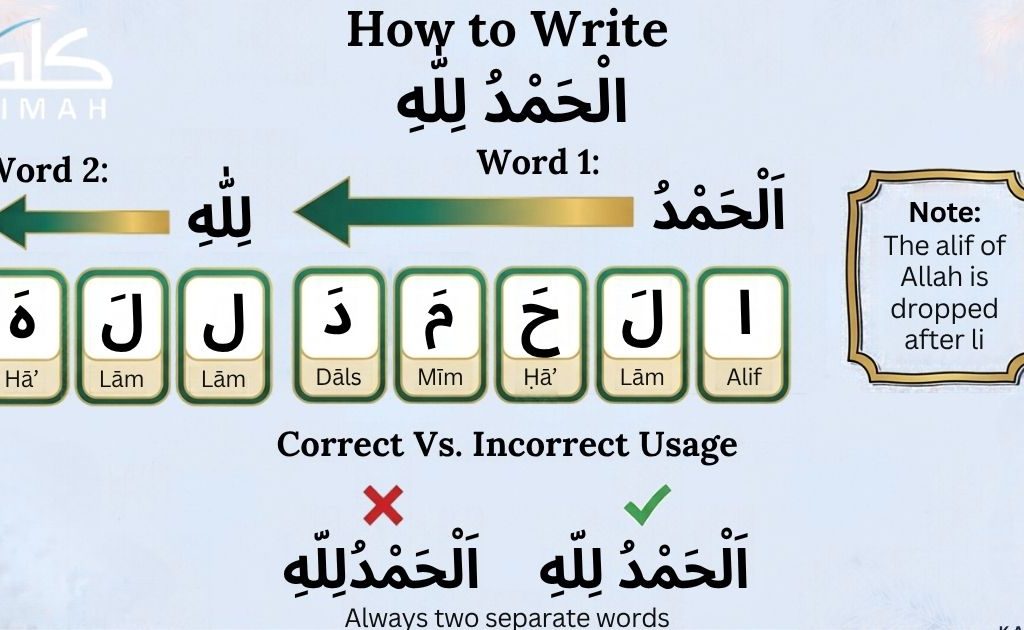
To write thank God in Arabic correctly, you need two separate words, الحمد and لله, with a space between them. Remember that Arabic is written from right to left.
Alhamdulillah takes only eight letters to write, yet it’s one of the most often misspelled Arabic phrases online. Once you know where the space goes and why one alif disappears, you’ll write it correctly every time.
How to Spell Alhamdulillah in Arabic Letter by Letter
Here is how to spell Alhamdulillah in Arabic, letter by letter:
- الحمد: Alif (ا) + Lām (ل) + Ḥā’ (ح) + Mīm (م) + Dāl (د)
- لله: Lām (ل) + Lām (ل) + Hā’ (ه)
Notice that لله has no alif after the two lāms. When the preposition li joins the word Allah (الله), the alif is dropped in writing.
Is it الحمدلله or الحمد لله?
The correct form is الحمد لله, written as two separate words. Joining them as “الحمدلله” is a common spelling mistake in messages and on social media.
Each word has its own grammatical role: al-ḥamdu is the subject (mubtada’), and lillāh is the predicate, so they must stay apart. Good writing habits are easier to build early with guided practice, like in our Arabic writing classes online.
Thank God in Arabic Pronunciation
The thank God in Arabic pronunciation is al-ḥam-du lil-lāh. Break it into four syllables and say them slowly before joining them together.
How Do You Pronounce Each Sound Correctly?
Alhamdulillah looks short, but it contains sounds that don’t exist in English. Small slips, like softening the ḥā’ or rushing the long vowel, change how it sounds when you say thank God in Arabic in prayer or recitation. Most learners struggle with three points:
- The ḥā’ (ح): a breathy “h” made deep in the middle of the throat. Don’t replace it with the soft English “h” or with “kh.”
- The doubled lām (لِّ): hold it slightly longer, because it carries a shaddah.
- The long “ā” in Allah: stretch it for two counts (madd ṭabī’ī).
Why Is the Lām in “Lillāh” Light?
In lillāh, the lām of Allah’s name is pronounced light (tarqīq) because it comes after a kasra. Compare this with “Allāhu Akbar,” where the lām comes after a fatḥa, so it’s pronounced heavy (tafkhīm).
Details like these are why it’s best to learn to say thank God in Arabic, like all recitation, with a teacher who can hear you. If you’re an adult starting, our Tajweed for beginners program covers these rules from the first lesson.
Inside Kalimah Center: Moments from Our Courses
Get a glimpse into the vibrant learning experience at Kalimah Center. These snapshots capture real moments from our live classes—where students engage deeply, connect with passionate instructors, and grow in a welcoming, supportive environment.
Master Arabic with Kalimah Center
Join our expert-led online classes and start your journey toward Arabic fluency today.
Book Your Free TrialAlhamdulillah Reply in Arabic
The right reply to Alhamdulillah depends on the situation. Here are the most common cases. In Muslim culture, replying to Alhamdulillah isn’t only good manners; in some situations, it’s part of the Sunnah. Knowing the right response helps you join conversations naturally and follow the Prophet’s ﷺ guidance in daily life.
What Do You Reply When Someone Sneezes and Says Alhamdulillah?
Reply with يَرْحَمُكَ اللَّهُ (Yarḥamuk-Allāh), “May Allah have mercy on you.” The person then answers يَهْدِيكُمُ اللَّهُ وَيُصْلِحُ بَالَكُمْ (Yahdīkumullāhu wa yuṣliḥu bālakum), “May Allah guide you and set your affairs right” (Sahih al-Bukhari 6224).
What Do You Reply When Someone Says Alhamdulillah After “How Are You?”
You can simply reply “Alhamdulillah” as well. You can also add a short prayer such as دامت عليك النعمة (Dāmat ‘alayka an-ni’mah), “May the blessing stay with you.”
When Should You Say Thank God in Arabic?
Muslims say it in good times and bad. When the Prophet ﷺ saw something he liked, he said, “Al-ḥamdu lillāhil-ladhī bi ni’matihi tatimmuṣ-ṣāliḥāt.” When he saw something he disliked, he said: “Al-ḥamdu lillāhi ‘alā kulli ḥāl” (Sunan Ibn Majah 3803).
كَانَ رَسُولُ اللَّهِ ـ صلى الله عليه وسلم ـ إِذَا رَأَى مَا يُحِبُّ قَالَ ” الْحَمْدُ لِلَّهِ الَّذِي بِنِعْمَتِهِ تَتِمُّ الصَّالِحَاتُ ” . وَإِذَا رَأَى مَا يَكْرَهُ قَالَ ” الْحَمْدُ لِلَّهِ عَلَى كُلِّ حَالٍ ” .
Teaching kids to say thank God in Arabic, along with other short adhkar, is one of the easiest ways to build gratitude at home. Our Quran for kids classes include these daily phrases in every lesson.
Learn to Recite Alhamdulillah and the Whole Quran Correctly
Knowing how to say thank God in Arabic is a beautiful first step. The next step is reading Al-Fatiha and the rest of the Quran with proper tajweed and real understanding.
At Kalimah Center, certified native tutors teach kids and adults in live one-on-one classes. You choose the schedule, and your tutor corrects every letter until it sounds right.
???? Explore Our Courses:
- Online Arabic Course: Tailored to your level, our comprehensive Arabic program includes 16 teaching levels and 400+ hours of personalized sessions.
- Online Quran With Tajweed Course: Perfect for non-Arabic speakers, our course spans 13 levels and equips you with Tajweed mastery from beginner to advanced.
- Online Arabic Course For Kids: Nurture your child’s love for Arabic with our engaging and structured program, available in 24 levels for primary, intermediate, and secondary stages.
Our programs fit every level, from children learning the Arabic letters to adults perfecting their makharij or memorizing the Quran. Every lesson combines recitation, meaning, and practice, so phrases like Alhamdulillah become part of your daily worship.
Join our Tajweed and Quran recitation circles, or start learning Arabic with our Arabic course. Book your free trial class today.
Master Arabic with Kalimah Center
Join our expert-led online classes and start your journey toward Arabic fluency today.
Book Your Free TrialConclusion
Alhamdulillah is the most complete way to say thank God in Arabic. It brings together praise, love, and reverence for Allah, and that’s what separates hamd from simple thanks or commendation.
You now know how to write thank God in Arabic as الحمد لله, in two separate words. You can read it with or without harakat and pronounce it as al-ḥam-du lil-lāh, with a clear ḥā’ and a light lām.
You also learned the right replies: Yarḥamuk-Allāh after a sneeze and a kind dua after “How are you?” Most importantly, saying thank God in Arabic in both ease and hardship keeps your heart connected to Allah all day.
Take-away message: say Alhamdulillah with your tongue, feel it in your heart, and live it through your actions. To master its recitation, and the whole Quran, learn with a qualified tajweed teacher.
FAQs
Here are quick answers to the questions people ask most about thanking God in Arabic.
How do you say thank God in Arabic?
You say Alhamdulillah (الحمد لله), meaning “All praise is for Allah.” Another phrase is Shukran lillāh (شكرًا لله), “Thanks to Allah,” but Alhamdulillah is the standard Islamic expression.
What is the difference between Alhamdulillah and Shukran?
Shukran means “thank you” and is said to people. Alhamdulillah is praise directed only to Allah, for His perfect attributes and His countless blessings.
Is Alhamdulillah written as one word or two?
It’s written as two words: الحمد لله. Writing it as one word (الحمدلله) is a common error because each word has its own grammatical role.
What is the reply to Alhamdulillah?
After a sneeze, reply “Yarḥamuk-Allāh.” In regular conversation, you can say “Alhamdulillah” back or add a short dua for the person.
Can non-Muslims say Alhamdulillah?
Yes. Many Arabic-speaking Christians use it in daily speech to express gratitude to God, since “Allah” is simply the Arabic word for God.