Has someone helped you, and you want to thank them with more than a quick “thanks”? Muslims around the world use one short phrase for that moment. Learning to write jazakallah khair in Arabic correctly is often one of the first steps learners take toward the language of the Quran.
The phrase is easy to say. Still, many people misspell it, leave out half of it, or use the wrong form for a woman or a group. Others aren’t sure how to answer when someone says it to them.
This guide shows you jazakallah khair in Arabic with and without harakat and explains what each word means. It also covers the Sunnah behind the phrase and the correct reply for every situation.
Key Takeaways
- How to write jazakallah khair in Arabic (جَزَاكَ اللَّهُ خَيْرًا) and what each word means.
- Why “Jazakallah” on its own is incomplete.
- The correct form of jazakallah khair in Arabic for a man, a woman, two people, and a group.
- The best replies, including وَإِيَّاكُمْ and بَارَكَ اللَّهُ فِيكَ.
- The hadith that makes this phrase the most complete way to thank someone.
Jazakallah Khair in Arabic
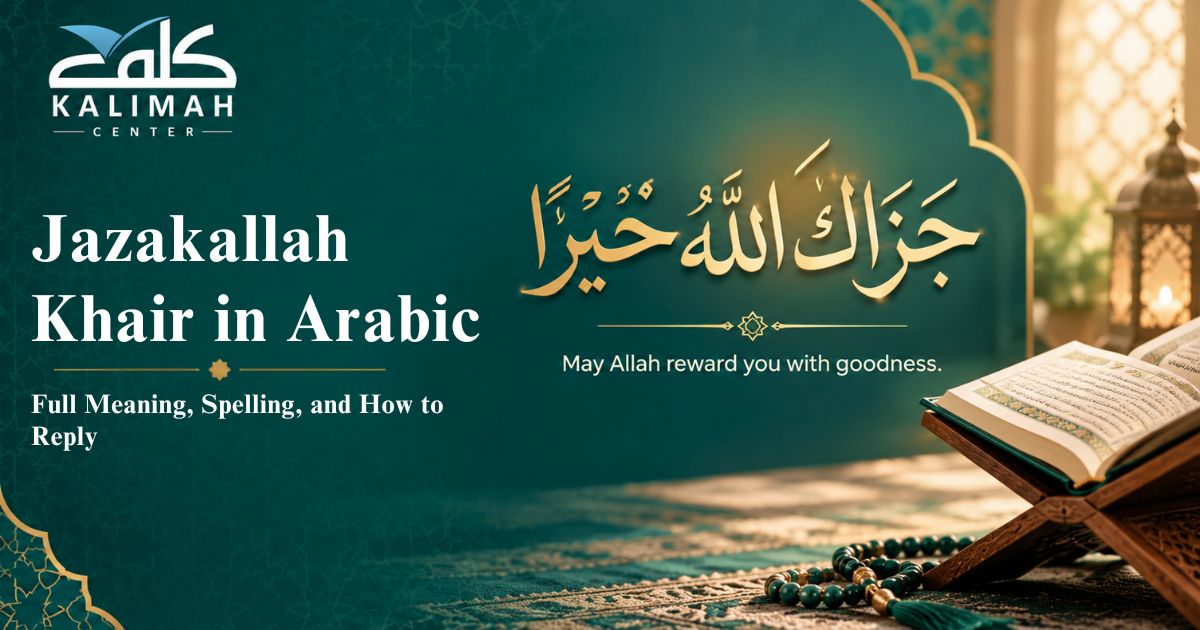
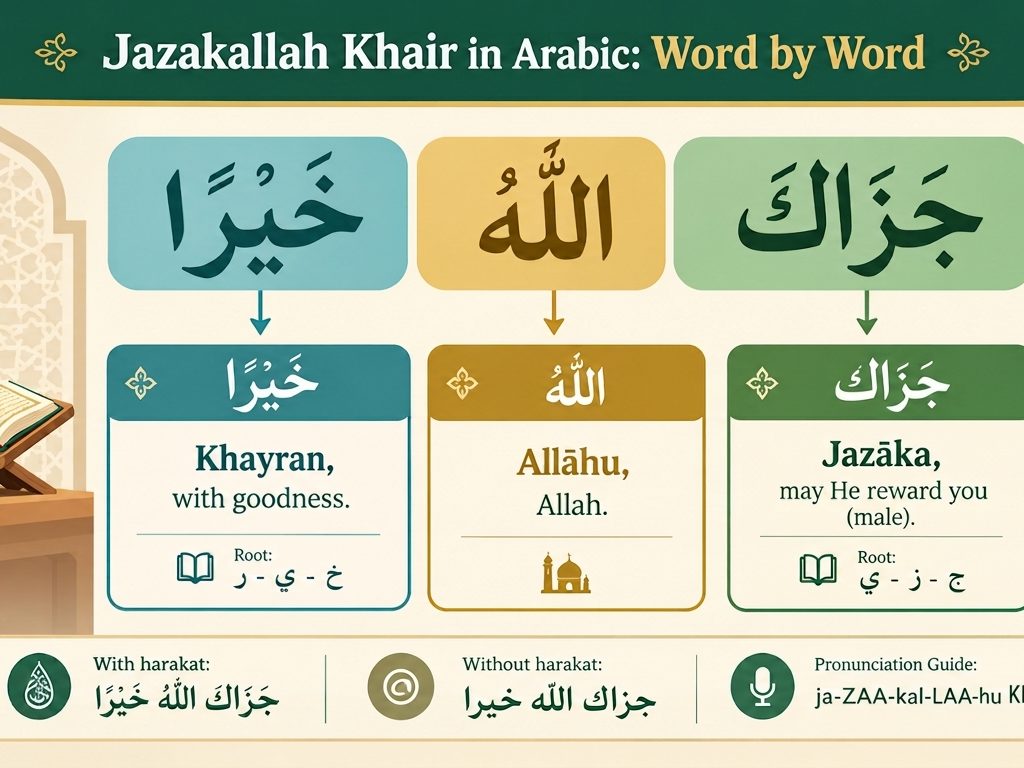
Jazakallah khair in Arabic is written جَزَاكَ اللَّهُ خَيْرًا and pronounced Jazāka-llāhu khayran. It means “May Allah reward you with goodness.” You aren’t only thanking the person. You’re asking Allah to repay them with a reward far greater than anything you could give.
What Does Each Word Mean?
The phrase has three parts, and each one adds to the meaning:
| Arabic | Transliteration | Meaning |
| جَزَى + كَ | Jazā + ka | He rewarded + you (male) |
| اللَّهُ | Allāhu | Allah |
| خَيْرًا | Khayran | (with) goodness |
The root ج-ز-ي means to reward or recompense. The scholar al-Mubarakfuri explained that khayran here means goodness in general, covering both this world and the Hereafter.
The Grammar Behind the Phrase
For students of Arabic grammar, the i’rab (إعراب) of jazakallah khair in Arabic is a classic exercise:
- جَزَى: a past-tense verb, built on an implied fatha.
- الكاف: an attached pronoun and the first object (مفعول به أول).
- اللَّهُ: the subject (فاعل), marked with a damma.
- خَيْرًا: the second object (مفعول به ثانٍ), marked with a fatha and tanween.
The verb is in the past tense, but its meaning is a supplication (dua), not a statement about something that already happened.
Common Mistakes to Avoid
Even native speakers and longtime learners slip up with this phrase, especially in quick texts and casual speech. These small errors can change its grammar or meaning, so they’re worth catching early. Here are the most common ones and how to fix them:
- Saying “جزاك الله خيرٌ”: khayr must be in the accusative case (خيرًا) because it is the second object.
- Saying “يجزاك الله”: the present tense of جَزَى is يَجْزِي, so the correct form is يَجْزِيكَ اللَّهُ خَيْرًا.
- Using the wrong pronoun: saying jazaka to a woman when it should be jazaki.
Small errors like these turn jazakallah khair in Arabic from a dua into a mistake. A structured online Arabic course helps you fix them early, before they become habits.
Jazakallah Khair in Arabic Without Harakat
Without harakat (diacritics), jazakallah khair in Arabic is written جزاك الله خيرا. This is how you’ll usually see it in text messages, on social media, and in everyday Arabic writing, where readers are expected to know the vowels.
When Should You Use Harakat?
Use the version with vowel marks, جَزَاكَ اللَّهُ خَيْرًا, when you write for beginners, children, or non-Arabic speakers. The marks show exactly how to pronounce each letter and whether you mean the male or female form.
The short form jazakallah khair is common in speech. For formal writing, the full jazakallahu khairan is the grammatically correct choice.
Experience Kalimah Center Classes
Watch real excerpts from our live sessions at Kalimah Center and see how we bring learning to life. These clips highlight our interactive, student-centered teaching approach across all our courses—designed to keep learners engaged, motivated, and actively involved every step of the way.
Master Arabic with Kalimah Center
Join our expert-led online classes and start your journey toward Arabic fluency today.
Book Your Free TrialJazakallah in Arabic
Jazakallah in Arabic is جَزَاكَ اللَّهُ, which means “May Allah reward you.” On its own, the phrase is incomplete because a reward (jazā’) can be good or bad.
Many non-Arab Muslims shorten it in daily speech, and listeners usually understand what they mean. Knowing the full form of jazakallah khair in Arabic, though, lets you say the dua exactly as it was taught.
Why You Should Add “Khair”
Adding خَيْرًا makes the dua clear: you’re asking Allah to reward the person with goodness. Many teachers encourage students to say the full phrase so it matches the wording the Prophet ﷺ taught.
The word khayran also widens the dua, because it covers every kind of good in this life and the next. Leave it out, and the most important part of the request goes unsaid.
Common English Spellings
You’ll see many spellings in English: JazakAllah Khair, Jazakallahu Khairan, Jazak Allahu Khayran, JZK. They all mean the same phrase. Writing jazakallah khair in Arabic script removes any doubt about its meaning or pronunciation.
English letters can only approximate Arabic sounds, which is why the same phrase shows up in so many spellings online. Once you learn the Arabic letters, you can read and pronounce it correctly every time.
Jazakallah Khair in Arabic for Women
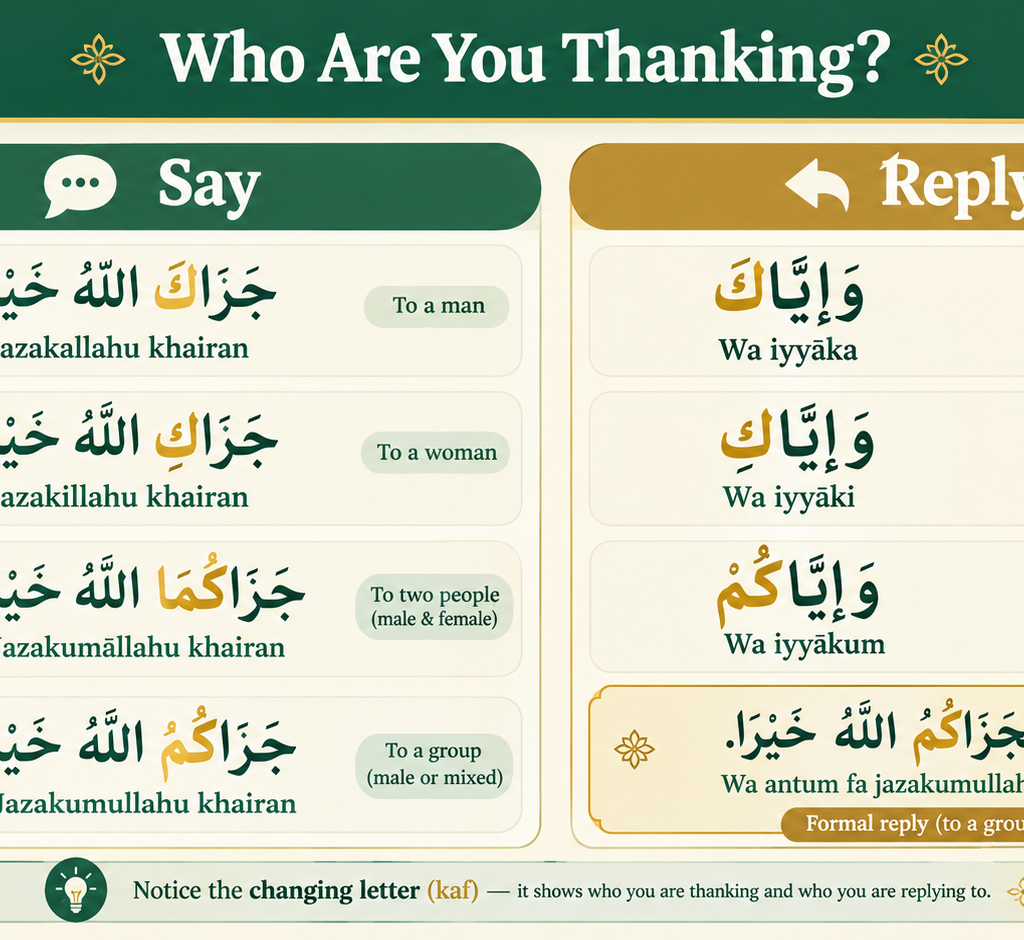
In Arabic, pronouns change with gender and number, so the phrase changes too. Jazakallah khair in Arabic for women is جَزَاكِ اللَّهُ خَيْرًا (Jazāki-llāhu khayran). The kaf takes a kasra instead of a fatha.
All Forms of Jazakallah Khair in Arabic
Once you understand how Arabic pronouns work, picking the right form is easy. The table below shows every common form of jazakallah khair in Arabic, whether you’re speaking to someone directly or making dua for a person who isn’t there.
| Speaking to/about | Arabic | Transliteration |
| One man | جَزَاكَ اللَّهُ خَيْرًا | Jazākallāhu khayran |
| One woman | جَزَاكِ اللَّهُ خَيْرًا | Jazākillāhu khayran |
| Two people | جَزَاكُمَا اللَّهُ خَيْرًا | Jazākumā-llāhu khayran |
| A group | جَزَاكُمُ اللَّهُ خَيْرًا | Jazākumullāhu khayran |
| About a man (absent) | جَزَاهُ اللَّهُ خَيْرًا | Jazāhullāhu khayran |
| About a woman (absent) | جَزَاهَا اللَّهُ خَيْرًا | Jazāhallāhu khayran |
| About a group (absent) | جَزَاهُمُ اللَّهُ خَيْرًا | Jazāhumullāhu khayran |
Some speakers use the plural جَزَاكُمُ اللَّهُ خَيْرًا when they address one respected person, such as a teacher or an elder. It’s a polite form, and people widely understand it.
Jazakallahu Khairan Reply
The most common jazakallahu khairan reply is وَإِيَّاكُمْ (Wa iyyākum), which means “and you too.” It sends the same dua back to the person who thanked you.
Replying is part of the etiquette, because it turns one dua into an exchange of goodwill between two people. Like the phrase itself, your reply should match the person in front of you.
Jazakallah Khair in Arabic: Reply for a Man, Woman, and Group
Choose your jazakallah khair in Arabic reply based on who said it to you:
| Reply to | Arabic | Transliteration |
| A man | وَإِيَّاكَ | Wa iyyāka |
| A woman | وَإِيَّاكِ | Wa iyyāki |
| A group | وَإِيَّاكُمْ | Wa iyyākum |
| Formal reply | وَأَنْتُمْ فَجَزَاكُمُ اللَّهُ خَيْرًا | Wa antum fa jazākumullāhu khayran |
Other Warm Replies
Wa iyyākum isn’t the only correct answer. Arabic has several other replies that return the kindness with a dua of your own, and each one works well in conversation, in a text message, or at the masjid:
- آمِين، وَإِيَّاكُمْ: “Ameen, and to you as well.”
- بَارَكَ اللَّهُ فِيكَ: “May Allah bless you.” Use فِيكِ for a woman and فِيكُمْ for a group.
- جَزَانَا وَإِيَّاكُمْ: “May He reward you and us.”
When you practice these replies out loud with a teacher, the correct vowels start to come naturally. That’s one reason students in our Arabic classes for children learn to read and write jazakallah khair in Arabic and other everyday Islamic phrases.
Inside Kalimah Center: Moments from Our Courses
Get a glimpse into the vibrant learning experience at Kalimah Center. These snapshots capture real moments from our live classes—where students engage deeply, connect with passionate instructors, and grow in a welcoming, supportive environment.
Master Arabic with Kalimah Center
Join our expert-led online classes and start your journey toward Arabic fluency today.
Book Your Free TrialThe Sunnah Behind Saying Jazakallah Khair
Saying jazakallah khair in Arabic is more than good manners. It follows a direct teaching of the Prophet ﷺ.
The Hadith in At-Tirmidhi
The strongest evidence for this phrase is a hadith recorded by Imam at-Tirmidhi. In it, the Prophet ﷺ explains how a Muslim can thank someone most completely, even with very few words: Usamah ibn Zaid narrated that the Messenger of Allah ﷺ said:
«مَنْ صُنِعَ إِلَيْهِ مَعْرُوفٌ فَقَالَ لِفَاعِلِهِ: جَزَاكَ اللَّهُ خَيْرًا، فَقَدْ أَبْلَغَ فِي الثَّنَاءِ»
“Whoever has a favor done for him and says to the one who did it, ‘Jazakallahu khairan,’ has done the most he can of praise” (Jami’ at-Tirmidhi 2035).
“He has done the most he can of praise” means this short dua fully covers the duty of thanks. Scholars explain that admitting you can’t truly repay a favor, and leaving the reward to Allah, is the highest form of appreciation.
A Dua That Returns to You
Islam encourages Muslims to answer kindness with kindness. When you can’t give back something of equal value, the Sunnah offers another way to repay the favor, and its benefit comes back to you as well
«وَمَنْ صَنَعَ إِلَيْكُمْ مَعْرُوفًا فَكَافِئُوهُ، فَإِنْ لَمْ تَجِدُوا مَا تُكَافِئُونَهُ فَادْعُوا لَهُ حَتَّى تَرَوْا أَنَّكُمْ قَدْ كَافَأْتُمُوهُ»
“Whoever does you a favor, repay him. If you cannot find anything to repay him with, pray for him until you feel you have repaid him” (Sunan Abi Dawud 1672).
And when a Muslim prays for his brother while he is absent, an angel says, “And for you the same” (Sahih Muslim 2732).
Together, these hadiths show that jazakallah khair in Arabic is a real way of repaying someone, not just a polite word. If you also pray for that person when they aren’t there, an angel asks Allah to give you the same good.
A Reflection From the Quran
The meaning behind jazakallah khair in Arabic has deep roots in the Quran. In Surah Ar-Rahman, Allah describes the gardens He has prepared for those who fear standing before Him, then asks a question that sums up how He rewards good deeds: Allah says:
﴿هَلْ جَزَاءُ الْإِحْسَانِ إِلَّا الْإِحْسَانُ﴾
“Is the reward for good anything but good?”
Scholars explain that whoever does good in this world will be met with Allah’s generosity and Paradise in the next. When you say jazakallah khair, you live out this principle by asking Allah to answer someone’s kindness with something even better.
Reading verses like this with correct pronunciation is at the heart of our Quran course. There, students link the words they say every day to the words of the Quran.
Learn Quran and Arabic With Kalimah Center Today
Knowing jazakallah khair in Arabic is a beautiful start, but it’s only one phrase. Imagine reading the Quran fluently, understanding your daily duas, and speaking Arabic with confidence. Every phrase you learn correctly brings that goal a step closer.
At Kalimah Center, qualified teachers guide kids and adults through Tajweed, Quran recitation, and Arabic. Classes are live, either one-on-one or in group classes, and every lesson fits your level and schedule.
Explore Our Courses:
- Online Arabic Course: Tailored to your level, our comprehensive Arabic program includes 16 teaching levels and 400+ hours of personalized sessions.
- Online Quran With Tajweed Course: Perfect for non-Arabic speakers, our course spans 13 levels and equips you with Tajweed mastery from beginner to advanced.
- Online Arabic Course For Kids: Nurture your child’s love for Arabic with our engaging and structured program, available in 24 levels for primary, intermediate, and secondary stages.
Teachers focus on correct pronunciation from the first lesson, so mistakes get fixed before they turn into habits. You might be a parent looking for Tajweed for kids, or an adult starting from the alphabet.
Either way, your path starts with one free trial class. Book it today and take your first real step. It’s an easy way to meet your teacher and see how lessons work before you decide.
Master Arabic with Kalimah Center
Join our expert-led online classes and start your journey toward Arabic fluency today.
Book Your Free TrialConclusion
Jazakallah khair in Arabic is written جَزَاكَ اللَّهُ خَيْرًا, or جزاك الله خيرا without harakat. It means “May Allah reward you with goodness,” and it turns simple thanks into a dua asking Allah to repay a kindness. Learning it properly is a small step with a lasting reward.
The phrase changes with the person you’re speaking to: جَزَاكِ for a woman and جَزَاكُمْ for a group. The best reply is وَإِيَّاكَ or وَإِيَّاكُمْ.
Avoiding small grammar mistakes keeps the meaning intact. Using the right form shows care for the language and for the person you’re thanking.
The takeaway is simple: learn jazakallah khair in Arabic, make this Sunnah part of your daily speech, and say it sincerely. Each time you do, you thank a person, remember Allah, and revive a teaching of the Prophet ﷺ. Jazakumullahu khairan for reading.
FAQs
Here are quick answers to the questions people ask most often about this phrase.
How do you write jazakallah khair in Arabic?
With harakat, it’s written جَزَاكَ اللَّهُ خَيْرًا. Without them, it’s جزاك الله خيرا. Use جَزَاكِ for a woman and جَزَاكُمْ for a group.
Is it better to say jazakallah khair than shukran?
Both are acceptable. Shukran (شكرًا) simply means “thank you,” while jazakallah khair in Arabic is a dua. The Prophet ﷺ described it as the most complete way to praise someone for a favor.
What is the correct reply to jazakallahu khairan?
Say وَإِيَّاكَ to a man, وَإِيَّاكِ to a woman, or وَإِيَّاكُمْ to a group. A fuller reply is وَأَنْتُمْ فَجَزَاكُمُ اللَّهُ خَيْرًا.
Is “jazakallah” alone correct?
People will understand it, but it’s incomplete. Jazakallah means “May Allah reward you,” and adding khairan makes it a reward of goodness.
Can I say jazakallah khair to a non-Muslim?
Many scholars allow general good wishes to non-Muslims, while some prefer a dua for guidance instead. A simple “thank you” or shukran, is always appropriate.
What does JZK mean?
JZK is an online abbreviation of Jazakallah Khair. It’s fine in casual chats, but writing the full phrase, ideally in Arabic, is better because it is a dua.