Walk into a classroom in Cairo, London, or Kuala Lumpur, and you’ll probably meet a Muhammad, an Omar, a Maryam, or a Noor.
These common Arabic names have been passed down for more than a thousand years, and parents still choose them today. Some carry the name of a prophet, others come straight from the Quran, and almost all of them are easy to say no matter where you live.
If you’re picking a name for your baby, or you’re just curious what your own name means, you’re in the right place.
Below you’ll find the most popular Arabic names for boys and girls, plus a list of rare ones for parents who want something less familiar. Each name comes with its Arabic spelling, a simple guide to saying it, and what it really means.
What you will learn in this article
- The most common Arabic names for boys and girls.
- Rare Arabic names that few families use today.
- How each name looks in Arabic script.
- How to say Arabic sounds that English does not have.
- How to pick a name you will not regret.
Most Common Arabic Names For Boys
The most common Arabic names for boys come from the Quran, the prophets, and the Prophet’s companions. In every table, capital letters show the part of the name you stress. An apostrophe (‘) stands for the Arabic letter ع.
The Most Popular Muslim Names For Boys
These are the names you’ll hear called out most often in mosques, schools, and family gatherings around the world. Many parents pick them to honor the Prophet ﷺ, his family, or the prophets before him, so each name comes with a story your son can grow up proud of.
| Name | In Arabic | Say it | Meaning and story |
| Muhammad | محمد | moo-HAM-mad | Praised again and again. The name of the Prophet ﷺ |
| Ahmad | أحمد | AH-mad | Most worthy of praise. Another name of the Prophet ﷺ |
| Omar | عمر | ‘OO-mar | Long life. Name of the second caliph, Umar ibn al-Khattab |
| Ali | علي | ‘a-LEE | High in rank. Name of the Prophet’s cousin |
| Yusuf | يوسف | YOO-suf | Prophet Joseph. A full surah tells his story |
| Abdullah | عبد الله | ab-DUL-lah | Servant of God |
| Abdulrahman | عبد الرحمن | ab-dur-rah-MAAN | Servant of the Most Merciful |
| Adam | آدم | AA-dam | The first man. Linked to the word for the earth’s surface |
| Yaseen | ياسين | yaa-SEEN | The first letters of Surah Ya-Sin |
| Hamza | حمزة | HAM-zah | Strong and firm. The Prophet’s uncle, known as the Lion of God |
Abdullah and Abdulrahman have a special place in Islam. The Prophet ﷺ said these two names are the most loved by God, as reported in Sahih Muslim. Scholars at Islamweb also say that names starting with “Abd” and joined to a name of God share this honor.
That is why you meet so many men named Abdulaziz, Abdulkarim, and Abdulmalik. Each one means “servant of” a name of God.
Other Well-Known Arabic Names For Boys
Not every popular name belongs to a prophet or a famous companion. The names below are loved for their meanings, like strength, growth, and safety, which parents hope their sons will carry with them for life.
| Name | In Arabic | Say it | Meaning and story |
| Khalid | خالد | KHAA-lid | Lasting forever. Khalid ibn al-Walid was a famous companion |
| Iyad | إياد | ee-YAAD | Strength and firm support |
| Ziyad | زياد | zee-YAAD | Growth, more of something good |
| Tamim | تميم | ta-MEEM | Complete and strong. Also the name of a large Arab tribe |
| Rayyan | ريّان | ray-YAAN | Fully watered after thirst |
| Saleem | سليم | sa-LEEM | Safe and free from harm |
| Kinan | كنان | ki-NAAN | Cover and shelter |
Rayyan has a lovely link to fasting. The Prophet ﷺ said Paradise has a gate called Ar-Rayyan, and only people who fast will enter through it. You can read this hadith in Sahih al-Bukhari.
Families who love Ramadan often choose this name for that reason. A small fact like this can help you decide between two names you like.
Most Common Arabic Names For Girls
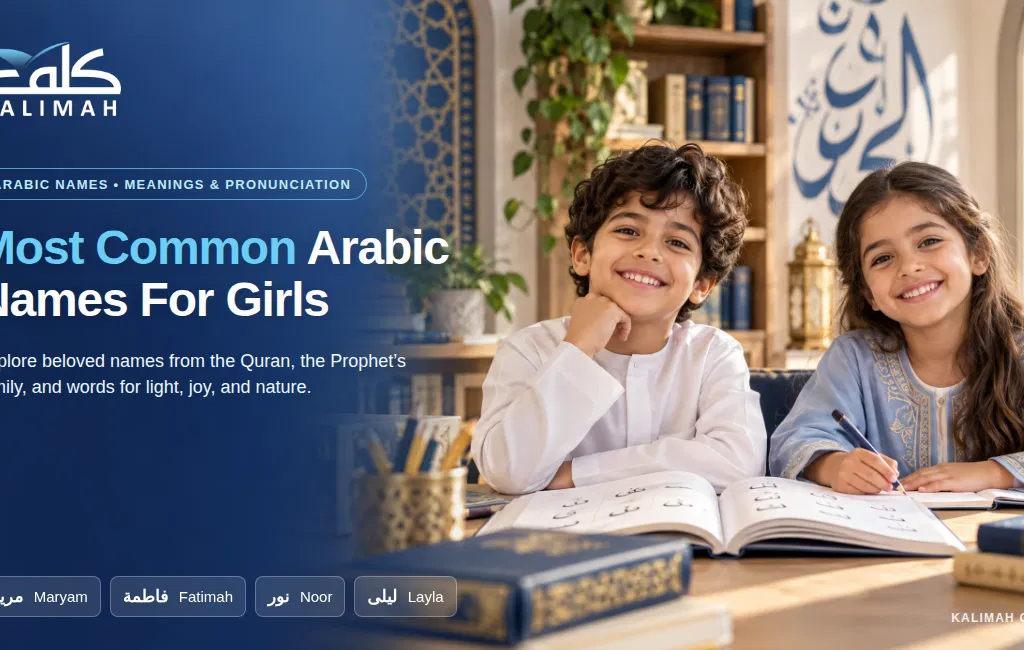
The most common Arabic names for girls belong to the women of the Quran and the Prophet’s family. Next come names about light, joy, and nature.
The Most Popular Muslim Names For Girls
These names belong to some of the most respected women in Islam, from the mother of Prophet Isa to the Prophet’s own wives and daughters. Giving your daughter one of them links her to a woman whose faith, kindness, or courage is still remembered today.
| Name | In Arabic | Say it | Meaning and story |
| Maryam | مريم | MAR-yam | Mother of Prophet Isa. Means a woman devoted to God |
| Fatimah | فاطمة | FAA-ti-mah | One who keeps away from wrong. The Prophet’s daughter |
| Khadijah | خديجة | kha-DEE-jah | The Prophet’s first wife and the first person to believe in him |
| Aisha | عائشة | ‘AA-i-shah | Full of life. A wife of the Prophet and a great teacher of hadith |
| Zainab | زينب | ZAY-nab | A sweet-smelling tree. Also a daughter of the Prophet |
| Jannah | جنّة | JAN-nah | Garden, Paradise |
| Joudi | جودي | JOO-dee | The mountain where Noah’s ship came to rest (Quran 11:44) |
Maryam is the only woman called by name in the Quran. A whole chapter, Surah Maryam, carries her name. This is one reason her name never goes out of style.
Joudi is a newer favorite. Parents like it because it is short, soft, and tied to a story every Muslim child learns.
Other Well-Loved Arabic Names For Girls
Many parents want a name that feels warm and gentle, so they turn to words for light, joy, and the beauty of nature. You’ll hear the names below in homes across the Arab world, and most of them are short enough to sound just as sweet in English.
| Name | In Arabic | Say it | Meaning and story |
| Noor | نور | NOOR | Light |
| Sarah | سارة | SAA-rah | Princess. In Arabic, also “one who brings joy.” Wife of Prophet Ibrahim |
| Layla | ليلى | LAY-laa | Night. The heroine of the old love story Layla and Majnun |
| Farah | فرح | FA-rah | Joy |
| Reem | ريم | REEM | White gazelle |
| Layan | ليان | la-YAAN | Softness and an easy life |
| Salma | سلمى | SAL-maa | Safe and at peace |
| Salwa | سلوى | SAL-waa | Comfort that takes sadness away |
| Arwa | أروى | AR-waa | Mountain goat. Queen Arwa ruled Yemen long ago |
Salwa also appears in the Quran. In Surah Al-Baqarah 2:57, God sent food called al-mann and as-salwa to the Children of Israel. Many parents love names like this. The more they read, the more the name means to them.
Does your daughter carry one of these names? Then reading it in the Quran is a sweet first goal. The Arabic course for kids at Kalimah Center starts at that level, with teachers trained to work with children.
Experience Kalimah Center Classes
Watch real excerpts from our live sessions at Kalimah Center and see how we bring learning to life. These clips highlight our interactive, student-centered teaching approach across all our courses—designed to keep learners engaged, motivated, and actively involved every step of the way.
Master Arabic with Kalimah Center
Join our expert-led online classes and start your journey toward Arabic fluency today.
Book Your Free TrialUnique Arabic Names For Boys And Girls
Unique Arabic names are old, correct names that few families use today. They are a good choice if you want a real Arabic name that still feels special at school.
Unique Arabic Names For Boys
These old Arabic names were once common among poets, warriors, and early scholars, but few families choose them today. They are a great pick if you want a strong name with real history that your son probably won’t share with anyone else in his class.
| Name | In Arabic | Say it | Meaning and story |
| Ri’bal | رئبال | ri’-BAAL | Lion |
| Durgham | ضرغام | DUR-gham | Lion, brave and bold |
| Taleed | تليد | ta-LEED | Honor passed down from grandparents |
| Areeb | أريب | a-REEB | Smart and quick to understand |
| Urwah | عروة | ‘UR-wah | A strong handhold. Urwah ibn al-Zubayr was an early scholar |
| Miqdam | مقدام | miq-DAAM | Brave, the first to step forward |
| Jasir | جاسر | JAA-sir | Daring, not afraid of danger |
| Humam | همّام | hum-MAAM | Brave and set on doing big things |
Humam has a strong story behind it. In a hadith in Al-Adab Al-Mufrad, the Prophet ﷺ called Harith and Humam the most truthful names. Very few people know this, so the name is still rare.
Urwah comes with a verse. The phrase “the firmest handhold” in Quran 2:256 uses the same word to describe faith.
Read also: Arabic Phrases for Travel
Unique Arabic Names For Girls
These names were often heard in classic Arabic poetry and in verses of the Quran, yet you rarely meet a girl who carries one today. Each one has a soft sound and a gentle meaning, from a spring in Paradise to a quiet night journey.
| Name | In Arabic | Say it | Meaning and story |
| Salsabil | سلسبيل | sal-sa-BEEL | A spring in Paradise (Quran 76:18) |
| Sajaa | سجى | sa-JAA | Calm and still |
| Raneem | رنيم | ra-NEEM | A sweet tune |
| Shadin | شادن | SHAA-din | A young gazelle that can stand on its own |
| Alaa’ | آلاء | aa-LAA’ | Blessings. Repeated many times in Surah Ar-Rahman |
| Areej | أريج | a-REEJ | A sweet smell |
| Sura | سُرى | SU-raa | Traveling by night |
| Lama | لمى | LA-maa | A dark tint on the lips, seen as beauty in old poems |
Watch out for Alaa’. In English it looks like Alaa (علاء), a boy’s name that means high rank. The girl’s name آلاء starts with a long “aa” and ends with a stop in the throat. The boy’s name علاء starts with ع. Because the two look the same in English, the Arabic spelling matters here.
Salsabil is long, so many families shorten it at home. Sabil and Salsa are common nicknames. It is a good idea to choose the nickname you like early, before others choose one for you.
How Arabic Names Are Written In Arabic Letters
Every Arabic name has one correct spelling in Arabic. Once it moves into English, though, people often spell it their own way. You don’t need to speak Arabic to understand why this happens, and it’s actually pretty simple.
How A Three-Letter Root Gives Arabic Names Their Meaning
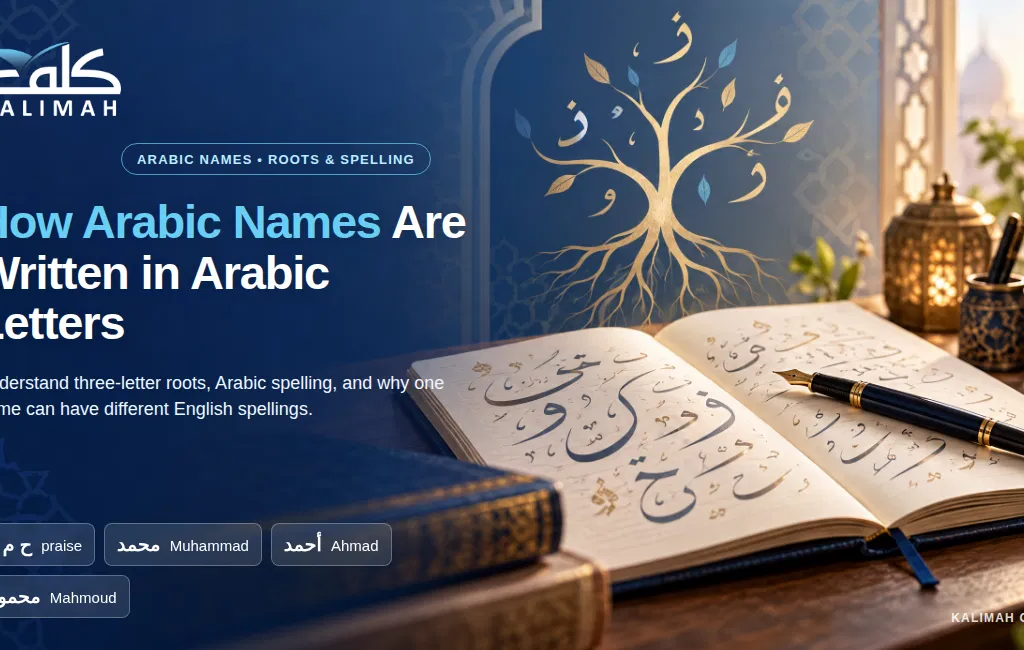
Most Arabic words start from just three letters. Picture them as the roots of a tree. The roots hold one main idea, and lots of different words branch out from them.
Take the letters ح م د, which are all about praise. Four well-known names grow from them. Hamid is “someone who praises,” and Mahmoud is “praised.” Ahmad means “the most praised,” and Muhammad means “praised over and over.”
Plenty of other names work the same way. One set of letters carries the idea of peace, and that’s where Salim and Salma come from. Another set is about kindness, which gives us Karim and Akram.
So when two Arabic names look a little alike, there’s a good chance they share a meaning too. Some parents love this. They’ll name a brother and sister Salim and Salma so the names feel like a pair, while each child still gets one of their own.
Why One Arabic Name Has Different English Spellings
Arabic has sounds and little marks that English simply doesn’t have. So when someone writes an Arabic name in English letters, they have to make a few choices, and not everyone chooses the same way.
Take Fatima and Fatimah. Many girls’ names in Arabic end with a soft sound that some people write as an “h” and others leave off. Both spellings are correct, and both mean the same name.
Rayyan is another good example. Arabic uses a small mark to tell you a sound should be doubled, and that’s why the name is spelled with two y’s.
Then there’s Abdur-Rahman. This name has the Arabic word for “the” tucked inside it, and when you say it out loud, that sound slides into the next letter. That’s why you’ll hear “Abdur-Rahman” instead of “Abdul-Rahman.”
It also helps to know that Arabic is read from right to left, the opposite of English. Most of its letters join together too, so Muhammad (محمد) looks like one flowing line instead of four separate letters.
If you want to make sure everyone says your child’s name the right way, ask an Arabic teacher to add the small vowel marks to it. Those tiny marks show exactly how the name should sound, so there’s no guessing.
How To Practice Saying An Arabic Name, Step By Step
You don’t need hours of study to say a name well. A few minutes a day and these simple steps will get you there.
- Step 1: Break the name into small parts. Use the “Say it” column in the tables above. For example, Rayyan becomes ray-YAAN.
- Step 2: Say each part slowly. Don’t rush. Once each part feels easy, put them back together.
- Step 3: Stress the right part. The part in capital letters is the one you say a little louder and longer.
- Step 4: Listen to a native speaker. Find a short recording of the name, or ask an Arabic-speaking friend to say it for you.
- Step 5: Record yourself and compare. Play your version next to theirs. It’s surprising how easy it is to hear the gaps this way.
- Step 6: Learn where each sound starts. Some sounds come from your throat, others from your tongue or lips. This guide to the makharij of Arabic letters shows you where, one sound at a time.
- Step 7: Practice a little every day. Five minutes a day works better than one long session a week. With kids, turn it into a game. Say everyone’s name at dinner and let your child correct you.
If you want to get it right faster, a teacher who can hear you makes all the difference. Kalimah Center offers live one-on-one lessons with native Arabic tutors, and you can check the Kalimah Center pricing page to find a plan that fits your budget.

How To Choose An Arabic Name For Your Child, Step By Step
Follow these steps once you have a short list of names you like.
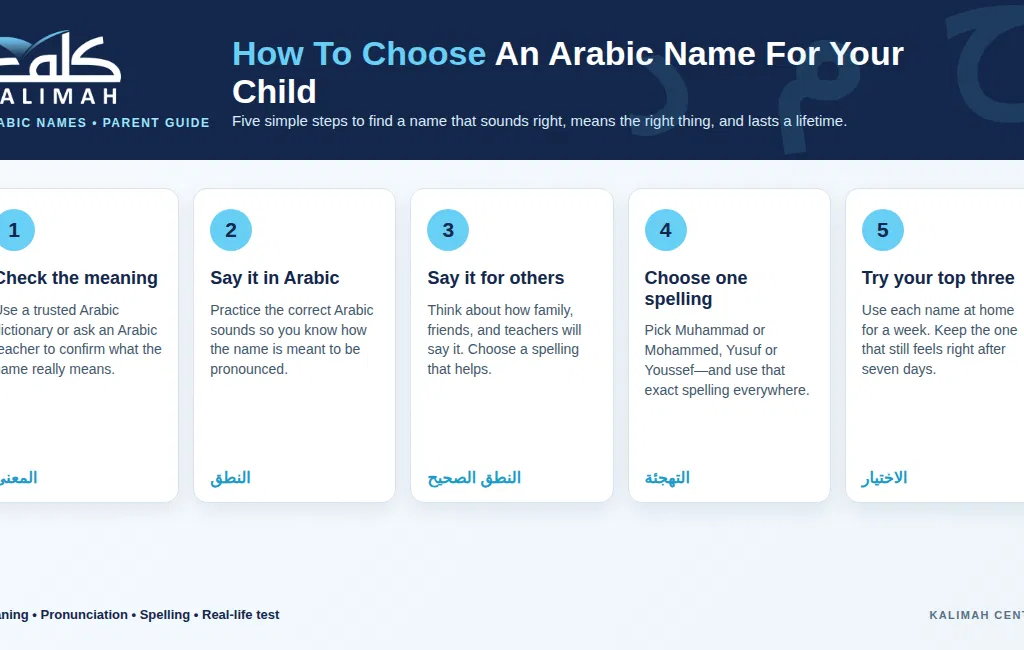
- Check what the name really means: Don’t rely on just one website, because some give names pretty meanings that aren’t true. Look the name up in a trusted Arabic dictionary, like the classic Lisan al-Arab, or ask an Arabic teacher to confirm it.
- Say it the Arabic way: Practice the name with the right Arabic sounds, so you know how it’s supposed to sound.
- Say it the way others will: Now say it the way your family, friends, and your child’s future teachers probably will. If their version turns it into a different word, think about another name, or choose a spelling that helps people say it right.
- Pick one English spelling and stick to it: Decide early between options like Muhammad or Mohammed, or Yusuf or Youssef. Use that exact spelling on the birth certificate, passport, and school records. Mixed spellings can cause real headaches at airports and offices.
- Test your top three names at home: Use them out loud for a week, calling your baby or your bump by each one. The name that still feels right after seven days is usually the one to keep.
Naming Mistakes To Avoid
Even careful parents make a few common slips. Here’s what to watch for.Don’t use “Abdul” on its own. It means “servant of the,” so it isn’t a complete name. It always needs a second part, like Abdullah or Abdulrahman.
Be careful with names that belong only to God. Names like Ar-Rahman or Al-Khaliq should always be joined with “Abd,” as in Abdulrahman or Abdulkhaliq. Simple words like Kareem or Aziz, without “al” in front, are fine for people.
Look closely at the meaning, not just the sound. Some names sound nice but mean something harsh. In a hadith in Al-Adab Al-Mufrad, the Prophet ﷺ called Harb, which means war, and Murrah, which means bitter, the ugliest names.
Think about your local language too. A name can be beautiful in Arabic but sound rude or funny where you live, so say it to a few local friends before you decide.
Finally, don’t trust every list you find online. Some sites include names like Linda or Ayla as Arabic names, but they don’t come from Arabic at all. If an Arabic origin matters to you, ask a teacher to check.
Inside Kalimah Center: Moments from Our Courses
Get a glimpse into the vibrant learning experience at Kalimah Center. These snapshots capture real moments from our live classes—where students engage deeply, connect with passionate instructors, and grow in a welcoming, supportive environment.
Master Arabic with Kalimah Center
Join our expert-led online classes and start your journey toward Arabic fluency today.
Book Your Free TrialBook A Free Arabic Lesson at Kalimah Center Today
You chose a name with a beautiful meaning. Now give your child, and yourself, the skill to read it, write it, and say it the right way. Kalimah Center has taught Arabic and Quran online for more than 14 years. With Kalimah Center, you get:
- Native Arabic teachers, many trained at Al-Azhar
- One-on-one classes, so the teacher focuses only on you
- Male and female teachers to choose from
- A kids’ Arabic course with 24 levels and child-trained teachers
- An adult Arabic course with 16 levels and more than 400 hours of lessons
- A Quran with Tajweed course taught by teachers who hold Ijazah
- Kalimah’s own books and lesson plan, built over many years
- A certificate each time you pass a level
- Lesson material you can open any time, day or night
- A class schedule you set to fit your week
Start with a free trial lesson. You pay nothing until you are sure it is right for you.

Explore Our Courses:
Browse our courses and start your learning journey today.
- Online Arabic Course: Tailored to your level, our comprehensive Arabic program includes 16 teaching levels and 400+ hours of personalized sessions.
- Online Quran With Tajweed Course: Perfect for non-Arabic speakers, our course spans 13 levels and equips you with Tajweed mastery from beginner to advanced.
- Online Arabic Course For Kids: Nurture your child’s love for Arabic with our engaging and structured program, available in 24 levels for primary, intermediate, and secondary stages.
Conclusion
Common Arabic names last because they carry meaning, faith, and history in one word. For boys, Muhammad, Ahmad, Omar, and Ali lead the list. For girls, Maryam, Fatimah, Noor, and Sarah are the names you will hear most.
If you want something rare, the old Arabic names are waiting. Urwah, Humam, and Durgham sound strong and still feel fresh. Salsabil, Sajaa, and Raneem are gentle and very rarely heard. Each one is as correct and as Arabic as the most popular names.
Your goal can guide your choice. If faith comes first, a name from the Quran or the Prophet’s family is a safe and loved pick. If you want a name few children share, look at the rare lists. If your family lives far from the Arab world, choose a name whose sounds your child’s friends can say.
In the end, the best name is one you understand fully. Know its meaning, say it with the right sounds, and keep one spelling for life. Do that, and your child’s name will be a gift they are proud to carry.
FAQs
Parents often have more questions once they start looking at Arabic names. Here are clear answers to the ones we hear most.
Can Non-Muslims Use Arabic Names?
Yes, non-Muslims can use Arabic names, and many do. Arab Christians use names like Butrus (Peter), Ilyas (Elias), and Jamil. A name with a good meaning is open to anyone.
What Do “Bin” And “Bint” Mean In An Arabic Name?
Bin means “son of,” and bint means “daughter of.” So Ali bin Omar is Ali, the son of Omar. In many Arab countries, full names list the father and grandfather this way.
What Does “Abu” Or “Umm” Mean Before A Name?
Abu means “father of,” and Umm means “mother of.” A man named Ahmad with a son called Yusuf may be called Abu Yusuf. This kind of name is called a kunya, and it shows respect.
Are There Arabic Names For Both Boys And Girls?
Yes, a few Arabic names work for both boys and girls. Noor, Salam, and Ihsan are common examples. In some countries, Noor is more often a girl’s name, while boys use Nur ad-Din.
Did The Prophet Ever Change People’s Names?
Yes, the Prophet ﷺ changed some names that had a bad meaning. Abu Bakr was once called Abd al-Ka’bah, and the Prophet named him Abdullah. Abdulrahman ibn Awf was once called Abd Amr.
Which Arabic Names Are Easy To Say In English?
Adam, Sarah, Layla, Noor, Reem, Zain, and Sami are easy to say in English. They have no throat sounds, so they sound almost the same in both languages.
What Does “Al” Mean In An Arabic Family Name?
Al usually means “the,” as in Al-Hashimi, “the one from the Hashim family.” When it is spelled آل, as in Al Saud, it means “the family of.” Both are part of the surname, not the first name.