You’re standing outside a café in Cairo. Your friend checks the time, grabs his keys, and says one word: “Yalla.” Everyone gets up. Nobody asks what he meant.
If you’re new to Arabic, you might be the only one still sitting there. That’s usually when people start wondering what does yalla mean in Arabic, and why it seems to pop up in every other sentence.
The short answer is “let’s go.” But that’s only part of it. The same word can push a slow friend out the door, cheer on a football team, or close a phone call, and Arabs switch between these without thinking twice.
Below, we’ll walk through each meaning with real examples, then cover how to say it, how to spell it, and where it came from. By the end, you’ll be the one saying “yalla” first.
What You’ll Learn in This Article
- The six main meanings of yalla, with real examples.
- How to tell which meaning someone has in mind.
- Where the word yalla came from.
- How to say and spell yalla the right way.
- What “yalla imshi” means and when it’s rude.
- How to say “let’s go” in Egypt, the Levant, and the Gulf.
Yalla in Arabic Language
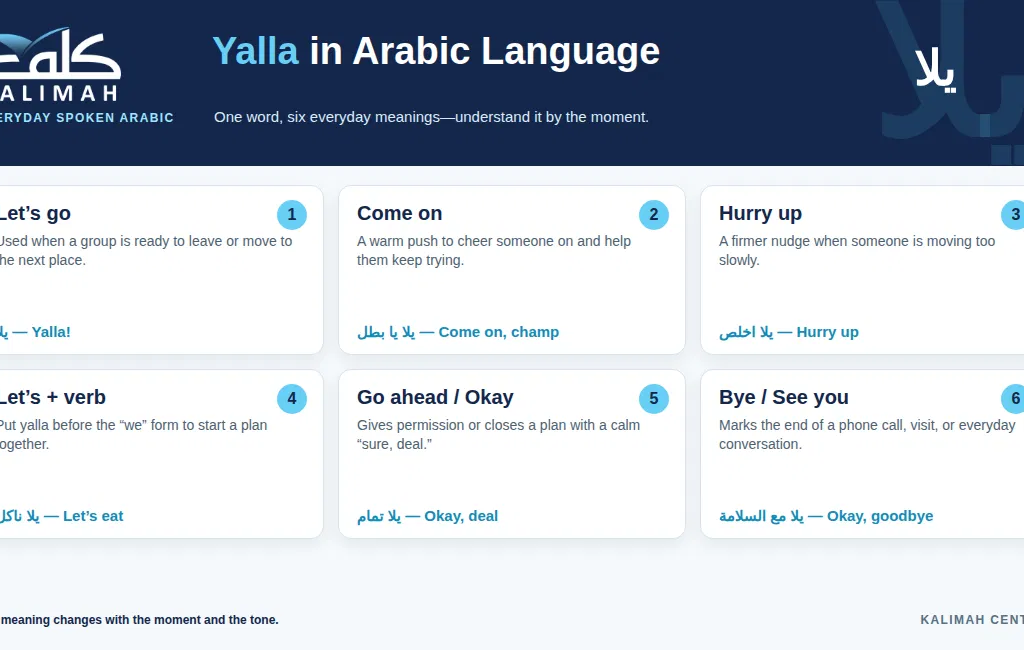
Yalla (يلا) is a spoken Arabic word that means “let’s go,” “come on,” or “hurry up.” People also use it to say “go ahead,” “okay,” or “bye.” It isn’t formal Arabic. You hear it in daily talk from Morocco to Iraq.
Each meaning fits a different moment. Below are all six, with phrases you can start using today.
Yalla Means “Let’s Go”
This is the meaning you’ll hear the most. When a group is ready to leave, someone says “yalla,” and everyone gets up. It works just like “let’s go” in English.
Picture a family at a wedding late at night. The kids are sleepy, and the car keys are out. The mom looks at everyone and says one word: “Yalla.” No one needs to hear more.
You’ll hear the same thing when friends leave a café or when a class ends. A tour guide says it to move the group to the next stop. A coach says it when the team walks out to the field.
This yalla is an invite, not an order. The speaker is going too. That’s why it feels friendly, even when a teacher or a boss says it.
It’s also a great first word for new learners. You can use it on day one, and people will understand you right away.
Yalla Means “Come On”
Yalla can also mean “come on” when you want to cheer someone up. It’s the yalla of sports fans. In a full stadium, you’ll hear “yalla, yalla!” each time the team gets close to a goal.
Parents use it too. A dad might say yalla ya batal (يلا يا بطل), which means “come on, champ.” He says it to a child who is learning to ride a bike and is scared to fall.
A friend might say it to you before a big exam or a job interview. A trainer at the gym might say it when you have two more push-ups left.
Here, yalla has nothing to do with leaving. No one is going anywhere. The speaker wants you to push a bit harder and keep trying. This yalla is warm. The person saying it is on your side. They aren’t rushing you. They’re telling you that you can do it.
Yalla Means “Hurry Up”
Yalla is also the Arabic word for “hurry up.” You’ll hear it when someone is slow and the other person wants them to move faster.
A common Egyptian phrase is yalla ikhlas (يلا اخلص). It means “hurry up and finish.” A mom might say it to a child who is still eating breakfast while the school bus waits outside.
Arab friends often joke about being late, so this yalla gets a lot of use. If your friend is still at home when you’re already at the meeting spot, a quick call with “Yalla!” says it all.
You’ll hear it on the road too. In Cairo, bus drivers often shout “yalla” at slow cars that block their way. They want the other driver to move, and fast.
This yalla isn’t mean, but it isn’t soft either. It’s a push. Think of it as a short way to say “we don’t have all day.”
Yalla Means “Let’s” Before a Verb
Yalla can start a plan when you put a verb right after it. This is one of the easiest ways to build a full Arabic sentence.
The rule is simple. Say yalla, then the verb in the “we” form. Nil’ab (نلعب) means “we play.” So yalla nil’ab (يلا نلعب) means “let’s play.”
Here are a few more you can try today:
- Yalla nakul (يلا ناكل): let’s eat
- Yalla nibda’ (يلا نبدأ): let’s start
- Yalla nitfarrag (يلا نتفرج): let’s watch
Watch out for one small mistake. If you say yalla akul, you’re saying “come on, I’ll eat,” not “let’s eat.” The “n” at the start of the verb is what turns it into “we.”
Once you know this rule, you can make dozens of new sentences with one word. For more simple lines like these, see our guide to basic Arabic conversation for beginners.
Yalla Means “Go Ahead” or “Okay”
Sometimes yalla means “go ahead.” You say it when you give someone the green light to start. Say a friend asks, “Can I put on the movie?” You can answer with one word: “Yalla.” It means “sure, go ahead.” A teacher might say it after handing out a test, so students know they can begin.
Yalla can also seal a deal. At a market, you and the seller go back and forth on a price. When you both agree, one of you says yalla, tamam (يلا تمام). It’s like saying “okay, deal” in English.
You’ll hear it in family plans too. “Dinner at grandma’s on Friday?” “Yalla.” The plan is set, and no more talk is needed. In this use, yalla is calm. There’s no rush and no cheering. It simply means the talking is done and it’s time to act.
Yalla Means “Bye” or “See You”
Yalla often marks the end of a talk. You’ll hear it most at the end of phone calls. People say yalla, ma’a as-salama (يلا مع السلامة), which means “okay, goodbye.” Many people mix in English and just say “yalla, bye.” It may sound funny to new learners, but it’s normal in daily life.
Here, yalla works like “alright then” in English. It tells the other person you’re ready to hang up. If they say “yalla” back, the call is over.
You’ll hear it at the end of visits too. A guest stands up, picks up their bag, and says “yalla.” Everyone knows it’s time for hugs and goodbyes at the door. You can pair yalla with many other ways to say farewell. Learn them in our article on how to say goodbye in Arabic.
Experience Kalimah Center Classes
Watch real excerpts from our live sessions at Kalimah Center and see how we bring learning to life. These clips highlight our interactive, student-centered teaching approach across all our courses—designed to keep learners engaged, motivated, and actively involved every step of the way.
Master Arabic with Kalimah Center
Join our expert-led online classes and start your journey toward Arabic fluency today.
Book Your Free TrialHow to Tell Which Yalla Someone Means
Yalla always sounds like the same word, so the meaning comes from how it’s said and when. You can work it out in three quick steps.
Step 1: Listen to the Speed
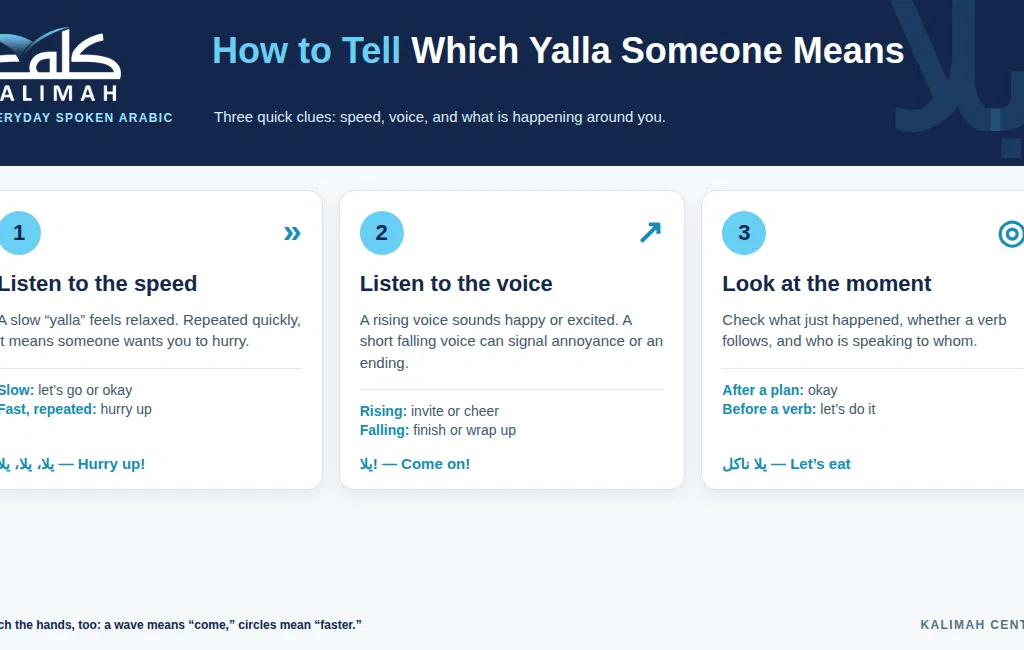
Start with how fast the person says it. One slow “yalla” is relaxed. It usually means “let’s go” or “okay.” Two or three fast ones in a row, like “yalla, yalla, yalla,” mean the person wants you to hurry. You’ve taken too long, and they’re letting you know.
Step 2: Listen to the Voice
Next, notice whether the voice goes up or down. If it goes up at the end, the person is happy or excited. They’re inviting you or cheering you on. If it drops hard and short, they’re annoyed or wrapping things up. You’ll hear this one a lot at the end of phone calls.
You won’t pick this up from a word list. You have to hear real people talk. In the Online Arabic Course at Kalimah Center, you learn live with native tutors over sixteen levels and more than 400 hours of one-on-one lessons. That way, you’re hearing real Arabic voices from your very first class.
Step 3: Look at What’s Happening
If you still aren’t sure, look around and ask yourself three things:
- What just happened? If people just agreed on a plan or a price, yalla means “okay.”
- Is there a verb after it? If so, it means “let’s” do that thing. Yalla nakul means “let’s eat.”
- Who’s talking to whom? When a boss says it to a slow worker, they’re rushing them. When a fan says it to a player, they’re cheering.
Watch people’s hands, too. A big wave of the arm means “come with us.” A hand spinning in quick little circles means “faster.”
These steps will feel slow the first few times. After a couple of weeks of real conversations, you won’t need them. You’ll hear a “yalla” and just know what it means.
Where the Word Yalla Comes From
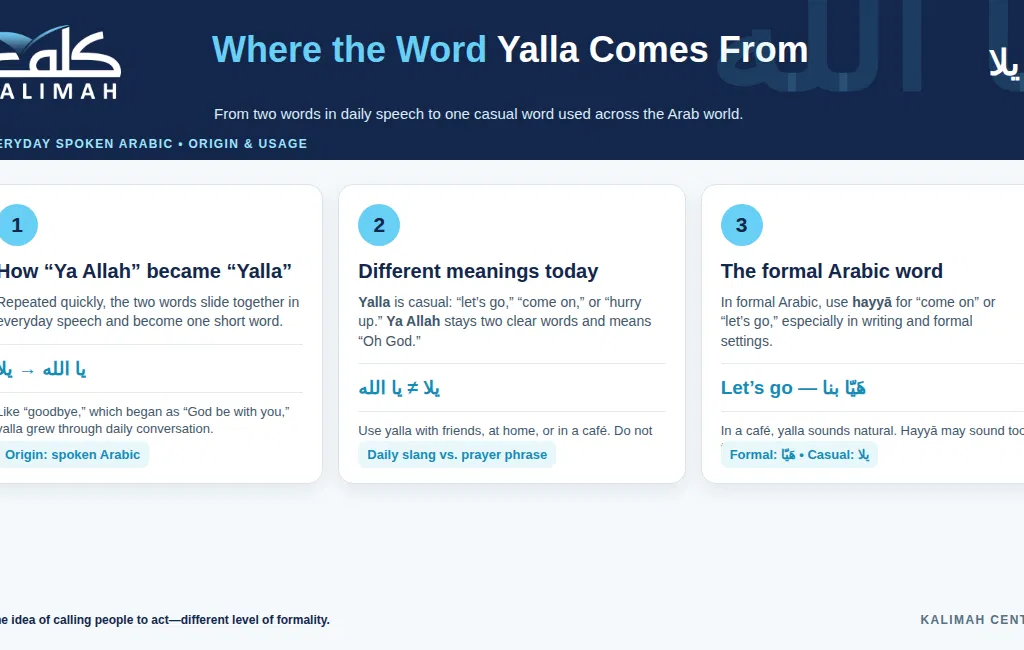
Yalla began as two words, yā Allāh (يا الله), which mean “O God.” Today, it’s a single, everyday word with no prayer meaning at all. The story behind it is short. The three parts below explain how it changed and what it sounds like in formal Arabic.
How “Ya Allah” Became “Yalla”
Long ago, people said yā Allāh when they started a job. It was a way to ask God for help before lifting a heavy load or setting off on a trip. Scholars on IslamWeb explain that the phrase got shorter as people said it over and over.
Say “ya Allah” fast a few times, and you’ll hear it happen. The two words slide into each other and turn into “yalla.”
English has a word with the same kind of story. “Goodbye” started as “God be with you.” People said it so often that it shrank into one short word. Most English speakers today don’t think of God when they say goodbye.
Yalla is just like that. It was born in daily speech, not in books. That’s why you’ll hear it far more on the street than in a classroom.
Yalla and Ya Allah Are Different Today
Even though yalla came from ya Allah, the two don’t mean the same thing now. Yalla is everyday slang, while ya Allah is still a prayer.
Arabic speakers of every faith say yalla. Muslims, Christians, and people of other beliefs all use it the same way. When someone says “yalla, let’s eat,” no one thinks of God.
Ya Allah is different. People say it as two clear words, with a long “aa” sound in the middle. They say it when they’re in pain, when they hope for something, or when they’re amazed. It’s close to “Oh God” in English.
So be careful not to mix them up. A cheerful “yalla” at a sad moment would sound strange. And saying “ya Allah” just to rush a friend would sound far too serious.
The Formal Arabic Word for Yalla
In formal Arabic, the word for yalla is hayyā (هيّا). To say “let’s go,” you say hayyā binā (هيّا بنا). You’ll see hayyā in school books, kids’ songs, and the news. You may know a close cousin of it from the call to prayer: hayya ‘ala as-salah, which means “come to prayer.” Both carry the same idea of calling people to act.
Use hayyā when you write an email, an essay, or a school paper. Yalla is too casual for those. But in a café, at home, or with friends, hayyā sounds stiff. It’s a bit like saying “let us depart” to your friends in English. They’d understand you, but they might laugh. In daily talk, yalla is always the better fit.
How to Say and Spell Yalla
You say yalla as “YAL-lah” and write it يلا in Arabic. It’s easy to get close, but one small detail is what makes you sound like a native speaker.
How To Pronounce Yalla Step By Step
Here’s how to say it in four steps.
- Start with “yal.” Say it like the beginning of “yellow,” but with an “a” sound. This part gets the stress.
- Hold the “l.” Keep your tongue on the “l” for about half a second before you move on. This is the step most learners skip.
- Finish with “lah.” Say it like the “la” in “la la la.”
- Let the end fade. Finish with a soft, open “ah.” Don’t add a hard “h” sound, like the one in “hat.”
When you put it all together, you get yal-la, not a quick “ya-la.” That longer “l” comes from a small mark in Arabic called the shadda (ّ), and its job is to double a letter.
Try it out loud ten times, then use it in a short phrase like yalla nakul (“let’s eat”). Give it a day or two and it’ll start to feel natural.
How to Spell Yalla in Arabic
The usual Arabic spelling is يلا. It’s made of three letters: ي (ya), ل (lam), and ا (alif).
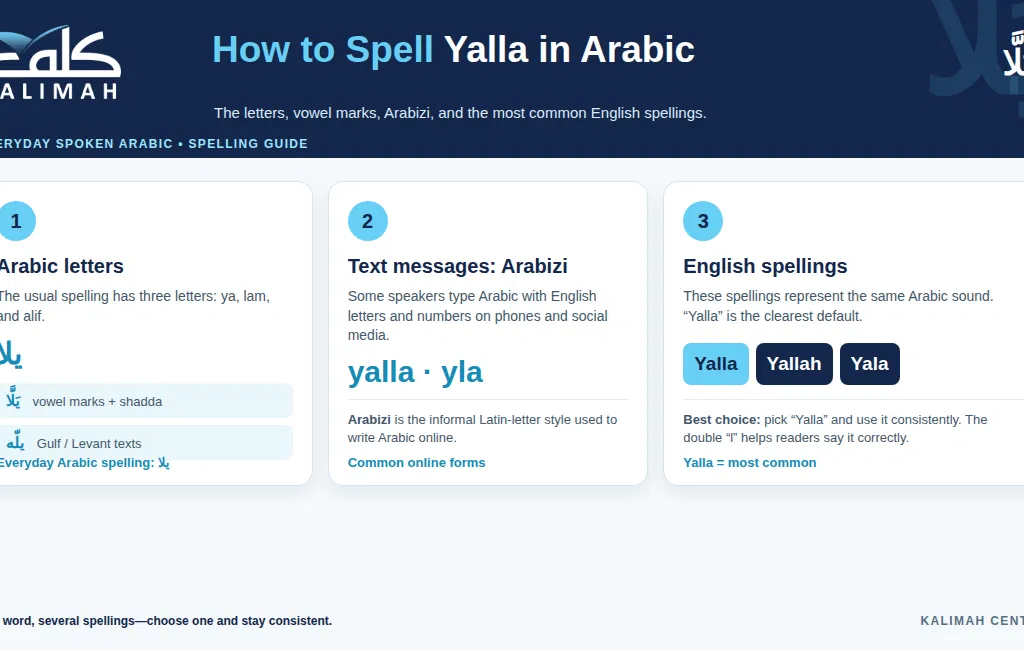
You might see it written a few other ways, but they’re all the same word:
- يلا is the everyday spelling you’ll see most often.
- يَلَّا has the vowel marks added. The little “w” shape above the ل is the shadda, which shows you the double “l.”
- يلّه shows up in some Gulf and Levant texts. The ه (ha) at the end is a nod to the word Allah.
In text messages, a lot of Arabs don’t use Arabic letters at all. They type Arabic words with English letters and numbers, a style known as Arabizi. That’s why you’ll often see “yalla,” or sometimes just “yla,” on phones and social media.
Yalla, Yallah, or Yala: Which Is Correct?
All three spellings are correct. They’re just different ways to write the same Arabic sound with English letters. One online dictionary of Jewish English lists yalah, yallah, and yala as other spellings of the same word, and you’ll find even more online.
- “Yalla” is the most common. You’ll see it on shop signs, in songs, and in brand names. It also matches how most people say the word.
- “Yallah” adds an “h” at the end. That “h” is a small hint of the word’s roots in ya Allah. Some writers like it for that reason.
- “Yala” drops one “l.” It’s simpler, but it can lead you to say the word too fast. If you want to sound right, pick “yalla.” It shows the double “l,” and it’s the spelling most readers will know.
Read also: Common Arabic Names For Boys and Girls
What Does Yalla Imshi Mean in Arabic?
Yalla imshi (يلا امشي) means “come on, go” or “hurry up and go.” The word imshi means “walk” or “go,” so the phrase tells someone to get moving. How it lands depends on who says it, to whom, and how.
When Yalla Imshi Is Normal
Yalla imshi is very common with kids. A mom at the door might say yalla imshi ‘ala el-madrasa, “come on, go to school.” She isn’t angry. She just wants her child out the door on time.
Close friends use it too, often as a joke. If your friend keeps telling the same story for the third time, you might laugh and say “yalla imshi.” Between friends, it’s playful, like “oh, get out of here!”
Kids pick up phrases like this fast, because they hear them at home every day. If you want your child to understand and speak real Arabic, the Arabic Course for Kids at Kalimah Center can help. It comes in 24 levels across primary, intermediate, and secondary stages, and children practice speaking by talking with other Arabic speakers.
When Yalla Imshi Sounds Rude
Said in a hard voice, yalla imshi turns into “go away” or “get lost.” Learners on Reddit’s Arabic forum often ask about this, because they heard it used that way in shows and films.
Never say it to an older person, a stranger, or someone serving you. To them, it sounds like you’re pushing them away. In Arab culture, respect for elders and guests matters a lot, so this can really hurt.
If you’re not sure, choose a kinder phrase. In Egypt, ta’ala ma’aya (تعالى معايا) means “come with me.” It asks the person to join you instead of sending them off.
When in doubt, leave imshi out. A simple, smiling “yalla” is almost never rude.
“Let’s Go” in Arabic Dialects
To say “let’s go” in Arabic, most people use yalla plus a local word. Each region adds its own touch. Here are the phrases you’ll hear in three of the biggest Arabic-speaking areas.
“Let’s Go” in Egyptian Arabic
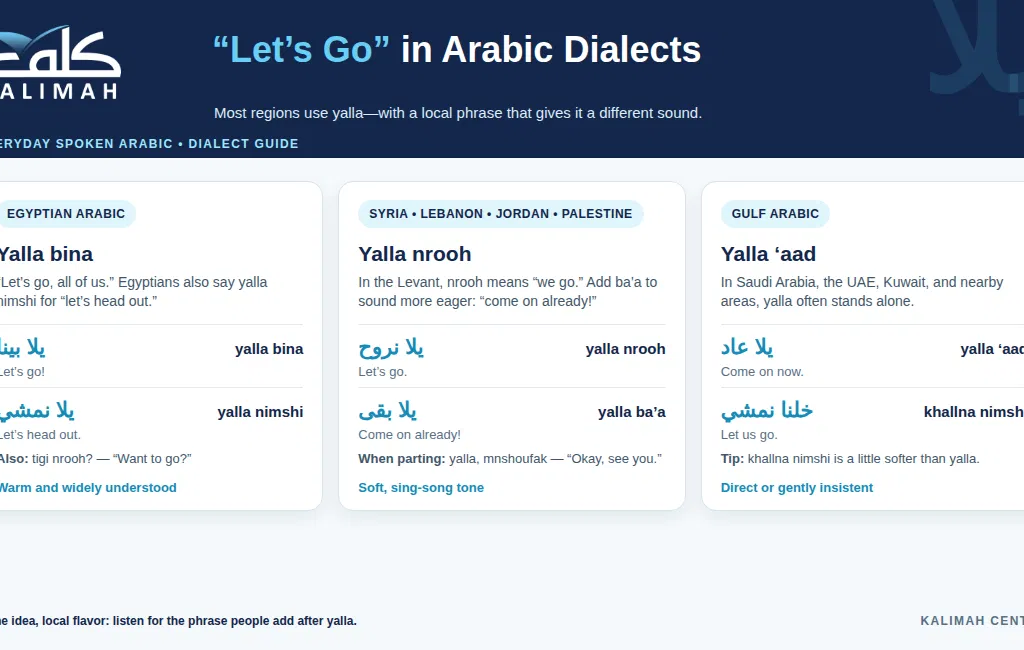
Egyptians say yalla bina (يلا بينا), which means “let’s go, all of us.” They also say yalla nimshi (يلا نمشي), “let’s head out.” Egyptian Arabic is widely understood across the Arab world, thanks to its films, shows, and songs.
An invite often starts with tigi nrooh? (تيجي نروح؟), which means “want to go?” The happy answer is “Yalla bina!” Here’s how it sounds in a real chat:
- Tigi nrooh el-hafla? Want to go to the party?
- Yalla bina! Let’s go!
Egyptians use yalla all through the day, from the morning rush to late-night plans with friends. For more words like this, read our list of Egyptian Arabic vocabulary.
“Let’s Go” in Syria, Lebanon, Jordan, and Palestine
In these countries, known together as the Levant, people say yalla nrooh (يلا نروح). The word nrooh means “we go.”
When they want to sound more eager, they add ba’a (بقى). Yalla ba’a! means “come on already!” You might hear it when someone has waited a long time for a friend to get ready.
Levant speakers also say yalla, mnshoufak (يلا منشوفك) when they part. It means “okay, see you.” It’s warm and casual, and you’ll hear it at the end of almost every visit.
These phrases sound soft and a bit sing-song. If you’ve watched Syrian or Lebanese shows, you’ve likely heard them many times already.
“Let’s Go” in Gulf Arabic
In Saudi Arabia, the UAE, Kuwait, and nearby countries, yalla often stands alone. People also say yalla nimshi or yalla nrooh. A very Gulf phrase is yalla ‘aad (يلا عاد). It means “come on now,” and it shows the speaker is tired of waiting. A friend might say it when you take too long to choose food at a restaurant.
You may also hear khallna nimshi (خلنا نمشي), “let us go.” It’s a bit softer than yalla. Gulf speakers often use both in the same talk, one right after the other. If you plan to visit or work in the Gulf, these short phrases will help you fit in fast. People there are happy when visitors use their local words.
Watch a real lesson before you book
Not sure what online Arabic classes look like? This short clip gives you a feel for our teaching style and how each class is built around the student.
Master Arabic with Kalimah Center
Join our expert-led online classes and start your journey toward Arabic fluency today.
Book Your Free TrialBook Your First Arabic Class at Kalimah Center Today
Knowing yalla is a great first step. But real Arabic talks move fast. To keep up, you need to hear native speakers, speak out loud, and get your mistakes fixed right away.
That’s exactly what Kalimah Center gives you:
- Native tutors you can trust: Kalimah’s tutors are native speakers with real teaching credentials, including Al-Azhar graduates and Ijazah holders
- Your choice of class type: one-on-one or group classes, with male and female tutors
- A clear study plan: Kalimah built its own curriculum, so you always know your next step
- Proof of progress: you get a certificate at the end of each level you finish
- Live practice: tutors fix your pronunciation in real time in every session
- Years of experience: Kalimah opened in 2011 in Egypt and moved online in 2018 to teach learners around the world
Pick your goal, whether it’s spoken Arabic, formal Arabic, Quranic Arabic, or Arabic for your kids. Kalimah Center will match you with the right tutor and the right level.
Yalla! Book your first class now and start speaking Arabic with confidence.

Explore Our Courses:
Browse our Arabic courses and find the right one for you.
- Online Arabic Course: Tailored to your level, our comprehensive Arabic program includes 16 teaching levels and 400+ hours of personalized sessions.
- Online Quran With Tajweed Course: Perfect for non-Arabic speakers, our course spans 13 levels and equips you with Tajweed mastery from beginner to advanced.
- Online Arabic Course For Kids: Nurture your child’s love for Arabic with our engaging and structured program, available in 24 levels for primary, intermediate, and secondary stages.
Conclusion
So, what does yalla mean in Arabic? In short, it’s the word Arabs use to get things moving. It can invite, cheer, push, agree, or say goodbye, all in two quick beats.
What makes yalla special is that one word does so many jobs. Your ears and eyes tell you which job it’s doing. That’s a skill you build by listening, not by reading.
The word also carries a bit of history. It grew out of an old habit of calling on God before starting work, then became plain slang over many years. That’s why it now belongs to every Arabic speaker, no matter their faith.
Want to start using it this week? Try this simple plan. On day one, say “yalla” out loud ten times with the double “l.” On day two, make three “let’s” sentences, like yalla nakul. On day three, end a call or a chat with “yalla, bye.”
Then keep going. Watch one short Arabic show and count how many times you hear yalla. Each time, guess which meaning it has. By the end of the week, the word will feel like your own.
Small words like this are the doors into real Arabic talk. Learn them well, use them often, and the bigger words will follow. Yalla, let’s keep learning!
FAQs
Learners often have a few more questions once they start using yalla. Here are short, clear answers to the ones we hear most.
Is Yalla Used Outside the Arab World?
Yes, yalla is used in many places outside the Arab world. It’s very common in Hebrew as a way to say “come on” or “hurry up”, and forms of the word also show up in Finnish, Norwegian, and Swedish.
Does Yalla Change for Men, Women, or Groups?
No, yalla never changes its form. You say the same “yalla” to a man, a woman, a child, or a whole group.
What Does Yalla Habibi Mean?
Yalla habibi (يلا حبيبي) means “come on, my dear.” People say it to friends, family, and kids in a warm, loving way.
What Does Yalla Shabab Mean?
Yalla shabab (يلا شباب) means “come on, guys.” Shabab means “young people,” and it’s used to call a group of friends to act.
How Do You Reply When Someone Says Yalla?
You can reply with “yalla” or tamam (تمام) to agree. If you need more time, say dakika (دقيقة), which means “one minute.”
Is the Word Yalla in the Quran?
No, the word yalla is not in the Quran, because it’s a spoken slang word. The Quran uses the formal word halumma (هلمّ) to mean “come.”
Can Non-Arabs Say Yalla?
Yes, non-Arabs can say yalla, and most Arabs love hearing it. Just use a friendly tone, and save it for casual moments, not formal ones.