Picture this. You are at a friend’s house, and their mom brings out a big plate of food. Your friend takes one bite and says, “Wallah, this is the best rice I have ever had.” Everyone at the table nods. You smile and nod too, but you are not sure what you just agreed to.
You are not alone. Wallah is one of the most used words in spoken Arabic. You hear it in songs and in shops. You see it under TikTok videos and in group chats. Lots of people who do not speak Arabic now use it too.
So what does wallah mean in Arabic? The short answer is easy. The full answer is more fun. This one small word can be a promise, a question, or a cry of shock. It all depends on how you say it.
It also carries real weight. For many Arabic speakers, wallah is not just slang. It is a promise made in God’s name. That is why it helps to know the rules before you use it.
So let’s keep it simple. You’ll learn what wallah means, how to write it, how to say it, and when it’s right to use it.
What You’ll Learn In This Article
- The meaning of wallah and where the word comes from.
- How to write wallah in Arabic letters.
- How to pronounce wallah and wallahi.
- The real difference between wallah and wallahi.
- What Islam says about swearing by God.
Wallah in Arabic
Wallah (والله) means “I swear by God.” People say it to show they are telling the truth. It works like “I swear” in English, but it names God as the witness.
The word is short, but it carries a lot. Below you will see where it comes from and the many ways people use it.
Where The Word Wallah Comes From
Wallah is made of two parts. The first part is “wa” (وَ). The second part is “Allah” (الله), the Arabic name for God. Most of the time, “wa” means “and.” In wallah, it has a different job. Here it means “by,” as in “by God.” Arabic teachers call it the wāw of oath, or wāw al-qasam.
The name Allah is special in Arabic. The Almaany Arabic dictionary says this name belongs to God alone. No person can be called by it. That is why wallah is not a small word. When you say it, you use God’s name to back up what you say. In Arabic, that is a real oath.
You will hear the same word from Morocco to Iraq. Arabic has many dialects, but wallah sounds almost the same in all of them. Learn it once, and you can use it in any Arab country you visit.
Five Ways People Use Wallah Every Day
Wallah does not always mean the same thing. The way you say it changes the meaning. These are the five uses you will hear most:
| Meaning | Example | How it sounds |
| “I swear to God” | “Wallah, I didn’t take it.” | Calm and serious |
| “By God” | “Wallah, this is the truth.” | Firm and slow |
| “Honestly” | “Wallah, the food was so good.” | Light and friendly |
| “Really?” | “Wallah? He quit his job?” | Voice goes up at the end |
| “No way!” | “Wallah! They cancelled it again?” | Sharp and loud |
The first two are real oaths. The speaker swears that something is true. The last three grew out of the oath over time. People use them to react, not to swear.
A quick tip helps. If wallah stands alone and the voice goes up, it is a question. If it starts a sentence in a calm voice, the speaker is backing up what comes next. You may also hear “wallah ya’ni.” It means something like “honestly, well…” People say it when they need a second to think.
Read also: Muslim Words Used in Daily Life
How to Write Wallah in Arabic Letters
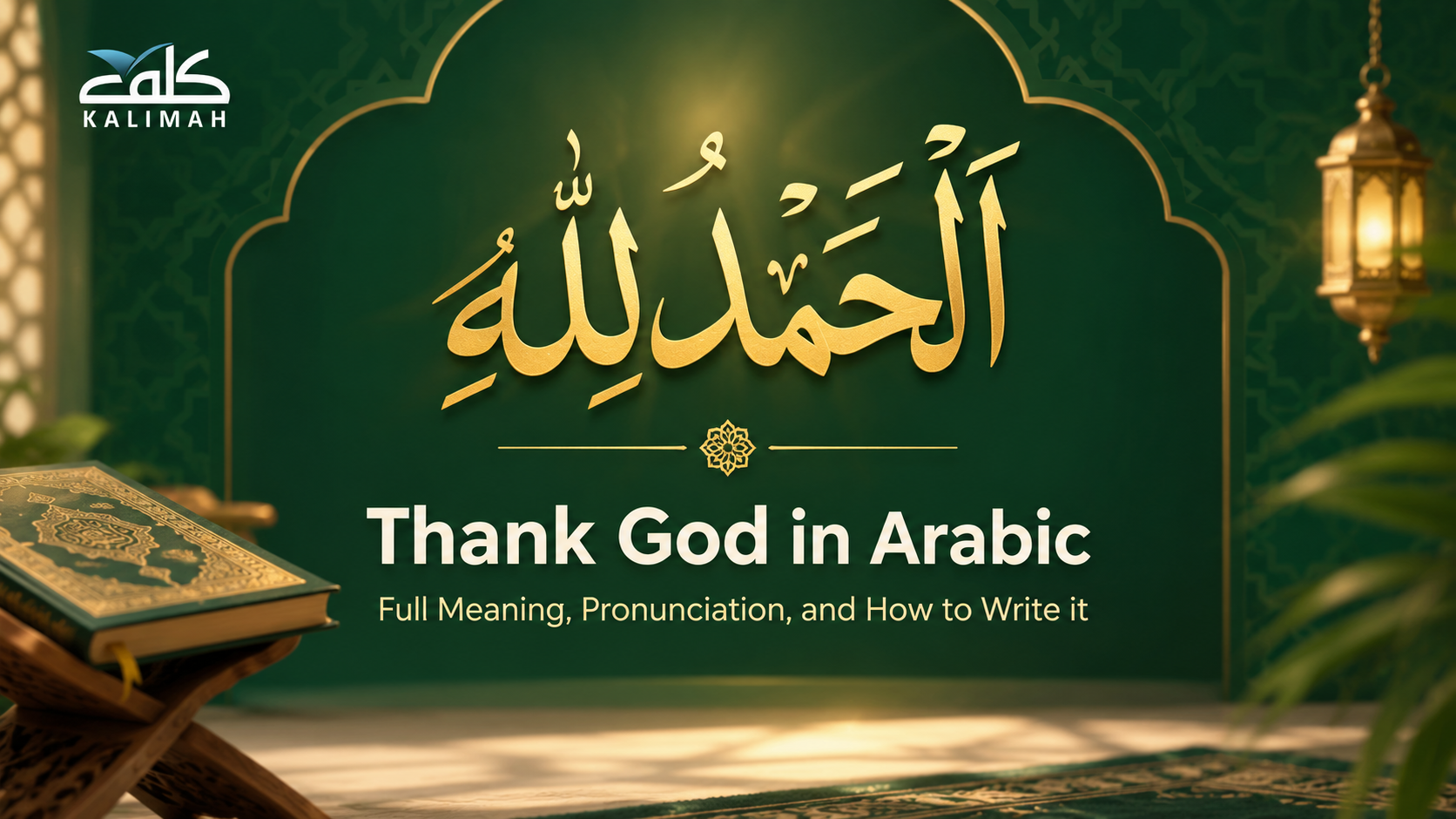
Wallah is written والله in Arabic letters. With all the vowel marks added, it looks like this: وَاللَّهِ. The good news is that you only need five letters and a few small marks. Grab a pen and some paper, and follow the steps below. Remember that Arabic goes from right to left, so start on the right side of the page.
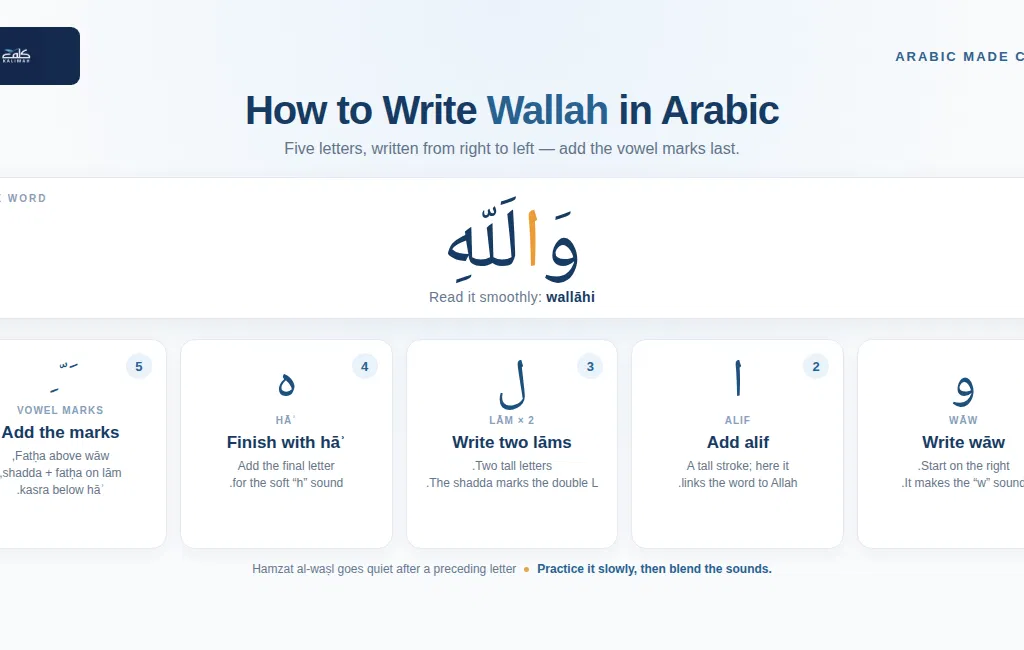
- Write the wāw (و): Start on the right with wāw. It looks a bit like a comma with a round head, and it makes the “w” sound. Wāw never joins the letter after it, so leave a small gap when you finish.
- Add the alif (ا): Next, draw a straight line from top to bottom. This is the alif. You write it, but you don’t say it here. Like wāw, alif doesn’t join the next letter, so leave another small gap.
- Write the two lāms (لل): Now write two lāms side by side. Each one is a tall line with a small hook at the bottom. These two letters do join, so keep your pen moving from one to the next.
- Finish with the hā’ (ه): Join a small loop to the end of the second lām. This is the hā’, and it gives the soft “h” at the end. Your word now reads والله.
- Add the vowel marks: Put a small slash above the wāw (وَ). Then draw the shadda, a tiny “w” shape, above the second lām, with a small slash on top of it (لَّ). Last, put a small slash under the hā’ (هِ). Now you have وَاللَّهِ.
Why the Word Looks the Way It Does
You may wonder why you write an alif you don’t say. The alif at the start of Allah is a linking alif, called hamzat al-waṣl. When a letter comes before it, the alif goes quiet. So “wa” and “Allah” blend into one smooth word: “wallah.”
The shadda has a job too. It tells you to say the L twice. That’s why English spells wallah with two L’s. Many beginners say each letter on its own, like “wa-Allah.” It sounds stiff. Let the sounds run together, and you’ll sound much more like a native speaker.
Here’s a tip that works. Write the word slowly five times, and say each letter out loud as you go. By the fifth time, your hand and your ear will know it.
Read also: What Does Yalla Mean in Arabic?
Experience Kalimah Center Classes
Watch real excerpts from our live sessions at Kalimah Center and see how we bring learning to life. These clips highlight our interactive, student-centered teaching approach across all our courses—designed to keep learners engaged, motivated, and actively involved every step of the way.
How to Pronounce Wallah the Right Way
Wallah is pronounced wal-LAAH. Wallahi is pronounced wal-LAA-hi. In both, the stress falls on the long middle sound.
Getting it right comes down to two things: how you split the sounds and how you say the L. The steps below cover the first one. The section after it covers the L.
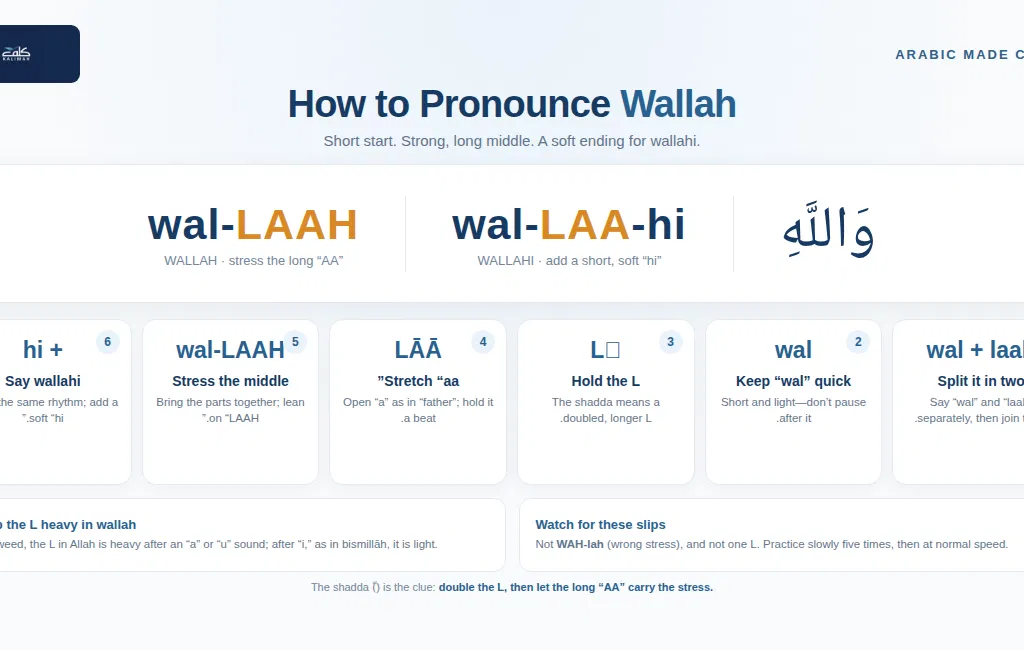
- Split the word in two: Break wallah into two parts: “wal” and “laah.” Say each part on its own a few times before you join them.
- Say “wal” short and quick: This part should be over almost as soon as it starts, like the “wal” in “walnut.” Don’t stop on it.
- Hold the L.
Now let the L stay on your tongue a little longer than usual. Try saying “wall lamp” fast, and you’ll feel it. That longer L comes from the shadda. - Stretch the “aa.”: Say “laah” with a long, open “aa,” like the “a” in “father,” but hold it a beat longer. If you rush it, the word sounds cut off.
- Put it together: Join the parts into wal-LAAH. Push a little harder on the second part. That’s where the stress goes.
- Add “hi” for wallahi: To say wallahi, keep everything the same and add a soft, short “hi” at the end: wal-LAA-hi.
Two Mistakes to Watch For
Many learners say “WAH-lah.” That puts the stress on the first part, and native speakers will hear the difference right away. Keep the weight on “LAAH.” Others say “wa-lah” with one L. Without the double L, the word loses its shape and sounds flat.
Now practice. Say it slowly five times, then at normal speed. Record yourself on your phone and play it next to a native speaker. You’ll hear what to fix in seconds.
Why the L in Allah Sounds Heavy
The L in Allah is not like the L in “love.” It is a heavy, deep L. You say it from the back of your mouth. Arabic teachers call this tafkhīm. The L turns heavy when the sound before it is “a” or “u.” In wallah, the sound before it is “wa.” So the L in wallah is always heavy.
Now compare it with bismillāh (بسم الله). Here the sound before the L is “i.” So the L turns light and thin. It is the same name, but it sounds different. The vowel before it decides.
This rule comes from tajweed, the set of rules for reading the Quran. Many learners miss it for years. A good teacher can fix it in one lesson.
If you want to read the Quran with the right sounds, Kalimah Center’s Online Quran With Tajweed Course teaches rules like this step by step. The teachers hold an Ijazah, a formal license to teach the Quran.
Master Arabic with Kalimah Center
Join our expert-led online classes and start your journey toward Arabic fluency today.
Book Your Free TrialRead also: Hard Arabic Words for Advanced Learners
Wallah vs. Wallahi: What Is the Difference?
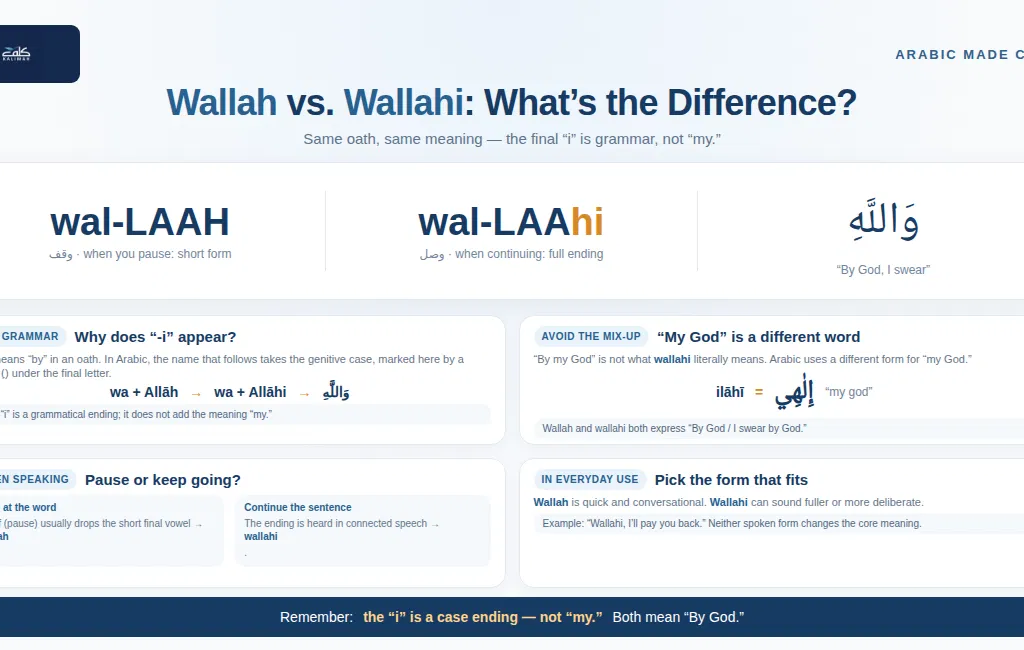
Wallah and wallahi are the same word with the same meaning. Both mean “by God, I swear.” Native speakers switch between them all the time. So why are there two forms? The answer comes from Arabic grammar and from the way people pause when they talk.
What the “i” at the End Really Means
Many websites say the “i” in wallahi means “my.” They say wallahi means “by my God.” That is not correct. The real reason is simple. In wallah, the “wa” acts like the word “by.” In Arabic grammar, a word that comes after this kind of “by” gets a short “i” sound at the end. Arabic marks this sound with a small line under the letter. It is called a kasra.
So “Allah” becomes “Allahi.” The “i” is just that grammar sound. It adds no extra meaning at all. If you want to say “my God” in Arabic, you use a different word. It is ilāhī (إلهي). So wallahi does not mean “by my God.” It simply means “by God,” said with its full ending.
This is a good example of why grammar matters. One tiny sound can lead people to the wrong meaning. Once you know the rule, the mix-up goes away.
When to Say Wallah and When to Say Wallahi
Arabic has a simple rule for pauses. When you stop at the end of a word, you drop the short sound at the end. This rule is called waqf. So when people say the word fast, or stop right after it, you hear “wallah.” When they say it slowly, or keep talking after it, you often hear “wallahi.”
The full form takes a moment longer to say. Because of that, it can sound more careful and serious. Many people use wallahi for a big promise, such as “Wallahi, I will pay you back.”
The short form fits quick moments better. A fast “wallah” works when you hear big news. Neither form is more correct. Pick the one that fits how you speak in that moment.
Other English Spellings of Wallah
There is no one set way to write Arabic words in English letters. So you will see this word spelled in a few ways:
- Wallah: the most common spelling.
- Walla: the same word without the final “h,” common in texts.
- Wallahi, wallahy, wallahe: the full form, with the “i” ending.
- Vallah, vallahi: the same oath in Turkish, Bosnian, and Persian. In these languages, the Arabic “w” turns into a “v.”
All of these point to one Arabic word: والله.
Read also: Beautiful Arabic Words With Deep Meaning
Other Ways to Say “Swear to God” in Arabic
The most common way to say “swear to God” in Arabic is wallah. But it is not the only one. Arabic has a few other oath phrases. Each one fits a different moment. The section below shows you which to use and when.
Four Arabic Oaths and When People Use Them
You may hear these four oaths:
- Uqsimu billāh (أقسم بالله): This means “I swear by God.” It is formal and clear. You hear it in court, in speeches, and in serious talks.
- Billāhi (بالله): This means “by God.” People also use it to ask for something, like “please, for God’s sake.”
- Tallāhi (تالله): This is a rare oath used in old, formal Arabic. It appears in the Quran, in Surah Yusuf, verse 85.
- Wallāhi l-‘aẓīm (والله العظيم): This means “by God the Almighty.” It is a stronger form, and you hear it a lot in Egypt.
Notice the first letter in the short oaths: wa, bi, and ta. These three letters can all turn a word into an oath. Imam al-Bukhari lists all three in his chapter on how to swear.
Kalimah Center’s Online Arabic Course explains these letters as part of its 16-level program. You learn the grammar behind the words you hear every day, with a native teacher in one-on-one classes.

Is Saying Wallah Allowed in Islam?
Yes, saying wallah is allowed in Islam if what you say is true. In fact, Islam teaches that an oath should only be made by God. The Prophet Muhammad ﷺ said that whoever swears should swear by Allah or stay silent (Sahih al-Bukhari, 2679).
Still, Muslims treat this word with care. The sections below explain the rules and give you a simple way to check yourself.
Why Lying With Wallah Is a Major Sin
A false oath is a lie that uses God’s name. In Islam, that makes it much worse than a normal lie.
The Prophet ﷺ listed the false oath among the major sins (Sahih al-Bukhari, 6675). In Arabic, this kind of oath is called al-yamīn al-ghamūs. The word ghamūs means “something that sinks.” Scholars say the name fits, because the false oath sinks a person deep into sin.
There is no easy fix for this kind of oath. Scholars explain that a payment or a fast does not wipe it away. The person needs to repent sincerely and stop.
This is why some Muslims pause before they say wallah. They want to be sure their words are true first. To them, it is not just slang. It is a promise made in front of God.
What to Do If You Break a Promise Made With Wallah
Islam treats two kinds of oaths in different ways.
- The first kind is the oath you say without meaning it. It slips out in normal talk, like “no, wallah, I’m fine.” The Quran says God does not hold you to these slips (Surah Al-Baqarah, 2:225). In Arabic, this is called laghw.
- The second kind is a real promise about the future. You plan it and mean it, like “Wallahi, I will visit you on Friday.” If you break this kind of promise, you need to make it up.
The Quran explains how in Surah Al-Ma’idah, verse 89. You can feed ten people in need or give them clothes. If you cannot do that, you fast for three days. This act is called kaffārah.
So think before you make a real promise with wallah. Keep it if you can.
Ask Yourself Three Questions Before You Say Wallah
Try this simple check. Call it the three-question oath check. Ask yourself these questions before you say wallah:
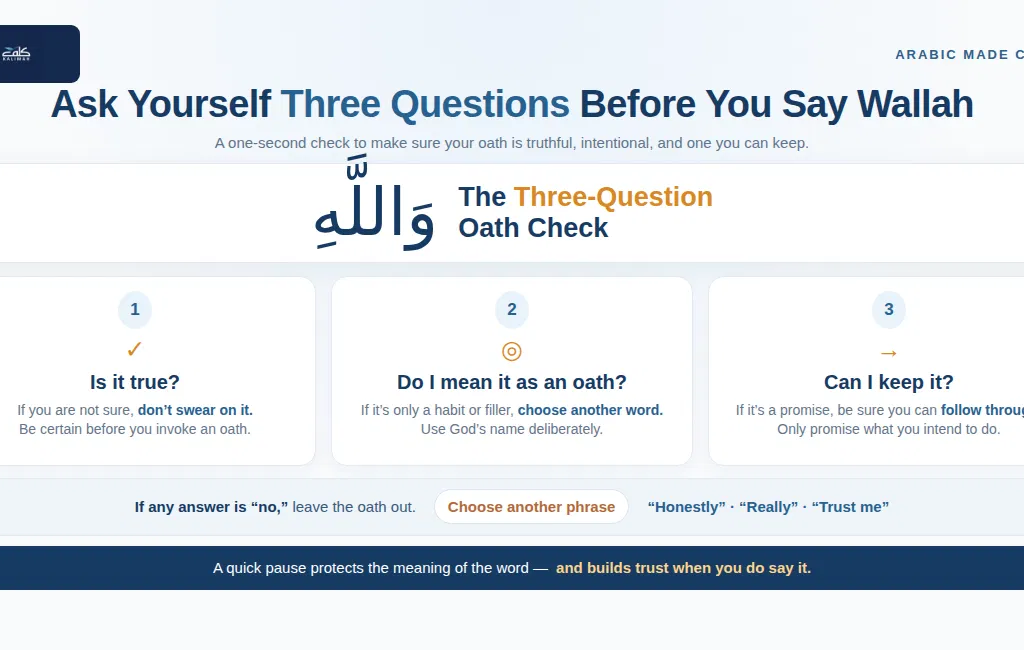
- Is it true? If you are not sure, do not swear on it.
- Do I mean it as an oath? If it is just a habit, pick a different word.
- Can I keep it? If it is a promise, make sure you can follow through.
If you answer “no” to any of these, use another word. “Honestly,” “really,” or “trust me” all work fine. They show you mean what you say, without using God’s name.
The check takes only a second. Over time, it becomes a habit. And it keeps the word strong. When people know you only say wallah when you mean it, they trust you more when you do.
Watch a real lesson before you book
Not sure what online Arabic classes look like? This short clip gives you a feel for our teaching style and how each class is built around the student.
Master Arabic with Kalimah Center
Join our expert-led online classes and start your journey toward Arabic fluency today.
Book Your Free TrialStart Learning Arabic With Kalimah Center Today
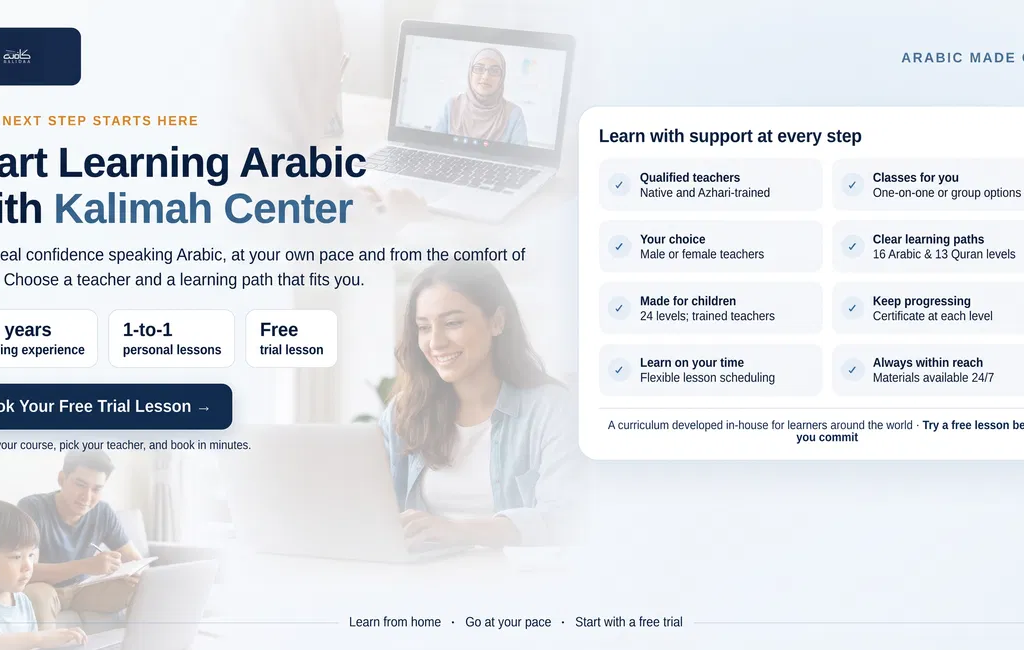
Now you know what wallah means. The next step is to speak Arabic with real confidence. Kalimah Center helps you get there, at your own pace and from your own home.
When you learn with Kalimah Center, you get:
- 14+ years of teaching experience with students around the world.
- Native and Azhari-trained teachers who are certified to teach Arabic and Quran.
- One-on-one classes, so your teacher focuses only on you, with group classes also available.
- Male and female teachers, so you can choose who you feel most comfortable with.
- A program built in-house, with 16 levels in the Arabic course and 13 levels in the Quran course.
- A course made for kids, with 24 levels and teachers trained to teach children.
- A certificate for each level you pass.
- 24/7 access to your learning materials.
- Flexible times that fit your schedule.
- A free trial lesson, so you can try it before you pay.
Choose your course, pick your teacher, and book your first class in minutes.
Explore Our Courses:
Not sure where to start? Look through our courses and pick the one that suits you.
- Online Arabic Course: Tailored to your level, our comprehensive Arabic program includes 16 teaching levels and 400+ hours of personalized sessions.
- Online Quran With Tajweed Course: Perfect for non-Arabic speakers, our course spans 13 levels and equips you with Tajweed mastery from beginner to advanced.
- Online Arabic Course For Kids: Nurture your child’s love for Arabic with our engaging and structured program, available in 24 levels for primary, intermediate, and secondary stages.
Conclusion
So, what does wallah mean in Arabic? At its heart, it is a promise made in God’s name. Everything else in this guide grows from that one idea, from the friendly “wallah” at the dinner table to the serious “wallahi” before a big promise.
Now it is time to use what you learned. Start with your ears. The next time you watch an Arabic show or listen to an Arabic song, listen for wallah. Ask yourself which of the five meanings fits. Is the speaker swearing, asking, or just reacting?
Then move to your voice. Say the word out loud each day this week. Split it into “wal” and “laah,” hold the double L, and make the L deep. Small daily practice beats one long session.
Next, write it. Copy والله by hand until you can write it without looking. Then look for it in Arabic text online. Seeing it in real sentences will help you read it fast.
Last, think about how you use it. Wallah is a real oath, not a filler word. Before you say it, run the three-question check. People will trust your words more when you save wallah for the times you mean it.
One word can open the door to a whole language. If wallah got you curious, a native teacher can help you go much further, one clear step at a time.
FAQs
You may still have a few things to ask. These quick answers cover the ones people ask most.
What Is the Right Response When Someone Says Wallah?
There is no set reply to wallah, because it is not a greeting. You simply react to what the person said. A nod, a smile, or “I believe you” all work fine.
Can Non-Muslims Say Wallah?
Yes, non-Muslims can say wallah. Many Arab Christians use it every day. Just say it with respect, since it is an oath by God and not a trendy word.
Is It Haram to Say Wallah All the Time?
Saying wallah when you tell the truth is not haram. Still, scholars advise against saying it out of habit. Using God’s name in every sentence can make the oath lose its weight.
What Does “On Wallahi” Mean?
“On wallahi” is slang that mixes English and Arabic. It means “I swear to God.” In Arabic, you would just say wallahi, since the “on” repeats what the word already means.
What Is the Difference Between Wallah and Inshallah?
Wallah means “I swear by God” and is about what is true now. Inshallah (إن شاء الله) means “if God wills.” People say inshallah when they talk about plans for the future.
What Does Wallah Habibi Mean?
Wallah habibi means “I swear, my dear” or “honestly, my friend.” Habibi (حبيبي) means “my dear” and is used with a male. For a female, people say habibti (حبيبتي).
What Does Wallahi Billahi Tallahi Mean?
Wallahi billahi tallahi is a triple oath. It means “by God, by God, by God,” using all three oath letters. People say it when they want to show they are very serious.