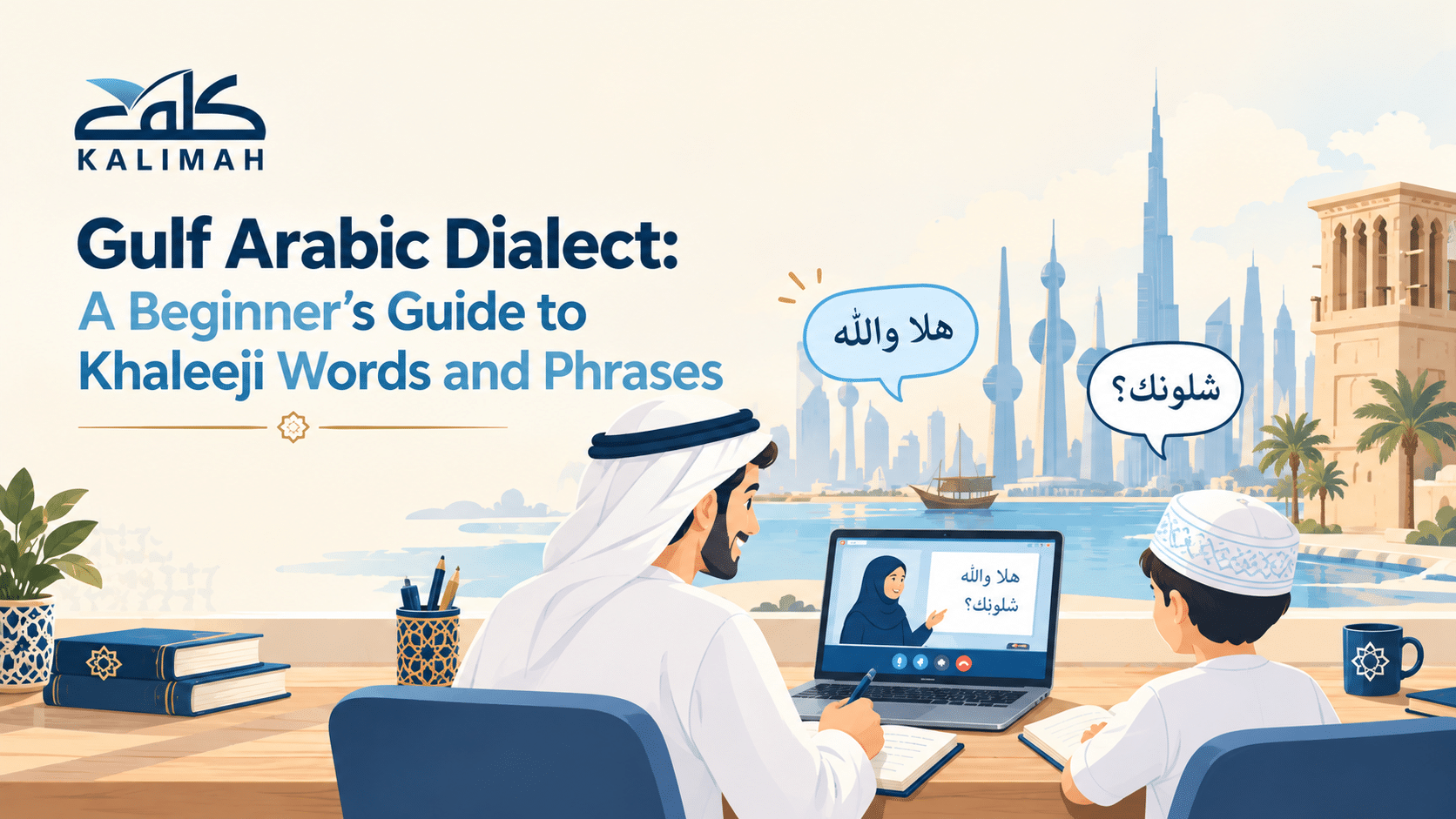
Have you ever heard someone say “Hala wallah, shlonak?” and wondered which Arabic that was? It’s the Gulf Arabic dialect, the everyday spoken Arabic of the UAE, Saudi Arabia, Qatar, Kuwait, Bahrain, and Oman.
Millions of people use the Gulf Arabic dialect at home, at work, and on social media every day. Yet most textbooks teach only Modern Standard Arabic, so many learners arrive in the Gulf and struggle to follow a simple chat.
In this guide, you’ll learn what Khaleeji Arabic is, where people speak it, how it sounds, and which words and phrases to learn first. We’ll also explain how it connects to Quranic Arabic, so families learning the Quran know where it fits.
Take Away: What You Will Learn
- What the Gulf Arabic dialect is and which countries speak it
- How Khaleeji differs from Modern Standard Arabic (Fusha) and Quranic Arabic
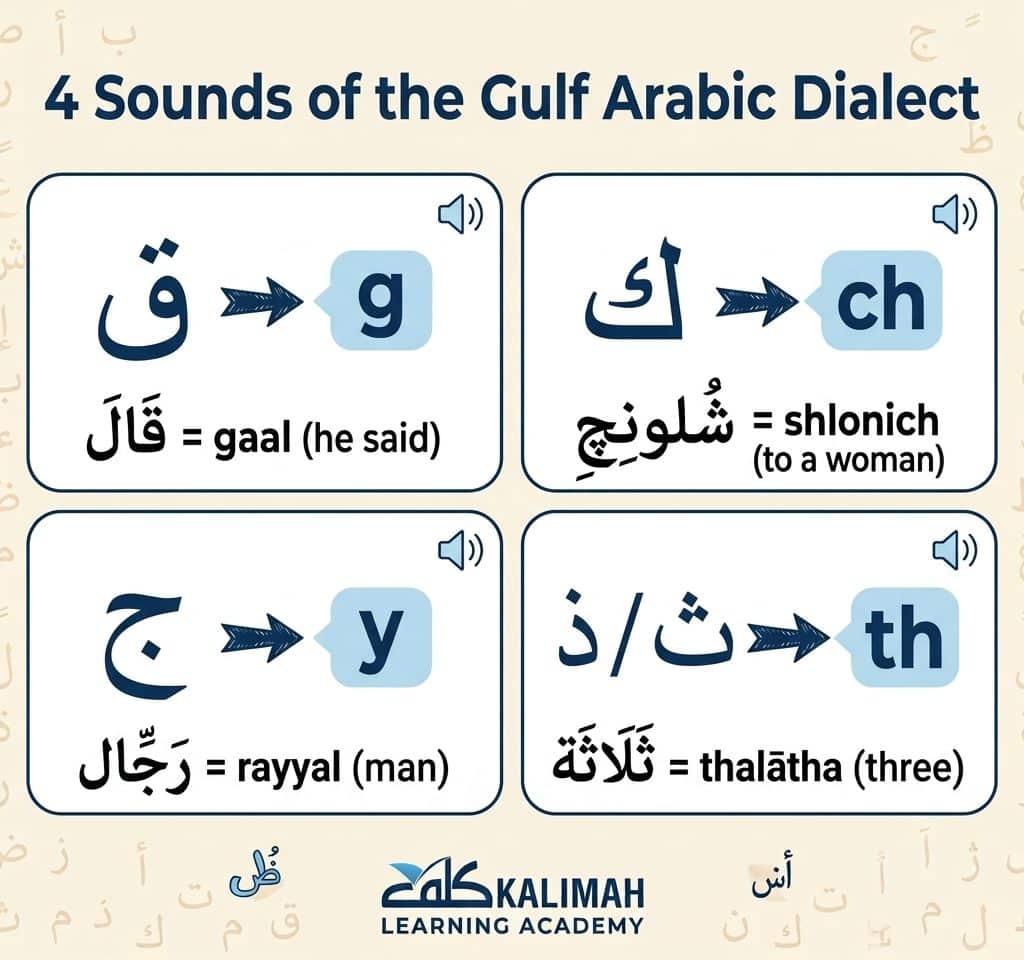
- The 4 pronunciation features that make Gulf speech easy to recognize
- Essential Gulf Arabic dialect words and phrases with transliteration
- A practical plan to start learning, for kids and adults
What Is the Gulf Arabic Dialect?
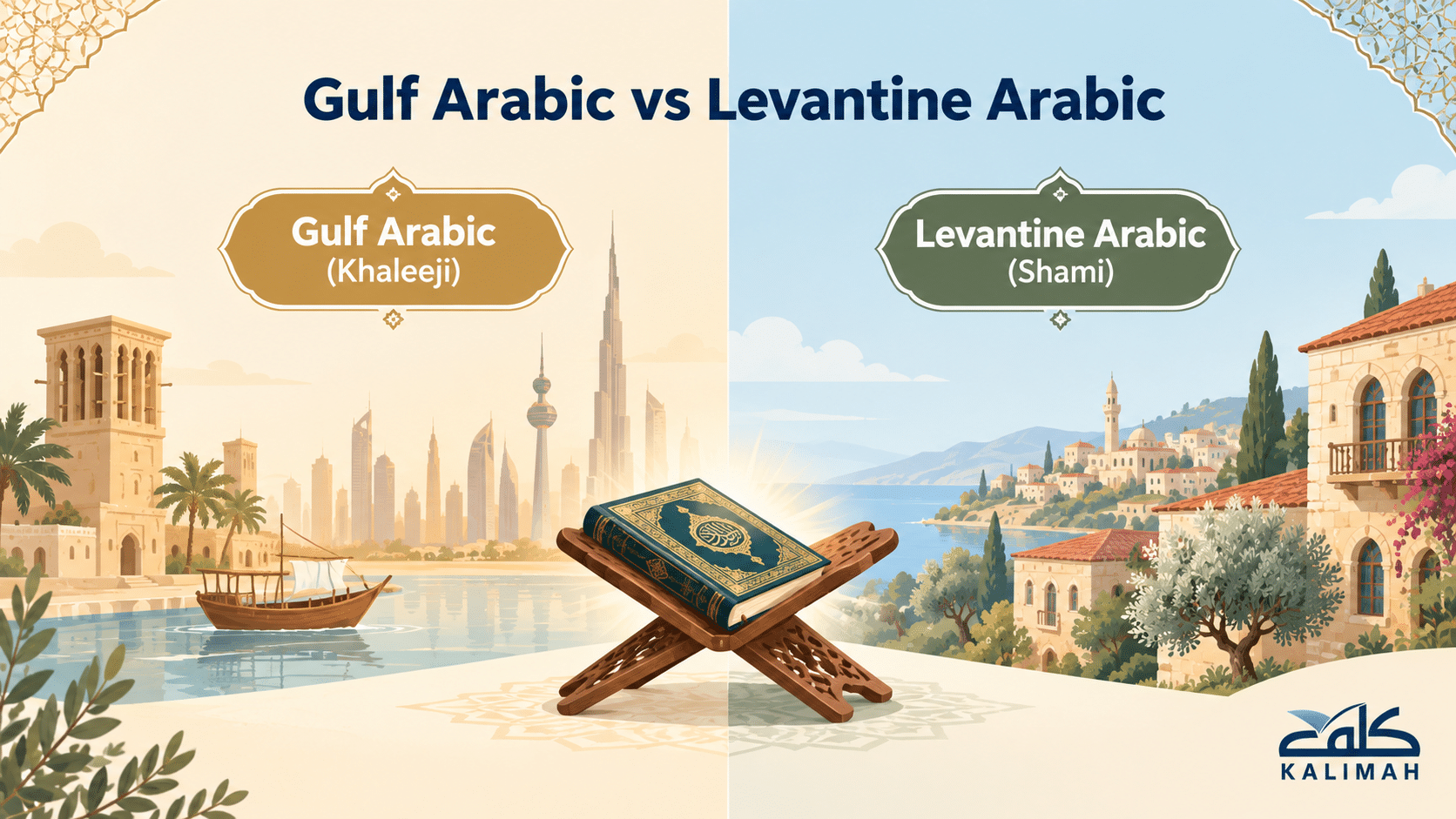
The Gulf Arabic dialect is the spoken Arabic of the Arabian Gulf region. Locals call it Khaleeji (خليجي), which means “of the Gulf.” It isn’t one fixed language but a family of closely related local varieties.
Kuwaiti, Bahraini, Qatari, and Emirati speech all belong to this family. Speakers from these countries understand each other with little effort, even though their accents and some words differ.
Where Is Khaleeji Arabic Spoken?
According to an overview of Gulf Arabic, people speak the dialect in Kuwait, Bahrain, Qatar, the UAE, eastern Saudi Arabia, northern Oman, and southern Iraq.
Saudi Arabia is more varied. Najdi speech in Riyadh shares a lot with Khaleeji, while Hijazi Arabic in Jeddah and Makkah has its own flavor. Omani Arabic is related but has more local features.
Gulf Arabic Dialect vs. Modern Standard Arabic (Fusha)
People use the Gulf Arabic dialect in daily life, while Fusha is the formal standard used in news, books, and official documents. Nobody grows up speaking Fusha at home, but Gulf children grow up speaking Khaleeji.
| Aspect | Gulf Arabic (Khaleeji) | Fusha (MSA) |
| Main use | Daily conversation, family, social media | News, books, formal speeches |
| Spoken at home? | Yes | No |
| Written? | Rarely, and informally | Yes, the standard written form |
| Best for | Talking with Gulf communities | Reading, studying, formal settings |
How Does the Gulf Dialect Relate to Quranic Arabic?
The Quran was revealed in Classical Arabic, the ancestor of Fusha, not in any modern dialect. Khaleeji keeps several classical sounds and word roots, so Quran learners often find Gulf speech surprisingly familiar.
Still, the dialect doesn’t replace Tajweed. Gulf speakers pronounce ق as “g” in daily speech, but in Quran recitation it must be a true qaf. Our Online Quran With Tajweed Course teaches each letter from its correct articulation point.
Experience Kalimah Center Classes
Watch real excerpts from our live sessions at Kalimah Center and see how we bring learning to life. These clips highlight our interactive, student-centered teaching approach across all our courses—designed to keep learners engaged, motivated, and actively involved every step of the way.
Master Arabic with Kalimah Center
Join our expert-led online classes and start your journey toward Arabic fluency today.
Book Your Free Trial4 Sound Changes in Gulf Arabic Dialect Pronunciation
A few pronunciation habits give Khaleeji its character. Once you know them, you can recognize a Gulf speaker within a sentence or two. Pronunciation is the first thing that sets the Gulf Arabic dialect apart from other varieties. Learning these sound changes early helps you understand native speakers faster and keeps your own speech natural.
Qaf (ق) Becomes a Hard “G”
Gulf speakers usually pronounce ق like the “g” in “go.” So قال (he said) becomes gaal, and قهوة (coffee) becomes gahwa. In Cairo or Beirut, the same letter often becomes a glottal stop instead.
You’ll hear this change in many everyday words, such as galb (heart), gabil (before), and agdar (I can). Practice moving between the dialect “g” and the classical qaf, so you’re ready for both conversation and recitation.
Kaf (ك) Sometimes Becomes “Ch”
In many Gulf varieties, ك changes to “ch,” especially when you’re talking to a woman. That’s why “How are you?” is shlonak to a man and shlonich to a woman. The same change shows up in other words, like chem? (how many?) in Kuwaiti speech.
Pay attention to the endings -ak and -ich, because using the right one shows respect and real attention to the person you’re talking to.
Jeem (ج) Can Become “Y”
In Kuwaiti, Emirati, Bahraini, and Qatari speech, ج often softens into a “y.” The word رجّال (man) can sound like rayyal. This is less common in central Saudi speech. You may also hear yāy for jāy (coming) or diyāy for dijāj (chicken).
At first, you only need to recognize this sound when you hear it, and your ear will adjust with regular listening.
The “Th” Sounds Survive
Khaleeji keeps ث (“th” as in “think”) and ذ (“th” as in “this”). Many Egyptian and Levantine speakers change these to t, s, d, or z. If you learned the alphabet with its classical sounds, this will feel familiar.
Words like thalātha (three) and hādha (this) keep their classical sounds in Khaleeji speech. This makes the Gulf Arabic dialect a helpful bridge for Quran learners who already practice these letters in Tajweed lessons.
For more, read Is the Arabic Alphabet the Same for All Dialects?
Gulf Arabic Dialect Words
A small set of common Gulf Arabic dialect words gives you a strong start. Focus on words you’ll use every day rather than long vocabulary lists. You’ll hear these words in shops, offices, and homes across the region. Learn them in context, and you’ll soon recognize them in real conversations.
Survival Words for Daily Life
Start with words that help you handle basic situations, ask simple questions, and respond naturally. The table below lists eight common words you’ll hear many times a day in any Gulf country.
| Arabic | Transliteration | Meaning |
| زين | zayn | good/fine |
| أبغى | abghā (or abi) | I want |
| الحين | el-ḥīn | now |
| وين؟ | wēn? | where? |
| ليش؟ | lēsh? | why? |
| وايد | wāyid | a lot / very |
| خلاص | khalāṣ | done / enough |
| إنزين | inzēn | okay / alright |
Words for Food, Shopping, and Getting Around
At a café, you’ll ask for gahwa (coffee), chāy/shāy (tea), or mōya (water). In shops, bkam? means “how much?”, ghāli means “expensive,” and rakhīṣ means “cheap.”
For directions, remember yamīn (right), yasār (left), guddām (in front), and warā (behind). These words alone get you through many taxi rides and shop visits.
Why Small Word Sets Work Best
Learning five or six words at a time helps you remember each word’s sound, meaning, and use. Say them aloud, use them in short sentences, and review them over the next few days.
Spaced repetition means reviewing words after one day, three days, and one week, and it helps them stay in your long-term memory. Flashcards with audio work especially well, because you learn the Gulf Arabic dialect mostly by listening and speaking.
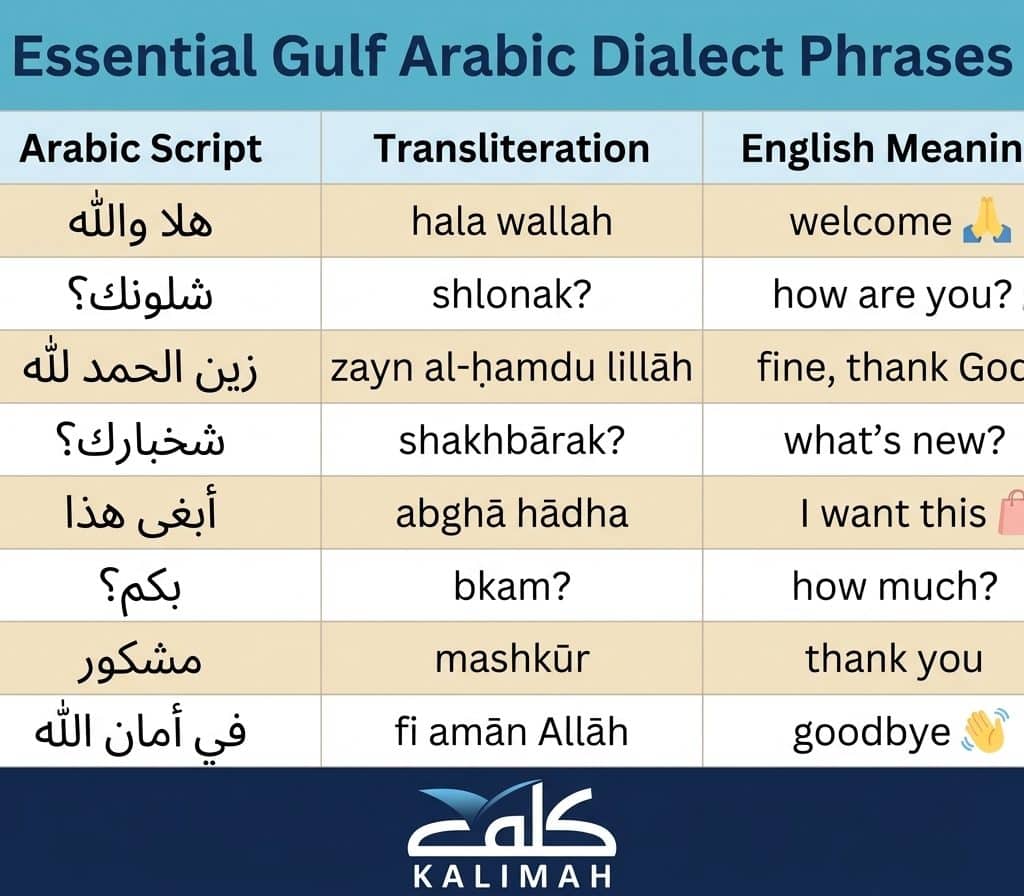
Gulf Arabic Dialect Phrases
Words become useful when you combine them into real conversations. You’ll hear the Gulf Arabic dialect phrases below in your very first week in the region.
Greetings and Polite Expressions
Greetings matter a lot in Gulf culture, and locals appreciate visitors who use them. Start with these warm expressions to open any conversation politely.
- Hala / Hala wallah: a warm “hi” or “welcome”
- Shlonak? / Shlonich?: How are you? (to a man / to a woman)
- Zayn, al-ḥamdu lillāh: Fine, praise be to God
- Shakhbārak?: What’s new with you?
- Yaʿṭīk el-ʿāfya: May God give you health (a Gulf-style “thank you”)
Many everyday Gulf Arabic dialect phrases carry religious meaning, such as al-ḥamdu lillāh and Fi amān Allāh (goodbye, or “in God’s protection”). Our guide on Thank God in Arabic explains the full meaning of Alhamdulillah.
Phrases for Everyday Situations
These short phrases help you shop, ask for help, and respond politely. Practice them aloud until they come to you without thinking.
- Abghā hādha: I want this
- Mā agdar: I can’t
- Mashkūr: Thank you
- Mā fī mushkila: No problem
For more sentence patterns that work across dialects, see our guide to learning Arabic phrases and sentences.
Inside Kalimah Center: Moments from Our Courses
Get a glimpse into the vibrant learning experience at Kalimah Center. These snapshots capture real moments from our live classes—where students engage deeply, connect with passionate instructors, and grow in a welcoming, supportive environment.
Master Arabic with Kalimah Center
Join our expert-led online classes and start your journey toward Arabic fluency today.
Book Your Free TrialHow to Start Learning the Gulf Arabic Dialect
Khaleeji isn’t especially hard. The real challenge is that there are few structured resources for it. Many learners study from MSA books and are surprised that nobody in Abu Dhabi talks like the textbook.
1. Build a Strong Base in the Arabic Script and Sounds
Reading Arabic letters helps you see how words are built, and you can learn the script in days, not months. Pronouncing letters like ع, ح, and ق correctly also prepares you for Quran recitation.
Start with the letter shapes and how they change at the start, middle, and end of a word. Then move on to short vowels and joining rules, with a teacher guiding you through sounds English doesn’t have.
2. Start With Real Phrases, Not Grammar Tables
Begin with greetings, numbers, and common verbs inside full sentences. Say them out loud from the first week, even if you make mistakes.
For example, learn Abghā gahwa, law samaḥt (I’d like a coffee, please) as one complete phrase. Learning whole phrases like this lets you speak the Gulf Arabic dialect sooner, and you’ll pick up the grammar naturally over time.
3. Listen to Gulf Speech Specifically
Listen to Khaleeji podcasts, Kuwaiti and Saudi TV series, and voice notes from Gulf friends. For advanced learners, a Khaliji dictionary is a useful Arabic-to-Arabic reference.
Try shadowing: play a short clip, pause it, and repeat the line with the same rhythm and tone. Just ten minutes a day trains your ear to catch Gulf Arabic dialect words at natural speed.
4. Learn With a Qualified Teacher
A teacher corrects your pronunciation early, before bad habits set in. At Kalimah Center, our one-on-one online Arabic course builds a solid Fusha foundation, which makes it much faster to pick up any dialect, including Khaleeji.
Live lessons also give you real speaking practice, instant feedback, and a clear study plan. This guidance matters even more for kids, who learn best with patient teachers and structured, interactive sessions.
Start Your Khaleeji Arabic Journey With Kalimah Center Today
The Gulf Arabic dialect is easier to understand when you already have a solid base in Arabic. Kalimah Center helps kids and adults build that base with certified native teachers.
Join our Tajweed and Quran recitation circles to perfect every letter, or choose our Arabic language program to read, write, and speak with confidence. All lessons are live, online, and fit your schedule.
Explore Our Courses:
- Online Arabic Course: Tailored to your level, our comprehensive Arabic program includes 16 teaching levels and 400+ hours of personalized sessions.
- Online Quran With Tajweed Course: Perfect for non-Arabic speakers, our course spans 13 levels and equips you with Tajweed mastery from beginner to advanced.
- Online Arabic Course for Kids: Nurture your child’s love for Arabic with our engaging and structured program, available in 24 levels for primary, intermediate, and secondary stages.
Book your free trial lesson today and see how fast you can progress. Your first Arabic conversation, or your first correct recitation, is closer than you think.
Master Arabic with Kalimah Center
Join our expert-led online classes and start your journey toward Arabic fluency today.
Book Your Free TrialConclusion
The Gulf Arabic dialect, or Khaleeji, is the living spoken Arabic of the GCC countries. People use it in daily life where they wouldn’t use Fusha, yet it keeps many classical sounds that feel familiar to Quran learners.
You now know its main sound changes: ق as “g,” ك as “ch,” ج as “y,” and the surviving “th” sounds. You also have a starter set of Gulf Arabic dialect words and phrases to use in real life.
The main takeaway is simple: build a strong foundation in Arabic and correct pronunciation first, then add the Gulf Arabic dialect through listening and speaking. With the right teacher, you can reach both goals.
FAQs
Here are quick answers to the questions learners ask most about the Gulf Arabic dialect.
Is Khaleeji the same as Gulf Arabic?
Yes. Khaleeji (خليجي) means “of the Gulf,” and it’s what speakers call their own dialect. Both names refer to the same group of spoken varieties across the GCC.
Is the Gulf Arabic dialect hard to learn?
It’s about as hard as any other spoken Arabic dialect. Its clear pronunciation and classical sounds help beginners, but there are fewer courses for it than for Egyptian or Levantine Arabic.
Should I learn MSA or Gulf Arabic first?
It depends on your goal. For reading, formal settings, and understanding the Quran, start with Fusha. For daily conversation in the Gulf, start with the dialect, ideally on top of a basic Fusha foundation.
Can Gulf Arabic speakers understand Egyptian and Levantine Arabic?
Yes. Most people in the Gulf grew up with Egyptian films and Levantine music, so they follow both easily. It can be harder the other way around when Gulf speakers use a lot of local slang.
Does learning the Gulf dialect help with reading the Quran?
It helps with familiar word roots and with sounds like ث and ذ. However, Quran recitation follows Tajweed rules, so you must pronounce letters like ق in the classical way, not as the dialect’s “g.”