Have you ever heard a Saudi say “wesh al-akhbar?” and wondered why it sounds nothing like your Arabic textbook? You’re not the only one. The Saudi Arabic dialect isn’t one single way of speaking, and that surprises a lot of learners.
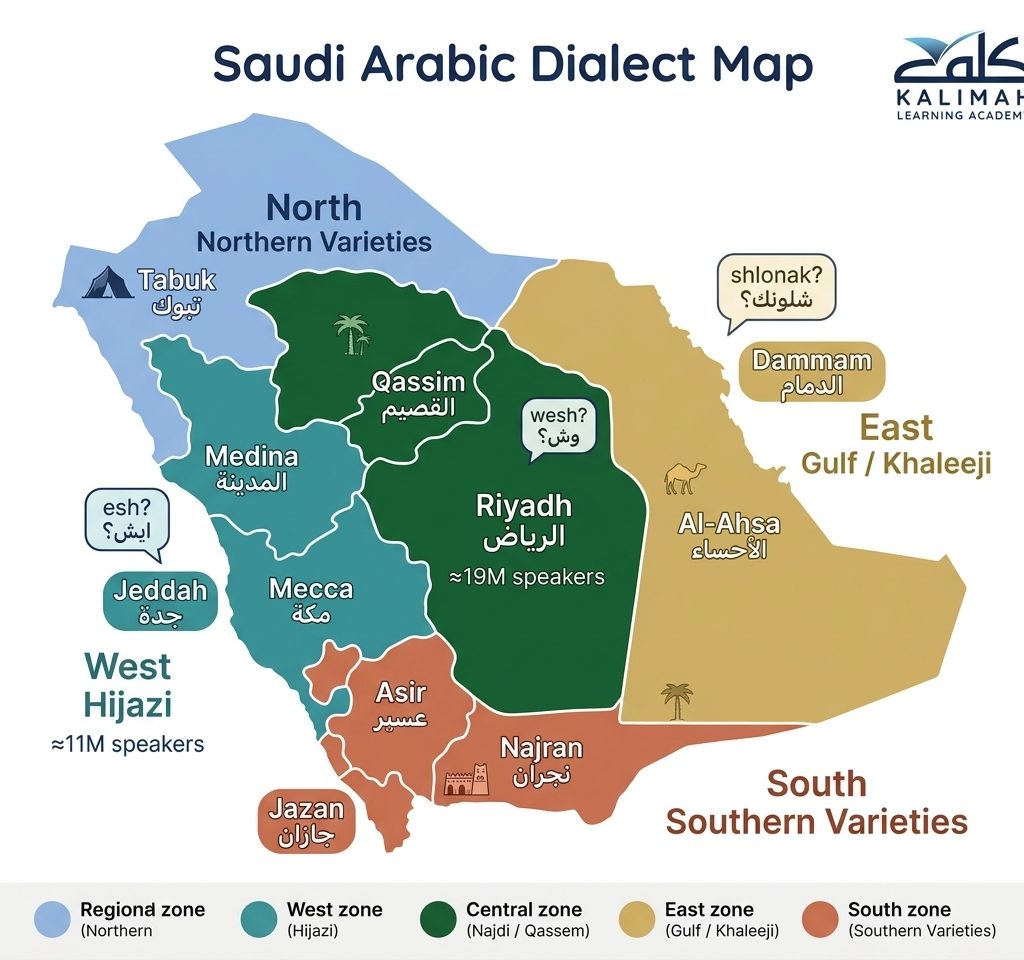
Saudi Arabia has several regional varieties. According to Ethnologue, Najdi alone has about 19 million speakers, and Hijazi has about 11 million. Each region has its own words, sounds, and everyday expressions.
This guide covers how the Saudi Arabic dialect is divided, how it sounds, and the words and phrases you’ll hear most often. You’ll also see how it connects to the Arabic of the Quran.
Take Away: What You Will Learn
- The three main dialect families of Saudi Arabia and where each one is spoken.
- The main sound changes that separate Saudi speech from Modern Standard Arabic.
- Common Saudi Arabic dialect words, with the Najdi and Hijazi forms side by side.
- Useful Saudi Arabic dialect phrases for greetings, politeness, and shopping.
- How studying the Quran and Fusha helps you understand Saudi speech faster.
What Is the Saudi Arabic Dialect?
The Saudi Arabic dialect is the group of spoken Arabic varieties used across Saudi Arabia. Linguists classify them as Peninsular Arabic.There are three main families, Najdi, Hijazi, and Gulf, plus southern and northern varieties.
Each family follows the country’s geography. Here’s a quick look at each one and where you’ll hear it.
Najdi Arabic (Central Region)
Najdi is spoken in Riyadh, Al-Qassim, Ha’il, and the central plateau. The modern Riyadh accent is the prestige form of the Saudi Arabic dialect, and it’s the one you hear in government and broadcasting. Ethnologue lists it under its own code, “ars.”
Najdi grew out of the speech of desert tribes and oasis towns, which helped it keep many older Arabic sounds and words. Today, Riyadh’s media and government influence is spreading its urban accent and gradually smoothing out the regional differences around it.
Hijazi Arabic (Western Region)
Hijazi is spoken along the Red Sea coast in Jeddah, Mecca, Medina, and parts of Taif. Centuries of pilgrims and merchants shaped it. That’s why urban Hijazi is widely understood and is common in business and the media.
Because millions of pilgrims visit Mecca and Medina every year, Hijazi picked up words from many languages and cultures. Its urban form also differs from the Bedouin speech of the Hijazi tribes, so you may hear two quite different accents in the same region.
Gulf (Khaleeji) Arabic (Eastern Province)
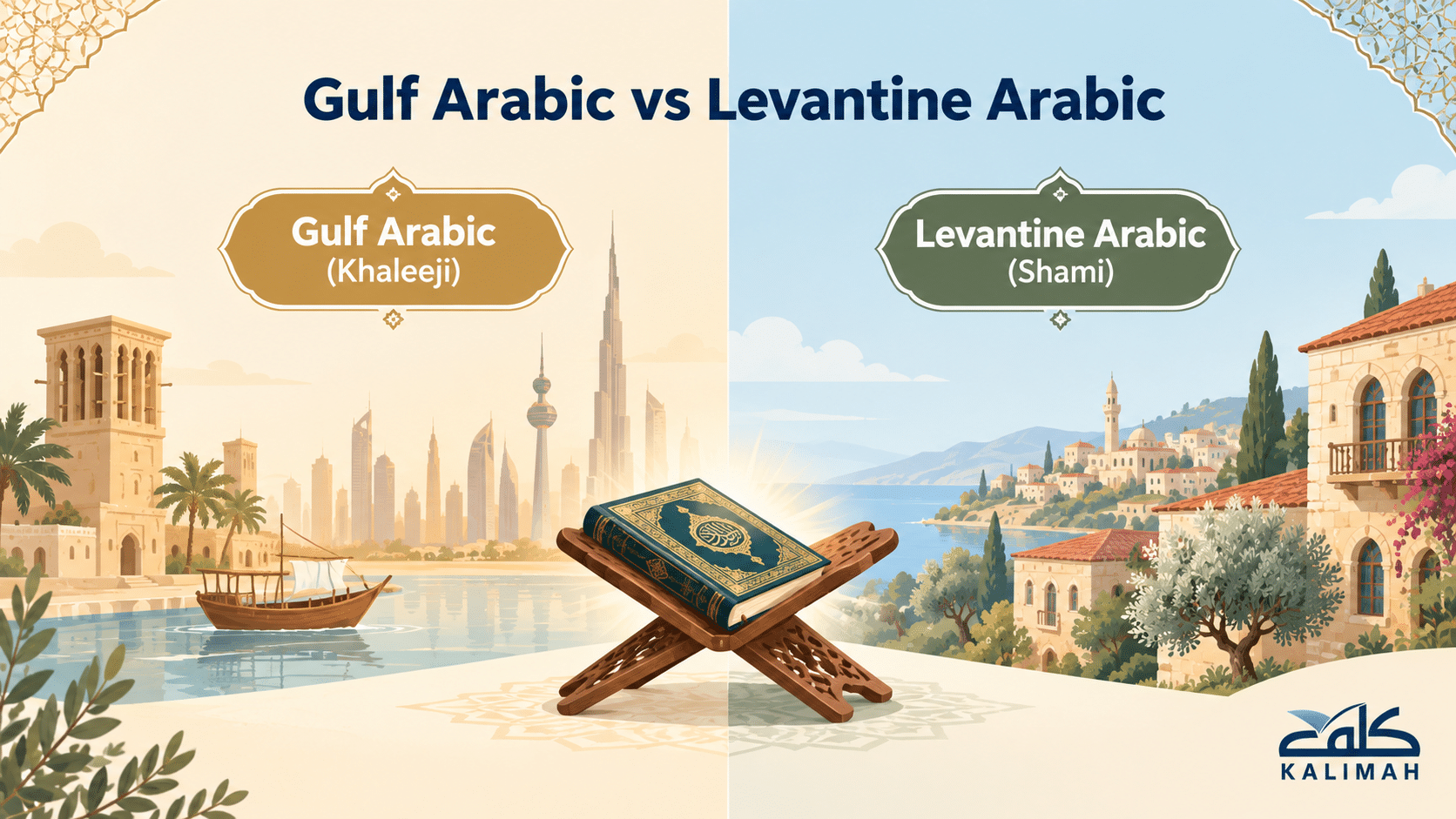
Gulf Arabic is spoken in Dammam, Qatif, and Al-Ahsa. It’s close to the Arabic spoken in Kuwait, Bahrain, Qatar, and the UAE, so people in the Eastern Province understand their neighbors easily.
This branch of the Saudi Arabic dialect varies within itself too. Al-Ahsa has its own local variety, and the people of Qatif and Saihat speak a Baharna variety that they share with communities on the other side of the Gulf, in Bahrain.
Southern and Northern Varieties
In Asir, Jazan and Najran, speech has features influenced by Yemeni Arabic. In the north near Tabuk, the dialect shares features with Jordanian and Syrian Bedouin speech.
The south keeps some of the oldest speech features in the Kingdom. In parts of Jazan, for example, some speakers replace the article “al-” with “am-.” Arab scholars call this feature tamtamaniyya, and classical sources already mention it.
How the Saudi Arabic Dialect Sounds Different From Fusha
Most of the gap between what you read and what you hear comes from a few sound changes. Once you know them, you’ll recognize many Saudi Arabic dialect words you already know.
These changes follow clear patterns. If you already know the points of articulation of the letters (makharij al-huruf) from Tajweed lessons, you can usually spot each change quickly, because you know exactly which sound the dialect is replacing.
The Qaf Becomes a Hard “G”
In Najd and the Hijaz, the letter ق (qaf) is often said as a plain “g.” So قهوة (coffee) becomes “gahwa,” not “qahwa.” Religious words keep the classical sound, so nobody says “al-Gur’an.”
This “g” isn’t modern slang. Linguists link it to old Bedouin Arabic speech. When you recite the Quran, though, you must always pronounce the full qaf from the back of the tongue, as Tajweed rules require.
The Kaf Can Become “Ts” in Najdi
Older Najdi speakers sometimes turn ك (kaf) into a “ts” sound, so كلب (dog) becomes “tsalb.” This sound is dying out, and younger people in Riyadh rarely use it.
Arab grammarians described a related feature called kaskasa, a change to the kaf when speaking to a woman. You can still hear a version of it in Najd, where older speakers may pronounce the feminine “-ki” (your) closer to “-ts.”
The “Th” Sounds in Najdi and Hijazi
Najdi keeps the “th” sounds of ث and ذ, just like Fusha. Many urban Hijazi speakers change them to t, d, or z. That’s one reason Najdi feels closer to the Arabic you study in Quran classes.
For Quran students, this difference matters. Tajweed treats ث, ذ and ظ as separate letters, all made with the tip of the tongue against the upper front teeth. Practicing them carefully improves your recitation and also trains your ear for Najdi speech.
Experience Kalimah Center Classes
Watch real excerpts from our live sessions at Kalimah Center and see how we bring learning to life. These clips highlight our interactive, student-centered teaching approach across all our courses—designed to keep learners engaged, motivated, and actively involved every step of the way.
Master Arabic with Kalimah Center
Join our expert-led online classes and start your journey toward Arabic fluency today.
Book Your Free TrialSaudi Arabic Dialect Words You Will Hear Every Day
A handful of short words make up a large share of daily conversation. Learn them first for quick progress. They’ll also help you tell a Riyadh speaker from a Jeddah speaker after one sentence.
Najdi vs Hijazi: Key Saudi Arabic Dialect Words
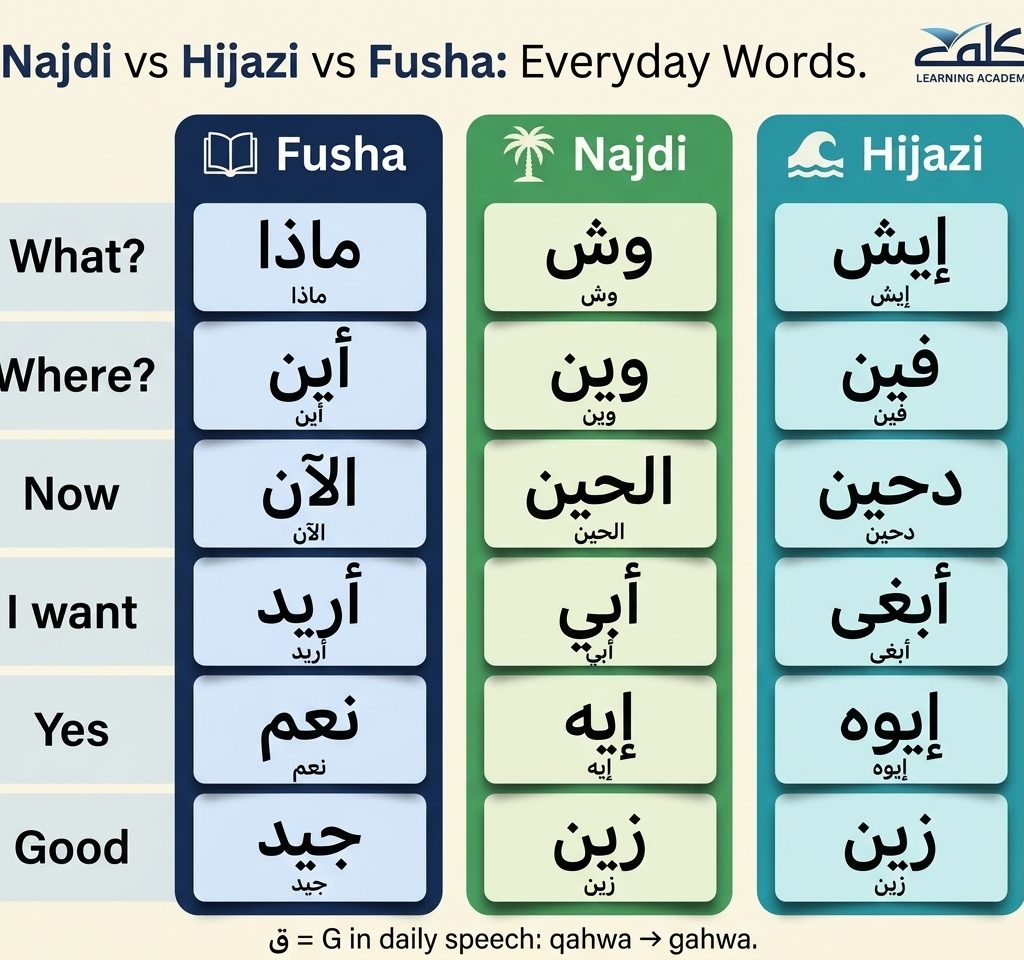
The table below compares seven everyday words in Fusha, Najdi, and Hijazi. Read each row from left to right to see how one idea changes across the Saudi Arabic dialect map, and notice the words the two regions share.
| English | Fusha (MSA) | Najdi (Riyadh) | Hijazi (Jeddah) |
| What? | ماذا (matha) | وش (wesh) | إيش (esh) |
| Where? | أين (ayna) | وين (wein) | فين (fein) |
| Now | الآن (al-aan) | الحين (al-heen) | دحين (daheen) |
| I want | أريد (ureed) | أبي (abi) | أبغى (abgha) |
| Yes | نعم (na’am) | إيه (eh) | إيوه (eewa) |
| Why? | لماذا (limatha) | ليش (lesh) | ليش (lesh) |
| Good, fine | جيد (jayyid) | زين (zein) | زين (zein) |
The question words split neatly between the two regions. Say “daheen” in Riyadh or “wesh” in Jeddah, and people will know you’re not local, so pick one variety and stick with it.
Common Saudi Arabic Dialect Words Across the Kingdom
Some words work almost everywhere in the country. It makes them a safe starting point for any learner of the Saudi Arabic dialect, whatever region they plan to visit. These are the most useful to learn early:
- Khalas (خلاص): done, finished, enough.
- Marrah (مرّة): very or really, as in “marrah hilu” (really nice).
- Zein (زين): good or okay.
- Abshir (أبشر): consider it done. You say it when someone asks you for a favor.
Saudi Arabic Dialect Phrases for Greetings and Daily Life
Greetings and polite expressions are the parts of the dialect you can use most widely. A few warm Saudi Arabic dialect phrases will make people welcome you in shops, mosques, and homes.
Greeting Phrases
Greetings in Saudi Arabia are warm and often long. People usually ask about each other’s health and family before getting down to business, so knowing a few greetings shows respect from the very first minute.
- As-salamu alaykum (السلام عليكم): the greeting you can use with anyone. The reply is “wa alaykum as-salam.”
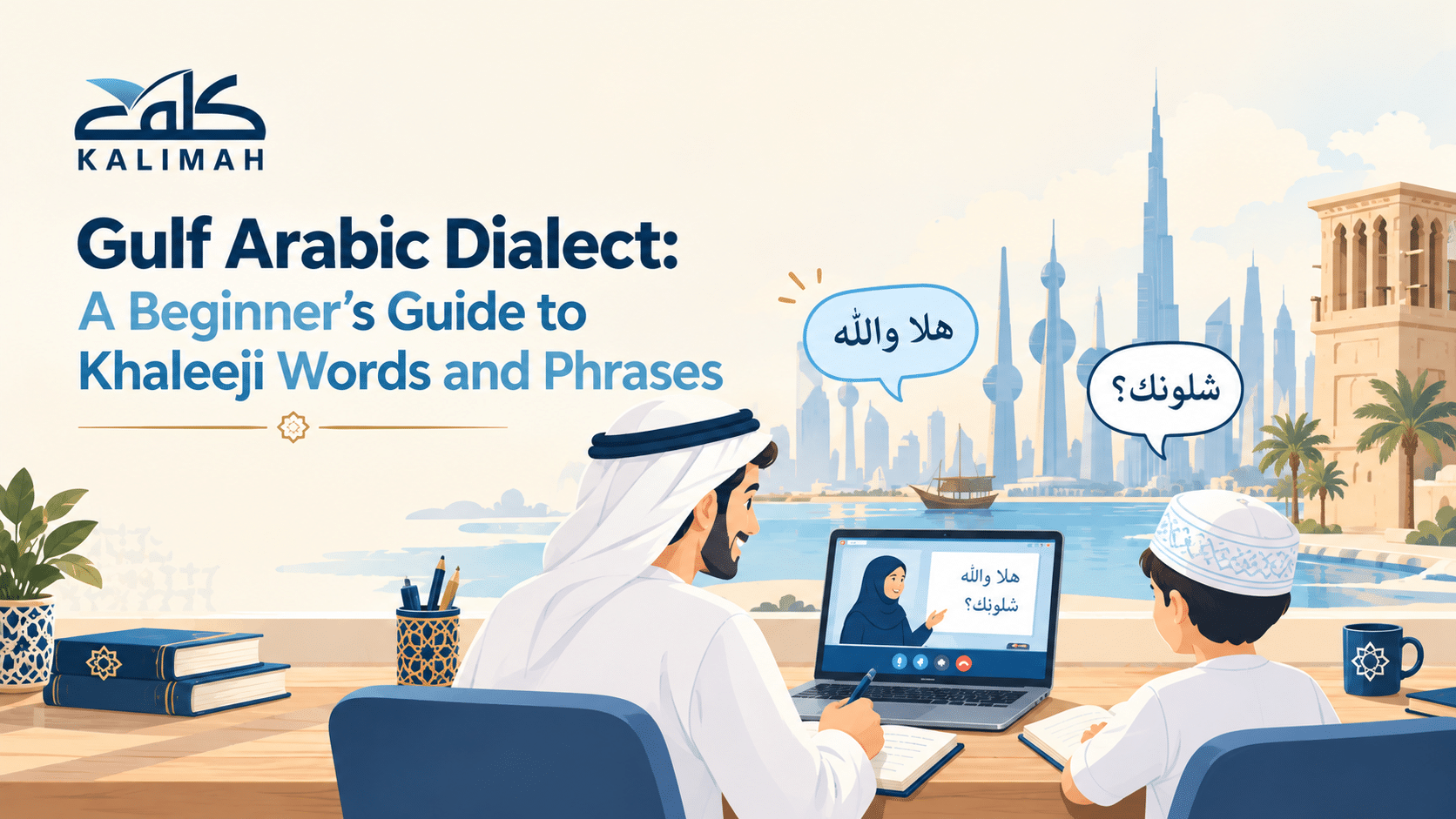
- Hala wallah (هلا والله): a warm “great to see you.” Reply with “hala fik.”
- Shlonak? (شلونك): “How are you?” to a man in Najdi. In Jeddah, say “kayf halak?”
- Wesh al-akhbar? (وش الأخبار): “What’s new?” among friends.
Polite Phrases
Politeness in Saudi culture often has a religious touch. Many everyday replies mention Allah, so these Saudi Arabic dialect phrases will feel familiar to Quran learners who already use expressions like “in sha’ Allah” and “jazak Allahu khayran.”
- Ma’lesh (معليش): “never mind” or “sorry about that,” for small slips.
- Ala rasi (على راسي): literally “on my head.” It means “with pleasure.”
- Allah yisallimak (الله يسلمك): a warm reply when someone thanks you.
Phrases for Shopping and Travel
Markets (souqs) and taxis are where visitors use Arabic the most. Even a short question in the local Saudi Arabic dialect usually earns a smile and makes the conversation easier, so practice these phrases before your trip.
- Bikam hadha? (بكم هذا): How much is this?
- Wein al-hammam? (وين الحمام): Where is the bathroom? In Jeddah, say “fein.”
- Ma fahimt (ما فهمت): I didn’t understand.
These phrases are a great start, but real fluency comes from a solid grounding in Fusha. In Kalimah Center’s Online Arabic Course, native tutors build that foundation step by step.
Inside Kalimah Center: Moments from Our Courses
Get a glimpse into the vibrant learning experience at Kalimah Center. These snapshots capture real moments from our live classes—where students engage deeply, connect with passionate instructors, and grow in a welcoming, supportive environment.
Master Arabic with Kalimah Center
Join our expert-led online classes and start your journey toward Arabic fluency today.
Book Your Free TrialIs the Saudi Arabic Dialect Close to the Language of the Quran?
Yes. It’s one of the spoken dialects closest to Classical Arabic. Arabic began in the Arabian Peninsula, and people there had less contact with other languages than people in many other regions.
The Quran was revealed in the Hijaz, in the Arabic of Quraysh. Today’s dialects have changed a lot since then, but many Saudi words still come straight from Classical roots. “Zein,” for example, comes from a Classical Arabic word meaning beauty or goodness.
That’s why Quran learners often find Saudi speech easier to follow. Studying Tajweed and recitation in a structured online Quran course trains your ear for sounds like the “th” of ذ, which Najdi speakers still use.
Which Saudi Dialect Should You Learn First?
Start with Najdi unless your work or family is in the west. It’s the prestige form, people understand it across the country, and it’s the closest to Modern Standard Arabic.
Choose Hijazi, the western Saudi Arabic dialect, if you plan to live in Jeddah, Mecca or Medina. Choose Gulf Arabic if you’re moving to the Eastern Province. Whichever you pick, a solid grounding in Fusha makes every Saudi variety easier.
Few major apps teach a Saudi dialect, so the best plan is simple: learn Fusha first, then add the dialect with a native tutor. Our complete guide to Arabic dialects explains how all the main varieties compare.
Parents can start their children early too. In our Arabic course for kids, young learners master letters and sounds first. You can read more about this in Is the Arabic Alphabet the Same for All Dialects?
Learn Arabic and Quran With Kalimah Center Today
Do you want to understand Saudi speech and recite the Quran with confidence? At Kalimah Center, kids and adults take live one-on-one lessons with qualified native tutors, and every class is adapted to the learner’s level.
Our Tajweed circles train you to pronounce every letter correctly, from the deep qaf to the soft “th” sounds. If you’re just starting, our guide to Tajweed for beginners online shows you what to expect.
Explore Our Courses:
- Online Arabic Course: Tailored to your level, our comprehensive Arabic program includes 16 teaching levels and 400+ hours of personalized sessions.
- Online Quran With Tajweed Course: Perfect for non-Arabic speakers, our course spans 13 levels and equips you with Tajweed mastery from beginner to advanced.
- Online Arabic Course For Kids: Nurture your child’s love for Arabic with our engaging and structured program, available in 24 levels for primary, intermediate, and secondary stages.
Alongside Quran recitation, our Arabic programs build strong Fusha skills that make any dialect easier, including the Saudi Arabic dialect. Book your free trial lesson today and take your first step.
Master Arabic with Kalimah Center
Join our expert-led online classes and start your journey toward Arabic fluency today.
Book Your Free TrialConclusion
Saudi Arabia doesn’t speak with one voice. Najdi in the center, Hijazi in the west, and Gulf Arabic in the east each have their own sounds and vocabulary. The south and the north add even more variety.
You now know the main sound changes, the most useful Saudi Arabic dialect words, and the phrases you need for everyday conversation. Pick one variety and use it consistently. For most learners, that’s Najdi.
The main takeaway is this: the Saudi Arabic dialect is rooted in Classical Arabic, so strong Fusha and Quran skills are your fastest way to understand it. Learn those first, and the dialect will come naturally.
For Muslim families, there’s one more benefit. Every hour spent on Fusha and Tajweed builds the skills to recite the Quran correctly and to understand the Saudi Arabic dialect, so one learning plan serves both goals for kids and adults.
FAQs
Here are quick answers to the questions learners ask most about the Saudi Arabic dialect.
How do you say hi in Saudi Arabia?
The safe greeting is “as-salamu alaykum,” and the reply is “wa alaykum as-salam.” A warmer, more local hello is “hala wallah,” and you answer it with “hala fik.”
What is the difference between Najdi and Hijazi Arabic?
Najdi is spoken in Riyadh and central Saudi Arabia, and Hijazi in Jeddah, Mecca, and Medina. The biggest differences are in everyday words: “wesh” vs “esh” for “what,” and “al-heen” vs “daheen” for “now.”
Is Saudi Arabic the same as Gulf Arabic?
Not exactly. Gulf Arabic is spoken in the Eastern Province, while Najdi and Hijazi are spoken across most of the rest of the country. Najdi and Gulf Arabic share many features, so their speakers understand each other easily.
Is the Saudi dialect hard to learn?
No. It’s one of the easier dialects for people who have studied Fusha. Najdi keeps many Classical sounds and words, so what you learn in Modern Standard Arabic and Quran study carries over directly.
How do you say sorry in the Saudi dialect?
For a real apology, a man says “asif,” and a woman says “asifa.” For small slips and setbacks, Saudis say “ma’lesh,” which means “never mind” or “sorry about that.”
Can kids learn the Saudi dialect?
Yes. Children pick up spoken Arabic quickly, especially once they’ve learned the alphabet and correct pronunciation in Fusha and Quran lessons.