Have you ever listened to a shop owner in Makkah or a taxi driver in Jeddah and noticed that the Arabic sounded different from the Arabic you recite in the Quran? What you heard was most likely Hejazi Arabic, the everyday speech of western Saudi Arabia.
Hejazi Arabic is spoken by around 11 million people, and it is one of the most widely understood dialects in the Arabian Peninsula. If you are planning Hajj or Umrah, or you are learning Quranic Arabic, knowing a little of this dialect will make the holy cities feel much more familiar.
In this guide, you will learn where the dialect is spoken, how it sounds, which words and phrases are most useful, and how it fits with your Quran and Tajweed studies.
Take Away: What You Will Learn
- What Hejazi Arabic is, where it is spoken, and who speaks it.
- The key sounds that set the Hejazi dialect apart, such as the “g” for qaf.
- Common Hijazi Arabic words and phrases you can use in Makkah and Madinah.
- Why Quran learners should build Classical Arabic first, then add the dialect.
What Is Hejazi Arabic?
Hejazi Arabic (also spelled Hijazi Arabic) is a regional spoken variety of Arabic used in the Hejaz region of western Saudi Arabia. It is a living, everyday dialect, not a written standard like Modern Standard Arabic (MSA).
Where Is Hejazi Arabic Spoken?
It is spoken mainly in Jeddah, Makkah, and Madinah, and partly in Ta’if. These cities sit on the main routes of trade and pilgrimage, so millions of visitors hear the dialect every year.
The dialect also travels beyond the Hejaz. Hejazi families living in Riyadh, the Gulf, and abroad keep using it at home, and Saudi TV series and social media help spread Hejazi Arabic expressions across the Arab world.
How Many People Speak Hejazi Arabic?
Estimates range from about 7 to 11 million speakers, and cites about 11 million in 2018. Its ISO 639-3 code is “acw,” which linguists use to classify it as a distinct variety.
This large speaker base makes Hejazi Arabic one of the most practical dialects to learn in Saudi Arabia. It is the language of everyday business in Jeddah’s markets and the hotels around the Haram, where pilgrims from every country meet.
Is Hejazi Arabic the Same as Quranic Arabic?
No. Quranic Arabic is Classical Arabic, the language of revelation and formal learning. Hejazi Arabic is a modern spoken dialect that grew out of it. The two share roots and much of their vocabulary, but the dialect has simpler grammar and pronounces several sounds differently.
Think of it this way: the Quran gives you the roots, and the dialect shows how those roots are used today. A learner who knows Quranic words such as qalb or ism will often recognize them in Hejazi speech, even when the pronunciation shifts slightly.
Experience Kalimah Center Classes
Watch real excerpts from our live sessions at Kalimah Center and see how we bring learning to life. These clips highlight our interactive, student-centered teaching approach across all our courses—designed to keep learners engaged, motivated, and actively involved every step of the way.
Master Arabic with Kalimah Center
Join our expert-led online classes and start your journey toward Arabic fluency today.
Book Your Free TrialHejazi Arabic Dialect: Key Pronunciation and Grammar Features
The Hejazi Arabic dialect is known for its smooth, soft rhythm, especially in the big commercial cities. A few clear features help you recognize it within seconds.
Knowing these features is useful for two reasons. It helps you understand native speakers faster, and it shows you exactly where everyday Hejazi Arabic differs from the careful pronunciation that Tajweed requires when you recite the Quran.
The Qaf (ق) Is Pronounced as “G”
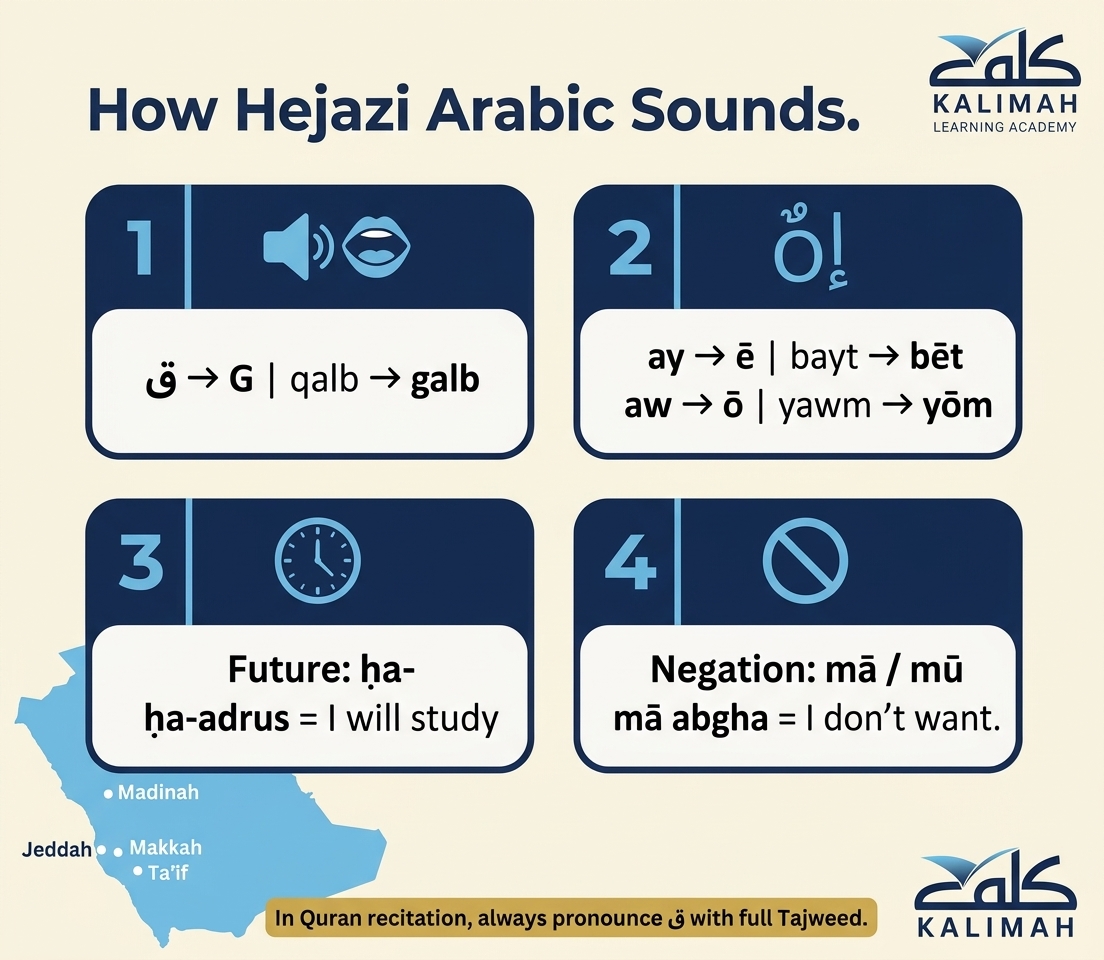
In everyday speech, the letter qaf is usually pronounced as a hard “g,” like the g in “go.” So qalb (heart) sounds like galb, and aqrab (closest) sounds like agrab.
This matters for Quran students. In recitation, qaf must always keep its full Tajweed sound from the back of the tongue. The “g” belongs only to casual conversation.
Vowels and Diphthongs
Hejazi Arabic has eight main vowel sounds, and short and long vowels are clearly distinct. The diphthongs “ay” and “aw” often become long “ē” and “ō,” so bayt (house) sounds like bēt and yawm (day) sounds like yōm.
Unlike Najdi and many Gulf dialects, Hejazi speech keeps its short vowels clear. That makes it easier to follow if you already read the Quran with full vowel marks.
Simple Grammar Markers
The dialect uses simple prefixes that are easy to spot. The future is marked with ḥa-, as in ḥa-adrus (I will study). Ongoing actions often take b-, as in b-akul (I am eating).
Negation uses mā or mū, without the extra “-sh” ending you hear in Egyptian or Levantine Arabic. For example, mā abgha means “I don’t want.”
Urban vs. Rural Hejazi Speech
When people say “Hejazi Arabic,” they usually mean the urban dialect of Jeddah, Makkah, and Madinah. Rural, coastal (Tihamah), and Bedouin varieties also exist across the wider Hejaz, and at the edges they blend into Najdi and Jordanian speech.
Hijazi Arabic Words Every Learner Should Know
A small set of Hijazi Arabic words will carry you through most short conversations in the holy cities. Many of them are worn-down forms of Classical words, so Quran students often recognize the root.
Question Words
Question words are the first thing every visitor needs, because they let you ask for places, prices, and help. In Hejazi Arabic, most of them are short, one-syllable forms that are easy to remember and pronounce.
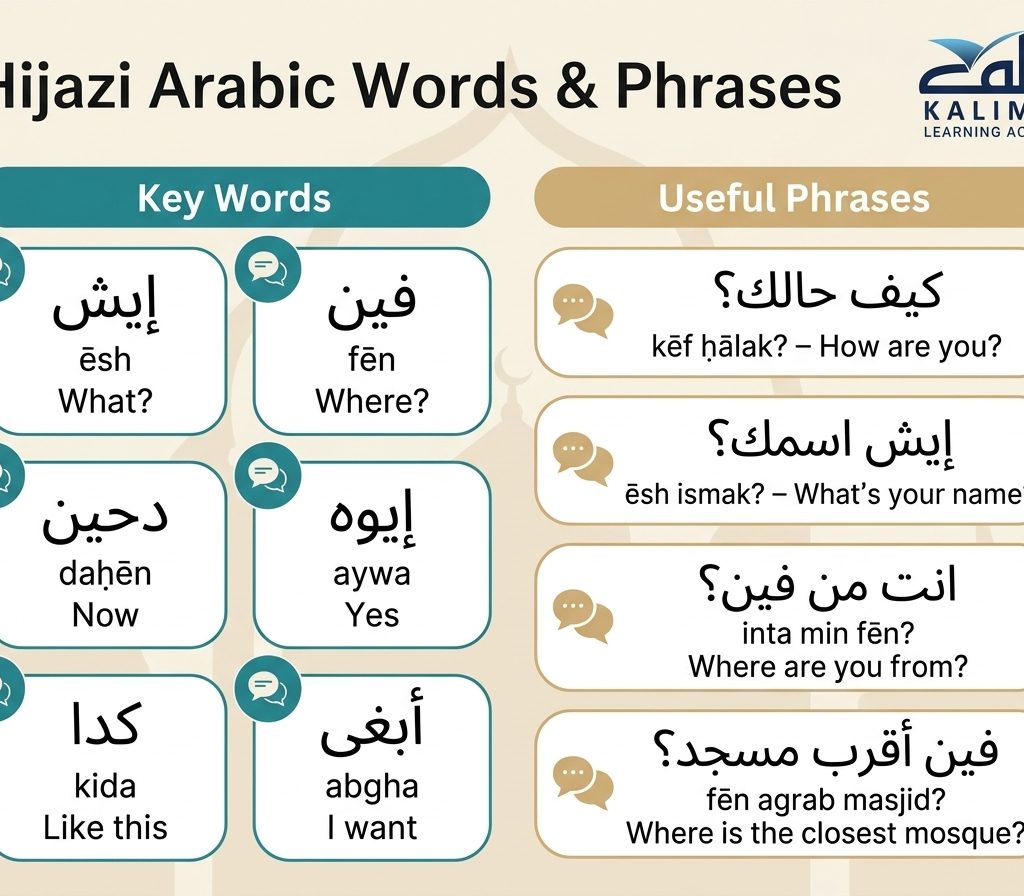
- إيش (ēsh): What? (from ayyu shay’, “which thing”)
- فين (fēn): Where?
- ليش (lēsh): Why?
- كيف (kēf): How?
Notice how close these words stay to Classical Arabic: kēf is simply kayfa with a shifted vowel, and lēsh comes from li-ayyi shay’, “for what thing.” Recognizing these roots makes your vocabulary grow much faster.
Everyday Words
You will hear the words below in almost every Hejazi conversation. Learn them together, because they combine naturally into full sentences.
- دحين (daḥēn): Now
- إيوه (aywa): Yes
- كدا / كذا (kida): Like this, this way
- أبغى (abgha): I want; تبغى / تبغي (tabgha / tabghi): You want (male / female)
- علشان (ʿashān): Because, in order to
- بعدين (baʿdēn): Later
If you enjoy seeing how a word changes across dialects, read our guide on how to say cat in Arabic, which compares MSA and dialect forms.
Loanwords From Trade and Hajj
Centuries of trade and the annual Hajj brought words from Turkish, Persian, Italian, French, Malay, and African languages into local speech. A well-known example is كبري (kubri, overpass), from the Turkish köprü (bridge).
Other common examples include جزمة (jazma, shoe) and بسكليتة (biskilēta, bicycle). These borrowed words reflect the Hejaz’s long history as a meeting point for Muslims from around the world, which gives Hejazi Arabic its rich and varied vocabulary.
Inside Kalimah Center: Moments from Our Courses
Get a glimpse into the vibrant learning experience at Kalimah Center. These snapshots capture real moments from our live classes—where students engage deeply, connect with passionate instructors, and grow in a welcoming, supportive environment.
Master Arabic with Kalimah Center
Join our expert-led online classes and start your journey toward Arabic fluency today.
Book Your Free TrialHijazi Arabic Phrases for Daily Conversation
Single words help, but Hijazi Arabic phrases let you greet people, ask for directions, and show good manners. Here are the most practical ones for visitors and learners.
Greetings and Introductions
Greetings open every conversation in the Hejaz, and locals appreciate visitors who try a few words in their dialect. Start with these simple questions and answers, which you can use with shopkeepers, hotel staff, and fellow worshippers.
- كيف حالك؟ (kēf ḥālak?): How are you?
- أنا بخير / أنا تمام (ana bikhēr / ana tamām): I am fine.
- إيش اسمك؟ (ēsh ismak?): What is your name?
- انت من فين؟ (inta min fēn?): Where are you from?
When you reply, keep it short and warm, and add alḥamdulillāh after saying you are fine. When speaking to a woman, say ḥālik, inti, and ismik instead, because Hejazi Arabic changes word endings for gender.
You will also hear Islamic expressions everywhere in the Hejaz. Brush up on them with our articles on Jazakallah Khair in Arabic and how to say thank God in Arabic.
Useful Phrases for Pilgrims
During Hajj and Umrah, you will often need to find a mosque, buy water, or ask for the Haram gates. These Hijazi Arabic phrases cover the most common situations pilgrims face in Makkah and Madinah.
- فين أقرب مسجد؟ (fēn agrab masjid?): Where is the closest mosque?
- بكم دا؟ (bikam da?): How much is this?
- أبغى أروح الحرم (abgha arūḥ al-ḥaram): I want to go to the Haram.
Speak slowly and point when needed, because locals are used to helping visitors from many countries. Even if your Hejazi Arabic is basic, a polite law samaḥt (please) before your question usually earns a friendly, patient answer.
Polite and Emotional Expressions
Good manners are central to Hejazi culture, and the right words help you avoid misunderstandings. These expressions are useful when you want to clarify a request or smooth over a difficult moment with someone.
- إيش تبغى أسوي بالضبط؟ (ēsh tabgha asawwi biḍ-ḍabṭ?): What do you want me to do exactly?
- ما كنت أبغى أزعلك (ma kunt abgha azʿalak): I didn’t mean to upset you.
Phrases like these reflect the gentle, kind speech that the Quran encourages. Pair them with maʿlēsh (never mind, sorry) and jazāk Allāhu khayran to sound respectful and natural in any Hejazi conversation.
Should You Learn Hejazi Arabic or Quranic Arabic First?
If you are learning the Quran, start with Classical Arabic and correct recitation, then add Hejazi Arabic as a practical extra. The Quran is your foundation, and the dialect is a useful tool for travel and daily life.
Why Quranic Arabic Comes First
Hejazi Arabic changes sounds that Tajweed protects, such as the qaf and the interdental letters ث and ذ. If you learn recitation first, your tongue learns to pronounce each letter from its correct makhraj before casual habits form.
A structured online Quran course with a qualified teacher builds this base step by step, from letter sounds to fluent Tajweed recitation.
How Hejazi Arabic Helps During Hajj and Umrah
Once your Classical base is strong, a few dialect phrases help you ask for directions, shop, and connect with local people. Many visitors can follow the imam’s recitation in the Haram but still struggle with everyday chat in the market.
A solid Arabic language course closes that gap, so you can follow both the recitation and the conversations around you.
Can Children Learn Hejazi Arabic Too?
Yes. Children pick up spoken patterns quickly, but they gain the most when they first learn to read Arabic letters and Quranic words correctly. Our Arabic course for kids builds this foundation through short, engaging lessons.
Join Kalimah Center and Master Quran and Arabic With Confidence
Ready to move from listening to understanding? At Kalimah Center, our Tajweed and Quran recitation circles help kids and adults read the Quran with accurate, beautiful pronunciation.
Our qualified teachers give you one-on-one attention, flexible schedules, and a clear learning path. You learn every letter from its correct articulation point and get live feedback in every session.
Explore Our Courses:
- Online Arabic Course: Tailored to your level, our comprehensive Arabic program includes 16 teaching levels and 400+ hours of personalized sessions.
- Online Quran With Tajweed Course: Perfect for non-Arabic speakers, our course spans 13 levels and equips you with Tajweed mastery from beginner to advanced.
- Online Arabic Course For Kids: Nurture your child’s love for Arabic with our engaging and structured program, available in 24 levels for primary, intermediate, and secondary stages.
Our Arabic language programs open the door to Classical Arabic and everyday expressions too. Contact us today to book your first lesson and take your first confident step.
Master Arabic with Kalimah Center
Join our expert-led online classes and start your journey toward Arabic fluency today.
Book Your Free TrialConclusion
Hejazi Arabic is the warm, everyday dialect of Jeddah, Makkah, and Madinah. Millions of people speak it, and it is understood across much of the Arabian Peninsula, which makes it valuable for every visitor to the holy cities.
You now know its main features, from the “g” sound of qaf to the ḥa- future marker, along with the core Hijazi Arabic words and phrases you will hear on the street. These small pieces make daily conversation much easier.
The key takeaway is simple: build your Quranic Arabic and Tajweed first, then add Hejazi Arabic as a practical skill. With the right teacher, both grow together and deepen your connection to the Quran.
FAQs
Here are quick answers to the questions learners ask most often about Hejazi Arabic.
Is Hejazi Arabic easy to learn?
No. Hejazi Arabic is considered one of the easier Arabic dialects. Its short vowels stay clear, its grammar is simple, and its vocabulary is close to Classical Arabic, especially if you already read the Quran.
What is the difference between Hejazi and Najdi Arabic?
Hejazi is the dialect of western Saudi Arabia, while Najdi is spoken in the central region, including Riyadh. Najdi often drops short vowels and keeps more Bedouin features, while urban Hejazi sounds softer.
Do people in Makkah and Madinah understand Modern Standard Arabic?
Yes. Most people understand MSA from school, the media, and religious life. Still, using a few Hejazi words like “aywa” and “fēn” makes conversations warmer and easier.
Does Hejazi Arabic affect Quran recitation?
No. It should not. Hejazi speakers pronounce qaf as “g” in daily speech, but Quran recitation must follow Tajweed rules. Learning with a qualified teacher keeps the two clearly separate.
How do you say “what” in Hejazi Arabic?
You say إيش (ēsh). It comes from the Classical phrase ayyu shay’, meaning “which thing,” and appears in questions such as ēsh ismak? (What is your name?).