You’ve kept a 60-day streak and you can spot the letter ب inside a word. Then an Arabic speaker says one quick sentence and you catch nothing. If that sounds familiar, you’re probably asking: is Duolingo good to learn Arabic, or is it just a fun daily habit?
Arabic rewards every hour you put into it, but it asks a lot: a new script, unfamiliar sounds and a grammar built on roots. At Kalimah Centre, our native tutors meet many learners who started on a phone app and now want to know what comes next.
In this review, we answer “is Duolingo good to learn Arabic” by looking at what the course teaches, where it helps and where it leaves gaps. You’ll also get free tools and a clear plan for turning app practice into real reading, listening and speaking.
Key Highlights of This Article:
- What the Arabic course covers and which learners benefit most.
- The real strengths and the clear limits of learning only with an app.
- Free tools that strengthen your reading, listening and writing.
- How to move from app basics to confident, real-life Arabic.
Is Duolingo Good To Learn Arabic?
Yes, it’s good for your first steps in Arabic, but it won’t carry you to fluency by itself. So is Duolingo good to learn Arabic as a complete solution? Not quite. The sections below cover what the course delivers, who it suits best and where you’ll need extra support.
What The Arabic Course Actually Teaches
The Arabic course, released in 2019 for English speakers, teaches Modern Standard Arabic, also called Fusha. This is the formal variety used in news, books, official speeches and most written content across the Arab world. You can follow the course on Android, iOS or in a web browser.
Lessons introduce the alphabet in small groups, then build toward short words, useful phrases and simple sentences. The topics are practical: greetings, food, family, directions and daily routines. Exercises mix listening, matching, translating and tapping word tiles, so each skill gets a short workout.
What you can realistically expect is strong recognition. After steady practice, most learners can read slowly, sound out new words and understand short, familiar phrases. For a complete beginner that’s a real achievement, because the script is usually the first barrier that makes people give up on Arabic.
Who Gets The Most Value From The App
Complete beginners gain the most. If you’re curious about Arabic but not ready to commit, the app is a low-pressure way to try it. You can find out whether you enjoy the sounds and the script before you invest money and time in structured classes.
Busy learners benefit too. A lesson takes only a few minutes, so it fits into a coffee break or a commute. Muslims who want to recognize letters before starting Quran reading often find it a gentle first step, as long as they move on to proper guidance soon after.
There’s good reason to start. As highlighted on UNESCO’s World Arabic Language Day page, Arabic is used daily by more than 400 million people. Even a small foundation helps with travel, faith, family heritage and career opportunities across many countries and industries.

Where The Course Stops Short
The honest answer to “is Duolingo good to learn Arabic” changes once you pass the beginner stage. The content stays close to short, simple sentences, so intermediate learners soon feel they’re reviewing more than growing. Deeper reading, long listening and free conversation are outside its scope.
Arabic simply needs more time than any app can give. You can check the official estimates on the U.S. Department of State’s foreign language training page. It places Arabic in its hardest category for English speakers and estimates about 88 weeks, or 2,200 class hours, to reach professional working proficiency.
A few minutes a day can’t cover that distance alone. This is where Kalimah Centre’s Online Arabic Course helps. It has 16 structured levels, more than 400 one-on-one study hours and a free placement test that starts you at the right level for your current skills.
Read Also: Is Arabic Hard To Learn? What Are The Hardest Parts?
Experience Kalimah Center Classes
Watch real excerpts from our live sessions at Kalimah Center and see how we bring learning to life. These clips highlight our interactive, student-centered teaching approach across all our courses—designed to keep learners engaged, motivated, and actively involved every step of the way.
Master Arabic with Kalimah Center
Join our expert-led online classes and start your journey toward Arabic fluency today.
Book Your Free TrialIs Duolingo Good For Learning Arabic Basics? Its Main Strengths
Yes, Duolingo is good for learning Arabic basics, especially the script, core vocabulary and a daily study routine. These strengths explain why so many beginners start there. Knowing them helps you use the app for what it does best instead of expecting it to do everything.
Gradual Introduction To The Arabic Alphabet
Arabic has 28 letters, is written from right to left, and most letters change shape depending on where they sit in a word. Facing all of that at once overwhelms many beginners. The app splits the alphabet into small sets, so you meet a few letters at a time and practice them repeatedly.
Transliteration can help in these early weeks. For a full letter-by-letter reference, see the Library of Congress Arabic Romanization Table. It’s a free, printable chart showing how each Arabic letter and vowel mark is written in Latin characters, so keep it next to you while you study.
Still, recognizing letters isn’t the same as reading fluently with correct vowels and pronunciation. Kalimah Centre’s Arabic Reading Course takes you from the alphabet to confident reading step by step. Native teachers correct your pronunciation of every sound during live sessions.
Short Daily Lessons That Build A Habit
Streaks, points and friendly reminders turn study into a small daily game. That design keeps you coming back, which matters because consistency is what drives language learning. Ten focused minutes a day usually beat one long, tiring session on the weekend, and the app makes those minutes easy to start.
The built-in review helps too. Words you got wrong come back in later lessons, which gives your memory a second and third chance to keep them. Over the weeks, this repetition builds a vocabulary base that makes later Arabic study much less intimidating.
One warning: protecting the streak can become the goal instead of learning. To avoid that, repeat lessons you rushed through, say every answer out loud and write new words in a notebook. These small habits turn passive tapping into active practice that you actually remember.
Free Access On Phone And Web
The core lessons are free and ad-supported, with an optional paid plan that removes ads and adds extra features. That makes the app one of the easiest ways to try Arabic at no cost, whether you’re a student, a parent or a working professional with a tight budget.
There’s no scheduling, either. You can study at midnight, at lunch or in a waiting room, on your phone or laptop. For people with unpredictable routines, this removes a common excuse and keeps Arabic in their week, even during busy months.
Free and flexible doesn’t mean complete, though. If you want live interaction at an affordable price, Kalimah Centre’s Arabic Group Classes let you learn alongside classmates with a native teacher. You practice real conversations while keeping your learning budget manageable.
Recommended reading: Tools to Learn Arabic: Top 8 Types
Limitations Of Duolingo’s Arabic Course
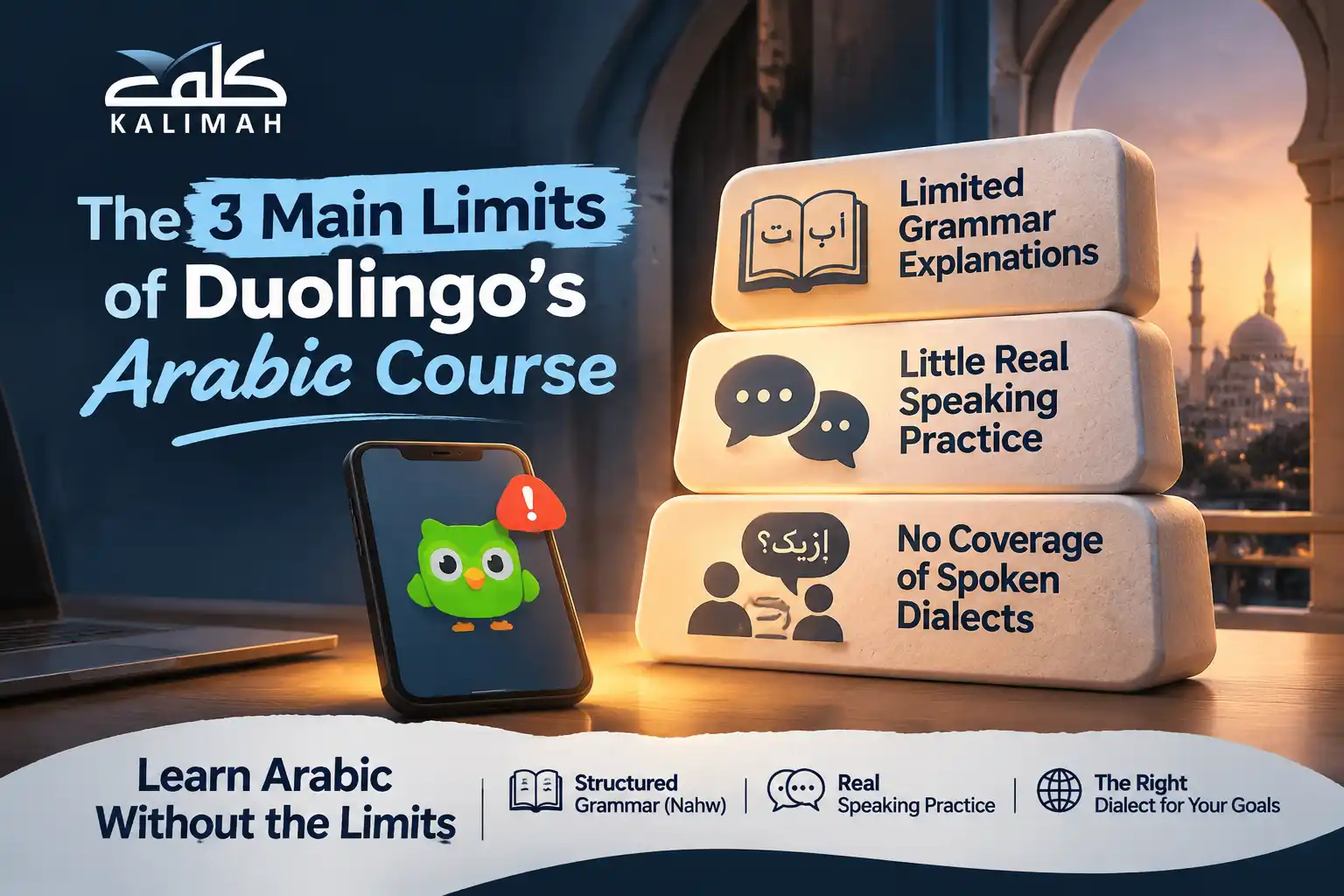
Every tool has limits, and knowing them early saves you months of frustration. If you’re asking “is Duolingo good for learning Arabic” beyond the basics, you need to weigh three clear gaps: grammar, speaking and dialects. Here’s what each gap means and how to close it.
1. Limited Grammar Explanations
Arabic grammar is logical but rich. Most words grow from three-letter roots, verbs follow fixed patterns, and nouns change for gender and number, including a special dual form. Once you understand these systems they unlock thousands of words, yet the app mostly teaches through examples rather than clear rules.
As a result, many learners memorize whole sentences without knowing why they work. When they try to build their own sentences, mistakes show up in verb endings and agreement. Working out a rule from repeated examples is slow, and it often leaves habits that are hard to fix later.
A structured grammar path spares you that trial and error. Kalimah Centre’s Online Arabic Grammar Course: Nahw from Beginner to Advanced starts with noun forms and sentence types, then moves on to verb conjugations. Native, Azhari-trained teachers guide you through every stage.
2. Little Real Speaking Practice
Speaking exercises in the app mostly ask you to repeat set phrases. That trains your mouth to form the sounds, but it isn’t conversation. A real chat involves follow-up questions, unexpected answers and quick thinking, and no pre-written exercise can fully recreate that.
Pronunciation is another challenge. Sounds such as ع, ح, ق and خ have no English equivalent, and small mistakes can change a word’s meaning. A human ear catches these details right away and can show you how to position your tongue and throat, which automated checks can’t do well.
If speaking is your main goal, the Arabic Speaking Course at Kalimah Centre focuses on talking from the first day. Native tutors use role-play, question-and-answer drills and storytelling. Their personal feedback builds both accuracy and the confidence to speak without freezing.
3. No Coverage Of Spoken Dialects
Arabic doesn’t have just one spoken form. Alongside Modern Standard Arabic, people speak regional dialects in daily life, such as Egyptian, Levantine, Gulf and Maghrebi. Shopkeepers, friends and relatives rarely use formal Arabic at home or on the street, which surprises many learners on their first trip.
Because the course teaches only the formal variety, everyday speech will sound different. For example, “How are you?” is كيف حالك؟ (kayfa ḥāluk) in Fusha but إزيك؟ (izzayyak) in Egyptian Arabic. Similarly, “What do you want?” is عايز إيه؟ (ʿāyez ʾēh) instead of ماذا تريد؟ (mādhā turīd).
That isn’t a flaw in itself, because Modern Standard Arabic is the right base for reading, news and religious texts. Just set clear expectations. Build your Fusha foundation first, then add the dialect that fits your goals, whether that’s travel, work or talking with family.
Further reading: How To Say Yes & No In Arabic – Formal, Egyptian And Dialect Words
How To Boost Your App Lessons With Free Arabic Tools
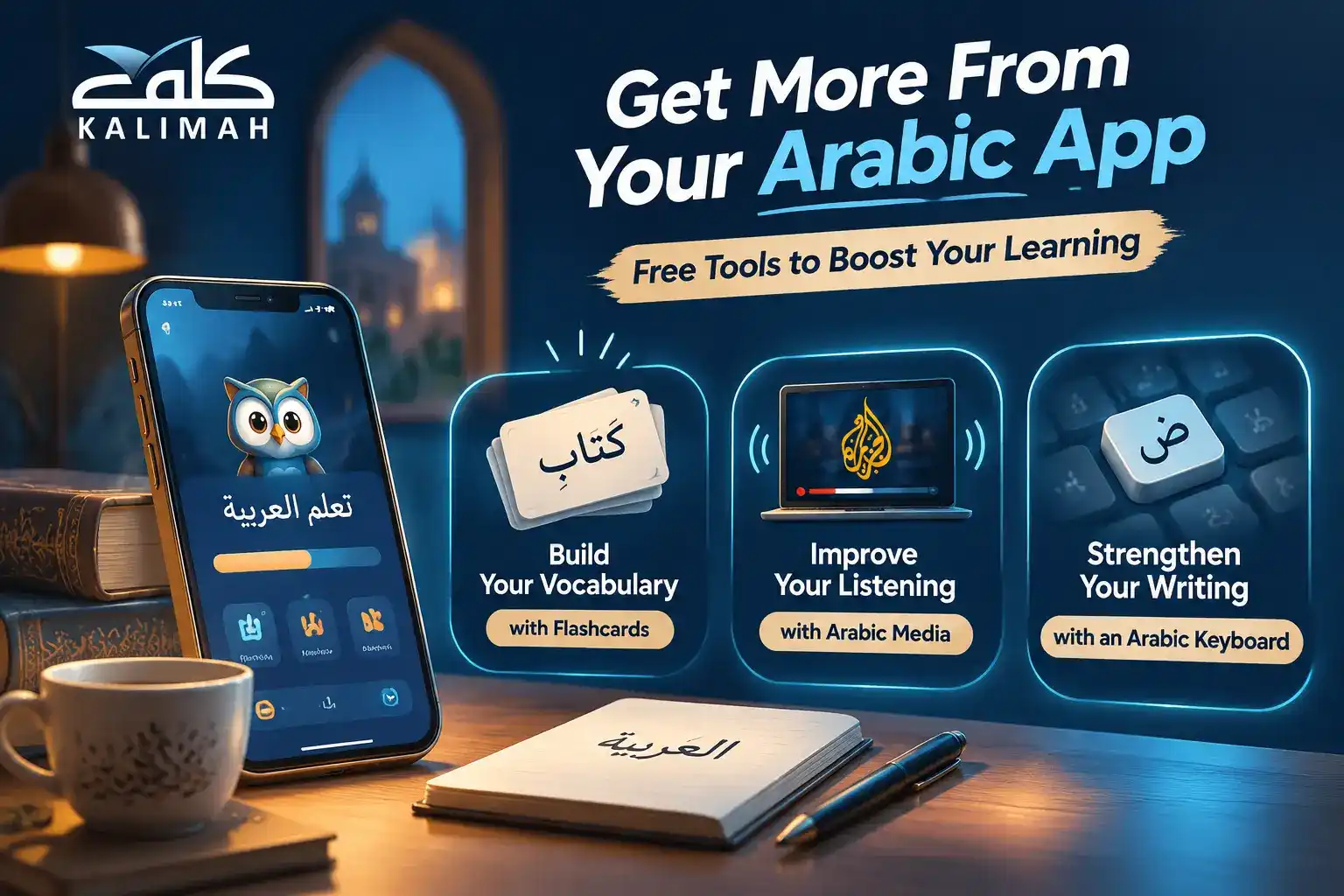
The most practical answer to “is Duolingo good to learn Arabic” is to treat the app as one tool among several. With a few free resources, you can cover vocabulary, listening and writing, which the app only touches lightly. Here are three practical additions you can start this week.
1. Pair Lessons With A Free Flashcard App
The app reviews words in its own order, which may not match the vocabulary you personally struggle with. Building your own flashcard deck puts you in control. You decide which words matter, how often they come back and which example sentences help you remember them.
For a reliable free option, use Anki’s official download page to get this open-source flashcard program. The computer version is free on all major platforms, and the Android version is free as well. It uses spaced repetition, so difficult words come back more often than easy ones.
Make every card count. Add the Arabic word with its vowel marks, the meaning, a short example sentence and audio where possible. Group related words by root, such as كتب, كاتب and مكتبة, so you start noticing patterns. Ten minutes of review a day is enough.
2. Add Real Listening From Arabic Media
The app’s audio is clear and slow, which is great for beginners but far from real speech. Native speakers link words together, speed up and drop sounds. Without regular exposure to natural audio, even learners with a strong vocabulary struggle to follow conversations or news reports.
A free resource with plenty of material is the Al Jazeera Arabic YouTube channel, which carries news and programs in Modern Standard Arabic. Since the course also teaches Fusha, these clips connect directly to what you’re already studying. Start with short headline segments rather than long documentaries.
Use a simple routine. Pick a two-minute clip, listen once without subtitles and write down every word you catch. Replay it at a slower speed, then shadow a few sentences by speaking along with the presenter. Repeat the same clip over several days until it feels comfortable.
3. Practice Writing With An Arabic Keyboard
Tapping word tiles isn’t writing. When you type or write Arabic yourself, you have to recall each letter, its shape and the correct order. This active recall strengthens spelling and reading together, and it quickly shows you which letters you still mix up.
Setting up an Arabic keyboard takes about a minute. For the full steps, see Google’s Gboard guide to typing in a different language, which shows how to add Arabic to your phone. After that, you can switch between English and Arabic with one tap.
Give yourself a small daily writing task. Type three short sentences about your day, such as what you ate or where you went. Writing the same sentences by hand in a notebook helps even more. Over time, these short journal entries become a record of your progress in Arabic.
Related read: Arabic Language Learning Resources: Books, Apps, Courses & Tools
Kalimah Centre Turns App Basics Into Real Arabic Skills
If you’ve spent weeks asking “is Duolingo good to learn Arabic” and still feel stuck, what’s usually missing is guidance. Kalimah Centre starts with a free placement test, so the progress you made on the app counts. You begin at the right level and skip material you’ve already mastered.
Every level has a clear finish line. To move up, you pass a final oral exam with at least 60%, which means you show you can use what you’ve learned, not just recognize it. That kind of accountability is something streaks and points can’t give you on their own.
Your lessons follow a curriculum built on well-known textbooks such as Iqraa and Al-Arabiyya Bayna Yadayka. They’re taught by certified native tutors who are experienced with non-Arabic speakers. Students who pass a level can request a certificate of completion, which is useful proof of progress for study or work.
Inside Kalimah Center: Moments from Our Courses
Get a glimpse into the vibrant learning experience at Kalimah Center. These snapshots capture real moments from our live classes—where students engage deeply, connect with passionate instructors, and grow in a welcoming, supportive environment.
Master Arabic with Kalimah Center
Join our expert-led online classes and start your journey toward Arabic fluency today.
Book Your Free TrialBook Your Free Arabic Trial Class With Kalimah Centre Today!
Ready to move beyond tapping tiles? Book your free trial lesson with Kalimah Centre today and meet a native tutor who will assess your level and answer your questions. Your tutor will then build a learning plan around your schedule and your goals, whether that’s reading, speaking or understanding the Quran.
Your first class is free, with no commitment required. Claim your free Arabic trial class now and see what live correction, clear grammar explanations and real conversation practice can do in a single session with an experienced teacher.
Explore Our Courses:
Online Arabic Course: Tailored to your level, our comprehensive Arabic program includes 16 teaching levels and 400+ hours of personalized sessions.
Online Quran With Tajweed Course: Perfect for non-Arabic speakers, our course spans 13 levels and equips you with Tajweed mastery from beginner to advanced.
Online Arabic Course For Kids: Nurture your child’s love for Arabic with our engaging and structured program, available in 24 levels for primary, intermediate, and secondary stages.
Keep your app streak if you enjoy it, but give your Arabic the structure it needs. The sooner you add live guidance, the sooner those daily minutes turn into conversations you can actually hold. Your place at Kalimah Centre is waiting, so take that first step today.
Master Arabic with Kalimah Center
Join our expert-led online classes and start your journey toward Arabic fluency today.
Book Your Free TrialFinal Verdict And Key Takeaways
We’ve covered what the Arabic course teaches, who benefits most and why it does well with the alphabet, daily habits and free access. We also looked at its clear limits in grammar, speaking and dialects. Finally, we covered free tools that fill many of those gaps at no cost: flashcards, Arabic news clips and a phone keyboard.
So, is Duolingo good to learn Arabic? It’s a strong, friendly starting point that takes away the fear of the script and builds a steady routine. It isn’t a full path to fluency, though. Real progress needs grammar that’s explained, live speaking practice and feedback from someone who can hear exactly what you say.
The key takeaway is simple: use the app as your warm-up, not your whole workout. Combine it with free resources, set clear goals and add a native teacher when you’re ready to speak. That balance is how app learners become confident Arabic speakers, readers and listeners who can use the language in real life.
Frequently Asked Questions
Can Duolingo Make You Fluent In Arabic?
No. It builds a beginner foundation, but fluency needs explained grammar, live speaking and personal feedback. Kalimah Centre’s native tutors take you from app basics to confident conversation through structured one-on-one levels.
Does Duolingo Teach Modern Standard Arabic Or A Dialect?
It teaches Modern Standard Arabic, the formal variety used in media and books, not a spoken dialect. Kalimah Centre builds your Fusha foundation first, then helps you add the practical expressions you need for daily life.
Is Duolingo Good For Learning Arabic For Quran Reading?
It helps you recognize letters, but it doesn’t teach Quranic reading rules or Tajweed. Kalimah Centre gives you expert guidance from Ijazah-certified teachers who correct your recitation letter by letter in live lessons.
How Long Should I Use The App Before Joining Arabic Classes?
A few weeks is enough to learn the alphabet and some basic words, so there’s no need to wait longer. Kalimah Centre’s free placement test then measures your level and starts you at the right point.
Can Children Use The App To Learn Arabic?
Kids may enjoy the game style, but they need patient, age-appropriate teaching to keep progressing. Kalimah Centre’s Online Arabic Course for Kids offers 24 levels designed for young learners.