If you have ever wondered how to pronounce Arabic r correctly, you are dealing with one of the most distinctive sounds in the language.
The Arabic letter ر (Ra) is not the same “R” you use in English — it is a rolled, tapped sound made with the tip of the tongue. Learning how to pronounce Arabic r properly changes how natural and clear your Arabic sounds, and it affects whether listeners understand you the way you intend.
This guide breaks down exactly where your tongue should go, how the sound changes with different vowels, and which mistakes trip up most learners. At Kalimah Center, this is one of the first sounds new students work on, because getting it right early makes every word after it easier to say.
A. What Makes the Arabic Ra Different From the English R
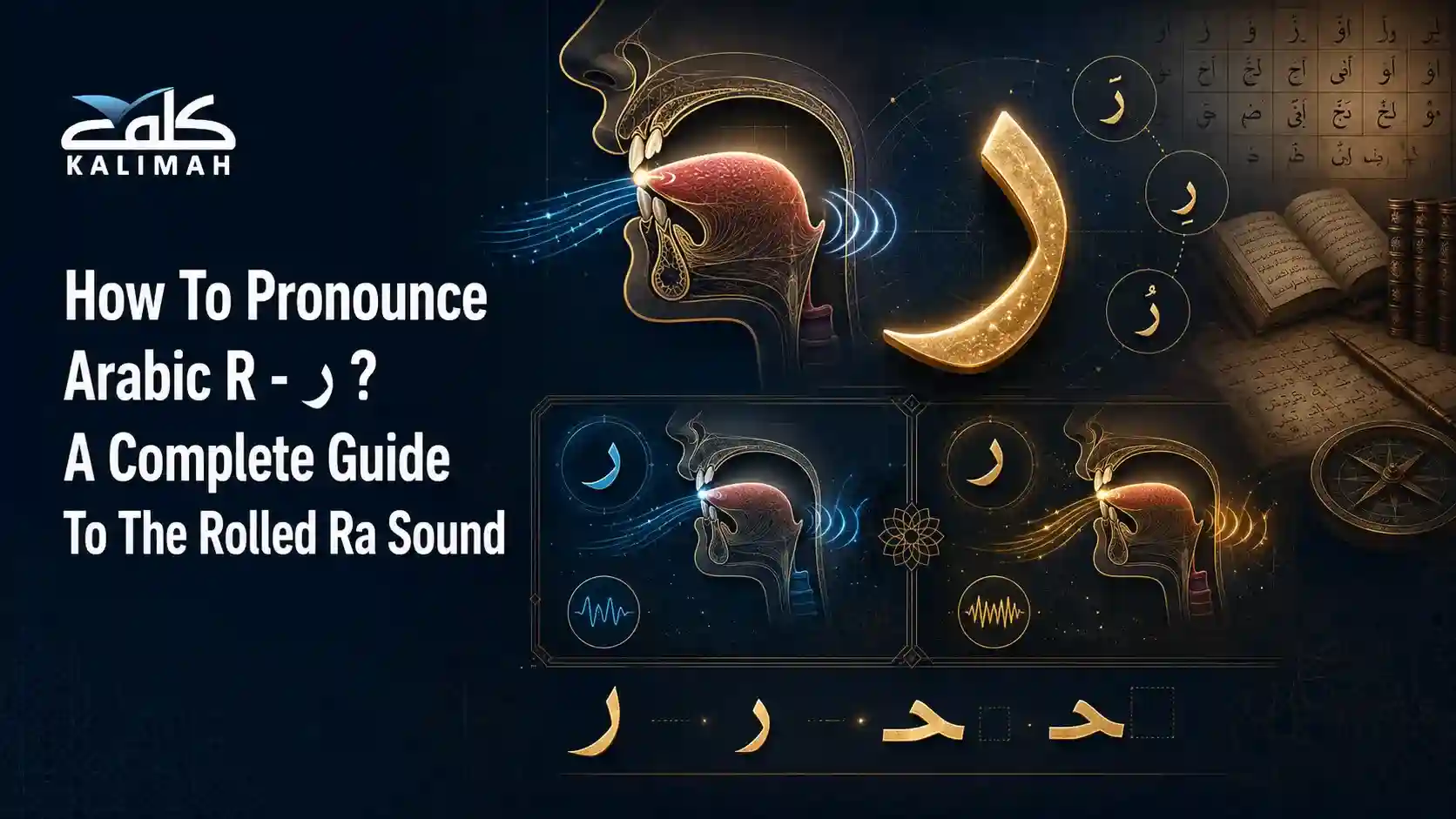
The Arabic letter ر (Ra) is an alveolar trill — a sound produced by rapidly vibrating the tip of the tongue against the alveolar ridge, the small ridge just behind your upper front teeth.
The English “R,” by contrast, is formed further back in the mouth with the tongue pulled back and never touching the roof of the mouth. That single difference in tongue placement is the whole reason learning how to pronounce Arabic r feels unfamiliar at first.
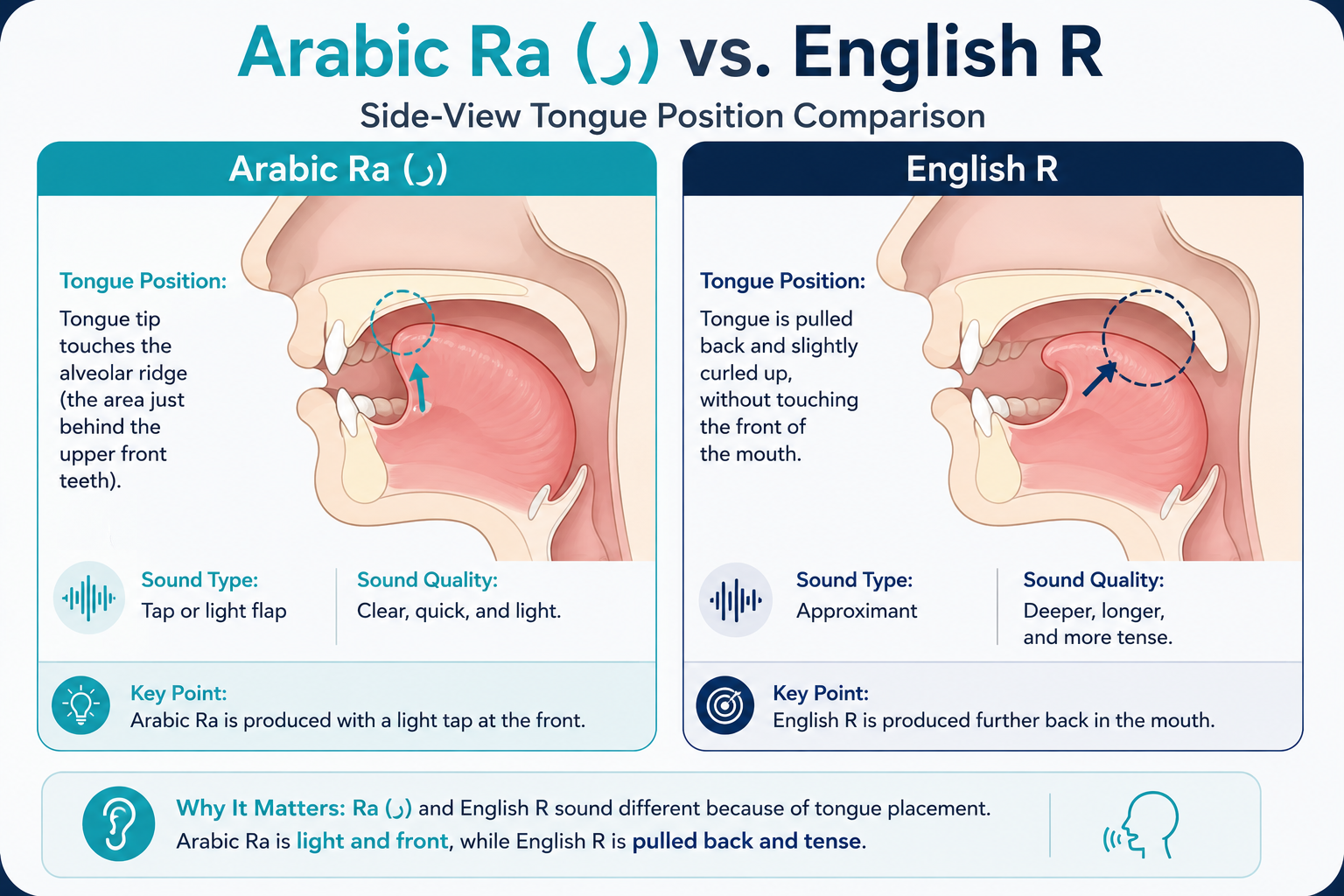
Ra is also a non-connecting letter in the Arabic script, meaning it never joins to the letter that follows it.
Any letter written after a Ra always starts in its isolated or initial shape, creating a visible break in the word. This is purely a writing rule and has no effect on pronunciation, but it often confuses beginners who expect every letter to connect smoothly.
The Tongue Mechanics Behind the Sound
The trill happens because air pushed from the lungs causes the relaxed tongue tip to bounce rapidly against the alveolar ridge — usually two or three quick taps, not a long rolling motion. The sides of the tongue stay lightly anchored against the upper back teeth, which channels the airflow through the center and keeps the trill controlled rather than sloppy.
Why English Speakers Struggle With It?
English simply has no equivalent sound, so the muscles needed for this quick tongue-tip vibration are usually undertrained. Most learners default to the retracted English “R,” which native Arabic speakers immediately notice, since it changes the texture of the word without changing its spelling.
Read Also: How to Pronounce KH in Arabic
B. How to Pronounce Arabic R Step by Step?
Learning how to pronounce Arabic r is a matter of tongue placement, airflow, and repetition — not natural talent. Follow these steps in order, and practice each one before moving to the next.
- Rest the tip of your tongue lightly against the alveolar ridge, just behind your upper front teeth.
- Keep the tongue relaxed rather than tense — a stiff tongue cannot vibrate.
- Push a steady stream of air from your lungs over the tongue tip.
- Let the airflow bounce the tongue tip against the ridge two or three times in rapid succession.
- If the trill won’t start, try humming a low “d-d-d” sound while pushing air — this loosens the same muscles.
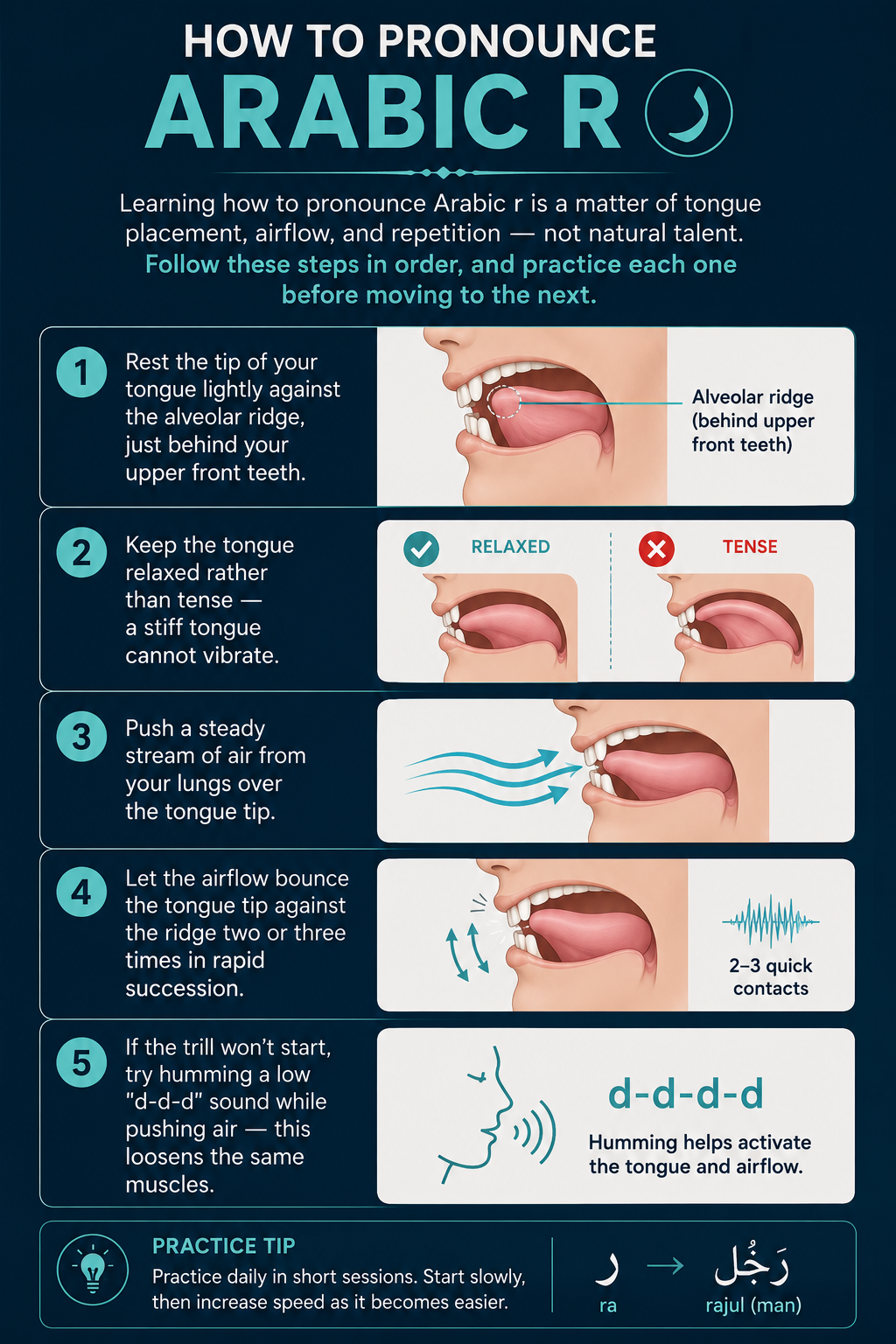
A practical trick many teachers use: practice the trill between two vowels first, such as in “ara,” since the sound flows more easily when it isn’t isolated at the start of a word.
Once the tap is consistent between vowels, moving it to the front of a word becomes much easier.
Kalimah Center’s live instructors typically spend one full session just on tongue-tip placement before introducing full words, because trying to fix the trill later — after bad habits form — takes far longer than building it correctly from the start.
Read Also: Is Italki Good for Arabic Learning
C. Heavy and Light Ra: Understanding Tafkheem and Tarqeeq
Yes — the letter ر is not pronounced identically in every word. Arabic recitation and pronunciation rules classify Ra as either heavy (tafkheem, تفخيم) or light (tarqeeq, ترقيق), depending on the vowel attached to it and the letters around it.
When Ra carries a fatha (َ) or a damma (ُ), it is pronounced with a fuller, deeper quality — the back of the tongue lifts slightly, giving the sound more weight.
Examples include رَمْل (raml, “sand”) and رُزْق (rizq, “provision”). When Ra carries a kasra (ِ), the sound thins out and becomes lighter, as in رِجَال (rijaal, “men”).
Getting tafkheem and tarqeeq wrong does not usually change a word’s meaning, but it does mark a speaker as a beginner and, in Quranic recitation specifically, affects the correctness of the reading.
This is one of the details general pronunciation guides skip — most only teach the base trill and never mention that the same letter shifts weight depending on its vowel.
Experience Kalimah Center Classes
Watch real excerpts from our live sessions at Kalimah Center and see how we bring learning to life. These clips highlight our interactive, student-centered teaching approach across all our courses—designed to keep learners engaged, motivated, and actively involved every step of the way.
Master Arabic with Kalimah Center
Join our expert-led online classes and start your journey toward Arabic fluency today.
Book Your Free TrialD. Common Mistakes When Pronouncing Arabic R
The single most common mistake is substituting the retracted English “R” for the tapped Arabic trill — the tongue curls back instead of tapping forward, and the sound comes out muffled rather than crisp.
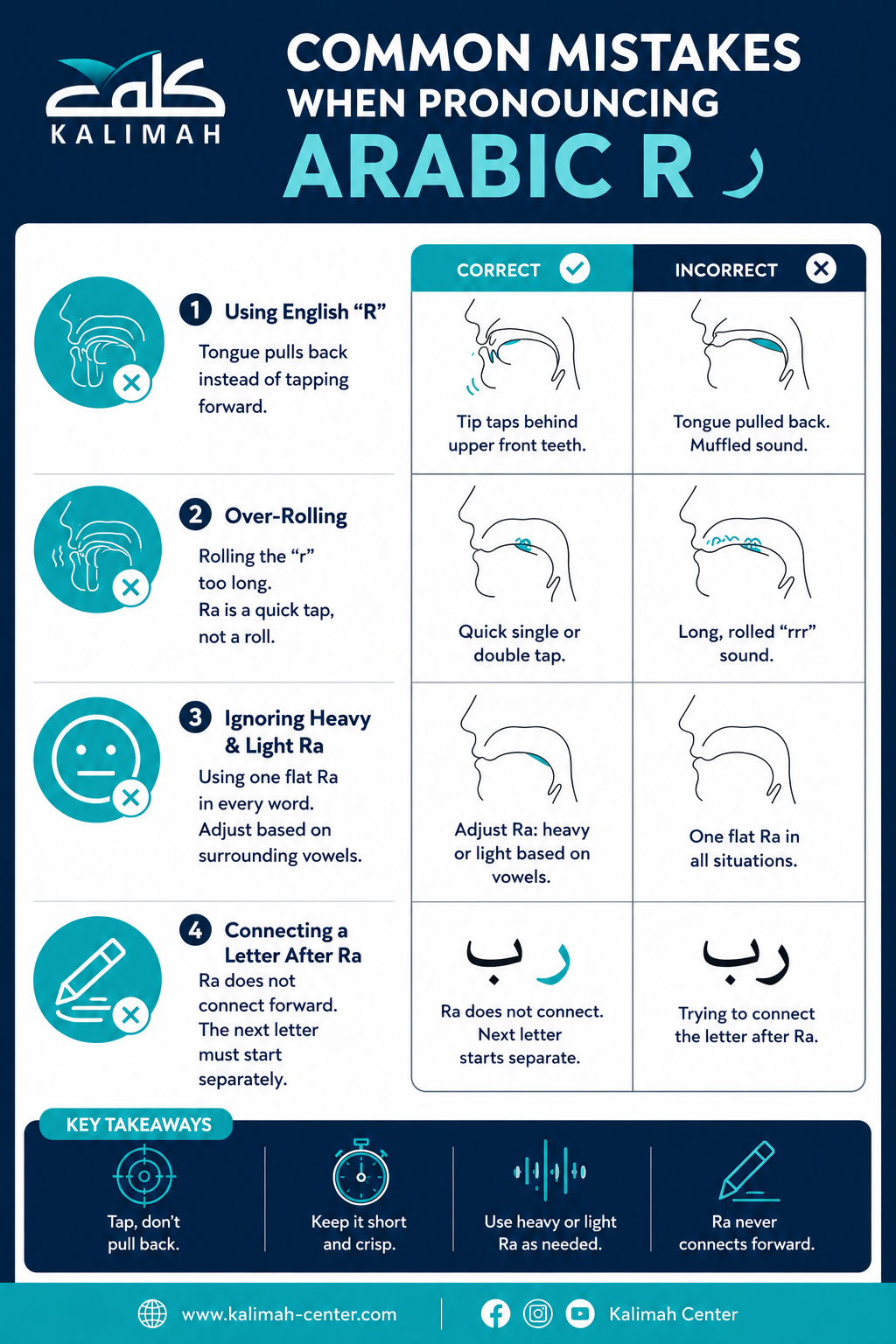
A second common error is over-rolling: some learners, having heard the trill compared to Spanish “rr,” roll it far too long. In everyday spoken Arabic, Ra is usually a quick single or double tap, not an extended roll.
A third mistake is ignoring the heavy-light distinction altogether and using one flat version of Ra in every word, regardless of the surrounding vowels.
A fourth, writing-related error is trying to connect a letter to a Ra that comes before it — since Ra never connects forward, the following letter must always start in its separate form.
Read Also: How to Pronounce ظ in Arabic
E. Practicing With Real Arabic Words
Repetition with real vocabulary is what turns the mechanical trill into a natural habit. Below are common words that use ر in different positions and with different vowels:
- رَجُل (rajul) — man
- رَأْس (ra’s) — head
- بَحْر (baḥr) — sea
- نُور (nūr) — light
- رِزْق (rizq) — provision, sustenance
- رَمَضَان (Ramaḍān) — Ramadan
- قُرْآن (Qur’ān) — Quran
Say each word slowly at first, focusing on tongue placement before speed. Once the trill is consistent, gradually increase your speaking pace until the sound feels automatic rather than deliberate.
Learning how to pronounce Arabic r in isolation is useful, but hearing it corrected in real time by a native speaker is what actually fixes bad habits — reading a guide alone can only take you so far.
This is exactly the kind of feedback students get in live sessions at Kalimah Center, where a teacher listens to each attempt and adjusts tongue placement on the spot instead of leaving you to guess.

Why the Letter Ra Matters in Arabic and Islamic Culture?
The letter ر appears in some of the most frequently spoken words in Islamic worship. It is part of Ar-Rahman (الرحمن, “The Most Merciful”) and Ar-Raheem (الرحيم, “The Most Compassionate”) — two of the 99 Names of Allah that open nearly every chapter of the Quran in the phrase “Bismillah ar-Rahman ar-Raheem.”
It also appears in Ar-Razzaq (الرزاق, “The Provider”). The shared root R-Ḥ-M behind several of these names is the same root that gives Arabic its vocabulary for mercy and compassion.
Because these words are recited daily by hundreds of millions of people, the Ra is arguably one of the most-pronounced letters in the world — which is one more reason getting it right is worth the practice time.
Mastering letters like Ra is also a foundation for reading Tajweed rules correctly later on, since heavy and light letter classifications extend beyond Ra to several other Arabic consonants.
Start Speaking Arabic With Confidence Today
Reading about pronunciation only gets you partway there — real progress happens when a native teacher hears you say the sound and corrects it in real time.

A guide can show you where your tongue should go; only live feedback tells you whether it actually landed.
Kalimah Center’s online classes are built around exactly this kind of direct correction, so a stuck English-style R gets fixed in your first few sessions instead of turning into a habit you carry for years.
Our courses:
- Best Online Arabic Classes for Adults: one-on-one and small-group sessions focused on pronunciation, reading, and speaking from day one.
- Intensive Arabic Group Classes with Affordable Fees: learn alongside other students at a lower cost, with the same live correction and structured progress.
- Arabic Classes for Kids: a dedicated track for younger learners, built around simple letters and sounds like Ra from the very first lesson.

Inside Kalimah Center: Moments from Our Courses
Get a glimpse into the vibrant learning experience at Kalimah Center. These snapshots capture real moments from our live classes—where students engage deeply, connect with passionate instructors, and grow in a welcoming, supportive environment.
Here Are The Reviews On Our Courses:
Our students frequently commend the excellence of our courses and the commitment shown by our instructors. You can read their complete reviews on Trustpilot.
Read more reviews on Trustpilot

🚀 Start Your Free Trial Today! 🚀
Don’t miss out on this life-changing opportunity to deepen your faith and knowledge. Sign up now for your free trial and take the first step towards becoming a better practicing Muslim with Kalimah Center!
Master Arabic with Kalimah Center
Join our expert-led online classes and start your journey toward Arabic fluency today.
Book Your Free TrialConclusion
Learning how to pronounce Arabic r comes down to a simple mechanical shift: moving the tongue from the back of the mouth (as in English) to the alveolar ridge, where a quick tap or trill produces the authentic sound.
From there, the heavy and light variations, the non-connecting nature of the letter, and its presence in some of the most recited words in Islamic worship all add depth to a sound that looks simple on paper but carries real weight in both everyday speech and religious recitation.
With consistent practice and correction from a native speaker when possible — the Arabic Ra becomes second nature far faster than most learners expect.
Frequently Asked Questions
Here are direct answers to the questions learners most often ask about the Arabic R sound, including a few points this guide hasn’t fully covered yet.
1. Is the Arabic R the same as the Spanish rolled R?
They are similar but not identical. Both are alveolar trills produced with the tongue tip, but Arabic Ra is typically a shorter single or double tap in everyday speech, while Spanish “rr” is often a longer, more sustained roll.
2. Can adults learn to trill the Arabic R if they never could as a child?
Yes. The trill depends on tongue muscle coordination, which can be trained at any age through repetition. Most adult learners develop a consistent trill within a few weeks of focused daily practice.
3. Why does Ra sometimes sound heavier in one word and lighter in another?
This is the tafkheem (heavy) and tarqeeq (light) distinction. A fatha or damma vowel produces a heavier Ra, while a kasra vowel produces a lighter one, as explained in the tafkheem and tarqeeq section above.
4. Does mispronouncing Ra change a word’s meaning?
Usually not, but it does make a speaker sound less fluent and can affect correctness in Quranic recitation specifically, where precise articulation rules apply.
5. What is the fastest way to fix a stuck-back English-style R?
Practice the trill between two vowels first, such as in “ara,” since the sound is easier to produce mid-word than at the very start. Getting feedback from a live teacher speeds this up significantly compared to practicing alone.