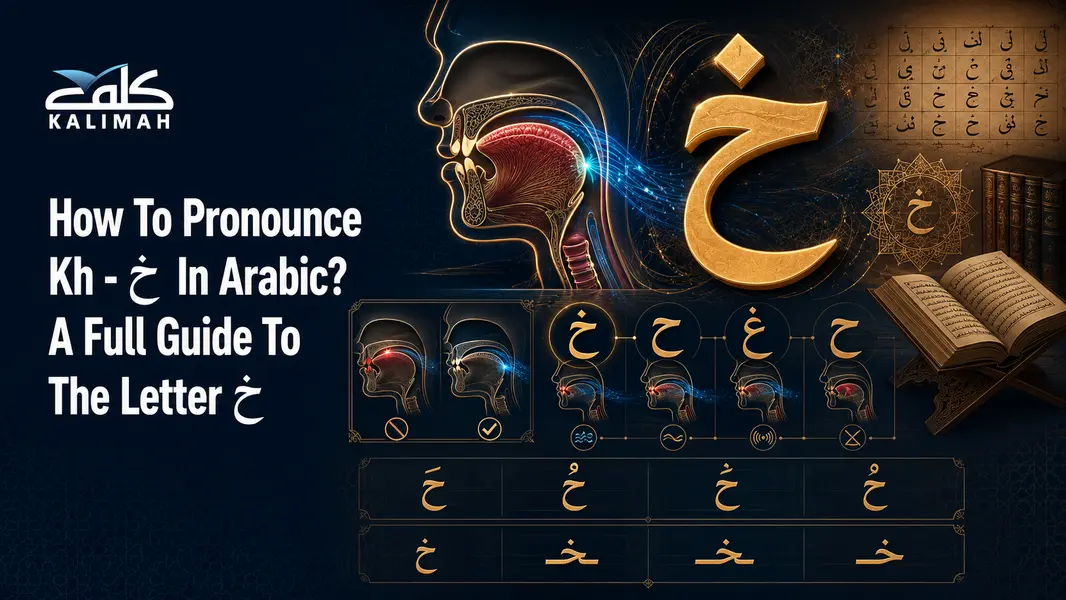
If you’ve been wondering how to pronounce kh in Arabic, you’re dealing with one of the trickiest sounds for English speakers to get right. The letter خ (kha) doesn’t exist in English, which is why so many learners default to a simple “k” or “h” instead of the real throat sound. This guide breaks down exactly where the sound comes from, how to shape your mouth, and how to avoid the most common mistakes.
By the end, you’ll know how to produce kha correctly, recognize its four written forms, and practice it with real Arabic words.
What You’ll Learn in This Article
- What the letter خ (kha) sounds like and where it’s produced in the mouth
- How to physically position your tongue and throat to say it correctly
- The four written forms of kha and when each one is used
- The most common pronunciation mistakes and how to fix them
- Real Arabic words to practice the sound in different positions
Kha (خ) is the seventh letter of the Arabic alphabet, sitting between ح (Haa) and د (Dal). It represents a voiceless velar fricative — a rough, breathy sound produced at the back of the mouth, closer to where you’d make a “k” than a regular “h.”
Visually, kha is a curved shape with a single dot placed above it. This dot is what separates it from two look-alike letters: ج (jim), which has a dot below the curve, and ح (haa), which has no dot at all. In handwriting, that single dot is the only thing telling the reader which of the three letters they’re looking at.
Kha is produced at the back part of the throat closest to the mouth, an area classified in Arabic phonetics as أدنى الحلق (the front part of the throat).
Air is pushed through a narrow gap between the back of the tongue and the soft palate, creating friction rather than a full stop. That friction is what gives kha its rough, scraping quality — very different from the clean “k” sound in English, where the tongue fully touches the roof of the mouth and then releases.
A. How To Physically Produce The Kh Sound
Understanding where the sound comes from is only half the job — you also need a physical method for actually making it. Here’s the step-by-step mechanism anyone learning how to pronounce kh in Arabic can follow.
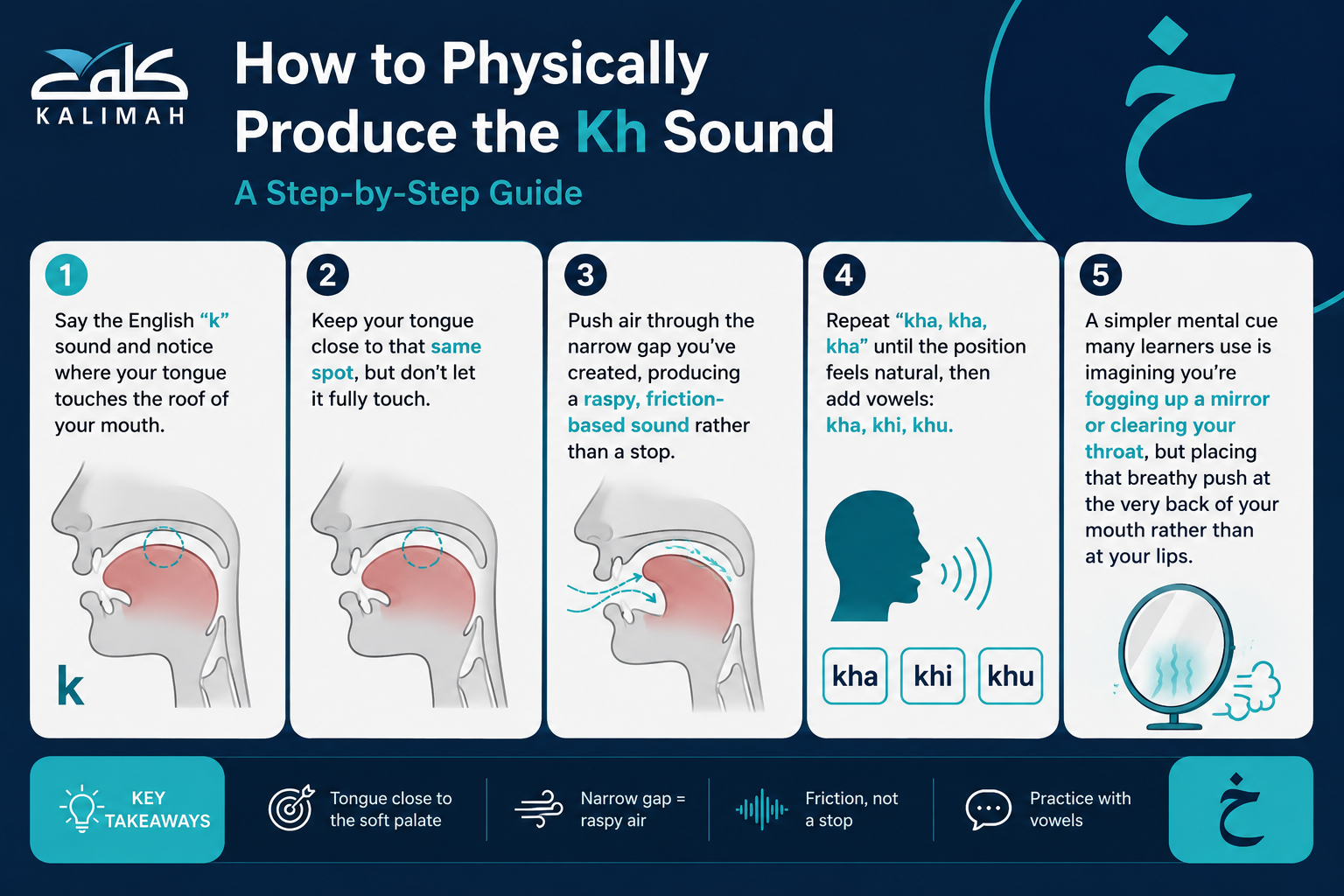
- Say the English “k” sound and notice where your tongue touches the roof of your mouth.
- Keep your tongue close to that same spot, but don’t let it fully touch.
- Push air through the narrow gap you’ve created, producing a raspy, friction-based sound rather than a stop.
- Repeat “kha, kha, kha” until the position feels natural, then add vowels: kha, khi, khu.
A simpler mental cue many learners use is imagining you’re fogging up a mirror or clearing your throat, but placing that breathy push at the very back of your mouth rather than at your lips.
Read Also: How to Pronounce ظ in Arabic
B. Comparing Kha With Similar Letters
Arabic has three related throat letters that English speakers often confuse: ح (haa), خ (kha), and غ (ghayn).
Haa is produced in the middle of the throat with a softer, breathier quality. Kha is produced further back, near the velum, with more friction.
Ghayn is the voiced counterpart of kha — same friction point, but your vocal cords vibrate while you produce it. One practical drill: alternate between خير (khayr, “good”) and حير (a nonsense pair used only for contrast) to feel the difference in throat position.
C. The Four Written Forms Of خ
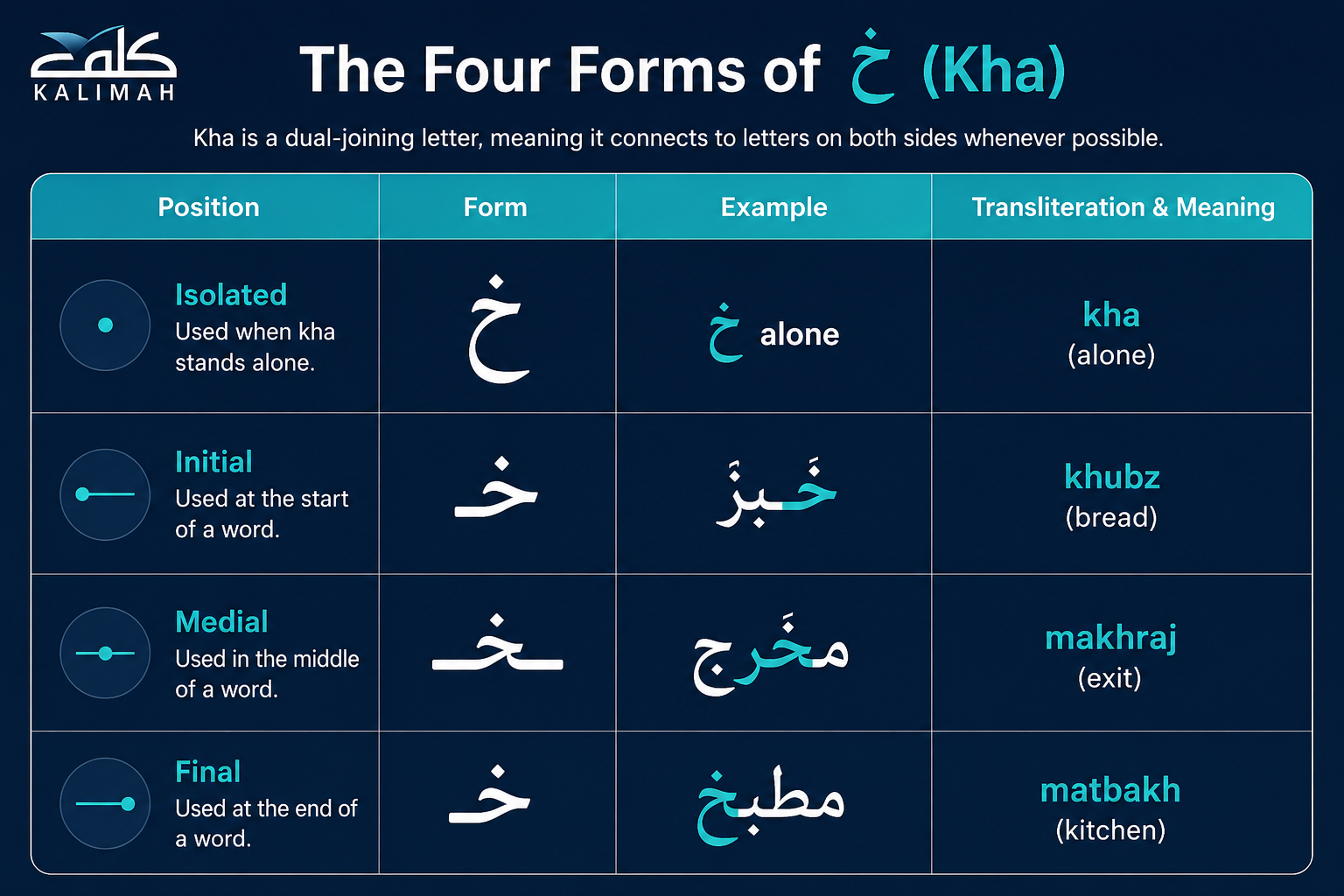
Bridge: pronunciation and writing go hand in hand — you can’t read kha correctly in a word if you don’t recognize its shape in context. Like most Arabic letters, kha changes shape depending on where it sits in a word.
| Position | Form | Example |
| Isolated | ﺥ | خ alone |
| Initial | ﺧـ | خبز (khubz — bread) |
| Medial | ـﺨـ | مخرج (makhraj — exit) |
| Final | ـﺦ | مطبخ (matbakh — kitchen) |
Kha is a dual-joining letter, meaning it connects to letters on both sides whenever possible. The isolated form is used when kha stands alone or comes at the end of a word after a right-joining letter.
The initial form appears at the start of a word, the medial form in the middle, and the final form at the end when a connecting letter precedes it.
D. Common Mistakes When Pronouncing Kh
Even after learning the correct throat position for khaʾ, most learners fall into a handful of predictable habits that undo the sound.
These mistakes usually come from relying on the closest familiar English sound instead of the actual friction point in the mouth, or from mixing kha up with the other Arabic throat letters.
Recognizing these patterns early makes it much easier to correct them before they turn into a fixed habit.
Mistake 1: Substituting Kha with K or H
The most frequent mistake is replacing khaʾ with a plain “k” sound, which turns words like خير (khayr, “good”) into something unrecognizable to a native speaker.
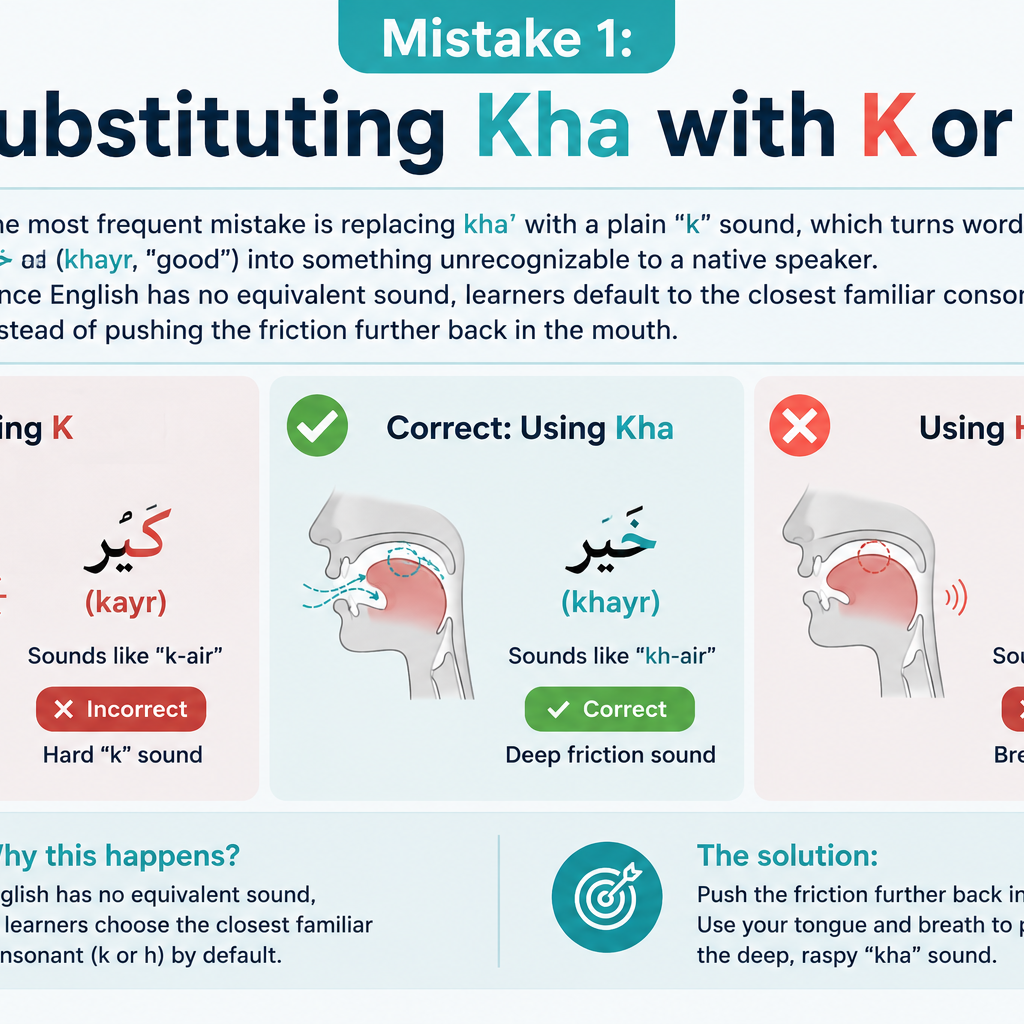
Since English has no equivalent sound, learners default to the closest familiar consonant instead of pushing the friction further back in the mouth.
Read Also: Arabic Immersion Magnet School
Inside Kalimah Center: Moments from Our Courses
Get a glimpse into the vibrant learning experience at Kalimah Center. These snapshots capture real moments from our live classes—where students engage deeply, connect with passionate instructors, and grow in a welcoming, supportive environment.
Master Arabic with Kalimah Center
Join our expert-led online classes and start your journey toward Arabic fluency today.
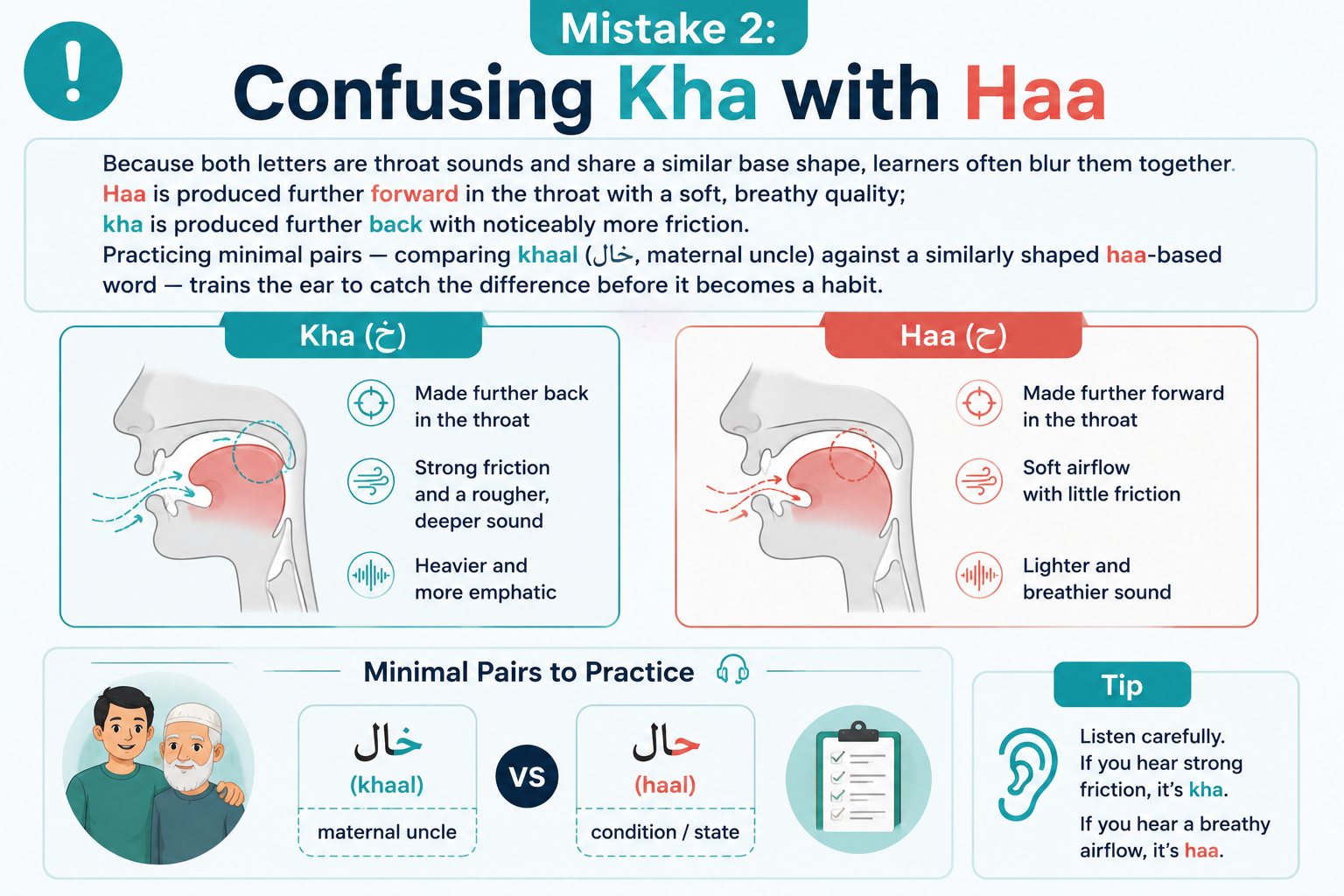
Book Your Free TrialMistake 2: Confusing Kha with Haa
Because both letters are throat sounds and share a similar base shape, learners often blur them together. Haa is produced further forward in the throat with a soft, breathy quality; kha is produced further back with noticeably more friction.
Practicing minimal pairs — comparing khaal (خال, maternal uncle) against a similarly shaped haa-based word — trains the ear to catch the difference before it becomes a habit.
At Kalimah Center, this kind of live correction is exactly where a one-on-one Quran and Arabic teacher makes the biggest difference — a native instructor catches these small slips in real time, something recordings and apps alone can’t do.
Read Also: How To Pronounce Arabic Letter Ayn?
E. Practice Words for the Letter Kha
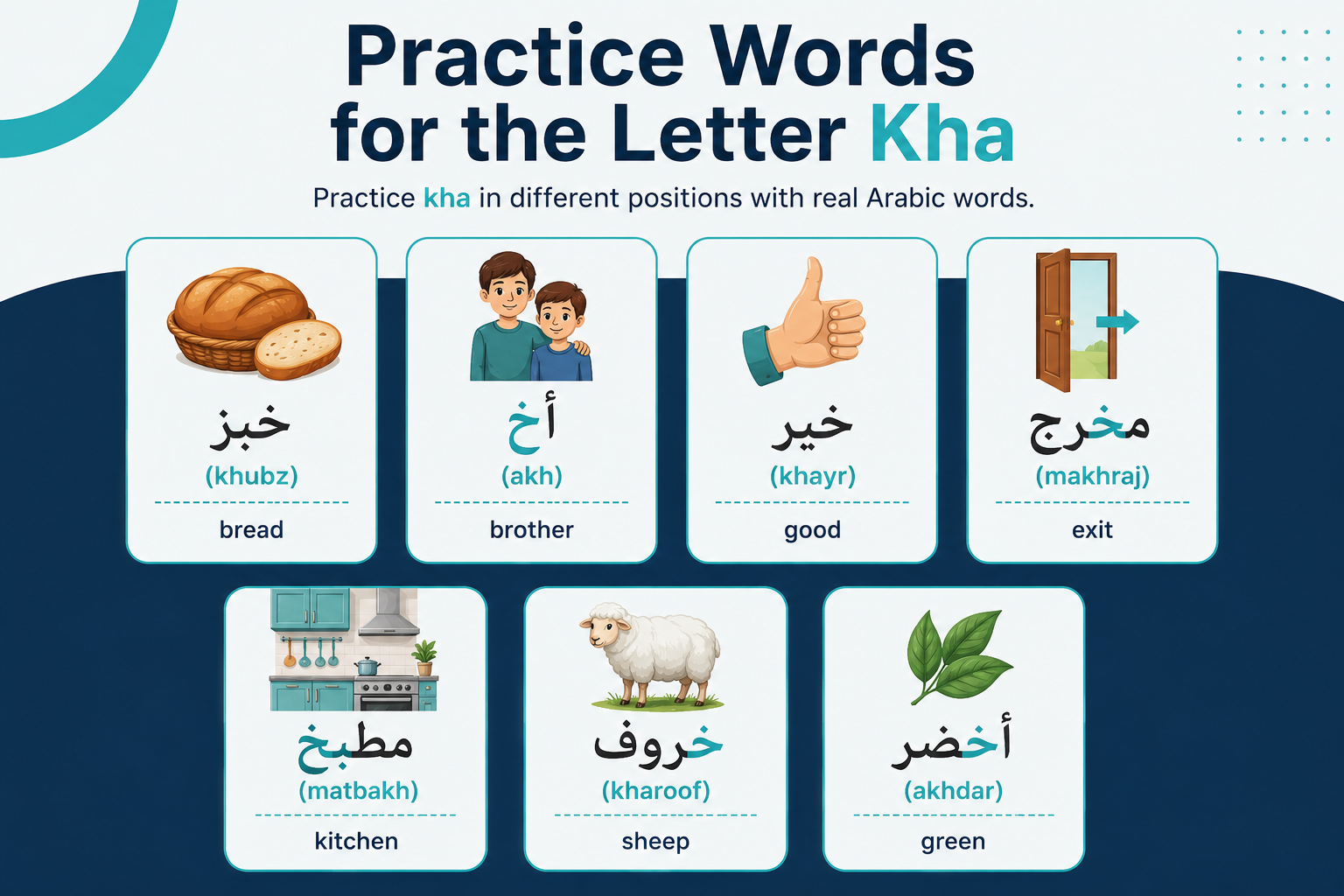
Once the mouth position feels stable, move from isolated repetition into real vocabulary:
- خبز (khubz) — bread
- أخ (akh) — brother
- خير (khayr) — good
- مخرج (makhraj) — exit
- مطبخ (matbakh) — kitchen
- خروف (kharoof) — sheep
- أخضر (akhdar) — green
Say each word slowly, then increase speed only once the kha sound stays consistent regardless of pace.
Recording yourself and comparing it to a native speaker’s pronunciation is one of the fastest ways to catch small errors early, before they turn into a fixed habit.
If you’re building this vocabulary as part of structured lessons rather than on your own, Kalimah Center’s group classes pair pronunciation drills like these with real conversation practice, so the sound sticks in context rather than in isolation.
Read Also: Is Italki Good for Arabic Learning
Buy Your Spot in a Live Arabic Class Today
Reading about the kha sound only gets you so far — real progress happens when a native-speaking teacher hears you say it and corrects you on the spot.

Kalimah Center’s live online classes are built around exactly that kind of direct, personal feedback, whether you’re starting from the alphabet or refining pronunciation you’ve already been working on.
Learn Arabic Online with a teacher who can catch your specific mistakes with khaʾ and the other throat letters before they become permanent habits.
Choose from Best Online Arabic Classes For Adults, Intensive Arabic Group Classes With Cheap Fees, or Learn Arabic Online For Kids if you’re enrolling a child.

Inside Kalimah Center: Moments from Our Courses
Get a glimpse into the vibrant learning experience at Kalimah Center. These snapshots capture real moments from our live classes—where students engage deeply, connect with passionate instructors, and grow in a welcoming, supportive environment.
Here Are The Reviews On Our Courses:
Our students frequently commend the excellence of our courses and the commitment shown by our instructors. You can read their complete reviews on Trustpilot.
Read more reviews on Trustpilot

📚 Explore Our Courses:
Online Arabic Course: Tailored to your level, our comprehensive Arabic program includes 16 teaching levels and 400+ hours of personalized sessions.
Online Quran With Tajweed Course: Perfect for non-Arabic speakers, our course spans 13 levels and equips you with Tajweed mastery from beginner to advanced.
Online Arabic Course For Kids: Nurture your child’s love for Arabic with our engaging and structured program, available in 24 levels for primary, intermediate, and secondary stages.
🚀 Start Your Free Trial Today! 🚀
Don’t miss out on this life-changing opportunity to deepen your faith and knowledge. Sign up now for your free trial and take the first step towards becoming a better practicing Muslim with Kalimah Center!
Master Arabic with Kalimah Center
Join our expert-led online classes and start your journey toward Arabic fluency today.
Book Your Free TrialConclusion
Learning how to pronounce kh in Arabic comes down to three things: understanding where the sound is produced in the throat, training your mouth to make friction instead of a stop, and practicing consistently with real words until the habit sticks.
The letter خ has four written forms depending on its position in a word, and it’s easy to confuse with ح and غ if you don’t isolate the differences early.
With steady practice — and correction from a native speaker when possible — the kha sound stops being unfamiliar and becomes a natural part of your Arabic pronunciation.
Frequently Asked Questions
Here are quick answers to the questions learners ask most often about how to pronounce kh in Arabic, based on common search queries and sticking points from real students.
1. Is خ pronounced like an English K?
No, khaʾ is not the same as an English “k.” A “k” is a stop consonant where the tongue fully touches the roof of the mouth and releases; khaʾ is a fricative, meaning air continuously flows through a narrow gap, creating friction and a rougher sound.
2. What is the closest English sound to kha?
There’s no exact English equivalent, but the “ch” in the Scottish word “loch” or the German name “Bach” are close approximations. Both are produced with friction near the back of the mouth, similar to how khaʾ is formed in Arabic.
3. How is kha different from ح (haa)?
Khaʾ is produced further back in the mouth, near the velum, with noticeably more friction than ح, which is produced in the middle of the throat with a softer, breathier quality. Practicing minimal word pairs is the fastest way to train your ear to tell them apart.
4. Does khaʾ change shape when writing?
Yes, khaʾ has four forms — isolated, initial, medial, and final — depending on where it falls in a word. The dot above the curve stays in all forms and is what distinguishes it from ح and ج.
5. What are good practice words for khaʾ?
Common practice words include خبز (khubz, bread), أخ (akh, brother), خير (khayr, good), and مطبخ (matbakh, kitchen). Practicing the sound in the initial, medial, and final positions of these words builds consistency.