Your Arab friend’s face pops up on the video call. It’s 7 p.m. where she lives, and you want to open in Arabic. But what do you say?
You say masā’ al-khayr (مساء الخير). That’s good evening in Arabic, and it’s the greeting you’ll hear most from noon until night. Shop owners say it. Teachers say it. Your friend’s mom will probably say it too, as she walks past the screen.
Below, you’ll learn what the words really mean and how to say them without tripping on the “kh.” You’ll also see how to write it, what changes when you greet a woman, and what to say back when someone greets you first.
What You Will Learn in This Article
- What masā’ al-khayr means, word by word.
- How to say good evening in Arabic the right way.
- How to write and type good evening in Arabic text.
- How to say good evening in Arabic to a woman, a man, or a group.
- How to reply, plus dialect forms and example sentences.
What Is Good Evening in Arabic?
Good evening in Arabic is مساء الخير (masā’ al-khayr). It works in standard Arabic and in every Arabic dialect. First, let’s look at what the words mean and when the evening starts.
The Meaning of Masā’ al-Khayr, Word by Word
The phrase has only two words. The first is مساء (masā’), which means “evening.” The second is الخير (al-khayr), which means “goodness” or “the good.”
Put together, the words mean “evening of goodness.” So you are not only saying “good evening.” You are wishing the other person an evening full of good things. The Almaany Arabic dictionary explains the phrase as a wish. It hopes that the start of the night brings good to you.
The word masā’ comes from the Arabic root م-س-و. This root gives other useful words too. أمسى (amsā) means “evening came.” أمسية (umsiya) means “an evening event,” like a poetry night.
Most English pages only say the phrase means “good evening.” Knowing the full meaning helps you remember it. It also helps you see why Arabs think of it as a kind wish, not just a hello.
When to Say Good Evening in Arabic
Many learners think the evening greeting starts at sunset. In Arabic, it starts much earlier. Most Arabs switch from the morning greeting to the evening greeting around noon.
Arabic has no common, separate greeting for “good afternoon.” So masā’ al-khayr covers both the afternoon and the evening. Here is an easy rule. Before noon, say صباح الخير (ṣabāḥ al-khayr), “good morning.” After noon, say مساء الخير (masā’ al-khayr).
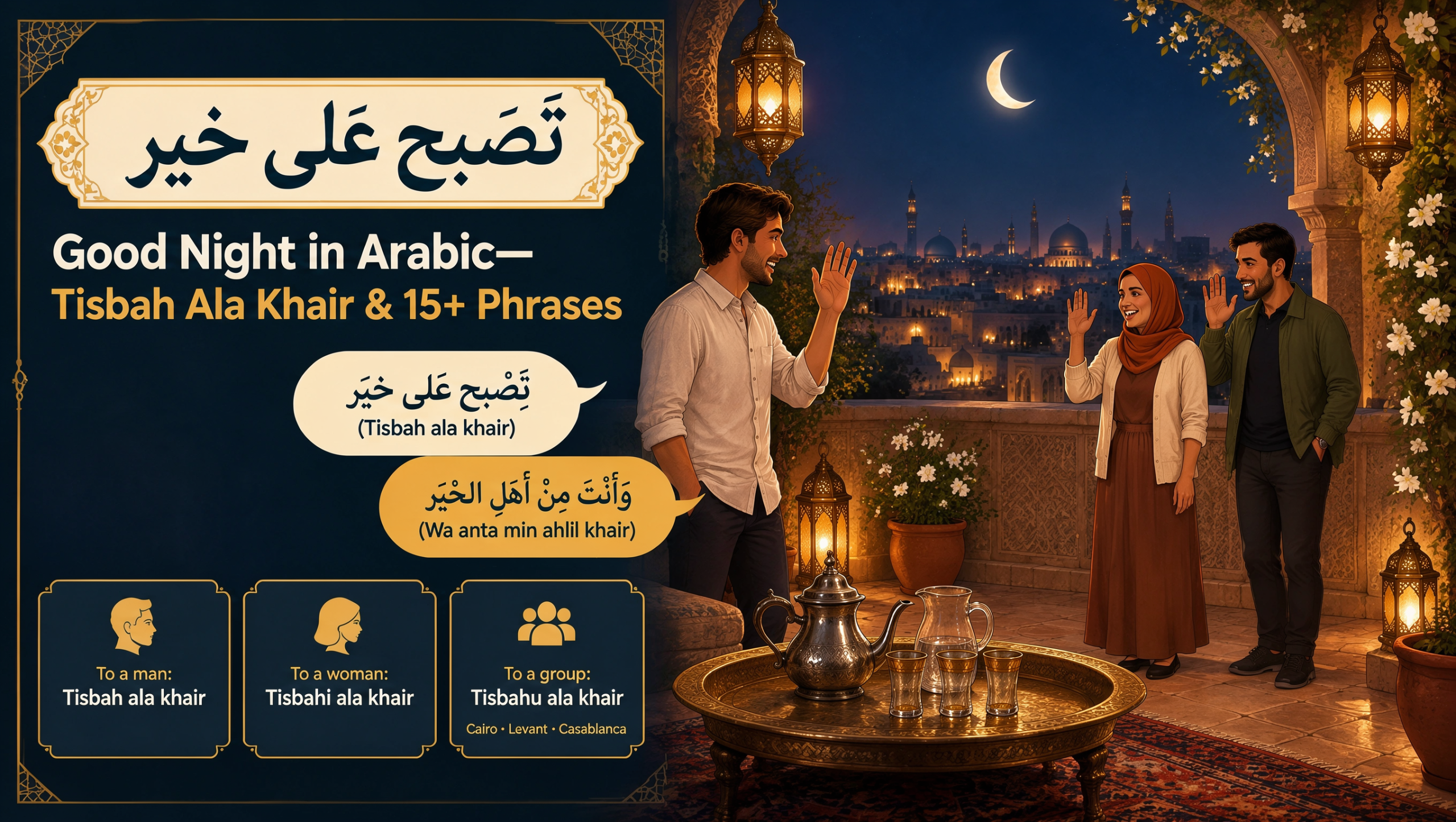
At the end of the night, you need a different phrase. When you leave or go to bed, say تصبح على خير (tuṣbiḥ ʿalā khayr). It means “may you wake up to goodness.” To a woman, say tuṣbiḥīna ʿalā khayr.
A common mistake is using masā’ al-khayr as a goodbye. It is only for meeting people. When someone says tuṣbiḥ ʿalā khayr to you, reply with وأنت من أهله (wa anta min ahlih). It means “and may you be one of its people.”
Saying Good Evening in Arabic
Knowing how to say good evening in Arabic comes down to a few sounds. Some of these sounds do not exist in English. Below, you will learn the phrase in small parts and then see the mistakes to avoid.
Pronunciation Guide, Sound by Sound
The best way to learn the phrase is to say it in small pieces. The table below shows each part with a simple English spelling.
| Part | Say it like | Tip |
| ma | mah | Short “a,” like in “mud” |
| sā’ | SAA’ | Long “aa,” like in “father,” then a small stop in your throat |
| al | al | Like the “Al” in “Albert” |
| khayr | KHAIR | “Kh” is the rough throat sound in Scottish “loch” |
- Now put the parts together: mah-SAA’ al-KHAIR. The strong beats fall on “SAA” and “KHAIR.”
- Start slowly. Say each part three times on its own. Then join the first two parts. Next, join the last two parts. When it feels easy, say the whole phrase at normal speed.
- Try saying it with a smile. A smile changes your voice and makes the greeting sound warm. Arabs notice this right away.
- It also helps to record yourself on your phone. Listen back and compare it with a native speaker. You will catch your own mistakes much faster this way.
Read also: Good Morning in Arabic
Common Pronunciation Mistakes to Avoid
The first mistake is saying “k” instead of “kh.” The letter خ is not a “k.” It comes from the back of the throat, with a light, scratchy sound. If you say “kayr,” people may not understand you.
The second mistake is dropping the stop at the end of masā’. This small stop is the hamza (ء). In casual speech, many Arabs drop it. But in standard Arabic, you should keep it.
The third mistake is about the little word “al.” Arabic letters fall into two groups. “Moon letters” keep the “l” sound. “Sun letters” swallow it. خ is a moon letter, so you say “al-khayr” with a clear “l.” The reply uses a sun letter, so its “l” goes silent.
These sounds are hard to fix alone. In Kalimah Center’s online Arabic course, a native tutor listens as you speak. Your tutor fixes each sound on the spot, so bad habits never settle in.
What happens in a Kalimah Center class?
This short sample shows you a real lesson in action, with clear explanations, live practice, and gentle correction from the teacher.
Read also: Arabic Sayings about Friendship
Good Evening in Arabic Text
Good evening in Arabic text is written مساء الخير. Arabic is read from right to left. You will see the phrase in a few forms, and you can type it on any phone in seconds.
Three Ways to Write Good Evening in Arabic
The first form is the standard one: مساء الخير. Most Arabic writing leaves out short vowel marks. So this is what you will see in books, on signs, and in the news.
The second form adds the vowel marks: مَسَاءُ الْخَيْرِ. These small marks show how to say each letter. You will find them in learner books and dictionaries. They help a lot when you are just starting.
The third form is chat spelling: مسا الخير. Here, the last letter ء is dropped. It is casual, but you will see it all the time on WhatsApp and social media.
Some people also type Arabic with English letters and numbers. This is called Arabizi. In Arabizi, 2 stands for ء, 5 stands for خ, 3 stands for ع, and 7 stands for ح.
So a friend might send you “masa2 el5eer” or just “masa el kheir.” Both mean good evening. Once you know the number code, these messages are easy to read.
Typing Good Evening in Arabic on Your Phone
First, add an Arabic keyboard. On an iPhone, go to Settings, then Keyboard, and add Arabic. On Android, open your keyboard settings and add Arabic as a language.
Next, type the letters in this order: م, then س, then ا, then ء. Press space. Then type ا, ل, خ, ي, ر.
You do not need to join the letters yourself. Your phone links them for you. The ء at the end of مساء stays on its own. That is normal and correct. Do not worry about typing from right to left. The keyboard handles the direction for you. Just tap the letters in order.
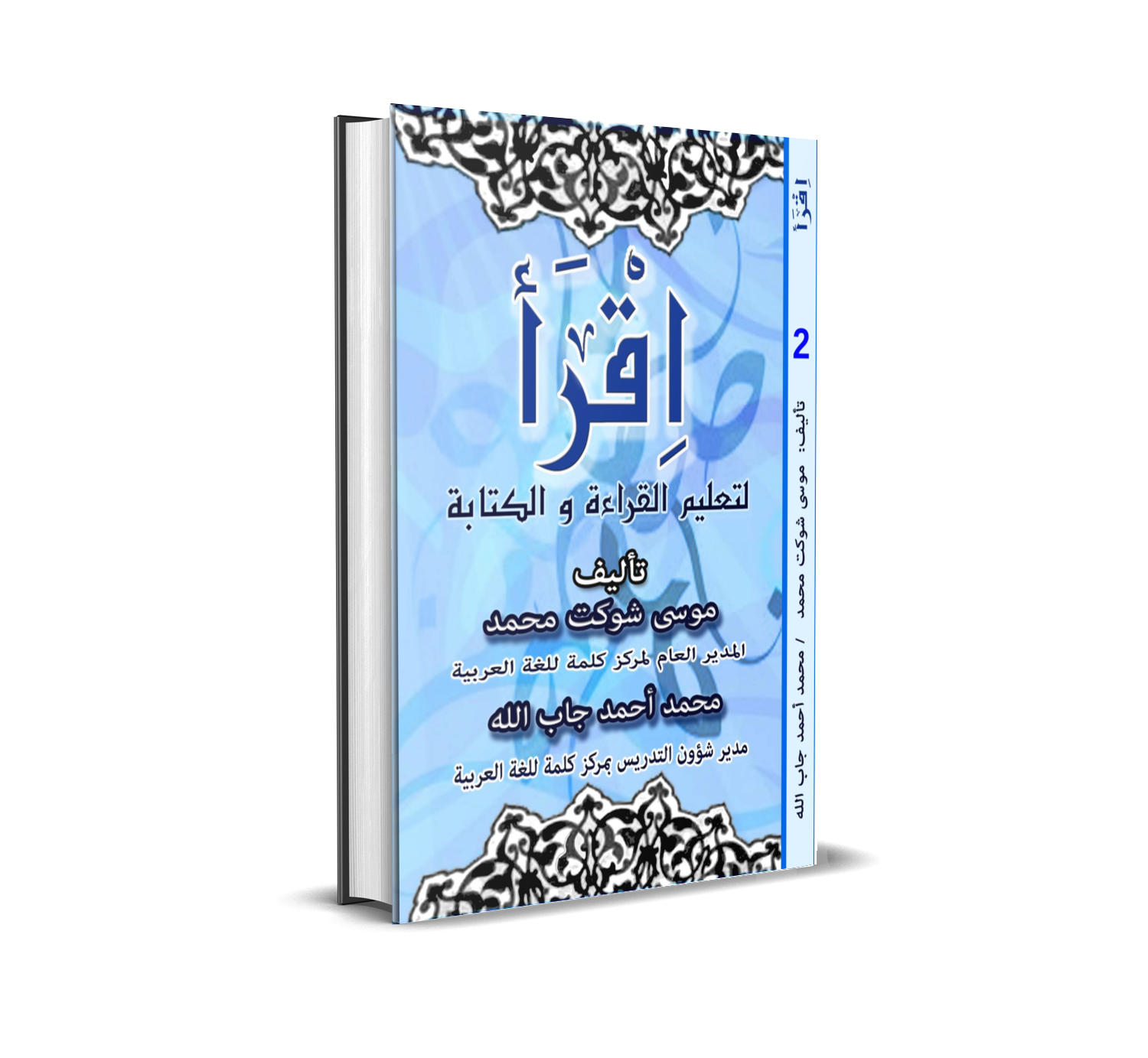
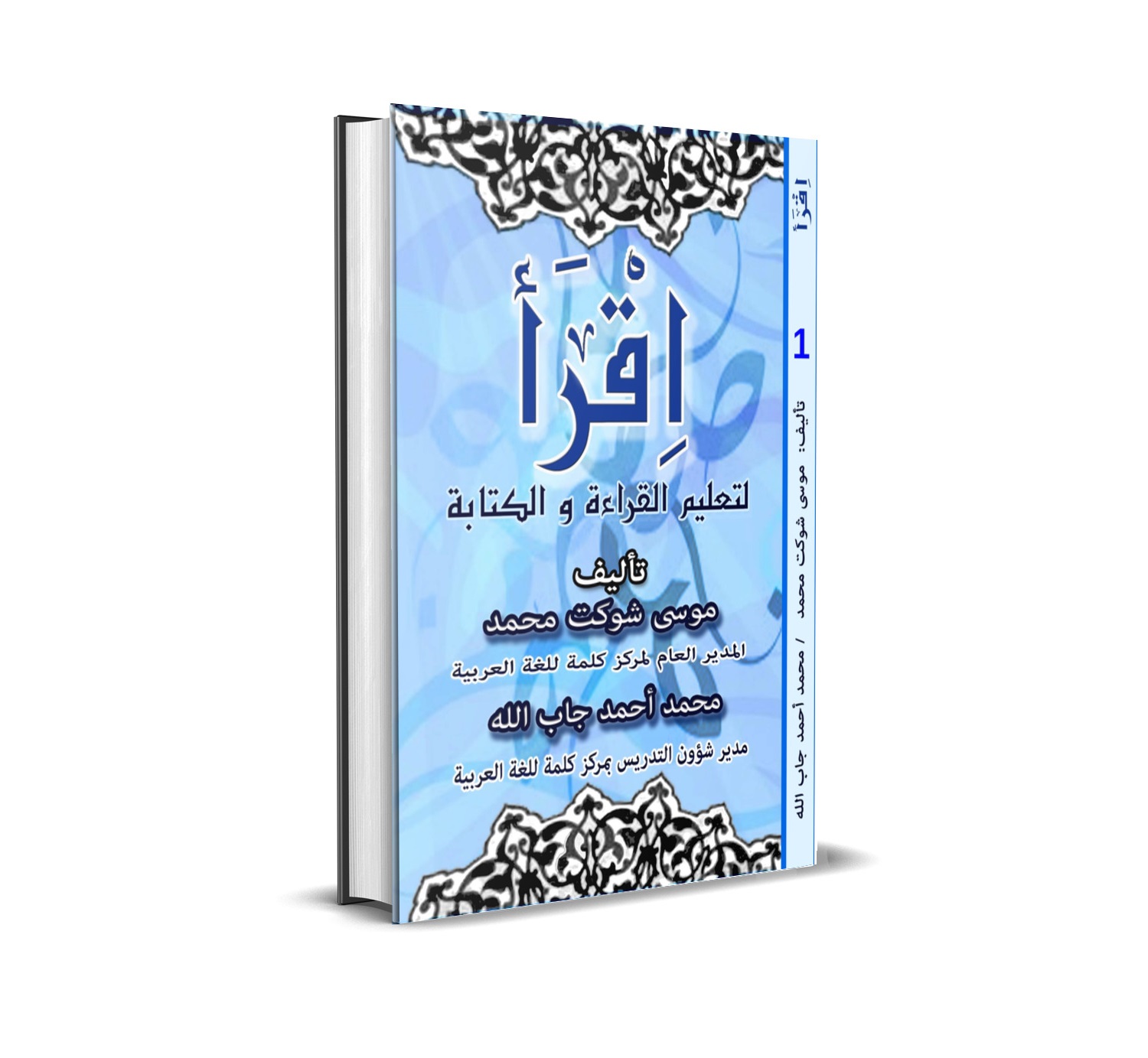
Writing by hand takes more practice. A good place to start is Eqraa wa Oktob (إقرأ واكتب), “Read and Write”, from Kalimah Center’s book shop. It’s a PDF book made to teach Arabic reading and writing, so you can practice your letters at home, at your own pace. Once the letters feel easy, phrases like مساء الخير come much faster.
Master Arabic with Kalimah Center
Join our expert-led online classes and start your journey toward Arabic fluency today.
Book Your Free TrialGood Evening in Arabic to a Woman
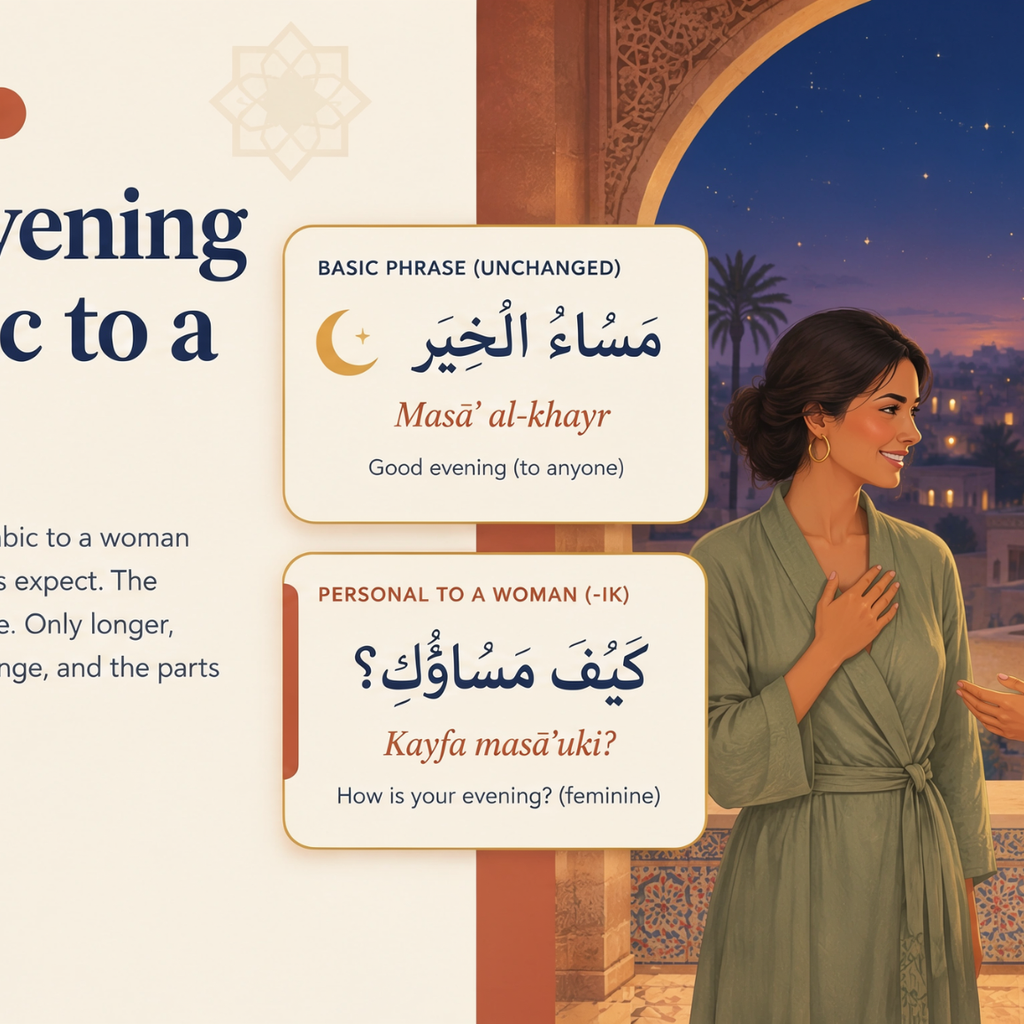
Saying good evening in Arabic to a woman is easier than many learners expect. The basic phrase stays the same. Only longer, more personal phrases change, and the parts below show you how.
Why the Basic Greeting Does Not Change
Arabic often changes words based on who you talk to. A man, a woman, and a group can each need a different ending. This is why many learners worry about greeting a woman.
But masā’ al-khayr has no word for “you” in it. It only says “evening of goodness.” So it stays the same for everyone.
You can say it to your teacher, your neighbor, or a full room. Nothing changes. For example, “masā’ al-khayr yā Sāra” and “masā’ al-khayr yā Aḥmad” use the very same greeting.
The change only happens when you add “you” or “your.” Arabic shows “your” with an ending on the word. It is -ka for a man, -ki for a woman, and -kum for a group. Learn these three endings once. Then you can change almost any evening phrase the right way, as the next part shows.
Formal Forms for a Man, a Woman, and a Group
Arabic has a formal evening wish: طاب مساؤك (ṭāba masā’uk). It means “may your evening be good.” There is also a warm, prayer-like wish: مسّاك الله بالخير (massāk Allāh bil-khayr). It means “may God make your evening good.”
Both phrases change their endings based on who you speak to. The table below shows all six forms. The Parallel Arabic phrase guide lists the same forms of ṭāba masā’uk.
| Meaning | To a man | To a woman | To a group |
| May your evening be good | طاب مساؤكَ (ṭāba masā’uka) | طاب مساؤكِ (ṭāba masā’uki) | طاب مساؤكم (ṭāba masā’ukum) |
| May God make your evening good | مسّاكَ الله بالخير (massāka Allāh bil-khayr) | مسّاكِ الله بالخير (massāki Allāh bil-khayr) | مسّاكم الله بالخير (massākum Allāh bil-khayr) |
Use ṭāba masā’uk in serious settings. A speaker may open a talk with “ṭāba masā’ukum.” A student may start an email to a female teacher with “ṭāba masā’uki.”
Use massāk Allāh bil-khayr when you want to sound kind and respectful. Older people love it. You will hear it a lot in the Gulf.
In daily chats, the plain masā’ al-khayr is enough. Formal phrases in a casual chat can sound a little stiff, like saying “Good evening, madam” to your best friend.
Polite Tips for Greeting a Woman
The safest choice is the greeting plus a title. Say مساء الخير يا أستاذة (masā’ al-khayr yā ustādha). It is close to “Good evening, ma’am.” For a doctor, say “yā duktūra.”
Be careful with greeting lists online. Many of them mix plain greetings with romantic lines, and some even call the reader “the rose of my life.”
Those lines are for a wife, a husband, or close family. With a coworker or a new friend, they can sound too personal. In more traditional places, keep the greeting short. Skip extra comments about her looks. A warm tone and a polite title say enough.
Using her first name is fine at work, if she uses yours. If you are not sure, start with the title. She will tell you if she likes her name better.
Read also: Arabic Sayings About Love
Replying to Good Evening in Arabic
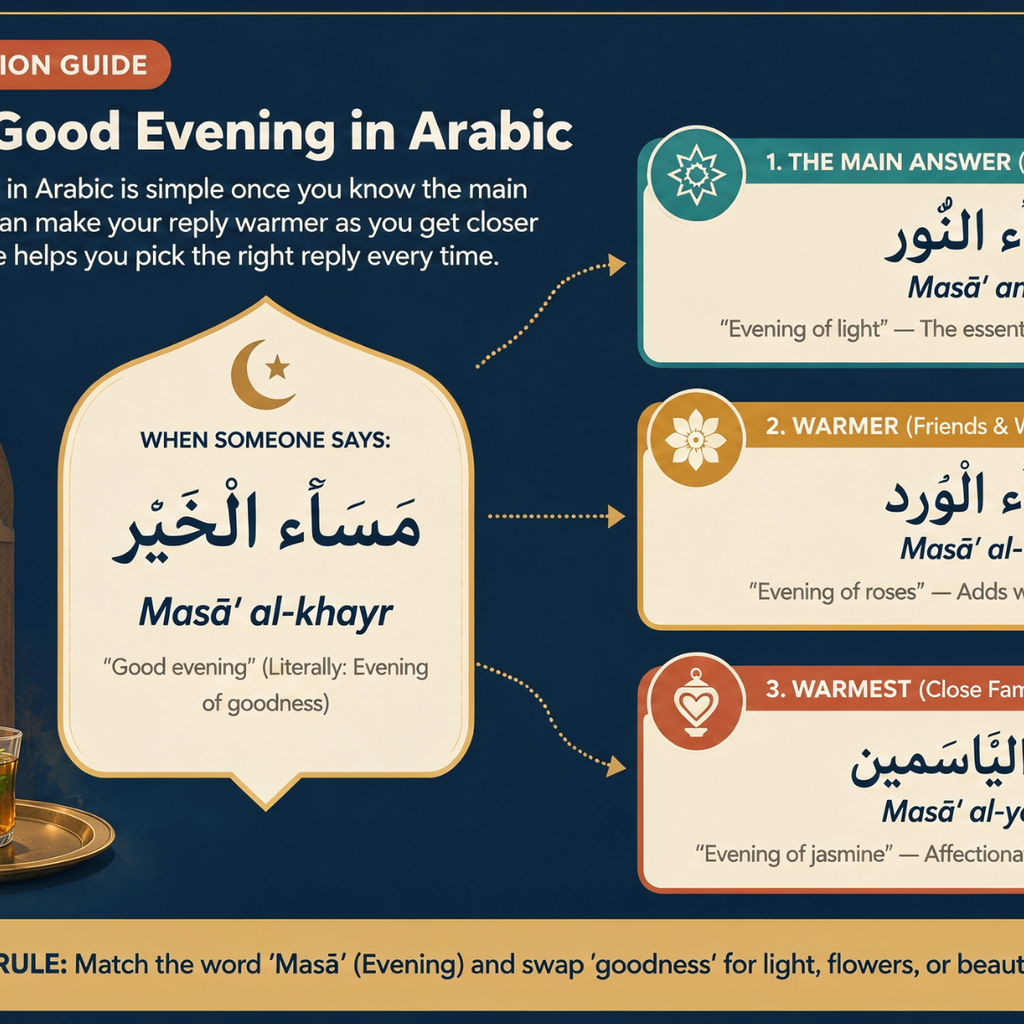
Replying to good evening in Arabic is simple once you know the main answer. From there, you can make your reply warmer as you get closer to someone. One easy rule helps you pick the right reply every time.
The Standard Reply and Warmer Options
The standard reply is مساء النور (masā’ an-nūr). It means “evening of light.” Say it like “mah-SAA’ an-NOOR,” with a long “oo” like in “moon.” Here is a nice way to remember it. The evening brings darkness, so you answer with light. Someone wishes you goodness, and you wish them light back.
This reply works with anyone, anywhere. You can say it to a shop owner, a teacher, or a friend. You can never go wrong with it. You can also add a name to make it warmer. For example, “masā’ an-nūr yā Mona” sounds friendly and personal.
Arabs also use warmer replies, as the table below shows.
| Arabic | Say it like | Meaning | Best for |
| مساء النور | masā’ an-nūr | Evening of light | Anyone |
| مساء النور والسرور | masā’ an-nūr was-surūr | Evening of light and joy | Friends, coworkers |
| مساء الورد والياسمين | masā’ al-ward wal-yāsmīn | Evening of roses and jasmine | Friends, family |
| مسّاك الله بالخير والرضا | massāk Allāh bil-khayr war-riḍā | May God give you an evening of good and peace | Older people |
The Simple Rule for Replying to Any Arabic Greeting
Here is a simple rule for any evening greeting. We call it “match-and-raise.” First, match the shape of what you heard. Then, add one small step of warmth.
Look at how it works. If someone says “masā’ al-khayr,” you say “masā’ an-nūr.” If someone starts with “masā’ an-nūr,” you say “masā’ an-nūr was-surūr.”
It works for formal phrases too. If someone says “ṭāba masā’uk,” reply with “wa ṭāba masā’uk.” That means “and may your evening be good, too.”
Why does this work? In Arab culture, a reply is a chance to give kindness back with a little extra. Matching keeps your answer correct. Raising it by one step makes it feel warm.
Match the style, too. If someone greets you in their local dialect, you can reply in standard Arabic. They will still understand you and smile. Just do not go too far. One step up is enough. Jumping from a plain greeting to a long, flowery line can sound strange.
Good Evening in Arabic Dialects
The written greeting is the same across the Arab world. But the way people say it changes from country to country. The table below shows the forms you will hear most often.
| Region | Written | Say it like |
| Egypt | مساء الخير | masa el-kheer |
| Levant (Syria, Lebanon, Jordan, Palestine) | مسا الخير | masa l-kheir |
| Morocco | مسا الخير | msa lkhir |
| Gulf and Saudi Arabia | مسا الخير | masa il-khair |
Egypt also has a cheerful local favorite: مساء الفل (masa el-full). It means “evening of jasmine.” You will hear it in shops, cafes, and taxis. Moroccan Arabic uses very short vowels. That is why “masā'” sounds almost like “msa” there.
If you are new to Arabic, start with masā’ al-khayr. Everyone understands it. Later, you can pick up the local sound of the country you visit most.
Good Evening in Arabic Example Sentences
Seeing the greeting in real sentences makes it easier to use. The examples below cover common moments in daily life.
- مساء الخير يا سارة (masā’ al-khayr yā Sāra): Good evening, Sara.
- مساء الخير يا أستاذ (masā’ al-khayr yā ustādh): Good evening, sir.
- مساء الخير جميعاً (masā’ al-khayr jamīʿan): Good evening, everyone.
- مساء الخير، أنا عمر (masā’ al-khayr, anā ʿUmar): Good evening, I’m Omar.
Here is a short chat at a friend’s door:
Omar: مساء الخير يا ليلى. (masā’ al-khayr yā Laylā.) Good evening, Layla.
Layla: مساء النور يا عمر، تفضل. (masā’ an-nūr yā ʿUmar, tafaḍḍal.) Good evening, Omar. Please come in.
Omar: شكراً. (shukran.) Thank you.
A quick look at learning with us
See how a live class works, from the teacher’s explanation to the student’s recitation. It’s a simple way to know what to expect before your first lesson.
Master Arabic with Kalimah Center
Join our expert-led online classes and start your journey toward Arabic fluency today.
Book Your Free TrialBook Your Free Lesson at Kalimah Center and Speak Arabic With Confidence
Reading a greeting is easy. Saying it out loud to a real person is where most learners freeze. Kalimah Center helps you get past that point with live practice from your very first class.
Here is what you get at Kalimah Center:
- Native Arabic tutors who are certified to teach Arabic and Quran, including teachers from Al-Azhar.
- Your choice of a male or female teacher, so you feel at ease.
- One-on-one classes, or group classes if you like learning with others.
- A full Arabic course based on Kalimah’s own lesson plan, with 16 levels and 400+ hours of lessons.
- Speaking, listening, reading, and writing practice in every class.
- Mistakes fixed right away, with hands-on exercises in each lesson.
- Course material you can open any time, day or night.
- A certificate for each level you pass.
- Class times that fit your week, backed by 14+ years of teaching experience.
Your first lesson is free. Book it today and say your first masā’ al-khayr to a real tutor.

Explore Our Courses:
- Online Arabic Course: Tailored to your level, our comprehensive Arabic program includes 16 teaching levels and 400+ hours of personalized sessions.
- Online Quran With Tajweed Course: Perfect for non-Arabic speakers, our course spans 13 levels and equips you with Tajweed mastery from beginner to advanced.
- Online Arabic Course For Kids: Nurture your child’s love for Arabic with our engaging and structured program, available in 24 levels for primary, intermediate, and secondary stages.
Conclusion
You now know that good evening in Arabic is masā’ al-khayr, and that the reply is masā’ an-nūr. You also know the formal forms, the polite tips, and the local sounds. The next step is to use them, because a greeting you only read fades fast.
Here is a simple plan for your first week. On days one and two, say the phrase out loud ten times each morning. Record yourself once and listen for the “kh” and the small stop at the end of masā’.
On day three, type the phrase on your phone in Arabic letters. Send it to a friend or save it as a note. On day four, write it by hand five times, first with vowel marks and then without them.
On day five, practice the reply. Ask a friend, a family member, or a tutor to greet you, and answer with masā’ an-nūr. Then try the match-and-raise rule with a warmer reply.
On days six and seven, use the greeting for real. Greet an Arab neighbor, a shop owner, or a classmate after noon. Notice how people smile when you speak their language, even with a few small mistakes.
Small daily steps like these turn a new phrase into a habit. Once masā’ al-khayr feels natural, the next greeting will come faster, and real Arabic chats will follow.
FAQs
Learners often have a few more questions once they know the basic greeting. Below are short, clear answers to the ones we hear most.
Is Masā’ al-Khayr Formal or Casual?
Masā’ al-khayr is both formal and casual. You can say it to a friend, a boss, or a stranger. It fits almost every setting.
Should I Say As-Salamu Alaykum or Masā’ al-Khayr First?
Many Muslims say As-salamu alaykum first, then add masā’ al-khayr. The Prophet ﷺ urged Muslims to spread the greeting of peace among themselves (Sahih Muslim, Hadith 54). Using both is polite and very common.
Can Non-Muslims Say Masā’ al-Khayr?
Yes, anyone can say masā’ al-khayr. It is a daily greeting, not a religious phrase. Arabs of all faiths use it every day.
How Do You Say “Good Evening, How Are You?” in Arabic?
Say مساء الخير، كيف حالك؟ (masā’ al-khayr, kayfa ḥāluk?). To a woman, say “kayfa ḥāluki?” with an “i” at the end.
How Do You Say Good Evening to Your Wife or Husband in Arabic?
To your wife, say مساء الخير يا حبيبتي (masā’ al-khayr yā ḥabībatī), “good evening, my love.” To your husband, say “yā ḥabībī.” Keep these for close family only.
What Is the Difference Between Masā’ and Layl in Arabic?
Masā’ (مساء) means “evening,” while layl (ليل) means “night.” That is why you greet with masā’ al-khayr but say good night with a different phrase.
How Do You Say 7 p.m. in Arabic?
Say الساعة السابعة مساءً (as-sāʿa as-sābiʿa masā’an). The word masā’an means “in the evening,” so it works like “p.m.” in English.
How Do You Reply to Good Morning in Arabic?
Reply to ṣabāḥ al-khayr with صباح النور (ṣabāḥ an-nūr), “morning of light.” It follows the same pattern as the evening greeting and its reply.