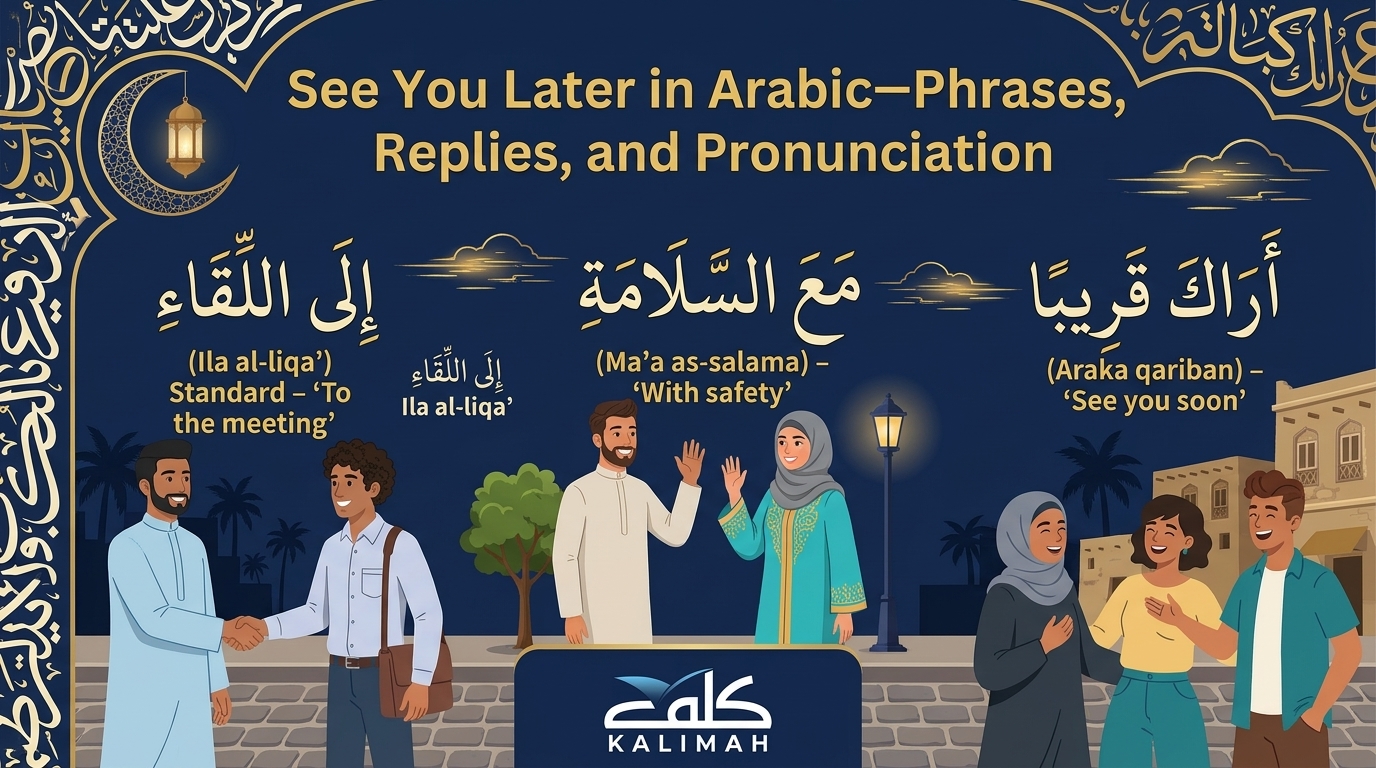
Picture this. You’ve just finished coffee with an Arab friend, and it’s time to go. You stand up, open your mouth, and nothing comes out. Is it ma’a as-salaama? Ila al-liqaa’? Learning how to say see you later in Arabic seems simple until the moment you need it.
The tricky part is that Arabic doesn’t have just one version. There’s the formal Arabic that everyone understands, and there are local dialects people actually use with friends and family. The words also shift a little depending on whether you’re talking to a man, a woman, or a group.
So let’s keep it simple. We’ll start with the main phrase, then show you what to say back, how Egyptians say it, and how it sounds in other Arab countries. You’ll get easy pronunciation for every phrase, plus a few short dialogues to practice at the end.
What You Will Learn In This Article
- The main way to say see you later in Arabic, for a man, a woman, or a group.
- What to say back when someone says goodbye to you.
- How Egyptians say see you later in daily life.
- How people say it in the Levant, the Gulf, and Morocco.
- Three short dialogues you can practice today.
Saying See You Later In Arabic
The main way to say see you later in Arabic is أراكَ لاحقاً (araaka laahiqan) to a man and أراكِ لاحقاً (araaki laahiqan) to a woman. This is Modern Standard Arabic, or MSA. People in every Arab country understand it, and it fits polite and formal places.
The first part below shows how the phrase changes for each person. The second part gives you other formal goodbyes, plus one word you should not use every day.
Araaka Laahiqan For A Man, A Woman, Or A Group
Araaka laahiqan has two parts. Araaka means “I see you.” Laahiqan means “later.” So the whole phrase means “I see you later.”
Only the “you” ending changes, based on who you are talking to. The table below shows every form, so you can choose the right one quickly.
| Who you are talking to | Arabic | Say it like this |
| One man | أراكَ لاحقاً | araaka laahiqan |
| One woman | أراكِ لاحقاً | araaki laahiqan |
| Two people | أراكما لاحقاً | araakumaa laahiqan |
| A group of men, or men and women | أراكم لاحقاً | araakum laahiqan |
| A group of women | أراكنَّ لاحقاً | araakunna laahiqan |
Arabic has a special form for exactly two people, called the dual. You will see it in books and formal speech. In daily talk, most people use araakum for any group.
One sound needs care. The ق in laahiqan is a deep “q,” made at the very back of your throat. If you say “laahikan,” people will understand you, but a native ear will notice.
Other Formal Ways To Say Goodbye In Arabic
MSA has a few more ways to say goodbye. Each one points to a different time. You keep the same pattern and just change the time word at the end. The table below shows the most useful ones. Pick the one that matches when you will meet again.
| Phrase | Say it like this | Meaning |
| إلى اللقاء | ila al-liqaa’ | Until we meet again |
| أراكَ قريباً / أراكِ قريباً | araaka qareeban / araaki qareeban | See you soon |
| أراكَ غداً / أراكِ غداً | araaka ghadan / araaki ghadan | See you tomorrow |
Ila al-liqaa’ is the easiest of the three. It never changes, so it works for a man, a woman, or a group. You will hear it at the end of news shows and formal meetings.
Now, one word to save for special moments. وداعاً (wadaa’an) means “farewell,” and it sounds final. People say it to someone moving far away, or in sad scenes in films. Said to a coworker you will see tomorrow, it can sound strange or even worrying.
Replying When Someone Says See You Later In Arabic
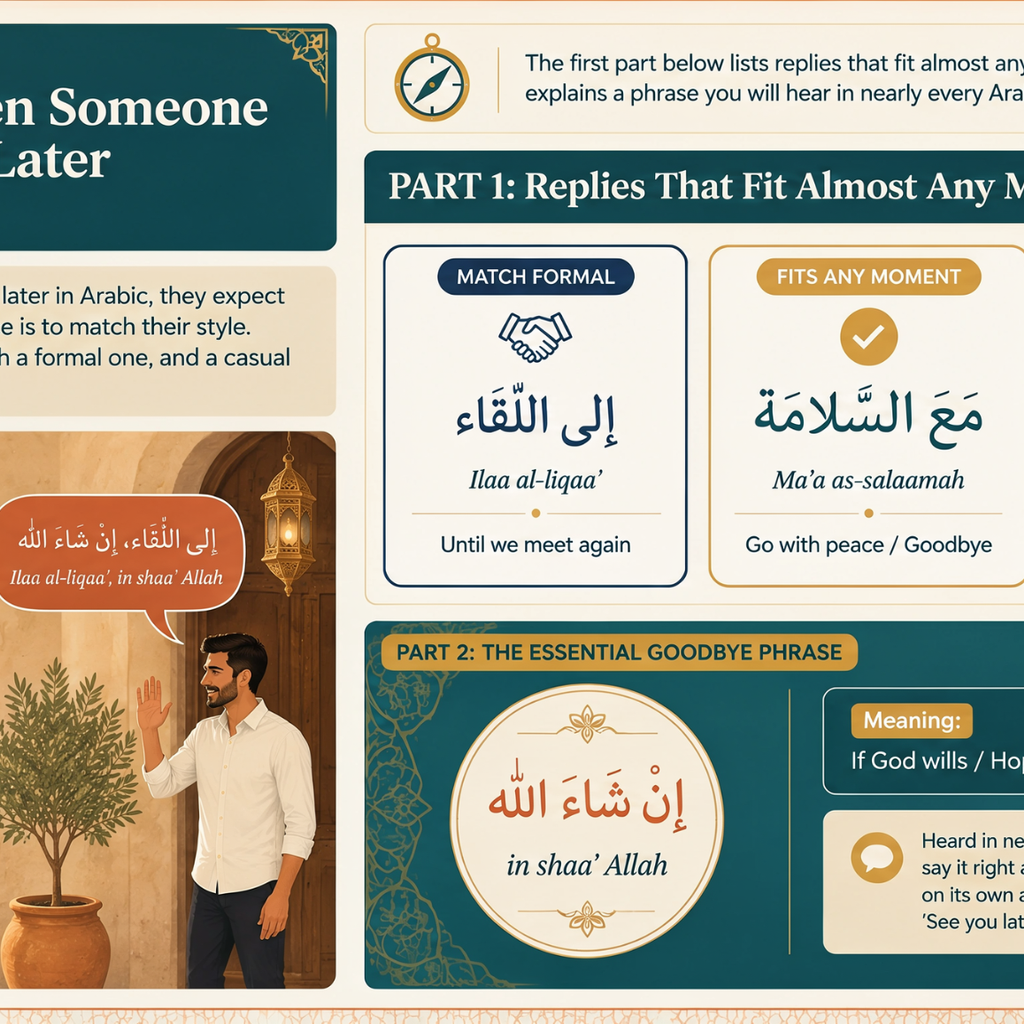
When someone says see you later in Arabic, they expect a short reply. The safest choice is to match their style. Answer a formal goodbye with a formal one, and a casual goodbye with a casual one.
The first part below lists replies that fit almost any moment. The second part explains a phrase you will hear in nearly every Arab goodbye: in shaa’ Allah.
Short Replies That Fit Any Setting
You do not need to think of something new. Often, you just repeat the same phrase back or add a kind wish. The table below shows the replies you will use most.
| When they say | You reply | Say it like this |
| أراكَ لاحقاً | أراكَ لاحقاً (to a man) / أراكِ لاحقاً (to a woman) | araaka laahiqan / araaki laahiqan |
| إلى اللقاء | إلى اللقاء | ila al-liqaa’ |
| مع السلامة | الله يسلمك (to a man) / الله يسلمِك (to a woman) | Allah yisallimak / Allah yisallimik |
| أشوفك بعدين | وانت كمان (to a man) / وانتي كمان (to a woman) | w enta kamaan / w enti kamaan |
The reply to ma’a as-salaama is worth learning first. Ma’a as-salaama means “go with safety,” and you can use it in any setting, from a shop to an office. Its reply, Allah yisallimak, means “may God keep you safe too.”
W enta kamaan simply means “you too.” It is casual and friendly. Say it with a smile, and it works with friends, classmates, and neighbors.
Why Arabs Add In Shaa’ Allah To Future Plans
إن شاء الله (in shaa’ Allah) means “if God wills.” Arabs add it to almost any plan for the future. So “see you tomorrow” often becomes “see you tomorrow, in shaa’ Allah.”
This habit comes from the Quran. In Surah Al-Kahf, verses 23-24 (18:23-24), Muslims are told not to say they will do something tomorrow without adding “if God wills.”
Today, Arab Christians and non-religious Arabs use it too. For them, it is a normal part of polite speech. You can also use in shaa’ Allah as a full reply. If a friend says “see you later,” you can simply answer “in shaa’ Allah.” It sounds warm and natural.
Leaving it out is not wrong. But adding it makes you sound much more like a local, and people often smile when a learner uses it.
Habits like this stick faster when you use them in real talks. In the Kalimah Center online Arabic course, native tutors build goodbyes into live practice, so you learn the words and the right moment to say them.
Master Arabic with Kalimah Center
Join our expert-led online classes and start your journey toward Arabic fluency today.
Book Your Free TrialSee You Later In Egyptian Arabic
In Egyptian Arabic, see you later is أشوفك بعدين. Say ashoofak ba’deen to a man and ashoofik ba’deen to a woman. It is the everyday phrase in Cairo, Alexandria, and in Egyptian films and TV.
Many learners pick Egyptian Arabic as their first dialect, and this guide on where to learn Arabic compares the main options. The two parts below show the main Egyptian phrase and the warmer ways Egyptians say goodbye.
Ashoofak Ba’deen For A Man, A Woman, Or A Group
Ashoofak ba’deen has two parts. Ashoofak means “I see you.” Ba’deen means “later.” Egyptians use the verb shaaf, “to see,” instead of the MSA verb. Like the MSA phrase, it changes with the person. The table below shows each form.
| Who you are talking to | Arabic | Say it like this |
| One man | أشوفَك بعدين | ashoofak ba’deen |
| One woman | أشوفِك بعدين | ashoofik ba’deen |
| A group | أشوفكم بعدين | ashoofkum ba’deen |
The mark ‘ in ba’deen stands for the letter ع. It is a deep sound made by tightening your throat. A plain “a” is still understood while you practice.
Egyptians often use this phrase when they have not set a time to meet. It keeps things open. You can also cut it short to just ashoofak, which means “see you.” Many people add the friend’s name too. “Ashoofak ba’deen ya Ahmed” sounds friendly and personal.
Warmer Egyptian Goodbyes For Friends And Family
Egyptians have many ways to say goodbye. Some are quick and casual. Others carry a kind wish for the other person. The table below shows the ones you will hear most. Each one fits a slightly different moment.
| Phrase | Say it like this | When to use it |
| أشوفك بكرة | ashoofak bokra | See you tomorrow, when leaving work or class |
| أشوفك على خير | ashoofak ‘ala kheer | See you in good health, warm and friendly |
| أشوف وشك بخير | ashoof weshak bekheer | May I see your face in good health, very warm |
| سلام | salaam | A quick “bye” |
| يلا باي | yalla bye | Very casual, common on the phone |
Ashoof weshak bekheer is a lovely phrase to learn. It shows you care about the person, not just about leaving. Yalla bye mixes Arabic and English. Yalla means “come on” or “okay,” and many young Egyptians use the pair to end phone calls.
What happens in a Kalimah Center class?
This short sample shows you a real lesson in action, with clear explanations, live practice, and gentle correction from the teacher.
See You Later In Other Arabic Dialects
Every Arab region has its own way to say see you later. If you know where your friend is from, using their phrase makes a great impression. The three parts below cover the Levant, the Gulf, and Morocco. Each one gives you the main phrase and the local goodbye customs.
Levantine Arabic: Bshoofak Ba’deen
Levantine Arabic is spoken in Lebanon, Syria, Jordan, and Palestine. Here, see you later is بشوفك بعدين. Say bshoofak ba’deen to a man, bshoofik ba’deen to a woman, and bshoofkon ba’deen to a group.
Notice the “b” at the start. Egyptians drop it and say ashoofak, but Levantine speakers keep it. The Levant also has a special pair of goodbye phrases. The person who is leaving says بخاطرك (bkhaatrak). It means something like “I leave with your blessing.”
The person who stays answers الله معك (Allah ma’ak), which means “God be with you.” To a woman, it is Allah ma’ik. To a group, it is Allah ma’kon. So in Beirut or Amman, a full goodbye may go like this: “Bkhaatrak.” “Allah ma’ak, bshoofak ba’deen.” It sounds warm and very local.
Gulf Arabic: Ashoofak Ba’deen And Fimaan Illah
In Saudi Arabia, the UAE, Kuwait, and Qatar, people often say أشوفك بعدين (ashoofak ba’deen), just like in Egypt. To a woman, it is ashoofich in Kuwait and ashoofik in many other areas.
The most common Gulf goodbye, though, is فمان الله (fimaan illah). It is a fast way of saying fi amaan illah, “in God’s care.” The usual reply is فمان الكريم (fimaan al-kareem). It means “in the care of the Generous One,” and it is a kind way to return the wish.
Gulf goodbyes often come with a wish for the road. If someone is driving or flying, people may say toosal bissalaama, “may you arrive safely.” These phrases are short, but they carry a lot of care. Using fimaan illah in Riyadh or Dubai shows you know the local way.
Moroccan Arabic: Nshoofek Men Ba’d
In Morocco, see you later is نشوفك من بعد (nshoofek men ba’d). Nshoofek means “I see you,” and men ba’d means “later.” In Tunisia and Algeria, you will hear a similar form, nshoofek ba’d.
For a plain goodbye, Moroccans say بسلامة (bslaama). It is short, easy, and works almost anywhere in the country.NMoroccans also say تهلا (thalla), which means “take care.” It is friendly and caring, and people use it with those they know well. Moroccan Arabic, called Darija, mixes in French words. So you may hear à bientôt, “see you soon,” or à plus, “see you later,” in the same chat.
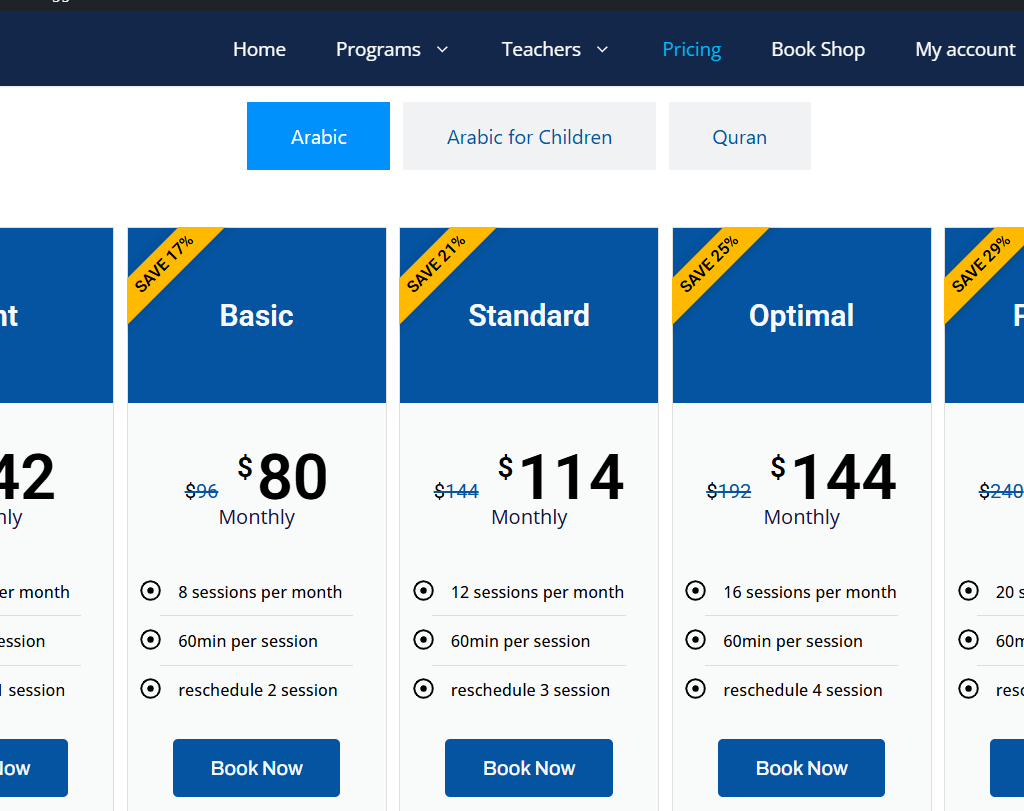
Darija can sound very different from Egyptian or Levantine Arabic. Still, bslaama is easy to learn, and Moroccans enjoy hearing visitors use it. Most learners start with MSA and one dialect, then add more over time. You can compare the Kalimah Center prices and plans to find a schedule that fits your budget and your goal.
Three Short Dialogues To Practice See You Later In Arabic
Phrase lists teach you words. Dialogues show you how people really say goodbye. Read each talk out loud, then try it with a friend.
A Formal Goodbye In Standard Arabic
This talk fits the end of a meeting or a class. Both people use MSA and stay polite.
A: شكراً على وقتك. أراكَ غداً إن شاء الله.
shukran ‘ala waqtik. araaka ghadan in shaa’ Allah.
Thank you for your time. See you tomorrow, God willing.
B: إن شاء الله. إلى اللقاء.
in shaa’ Allah. ila al-liqaa’.
God willing. Until we meet again.
A: مع السلامة.
ma’a as-salaama.
Goodbye.
B: الله يسلمك.
Allah yisallimak.
May God keep you safe.
Notice how person A thanks the other person first. Ending with thanks makes a formal goodbye feel kind, not cold.
A Casual Goodbye In Egyptian Arabic
This chat is between two friends in Cairo. Mona is leaving, and she is talking to Karim.
Mona: يلا، أنا ماشية. أشوفك بعدين.
yalla, ana mashya. ashoofak ba’deen.
Okay, I am leaving. See you later.
Karim: ماشي، أشوفِك على خير.
mashi, ashoofik ‘ala kheer.
Okay, see you in good health.
Mona: وانت كمان. سلام!
w enta kamaan. salaam!
You too. Bye!
Karim: سلام!
salaam!
Bye!
Look at Karim’s reply. Mona used a simple phrase, and he answered with a warmer one. Returning a goodbye with a little extra kindness is a common habit in Egypt.
A Casual Goodbye In Levantine Arabic
This chat takes place at a friend’s home in Amman. Sami is the guest, and Rami is the host.
Sami: يلا، بخاطرك.
yalla, bkhaatrak.
Okay, I am leaving with your blessing.
Rami: الله معك. ليش مستعجل؟
Allah ma’ak. leish mista’jil?
God be with you. Why the rush?
Sami: عندي شغل بكرا. بشوفك بعدين.
‘andi shughl bukra. bshoofak ba’deen.
I have work tomorrow. See you later.
Rami: إن شاء الله.
in shaa’ Allah.
God willing.
Sami gives a reason for leaving: he has work tomorrow. A short reason makes your exit feel polite, so the host does not think you are bored.
Tips To Say Goodbye The Arab Way
Knowing the words is only half the job. These habits help your goodbyes feel natural.
- Expect a long goodbye. In many Arab homes, leaving takes more than one try. The host may offer more tea, walk you to the door, and keep talking there.
- Say goodbye to everyone. When you leave a group, say goodbye to each person, not just the host. One wave to the whole room can feel rude.
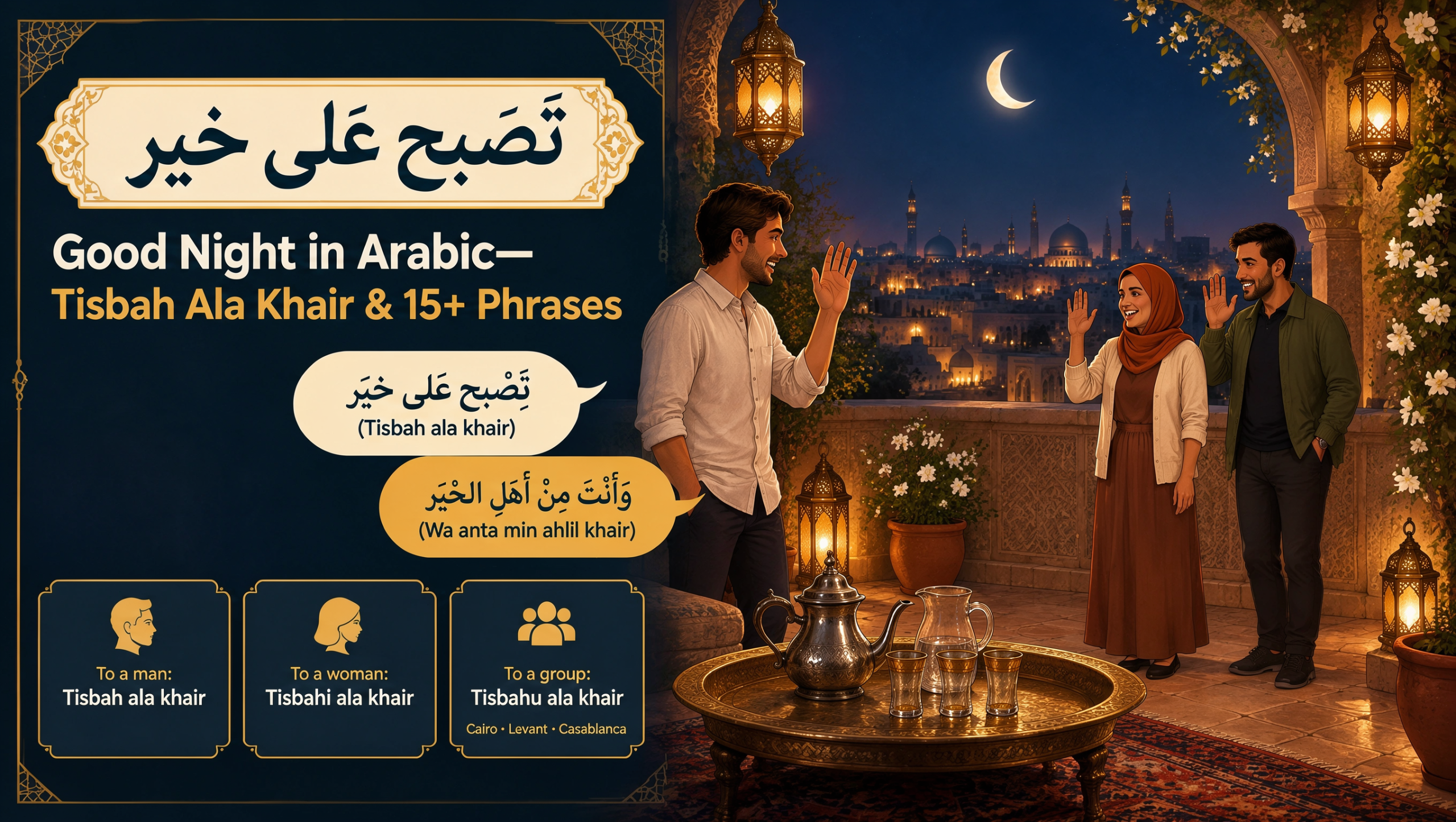
- Use a night goodbye after dark. At night, people often say تصبح على خير (tisbah ‘ala kheer), “good night,” to a man, and tisbahi ‘ala kheer to a woman.
- Pair your goodbye with a good greeting. A warm goodbye means more after a warm hello. You can learn the full set of greetings in this guide on how to say hi in Arabic.
- Keep building your phrases. Once goodbyes feel easy, try the books and tools in this list of Arabic learning resources.
Inside Kalimah Center: Moments from Our Courses
Get a glimpse into the vibrant learning experience at Kalimah Center. These snapshots capture real moments from our live classes—where students engage deeply, connect with passionate instructors, and grow in a welcoming, supportive environment.
Master Arabic with Kalimah Center
Join our expert-led online classes and start your journey toward Arabic fluency today.
Book Your Free TrialStart Speaking Arabic With Confidence At Kalimah Center
You can read every phrase in this guide and still freeze at the door. Speaking well takes live practice, with someone who hears your mistakes and fixes them on the spot.
Kalimah Center opened in Cairo in 2011. By 2017, it had taught more than 7,000 students from around the world. Today, you can learn with the same team online, from home.
Your teacher will be a native Arabic speaker, trained to teach Arabic and Quran. You can choose a male or a female teacher, so you learn with someone you feel at ease with. Every lesson is live and one-on-one on Zoom, and the focus is on speaking. You can study MSA, Egyptian Arabic, or Quranic Arabic, all in one place.
You also get a clear path. Kalimah uses its own books and a 16-level system, so you always know where you are and what comes next. When you finish a level or a course, you receive a certificate.
Best of all, you can start for free. Book your free placement test and trial lesson now, and practice greetings and goodbyes with a native speaker in your very first class.
Explore Our Courses:
- Online Arabic Course: Tailored to your level, our comprehensive Arabic program includes 16 teaching levels and 400+ hours of personalized sessions.
- Online Quran With Tajweed Course: Perfect for non-Arabic speakers, our course spans 13 levels and equips you with Tajweed mastery from beginner to advanced.
- Online Arabic Course For Kids: Nurture your child’s love for Arabic with our engaging and structured program, available in 24 levels for primary, intermediate, and secondary stages.
Conclusion
Saying see you later in Arabic is one of the first skills every learner needs. In MSA, say araaka laahiqan to a man and araaki laahiqan to a woman. For a group, say araakum laahiqan. If you want one phrase that never changes, use ila al-liqaa’.
A good goodbye goes both ways. When someone says goodbye to you, repeat their phrase, return their wish, or simply say in shaa’ Allah. That small reply shows warmth and good manners.
Each region adds its own flavor. Egyptians say ashoofak ba’deen. The Levant has the bkhaatrak and Allah ma’ak pair. The Gulf uses fimaan illah, and Morocco uses bslaama. You do not need every dialect at once. Start with MSA, so people understand you in every country. Then learn the dialect of the people you talk to most.
A simple plan helps. On day one, practice the MSA forms until the endings feel easy. On day two, practice the replies. On day three, read the three dialogues out loud. After a few days, goodbyes will stop feeling awkward. You will leave every coffee, class, and visit with a warm, natural “see you later.”
FAQs
Many learners have a few more questions once they know the main phrase. The short answers below cover the ones we hear most often.
How Do You Say See You Soon In Egyptian Arabic?
In Egyptian Arabic, see you soon is أشوفك قريب (ashoofak ‘orayyeb). To a woman, say ashoofik ‘orayyeb.
Is Araak Ba’deen Correct?
Araak ba’deen is understood, but it mixes an MSA word with an Egyptian word. Egyptians usually say ashoofak ba’deen in casual talk.
Can I Say Yalla Bye To My Boss?
It is better not to. Yalla bye is very casual, so use ma’a as-salaama or ila al-liqaa’ at work.
How Do You Say See You Next Week In Arabic?
In MSA, you say أراكَ الأسبوع القادم (araaka al-usboo’ al-qaadim). In Egyptian Arabic, you say أشوفك الأسبوع الجاي (ashoofak el-usboo’ eg-gayy).
How Do You Say Take Care In Arabic?
In MSA, you say اعتنِ بنفسك (i’tani bi-nafsak) to a man. In Egyptian Arabic, you say خلي بالك من نفسك (khalli baalak min nafsak).
How Do You Write See You Later In A Text Message?
Many young Arabs text in Latin letters, with numbers for some sounds. For example, 3 stands for ع, so you may see “ashofak ba3deen” or “yalla bye.”
What Does A Host Say When A Guest Leaves In Arabic?
In Egypt and the Levant, a host often says نورتنا (nawwartena), “you lit up our home.” The guest replies ده نورك (da noorak) in Egypt, which means “it is your light.”
Do Arabs Hug When They Say Goodbye?
Close friends of the same gender often hug or kiss on the cheeks. Between men and women, it is best to wait and see if the other person offers a hand first.