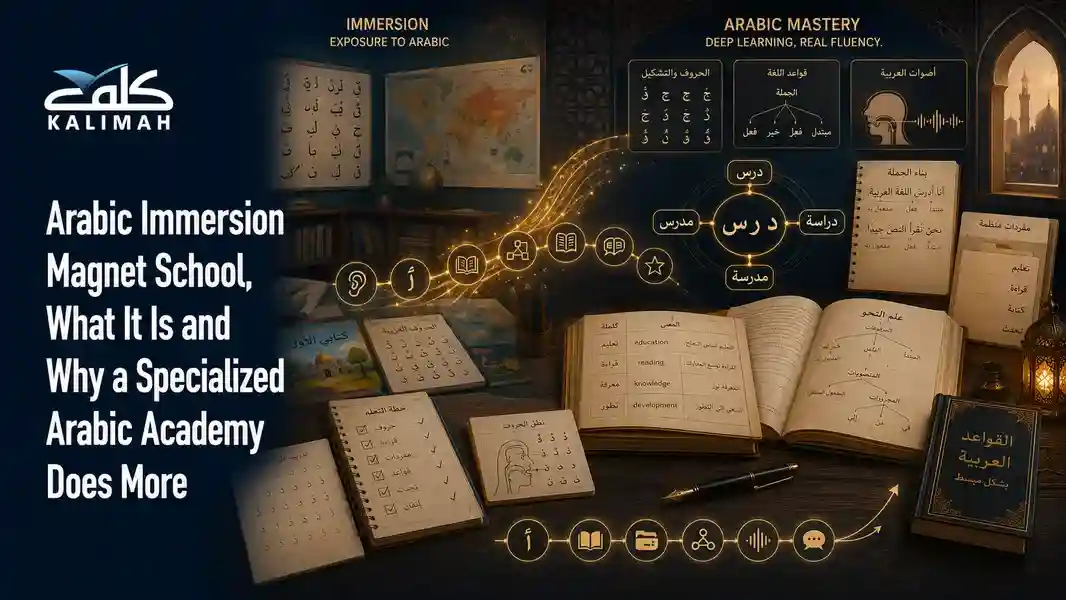
If you’ve been searching for an arabic immersion magnet school for your child — or for yourself — you’re already asking the right question. You understand that casual apps and YouTube videos don’t build real Arabic fluency. You want structure, depth, and genuine immersion.
But here’s what most people discover too late: magnet schools are geographically limited, enrollment is lottery-based, and the Arabic component is woven into a general curriculum rather than placed at the center of it. If you’re serious about Arabic mastery — not just exposure — there’s a more direct path.
This article explains exactly what an Arabic immersion magnet school is, what it does well, where it falls short, and why a specialized Arabic academy like Kalimah Center delivers focused, expert-guided instruction that magnet programs simply aren’t designed to provide.
What You’ll Learn in This Article
- What an Arabic immersion magnet school is and how it works
- The real difference between language immersion and language mastery
- Why specialized Arabic academies outperform general programs in depth and outcomes
- How to choose the right Arabic learning path for your goals
- How Kalimah Center’s approach compares — and where it goes further
What Is an Arabic Immersion Magnet School?
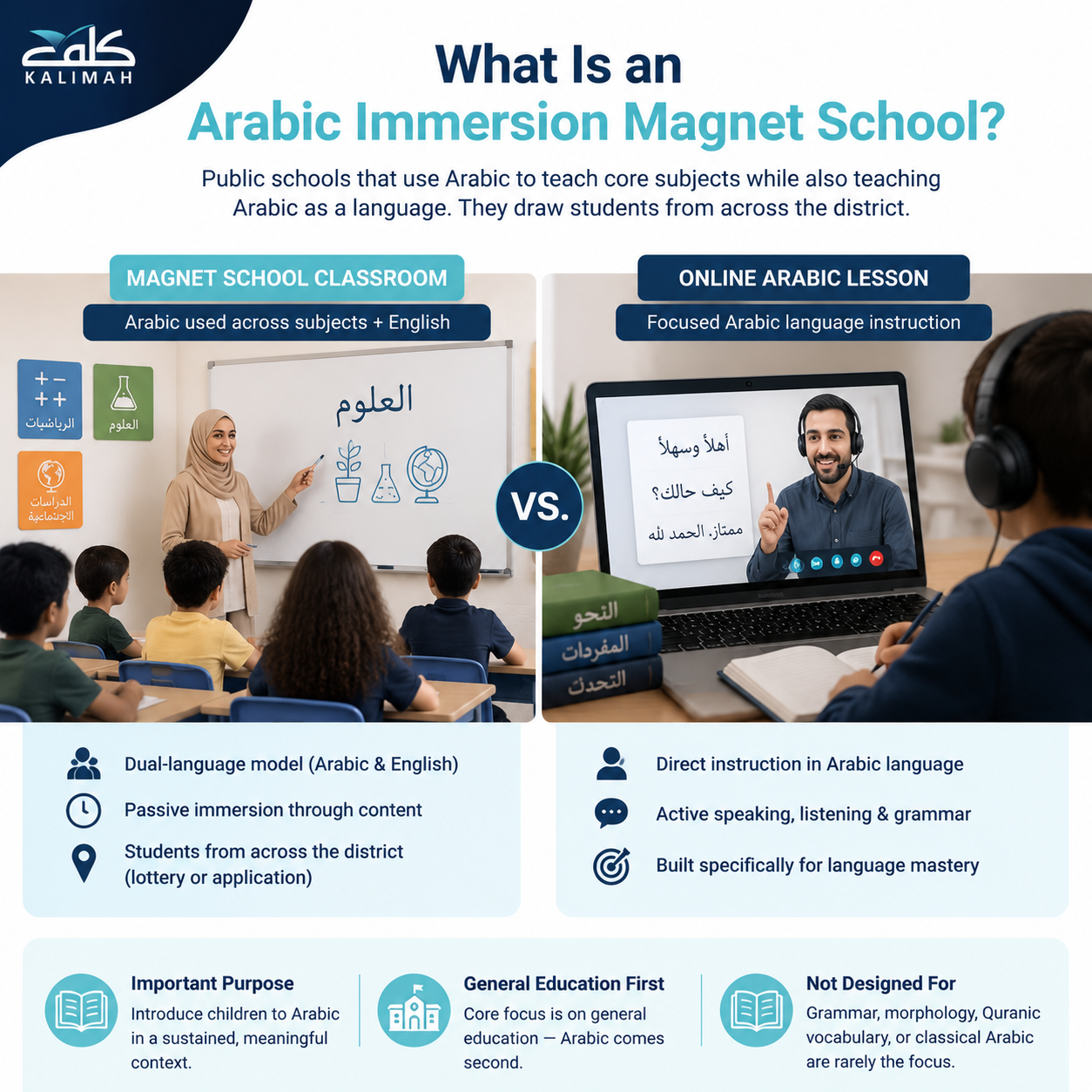
An arabic immersion magnet school is a public school that uses Arabic as a medium of instruction across core subjects — math, science, social studies — while also teaching Arabic as a language subject.
The “magnet” element means it draws students from across a district, often through a lottery or application process, rather than serving only a local zone.
These schools typically follow a dual-language model: students spend part of the day learning in Arabic and part in English, with the ratio shifting over the years.
By design, this creates passive immersion — children absorb Arabic through content rather than through direct linguistic instruction.
Magnet programs serve an important purpose. They introduce children to Arabic in a sustained, meaningful context. But they are built around general education first and Arabic second. Grammar, morphology, Quranic vocabulary, and classical literary Arabic are rarely the focus — because they aren’t the program’s primary mandate.
How Arabic Immersion Works And Where It Stops?
Immersion is widely regarded as one of the fastest routes to language acquisition — but “fast” depends entirely on what you’re measuring. For young children building listening instincts and everyday vocabulary, immersion delivers real results.
For learners whose goal is grammatical accuracy, Quranic literacy, or professional-level reading, the picture is more complicated. Understanding exactly what immersion does — and what it doesn’t — helps you make a smarter decision about your Arabic education path.
1. The Real Strengths of Arabic Immersion
Immersion is one of the most effective early-childhood language acquisition methods. When a child hears Arabic used to explain a math concept or a history lesson, the brain processes the language as a tool for meaning rather than as an academic subject.
This builds natural listening comprehension and everyday vocabulary faster than translation-based methods.
Research on dual-language programs consistently shows that children in immersion schools outperform peers in second-language acquisition benchmarks during the elementary years — particularly in listening and speaking.
2. The Limits of Immersion-Only Learning
The limitation of immersion is structural, not intentional. General immersion programs are not designed to teach Arabic grammar explicitly, to distinguish between Modern Standard Arabic (MSA) and Classical Arabic, or to build the morphological roots system (wazan) that underpins Arabic vocabulary.
A child who graduates from an immersion magnet program may speak conversational Arabic comfortably but be unable to read a newspaper, understand a Quranic verse in context, or construct a grammatically correct formal sentence.
These are not failures of effort — they are the predictable outcome of a curriculum that treats Arabic as a medium rather than a mastery goal.
For families whose goal is Quranic understanding, advanced literacy, or professional Arabic proficiency, immersion alone is not enough.
Read Also: Is Al Jazeera Learning Arabic Free?
Inside Kalimah Center: Moments from Our Courses
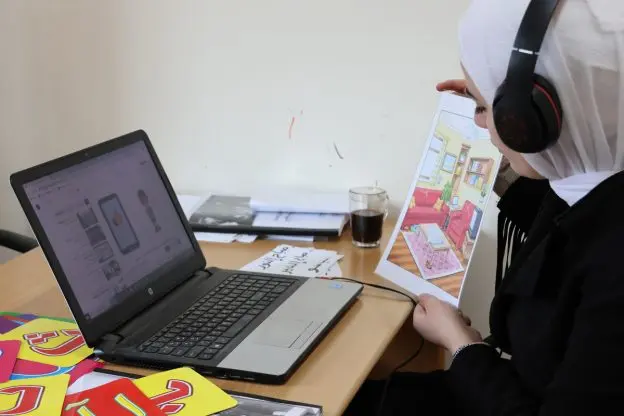
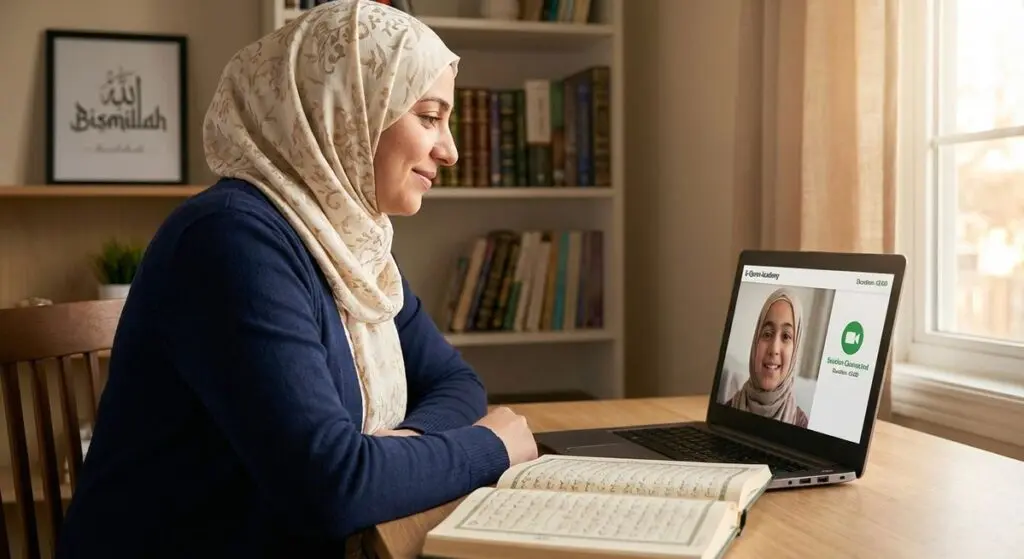
Get a glimpse into the vibrant learning experience at Kalimah Center. These snapshots capture real moments from our live classes—where students engage deeply, connect with passionate instructors, and grow in a welcoming, supportive environment.
Master Arabic with Kalimah Center
Join our expert-led online classes and start your journey toward Arabic fluency today.
Book Your Free TrialThe Difference Between Arabic Exposure and Arabic Mastery
This is the key distinction that most Arabic learning content avoids stating clearly: exposure builds familiarity; mastery requires structured instruction.
Magnet schools, language apps, and YouTube channels all deliver exposure. They create familiarity with the sounds, rhythms, and basic vocabulary of Arabic. That familiarity is genuinely valuable — and genuinely limited.
Mastery of Arabic requires three things that exposure-based environments rarely provide in full:
1. Explicit grammar progression
Arabic grammar (nahw and sarf) is a formal system with rules that must be taught sequentially. A learner who hasn’t studied i’rab (grammatical case endings) will consistently misread classical texts, including the Quran, because the meaning of a sentence changes depending on the case — and in most printed Arabic, the case endings aren’t written.
2. Structured reading development
Reading Arabic fluently is not automatic after listening and speaking. The Arabic script, the absence of short vowels in most text, and the complexity of root-pattern recognition require dedicated, progressive instruction.
3. Expert, personalized feedback
Errors in Arabic pronunciation and grammar calcify quickly without correction. Immersion environments don’t provide the consistent, one-to-one correction that produces accurate production.
This is precisely where Kalimah Center is built differently. Unlike general-purpose language platforms or magnet programs with broad mandates, Kalimah Center is a dedicated Arabic academy focused entirely on Arabic for children, adults, and non-native speakers — with specialist instructors and structured curricula designed to take learners from first contact with the alphabet through to confident fluency.
Read Also: How to Pronounce KH in Arabic
Why Apps and General Platforms Fall Short Too?
It’s worth naming the alternatives directly, because many families researching arabic immersion magnet school options will also encounter language apps and online learning platforms.
Apps like Duolingo and Rosetta Stone offer Arabic as one of dozens of languages. Their strength is accessibility and gamified consistency.
Their limitation is equally clear: they are designed for broad language exposure, not Arabic specialization.
They cannot teach you waqf rules in recitation, classical morphology, or the difference between fatha tanween and kasra tanween in context. They are general tools, not Arabic specialists.
Kalimah Center is not a general tool. It is an Arabic-only academy offering:
- Learn Arabic Online for adults — structured from beginner to advanced, with specialist instructors
- Intensive Arabic Group Classes With Cheap Fees — live, interactive, and affordable for families and professionals
- Learn Arabic Online For Kids — age-appropriate curricula with native-speaking teachers trained in child-centered methods
The distinction matters: apps and platforms teach Arabic alongside everything else. Kalimah Center teaches only Arabic, at depth, with intention.
Read Also: Arabic Language Books for Children: The 7 Best Picks for Every Age and Level
The Right Candidate for an Arabic Immersion Magnet School
An arabic immersion magnet school is the right choice if:
- You have a child in the early elementary years (K–6) and live near a school with a strong dual-language Arabic program
- Your primary goal is natural spoken fluency alongside standard academic education
- Enrollment is available and not subject to years-long waitlists
It is worth exploring — but it is not available to most families, because these schools are geographically limited to certain cities and districts, mostly in the United States.
Access depends entirely on where you live, and in most places, no such school exists within driving distance.
Read Also: Is Memrise Good for Learning Arabic?
Who Should Choose a Specialized Arabic Academy Instead?
A dedicated Arabic academy like Kalimah Center is the better fit when:
- You do not live near an Arabic immersion magnet school — or the nearest one has a closed enrollment
- Your goal goes beyond daily conversation to include Quranic literacy, classical texts, or professional Arabic
- You are an adult learner, not a child in the K–6 window where immersion is most effective
- You want explicit grammar instruction, not just immersion exposure
- You need flexible scheduling — evenings, weekends, or asynchronous options
- You want instruction tailored to your specific level rather than a classroom’s average pace
Kalimah Center serves learners on every continent through live online instruction. No geography required.
Start Learning Arabic With Kalimah Center Wherever You Are
Kalimah Center is a specialist Arabic academy — not a general language app, not a broad online platform.
Every instructor, every curriculum, and every lesson is built around one language: Arabic. Whether you’re a complete beginner, a parent enrolling your child, or an adult returning to Arabic after years away, Kalimah Center builds your skills with structured precision.
Explore Our Courses:
- Best Online Arabic Classes for Adults: for adults who want intensive, structured progress.
- Intensive Arabic Group Classes: for learners who want affordable group learning.
- Learn Arabic Online for Kids: for children beginning their Arabic journey.
Experience Kalimah Center Classes
Watch real excerpts from our live sessions at Kalimah Center and see how we bring learning to life. These clips highlight our interactive, student-centered teaching approach across all our courses—designed to keep learners engaged, motivated, and actively involved every step of the way.
Here Are The Reviews On Our Courses:
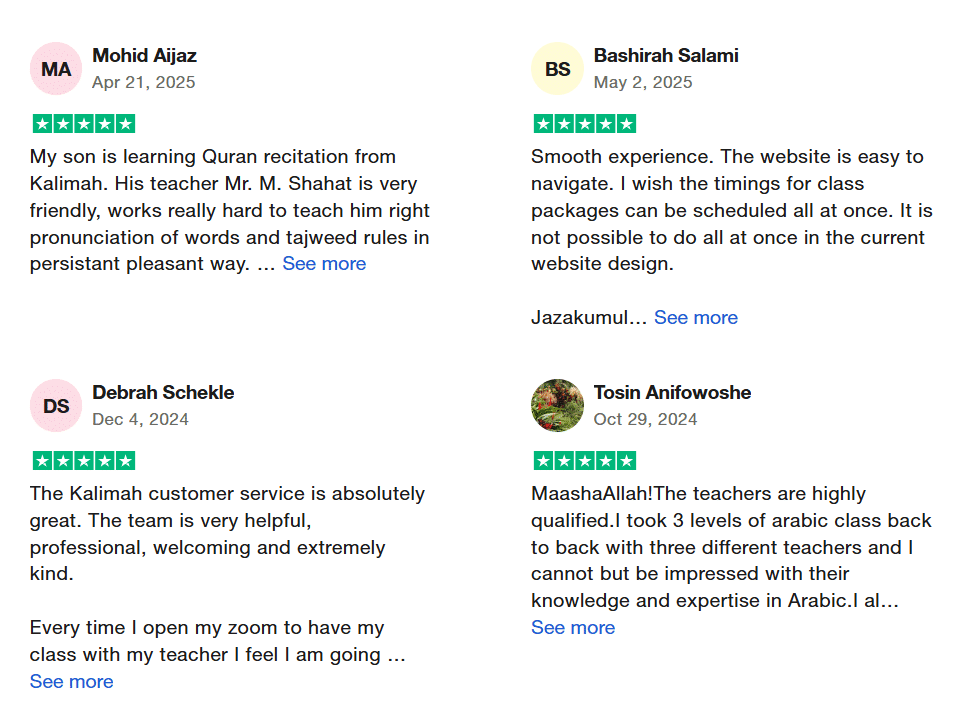
Our students frequently commend the excellence of our courses and the commitment shown by our instructors. You can read their complete reviews on Trustpilot.
Read more reviews on Trustpilot
🚀 Start Your Free Trial Today! 🚀
Don’t miss out on this life-changing opportunity to deepen your faith and knowledge. Sign up now for your free trial and take the first step towards becoming a better practicing Muslim with Kalimah Center!
Master Arabic with Kalimah Center
Join our expert-led online classes and start your journey toward Arabic fluency today.
Book Your Free TrialConclusion
An arabic immersion magnet school is a valuable option for families in the cities where they exist — but they are geographically restricted, enrollment-dependent, and designed around general education rather than Arabic mastery. They build exposure; they rarely build deep fluency.
For learners who want structured, expert-guided instruction in Arabic — at any age, from any location — a specialized academy is the more effective and more accessible path.
Kalimah Center offers exactly that: an Arabic-only environment with native-speaking specialists, progressive curricula, and flexible online delivery that no physical magnet school can match for reach or depth.
The goal isn’t just to hear Arabic. It’s to understand it, speak it accurately, read it confidently, and use it — for faith, for career, or for life. Kalimah Center is built for that goal.
Frequently Asked Questions About Arabic Immersion Magnet Schools
Here are answers to the most common questions parents and learners ask when exploring their Arabic education options.
What is an Arabic immersion magnet school?
An Arabic immersion magnet school is a public school that uses Arabic as the language of instruction for core academic subjects, alongside direct Arabic language teaching. Students are drawn from across a school district rather than a local zone, and enrollment is typically by application or lottery.
How is an Arabic immersion magnet school different from a regular bilingual school?
A magnet school is open to students district-wide and typically has a specific educational theme or focus — in this case, Arabic immersion — that distinguishes it from a neighborhood school. A standard bilingual school may offer some Arabic instruction but does not necessarily use Arabic as the primary medium for core subjects.
Can online Arabic academies replace an immersion magnet school?
Online Arabic academies like Kalimah Center cannot replicate the full-day immersive environment of a physical magnet school — but they provide something magnet schools don’t: specialist Arabic instruction, explicit grammar teaching, flexible scheduling, and access regardless of geography. For families without a nearby magnet option, or whose goals include classical or Quranic Arabic, a specialized academy delivers more targeted outcomes.
At what age should a child start learning Arabic?
Children as young as four or five can begin Arabic with age-appropriate phonics and vocabulary methods. Research consistently shows that early exposure builds stronger pronunciation and listening instincts. Kalimah Center’s online Arabic program for kids is designed for learners starting from the alphabet, with methods adapted to different age groups and learning stages.
Is Modern Standard Arabic or a dialect better to learn first?
For educational, Quranic, and professional purposes, Modern Standard Arabic (MSA) is the appropriate foundation. Dialects are valuable for daily conversation in specific regions but are not transferable across the Arabic-speaking world the way MSA is. Most structured Arabic curricula — including Kalimah Center’s — begin with MSA and introduce dialectal variation as a complement.
How long does it take to become fluent in Arabic?
Fluency timelines depend on starting level, consistency, and instruction quality. The U.S. Foreign Service Institute classifies Arabic as a Category IV language — one of the most demanding for English speakers — estimating approximately 2,200 hours to professional proficiency. With expert instruction and structured daily practice, most learners reach confident conversational ability within 12 to 18 months. Kalimah Center’s progressive curriculum is designed to make that timeline realistic rather than aspirational.