It’s 3 p.m., and your Arab coworker walks past your desk. You want to say hi, but “sabah al-khayr” feels wrong this late in the day. So what do you say?
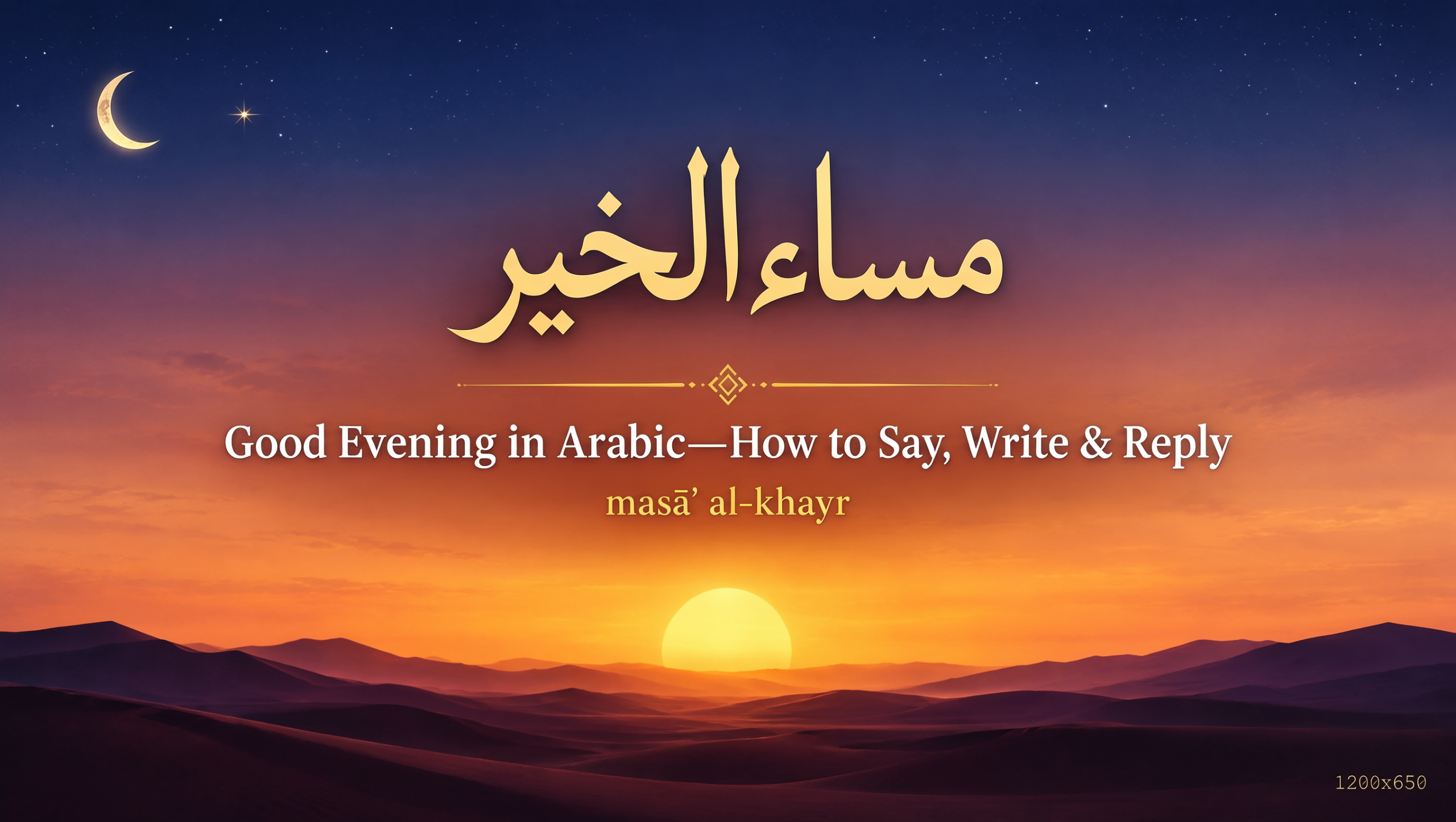
Good afternoon in Arabic is مساء الخير (masaa al-khayr). If someone says it to you first, answer with مساء النور (masaa an-nour).
Here’s the part that surprises most learners: Arabic doesn’t really have a separate “afternoon” greeting. You use the same phrase from around noon until you go to bed.
Below, you’ll find how to say it without sounding like a textbook, what changes when you talk to a man, a woman, or a group, how people say it in Egypt, and how to write it in a text.
What You Will Learn in This Article
- The one Arabic phrase for “good afternoon” and its reply.
- How to say each sound, step by step.
- When to switch from “good morning” to “good afternoon”.
- Polite forms for a man, a woman, and a group.
- How Egyptians say it and how to write it in messages.
Saying Good Afternoon in Arabic
The phrase for good afternoon in Arabic is مساء الخير (masaa al-khayr). It has just two words. Once you know what each word means, the reply makes sense too.
What Masaa Al-Khayr Means Word by Word
The first word is مساء (masaa). It means “evening.” But in Arabic, the evening starts much earlier than it does in English. It begins around midday.
The second word is الخير (al-khayr). It means “the good.” So the full phrase means “evening of good.” You are wishing the other person a good rest of the day. A dictionary like Reverso Context shows how this works. It gives both “good afternoon” and “good evening” for the same two Arabic words.
The phrase also matches the morning greeting. “Good morning” is صباح الخير (sabah al-khayr). Only the first word changes. “Morning” takes the place of “evening.”
So you get two greetings for the price of one. Learn the pattern once, and you can greet people at any time of day. That is a nice shortcut for a new learner.
How to Reply With Masaa An-Nour
When someone greets you with masaa al-khayr, you answer with مساء النور (masaa an-nour). It means “evening of light.” Follow these steps to get it right every time.
- Listen for the greeting. Wait until the other person says masaa al-khayr. This reply only works as an answer, so don’t use it to start a conversation.
- Swap “khayr” for “nour.” Keep the first word, masaa, the same. Then change the second word from “khayr,” which means good, to “nour,” which means light.
- Say it clearly. Say “mah-SAAH an-NOOR.” Stretch the “oo” in nour like the “oo” in “moon,” and drop the “l” sound so it’s “an-nour,” not “al-nour.”
- Add a smile or a name. A warm tone matters as much as the words. You can also add the person’s name or a title, like “masaa an-nour ya ustaadh.”
- Keep the talk going. After your reply, ask how they are. A simple كيف الحال (kayfa al-haal), “how is everything?”, works with anyone.
What if you forget and say masaa al-khayr back? That’s fine. People will understand you, and it isn’t rude. But masaa an-nour is what most Arabic speakers expect, and using it shows you know the custom.
Want to practice greetings like this out loud? In Kalimah Center’s Arabic online course, you work with native tutors on everyday situations, starting with greetings and shopping. Classes use role-play and question-and-answer drills, so you’ll say “masaa an-nour” in a real exchange, not just read it on a page.

Pronouncing Good Afternoon in Arabic
Many guides show only Arabic letters or a rough English spelling. That hides the sounds that make you sound natural.
The table below breaks each word into easy parts. Read the middle column out loud. Then practice the key sound in the last column.
| Word | Arabic | Say it like | Key sound |
| masaa | مساء | mah-SAAH | long “aa” with a short stop |
| al-khayr | الخير | al-KHAIR | rough “kh” from the throat |
| an-nour | النور | an-NOOR | long “oo” |
Saying the Long “Aa” and the Short Stop in Masaa
The word masaa has two parts: “ma” and “saa.” Say the first part fast. Then stretch the second part, like the “a” in “father.” Hold that “aa” a bit longer than feels normal. In Arabic, a long sound can change what a word means. So the length really matters.
At the very end, there is a tiny stop in your throat. It is the same break you make in “uh-oh.” In Arabic, this stop comes from a small letter called hamza (ء).
Many learners drop this stop and just say “masa.” People will still know what you mean. But the small stop makes your Arabic sound clean and correct. Try it slowly. Say “ma,” then “saaa,” then make a quick stop. Do it five times, then speed up. After a few tries, it will feel easy.
Saying the “Kh” in Khayr and the “Oo” in Nour
The hardest sound in this greeting is “kh,” from the letter خ. English does not have it. It sounds like the “ch” in the Scottish word “loch.” To make it, start to say “k.” Then let air scrape through the back of your throat. It should sound a little rough, like when you gently clear your throat.
Do not swap it for a plain “k.” If you say “al-kayr,” it sounds very foreign to Arabic speakers. In an-nour, stretch the “oo” like in “moon.” Also, notice that the “l” in “al” goes away here. You say “an-nour,” not “al-nour.”
This happens with some Arabic letters called sun letters. The “l” blends into the next sound. In al-khayr, the “l” stays, because خ is not a sun letter.
Experience Kalimah Center Classes
Watch real excerpts from our live sessions at Kalimah Center and see how we bring learning to life. These clips highlight our interactive, student-centered teaching approach across all our courses—designed to keep learners engaged, motivated, and actively involved every step of the way.
Master Arabic with Kalimah Center
Join our expert-led online classes and start your journey toward Arabic fluency today.
Book Your Free TrialWhen to Say Good Afternoon in Arabic
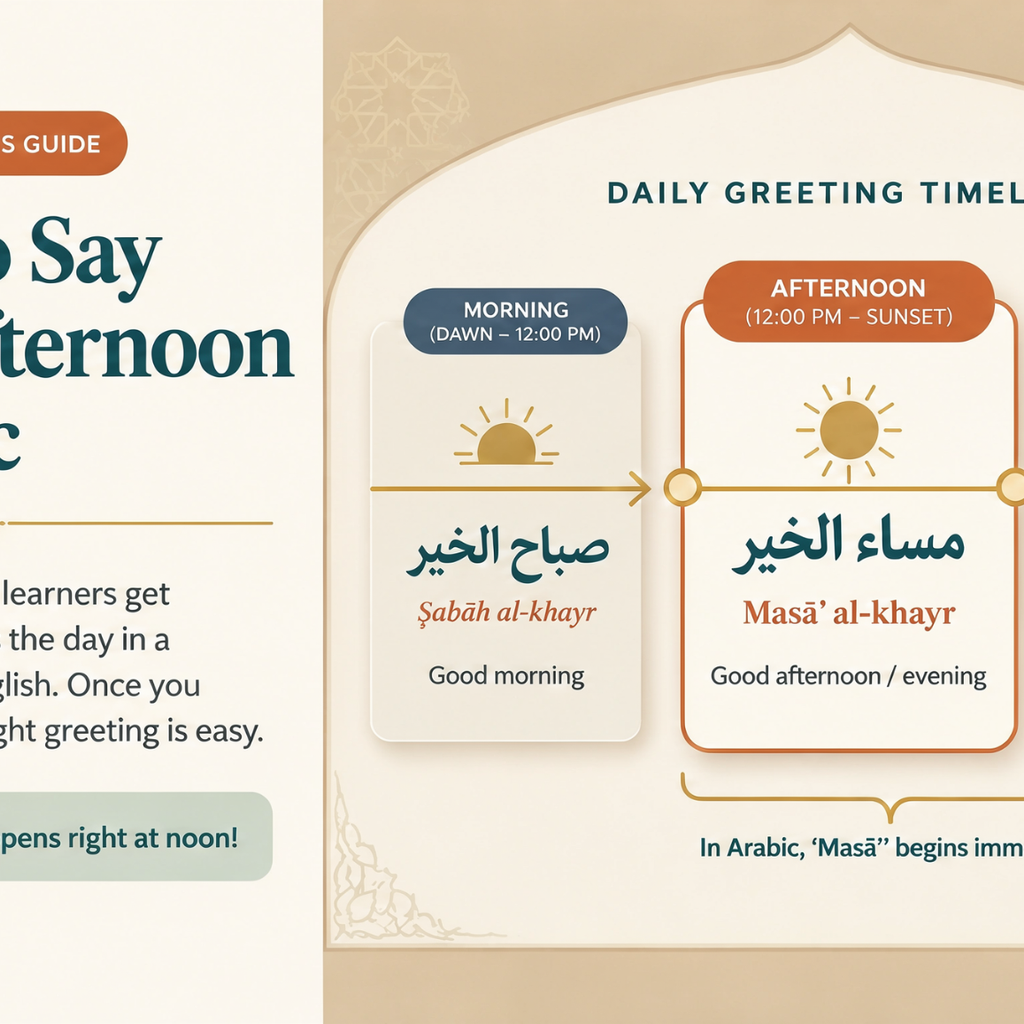
Timing is where many learners get mixed up. Arabic splits the day in a different way from English. Once you see how, picking the right greeting is easy.
Why Arabic Uses One Phrase for Afternoon and Evening
English splits the day into morning, afternoon, and evening. Arabic greetings split it into just two parts: morning and evening. Midday is the line between them.
This trips up a lot of learners. They look for a word that means “afternoon” in a greeting and can’t find one. That’s because Arabic speakers simply don’t need it. Some websites list a special “afternoon” phrase. Be careful with these. In daily life, people don’t use one.
You may also see نهاركم سعيد (naharukum saeed). It means “have a happy day.” It’s a real phrase, but it works more like “have a nice day.” People often say it when they leave, not when they arrive. So if you want to greet people the way Arabs really do, stick with masaa al-khayr. It’s correct, it’s common, and it’s safe in every Arab country.
The Midday Rule for Switching From Good Morning
Here is a simple rule. Before noon, say sabah al-khayr. After the midday prayer, around 12:00 to 1:00 p.m., switch to masaa al-khayr. In real life, the line is a bit soft. Many people keep saying “good morning” until they have had lunch. You will see this a lot in offices where work starts late.
Not sure what to say in the early afternoon? Let the other person go first. Then reply with the phrase that matches theirs. If they say sabah al-khayr, answer sabah an-nour. If they say masaa al-khayr, answer masaa an-nour. You cannot go wrong this way.
For a full list of greetings for each time of day, read Kalimah Center’s guide on how to say hi in Arabic.
Good Afternoon in Arabic to a Man, a Woman, or a Group
The basic phrase masaa al-khayr never changes. You say the same words to a man, a woman, or a whole room. That makes it the safest greeting for beginners.
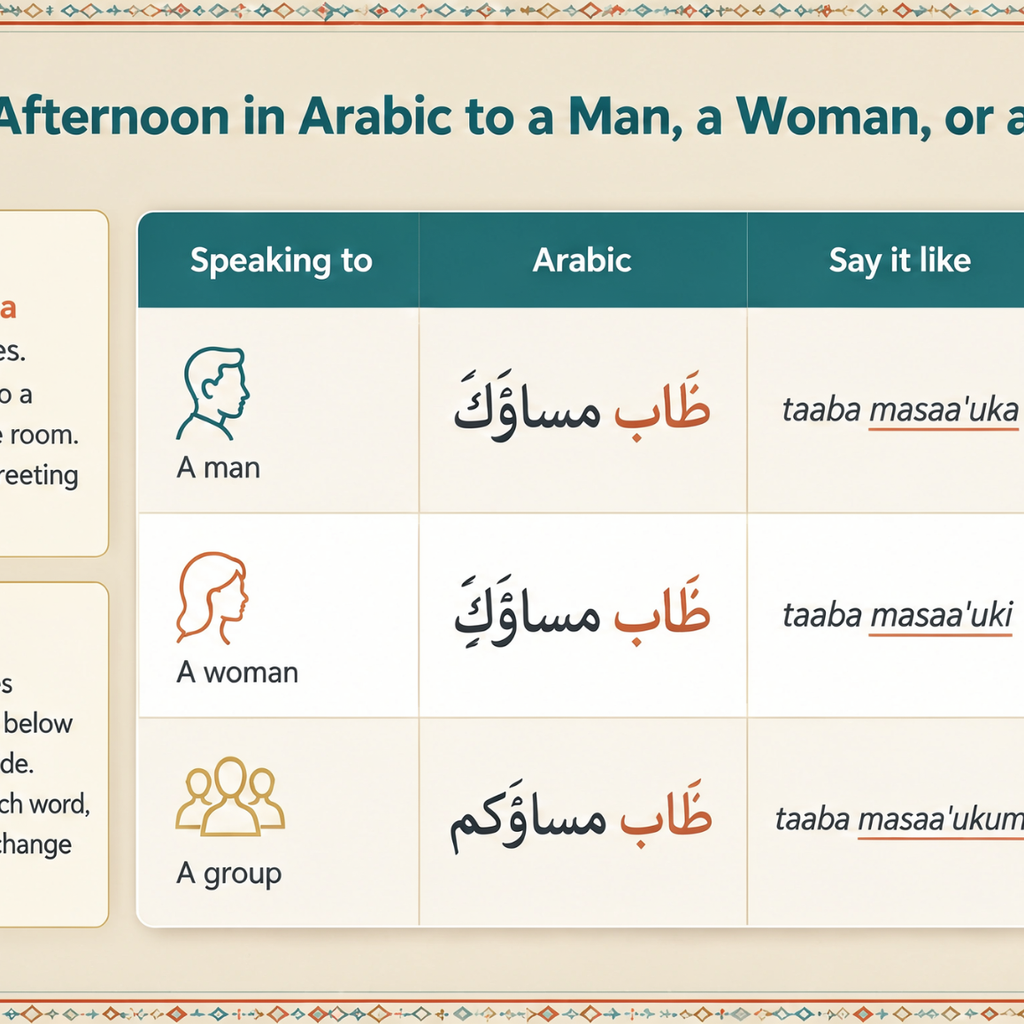
The more formal wish does change, though. The table below shows each form side by side. Look at the last sound of each word, because that is where the change happens.
| Speaking to | Arabic | Say it like | Meaning |
| A man | طاب مساؤكَ | taaba masaa’uka | May your evening be good |
| A woman | طاب مساؤكِ | taaba masaa’uki | May your evening be good |
| A group | طاب مساؤكم | taaba masaa’ukum | May your evening be good |
How the Formal Forms Change for Gender
The formal phrase is طاب مساؤك (taaba masaa’uk). It means “may your afternoon or evening be good.” It sounds polite and a bit fancy. Use it in formal emails, at events, or with older people you want to honor. In casual talk, masaa al-khayr is enough. To a man, end with “-uka.” To a woman, end with “-uki.” To a group, end with “-ukum.”
Here is the tricky part. Without vowel marks, the forms for a man and a woman look the same on paper. The only difference is the last sound you say.
The same rule works for “how are you?” Say kayfa haaluka to a man and kayfa haaluki to a woman. If you are not sure, use كيف الحال (kayfa al-haal). It means “how is everything?” and it fits anyone.
Example Sentences With Polite Titles
Arabic speakers often add a title after the greeting. It makes the greeting sound kind and polite.
- To a man, say مساء الخير يا أستاذ (masaa al-khayr ya ustaadh). It means “Good afternoon, sir.” The word “ustaadh” means teacher, but people use it as a polite title for any man.
- To a woman, say مساء الخير يا سيدتي (masaa al-khayr ya sayyidati). It means “Good afternoon, madam.” With a name, you can say مساء الخير يا أستاذة منى (ya ustaadha Mona), or “Good afternoon, Ms. Mona.”
- To a group, say مساء الخير جميعًا (masaa al-khayr jamee’an). It means “Good afternoon, everyone.” For a speech, say طاب مساؤكم سيداتي سادتي, or “Good afternoon, ladies and gentlemen.”
- In Egypt, you will also hear يا فندم (ya fandim) in shops and offices. It is very polite, and it works for both men and women.
Read also: Good Morning in Arabic
Good Afternoon in Arabic Egyptian Dialect
Egyptian Arabic is the spoken dialect most people learn. It is also widely understood across the Arab world. The greeting is written the same way, but it sounds a little different.
How Egyptians Say Masaa El-Kheir
In Egypt, good afternoon is still written مساء الخير. But Egyptians say it as “masaa il-kheir” or “masaa el-kheir.” Two sounds change. First, “al” turns into “il” or “el.” Second, “khayr” turns into “kheir,” with a long “ee” sound, like in “here.”
The reply changes in the same way. مساء النور sounds like “masaa in-nour” or “masaa en-nour.” After the greeting, Egyptians often ask إزيك. To a man, it sounds like “ezzayak.” To a woman, it sounds like “ezzayek.” It means “how are you?” A good answer is الحمد لله (il-hamdu lillah), which means “thank God.”
If you live in Egypt or plan to visit, use these forms. They help you sound like a local, not like a textbook. People also tend to relax and chat more when you use their way of speaking.
Egyptian Replies Like Masaa El-Foll
Egyptians love to get creative with the reply. Instead of “light,” they often answer with a flower or something sweet.
The table below lists the replies you will hear most. Start with the first two. Then try the others with friends.
| Reply | Egyptian sound | Meaning |
| مساء النور | masaa in-nour | evening of light |
| مساء الفل | masaa il-foll | evening of jasmine |
| مساء الورد | masaa il-ward | evening of roses |
| مساء القشطة | masaa il-ishta | evening of cream |
Masaa il-foll is friendly and fits almost any place. Masaa il-ishta is playful, so keep it for friends. At work, masaa in-nour is the safe choice. Look at the word قشطة. Egyptians say the letter ق like a small throat stop. So it sounds like “ishta,” not “qishta.”
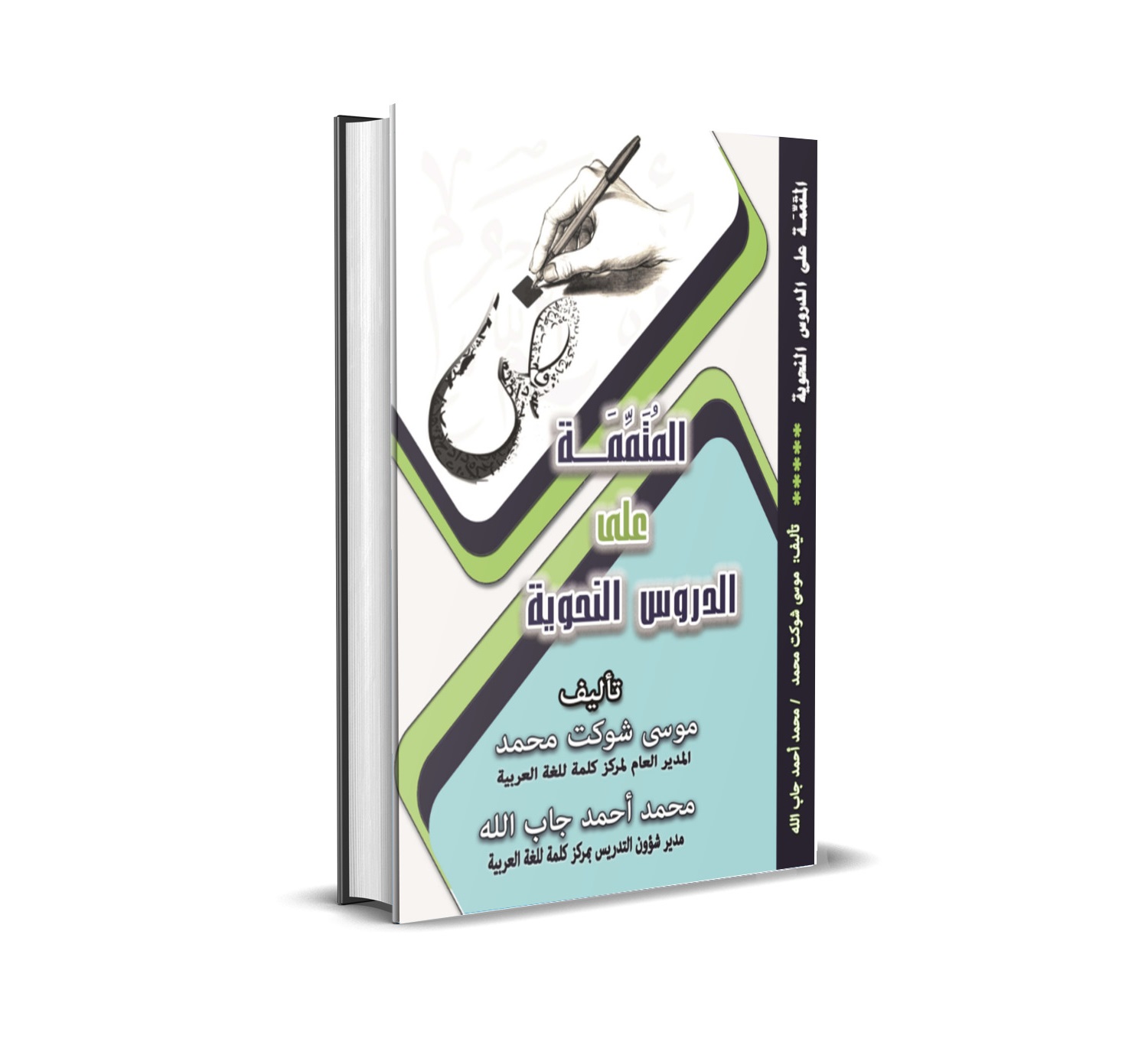
Wondering why one small vowel changes who you’re talking to? That’s Arabic grammar. Kalimah Center’s Al-Mutammimah Grammar book explains endings like these so you understand them, not just memorize them. Find more titles in the Kalimah Center book shop.
Read also: Good Evening in Arabic
Good Afternoon in Arabic Text
Writing the greeting is just as useful as saying it. You will need it for texts, emails, and cards.
How to Write Masaa Al-Khayr Correctly
In Arabic letters, good afternoon is written مساء الخير. Follow these steps to write it the right way every time.
- Start on the right. Arabic is read and written from right to left. So the first word, مساء, sits on the right, and الخير comes after it on the left.
- Write the first word, مساء. It has four letters: م (m), س (s), ا (aa), and ء (hamza). Don’t forget the hamza at the end. It’s small and easy to miss, but correct spelling needs it.
- Leave a space. Put one space between the two words, just like in English.
- Write the second word, الخير. It starts with ال, which means “the.” Join it to the rest of the word. Don’t write it on its own.
- Check before you send. Read the phrase once more before any work email, card, or business post. To Arabic readers, a missing hamza looks like a typo.
Short on time? Copy the phrase right from here: مساء الخير. For the reply, copy مساء النور. Both are ready to paste into a phone or a computer.
How People Type Good Afternoon in Chats and Emails
How you write good afternoon in Arabic depends on who you’re writing to. A chat with a friend and an email to your boss call for different spellings.
The table below shows the four most common ways, from most casual to most formal. Pick the one that fits your message.
| Where you’re writing | What to type | When to use it |
| Chat with friends | مسا الخير | Quick, casual messages |
| Chat in English letters | masa2 el 5eer | Friends who type “Franco” |
| Work email | مساء الخير أستاذ أحمد | Coworkers and clients |
| Formal letter | طاب مساؤكم | Official or very polite writing |
In casual chats, many people drop the hamza and type مسا الخير. That’s fine with friends, but it looks careless at work. “Franco” is a way of typing Arabic with English letters and numbers, and it’s very common in Egypt. In “masa2 el 5eer,” the 2 stands for the small throat stop, and the 5 stands for the “kh” sound.
In a work email, write the full phrase with the hamza, then add the person’s title. مساء الخير أستاذ أحمد means “Good afternoon, Mr. Ahmed.” For a very formal letter, use طاب مساؤكم. It sounds more polished than the everyday greeting.
Mistakes to Avoid When Saying Good Afternoon in Arabic
Most mistakes with this greeting are small and easy to fix. Knowing them now will save you awkward moments later.
Using the Reply or Good Night at the Wrong Time
The most common slip is starting with masaa an-nour. Remember, that is the reply. If you open with it, it sounds like you are answering someone who did not speak. Always start with masaa al-khayr.
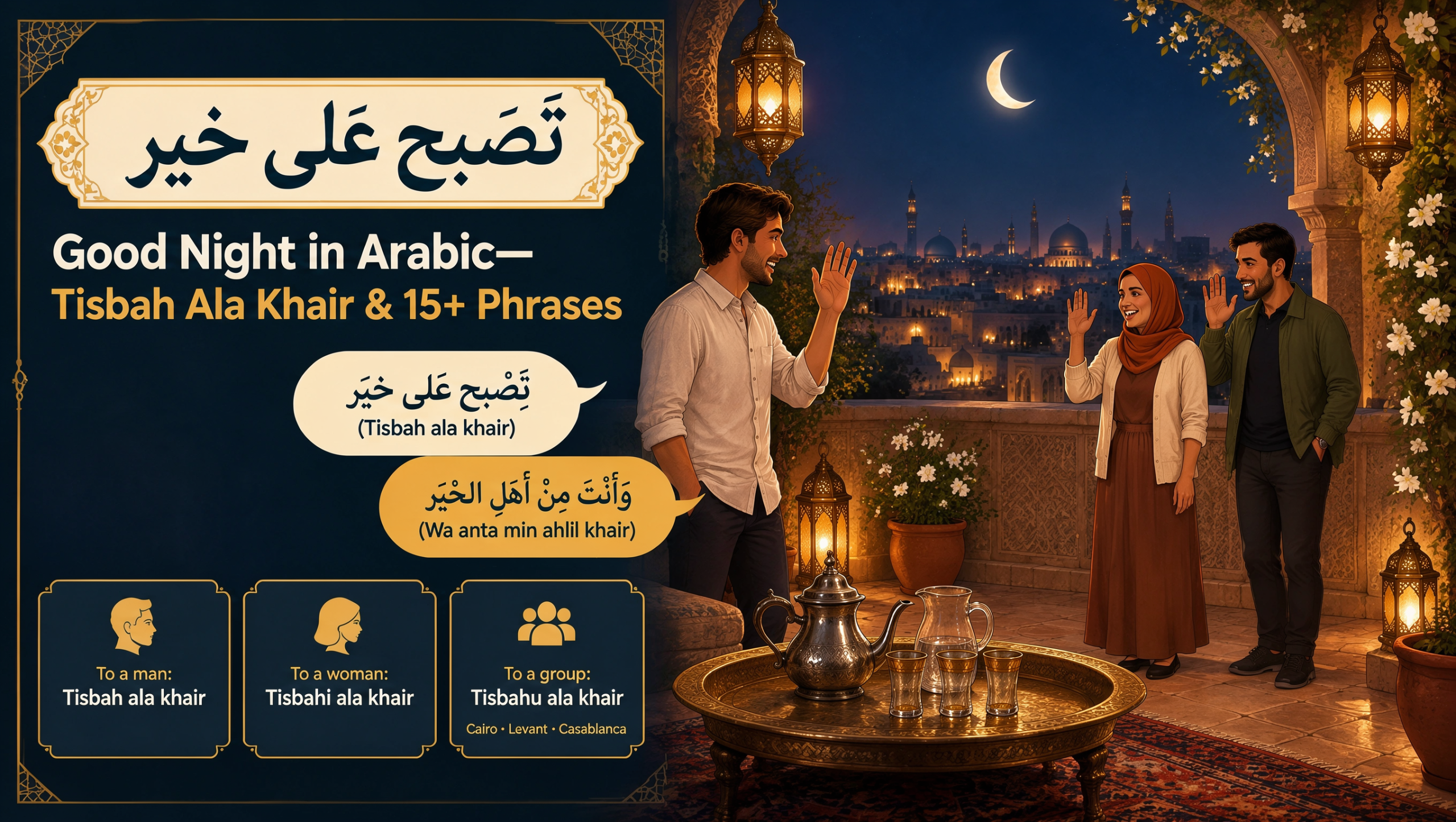
Another mistake is using “good night” as a hello. تصبح على خير (tisbah ala khayr) means “good night.” But you only say it when you leave at night. If you say it when you walk in, people will think you are about to leave. It is like walking into a party and saying “good night.”
Both slips come from mixing up when a phrase is used. A simple fix is to tie each phrase to a moment. Masaa al-khayr is for arriving. Masaa an-nour is for answering. Tisbah ala khayr is for leaving at night. Fix these two, and your greetings will sound natural right away.
Forgetting the Greeting of Peace
In many Arab and Muslim places, people say السلام عليكم (as-salaamu alaykum) first. It means “peace be upon you.” It works at any time of day.
The reply is وعليكم السلام (wa alaykum as-salaam), which means “and peace be upon you.” Non-Muslims can use it too, and people usually see it as a sign of respect.
This greeting matters a lot to Muslims. In one hadith, the Prophet Muhammad told believers to spread salam among themselves as a way to build love (Sahih Muslim, Hadith 54).
A simple order works almost everywhere. Say salaam first, then masaa al-khayr, then “how are you.”
Inside Kalimah Center: Moments from Our Courses
Get a glimpse into the vibrant learning experience at Kalimah Center. These snapshots capture real moments from our live classes—where students engage deeply, connect with passionate instructors, and grow in a welcoming, supportive environment.
Master Arabic with Kalimah Center
Join our expert-led online classes and start your journey toward Arabic fluency today.
Book Your Free TrialStart Speaking Arabic With Kalimah Center: Book Your Free Class Now
Knowing one greeting is a nice start. But real confidence comes when you can keep talking after “masaa al-khayr.” That is what Kalimah Center helps you do.
When you learn with Kalimah Center, you get:
- A school that has taught Arabic from Cairo since 2011.
- Live online classes with native Arabic teachers.
- Courses in Modern Standard Arabic, Egyptian Arabic, or both.
- A free placement test, so your course fits your level.
- Flexible times and personal feedback that fit your pace.
- A choice of private one-to-one lessons or a small group class.
- A certificate when you finish your course.
Your first class is free. Take it, meet your teacher, and see how fast your greetings turn into real talks.

Explore Our Courses:
- Online Arabic Course: Tailored to your level, our comprehensive Arabic program includes 16 teaching levels and 400+ hours of personalized sessions.
- Online Quran With Tajweed Course: Perfect for non-Arabic speakers, our course spans 13 levels and equips you with Tajweed mastery from beginner to advanced.
- Online Arabic Course For Kids: Nurture your child’s love for Arabic with our engaging and structured program, available in 24 levels for primary, intermediate, and secondary stages.
Conclusion: Say Good Afternoon in Arabic With Confidence
To say good afternoon in Arabic, use مساء الخير (masaa al-khayr). Reply with مساء النور (masaa an-nour). Arabic does not have a separate afternoon greeting, so this one phrase covers your whole day after noon.
Getting the sounds right makes a big difference. Stretch the “aa” in masaa, add the small throat stop, and use the rough “kh” in khayr. These small details turn a textbook phrase into natural speech.
Timing is simple once you know the midday rule. Use sabah al-khayr before noon and masaa al-khayr after it.
The basic greeting stays the same for everyone. Only the formal forms change: taaba masaa’uka to a man, taaba masaa’uki to a woman, and taaba masaa’ukum to a group. A title like “ya ustaadh” or “ya fandim” makes you sound even more polite.
In Egypt, the phrase sounds like masaa il-kheir, and people often reply with masaa il-foll. In writing, keep the hamza in مساء for anything formal.
Think of greetings as a door. Masaa al-khayr opens it, and what comes next is the fun part. To take that next step, read Kalimah Center’s guide to basic Arabic conversation for beginners.
FAQs
Learners often have the same few questions about this greeting. Below are short, clear answers to the ones we hear most.
How Do You Say Good Afternoon in Arabic?
You say مساء الخير (masaa al-khayr). It means “evening of good” and works from about noon until night.
What Is the Reply to Masaa Al-Khayr?
The reply is مساء النور (masaa an-nour), which means “evening of light.” In Egypt, people also say masaa il-foll.
Is There a Separate Word for Good Afternoon in Arabic?
No, Arabic has no common greeting just for the afternoon. The same phrase, masaa al-khayr, means both good afternoon and good evening.
How Do You Say Good Afternoon in Arabic to a Man?
You say masaa al-khayr, the same as for anyone. For a formal wish, say طاب مساؤكَ (taaba masaa’uka).
How Do You Say Good Afternoon in Arabic to a Woman?
You say masaa al-khayr, the same as for anyone. For a formal wish, say طاب مساؤكِ (taaba masaa’uki).
How Do Egyptians Say Good Afternoon in Arabic?
Egyptians say “masaa il-kheir,” written مساء الخير. The common replies are masaa in-nour and masaa il-foll.
What Time Should You Start Saying Masaa Al-Khayr?
Start after midday, around 12:00 to 1:00 p.m. Before that, say صباح الخير (sabah al-khayr), which means good morning.
Is Naharukum Saeed the Same as Good Afternoon?
Not quite. نهاركم سعيد (naharukum saeed) means “have a happy day,” and people often say it when they leave.
Do Good Afternoon and Good Evening Mean the Same Thing in Arabic?
Yes, both are مساء الخير (masaa al-khayr), and the reply to both is مساء النور (masaa an-nour). Arabic has a word for late afternoon, عصر (asr), but people don’t use it in greetings, so you won’t hear “asr al-khayr.”