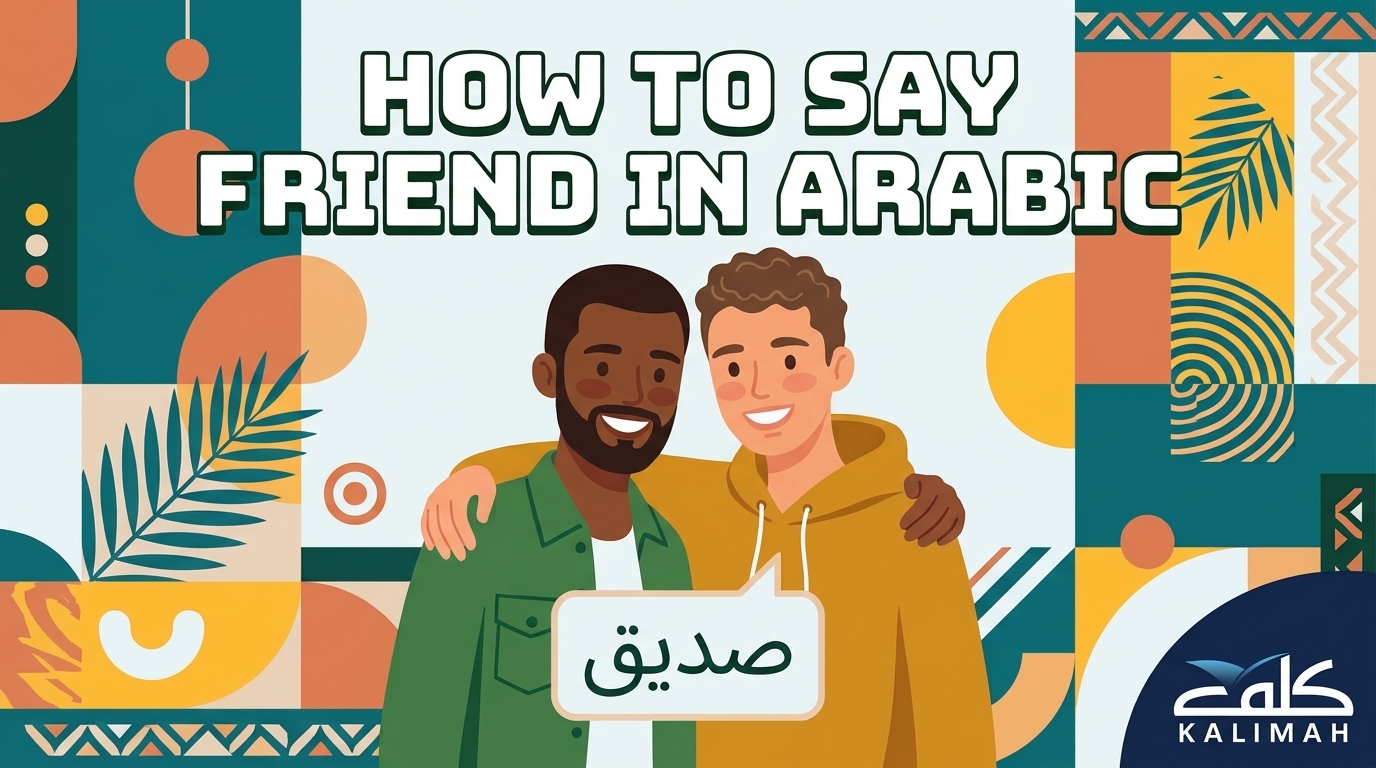
You want to call someone “my friend” in Arabic, so you look it up. Easy, right? Then a friend from Cairo says something different, and suddenly you’re not so sure. Learning how to say friend in Arabic can feel tricky at first, but it’s simpler than it looks.
Let’s start with the word everyone knows. A male friend is ṣadīq (صديق), and a female friend is ṣadīqah (صديقة). Want to say “my friend”? Just add “-ī” to the end. You get ṣadīqī for a man and ṣadīqatī for a woman.
Of course, Arabic likes to keep things interesting. The word shifts a bit for two friends, a group of friends, or a best friend. And on the street, people often use their own local words. In Egypt, you’ll hear ṣaḥbī. In Lebanon, it’s usually rfīʾī.
Don’t worry, you won’t need to memorize it all at once. We’ll go through it together in six easy steps, with clear examples and a few tips that will help you sound natural from day one.
Step 1: Learn The Basic Arabic Word For Friend
The first step is the one word every Arab knows. People use it in books, on the news, and in school.
What The Word Ṣadīq Means
The Arabic word for friend is ṣadīq (صديق). Old Arabic word books describe a ṣadīq as a friend whose love is honest. You can read these meanings in Almaany.
This meaning comes from the word’s roots. Most Arabic words grow from three main letters. For ṣadīq, those letters are ص د ق (ṣ-d-q). Together, they carry the idea of truth. The word ṣidq, for example, means honesty. So in Arabic, a friend is someone who tells you the truth.
An old Arabic saying puts this in a clever way. It goes “ṣadīquka man ṣadaqaka, lā man ṣaddaqaka.” It means your friend is the one who is honest with you.
It is not the one who agrees with everything you say. The two verbs sound almost the same. Only one letter is doubled. Yet that small change turns the meaning around. Keep this saying in mind, and the word will stay with you.
Pronouncing Ṣadīq Correctly
Many websites spell the word as “sadeek.” That is close, but two sounds are a little different from English. If you get them right, people will understand you faster.
- The first sound is ṣ (ص). It is a heavy “s.” Pull your tongue back a bit as you say it. The vowel after it will then sound deeper, like “sa” in “saw.”
- The second sound is q (ق). It is not the English “k.” You make it further back, near your throat. Try saying “k,” then slide the sound back as far as you can.
One more tip helps a lot. Make the long “ī” in the middle a little longer than the other sounds. That is where the stress goes. A common mistake is to say the word fast and flat. Slow down, push the “ī,” and it will sound much more natural.
The guide below shows how to say the most common forms. Read each line out loud two or three times.
| Word | Arabic | Say it like | Meaning |
| ṣadīq | صديق | sa-DEEQ | friend (male) |
| ṣadīqah | صديقة | sa-DEE-qah | friend (female) |
| ṣadīqī | صديقي | sa-DEE-qee | my friend (male) |
| ṣadīqatī | صديقتي | sa-DEE-qa-tee | my friend (female) |
| aṣdiqāʾ | أصدقاء | as-di-QAA’ | friends |
Do Not Confuse Ṣadīq With Ṣiddīq
There is a word that looks almost like ṣadīq. It is ṣiddīq (صدّيق), with a double “d.” In written Arabic, a small mark called a shadda shows the double letter. That tiny mark changes the meaning a lot.
Ṣiddīq means a person who is always truthful. What they say always matches what they do. The Quran calls the Prophet Ibrahim a ṣiddīq in Surah Maryam (19:41). It also uses the word for the Prophet Yusuf in Surah Yusuf (12:46). True believers are called aṣ-ṣiddīqūn in Surah Al-Hadid (57:19).
A well-known hadith in Sahih al-Bukhari (6094) explains how a person earns this name. It says that someone who keeps telling the truth is written with Allah as a ṣiddīq. Ṣiddīq is also the famous title of Abu Bakr, the first caliph. So if you call your friend ṣiddīq, it sounds like you are giving them a holy title. Keep the “d” single for everyday friends.
Step 2: Choose The Form For A Man Or A Woman
In Arabic, every noun is either male or female. The word for friend follows this rule, so think about who your friend is before you speak.
Friend In Arabic For A Male
For a male friend, use ṣadīq (صديق). This is the basic form from step one. It is also the form you will find first in any dictionary. In very old Arabic, people used ṣadīq in a special way. They could use it for one man, for a group, or even for a woman.
The word did not change at all. Today, you will see this mostly in old poems and classic books. In modern speech, people almost always change the word for a woman.
Here is a helpful habit. When you use ṣadīq, the words that describe it must also be male. For example, “ṣadīq jayyid” means “a good friend.” “Ṣadīq wafī” means “a loyal friend.” Both describing words have no special ending, because the friend is male. If you get used to checking this, your sentences will sound right much sooner. It is one of the first things a teacher listens for.
Friend In Arabic For A Female
For a female friend, use ṣadīqah (صديقة). The change is simple. You add the letter ة at the end. This letter is called tāʾ marbūṭah. When you stop on the word, it sounds like a soft “ah.”
This ending is the most common sign of a female word in Arabic. You will find it in many words you may already know. Muʿallimah means a female teacher. Ṭālibah means a female student. So once you learn it with ṣadīqah, you can use the same idea with hundreds of other words.
Remember that describing words must change too. “A good friend” for a woman is “ṣadīqah jayyidah.” “A loyal friend” becomes “ṣadīqah wafiyyah.” Notice how both describing words now end in “ah.”
The same rule works with words like “kind,” “new,” and “funny.” If the friend is a woman, every word that describes her should also end in “ah.”
Talking About Two Or More Friends
English has two choices: one friend or many friends. Arabic has three. It has a form for one, a form for many, and a special form for exactly two. To talk about two male friends, add “-ān” to the word. That gives you ṣadīqān. For two female friends, add “-atān” and say ṣadīqatān. You will hear these forms often in stories and the news.
For three or more friends, the word changes shape. The common plural is aṣdiqāʾ (أصدقاء). You use it for a group of men or for a mixed group. If even one man is in the group, aṣdiqāʾ is the right word.
Only when every friend is a woman do you say ṣadīqāt (صديقات). A less common plural, ṣudaqāʾ (صدقاء), also exists, but you will mostly see it in older writing.
The table below puts every form side by side. Save it and look back at it when you write or speak.
| Form | Arabic | How to say it | English |
| One male friend | صديق | ṣadīq | friend (male) |
| One female friend | صديقة | ṣadīqah | friend (female) |
| Two male friends | صديقان | ṣadīqān | two friends (male) |
| Two female friends | صديقتان | ṣadīqatān | two friends (female) |
| Male or mixed group | أصدقاء | aṣdiqāʾ | friends (male or mixed) |
| Female group | صديقات | ṣadīqāt | friends (female only) |
What happens in a Kalimah Center class?
This short sample shows you a real lesson in action, with clear explanations, live practice, and gentle correction from the teacher.
Read also: Arabic Sayings about Friendship
Step 3: Add An Ending To Say “My Friend”
Arabic does not use a separate word for “my,” “your,” or “his.” Instead, it adds a short ending to the noun.
The Endings For My, Your, His, And Her
To say “my friend” in Arabic, add “-ī” to the word. A male friend becomes ṣadīqī (صديقي). A female friend becomes ṣadīqatī (صديقتي). Look closely at the female form. The soft “ah” at the end turns into “at” before the new ending. This always happens when you add an ending to a female word. So ṣadīqah becomes ṣadīqat-, and then you add “-ī.”
The other endings follow the same plan. “-uk” means “your” when you speak to a man. “-uki” means “your” when you speak to a woman. “-uh” means “his,” “-uhā” means “her,” and “-unā” means “our.”
In slow, careful reading, “your friend” to a man is ṣadīquka. In everyday talk, people drop the last sound and say ṣadīquk. Both are correct. The table below shows each ending with a male and a female friend. Say each pair out loud to hear the pattern.
| Meaning | Male friend | Female friend |
| My friend | صديقي (ṣadīqī) | صديقتي (ṣadīqatī) |
| Your friend (to a man) | صديقك (ṣadīquk) | صديقتك (ṣadīqatuk) |
| Your friend (to a woman) | صديقكِ (ṣadīquki) | صديقتكِ (ṣadīqatuki) |
| His friend | صديقه (ṣadīquh) | صديقته (ṣadīqatuh) |
| Her friend | صديقها (ṣadīquhā) | صديقتها (ṣadīqatuhā) |
| Our friend | صديقنا (ṣadīqunā) | صديقتنا (ṣadīqatunā) |
| My friends | أصدقائي (aṣdiqāʾī) | صديقاتي (ṣadīqātī) |
Calling Someone “My Friend”
Sometimes you do not talk about a friend. You talk to them. In English, you might say “Hey, my friend!” In Arabic, you add one small word first. That word is yā (يا). It works like “hey” or “oh” when you call someone.
So to a man, you say yā ṣadīqī (يا صديقي). To a woman, you say yā ṣadīqatī (يا صديقتي). You can use it when you greet someone, thank them, or call them across a room. It sounds warm and kind.
You will also hear yā before names, like yā Aḥmad or yā Maryam. It is one of the most useful words in spoken Arabic. You can join it with a greeting to start a friendly chat. Our guide on how to say hi in Arabic gives you the greetings to pair with it.
The endings in this step work on almost every Arabic noun. Learn them once, and hundreds of words open up. That is why the Kalimah Center online Arabic course teaches them in the very first levels, with practice in every class.
Master Arabic with Kalimah Center
Join our expert-led online classes and start your journey toward Arabic fluency today.
Book Your Free TrialStep 4: Pick The Word That Fits How Close You Are
English uses “friend” for almost everyone. Arabic has special words for a coworker, a travel partner, a best friend, and a very deep bond.
Saying Best Friend In Arabic
The most natural way to say best friend in Arabic is aʿazz ṣadīq (أعز صديق). It means “the dearest friend.” To say “my best friend,” use aʿazz aṣdiqāʾī (أعز أصدقائي). Word by word, that is “the dearest of my friends.”
You have other good choices too. Ṣadīqī al-muqarrab (صديقي المقرب) means “my close friend.” Ṣadīq al-ʿumr (صديق العمر) means “friend of a lifetime.” People say it about a friend they have known since they were small. It carries a lot of warmth and history. For a female best friend, say aʿazz ṣadīqātī (أعز صديقاتي). You can also say ṣadīqatī al-muqarrabah (صديقتي المقربة).
In Egypt, young people use a slang word for a best friend. It is anteem (أنتيم), taken from the French word “intime.” It sounds casual and fun. Use it with friends your own age, not in a meeting or a letter.
The Six Levels Of Friendship In Arabic
Arabic sorts friends by how close they are. Some words fit people you see at work. Others fit people who hold a deep place in your heart. The table below moves from the most distant bond to the closest one. Each word has its own feeling and its own use.
| Level | Arabic | How to say it | Meaning |
| 1 | زميل | zamīl | coworker or classmate |
| 2 | صاحب | ṣāḥib | companion, someone you spend time with |
| 3 | رفيق | rafīq | travel partner |
| 4 | صديق | ṣadīq | true, honest friend |
| 5 | صفي | ṣafī | sincere friend with a pure heart |
| 6 | خليل | khalīl | the closest, deepest friend |
A ṣāḥib is not always a true friend. The Quran uses it for short-term company. For example, Prophet Yusuf speaks to the two men in prison as “yā ṣāḥibayi as-sijn” in Surah Yusuf (12:39).
Khalīl is the strongest word of all. Prophet Ibrahim is called Allah’s khalīl in Surah An-Nisa (4:125). One more word needs care. Qarīn (قرين) means a companion who is always by your side. But the Quran often uses it for a bad companion, so do not use it as praise.
Read also: How to Say Beautiful in Arabic
Step 5: Use The Local Word In Each Dialect
A dialect is the everyday Arabic people speak at home and on the street. Each country has its own, and each one has a favorite word for friend.
My Friend In Egyptian Arabic
In Egypt, “my friend” is usually ṣaḥbī (صاحبي) for a male friend. People understand ṣadīqī, but it sounds stiff, like a news reader. To call a friend, Egyptians say yā ṣaḥbī. To say “he is my friend,” they say da ṣaḥbī (ده صاحبي). The plural is ṣḥābī (صحابي), which means “my friends.”
For a female friend, women say ṣaḥbitī (صاحبتي) to each other. Here, you need to be careful. When a man says ṣaḥbitī, people may think he means his girlfriend. To keep things clear, Egyptian men often say ṣadīqtī (صديقتي) instead. Some say zimīltī (زميلتي), which means “my coworker.”
This small choice can save you from an awkward moment. It is a good example of why a dictionary alone is not enough. The same word can sound friendly from one person and romantic from another.
Friend In Lebanese Arabic
In Lebanon, the most common word for friend is rfīʾ (رفيق). It comes from the standard word rafīq. Lebanese speakers turn the “q” into a quick stop in the throat. It is like the small break in “uh-oh.” That is why it sounds like “rfee-ʾ.”
To say “my friend,” use rfīʾī (رفيقي). For a female friend, use rfīʾtī (رفيقتي). To say “this is my friend,” say hayda rfīʾī (هيدا رفيقي) for a man. For a woman, say hayde rfīʾtī (هيدي رفيقتي).
You will also hear ṣāḥbī in Lebanon, Syria, Jordan, and Palestine. Another warm word in Lebanon is khayyē (خيي). It means “my brother.”
Men use it with close male friends, the way English speakers say “bro.” Lebanese people also mix in French words a lot. So do not be surprised to hear “merci” or “bonjour” in the same sentence as rfīʾī.
Friend In Gulf Arabic
The Gulf countries include Saudi Arabia, Kuwait, Qatar, Bahrain, Oman, and the UAE. Here, a common word for a close male friend is khawī (خوي). It means “my buddy” or “my mate.” To say “this is my buddy,” people say hādha khawī.
Gulf speakers also change the “q” sound. In many Gulf dialects, it becomes a hard “g,” like in “go.” So ṣadīq can sound like ṣadīg. Rafīq can sound like rafīg. If you hear “rafīgī,” it simply means “my friend.”
There is also a word for your group of friends. Rabʿī (ربعي) means “my friends” or “my crew.” People use it when they talk about the friends they go out with. For a female friend, ṣadīqtī is a safe and clear choice in the Gulf. It works almost everywhere and does not cause any mix-up.
Friend In Moroccan Arabic
In Morocco, people speak a dialect called Darija. Here, “my friend” is ṣaḥbī (صاحبي) for a male. For a female, it is ṣaḥbtī (صاحبتي). Darija drops many short vowels, so words sound shorter and faster than in other dialects.
The plural is ṣḥābī (صحابي), meaning “my friends.” To say “this is my friend,” Moroccans say hāda ṣaḥbī (هادا صاحبي). Close male friends also call each other khūya (خويا), which means “my brother.”
Darija has one more fun habit. To call someone, Moroccans often use “a” instead of yā. So they say “a ṣaḥbī!” to mean “hey, my friend!” Use it, and locals will smile, because it shows you have really listened.
Darija also borrows some French and Berber words. At first, it may sound very different from other kinds of Arabic, but the core words are the same.
Choosing The Right Word Anywhere
You now know many words. The hard part is picking the right one fast. A simple test can help. We call it the Who-Where-How check.
- First, ask who. Is your friend a man or a woman, and are you a man or a woman? This tells you which form to use. It also tells you if a word like ṣaḥbitī is safe.
- Second, ask where. Are you in Egypt, Lebanon, the Gulf, Morocco, or a formal place? Use the local word with friends, and use ṣadīq in writing.
- Third, ask how close. Is this person a coworker, a friend, or your best friend? Move from zamīl to ṣadīq to aʿazz ṣadīq as the bond grows.
The table below shows the main words for each dialect. Use it with the three questions above.
| Dialect | My friend (male) | My friend (female) |
| Standard Arabic | ṣadīqī | ṣadīqatī |
| Egyptian | ṣaḥbī | ṣaḥbitī or ṣadīqtī |
| Lebanese | rfīʾī | rfīʾtī |
| Gulf | khawī | ṣadīqtī |
| Moroccan | ṣaḥbī | ṣaḥbtī |
Want to learn standard Arabic and a dialect together? Kalimah Center has plans for every budget, so you can check Kalimah Center’s prices and pick what fits you.

Step 6: Practice With Real Sentences
Words stick when you use them. This last step gives you ready phrases and full sentences to say out loud.
Saying Thank You My Friend In Arabic
To say “thank you, my friend” in Arabic, use shukran yā ṣadīqī (شكرا يا صديقي) to a man. To a woman, say shukran yā ṣadīqatī (شكرا يا صديقتي). These work well at work, at school, or with someone you just met.
With close friends, people use their local words. In Egypt, you will hear mersī yā ṣaḥbī. In Lebanon, people often say merci rfīʾī. In Morocco, it is shukran a ṣaḥbī. In the Gulf, shukran yā khawī is common between young men.
Many Arabs also add a short prayer to their thanks. Allāh ykhallīk (الله يخليك) means “may God keep you.” In Syria and Lebanon, yislamū (يسلمو) is a quick and friendly thanks.
These small extras show real warmth. After you thank a friend, you will often need to say goodbye. Our guide on how to say goodbye in Arabic gives you the right phrase for each moment.
Simple Sentences With The Word Friend
The sentences below are in standard Arabic. You can use them in any Arab country. Read the Arabic first, then the sound, then the English. Repeat each line until it feels easy.
| Arabic | How to say it | English |
| هو صديقي | huwa ṣadīqī | He is my friend. |
| هي صديقتي | hiya ṣadīqatī | She is my friend. |
| أنتَ صديق رائع | anta ṣadīq rāʾiʿ | You are a great friend. (to a man) |
| أنتِ صديقة رائعة | anti ṣadīqah rāʾiʿah | You are a great friend. (to a woman) |
| هؤلاء أصدقائي | hāʾulāʾi aṣdiqāʾī | These are my friends. |
| هذا صديقي أحمد | hādhā ṣadīqī Aḥmad | This is my friend Ahmad. |
| أين صديقك؟ | ayna ṣadīquk? | Where is your friend? |
Notice the first sentence. Arabic does not need a word for “is” when you talk about now. Huwa ṣadīqī is just “he my friend.” This makes short sentences very easy to build. Try it with a real friend’s name. Then change it for a female friend.
Watch a real lesson before you book
Not sure what online Arabic classes look like? This short clip gives you a feel for our teaching style and how each class is built around the student.
Master Arabic with Kalimah Center
Join our expert-led online classes and start your journey toward Arabic fluency today.
Book Your Free TrialStart Speaking Arabic With Kalimah Center Today
You now know how to say friend in Arabic. The next step is to talk with real people, and Kalimah Center can get you there faster. Kalimah Center has taught Arabic since 2011. It began in Cairo and now teaches students around the world online. Here is what you get:
- Native, qualified teachers. Every teacher speaks Arabic as a first language, and many studied at Al-Azhar. You can pick a male or a female teacher.
- Private or group classes. Learn one-on-one, or join a small group if you like to practice with others.
- A clear path. The adult Arabic course has 16 levels and more than 400 hours of lessons, built on Kalimah’s own books.
- Two kinds of Arabic. Learn the Arabic of books and the Egyptian Arabic people speak every day.
- Progress you can see. You get level reports, interactive exercises, and a certificate when you finish.
- Lessons that fit your life. Study from home at a time that suits you, and open your materials at any hour.
Not sure yet? Try a free trial class first. Meet a teacher, find your level, and decide later, with nothing to lose.

Explore Our Courses
- Online Arabic Course: Tailored to your level, our comprehensive Arabic program includes 16 teaching levels and 400+ hours of personalized sessions.
- Online Quran With Tajweed Course: Perfect for non-Arabic speakers, our course spans 13 levels and equips you with Tajweed mastery from beginner to advanced.
- Online Arabic Course For Kids: Nurture your child’s love for Arabic with our engaging and structured program, available in 24 levels for primary, intermediate, and secondary stages.
Conclusion
Learning how to say friend in Arabic starts with one honest word. Ṣadīq is the word for a male friend, and ṣadīqah is the word for a female friend. The roots of the word mean truth. That tells you something lovely about Arab culture. A real friend is someone who is honest with you, even when the truth is hard. It’s a nice thought to carry with you every time you use the word.
From that one word, you can build everything else. Use the dual for two friends and the plural for a group. Add an ending to say “my,” “your,” or “her” friend. Put yā in front when you call someone. Once you spot the pattern, you’ll see it really isn’t that hard.
When the bond is deep, reach for aʿazz ṣadīq or even khalīl. Just keep the “d” single, so you never give a friend a holy title by mistake.
Your words should also change with the place. Each Arab country has its own favorite word, and using it makes people feel closer to you. Say ṣaḥbī in Cairo or rfīʾī in Beirut, and watch how fast people smile. If you aren’t sure which word fits, run the Who-Where-How check. It takes a few seconds and saves you from most mistakes.
The best way to make these words your own is to use them every day. Thank a friend in Arabic. Introduce someone with “hādhā ṣadīqī.” Send a short message that starts with yā ṣadīqī. Each small use builds your confidence. You’ll mix up a word now and then, and that’s completely fine. Most Arabic speakers love it when someone tries, and they’ll gladly help you get it right.
FAQs
Learners often have a few more questions once they know the basic word. Here are short, clear answers to the most common ones.
How Do You Say “You Are My Friend” In Arabic?
To say “you are my friend” to a man, say anta ṣadīqī (أنتَ صديقي). To a woman, say anti ṣadīqatī (أنتِ صديقتي).
How Do You Write Friend In Arabic Letters?
Friend is written صديق, using the letters ص، د، ي، ق. Arabic is written from right to left, and these letters join together in one word.
What Is The Arabic Word For Friendship?
The Arabic word for friendship is ṣadāqah (صداقة). It comes from the same roots as ṣadīq, so it also carries the idea of truth.
How Do You Say Old Friend In Arabic?
An old friend in Arabic is ṣadīq qadīm (صديق قديم). For a woman, say ṣadīqah qadīmah (صديقة قديمة).
How Do You Say New Friend In Arabic?
A new friend in Arabic is ṣadīq jadīd (صديق جديد). For a woman, say ṣadīqah jadīdah (صديقة جديدة).
How Do You Say Friends Forever In Arabic?
Friends forever in Arabic is aṣdiqāʾ ilā al-abad (أصدقاء إلى الأبد). People often write it in cards, posts, and birthday notes.
Does Habibi Mean My Friend?
No, ḥabībī means “my dear” or “my love,” not “my friend.” Friends use it in a relaxed way, but its real meaning is love and care.
Where Is The Word Friend Mentioned In The Quran?
The Quran uses ṣadīq in Surah An-Nur (24:61) and Surah Ash-Shu’ara (26:101). The first verse allows eating at a friend’s house. The second describes people on Judgment Day who have no close friend to help them.