One of the hardest Arabic sounds for English speakers is the letter ع This letter is called ayn or ʿayn. Many learners search for how to pronounce Arabic letter ayn because it has no exact sound in English.
At first, ع may feel strange. It is not a normal “a,” not a regular vowel, and not the same as the letter ا. It comes from deep in the throat and needs slow practice.
The good news is that you do not need to force your throat or make an aggressive sound. With the right technique, you can learn how to pronounce ayn Arabic more naturally.
This guide explains the sound of ع, how it works in Arabic words, common mistakes, and simple exercises to help you practice.
How to Pronounce the Arabic Letter Ayn?
The Arabic letter ع (Ayn) is one of the most distinctive sounds in the Arabic language. It is produced deep in the throat and does not have an exact equivalent in English, which is why many beginners find it challenging at first.
To begin practicing the sound:
- Start with a short “ah” sound.
- Gently engage the muscles in the middle of your throat.
- Keep the sound voiced, meaning your vocal cords should vibrate.
- Release the sound smoothly without turning it into a cough or a harsh throat sound.
With regular practice, you will notice a deep, resonant sound that is unique to Arabic.
Here are some common examples that contain the letter ع:
عربي — ʿarabī — Arabic
عين — ʿayn — eye / spring
مع — maʿa — with
سمع — samiʿa — he heard
One of the most important things to remember is that ع should not be pronounced like a regular English vowel sound. It is a distinct Arabic consonant produced in the throat, and mastering it takes time and repeated listening practice. The more you hear native speakers and imitate the sound, the more natural your pronunciation will become.
What Is the Arabic Letter Ayn?
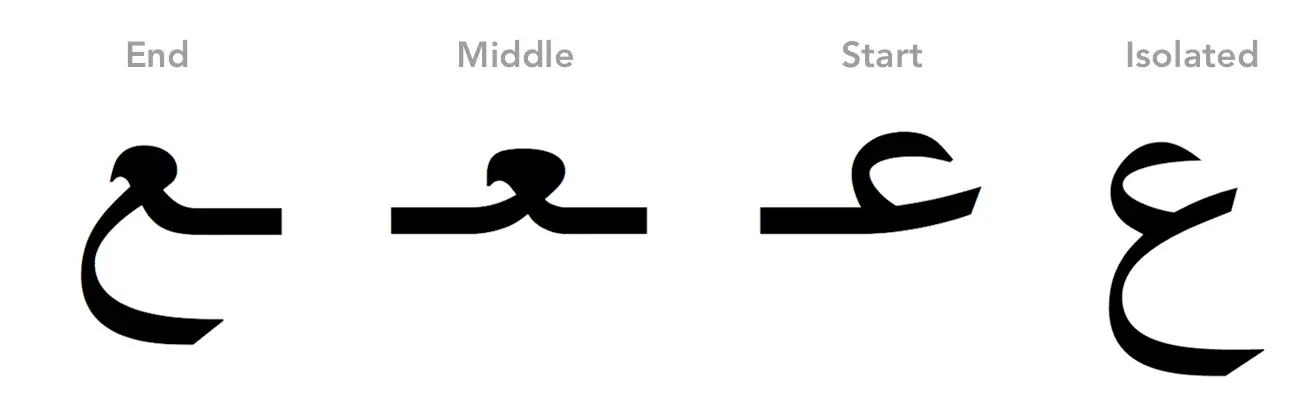
The letter ع is one of the Arabic throat letters. In Arabic, it is called ʿayn It is written as (ع).
It can appear at the beginning, middle, or end of a word.
Examples:
عربي — ʿarabī — Arabic
معلم — muʿallim — teacher
سمع — samiʿa — he heard
For many English speakers, ع is difficult because English does not have the same sound That is why learners often replace it with a vowel sound, but this can make the Arabic word sound unclear.
Step-by-Step Practice for Pronouncing the Arabic Letter Ayn (ع)
Many learners find the Arabic letter ع (Ayn) difficult at first, but it becomes much easier when you practice it in small, manageable steps. Focus on developing the sound gradually rather than trying to perfect it immediately.
Start with a Simple “Ah” Sound
Begin by saying a relaxed “ah” sound. Keep your mouth open naturally and your voice steady. There is no need to make the sound loud or forceful. This serves as the foundation for producing the letter Ayn.
Move the Sound Deeper into the Throat
Next, try moving the sound slightly deeper into your throat. Avoid relying too much on your lips or tongue. Unlike many English sounds, Ayn is produced farther back in the vocal tract. You should feel that the sound is coming from deeper than a normal vowel.
Gently Narrow the Throat
While continuing the sound, gently tighten the middle part of your throat. This subtle narrowing creates the characteristic quality of Ayn. Be careful not to squeeze too hard. If your throat feels strained or uncomfortable, relax and try again more gently.
Keep the Sound Voiced
Ayn is a voiced consonant, which means your vocal cords vibrate when you pronounce it. Place your hand lightly on your throat while practicing. You should be able to feel a vibration as you produce the sound.
Practice Ayn in Real Words
Once you are comfortable with the basic sound, begin practicing it within actual Arabic words. Learning the sound in context is often easier and more effective than repeating the letter by itself.
Try these common examples:
علي — ʿAlī — Ali
عن — ʿan — about / from
مع — maʿa — with
نعم — naʿam — yes
Remember that mastering Ayn takes patience and regular listening practice. The more you hear native Arabic speakers and repeat words containing ع, the more natural the sound will become.
Learn Arabic the Smart Way with Kalimah Center – From Basics to Real Fluency
Learning Arabic is not just about memorizing letters or rules—it’s about building real understanding and being able to use the language in everyday situations. Many learners struggle at the beginning, especially with unfamiliar sounds like ع (Ayn) or when trying to move from isolated words to full communication. That’s why having a structured system is essential.
The Online Arabic Course at Kalimah Center is designed to guide you step by step, starting from the basics and gradually building your skills in reading, pronunciation, and comprehension. With interactive lessons and teacher support, you don’t just learn Arabic—you actually practice it in a way that helps you speak and understand with confidence.
Start your Online Arabic Course today with Kalimah Center and begin building strong Arabic skills with expert support every step of the way.
How to Pronounce Ain in Arabic?
Some learners write the letter as “ain” instead of “ayn.” Both spellings refer to the same Arabic letter: ع. So, when you search for how to pronounce ain in Arabic, you are actually looking for the pronunciation of the same sound represented by ʿayn. The difference is only in English spelling, not in meaning or pronunciation.
The pronunciation is not like the English word “eye,” even though عين can mean “eye” in Arabic. The word عين is pronounced with the Arabic ع sound at the beginning, followed by a long vowel sound. It is not simply “eye-n.” A more accurate learner approximation is ʿayn, where the symbol ʿ is used in transliteration to represent the Arabic letter ع.
Why Is Ayn Difficult for English Speakers?
The Arabic letter ع (Ayn) is often difficult for English speakers because English does not use the throat in the same way when producing sounds. In English, most sounds are made using the lips, tongue, teeth, or the front part of the mouth. However, Ayn is produced deeper in the throat, which makes it feel unfamiliar and unusual at the beginning of the learning process.
Another reason it feels challenging is that the letter ع appears in different positions within words—at the beginning, middle, and end—and each position requires the learner to stay aware of the same deep throat sound while adjusting to the surrounding vowels and letters. This can make pronunciation feel inconsistent for beginners, even though the letter itself does not change.
For example:
عسل — ʿasal — honey
سعيد — saʿīd — happy
سمع — samiʿa — he heard
In all of these examples, the same letter ع is used, but learners need time and practice to get comfortable producing it naturally in different word positions.
Pronouncing the Arabic Letter Ayn (ع) at the Beginning of Words
When the letter ع (Ayn) appears at the beginning of a word, you must start the word directly with the throat sound. There is no vowel or sound before it, so the pronunciation begins from deep in the throat and carries into the rest of the word.
Examples:
عربي — ʿarabī — Arabic
عين — ʿayn — eye / spring
عسل — ʿasal — honey
عائلة — ʿā’ilah — family
This position is often the hardest for learners because English words do not normally begin with a deep throat consonant like ع. It may feel unfamiliar at first, but it becomes easier with slow and repeated practice.
Start step by step:
Say: عَ
Then: عَرَ
Then: عربي
Do not rush. Focus on producing the ع clearly at the beginning before moving into the rest of the word. With consistent practice, the sound will gradually become more natural.
Read also: Learn Arabic In Your Car
Experience Kalimah Center Classes
Watch real excerpts from our live sessions at Kalimah Center and see how we bring learning to life. These clips highlight our interactive, student-centered teaching approach across all our courses—designed to keep learners engaged, motivated, and actively involved every step of the way.
Master Arabic with Kalimah Center
Join our expert-led online classes and start your journey toward Arabic fluency today.
Book Your Free TrialPronouncing the Arabic Letter Ayn (ع) in the Middle of Words
When ع appears in the middle, it connects two sounds.
Examples:
معلم — muʿallim — teacher
سعيد — saʿīd — happy
لعبة — luʿbah — game / toy
بعد — baʿd — after
Middle-position ع can be easier because your voice is already moving.
Practice by slowing the word down:
sa — ʿī — d
saʿīd
Give Your Child a Strong Start in Arabic with Kalimah Center
Learning Arabic at a young age is one of the best gifts you can give your child. It helps them connect with the language of the Qur’an, understand Islamic values, and build confidence in reading and speaking Arabic from an early stage. But for kids, the key is not pressure—it’s fun, interaction, and a teaching method designed just for them.
The Online Arabic Course For Kids at Kalimah Center is specially designed to make Arabic enjoyable and easy to learn. The program uses child-friendly lessons, interactive activities, storytelling, and gradual level progression to help children learn Arabic naturally. It focuses on building strong foundations in reading, pronunciation, and basic communication in a supportive and engaging environment.
Enroll your child today in the Online Arabic Course For Kids and start building a strong Arabic foundation for their future.
Pronouncing the Arabic Letter Ayn (ع) at the End of Words
When ع appears at the end, you need to finish the word with the throat sound.
Examples:
سمع — samiʿa — he heard
رجع — rajaʿa — he returned
جمع — jamaʿa — he gathered
واسع — wāsiʿ — wide
Final ع can be difficult because learners often drop it completely.
Do not end the word too early. Let the throat sound appear clearly.
Difference Between the Arabic Letters Ayn (ع) and Alif (ا)
Many beginners confuse ع (Ayn) with ا (Alif), but they are completely different letters.
ا (Alif) is usually a long vowel sound like ā, while ع (Ayn) is a consonant produced from the throat. This difference changes both pronunciation and meaning.
Compare:
علي — ʿAlī — Ali
آلي — ālī — automatic / mechanical
The difference matters because ع can change the meaning of a word.
So, when learning how to pronounce Arabic letter ayn, remember that it is not just a vowel. It is a real Arabic consonant.
Difference Between the Arabic Letters Ayn (ع) and Hamza (ء)
Another common confusion for learners is between ع (Ayn) and ء (Hamza). Although both come from the throat, they are different sounds with different pronunciation rules.
The letter ء (Hamza) is a glottal stop, similar to the break in the English expression “uh-oh.” It is a very quick pause in the airflow. In contrast, ع (Ayn) is a deeper, voiced throat sound that continues with vibration from the vocal cords.
Compare:
سأل — sa’ala — he asked
سعل — saʿala — he coughed
The difference between Hamza and Ayn is very important because it can completely change the meaning of a word. Learners should practice both sounds carefully to avoid confusion.
Simple Practice Exercise for Ayn
Use this short exercise to train your pronunciation.
Start with single sounds:
عَ — ʿa
عِ — ʿi
عُ — ʿu
Then practice short words:
عن — ʿan
مع — maʿa
نعم — naʿam
علم — ʿilm
Then practice longer words:
عربي — ʿarabī
معلم — muʿallim
سعيد — saʿīd
عائلة — ʿā’ilah
Repeat slowly. Accuracy is more important than speed.
Best Tips to Pronounce Ayn Correctly
Learning ع takes time, so do not expect perfection in one day.
Here are the most useful tips:
- Listen to native Arabic speakers.
- Practice slowly.
- Do not force your throat.
- Record yourself.
- Compare your sound with native pronunciation.
- Practice ع inside real words.
- Repeat short words every day.
The most important tip is to stay relaxed If your throat hurts, stop and try again later with less pressure.
Read also: Best Newspapers To Learn Arabic
How Long Does It Take to Learn Ayn?
The time depends on the learner Some students can produce a close sound after a few days. Others need weeks or months to feel comfortable.
This is normal Ayn is one of the hardest Arabic sounds for English speakers. The goal is not instant perfection. The goal is steady improvement.
If you practice a few minutes every day, listen carefully, and get feedback, your pronunciation will become clearer over time.
Inside Kalimah Center: Moments from Our Courses
Get a glimpse into the vibrant learning experience at Kalimah Center. These snapshots capture real moments from our live classes—where students engage deeply, connect with passionate instructors, and grow in a welcoming, supportive environment.
Here Are The Reviews On Our Courses:
Our students frequently commend the excellence of our courses and the commitment shown by our instructors. You can read their complete reviews on Trustpilot.
Read more reviews on Trustpilot

Master Arabic Pronunciation with Kalimah Center
If you’re struggling with difficult Arabic sounds like ع (Ayn), you’re not alone. Many learners find it challenging because it comes from deep in the throat and doesn’t exist in English. But with the right guidance and structured practice, you can absolutely master it step by step and start pronouncing Arabic more confidently.
At Kalimah Center, you learn Arabic through a clear, structured system designed for non-native speakers. The lessons focus on real pronunciation practice, listening exercises, and direct teacher feedback, so you don’t just understand the rules—you actually train your mouth and voice to produce correct Arabic sounds naturally.
Start improving your Arabic pronunciation today with expert guidance and interactive learning at Kalimah Center
📚 Explore Our Courses:
Online Arabic Course: Tailored to your level, our comprehensive Arabic program includes 16 teaching levels and 400+ hours of personalized sessions.
Online Quran With Tajweed Course: Perfect for non-Arabic speakers, our course spans 13 levels and equips you with Tajweed mastery from beginner to advanced.
Online Arabic Course For Kids: Nurture your child’s love for Arabic with our engaging and structured program, available in 24 levels for primary, intermediate, and secondary stages.
🚀 Start Your Free Trial Today! 🚀
Don’t miss out on this life-changing opportunity to deepen your faith and knowledge. Sign up now for your free trial and take the first step towards becoming a better practicing Muslim with Kalimah Center!
Master Arabic with Kalimah Center
Join our expert-led online classes and start your journey toward Arabic fluency today.
Book Your Free TrialConclusion
Learning how to pronounce Arabic letter ayn is one of the biggest pronunciation challenges for English speakers.
The letter ع has no exact English equivalent. It is a voiced throat sound that needs patience, listening, and gentle practice.
Start by making a soft ah sound, move it deeper into the throat, and practice inside real words like عربي, عين, مع, نعم, and سعيد.
Do not force the sound. Do not rush. With regular practice, ع will become easier and more natural.
FAQ About How to Pronounce Arabic Letter Ayn
How do you pronounce Arabic letter ayn?
The Arabic letter ع is pronounced as a voiced throat sound. Start with an “ah” sound, gently tighten the throat, and keep the sound voiced.
How to pronounce ayn Arabic correctly?
To pronounce ayn Arabic correctly, produce the sound from deep in the throat without forcing it. Practice slowly with words like عربي, عين, مع, and نعم.
How to pronounce ain in Arabic?
Ain in Arabic refers to the letter ع. It is pronounced as a deep voiced throat sound, not like the English word “eye.”
Is ayn the same as alif?
No. ع is a consonant from the throat, while ا is usually a long vowel sound.
Is ayn the same as hamza?
No. Hamza ء is a glottal stop, while ayn ع is deeper and voiced.
Why is ayn hard for English speakers?
Ayn is hard because English does not have the same throat sound. English speakers need to train a new sound position.
Can I pronounce Arabic without ayn?
You may be understood in some contexts, but your Arabic will sound less accurate. Ayn is an important Arabic letter and can change word meanings