You want to learn Arabic in 3 hours — not someday, but this weekend, this evening, right now. That’s a realistic goal if you define it correctly: in 3 focused hours, you can build a working foundation in Arabic greetings, daily vocabulary, and basic sentence structure that lets you hold a real beginner conversation.
This guide gives you the exact 3-hour learning routine, the Arabic sentences to practice in each block, and the 15-minute daily follow-up plan that makes the session stick long-term.
What You’ll Learn in This Article?
- What “learn Arabic in 3 hours” actually means — and what’s genuinely achievable.
- A structured, time-blocked 3-hour Arabic intensive routine.
- The exact Arabic sentences and vocabulary to practice in each hour.
- How to build a daily 15–30 minute habit that locks in what you learned.
- The tools and methods that make 3 hours work as hard as possible.
What Can You Realistically Learn in Arabic in 3 Hours?
Three hours of focused Arabic study will not make you fluent. What it will do is give you a functional beginner foundation — the core vocabulary, sentence structures, and listening familiarity that form the base of everything else.
In 3 Structured Hours, a Complete Beginner Can Realistically Achieve:
- Recognition of 50–100 high-frequency Arabic words.
- Ability to form simple daily sentences.
- Confidence with greetings and basic conversation openers.
- Basic listening comprehension of slow, clear spoken Arabic.
The 20/80 Principle Applies
Roughly 20% of Arabic vocabulary covers 80% of everyday conversation. The 3-hour routine targets exactly that 20%
At Kalimah Center, learners who start with a focused intensive session and follow it with a daily 15–30 minute practice routine consistently build usable conversational Arabic within weeks, not years
Your 3-Hour Arabic Learning Routine
This routine is divided into three focused 60-minute blocks. Each hour builds on the previous one: vocabulary first, listening second, production third. Do not skip the order — the sequence is the method.
Hour 1 — Core Vocabulary and Daily Sentence Patterns (60 Minutes)
The first hour uses the most effective vocabulary cluster for beginners: daily routine sentences. These work because they are immediately personal, highly repetitive, and force you to combine verbs, subjects, and time references in every sentence — the three pillars of Arabic structure.
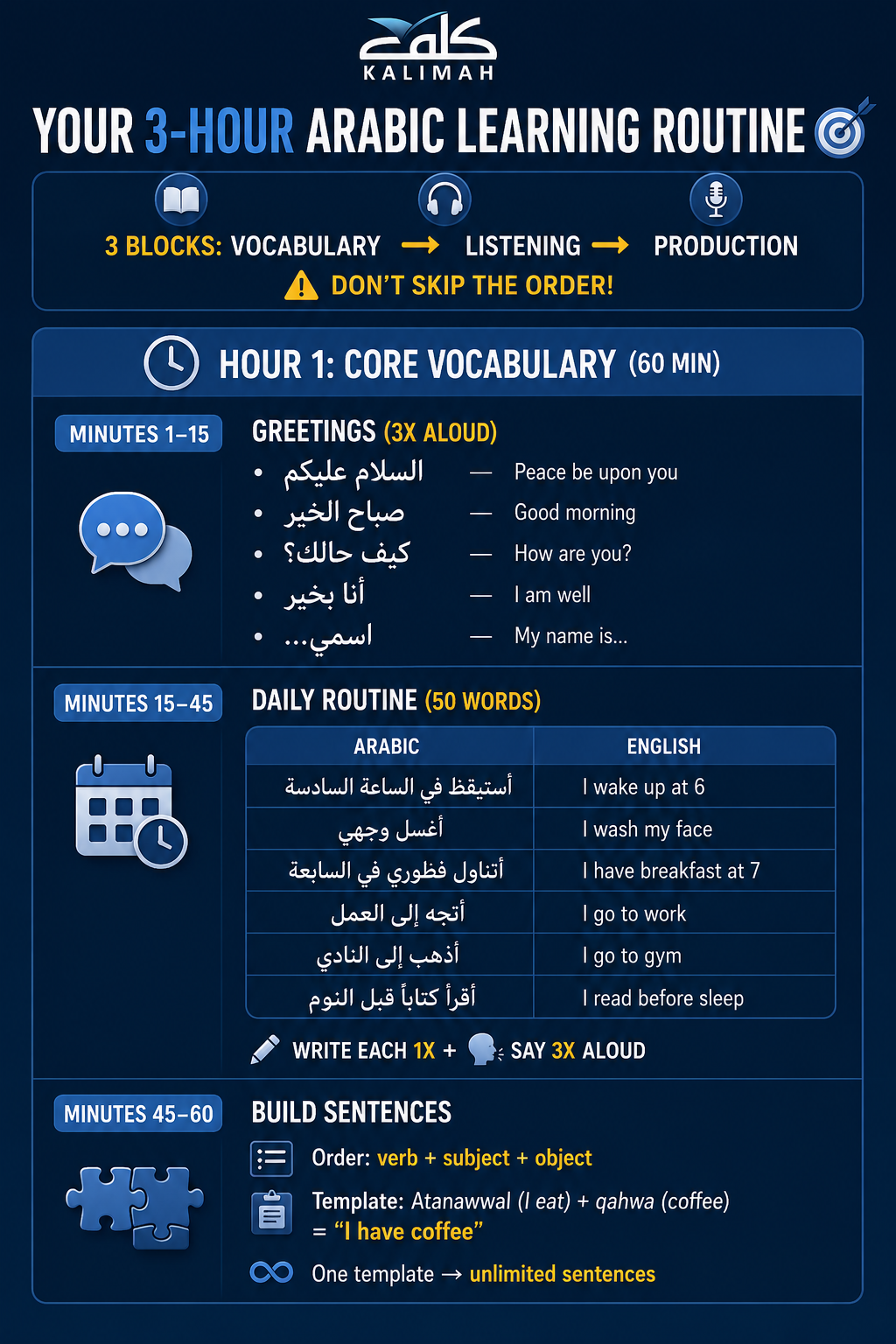
Minutes 1–15 — Greetings and Introductions
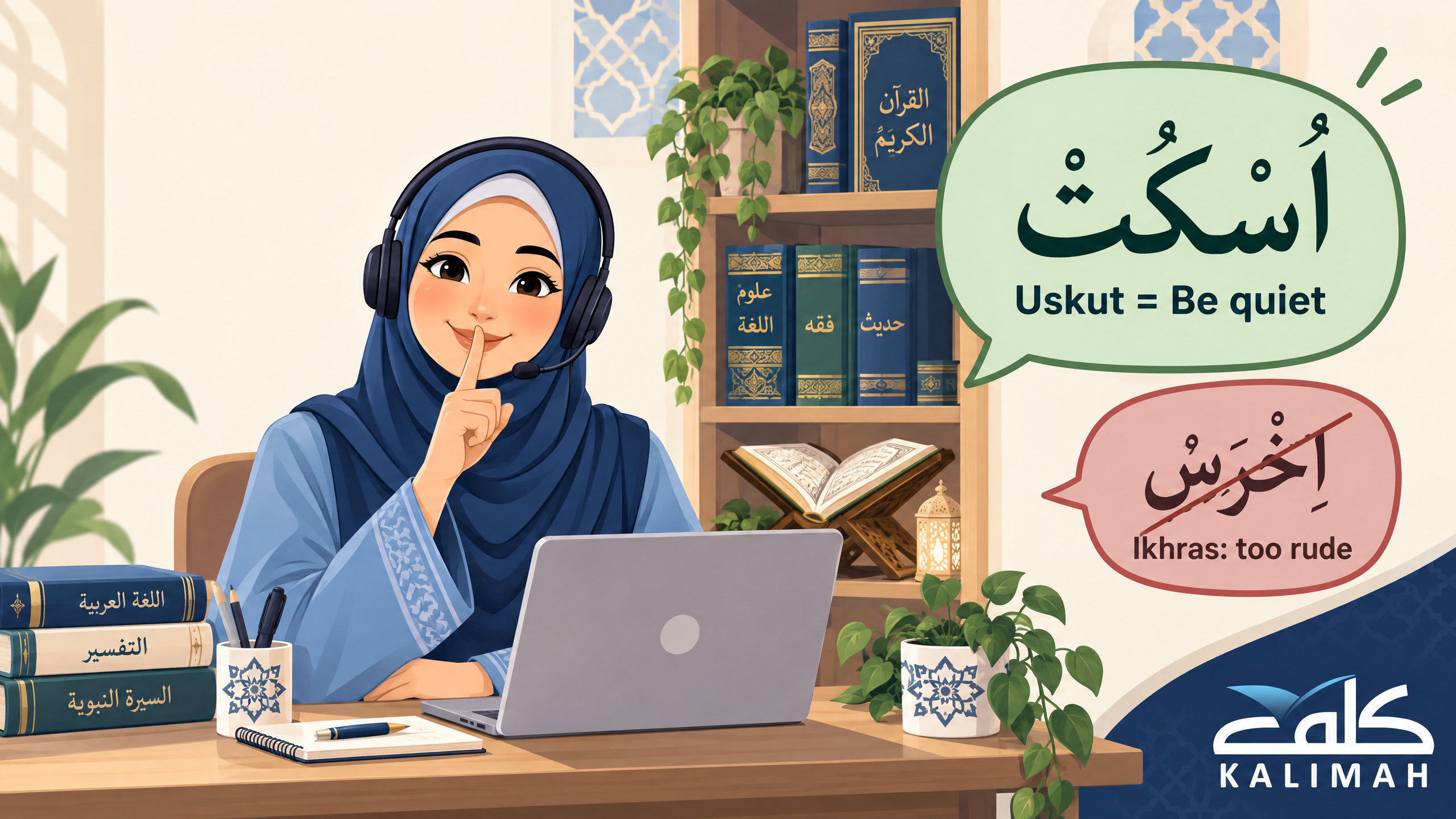
Start with the phrases you will use in every Arabic conversation, ever. Practice each one aloud three times before moving on:
- السلام عليكم / As-salamu alaykum — Peace be upon you (universal greeting)
- صباح الخير / Sabah al-khayr — Good morning
- مساء الخير / Masa’ al-khayr — Good evening
- كيف حالك؟ / Kayfa halak? — How are you?
- أنا بخير / Ana bikhayr — I am well
- اسمي… / Ismi… — My name is…
- تشرفت بمعرفتك / Tasharraftu bima’rifatik — Pleased to meet you
Minutes 15–45 — Daily Routine Vocabulary (Your First 50 Words)
The most powerful vocabulary cluster for beginners is daily routine verbs and time words. From the source content, here are the core sentences to learn — each one teaches you a verb, a time reference, and basic sentence order simultaneously:
| Arabic Sentence | Transliteration | Meaning |
| كل صباح أستيقظ في الساعة السادسة | Kull sabah astayqiz fi al-sa’a al-sadisa | Every morning I wake up at 6 |
| أغسل وجهي وأنظّف أسناني | Aghsil wajhi wa unazzif asnani | I wash my face and brush my teeth |
| أتناول فطوري في الساعة السابعة | Atanawwal futouri fi al-sa’a al-sabi’a | I have breakfast at 7 |
| بعد الفطور أتجه إلى العمل | Ba’d al-futur attajahu ila al-‘amal | After breakfast I go to work |
| أعود إلى البيت لتناول الغداء في الظهر | A’oud ila al-bayt li-tanawul al-ghada’ fi al-zuhr | I return home for lunch at noon |
| في المساء أذهب إلى النادي الرياضي | Fi al-masa’ athhab ila al-nadi al-riyadi | In the evening I go to the gym |
| بعد التمرين أتناول عشاءً خفيفاً | Ba’d al-tamrin atanawwal ‘asha’ khafifan | After exercise I have a light dinner |
| في الليل أقرأ كتاباً قبل النوم | Fi al-layl aqra’ kitaban qabl al-nawm | At night I read a book before sleeping |
Read each sentence, say it aloud three times, and write it once. The physical act of writing accelerates retention significantly.
Minutes 45–60 — Simple Sentence Construction
Arabic basic sentence order is: verb + subject + object. Practice this framework with what you just learned: take any verb from the table above and swap in a new object. Atanawwal (I have/eat) + qahwa (coffee) = “I have coffee.” One template, unlimited sentences.
Kalimah Center’s Arabic courses are built around exactly this context-first approach — teaching you to use structures immediately, not memorize rules before speaking. Their expert instructors walk you through this kind of pattern drilling from lesson one.
Hour 2 — Listening and Spoken Repetition (60 Minutes)
The second hour is entirely audio-focused. Arabic pronunciation has sounds that English does not — letters like ع (ayn), غ (ghayn), ح (ha), and خ (kha) require muscle memory that only develops through repeated listening and speaking, not reading. Skipping this hour is the most common mistake beginners make.
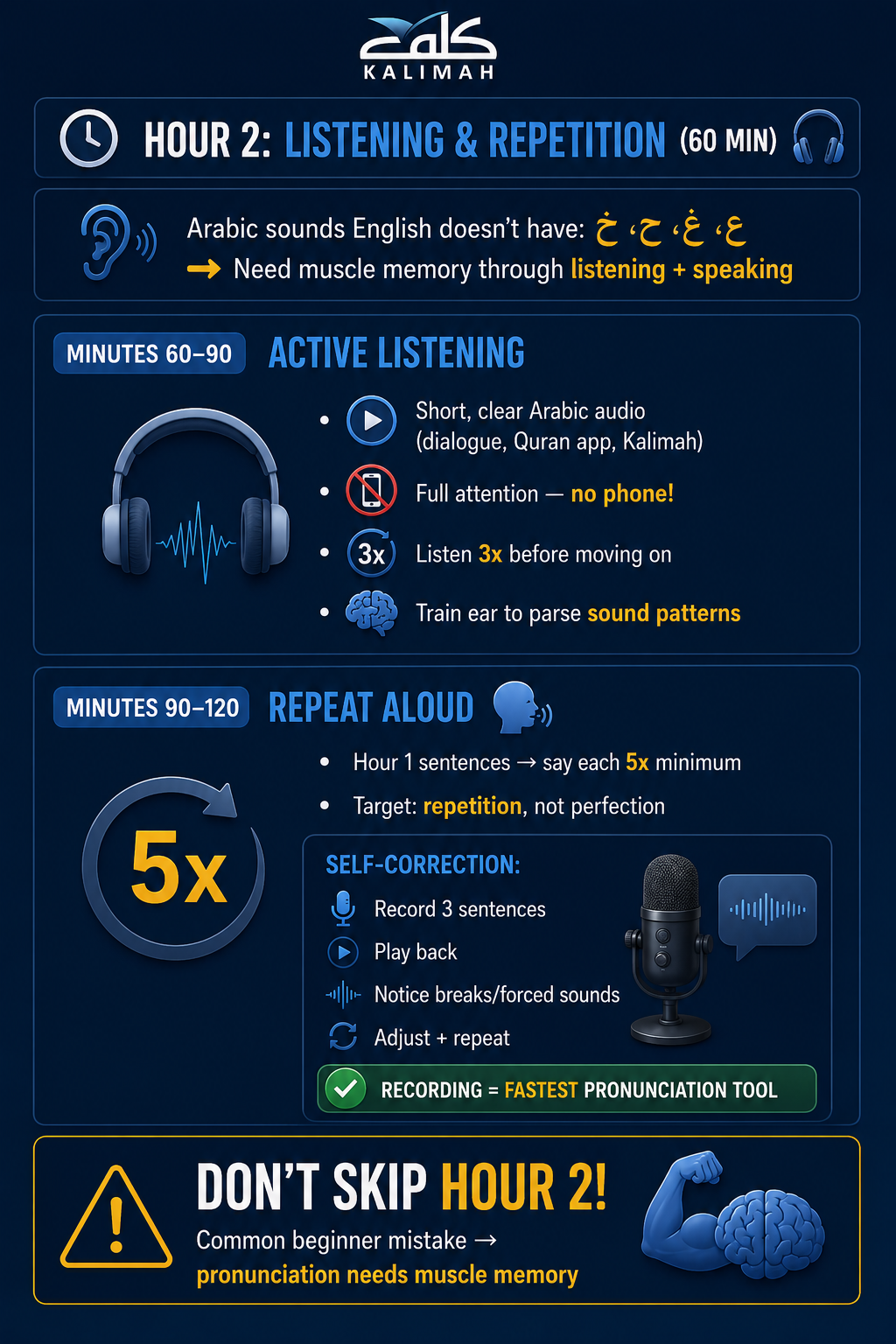
Minutes 60–90 — Active Listening
Find a short, clear Arabic audio clip — a beginner dialogue, a Quran recitation app at slow speed, or a lesson from Kalimah Center’s materials. Listen with full attention.
- Do not look at your phone.
- Try to catch any words from Hour 1 that you recognize.
- Listen to the same clip three times before moving on.
What you are training here is not comprehension — it is your ear’s ability to parse Arabic sound patterns. Arabic words in natural speech connect together, and this hour begins the process of teaching your brain where one word ends and another begins.
Minutes 90–120 — Repetition Aloud (Shadowing)
Take the daily routine sentences from Hour 1 and read every single one aloud, repeatedly. The target is not perfection — it is repetition. Each sentence should be said a minimum of five times.
This is the method used in the source content’s structured practice videos: hear it, repeat it, hear it again, repeat again.
A useful self-correction technique:
- Record yourself saying three sentences.
- Then play it back.
- Notice where your rhythm breaks or where a sound feels forced. Adjust and repeat.
This single habit — recording and reviewing — is one of the fastest pronunciation improvement tools available to self-studiers.
Hour 3 — Application and Writing (60 Minutes)
The third hour moves from input to output. You have vocabulary and you have listened — now you produce.
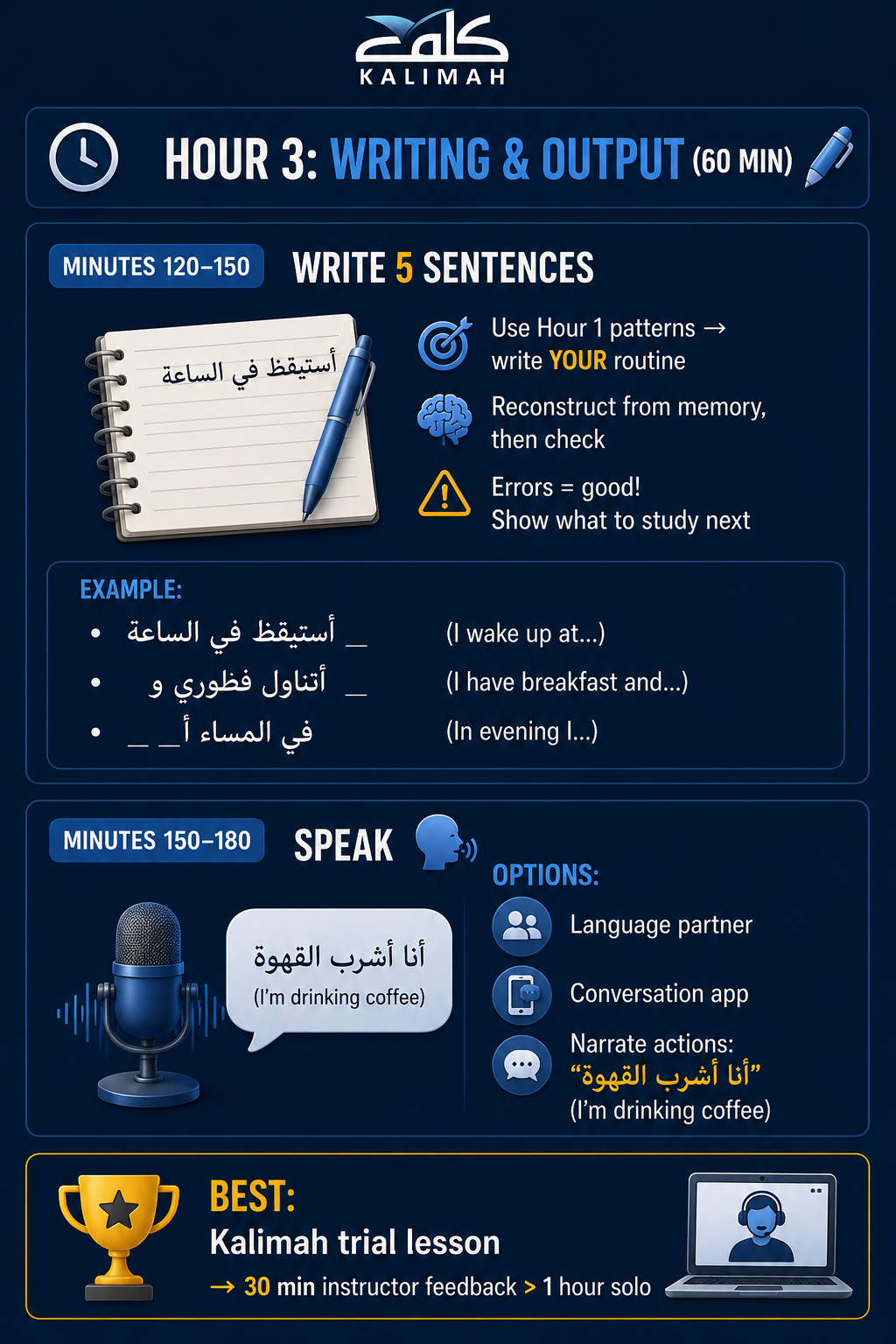
Minutes 120–150 — Write Your Own Daily Routine in Arabic
Using the sentence patterns from Hour 1, write five sentences describing your own daily routine. Do not copy the table — reconstruct from memory, then check. Your sentences will probably have errors. That is the point: the errors show you exactly what to study next.
Example framework to follow:
- كل صباح أستيقظ في الساعة ___ (Every morning I wake up at…)
- أتناول فطوري و ___ (I have breakfast and…)
- في المساء أ___ (In the evening I…)
- بعد ___ أ___ (After… I…)
- في الليل أ___ قبل النوم (At night I… before sleeping)
Experience Kalimah Center Classes
Watch real excerpts from our live sessions at Kalimah Center and see how we bring learning to life. These clips highlight our interactive, student-centered teaching approach across all our courses—designed to keep learners engaged, motivated, and actively involved every step of the way.
Master Arabic with Kalimah Center
Join our expert-led online classes and start your journey toward Arabic fluency today.
Book Your Free TrialMinutes 150–180 — Conversation Practice
In the final 30 minutes:
- Speak, Talk to a language exchange partner.
- Use a conversation app.
- Or simply narrate your actions aloud in Arabic as you do them.
“أنا أشرب القهوة” (Ana ashrab al-qahwa) — I am drinking coffee.
- Turning your environment into Arabic practice is one of the immersion strategies from the source content:
- Change your phone language to Arabic.
- Narrate your actions.
- Describe what you see.
If you have access to a Kalimah Center trial lesson, this is the ideal time to use it — 30 minutes of real-time feedback from a qualified instructor will do more to correct your output than another hour of solo practice.
Read Also: Does Bayyinah TV teach Arabic?
Your 3 Hours Are Done, Now What?
You have the vocabulary. You have the sentences. You have heard Arabic out loud and written it by hand.
Most learners stop here — and lose 60% of what they built within 72 hours.
The learners who don’t stop? They book one Kalimah session.
Not because they need to be taught everything again. Because one qualified instructor in one live session tells them three things no routine can: which sounds they are mispronouncing, which sentences they are building wrong, and exactly what to focus on in the next 3 hours.
That conversation changes everything about how the daily follow-up lands.
Read Also: Is Al Jazeera learning Arabic free?
Which Course Comes After Your 3 Hours?
Online Arabic Course — 16 Levels
You built the foundation today. The Arabic course builds the house — 400+ hours of one-on-one instruction across 16 levelsز
Your tutor is chosen by you, based on reviews written by learners who sat exactly where you are sitting right now.

Online Quran with Tajweed — 13 Levels
If the Arabic you built today is a bridge to the Quran, this is the road on the other side. Thirteen levels with Ijazah-certified instructors who connect every grammar rule and pronunciation habit to Quranic text — so your 3 hours become the beginning of something much larger.
Online Arabic for Kids — 24 Levels
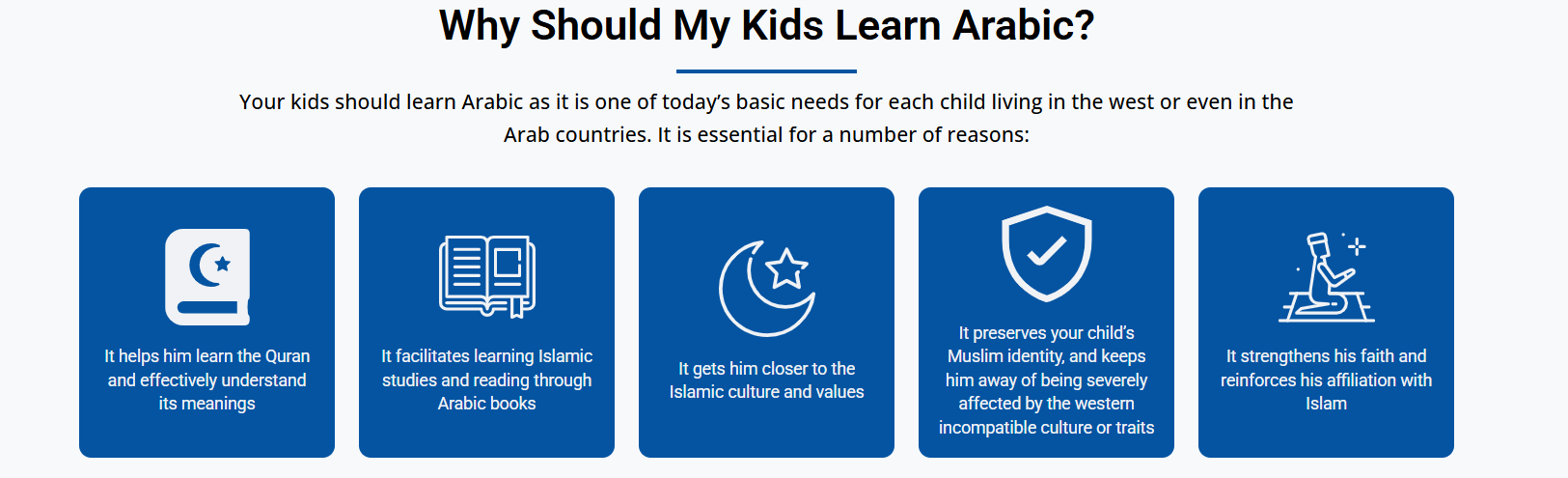
Did you do this session with your child? Kalimah’s children’s program features 24 levels crafted around how kids naturally absorb language: through hands-on interaction, playful learning, and instructors specially trained to teach young learners.
See your tutor’s reviews before you book — then start free
The 15–30 Minute Daily Follow-Up Routine
The 3-hour session builds your foundation. This daily follow-up is what makes it permanent.
Most Arabic learners plateau not because the language is too hard but because they stop the daily repetition that language acquisition requires.
The brain consolidates language during sleep — it can only consolidate what it was exposed to that day. Missing even 2–3 days per week in the first month significantly slows progress.
Here is the daily follow-up routine after your 3-hour intensive:
| Block | Duration | Activity |
| Listening | 10 minutes | One Arabic audio clip — beginner podcast, dialogue, or Quranic recitation |
| Writing and Application | 10 minutes | Write 3–5 sentences about what you will do today, using Hour 1 vocabulary |
| Review | 5–10 minutes | Review new words noted in a vocabulary journal; use spaced repetition |
The best time for this routine is immediately after Fajr prayer or with your morning coffee — attaching it to an existing anchor removes the willpower cost of starting each day.
Read Also: Arabic Immersion Magnet School
Inside Kalimah Center: Moments from Our Courses
Get a glimpse into the vibrant learning experience at Kalimah Center. These snapshots capture real moments from our live classes—where students engage deeply, connect with passionate instructors, and grow in a welcoming, supportive environment.
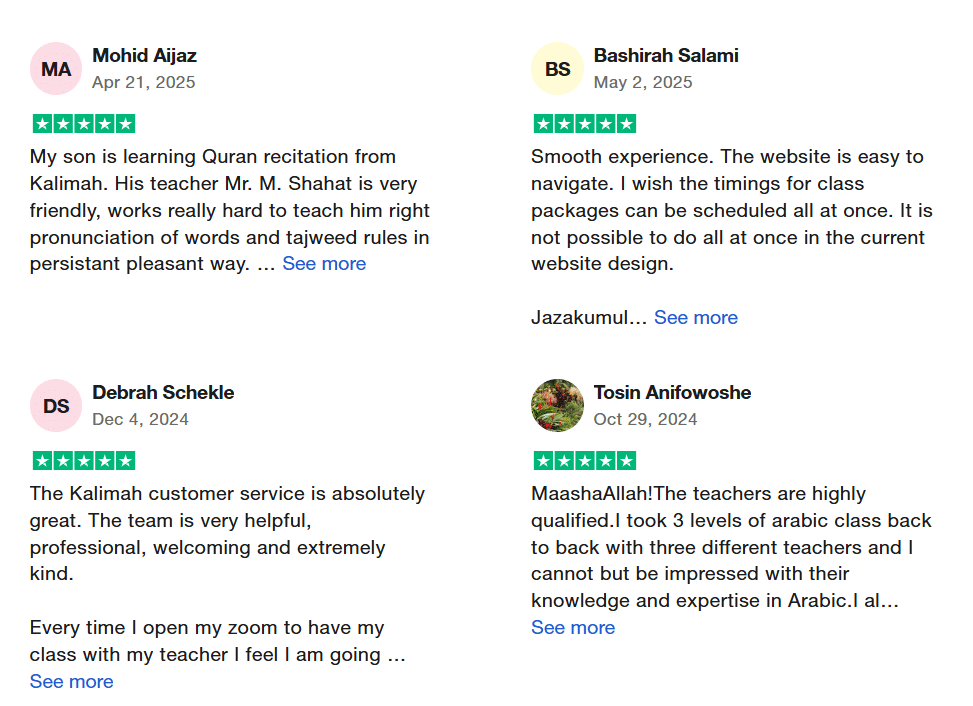
Here Are The Reviews On Our Courses:
Our students frequently commend the excellence of our courses and the commitment shown by our instructors. You can read their complete reviews on Trustpilot.
Read more reviews on Trustpilot
Unlock Your Potential in Arabic and Quran with Kalimah Center!
Ready to deepen your connection with the Quran and enhance your understanding of Arabic? Join Kalimah Center today and embark on a transformative journey of learning and growth! Our professional, handpicked Online Arabic and Quran Tutors are dedicated to helping you master these essential skills with ease and expertise.
📚 Explore Our Courses:
Online Arabic Course: Tailored to your level, our comprehensive Arabic program includes 16 teaching levels and 400+ hours of personalized sessions.
Online Quran With Tajweed Course: Perfect for non-Arabic speakers, our course spans 13 levels and equips you with Tajweed mastery from beginner to advanced.
Online Arabic Course For Kids: Nurture your child’s love for Arabic with our engaging and structured program, available in 24 levels for primary, intermediate, and secondary stages.
🚀 Start Your Free Trial Today! 🚀
Don’t miss out on this life-changing opportunity to deepen your faith and knowledge. Sign up now for your free trial and take the first step towards becoming a better practicing Muslim with Kalimah Center!
Master Arabic with Kalimah Center
Join our expert-led online classes and start your journey toward Arabic fluency today.
Book Your Free TrialConclusion
Learning Arabic in 3 hours means building a real, usable foundation — not fluency, but the vocabulary, sentence patterns, and listening familiarity that make every subsequent hour of practice more effective than the last.
The routine works because it sequences correctly: vocabulary first, listening second, production third. Each hour feeds the next. The daily 15-minute follow-up is what transforms a single intensive session into lasting Arabic ability.
Three hours is where every Arabic learner starts. The question is what you do with the next three hours after that.
Frequently Asked Questions About Learning Arabic in 3 Hours
Can you actually learn Arabic in 3 hours?
You cannot reach fluency in 3 hours, but you can build a functional beginner foundation. In 3 structured hours, a complete beginner can learn 50–100 essential vocabulary words, basic daily sentence patterns, greetings, and beginner listening comprehension. The key is focusing on the 20% of vocabulary that covers 80% of everyday conversation.
What is the best way to structure 3 hours of Arabic study?
Divide the 3 hours into three focused blocks: the first hour on core vocabulary and daily sentence patterns (including writing and reading aloud), the second hour on listening and spoken repetition (shadowing and recording yourself), and the third hour on production — writing your own sentences and speaking practice. Each hour builds on the previous one.
What Arabic vocabulary should I learn first?
The most efficient first vocabulary cluster is daily routine sentences — they combine verbs, time words, and objects in every phrase, teaching sentence structure while building vocabulary simultaneously.
Arabic verbs like أستيقظ (I wake up), أتناول (I eat/have), أذهب (I go), أعود (I return), and أقرأ (I read) provide you with a practical, personalized foundation for building your own Arabic sentences right away.
How do I maintain Arabic after an intensive 3-hour session?
Follow up with a 15–30 minute daily routine: 10 minutes of listening to Arabic audio, 10 minutes of writing simple sentences from the day’s vocabulary, and 5–10 minutes of spaced repetition review.
Daily consistency matters more than session length — missing days breaks the memory consolidation cycle that language retention depends on.
Is Modern Standard Arabic or Egyptian dialect better for beginners?
For 3-hour intensive learning, Modern Standard Arabic (MSA) is recommended because it is universally understood across the Arab world and forms the basis of written Arabic, Quranic Arabic, and formal media.
Egyptian Arabic is the most widely understood spoken dialect and is a strong choice if your goal is everyday conversation specifically with Egyptian speakers. Many learners begin with MSA structure and Egyptian dialect pronunciation simultaneously.