Classical Arabic (الفصحى التراثية) is the literary form of Arabic used in the Quran, pre-Islamic poetry, and centuries of Islamic scholarship. It differs from Modern Standard Arabic (MSA) in grammar complexity, vocabulary, and rhetorical richness. In Germany, learners can study Classical Arabic through university Arabistik departments (FU Berlin, Uni Heidelberg, LMU Munich), online academies with native instructors, or Islamic studies institutes.
A structured learning path typically starts with Arabic script and pronunciation, progresses through Nahw (syntax) and Sarf (morphology), and advances to Balagha (rhetoric) and direct text analysis. Most learners reach reading proficiency in Classical texts within 12–24 months of consistent study.
Key Takeaway Table:
| Factor | Details |
|---|---|
| What it is | The literary Arabic of the Quran, classical poetry, and Islamic scholarship |
| Different from MSA? | Yes — more complex grammar, richer vocabulary, rhetorical depth |
| Core disciplines | Nahw (syntax), Sarf (morphology), Balagha (rhetoric) |
| Who studies it | Quranic scholars, academic researchers, translators, Islamic studies students |
| Where to learn in Germany | Universities (Arabistik), online academies, Islamic institutes |
| Time to reading proficiency | 12–24 months (10+ hrs/week) |
| Key entry texts | Al-Ajrumiyyah (grammar), Qatr al-Nada (syntax), Quran with Tafsir |
What Is Classical Arabic? (And How It Differs from MSA and Dialects)
Classical Arabic (العربية الفصحى التراثية, al-‘Arabiyya al-Fuṣḥā al-Turāthiyya) is the literary form of Arabic that has been preserved through the Quran, pre-Islamic poetry (الشعر الجاهلي), Hadith literature, and centuries of Islamic scholarship. It is the linguistic register in which the foundational texts of Islamic civilization were composed.
How it relates to other forms of Arabic:
| Form | Time Period | Used For | Grammar Complexity | Example |
|---|---|---|---|---|
| Classical Arabic | ~5th century CE – present (as literary language) | Quran, Hadith, classical poetry, Islamic scholarship | Highest — full case system, dual forms, complex verb patterns | إِنَّا أَنزَلْنَاهُ قُرْآنًا عَرَبِيًّا (Quran 12:2) |
| Modern Standard Arabic (MSA) | ~19th century – present | News, formal writing, education, UN proceedings | High — simplified from Classical but retains core grammar | أعلنت الحكومة خطة جديدة (The government announced a new plan) |
| Spoken Dialects (Egyptian, Levantine, Gulf, etc.) | Evolved regionally over centuries | Daily conversation, informal media, social media | Lower — dropped case endings, simplified verb forms | إزيك؟ كويس الحمد لله (Egyptian: How are you? Good, thank God) |
Key characteristics of Classical Arabic:
- Full I’rab (case system): Every noun and verb ending changes based on its grammatical function. In the sentence “The student read the book” (قَرَأَ الطَّالِبُ الكِتَابَ), the ُ on طالب marks it as the subject (nominative), and the َ on كتاب marks it as the object (accusative). MSA often writes these but rarely pronounces them. Classical Arabic always applies them.
- Dual form: Classical Arabic has a distinct form for exactly two things (not just singular/plural). “Two books” = كِتَابَانِ (kitābāni). MSA retains this in writing but spoken Arabic has largely dropped it.
- Rich rhetorical devices (Balagha): Classical Arabic elevated rhetoric to a science. Concepts like Tashbih (simile), Isti’ara (metaphor), and Kinaya (metonymy) are studied as formal disciplines with precise rules.
- Root-based vocabulary: Like all Arabic, Classical Arabic builds words from 3-letter roots. The root ك-ت-ب (k-t-b, related to writing) produces: كِتَاب (book), كَاتِب (writer), مَكْتَبَة (library), مَكْتُوب (written/letter). Understanding roots unlocks vocabulary exponentially.
Why does it matter? If MSA is the language of today’s Arab world, Classical Arabic is the key to its past — and to its most sacred and influential texts. Learning Classical Arabic doesn’t just teach you a language; it gives you direct access to 1,400+ years of intellectual, spiritual, and literary heritage.
How to Learn Classical Arabic in Germany: A Step-by-Step Roadmap
Classical Arabic follows a well-established learning sequence that Islamic scholars have refined over centuries. Here’s the path from complete beginner to independent reader:
Phase 1: Foundations (Months 1–3)
– Master the Arabic alphabet and pronunciation, with special attention to Makhārij al-Huruf (articulation points)
– Learn basic vocabulary (200–300 high-frequency classical words)
– Understand the concept of Arabic’s root system (most words derive from 3-letter roots)
– Begin reading short Quranic verses with transliteration support
Phase 2: Grammar Core (Months 4–9)
– Study Nahw (syntax) systematically — start with Al-Ajrumiyyah or an equivalent primer
– Learn the case system (I’rab): nominative (مرفوع), accusative (منصوب), genitive (مجرور)
– Study Sarf (morphology): verb forms (أوزان), participles, verbal nouns
– Practice identifying grammatical functions in Quranic verses
– Build vocabulary to 800–1,000 words
Phase 3: Intermediate Reading (Months 10–18)
– Progress to Qatr al-Nada or equivalent intermediate grammar text
– Begin reading classical texts with teacher guidance (Hadith collections, short classical prose)
– Study Balagha (rhetoric) basics: simile (تشبيه), metaphor (استعارة), and other devices
– Practice written composition in formal Arabic
Phase 4: Advanced Engagement (Months 19–36+)
– Read classical literature, poetry, and scholarly works independently
– Analyze complex grammatical structures in extended texts
– Study advanced Balagha and literary criticism
– Engage with Tafsir literature directly in Arabic
How to study: The most effective approach combines structured instruction (with a qualified teacher) and self-study. A teacher corrects your grammar analysis in real-time — something no textbook can do. Supplement with daily vocabulary review, regular reading practice, and listening to Quranic recitation with attention to grammatical structures.
Read also: Best Online Arabic Classes in Germany
Why Learn Classical Arabic in Germany? Academic, Religious & Professional Value
Germany has one of Europe’s strongest traditions of Arabic scholarship. The Orientalistik departments at German universities have produced some of the world’s most important Arabic language research. Learning Classical Arabic in Germany positions you at the intersection of this academic tradition and the country’s growing Arabic-speaking community.
Academic applications:
| Field | How Classical Arabic Helps |
|---|---|
| Islamic Studies (Islamwissenschaft) | Read primary sources — Quran, Hadith, Fiqh texts, Tafsir — without translation dependency |
| Middle Eastern History | Access historical documents, court records, and chronicles in their original language |
| Arabic Literature | Engage with poetry, prose, and philosophy from the Jahiliyyah period through the Islamic Golden Age |
| Comparative Linguistics | Understand Semitic language structures; Arabic’s complex morphology is a rich research subject |
| Manuscript Studies | Germany’s state libraries (Berlin, Munich, Gotha) hold major Arabic manuscript collections |
Religious applications:
- Understand the Quran in its original language without relying on translations
- Study Hadith, Fiqh, and Islamic jurisprudence from primary texts
- Engage in scholarly discussion within Islamic communities in Germany
- Teach Quranic Arabic to the next generation
Professional applications in Germany:
- Translation and interpretation: Legal, diplomatic, and literary translation between Arabic and German
- Federal Foreign Office (Auswärtiges Amt): Arabic is a strategic language for German diplomacy
- International organizations: GIZ, UNHCR, and other Germany-based organizations working in the Arab world
- Museums and cultural institutions: Berlin’s Museum of Islamic Art, the Pergamon Museum, and regional collections need Arabic-literate staff
- Journalism: Arabic language skills are highly valued in German media covering the Middle East
For Germany’s Arabic-speaking community: Classical Arabic proficiency allows heritage speakers to bridge the gap between their spoken dialect and the formal, literary register — essential for reading Arabic literature, understanding khutbahs (sermons), and engaging with educational materials in Arabic.
Experience Learning Classical Arabic in Germany
Whether you attend in Berlin, Hamburg, Munich, or online from anywhere in Germany, our structured modules, expert teachers, and cultural depth will help you gain not just language skills, but also the ability to engage with centuries of Arabic heritage in its purest form.
Read also: Learn Arabic in Germany
Where to Study Classical Arabic in Germany
Germany offers multiple pathways for Classical Arabic study:
| Option | Format | Cost | Focus | Best For |
|---|---|---|---|---|
| German universities (Arabistik) | In-person, semester-based | Free–€300/semester (Semesterbeitrag) | Academic Arabic, Classical texts, literary analysis | Academic career, formal certification |
| Online academies (e.g., Kalimah Center) | Live video, 1-on-1 or group | €25–60/session | Quranic Arabic, Nahw, Sarf, practical reading | Flexible scheduling, Quranic focus |
| Islamic institutes | In-person or online | Varies (often donation-based) | Quranic Arabic, Islamic sciences curriculum | Religious scholarship |
| Self-study with classical texts | Independent | Cost of books only (€20–100) | Grammar and reading at own pace | Supplementary to instruction |
| VHS / Community courses | In-person, semester-based | €50–150/semester | MSA with some Classical elements | Budget learners, casual interest |
German universities with strong Arabic programs:
| University | Department | Notable Strengths |
|---|---|---|
| Freie Universität Berlin | Arabistik / Islamwissenschaft | One of Germany’s strongest Arabic departments; manuscript studies |
| Universität Heidelberg | Semitistik | Classical Semitic languages; Arabic philology tradition |
| LMU Munich | Institut für den Nahen und Mittleren Osten | Arabic linguistics, Islamic studies |
| Universität Hamburg | Asien-Afrika-Institut | Arabic language and culture, strong research focus |
| Universität Göttingen | Arabistik/Islamwissenschaft | Classical Arabic literary studies |
| Universität Münster | Arabistik und Islamwissenschaft | Islamic law, Arabic texts |
Note: German university courses typically teach MSA with Classical Arabic components integrated into upper-level courses. For dedicated Classical Arabic instruction with a Quranic focus, specialized online academies and Islamic institutes often provide more targeted curricula.
Master Arabic with Kalimah Center
Join our expert-led online classes and start your journey toward Arabic fluency today.
Book Your Free TrialRead also: Learn Quranic Arabic in Germany
Best Classical Arabic Textbooks and Resources
Traditional Curriculum (Hawza/Islamic Studies Path):
| Level | Text | Author | Focus |
|---|---|---|---|
| Beginner Grammar | Al-Ajrumiyyah (المقدمة الآجرومية) | Ibn Ajrum (13th c.) | Foundational Nahw — the most widely used Arabic grammar primer in history |
| Intermediate Grammar | Qatr al-Nada (قطر الندى) | Ibn Hisham (14th c.) | Intermediate syntax with detailed explanations |
| Advanced Grammar | Alfiyyat Ibn Malik (ألفية ابن مالك) | Ibn Malik (13th c.) | 1,000 verses of Arabic grammar in poetry form — the definitive reference |
| Morphology | Tasrif al-‘Izzi (تصريف العزي) | Al-Zanjani (13th c.) | Comprehensive Sarf reference |
| Rhetoric | Jawahir al-Balagha (جواهر البلاغة) | Ahmad al-Hashimi | Accessible Balagha textbook covering Ma’ani, Bayan, and Badi’ |
Modern Academic Textbooks (accessible for Western learners):
- Arabic Through the Quran by Alan Jones — bridges Quranic reading with grammar
- Al-Kitaab fii Ta’allum al-‘Arabiyya (Georgetown series) — standard university Arabic textbook
- A New Arabic Grammar by J.A. Haywood and H.M. Nahmad — thorough classical grammar reference in English
- Medina Arabic Course (free online) — used at the Islamic University of Medina; clear, progressive
Digital Resources:
- Aratools / Quranic Arabic Corpus — word-by-word grammatical analysis of every Quran verse
- Baheth.info — Arabic dictionary and morphological analysis tool
- Lane’s Lexicon (available free online) — the most comprehensive classical Arabic-English dictionary
- Tashkeel (vowelization) tools — websites that add vowel marks to unvoweled Arabic text
Pro tip for German learners: Many classical Arabic grammar texts have German-language commentaries and translations published by German Orientalist scholars. Check university library catalogs (especially FU Berlin and Heidelberg) for German-language Arabic grammar resources.
Read also: Madinah Arabic Course in Germany: Where & How to Study
Germany Classical Arabic Teachers

Our dedicated team of native Arabic teachers in Germany combines deep linguistic expertise with years of practical teaching experience to deliver high-quality Classical Arabic instruction:
- Personalized Coaching: Lessons tailored to your goals, whether you’re a complete beginner or pursuing advanced linguistic mastery.
- Focus on Fus’ha (Classical Arabic): Ideal for academic study, Islamic scholarship, and understanding classical literature.
- Cultural & Historical Insights: Learn how Classical Arabic shaped poetry, science, and scholarship throughout history, with practical application in today’s learning environment.
1. Teacher Abdullazim Ali
Abdullazim Ali is a native Arabic speaker with a strong background in Shariah and law. Having memorized the entire Holy Qur’an with Tajweed and holding an Ijazah in Quranic recitation, Abdullazim speaks fluent English and German. With over two years of teaching experience, he brings deep classical Arabic knowledge to engaging and accessible lessons.
2. Teacher Hussein Al-Sabbagh
Hussein Al-Sabbagh holds a Bachelor’s degree in Arabic Language and has over eight years of teaching experience. He is dedicated to refining students’ linguistic abilities through structured, interactive methods and delivers personalized Arabic and Quran instruction that adapts to each learner’s needs.
3. Teacher Mahmoud Sayed
Mahmoud Sayed is a native speaker who has memorized the Quran in four Qira’at styles and is fluent in French. With more than six years of Quran teaching experience and Ijazahs in multiple recitations like Shu’bah, Hafs, and Warsh, Mahmoud offers a unique blend of religious and linguistic expertise to learners from varied backgrounds.
4. Teacher Amr Ibrahim
Amr Ibrahim graduated from the Faculty of Dar Al Uloom with a degree in Arabic Language and Islamic Studies. Amr Ibrahim has over ten years of teaching experience. He specializes in teaching Arabic to non-native speakers using clear, practical strategies that accelerate learner progress efficiently.
5. Teacher Mohamed Shahat
Mohamed Shahat is a native Arabic speaker who studied Hadith and memorized the Quran with an Ijazah. Fluent in English and German, Mohamed is passionate about helping students build a personal and meaningful connection with the Quran through patient, tailored teaching approaches.
Meet all Quranic Arabic tutors and choose one that fits your learning style.
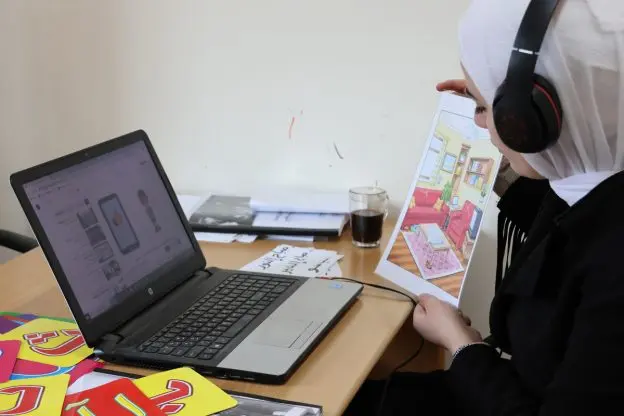
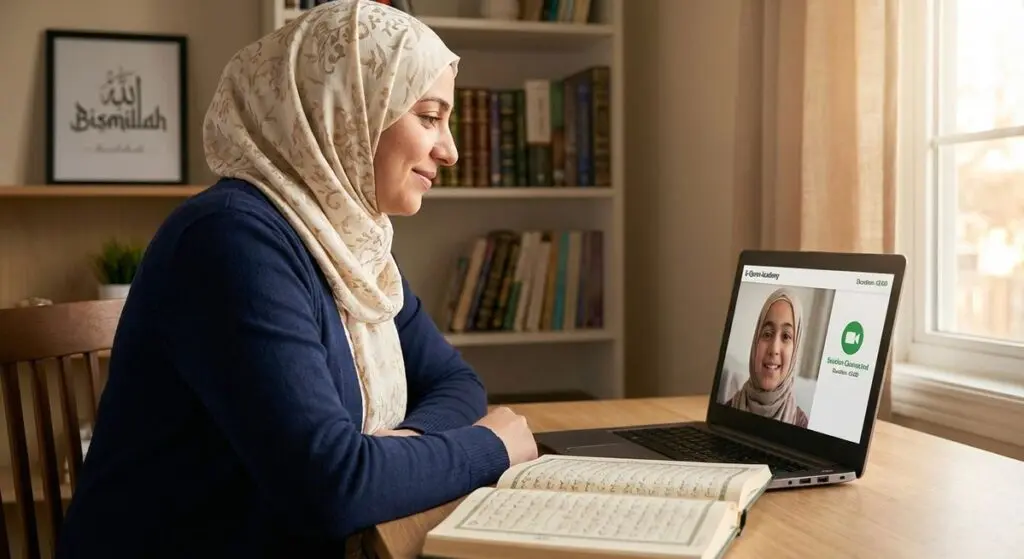
Inside Kalimah Center: Moments from Our Courses
Get a glimpse into the vibrant learning experience at Kalimah Center. These snapshots capture real moments from our live classes—where students engage deeply, connect with passionate instructors, and grow in a welcoming, supportive environment.
Study Classical Arabic with Kalimah Center
Kalimah Center offers structured Classical Arabic courses with native Arabic instructors, many trained at Al-Azhar University and holding Ijazah certifications:
- Group classes: €25/session (max 8 students) — online or in-person in Germany
- Private 1-on-1 lessons: €60/hour — personalized to your level and goals
- Curriculum: Covers Nahw, Sarf, Balagha, Quranic vocabulary, and direct text analysis
- Teachers fluent in German and English for clear grammatical explanations
- Free placement test + free trial class
Here Are the Reviews on Our Arabic Courses
Our students in Germany consistently share positive feedback about their learning experience, praising our structured curriculum, engaging teaching methods, and the dedication of our qualified instructors. Many highlight the balance between linguistic depth and practical application, making Classical Arabic both accessible and enjoyable.
Read independent reviews from real learners on our Trustpilot page to see how our Arabic courses have helped students achieve their goals—whether mastering grammar, improving pronunciation, or gaining the ability to understand classical texts with confidence.

Master Arabic with Kalimah Center
Join our expert-led online classes and start your journey toward Arabic fluency today.
Book Your Free TrialConclusion
Learning Classical Arabic in Germany opens doors to a rich world of literature, history, and spiritual understanding. With expert teachers, a structured curriculum, and both in-person and online access, you can develop skills that will last a lifetime.
Our program doesn’t just teach you a language—it equips you to connect with a cultural heritage that has influenced civilizations for centuries. Whether you live in Berlin, Munich, Hamburg, or anywhere else in Germany, your path to mastering Classical Arabic starts here.
FAQS about Learn Classical Arabic in Germany
Q1: What is the difference between Classical Arabic and Modern Standard Arabic?
Classical Arabic (Fusha Turathiyya) is the language of the Quran, pre-Islamic poetry, and medieval Islamic scholarship. Modern Standard Arabic (Fusha Mu’asira) evolved from it and is used today in news, formal writing, and education across the Arab world. The key differences: Classical Arabic has stricter grammar rules (full case endings are always applied), a richer and more archaic vocabulary, and complex rhetorical structures (Balagha). MSA simplifies some of these features for modern communication. Think of the relationship as similar to Shakespearean English vs. modern English — related but distinct in formality, vocabulary, and structure. Learning Classical Arabic gives you the deepest understanding of Arabic’s grammatical system and unlocks all historical texts.
Q2: How long does it take to learn Classical Arabic?
For most learners studying 8–10 hours per week, reaching a beginner reading level takes approximately 6–12 months. This includes mastering the script, basic Nahw (syntax), and core vocabulary. Intermediate proficiency — reading classical texts with a dictionary and understanding Quranic Arabic with Tafsir support — typically requires 18–24 months. Advanced mastery (independent analysis of classical literature, poetry, and scholarly texts) takes 3–5 years. Prior knowledge of MSA or any Arabic dialect significantly accelerates the process, as the script, core vocabulary, and many grammatical concepts overlap.
Q3: Is Classical Arabic harder than Modern Standard Arabic?
Yes, Classical Arabic is generally more challenging because it applies the full case system (I’rab) consistently, uses vocabulary that has fallen out of modern usage, and employs complex rhetorical devices. However, the difficulty is often overstated. If you approach it systematically — Nahw, then Sarf, then Balagha — the grammar follows logical patterns. Many students find that learning Classical Arabic actually deepens their understanding of MSA, because MSA’s rules are simplified versions of Classical Arabic’s more complete system.
Q4: Can I learn Quranic Arabic online while living in Germany?
Yes. Multiple online platforms offer Quranic and Classical Arabic courses with flexible scheduling suited to Central European time zones. Look for programs with Ijazah-certified teachers who can teach both the language (grammar, vocabulary, meaning) and recitation (Tajweed). The advantage of online learning is access to teachers trained at institutions like Al-Azhar, regardless of your location in Germany. Ensure the program covers not just recitation but also grammatical analysis (I’rab) of Quranic verses.
Q5: Can I study Classical Arabic at a German university?
Yes. Several German universities have strong Arabic and Islamic studies departments (Arabistik/Orientalistik): Freie Universität Berlin, Universität Heidelberg, LMU Munich, Universität Hamburg, Universität Göttingen, and Universität Münster all offer Arabic language programs that include Classical Arabic components. Some programs are available to non-degree students through Gasthörer (auditing) status. University courses provide academic rigor and formal certification but typically follow fixed semester schedules.
Q6: What books should I use to study Classical Arabic?
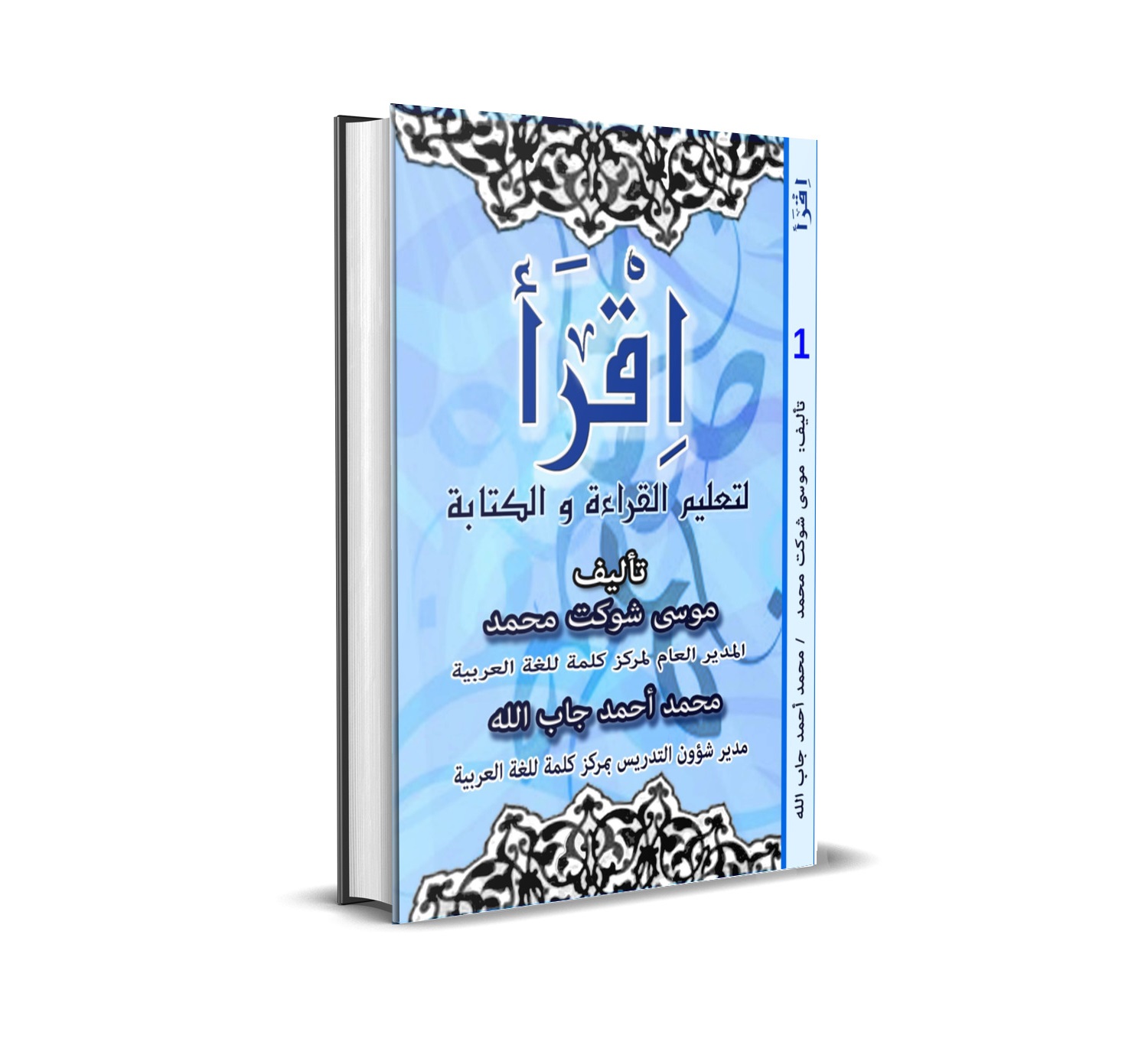
The traditional Islamic studies curriculum follows a progression: start with Al-Ajrumiyyah by Ibn Ajrum (foundational grammar), then Qatr al-Nada by Ibn Hisham (intermediate syntax), then Alfiyyat Ibn Malik (advanced grammar in verse form). For modern learners, Arabic Through the Quran by Alan Jones and Al-Kitaab series (Georgetown University Press) provide accessible entry points. For Sarf (morphology) specifically, Tasrif al-‘Izzi is the classical reference. Supplement textbooks with direct Quran reading using a Tafsir (like Tafsir al-Jalalayn for intermediate learners) to apply grammar in context.
Q7: Is Classical Arabic useful for my career in Germany?
Yes, in specific fields. Classical Arabic proficiency is valued in academic research (Islamic studies, Middle Eastern history, Arabic literature), translation and interpretation (legal, diplomatic, and literary translation), interfaith dialogue organizations, museum curation (Islamic art and manuscript collections in Berlin, Munich, Hamburg), journalism covering the Arab world, and intelligence/security analysis. Germany’s Federal Foreign Office (Auswärtiges Amt) and international organizations based in Germany (UNHCR, GIZ) also value Arabic language skills, with Classical Arabic providing the deepest linguistic foundation.