German residents can learn Arabic online through platforms like Kalimah Center, italki, Preply, ArabicPod101, and university distance programs. The best online Arabic courses offer Ijazah-certified native teachers, one-on-one sessions, and structured curricula covering MSA and dialects. Prices range from free (apps, YouTube) to €20–50/hour for live instruction.
Key factors when choosing: teacher qualifications, scheduling flexibility for German time zones, curriculum structure, and whether the platform offers a free trial. Most beginners reach basic conversational ability within 6–12 months of consistent online study.
Key Takeaway Table:
| Factor | Details |
|---|---|
| Best platforms from Germany | Kalimah Center, italki, Preply, ArabicPod101, Bayyinah TV |
| Price range | Free (apps) → €20/session (group) → €50/hour (private) |
| Format options | 1-on-1 video, group classes, self-paced, hybrid |
| Teacher qualifications to look for | Native speaker, Ijazah (for Quran), teaching certification, German/English fluency |
| Time to conversational level | 6–12 months (30 min/day) |
| Technology needed | Stable internet, webcam, mic, quiet space |
| Best for German residents | Platforms offering CET/CEST time zone scheduling |
Best Online Arabic Courses Available from Germany
Here’s an honest comparison of the top platforms accessible from Germany:
| Platform | Focus | Format | Price (approx.) | Free Trial | Best For |
| Kalimah Center | MSA, Quran, Tajweed | 1-on-1 & group (live) | €20/session (group), €50/hr (private) | ✅ Yes | Structured MSA + Quranic Arabic with Ijazah-certified teachers |
| italki | Any dialect or MSA | 1-on-1 (live) | €10–40/hr (varies by teacher) | ✅ Trial lesson | Conversational practice with individual teachers |
| Preply | Any dialect or MSA | 1-on-1 (live) | €12–50/hr (varies by teacher) | ✅ Trial lesson | Flexible scheduling, large teacher pool |
| Bayyinah TV | Quranic Arabic | Self-paced video | ~€11/month | ❌ (but free samples) | Understanding Quran in Arabic (Nouman Ali Khan) |
| ArabicPod101 | MSA + dialects | Self-paced audio/video | Free tier; Premium ~€8/month | ✅ Free tier | Listening practice, vocabulary building |
| Duolingo | MSA basics | Self-paced app | Free; Plus ~€7/month | ✅ Free tier | Absolute beginners wanting daily habit |
| Mondly | MSA + Egyptian | Self-paced app | Free tier; Premium ~€10/month | ✅ Free tier | Speech recognition practice |
| VHS Online | MSA (varies) | Group (live) | €50–150/semester | Varies | Budget-friendly structured courses |
| University programs | MSA, Classical Arabic | Group (live/recorded) | Free–€300/semester | Varies | Academic credit, formal certification |
How to read this table:
- For structured learning with teacher feedback: Kalimah Center, italki, or Preply
- For self-study supplementation: ArabicPod101, Duolingo, Bayyinah TV
- For budget learners: VHS online courses or free app tiers
- For Quranic Arabic specifically: Kalimah Center or Bayyinah TV
Disclosure: This article is published by Kalimah Center. We’ve included competitor platforms because we believe learners deserve honest, complete information to make the right choice.
Master Arabic with Kalimah Center
Join our expert-led online classes and start your journey toward Arabic fluency today.
Book Your Free TrialRead also: Learn Quranic Arabic in Germany
What Do Online Arabic Classes Actually Look Like?
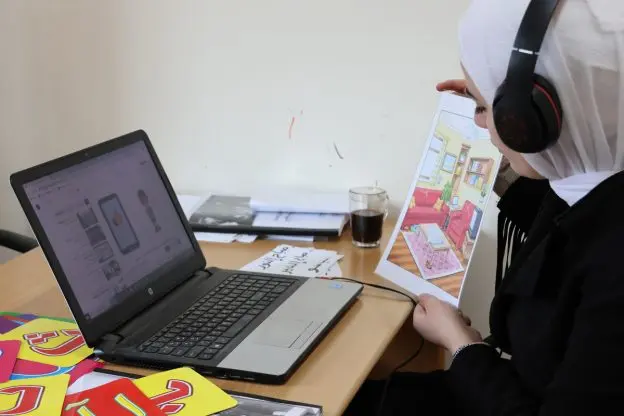
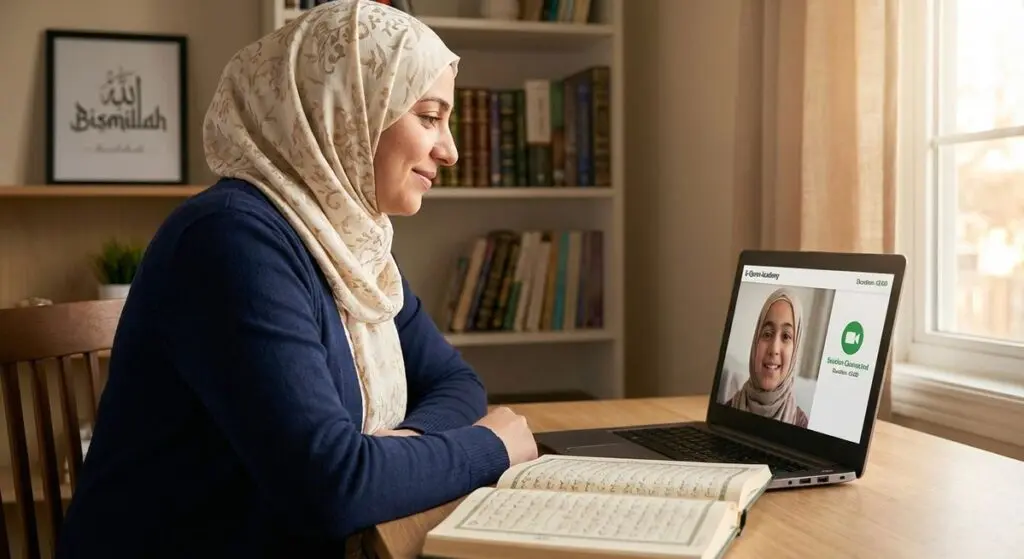
If you’ve never taken a live online language class, here’s exactly what to expect:
A Typical 1-Hour Private Lesson:
| Segment | Duration | What Happens |
| Warm-up | 5 min | Greet your teacher in Arabic; quick review of last lesson’s vocabulary |
| New material | 20 min | Teacher introduces new letters, grammar rules, or vocabulary with screen-sharing |
| Guided practice | 15 min | You practice reading, writing, or speaking while the teacher corrects in real-time |
| Conversation | 10 min | Apply what you’ve learned in a simple dialogue or scenario |
| Wrap-up | 5 min | Teacher assigns homework; previews next lesson’s topic |
| Homework (after class) | 15–30 min | Flashcard review, writing practice, or listening exercises |
A Typical Group Session (8–10 students):
- Teacher presents material via shared screen
- Students take turns reading aloud and answering questions
- Breakout rooms for paired conversation practice
- Group quizzes and vocabulary games
- Less individual speaking time than private lessons, but more affordable and social
Technology used:
Most platforms use Zoom, Google Meet, or custom video tools. Teachers share their screen to show Arabic text, use a digital whiteboard for writing demonstrations, and send materials via email or a learning portal. You’ll typically need:
- A laptop/tablet with camera and microphone
- Stable internet (10+ Mbps)
- A notebook for Arabic writing practice
- Optionally: a digital pen/tablet for on-screen writing
Experience Kalimah Center Classes
Watch real excerpts from our live sessions at Kalimah Center and see how we bring learning to life. These clips highlight our interactive, student-centered teaching approach across all our courses—designed to keep learners engaged, motivated, and actively involved every step of the way.
Read also: Learn Classical Arabic in Germany
What makes online Arabic learning different from other languages?
Arabic’s right-to-left script means screen-sharing and digital whiteboards are especially important — you need to see how your teacher writes letters and connects them in real-time. Good online Arabic teachers use large, clear fonts and write slowly during demonstrations. Many also provide downloadable practice sheets after each lesson.
How to Choose the Right Online Arabic Course from Germany
With dozens of platforms available, here are the five questions that matter most:
1. What are the teacher’s qualifications?
For MSA, look for teachers with degrees in Arabic language or education. For Quranic Arabic, an Ijazah (chain of certification back to the Prophet ﷺ) is essential. Native speakers are strongly preferred over non-native teachers, especially for pronunciation. Ask: Can I see the teacher’s credentials? Can I hear them recite or speak before committing?
2. Is it live or self-paced?
Live instruction with a real teacher is significantly more effective for beginners, especially for pronunciation correction. Self-paced apps are excellent supplements but shouldn’t be your only learning method. The ideal combination: 1–2 live sessions per week + daily self-study with apps.
3. Does the schedule work for Central European Time?
Many online Arabic teachers are based in Egypt, Jordan, or Saudi Arabia (1–2 hours ahead of CET). This actually works well — evening classes in Germany align with late-evening availability for teachers in the Middle East. Confirm timezone flexibility before enrolling.
4. Is there a free trial?
Never commit to a paid course without testing it first. A good free trial should include a real lesson (not just a sales pitch), a level assessment, and a chance to evaluate the teacher’s style. If a platform doesn’t offer a trial, treat that as a red flag.
5. What’s the curriculum structure?
Avoid platforms that offer random lessons with no progression path. Look for a clear sequence: alphabet → pronunciation → basic grammar → vocabulary → conversation → advanced topics. Ask to see a course outline or syllabus before enrolling.
Red flags to watch for:
- Teachers with no verifiable credentials
- No free trial or assessment
- “Learn Arabic in 30 days” promises
- No curriculum structure (just “conversation practice”)
- No Arabic script in materials (transliteration only)
Learning Arabic Online in Germany – Teachers

Our expert team of native Arabic teachers delivering online Arabic classes in Germany brings a wealth of linguistic knowledge and practical teaching experience to help you achieve your language goals with confidence:
- Personalized Coaching: Each lesson is tailored to your individual needs, learning style, and pace, ensuring effective progress.
- Focus on Modern Standard Arabic: Our instruction emphasizes Fus’ha, the formal Arabic ideal for academic, professional, and cultural contexts.
- Cultural and Practical Insights: Learn how Arabic is used in media, formal communication, and daily life both globally and within Germany’s diverse multicultural environment.
1. Teacher Abdullazim Ali
Abdullazim Ali is a native Arabic speaker with a strong background in Shariah and law. Having memorized the entire Holy Qur’an with Tajweed and holding an Ijazah in Quranic recitation, Abdullazim speaks fluent English and German. With over two years of teaching experience, he brings deep classical Arabic knowledge to engaging and accessible lessons.
2. Teacher Hussein Al-Sabbagh
Hussein Al-Sabbagh holds a Bachelor’s degree in Arabic Language and has over eight years of teaching experience. He is dedicated to refining students’ linguistic abilities through structured, interactive methods and delivers personalized Arabic and Quran instruction that adapts to each learner’s needs.
3. Teacher Mahmoud Sayed
Mahmoud Sayed is a native speaker who has memorized the Quran in four Qira’at styles and is fluent in French. With more than six years of Quran teaching experience and Ijazahs in multiple recitations like Shu’bah, Hafs, and Warsh, Mahmoud offers a unique blend of religious and linguistic expertise to learners from varied backgrounds.
4. Teacher Amr Ibrahim
Amr Ibrahim graduated from the Faculty of Dar Al Uloom with a degree in Arabic Language and Islamic Studies. Amr Ibrahim has over ten years of teaching experience. He specializes in teaching Arabic to non-native speakers using clear, practical strategies that accelerate learner progress efficiently.
5. Teacher Mohamed Shahat
Mohamed Shahat is a native Arabic speaker who studied Hadith and memorized the Quran with an Ijazah. Fluent in English and German, Mohamed is passionate about helping students build a personal and meaningful connection with the Quran through patient, tailored teaching approaches.
Meet all Quranic Arabic tutors and choose one that fits your learning style.
Read also: Learn Arabic in Germany
Online vs. In-Person Arabic Classes in Germany
| Factor | Online Classes | In-Person (VHS, Mosque, University) |
| Flexibility | ✅ Learn from anywhere, flexible scheduling | ❌ Fixed times and locations |
| Teacher pool | ✅ Access to native teachers worldwide | ⚠️ Limited to locally available teachers |
| 1-on-1 availability | ✅ Common and affordable | ❌ Rare; mostly group classes |
| Speaking time per lesson | ✅ High (especially private) | ⚠️ Shared among all students |
| Social/community aspect | ⚠️ Limited (depends on platform) | ✅ Strong — peer motivation, cultural immersion |
| Tech requirements | ⚠️ Need reliable internet + device | ✅ Show up with a notebook |
| Cost | ⚠️ Varies widely (€10–50/hr) | ✅ VHS: €50–150/semester; mosques: often free |
| Pronunciation correction | ✅ Good (if live with teacher) | ✅ Good |
| Writing practice | ⚠️ Requires digital tools or photo uploads | ✅ Natural pen-and-paper practice |
| Best for | Busy adults, remote learners, those wanting private instruction | Budget learners, those wanting classroom structure and peer interaction |
Best approach: Combine both. Use online private lessons for personalized instruction and pronunciation correction (1–2x/week) and attend a local VHS or community class for group practice and cultural immersion. This hybrid approach gives you the advantages of both formats.
Read also: Madinah Arabic Course in Germany: Where & How to Study
How to Stay Motivated When Learning Arabic Online
Online learning requires more self-discipline than in-person classes. Here’s what keeps successful learners on track:
1. Set micro-goals, not macro-goals
Instead of “become fluent in Arabic,” set weekly targets: “Learn 20 new words this week” or “Complete Noorani Qaida Lesson 5 by Friday.” Small wins build momentum.
2. Schedule lessons like appointments
Block your Arabic lesson time in your calendar as a non-negotiable appointment. Treat it the same way you’d treat a work meeting or doctor’s visit.
3. Find an accountability partner
Connect with another learner (through your course, online forums, or the Tandem app) and check in weekly on progress. Shared commitment dramatically reduces dropout rates.
4. Track your progress visually
Use a simple spreadsheet, app (like Ayah for Quran memorization), or a wall chart to mark completed lessons, memorized vocabulary, and milestones reached. Seeing your progress line grow is motivating.
5. Connect learning to your “why”
Remind yourself regularly why you started. Whether it’s reading the Quran, connecting with Arabic-speaking neighbors in Germany, advancing your career, or traveling — anchor your daily practice to your deeper motivation.
6. Use the “2-Day Rule”
Never skip two consecutive days. Missing one day is normal and human. Missing two days starts breaking the habit. Even 5 minutes of flashcard review on a busy day maintains your streak.
7. Reward yourself at milestones
Completed the alphabet? Treat yourself. Finished your first month of consistent study? Celebrate. Positive reinforcement works.
Read also: Learn Arabic in Germany: Beginner’s Guide, Tips & Resources
How to Incorporate Arabic Into Your Daily Routine in Germany
You don’t need to set aside hours. Here’s how to weave Arabic into your existing German daily life:
| Your Routine | Arabic Integration | Time Required |
|---|---|---|
| Morning commute (U-Bahn/S-Bahn) | Listen to an Arabic podcast or review flashcards on Anki | 15–20 min |
| Lunch break | Watch a 10-minute Arabic YouTube video | 10 min |
| Grocery shopping | Read Arabic labels at Turkish/Arabic supermarkets (found in most German cities) | 5 min |
| Cooking dinner | Follow an Arabic recipe video | 20 min |
| Before bed | Write 3 sentences in Arabic about your day | 10 min |
| Weekend | Visit an Arabic-speaking neighborhood; order food in Arabic | 30+ min |
At work (if applicable):
- Label your desk items with Arabic sticky notes
- Greet Arabic-speaking colleagues in Arabic
- Set your phone’s language to Arabic for one hour per day
- Listen to Arabic radio (BBC Arabic, MBC FM) during focused work tasks
The “German advantage”: Germany’s 3+ million Arabic speakers mean practice opportunities surround you. Most major cities have Arabic bakeries, restaurants, and shops where you can practice basic interactions. Unlike learners in countries with small Arabic communities, you can go from online lesson to real-world practice within the same day.
Free vs. Paid: What’s Worth Your Money?
| Resource Type | Free Option | Paid Option | Verdict |
|---|---|---|---|
| Vocabulary | Anki (community decks) | Anki (custom decks — same app) | ✅ Free is excellent |
| Alphabet learning | YouTube tutorials | Write It! Arabic app (€4) | ✅ Free is sufficient |
| Listening | YouTube, DW Arabic, podcasts | ArabicPod101 Premium (€8/mo) | ✅ Start free; upgrade for structure |
| Speaking practice | Tandem/HelloTalk (language exchange) | Live tutor on italki/Kalimah (€20–50/hr) | ⚠️ Free for casual practice; paid for correction |
| Grammar | YouTube explanations | Textbook (Al-Kitaab, €30–50) | ⚠️ Books worth the investment |
| Full structured course | Limited (VHS intro sessions, app trials) | Kalimah Center, Preply, university (€50–500) | 💰 Paid courses significantly accelerate progress |
| Quran recitation | YouTube reciters | Ijazah-certified teacher (€20–50/session) | 💰 Teacher essential for correct Tajweed |
Bottom line for German learners: You can learn Arabic alphabet and build basic vocabulary entirely for free. Once you need pronunciation correction, grammar guidance, and structured progression, investing in a qualified teacher (even once per week at €20/session) delivers dramatically faster results than self-study alone.
Read also: Arabic for Kids in Germany: Best Classes & Parent’s Guide
Start Your Online Arabic Journey with Kalimah Center
If you’re ready to learn Arabic online from Germany with qualified teachers, Kalimah Center offers:
- Ijazah-certified native Arabic teachers (many fluent in German and English)
- 1-on-1 and group classes — group sessions at €20/session (max 10 students), private lessons at €50/hour
- Flexible scheduling compatible with CET/CEST time zones
- Structured curriculum from complete beginner to advanced
- Free placement test + free trial class — test before you commit
Reviews on Our Arabic Courses
Our students consistently praise the quality of instruction, flexibility, and supportive environment provided by our online Arabic classes. Visit Trustpilot Reviews to read feedback from learners across Germany and beyond.

Master Arabic with Kalimah Center
Join our expert-led online classes and start your journey toward Arabic fluency today.
Book Your Free TrialConclusion
Learning Arabic online in Germany offers unmatched flexibility and access to quality instruction tailored to beginners. With experienced teachers, a supportive community, and a curriculum focused on practical communication and cultural understanding, you can confidently develop your Arabic skills at your own pace.
Whether you’re exploring where to learn Arabic in Germany or seeking the best online Arabic classes in Germany, this course opens the door to a rewarding and enriching language experience. Start today and unlock new personal and professional opportunities through Arabic.
Watch this video
FAQs about Learning Arabic Online in Germany
Q1: Is learning Arabic online as effective as in-person classes?
For most beginners, online Arabic classes are equally or more effective than in-person alternatives. One-on-one online sessions provide more speaking time per lesson than group classroom settings. The key factors for effectiveness are teacher quality, lesson consistency, and active practice outside class. The main disadvantage is the lack of peer interaction, which group online classes or language exchange partnerships can compensate for. Studies consistently show that learner motivation and consistency matter more than delivery format.
Q2: What technology do I need for online Arabic classes from Germany?
You need a stable internet connection (minimum 10 Mbps recommended for video calls), a computer or tablet with a webcam and microphone, and a quiet learning space. Most platforms use Zoom, Google Meet, or proprietary video tools. For writing practice, a digital pen/tablet (like Wacom) is helpful but not required — many students photograph handwritten work. Ensure your device can display Arabic script correctly (all modern devices support this natively). A second screen or printed materials alongside your video call can also improve the learning experience.
Q3: How do I choose the best online Arabic course from Germany?
Evaluate these five factors:
(1) Teacher qualifications — are they native speakers with teaching credentials or Ijazah certification?
(2) Curriculum structure — is there a clear progression from beginner to advanced?
(3) Scheduling flexibility — do they offer times that work in CET/CEST time zones?
(4) Free trial — can you test before committing?
(5) Reviews — check Trustpilot, Google Reviews, or student testimonials. Avoid platforms that only offer self-paced content with no live teacher interaction, as pronunciation correction requires real-time feedback.
Q4: Can I learn Arabic online for free in Germany?
You can start for free using apps (Duolingo, Anki), YouTube channels (ArabicPod101, Learn Arabic with Maha), and language exchange apps (Tandem, HelloTalk) to practice with native speakers. Deutsche Welle (DW) offers free Arabic-language content. Some mosques and community centers also offer free online Arabic classes. However, free resources have limitations — they rarely provide personalized pronunciation correction or structured progression. Most serious learners combine free tools for daily practice with paid live instruction (even once per week) for guided learning.
Q5: How many hours per week should I study Arabic online to make progress?
For steady beginner progress, aim for 4–6 hours per week total: 2 hours of live instruction (one or two sessions with a teacher) plus 2–4 hours of self-study (vocabulary review, listening practice, writing exercises). The FSI estimates Arabic requires approximately 2,200 class hours for professional proficiency, but basic conversational skills are achievable much sooner. The most important factor isn’t total hours but daily consistency — 30 minutes every day outperforms 3.5 hours on a single weekend day.