German residents can learn Arabic through local Volkshochschulen (VHS), university courses, online academies, and community language exchanges. For beginners, starting with Modern Standard Arabic (MSA/Fus’ha) provides the broadest foundation, while Egyptian or Levantine dialects are most useful for communicating with Germany’s Arabic-speaking communities.
Key first steps include mastering the 28-letter Arabic alphabet, learning 100 essential phrases, and practicing with native speakers — over 3 million Arabic speakers live in Germany. Certification options include telc Arabic exams and university placement tests.
Key Takeaway Table:
| Factor | Details |
|---|---|
| Best Starting Point | Modern Standard Arabic (Fus’ha) — universal foundation |
| Most Useful Dialects in Germany | Syrian/Levantine (largest community), Egyptian (most widely understood) |
| Arabic Speakers in Germany | 3+ million — practice opportunities in most major cities |
| Where to Learn | VHS, universities, online academies, mosque community courses, language exchange |
| Time to Basic Conversational Level | 6–12 months with consistent daily practice (30+ min) |
| Certification Options | telc Arabic, university placement exams, Goethe-Institut partner programs |
| Key First Step | Learn the 28-letter Arabic alphabet + basic pronunciation |
What Should Arabic Beginners in Germany Learn First?
Our beginner Arabic course covers six progressive modules: (1) Arabic script and pronunciation, (2) grammar basics and sentence building, (3) essential vocabulary for daily life in Germany, (4) listening skills with authentic Arabic audio, (5) speaking fluency through role-play scenarios relevant to life in Germany, and (6) practical application with an introduction to Arabic dialects. [See the full course curriculum →]
Below, we’ll cover the most important topics from these modules so you can start learning right now.
Module 1: Arabic Script & Pronunciation Foundations
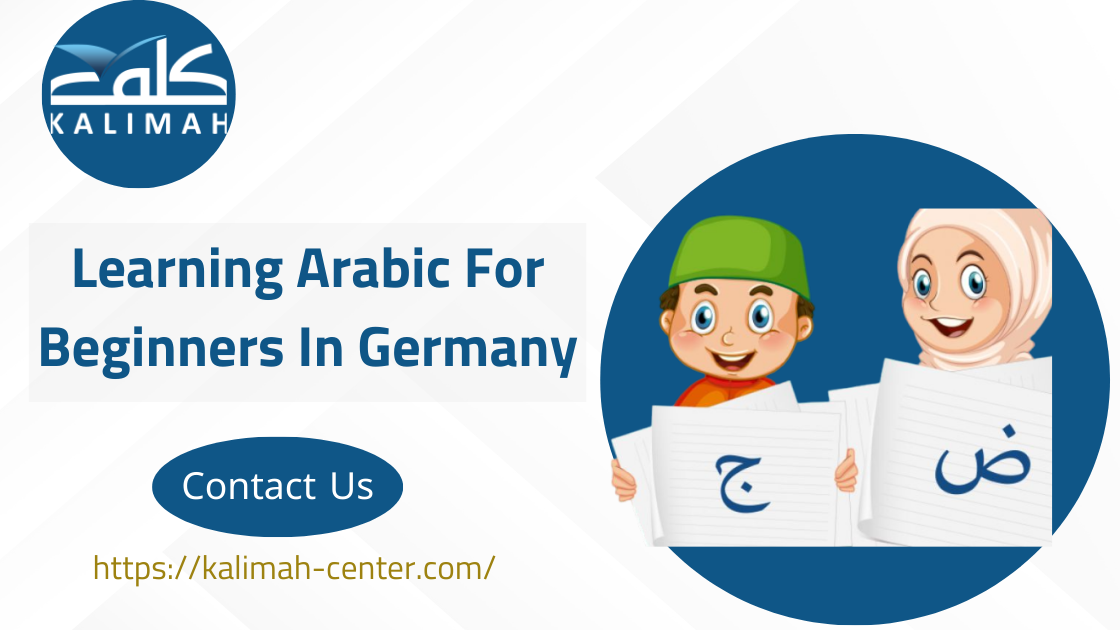
Start your Arabic learning journey by mastering the Arabic alphabet, letter shapes, and sounds. Gain the ability to recognize and write letters both individually and connected within words. Special attention is given to challenging sounds such as emphatic consonants and guttural letters to ensure clear and accurate pronunciation from the beginning.
- Letter Connection: Learn to link letters fluidly in writing.
- Sound Mastery: Practice distinct Arabic phonemes like ص (ṣād) and ع (ʿayn).
- Germany Context Drill: Practice Arabic words and names relevant to Germany’s diverse communities for practical fluency.
Module 2: Grammar Basics & Sentence Building
Learn how to construct grammatically correct sentences and communicate effectively in everyday situations.
- Gender and Case Agreement: Understand how nouns and adjectives agree in gender and case.
- Verb Conjugation: Use past, present, and future tenses in common contexts such as work, travel, and social interactions.
- Practical Task: Write simple emails or messages relevant to Germany’s multicultural environment.
Module 3: Essential Vocabulary & Common Expressions
Expand your vocabulary tailored to daily life, travel, dining, and professional settings in Germany.
- Themed Word Lists: Learn key vocabulary for shopping, ordering food, or attending community events.
- Memorization Tools: Use flashcards, mnemonic devices, and group activities for better retention.
- Quick Quizzes: Participate in mobile-friendly vocabulary tests designed for learning on the go.
Module 4: Listening Skills & Cultural Awareness
Enhance your listening comprehension with authentic Arabic audio materials and deepen your understanding of Arabic culture.
- Audio Resources: Listen to news, podcasts, and interviews from Arabic-speaking communities in Germany.
- Comprehension Exercises: Complete transcripts and join group discussions.
- Cultural Exploration: Discover how Arabic culture is celebrated locally through festivals and social gatherings.
Module 5: Speaking Fluency & Pronunciation Refinement
Gain confidence in speaking through practical dialogues and focused pronunciation exercises.
- Role Plays: Simulate real-life conversations such as greeting new people or ordering at cafes in Germany.
- Pronunciation Workshops: Improve intonation, stress, and rhythm with guided drills.
- Peer Feedback: Participate in small groups for instant feedback and encouragement.
Module 6: Practical Application & Future Learning Paths
Put your skills to work in real-world scenarios and explore options for further Arabic study.
- Scenario Practice: Engage in activities like negotiating business deals or planning travel in Arabic.
- Dialect Introduction: Receive an introductory overview of popular dialects such as Levantine or Egyptian Arabic.
- Learning Roadmap: Get personalized advice on next steps, whether for business Arabic, religious studies, or advanced language skills.
What to Expect After 6 Months of Learning Arabic
By completing this course, students can expect to:
1. Communicate Confidently in Basic Arabic
Engage in simple conversations, understand common expressions, and interact with Arabic speakers in Germany.
2. Read and Write Arabic Script
Develop the ability to read and write the Arabic alphabet with accuracy, facilitating further study or personal use.
3. Gain Cultural Understanding
Appreciate Arab customs and cultural nuances, enhancing your social interactions and intercultural competence.
4. Prepare for Advanced Learning
Build a strong foundation for intermediate and advanced Arabic courses or specialized fields such as Quranic studies or business Arabic.
5. Boost Cognitive Skills
Enhance memory, attention, and problem-solving through the mental exercise of learning a new language.
6. Open Professional and Academic Opportunities
Use your Arabic skills for career advancement, travel, or further academic pursuits within Germany and internationally.
Read also: Learn Quranic Arabic in Germany
The Arabic Alphabet Explained for German Speakers
Arabic uses 28 letters, written right-to-left. Unlike the Latin alphabet, most Arabic letters change shape depending on their position in a word (beginning, middle, end, or standalone). Here’s what German speakers need to know:
Key differences from the German alphabet:
| Feature | German | Arabic |
| Direction | Left to right | Right to left |
| Letter count | 26 (+ umlauts ä, ö, ü, ß) | 28 |
| Uppercase/lowercase | Yes | No — only one form per position |
| Vowels in writing | Always written | Short vowels often omitted |
| Letter connection | Letters are separate | Most letters connect to neighbors |
Sounds familiar to German speakers:
German actually shares several sounds with Arabic that other European languages lack:
| Arabic Sound | German Equivalent | Example |
| خ (Khaa) | “ch” in Bach, Nacht | خبز (khubz) = bread |
| ر (Raa) | Rolled R (Bavarian/Austrian German) | رجل (rajul) = man |
| ه (Haa) | “H” in Haus | هل (hal) = is/does (question word) |
Sounds that DON’T exist in German (practice these):
| Arabic Sound | How to Produce It | Practice Word |
| ع (Ayn) | Tighten throat muscles and push air through — like the start of a gentle gag | عين (‘ayn) = eye |
| ح (Haa) | Deep, breathy H — harder than German H, like fogging a mirror from deep in your throat | حب (hubb) = love |
| ص (Saad) | Emphatic S — press tongue flat against roof of mouth, say “S” with a heavier, darker tone | صباح (sabah) = morning |
| ض (Daad) | Emphatic D — press tongue sides against upper molars, say “D” with force | ضوء (daw’) = light |
| ق (Qaf) | Deep K from the very back of the throat — further back than German “K” | قلب (qalb) = heart |
Beginner tip: Start by learning 3-4 letters per day. Write each letter in all its positional forms (standalone, beginning, middle, end). Within 7–10 days, you’ll recognize the full alphabet. Use apps like “Write It! Arabic” for interactive practice.
German speaker advantage: Your familiarity with the ch sound (as in Bach) gives you a significant head start with Arabic خ— a sound that English speakers struggle with for months.
Master Arabic with Kalimah Center
Join our expert-led online classes and start your journey toward Arabic fluency today.
Book Your Free TrialRead also: Learn Classical Arabic in Germany
Which Arabic Dialect Should You Learn in Germany?
Germany is home to over 3 million Arabic speakers, predominantly from Syria, Iraq, Lebanon, Morocco, and Egypt. Your dialect choice should match your goals:
| Your Goal | Best Dialect | Why |
| Communicate with Arabic speakers in Germany | Syrian/Levantine Arabic | The majority of Arabic speakers in Germany (especially post-2015) have Syrian roots |
| Understand the widest range of Arabic media | Egyptian Arabic | Egypt’s film and music industry makes this the most universally understood dialect |
| Read, write, and use Arabic formally | Modern Standard Arabic (MSA) | Used in all written Arabic, news, academia, and official communication across 22 countries |
| Read the Quran and Islamic texts | Quranic/Classical Arabic | The language of the Quran, closely related to MSA but with classical grammar |
| Work in business with Gulf countries | Gulf Arabic | Relevant if your career involves Saudi Arabia, UAE, Qatar |
My recommendation: Start with MSA as your foundation. It’s understood everywhere, it’s the version taught in structured courses, and it gives you the grammatical framework to learn any dialect afterward. Once you have MSA basics (3–6 months), add a dialect based on your social circle or goals.
Germany-specific context: In cities like Berlin (Neukölln, Wedding, Moabit), Hamburg, Essen, and Cologne, you’ll hear Levantine Arabic daily. In Frankfurt and Munich, you’ll find more diverse Arabic-speaking communities. Knowing even basic Syrian Arabic phrases will immediately deepen your connections.
Read also: Arabic for Kids in Germany: Best Classes & Parent’s Guide
How to Practice Arabic in Your Daily Life in Germany
Living in Germany gives you unique advantages for Arabic practice that learners in many other European countries don’t have:
Daily Micro-Practices (5–15 minutes each):
| Time of Day | Activity | How |
| Morning commute | Listen to Arabic podcasts | ArabicPod101, BBC Arabic, DW Arabic |
| Lunch break | Review 10 flashcards | Anki app (Arabic deck) |
| Grocery shopping | Read Arabic product labels | Many German supermarkets carry Arabic-labeled products |
| Evening | Watch 20 min Arabic content | Netflix Arabic shows, YouTube channels |
| Before bed | Write 3 sentences in Arabic | Practice script in a notebook |
In-Person Practice Opportunities in Germany:
- Arabic restaurants and bakeries — order in Arabic (start with simple items: chai = tea, khubz = bread, shukran = thank you)
- Language exchange meetups (Sprachtandem) — platforms like Tandem, ConversationExchange, and local Stammtisch groups pair you with native Arabic speakers learning German
- Community centers and mosques — many offer free or low-cost Arabic conversation groups
- Arabic cultural festivals — cities like Berlin, Hamburg, and Cologne host Arabic cultural events year-round
- Volunteer work — organizations supporting Arabic-speaking refugees often welcome German speakers who are learning Arabic
At Work:
- Label common office items with Arabic sticky notes (كمبيوتر = computer, قلم = pen, مكتب = desk)
- Practice greetings with Arabic-speaking colleagues
- Set one weekly meeting or coffee chat in Arabic (even 5 minutes)
- Use Arabic numbers (٠١٢٣٤٥٦٧٨٩) when writing personal notes
Read also: Best Online Arabic Classes in Germany
Essential Arabic Vocabulary for German Speakers: 30 Words to Learn First
Start with high-frequency words you’ll use immediately. German speakers will notice some Arabic words have already entered German through Turkish or direct Arabic influence:
Greetings & Basics:
| Arabic | Transliteration | German | English |
|---|---|---|---|
| مرحبا | Marhaba | Hallo | Hello |
| السلام عليكم | As-salamu alaykum | Friede sei mit euch | Peace be upon you |
| شكراً | Shukran | Danke | Thank you |
| نعم | Na’am | Ja | Yes |
| لا | La | Nein | No |
| من فضلك | Min fadlak | Bitte | Please |
| كيف حالك؟ | Kayfa haluk? | Wie geht es dir? | How are you? |
| أنا بخير | Ana bikhayr | Mir geht es gut | I’m fine |
Words Already Familiar from German:
| Arabic | German Cognate | Connection |
|---|---|---|
| قهوة (qahwa) | Kaffee | Arabic → Turkish → German |
| سكر (sukkar) | Zucker | Arabic → Italian → German |
| صفر (sifr) | Ziffer | Arabic “zero” → German “cipher/digit” |
| مجلة (majalla) | Magazin | Arabic → French → German |
| الكحل (al-kuhl) | Alkohol | Direct Arabic → German |
| قطن (qutn) | Kattun (archaic: cotton fabric) | Arabic → German trade term |
Vocabulary Tips for German Speakers:
- Use your “ch” advantage: German ch (as in Buch) is nearly identical to Arabic خ — you already know this sound
- Create German-Arabic flashcards: Write the German word on one side and the Arabic on the other — your brain will create stronger connections than English-Arabic pairs
- Learn words in thematic groups: Focus on one topic per week (food, transport, greetings, work) rather than random word lists
- Use Arabic-German dictionaries: Langenscheidt and PONS both offer Arabic-German dictionaries (print and digital) that are more useful than Arabic-English resources for German speakers
Best Resources for Learning Arabic in Germany (2026)
Apps:
| App | Best For | Free/Paid | Language |
| Duolingo | MSA basics, daily habit building | Freemium | German interface available |
| Anki | Vocabulary retention (spaced repetition) | Free (desktop), paid (iOS) | Any language |
| Mondly | Conversational phrases, speech recognition | Freemium | German interface available |
| Tarteel AI | Quranic Arabic recitation feedback | Freemium | English/Arabic |
| Write It! Arabic | Alphabet writing practice | Paid (~€4) | English |
Books (Available in Germany):
- Arabisch für Dummies (Wiley) — German-language beginner guide
- Klett Langenscheidt Arabisch mit System — structured German-Arabic course
- Al-Kitaab series — standard university Arabic textbook
- PONS Arabisch Wörterbuch — comprehensive Arabic-German dictionary
In-Person Options:
- Volkshochschulen (VHS): Nearly every German city offers affordable Arabic courses (€50–€150 per semester). Search “VHS Arabisch” + your city.
- University language centers: Open to non-students at many institutions
- Mosque community classes: Often free, focused on Quranic Arabic
- Goethe-Institut partner programs: Some locations offer Arabic alongside their German programs
Online Platforms:
- Kalimah Center: Structured MSA courses with native Egyptian teachers, one-on-one and group options — [Start a free trial →]
- italki / Preply: Find individual Arabic tutors for conversation practice
- ArabicPod101: Audio/video lessons for self-study
- Deutsche Welle Arabic: Free Arabic-language news and learning content
Meet Our Arabic Teachers

Our team includes native Arabic speakers with backgrounds in linguistics, Islamic studies, and language education. Teachers hold Ijazah certifications in Quranic recitation and have 2–10+ years of teaching experience. Several are fluent in German and English, ensuring clear communication with beginners.
1. Teacher Abdullazim Ali
Abdullazim Ali is a native Arabic speaker with a strong background in Shariah and law. Having memorized the entire Holy Qur’an with Tajweed and holding an Ijazah in Quranic recitation, Abdullazim speaks fluent English and German. With over two years of teaching experience, he brings deep classical Arabic knowledge to engaging and accessible lessons.
2. Teacher Hussein Al-Sabbagh
Hussein Al-Sabbagh holds a Bachelor’s degree in Arabic Language and has over eight years of teaching experience. He is dedicated to refining students’ linguistic abilities through structured, interactive methods and delivers personalized Arabic and Quran instruction that adapts to each learner’s needs.
3. Teacher Mahmoud Sayed
Mahmoud Sayed is a native speaker who has memorized the Quran in four Qira’at styles and is fluent in French. With more than six years of Quran teaching experience and Ijazahs in multiple recitations like Shu’bah, Hafs, and Warsh, Mahmoud offers a unique blend of religious and linguistic expertise to learners from varied backgrounds.
4. Teacher Amr Ibrahim
Amr Ibrahim graduated from the Faculty of Dar Al Uloom with a degree in Arabic Language and Islamic Studies. Amr Ibrahim has over ten years of teaching experience. He specializes in teaching Arabic to non-native speakers using clear, practical strategies that accelerate learner progress efficiently.
5. Teacher Mohamed Shahat
Mohamed Shahat is a native Arabic speaker who studied Hadith and memorized the Quran with an Ijazah. Fluent in English and German, Mohamed is passionate about helping students build a personal and meaningful connection with the Quran through patient, tailored teaching approaches.
Meet all Quranic Arabic tutors and choose one that fits your learning style.
Why Choose Us for Learning Arabic for Beginners in Germany?
There are many reason to choose us, because:
1. Tailored Curriculum for German Learners
Our course content is designed specifically for learners residing in Germany, incorporating relevant cultural and social contexts.
2. Flexible Learning Options
Choose from in-person classes in major German cities or online lessons that fit your schedule.
3. Experienced Native Teachers
Learn from highly qualified native Arabic speakers with a passion for teaching and cultural exchange.
4. Supportive Learning Community
Join a vibrant community of learners and benefit from interactive sessions, forums, and practice groups.
5. Affordable and Transparent Pricing
We offer competitive course prices with options to suit different budgets and learning needs.
Reviews on Our Arabic Courses
Discover why students trust us for their Arabic learning journey by reading reviews on Trustpilot.
Course Prices
Choose the format that suits your lifestyle:
- Group Courses: €20 per session, twice a week, with small class sizes to ensure personal attention.
- Private Lessons: €50 per hour, fully personalized to your goals and pace.
All courses include a free placement test and a trial class to help you start with confidence.
Inside Kalimah Center: Moments from Our Courses
Get a glimpse into the vibrant learning experience at Kalimah Center. These snapshots capture real moments from our live classes—where students engage deeply, connect with passionate instructors, and grow in a welcoming, supportive environment.
Here Are The Reviews On Our Courses:
Our students frequently commend the excellence of our courses and the commitment shown by our instructors. You can read their complete reviews on Trustpilot.
Read more reviews on Trustpilot

Ready to Start Learning Arabic for Beginners in Germany?
Enroll today and begin your exciting journey into the Arabic language! Our expert teachers and comprehensive course materials make learning Arabic accessible, enjoyable, and effective—right here in Germany.
Visit the Kalimah Center to join Arabic classes that residents trust.
Thousands of students have trusted Kalimah Center to guide their Quran journey—and their voices say it best. From complete beginners to advanced learners, the feedback reflects sincere appreciation for the quality, consistency, and personal care they receive.
Book your free trial session now and see how fun, effective, and practical learning Arabic can be with Kalimah Center.
Master Arabic with Kalimah Center
Join our expert-led online classes and start your journey toward Arabic fluency today.
Book Your Free TrialConclusion
In conclusion, learning Arabic for beginners in Germany offers a unique opportunity to gain not only language skills but also cultural and religious insights that enrich your personal and professional life. With expert teachers, tailored lesson plans, and a focus on practical communication, you can confidently embark on your Arabic learning journey.
Whether your goal is to read the Qur’an, communicate in diverse communities, or enhance your career prospects, this course provides the essential foundation and ongoing support to help you succeed. Start today and open the door to a vibrant and rewarding language experience.
FAQs about Learning Arabic in Germany
Q1: Which Arabic dialect should I learn in Germany?
For maximum versatility, start with Modern Standard Arabic (MSA/Fus’ha) — it’s understood across all Arab countries and used in formal media, literature, and education. If you want to communicate with Germany’s largest Arabic-speaking community, learn Syrian/Levantine Arabic, as the majority of Arabic speakers in Germany have Syrian roots. Egyptian Arabic is the second most useful choice due to its wide recognition across the Arab world. Many learners study MSA for reading and writing while adding a dialect for conversation.
Q2: How can I practice Arabic in my daily life in Germany?
Germany offers abundant practice opportunities. Visit Arabic-speaking neighborhoods in cities like Berlin (Neukölln, Wedding), Hamburg, or Cologne. Attend Arabic cultural events, visit Arabic restaurants and shops, and join language exchange meetups (Tandem partners) through apps like Tandem or local Stammtisch groups. Listen to Arabic podcasts during your commute, switch your phone language to Arabic, and practice greetings with Arabic-speaking colleagues or neighbors. Many cities also have Arabic-language cultural centers and community organizations.
Q3: Can I get an Arabic language certification in Germany?
Yes. The telc (The European Language Certificates) organization offers Arabic language exams at multiple proficiency levels aligned with the Common European Framework of Reference (CEFR). Some German universities offer Arabic placement tests for academic programs. Additionally, certain Volkshochschulen (VHS) provide certificates upon course completion. For Quranic Arabic specifically, programs like Kalimah Center offer structured certification paths with Ijazah-certified instructors.
Q4: Is Arabic harder to learn for German speakers than other languages?
Arabic is classified as a Category III language by the FSI (Foreign Service Institute), meaning it typically requires more study hours than Romance or Germanic languages. However, German speakers have some advantages: both languages use grammatical cases, gendered nouns, and complex verb conjugation systems. The biggest challenges are learning the Arabic script (right-to-left), new phonetic sounds (like ع and ح), and the root-based word formation system. With consistent study, most German-speaking beginners achieve basic conversational ability within 6–12 months.
Q5: What free resources are available for learning Arabic in Germany?
Several free or low-cost options exist: Volkshochschulen (VHS) offer affordable Arabic courses in most German cities; apps like Duolingo (MSA), Anki (flashcards), and Mondly provide free tiers; YouTube channels like ArabicPod101 and Learn Arabic with Maha offer structured lessons; Deutsche Welle (DW) provides Arabic-language content useful for listening practice; and many mosques and Islamic cultural centers in Germany offer free or donation-based Arabic classes. University students can often audit Arabic courses for free.