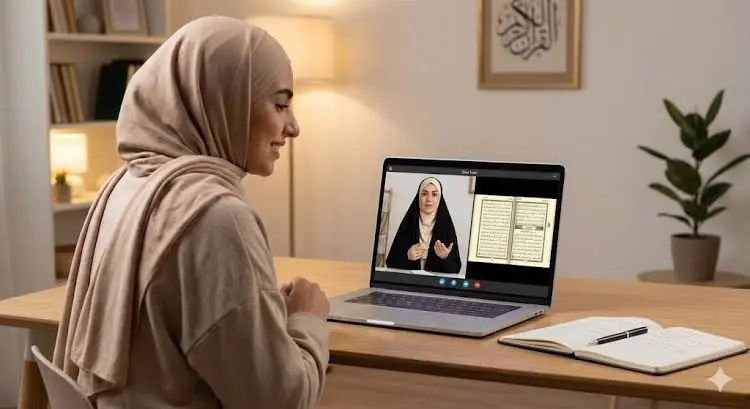
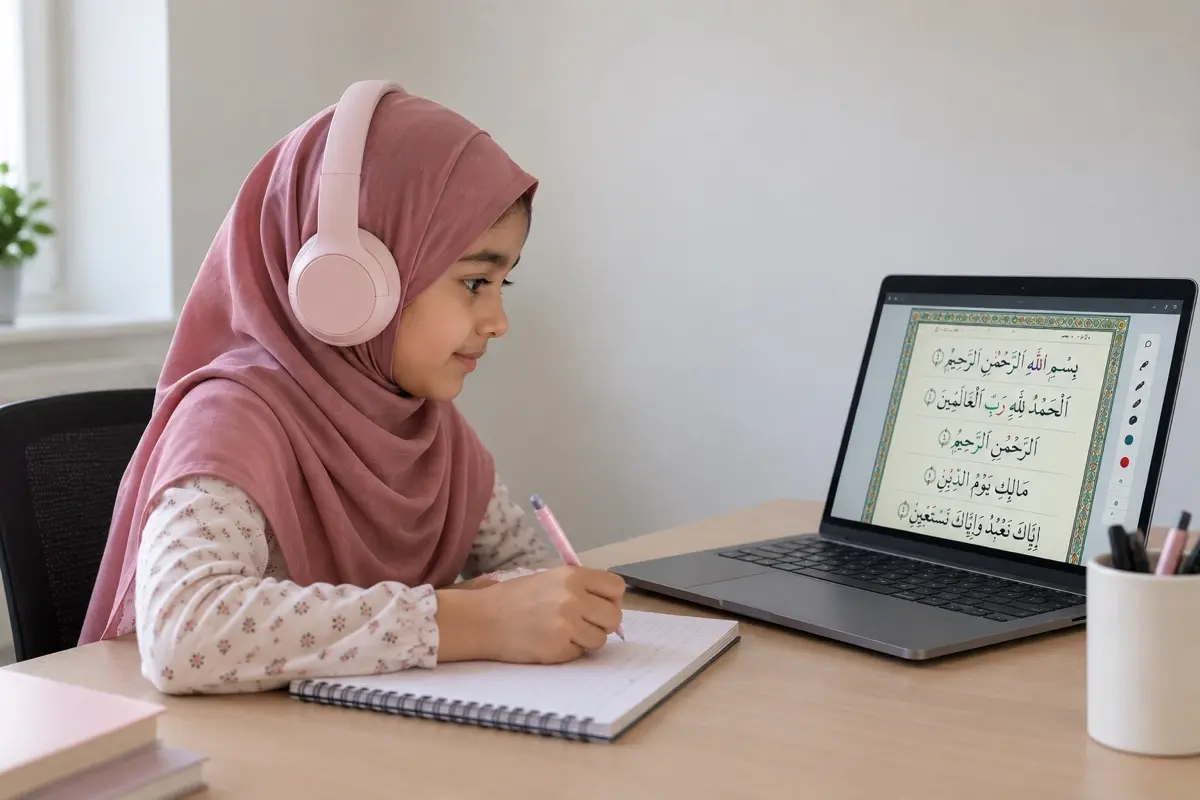
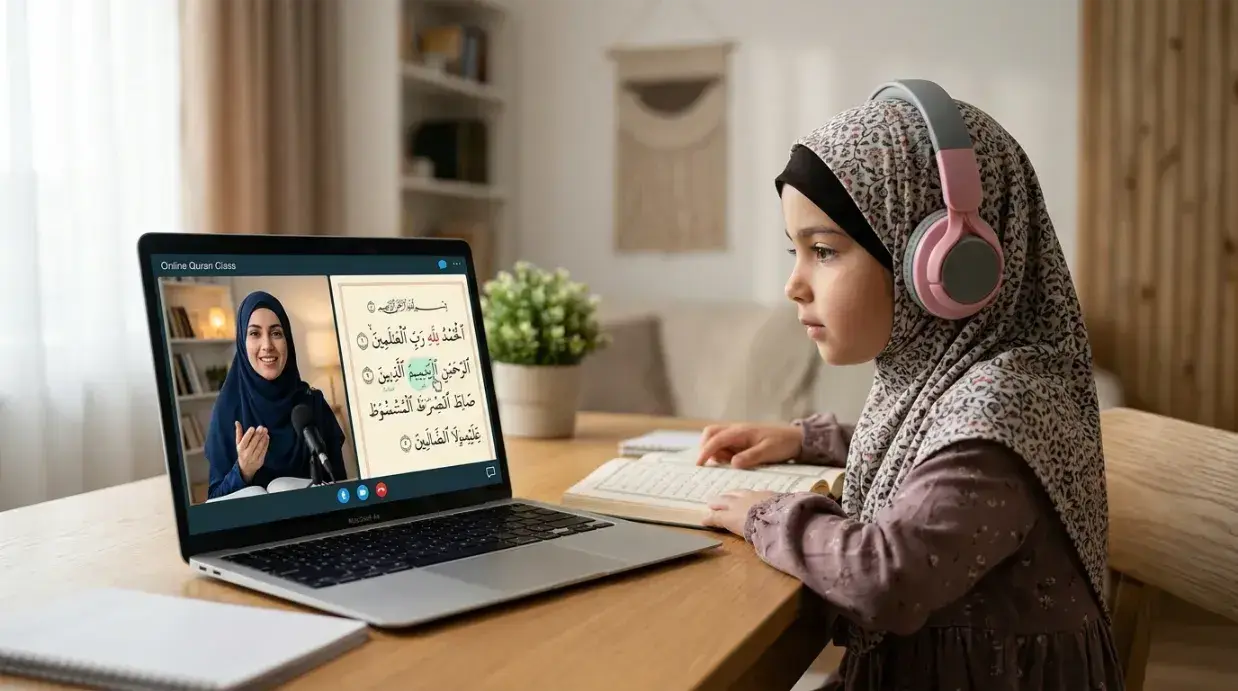
Muslims in Germany can study Quranic Arabic through mosque Tajweed circles (available in most cities, often free), online academies with CET-compatible scheduling, Islamic weekend institutes, and private tutors. Germany’s 5+ million Muslim population supports an extensive network of Quran study groups — from Berlin-Neukölln to Munich-Freimann. Group classes cost approximately €25/session, private Tajweed tutoring runs €60/hour, and many mosque programs are free.
Students can also pursue Tajweed Ijazah certification entirely online from Germany. The combination of accessible instruction and Germany’s large Arabic-speaking community makes it one of Europe’s best environments for Quranic Arabic study.
Key Takeaway Table:
| Factor | Germany-Specific Details |
|---|---|
| Where to study | Mosque Tajweed circles, online academies (Kalimah Center), Islamic institutes, private tutors |
| Cost | Free (mosque) → €25/session (group) → €60/hr (private) |
| Scheduling | Evening/weekend classes; CET/CEST compatible; Ramadan intensives |
| Cities with strongest programs | Berlin, Hamburg, Cologne, Frankfurt, Munich, Stuttgart, Essen |
| Ijazah from Germany? | Yes — online and in-person paths available |
| Muslim population | 5+ million — extensive community support network |
| Practice opportunities | Jumu’ah khutbahs, Taraweeh, Quran circles, Arabic-speaking neighbors |
What Is Quranic Arabic? (Quick Overview)
Quranic Arabic is a focused study of the Arabic language as it appears specifically in the Quran — covering the vocabulary, Tajweed (recitation rules), essential grammar patterns, and comprehension of Quranic verses. It’s distinct from full Classical Arabic study (which covers all pre-modern Arabic literature and deep grammar) and from Modern Standard Arabic (which focuses on contemporary communication).
Key facts:
- The Quran uses ~1,700 unique root words, but just ~300 roots cover 80% of the text
- Tajweed rules govern correct pronunciation and recitation
- You don’t need to become an Arabic grammar scholar to understand what you recite in Salah
- Meaningful comprehension of short Surahs is achievable within 6–12 months
The rest of this article focuses specifically on how to study Quranic Arabic while living in Germany — where to find classes, how to leverage Germany’s Muslim community for practice, and how to build a study routine around German daily life.
Read more about: Quranic Arabic
Why Germany Is an Ideal Place to Study Quranic Arabic
Germany offers advantages for Quranic Arabic study that most European countries can’t match:
1. Europe’s Largest Muslim Community Infrastructure
With over 5 million Muslims and approximately 2,500 mosques across the country, Germany has the most developed Islamic educational infrastructure in Western Europe. Almost every German city — and many smaller towns — has at least one mosque offering some form of Quran instruction. Larger cities have dozens of options across different Islamic traditions and teaching styles.
2. Year-Round Practice Environment
Unlike studying in isolation, Muslims in Germany hear Quranic Arabic regularly: during Jumu’ah khutbahs, in Quran study circles, at community events, during Ramadan Taraweeh prayers, and through Germany’s Arabic-speaking population. This ambient exposure reinforces classroom learning in a way that textbooks alone cannot.
3. Diverse Teaching Traditions
Germany’s Muslim community comes from across the Arab world, Turkey, South Asia, and Africa. This means you’ll find Quran teachers trained in different scholarly traditions — from Al-Azhar-trained Egyptian scholars to Turkish Diyanet-trained Hafiz to South Asian Dars-e-Nizami graduates. This diversity lets you find a teaching style that resonates with you.
4. Flexible Online Access
Germany’s strong internet infrastructure supports seamless video-based Quran lessons. CET/CEST timezone positioning works well with teachers based in Egypt, Jordan, and Saudi Arabia (1–2 hours ahead), meaning evening classes in Germany align with teacher availability in the Middle East.
5. Integration with Daily Spiritual Life
For Muslims living in Germany, Quranic Arabic study isn’t abstract — it immediately enhances your daily Salah, your Ramadan experience, your ability to follow khutbahs, and your engagement with community religious activities. Every lesson has a same-day application.
6. Community Motivation
Studying alongside fellow German Muslims — whether in a mosque halaqah or an online class group — provides accountability, encouragement, and shared purpose that dramatically improves consistency and completion rates compared to solo study.
Read also: Learn Classical Arabic in Germany
Where to Find Quranic Arabic and Tajweed Classes in Germany
Here’s a complete overview of every pathway available to German residents:
| Option | What It Covers | Format | Cost | Tajweed Depth | Best For |
|---|---|---|---|---|---|
| Mosque Tajweed halaqat | Quran recitation, basic–intermediate Tajweed | In-person, weekly (1–2 hrs) | Free–€20/month | Moderate–High (depends on teacher) | Regular practice, community, all levels |
| Online academies (e.g., Kalimah Center) | Structured Tajweed + vocabulary + grammar curriculum | Live video, 1-on-1 or group | €25–60/session | High (systematic curriculum) | Systematic progression, Ijazah path |
| Islamic weekend schools (Wochenendschulen) | Quran reading, Tajweed, Islamic studies | In-person, weekends (2–4 hrs) | €20–50/month | Moderate | Children, families |
| Private Tajweed tutors | Personalized recitation correction | In-person or online | €20–60/hour | High (individual attention) | Focused pronunciation work, advanced students |
| University Islamic studies | Academic Quranic Arabic, text analysis | Semester courses | Free (enrolled students) | Academic approach | Scholarly analysis, academic credit |
| Self-study with apps | Vocabulary, listening, basic Tajweed | Independent | Free–€11/month | Low (no teacher correction) | Supplementary practice only |
| Quran memorization (Hifz) programs | Full memorization with Tajweed | In-person or online, intensive | Varies | Very High | Students pursuing full Quran memorization |
Which option to choose based on your goal:
| Your Goal | Recommended Path | Why |
|---|---|---|
| Understand what I recite in Salah | Online structured course + self-study apps | Systematic vocabulary and grammar progression |
| Improve my Tajweed/recitation quality | Mosque halaqah + private tutor (occasionally) | Regular practice with teacher ear for correction |
| Earn a Tajweed Ijazah | Online academy with Ijazah-certified instructor | Requires systematic long-term teacher relationship |
| Teach my children Quran | Islamic weekend school + home practice | Children need peer environment + parental reinforcement |
| Academic study of the Quran | University program + supplementary Tajweed instruction | Academic credit + proper recitation skills |
| Memorize the entire Quran (Hifz) | Dedicated Hifz program (mosque or online) + Tajweed teacher | Requires intensive, specialized methodology |
Master Arabic with Kalimah Center
Join our expert-led online classes and start your journey toward Arabic fluency today.
Book Your Free TrialRead also: Best Online Arabic Classes in Germany
How to Fit Quranic Arabic Study Into Your German Daily Life
German daily routines are structured — use that structure to your advantage. Here’s how Muslims across Germany integrate Quran study:
For working professionals (Vollzeit/Teilzeit):
| Time Slot | Activity | How |
|---|---|---|
| Fajr + 15 min | Quran reading with word-by-word translation | Read 5–10 verses from where you left off yesterday. Use Quran.com word-by-word feature. |
| Morning commute (S-Bahn/U-Bahn/car) | Listen to Quran recitation or vocabulary review | Play Sheikh Al-Husary (Mu’allim version) and follow silently; or review Anki flashcards |
| Lunch break (15 min) | Study 5 new Quranic vocabulary words | Use Quranic app or printed word list |
| Evening (after work, 1–2x/week) | Online Tajweed class | 60–90 min structured lesson with teacher |
| Before bed (10 min) | Recite what you’ve memorized; review Tajweed rules | Recite aloud; self-correct using Tarteel AI app |
| Weekend (Saturday or Sunday, 1 hr) | Attend mosque halaqah OR extended self-study | Review week’s learning; practice longer recitation passages |
| Weekly total | ~6–8 hours |
For university students:
| Opportunity | How to Use It |
|---|---|
| Gaps between lectures | Review Quranic vocabulary flashcards in the Mensa or library |
| University library | Access Arabic linguistic resources and Tafsir collections |
| Prayer room (Gebetsraum) | Many German universities have Muslim prayer rooms — recite and practice there |
| Muslim student associations (MSA / Muslimische Studierendenvereinigung) | Join or form a Quran study circle with fellow students |
| Semester breaks | Intensive Quran study periods — some students complete entire Madinah books during Semesterferien |
For parents at home:
| Time Slot | Activity |
|---|---|
| During Kita/school hours | Online private lesson (morning or early afternoon) |
| After children’s bedtime | Self-study or online group class (evening session) |
| With children | Study together — children can learn alongside you; makes it a family activity |
| Weekend mosque visit | Attend family Quran program while children attend their own class |
Seasonal optimization (Germany-specific):
- Winter (Oct–Mar): Germany’s long, dark evenings are ideal for extended Quran study. Fajr is later (~7:00–8:00), making morning study before work feasible. Maghrib is early (~16:00–17:00), creating a natural evening study block.
- Summer (Apr–Sep): Fajr is very early (~4:00–5:00) — some students use the quiet pre-dawn hours for memorization. Longer daylight hours make evening mosque visits easier.
- Ramadan: The most productive period for Quranic Arabic study. Taraweeh prayers provide 1–2 hours of Quran listening nightly. Many mosques offer special Ramadan Tajweed intensives. Fasting naturally reduces distractions and increases focus. Use the Ramadan momentum to establish habits that carry into the rest of the year.
The German work-life balance advantage: Germany’s strong labor protections (regulated working hours, generous Urlaub) actually support language study better than many other countries. Use vacation days for intensive study retreats, and protect your evening study time as firmly as you protect your Feierabend.
Quranic Arabic for Muslim Families in Germany
For Muslim families in Germany, passing Quranic Arabic to the next generation requires intentional effort — German is the dominant language of school, society, and media. Here’s how families across Germany approach this:
For children (ages 4–12):
| Approach | Where/How | Cost | Effectiveness |
|---|---|---|---|
| Islamic weekend school | Saturday/Sunday programs at mosques | €20–50/month | Good — peer learning, structured curriculum |
| Online Quran class for kids | Platforms like Kalimah Center, Quran Academy | €25–60/session | Good — personalized attention, flexible |
| Parent-taught at home | Daily Quran reading together (10–15 min) | Free | Excellent supplement — but requires parent knowledge |
| Arabic-language Quran apps | Quranic, Quran for Kids | Free–€5/month | Good for vocabulary reinforcement |
| Summer Quran camps | Some mosques and organizations run Quran-focused summer programs | Varies | Excellent for intensive progress during school holidays |
For families studying together:
- Shared daily routine: Read one Quran page together after Maghrib — parents and children take turns reciting
- Family vocabulary game: Each week, choose 5 Quranic words. Everyone tries to spot them during the week in Quran recitation, du’as, or khutbahs
- Ramadan family challenge: Set a family goal for Ramadan (e.g., read through Juz 30 together, or memorize a new Surah as a family)
- Car/commute listening: Play Quran recitation during car trips instead of radio — normalize the sound of Quran in daily life
The bilingual challenge (German + Quranic Arabic):
Children growing up in Germany will naturally dominant in German. Quranic Arabic won’t develop automatically through passive exposure — it requires structured instruction. However, unlike conversational Arabic (which competes with German), Quranic Arabic has a clear, bounded curriculum (Tajweed + vocabulary + key Surahs) that children can master alongside their German schooling without overwhelming them. Think of it as learning to read music — a specific, learnable skill rather than an entire second language.
What German Muslim parents should know:
- Starting Quran instruction at age 5–6 is ideal — children at this age absorb pronunciation patterns naturally
- 15–20 minutes of daily practice is sufficient for children; consistency matters more than session length
- Mix instruction formats: weekend school for community, online class for structure, home practice for reinforcement
- Never make Quran study feel like punishment — associate it with positive experiences, family time, and achievement celebrations
- Many children in Germany memorize Juz ‘Amma (the 30th Juz) by age 8–10 through consistent weekend school + home practice
Read also: Learn Arabic in Germany
Complete Cost Breakdown: Quranic Arabic Study in Germany
| Category | Option | Monthly Cost | Annual Cost |
|---|---|---|---|
| Mosque Tajweed halaqah | Free or donation-based | €0–20/month | €0–240/year |
| Online group classes (e.g., Kalimah Center) | 2 sessions/week @ €25 each | ~€200/month | ~€2,400/year |
| Online private Tajweed lessons | 1 session/week @ €60 | €240/month | ~€2,880/year |
| Online private lessons | 2 sessions/week @ €60 | €480/month | ~€5,760/year |
| Islamic weekend school (children) | Weekly program | €20–50/month | €240–600/year |
| Private local tutor | 1 session/week | €80–200/month | €960–2,400/year |
| Self-study resources | Apps + free online materials | €0–11/month | €0–132/year |
| Physical Mushaf + Tajweed books | One-time purchase | — | €20–50 total |
Most popular combinations among German Muslims:
| Profile | Combination | Monthly Budget |
|---|---|---|
| Budget student | Free mosque halaqah + free apps + self-study | €0–20/month |
| Working professional | Online group classes (2x/week) + mosque halaqah (1x/week) | ~€200–220/month |
| Serious student (Ijazah goal) | Online private lessons (2x/week) + daily self-study | ~€480/month |
| Family (parent + child) | Parent: online group class. Child: weekend school + home practice | ~€225–250/month |
Tax deduction tip for German taxpayers: Language learning costs may be deductible as Werbungskosten (work-related expenses) if Arabic is relevant to your profession, or as Sonderausgaben (special expenses) for continuing education. This applies to course fees, textbooks, and even travel to classes. Consult your Steuerberater or include the costs in your annual Steuererklärung. While Quranic Arabic specifically is harder to claim than general Arabic, the language skills themselves are the deductible element.
Financial assistance: Some mosques and Islamic organizations offer fee waivers or scholarships for families who cannot afford private instruction. Ask your mosque’s social committee or local Islamic welfare organization (e.g., Islamic Relief Deutschland) about support options.
Expert German and Arabic Teachers
Our dedicated team of native Arabic teachers in Germany combines deep linguistic knowledge with extensive practical teaching experience to deliver high-quality Arabic and Qur’anic instruction:
- Personalized Coaching: Lessons tailored to your goals, whether you’re a beginner or seeking advanced Qur’anic understanding.
- Focus on Qur’anic Arabic: Emphasis on Fus’ha (Classical Arabic), perfect for religious study, cultural appreciation, and deeper comprehension of the Qur’an.
- Practical Insights: Learn how Qur’anic Arabic is applied in recitation, tafsir, and Islamic scholarship within Germany’s diverse multicultural context.
1. Teacher Abdullazim Ali
Abdullazim Ali is a native Arabic speaker with a strong background in Shariah and law. Having memorized the entire Holy Qur’an with Tajweed and holding an Ijazah in Quranic recitation, Abdullazim speaks fluent English and German. With over two years of teaching experience, he brings deep classical Arabic knowledge to engaging and accessible lessons.
2. Teacher Hussein Al-Sabbagh
Hussein Al-Sabbagh holds a Bachelor’s degree in Arabic Language and has over eight years of teaching experience. He is dedicated to refining students’ linguistic abilities through structured, interactive methods and delivers personalized Arabic and Quran instruction that adapts to each learner’s needs.

3. Teacher Mahmoud Sayed
Mahmoud Sayed is a native speaker who has memorized the Quran in four Qira’at styles and is fluent in French. With more than six years of Quran teaching experience and Ijazahs in multiple recitations like Shu’bah, Hafs, and Warsh, Mahmoud offers a unique blend of religious and linguistic expertise to learners from varied backgrounds.
4. Teacher Amr Ibrahim
Amr Ibrahim graduated from the Faculty of Dar Al Uloom with a degree in Arabic Language and Islamic Studies. Amr Ibrahim has over ten years of teaching experience. He specializes in teaching Arabic to non-native speakers using clear, practical strategies that accelerate learner progress efficiently.
5. Teacher Mohamed Shahat
Mohamed Shahat is a native Arabic speaker who studied Hadith and memorized the Quran with an Ijazah. Fluent in English and German, Mohamed is passionate about helping students build a personal and meaningful connection with the Quran through patient, tailored teaching approaches.
Meet all Quranic Arabic tutors and choose one that fits your learning style.
Inside Kalimah Center: Moments from Our Courses
Get a glimpse into the vibrant learning experience at Kalimah Center. These snapshots capture real moments from our live classes—where students engage deeply, connect with passionate instructors, and grow in a welcoming, supportive environment.
Study Quranic Arabic with Kalimah Center from Germany
Kalimah Center offers structured Quranic Arabic and Tajweed courses for German residents:
- Group classes: €25/session (max 8 students), 2 hours, twice weekly — evening and weekend slots
- Private Tajweed: €60/hour — one-on-one pronunciation correction and recitation guidance
- Ijazah pathway with certified instructors trained at Al-Azhar
- Scheduling designed for German work/school hours (CET/CEST)
- Free placement test + free trial class
- Courses for adults and children
Here Are the Reviews on Our Learn Quranic Arabic in Germany Course
Discover what our students have to say about their experience learning Qur’anic Arabic with the Kalimah Center. From beginners to advanced learners, students across Germany praise our engaging teaching style, knowledgeable instructors, and supportive learning environment. Read their full feedback and ratings on Trustpilot to see why so many choose us for their Qur’anic Arabic studies.

Master Arabic with Kalimah Center
Join our expert-led online classes and start your journey toward Arabic fluency today.
Book Your Free TrialConclusion
Learning Qur’anic Arabic in Germany opens the door to a deeper understanding of the Qur’an, Islamic heritage, and the beauty of the Arabic language. At the Kalimah Center, we provide a structured, engaging, and personalized approach that caters to learners of all backgrounds and proficiency levels. With expert native-speaking teachers, flexible learning options, and a supportive community, your journey becomes both enriching and enjoyable.
Whether your goal is to strengthen your spiritual connection, advance your academic pursuits, or gain valuable linguistic skills, our Learn Qur’anic Arabic in Germany course equips you with the tools, confidence, and knowledge to succeed. Enroll today and take the first step toward unlocking the timeless wisdom of the Qur’an.
FAQS about Learn Quranic Arabic in Germany
Q1: Where can I take Tajweed classes in Germany?
Tajweed instruction is widely available across Germany through multiple channels. Nearly every mosque in major German cities offers weekly Quran recitation circles — often free or donation-based. In Berlin alone, mosques in Neukölln, Wedding, Moabit, and Tempelhof run regular Tajweed halaqat. Online academies like Kalimah Center offer structured Tajweed courses with Ijazah-certified instructors at evening and weekend times compatible with German schedules. Many Islamic weekend schools (Wochenendschulen) include Tajweed as part of their children’s programs. For personalized correction, private tutors are available both locally and online through platforms like italki. Contact your nearest mosque and ask specifically for “Tajweed-Kurs” — many programs exist but aren’t widely advertised.
Q2: Can I earn a Tajweed Ijazah while living in Germany?
Yes, absolutely. An Ijazah can be earned both in-person (through qualified local teachers at mosques who hold their own Ijazah) and online (through video-call sessions with certified instructors). Online Ijazah is fully valid in Islamic scholarship — the requirement is that the teacher hears your recitation clearly and can correct it in real-time, which modern video technology supports perfectly. Several Kalimah Center instructors hold Ijazahs from Al-Azhar University and can guide German-based students through the certification process. For a Tajweed rules Ijazah (without full Quran memorization), expect 6–12 months of focused study. For a full Ijazah in Hafs ‘an ‘Asim (requiring complete Quran memorization), the timeline is typically 2–5 years.
Q3: How do I find a Quran teacher in my German city?
Start with your local mosque — most mosques in Germany offer some form of Quran instruction, even if they don’t advertise it online. Ask the imam or board directly: “Gibt es einen Tajweed-Kurs oder Quran-Lehrer?” (“Is there a Tajweed course or Quran teacher?”). Check mosque bulletin boards and community WhatsApp groups. For cities without local options (smaller towns, rural areas), online Quranic Arabic classes provide identical quality of instruction — you’re not disadvantaged by location. Islamic centers in larger cities (Berlin Islamic Center, Al-Nour Mosque Hamburg, Islamic Center Munich) often maintain lists of qualified Quran teachers in the region. Social media groups like “Muslime in [your city]” on Facebook can also connect you with local study circles.
Q4: Is it better to study Quranic Arabic at a German mosque or online?
Both have advantages. Mosque Tajweed circles offer community connection, peer motivation, and often free or low-cost instruction — plus you can attend Jumu’ah and other prayers in the same visit. Online classes offer flexible scheduling (crucial for German working professionals), access to teachers worldwide (not limited to locally available instructors), one-on-one attention for pronunciation correction, and recorded sessions for review. Many German Muslims combine both: they attend a weekly mosque halaqah for community and practice, while taking structured online lessons for systematic curriculum progression. For children, in-person mosque programs often work better due to the social element. For busy adults, online private lessons are typically more efficient.
Q5: How much does Quranic Arabic instruction cost in Germany?
Costs vary significantly by format. Mosque Tajweed circles are typically free or donation-based (€0–20/month). Structured online group classes at academies like Kalimah Center cost approximately €25 per 2-hour session (twice weekly = ~€200/month). Private one-on-one online tutoring runs €60/hour. VHS (Volkshochschule) courses that include some Quranic content cost €50–150 per semester. Islamic weekend schools for children charge €20–50/month. The Quran itself and many supplementary resources are free. For German taxpayers, language course costs may qualify as Weiterbildungskosten (continuing education expenses) and be partially tax-deductible — consult your Steuerberater for specifics.
Q6: How can I practice Quranic Arabic outside of class while living in Germany?
Germany offers more Quranic Arabic practice opportunities than almost any other European country. Attend Jumu’ah prayers — most German mosques deliver khutbahs partly or fully in Arabic. During Ramadan, attend Taraweeh prayers to hear extended Quran recitation nightly — follow along in your Mushaf and try to recognize vocabulary you’ve learned. Join or form a Quran study circle (halaqah) with fellow Muslims in your city. Listen to Quran recitation during your S-Bahn/U-Bahn commute. Volunteer as a Quran reading helper at your local mosque’s weekend school — teaching reinforces your own learning. Visit Arabic-speaking neighbors and community members who can help with pronunciation. Many German cities also host Quran recitation competitions (Musabaqat) where you can listen to excellent reciters and be inspired.