If you’re comparing Arabic to Mandarin, Vietnamese, or Thai, you’ve probably asked yourself: is Arabic a tonal language? The short answer is no — Arabic doesn’t use pitch to change the meaning of a word.
But that raises a more useful question that most learners actually mean to ask: is Arabic phonetic? That answer is yes, and understanding why changes how you should approach reading and pronunciation from day one.
This article breaks down what “tonal” really means, why Arabic doesn’t qualify, and what makes Arabic’s sound system phonetic instead. You’ll also get practical guidance for reading Arabic accurately, whether you’re starting from zero or already working through your first texts with Kalimah Center.
What You’ll Learn in This Article
- The real difference between a tonal language and a phonetic language
- Why Arabic is not tonal, with a direct comparison to true tonal languages
- Why Arabic is considered highly phonetic — and where that breaks down in real texts
- The role diacritics (harakat) play in Arabic pronunciation
- Common sound and reading challenges Arabic learners run into, and how to handle them
Is Arabic A Tonal Language?
A tonal language is one where the pitch you use to say a word changes its meaning, not just its emotion or emphasis. In Mandarin Chinese, for example, the syllable “ma” said with four different tones produces four completely different words: mother, hemp, horse, and a scolding term. The pitch itself carries grammatical or lexical information.
Vietnamese and Thai work the same way — rising, falling, and level pitch patterns are built into the vocabulary itself. Without matching the correct tone, a word is simply wrong, not just accented oddly.
Arabic does not work this way. Meaning in Arabic comes from consonant roots, vowel patterns, and grammatical structure — not from pitch. You can say a word with a rising, flat, or falling intonation and it will still mean the same thing.
Intonation in Arabic changes tone of voice (a question versus a statement, for instance), the same way it does in English, but it never flips one word into an unrelated one the way tone does in Mandarin.
This is the core reason the answer to “is Arabic a tonal language” is no: Arabic’s meaning-carrying unit is the letter and the vowel mark, not musical pitch.
Is Arabic a Phonetic Language?
Since Arabic isn’t tonal, the more accurate question learners are usually reaching for is whether Arabic is phonetic. It is — Arabic has one of the closest matches between written letters and spoken sounds of any major world language, provided the text is fully vocalized.
In its complete written form, every consonant sound has its own letter, and every vowel sound — short or long — has its own mark. Read a fully vocalized word correctly once, and you can reproduce its pronunciation exactly every time.
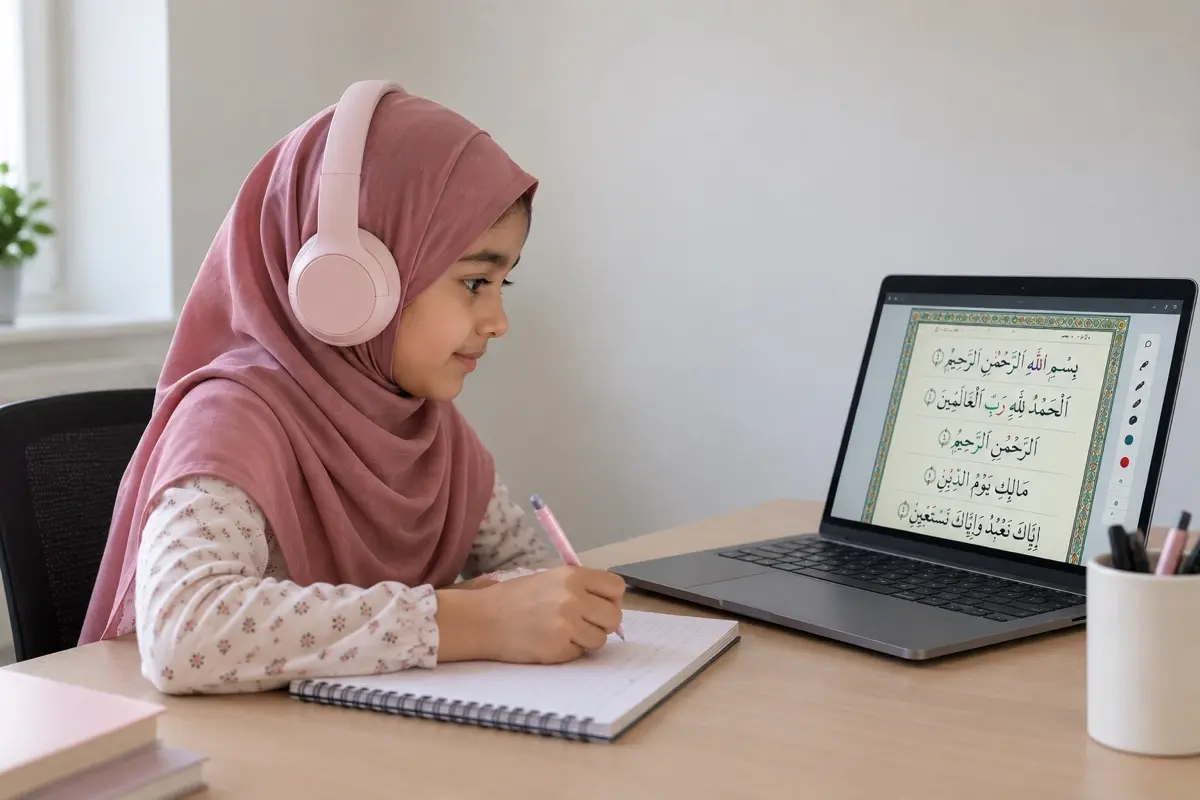
This is why Quranic text and children’s learning materials are written with full diacritics: there’s no guessing involved.
1. The Role of Diacritics (Harakat) in Arabic Phonetics
Harakat are the small marks placed above or below letters to show short vowel sounds — fatha, damma, and kasra. With them present, Arabic is phonetic in the strictest sense: what you see is exactly what you say.
The catch is that everyday Arabic — newspapers, novels, street signs, most books for adult readers — drops these marks almost entirely. A word like “علم” without diacritics could be read as “‘alima” (he knew) or “‘ulima” (it was known), depending on grammar and context.
This is where Arabic phonetic reading shifts from automatic to skill-based: native speakers fill in the missing vowels using vocabulary knowledge and sentence structure, and learners need to build that same instinct.
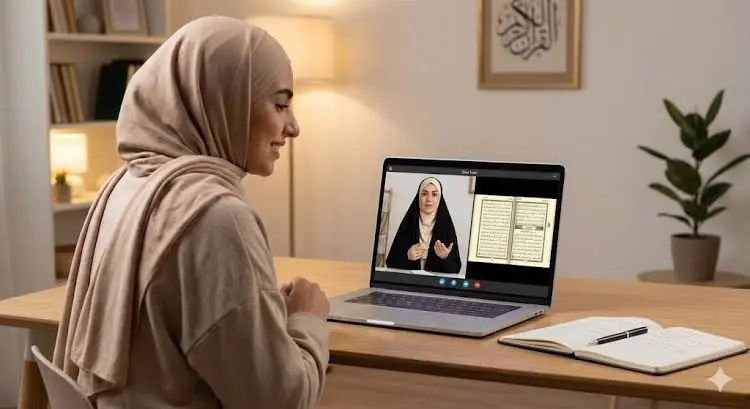
A structured Learn Arabic Online program is built specifically to bridge this gap — starting learners on vocalized text and gradually training them to read confidently once the marks disappear, which is exactly the stage where most self-taught learners get stuck.
2. Written Arabic vs. Spoken Dialects
There’s a second layer to how phonetic Arabic feels in practice: dialect. Modern Standard Arabic is the phonetic standard taught in schools and used in formal writing, but everyday spoken Arabic Egyptian, Levantine, Gulf, Maghrebi — shifts pronunciation in ways the standard script doesn’t always capture.
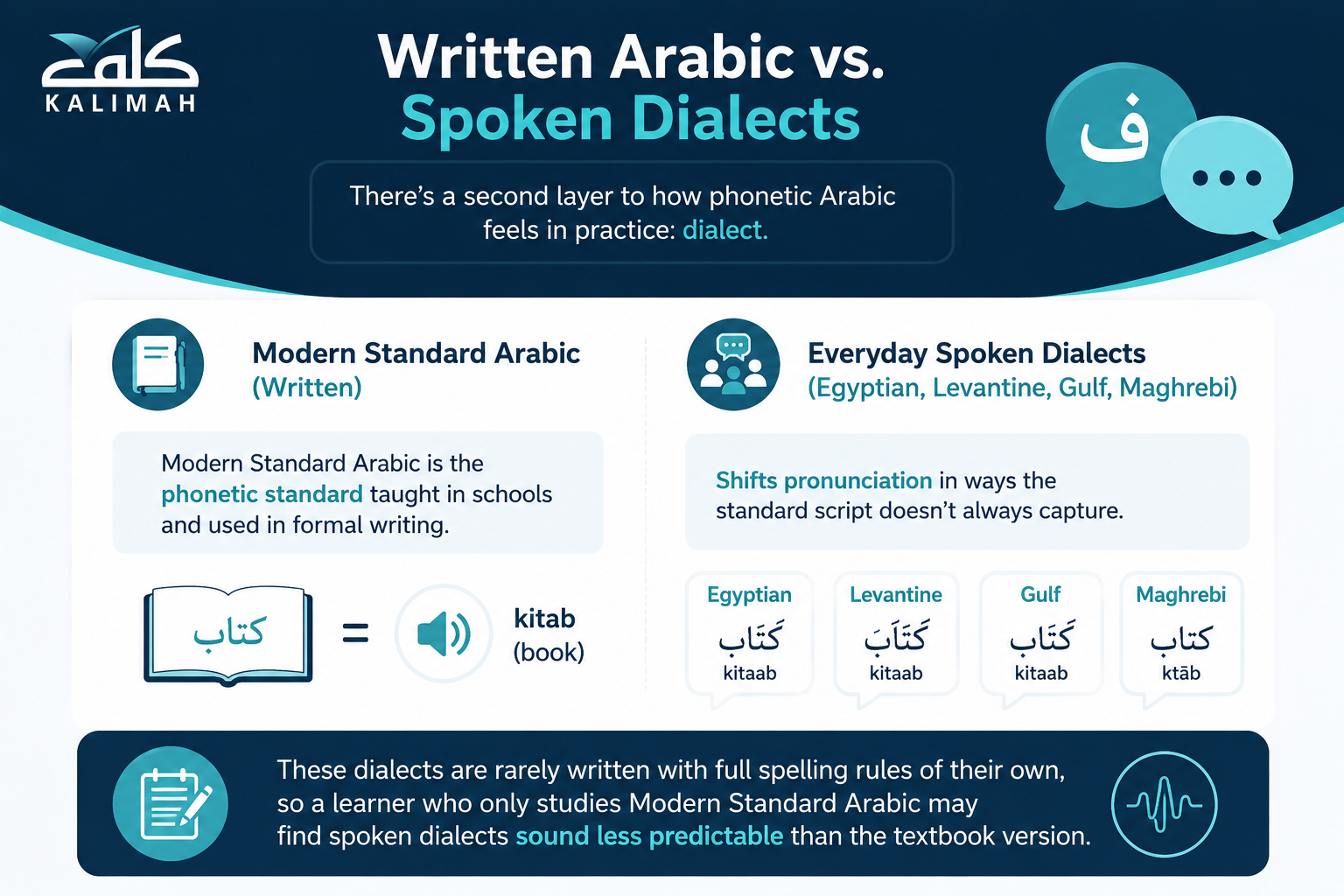
These dialects are rarely written with full spelling rules of their own, so a learner who only studies Modern Standard Arabic may find spoken dialects sound less predictable than the textbook version.
Read Also: Is Arabic A Tonal Language?
Why Does Arabic’s Sound System Feel Harder Than It Is?
Arabic uses 34 distinct sounds — 28 consonants and 6 vowels, short and long combined — against roughly 29 total sounds in English or French.
More sounds mean more precision is demanded from the reader, but they also let Arabic express finer shades of meaning through sound alone.
| Language | Total distinct sounds | Consonants | Vowels (short + long) |
| Arabic | 34 | 28 | 6 |
| English | ~29 | ~24 | ~5 |
| French | ~29 | ~20 | ~9 |
1. Sounds That Don’t Exist in Most Other Languages
Several Arabic consonants have no real equivalent in English, which is a major reason Arabic feels non-phonetic to beginners even though it technically isn’t.
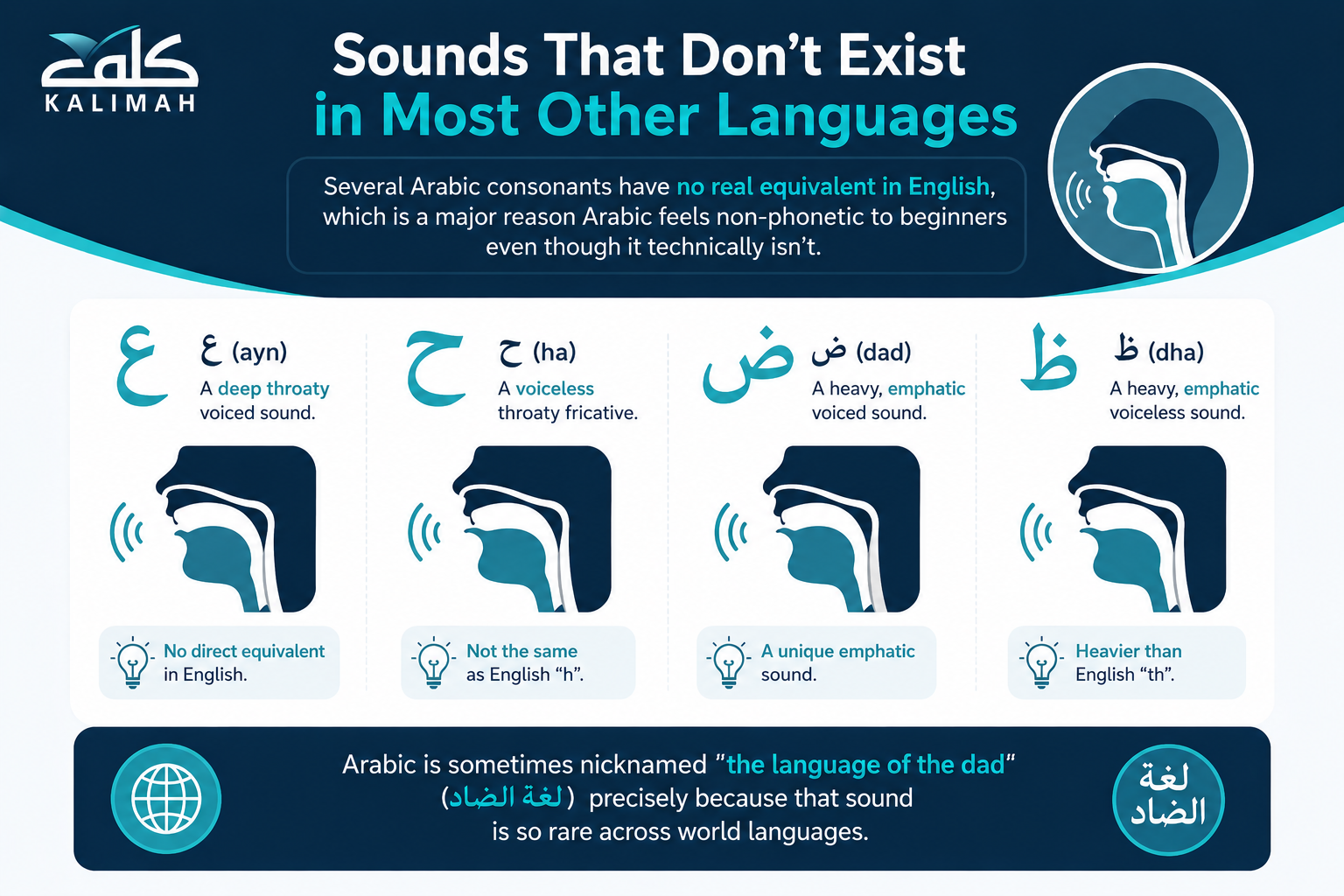
The letters ع (ayn) and ح (ha) are produced deep in the throat, while ض (dad) and ظ (dha) require a heavier, more emphatic articulation than their lighter counterparts.
Arabic is sometimes nicknamed “the language of the dad” (لغة الضاد) precisely because that sound is so rare across world languages.
Experience Kalimah Center Classes
Watch real excerpts from our live sessions at Kalimah Center and see how we bring learning to life. These clips highlight our interactive, student-centered teaching approach across all our courses—designed to keep learners engaged, motivated, and actively involved every step of the way.
Master Arabic with Kalimah Center
Join our expert-led online classes and start your journey toward Arabic fluency today.
Book Your Free Trial2. Letters That Change Shape, Not Sound
Arabic letters change their written form depending on where they sit in a word — beginning, middle, end, or standalone — but the sound they represent stays constant.
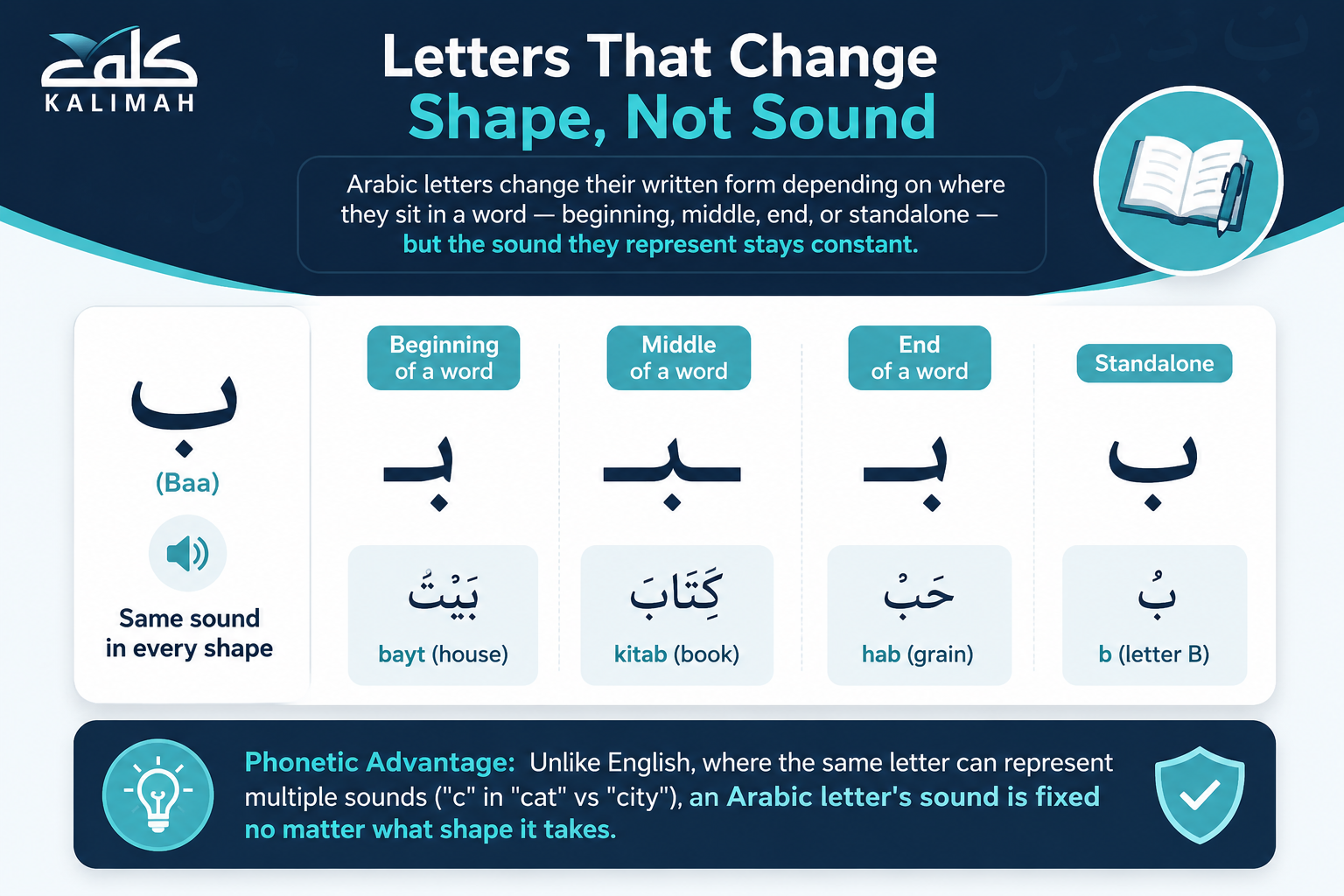
This is actually a phonetic advantage once you learn the shapes: unlike English, where the same letter can represent multiple sounds (“c” in “cat” versus “city”), an Arabic letter’s sound is fixed no matter what shape it takes.
Many learners with Kalimah Center find this consistency easier to rely on once the letter-shape stage is behind them.
Read Also: How to pronounce ha in Arabic
Common Reading Challenges For Arabic Learners
The gap between “Arabic is phonetic in theory” and “Arabic feels hard to read” almost always comes down to three specific issues.
1. Missing vowel mark
Once diacritics disappear from a text, you’re reading by pattern recognition and context, not by direct sound-to-letter mapping.
This is a vocabulary problem more than a phonetic one — the more root words and common patterns you know, the faster you fill in the gaps.
2. Throat-based sounds
Distinguishing ع from ح, or ق from ك, takes physical practice, not just listening. Many learners default to the nearest English sound, which changes the word’s meaning entirely — a common mistake that structured pronunciation drills are designed to correct early, before it becomes a habit.
Because the question “is Arabic tonal” comes up so often, some learners unconsciously start adding musical inflection to distinguish similar-sounding words. This doesn’t help — and can sound unnatural — because Arabic distinguishes meaning through consonant precision and vowel length, not pitch.
Structured, guided practice — whether through Best Online Arabic Classes for Adults or Intensive Arabic Group Classes with Cheap Fees — shortens this learning curve considerably, since a teacher can correct pronunciation in real time rather than letting a habit set in.
Read Also: Singular in Arabic
Start Reading Arabic With Confidence Today
Knowing that Arabic is phonetic, not tonal, answers the theory. Reading it fluently — without stalling on missing vowel marks or mixing up ع and ح — takes guided practice with a real teacher correcting you in real time, not months of guesswork alone.
Kalimah Center builds this progression in a specific order: full vocalization first, so every sound-to-letter link is automatic before diacritics disappear; then dialect and context work, so unvocalized texts stop feeling like a guessing game.
Each step is drilled with an instructor who catches mispronunciation before it becomes a habit — not after.

Three starting points, depending on where you’re learning from:
- Best Online Arabic Classes for Adults: one-on-one, phonetics-first instruction for adults starting from zero.
- Intensive Arabic Group Classes With Cheap Fees: small groups, same phonetic foundation, lower cost per lesson.
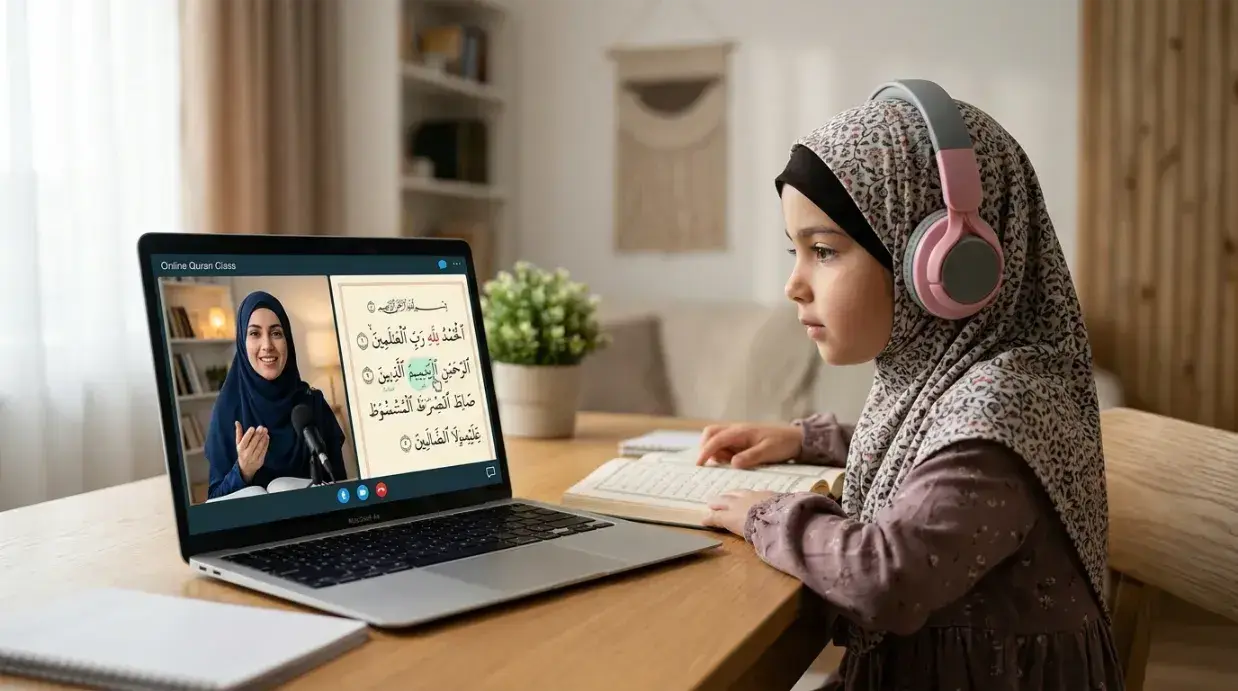
- Learn Arabic Online for Kids: vocalized texts and age-paced lessons for parents starting their kids early.
- Online Arabic Course: Tailored to your level, our comprehensive Arabic program includes 16 teaching levels and 400+ hours of personalized sessions.
- Online Quran With Tajweed Course: Perfect for non-Arabic speakers, our course spans 13 levels and equips you with Tajweed mastery from beginner to advanced.
- Online Arabic Course For Kids: Nurture your child’s love for Arabic with our engaging and structured program, available in 24 levels for primary, intermediate, and secondary stages.
Master Arabic with Kalimah Center
Join our expert-led online classes and start your journey toward Arabic fluency today.
Book Your Free TrialExperience Kalimah Center Classes
Watch real excerpts from our live sessions at Kalimah Center and see how we bring learning to life. These clips highlight our interactive, student-centered teaching approach across all our courses—designed to keep learners engaged, motivated, and actively involved every step of the way.
Here Are The Reviews On Our Courses:
Our students frequently commend the excellence of our courses and the commitment shown by our instructors. You can read their complete reviews on Trustpilot.

🚀 Start Your Free Trial Today! 🚀
Don’t miss out on this life-changing opportunity to deepen your faith and knowledge. Sign up now for your free trial and take the first step towards becoming a better practicing Muslim with Kalimah Center!
Master Arabic with Kalimah Center
Join our expert-led online classes and start your journey toward Arabic fluency today.
Book Your Free TrialConclusion
Arabic is not a tonal language — pitch doesn’t change words the way it does in Mandarin or Vietnamese. What Arabic is, is a highly phonetic language: with full diacritics, every sound maps directly to a letter, and pronunciation becomes predictable rather than guessed.
The complexity most learners run into comes from missing vowel marks in everyday writing and from sounds that simply don’t exist in other languages, not from any tonal system.
With consistent, guided practice, that gap closes quickly — and it’s exactly the gap Kalimah Center‘s programs are built to close.

Read also: Arabic Immersion Programs – The Complete Guide to Finding the Best Fit
Frequently Asked Questions
Here are quick answers to the questions learners most often ask alongside “is Arabic a tonal language.”
1. Is Arabic phonetic or not?
Arabic is phonetic when fully vocalized with diacritics — each letter and vowel mark corresponds directly to one sound. Without diacritics, which is how most adult texts are written, readers rely on context and vocabulary to supply the missing vowels.
2. Why do people think Arabic might be tonal?
Because Arabic has sounds unfamiliar to non-native speakers, like ع and ح, learners sometimes assume pitch changes are involved. In reality, meaning comes from consonant and vowel accuracy, not musical tone.
3. How many sounds does Arabic have?
Arabic has 34 distinct sounds in total: 28 consonants and 6 vowels, including both short and long vowel forms. This is more than English or French, which each use around 29 sounds.
4. Do Arabic dialects change the phonetic system?
Yes. Modern Standard Arabic follows a consistent phonetic standard, but spoken dialects like Egyptian, Levantine, and Gulf Arabic shift certain pronunciations in ways the standard script doesn’t always show.
5. What’s the fastest way to learn Arabic pronunciation accurately?
Start with fully vocalized texts, practice listening alongside reading, and get real-time correction from a teacher. Programs like Learn Arabic Online for Kids apply this exact sequence for younger learners, and the same structure works for adults starting from zero.