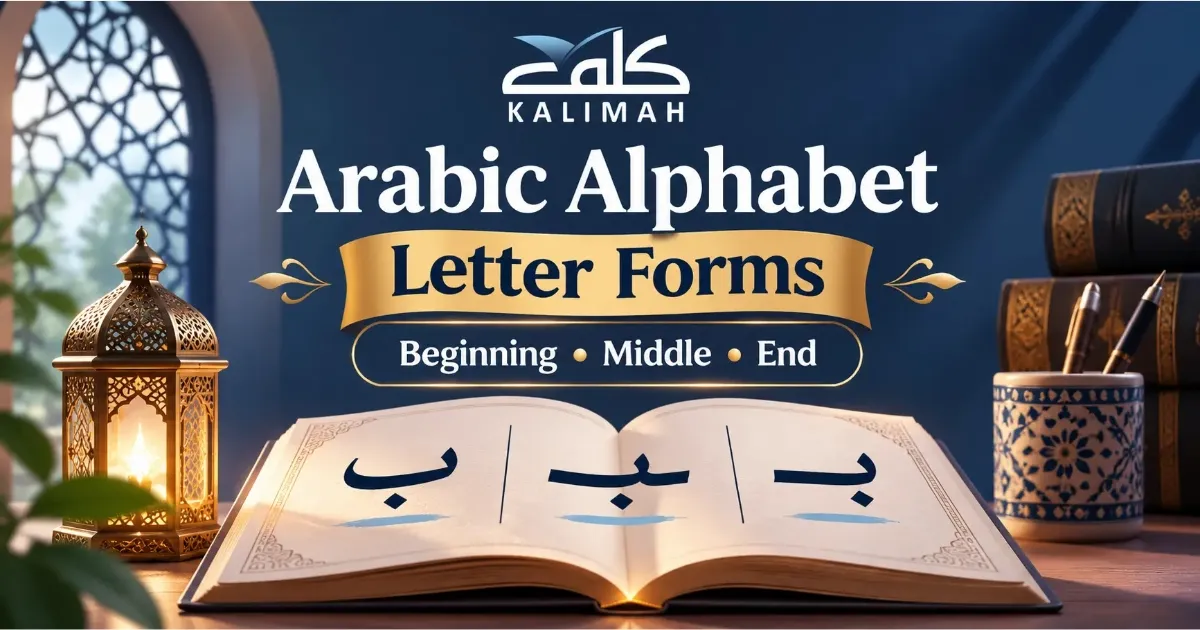
You finally memorized all 28 Arabic letters, then opened a simple Arabic sentence and recognized almost none of them. Don’t worry, this happens to nearly every beginner, and the reason is surprisingly simple.
Arabic letters change their shape depending on where they sit in a word. Once you understand the Arabic alphabet letter forms beginning middle and end, words that looked like random curves start to make sense.
At Kalimah Centre, we see this “aha” moment with our students every day. This guide walks you through the exact system our native tutors use to make letter shapes click, quickly and without stress.
You will learn the rules behind the shapes, the letters that break them, and practical daily habits, plus free tools that let you practice at home.
1. Understand The Arabic Alphabet Letter Forms Beginning Middle And End
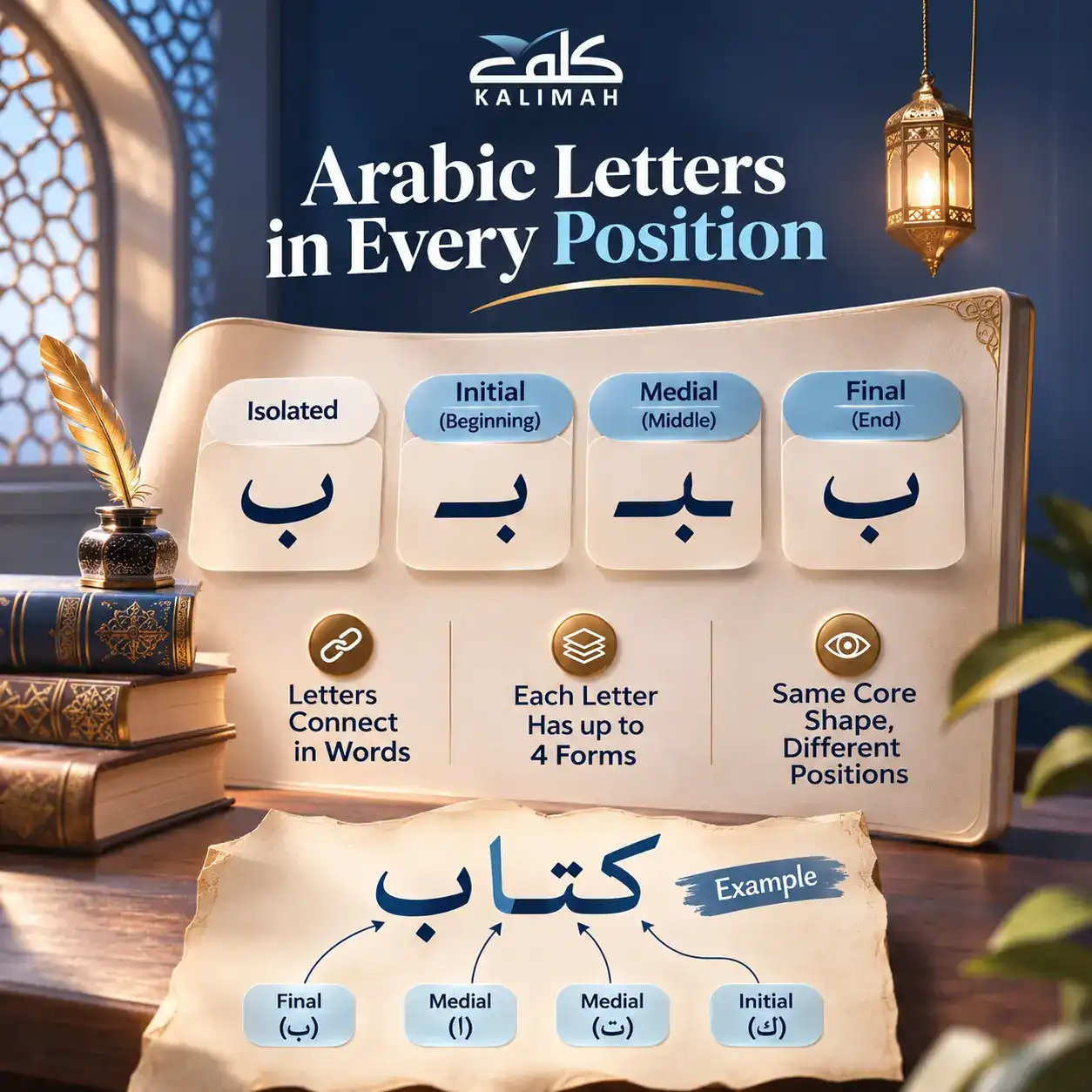
Every Arabic letter can appear in up to four forms: isolated, initial, medial, and final. Learning the Arabic alphabet letter forms beginning middle and end means learning one core shape per letter, then noticing how it trims or extends to join its neighbors.
What Isolate, Initial, Medial, And Final Mean
The isolated form is the letter written alone, the way you first met it in the alphabet song. The initial form starts a word and connects only to the letter after it. The medial form sits in the middle and connects on both sides.
The final form ends a word and connects only to the letter before it. Teachers often call this set the Arabic alphabet isolate initial medial final system, and some charts list it backwards as final, medial, initial, starting from the right.
That reversed order isn’t a mistake. Since Arabic is read from right to left, a chart of the Arabic alphabet final medial initial simply follows the reading direction. Whichever order you see, the four shapes and their rules stay exactly the same.
Why Arabic Letters Change Shape In A Word
Arabic is a cursive script, so letters are designed to flow into each other like joined-up handwriting. To join smoothly, a letter usually loses its tail at the start of a word and keeps it at the end, where the word needs a clear finish.
According to the official guidelines on W3C’s Arabic & Persian Layout Requirements, each letter has one, two, or four joining forms. Letters with all four forms are called dual-joining, while a few letters only join from one side.
The good news is that the core of each letter rarely changes. The “body” of ب stays the same small bowl with one dot below, and only the connecting stroke appears or disappears. Train your eye on that body, and recognition becomes far easier.
Arabic Alphabet All Forms Chart
The table below shows the Arabic alphabet initial medial final shapes for all 28 letters. Read each row from left to right as isolated, initial, medial, and final, and notice how many letters keep the same core.
| Letter | Isolated | Initial | Medial | Final |
| Alif | ا | ا | ـا | ـا |
| Baa | ب | بـ | ـبـ | ـب |
| Taa | ت | تـ | ـتـ | ـت |
| Thaa | ث | ثـ | ـثـ | ـث |
| Jeem | ج | جـ | ـجـ | ـج |
| Haa | ح | حـ | ـحـ | ـح |
| Khaa | خ | خـ | ـخـ | ـخ |
| Dal | د | د | ـد | ـد |
| Dhal | ذ | ذ | ـذ | ـذ |
| Raa | ر | ر | ـر | ـر |
| Zay | ز | ز | ـز | ـز |
| Seen | س | سـ | ـسـ | ـس |
| Sheen | ش | شـ | ـشـ | ـش |
| Saad | ص | صـ | ـصـ | ـص |
| Daad | ض | ضـ | ـضـ | ـض |
| Taa (emphatic) | ط | طـ | ـطـ | ـط |
| Dhaa (emphatic) | ظ | ظـ | ـظـ | ـظ |
| Ayn | ع | عـ | ـعـ | ـع |
| Ghayn | غ | غـ | ـغـ | ـغ |
| Faa | ف | فـ | ـفـ | ـف |
| Qaf | ق | قـ | ـقـ | ـق |
| Kaf | ك | كـ | ـكـ | ـك |
| Lam | ل | لـ | ـلـ | ـل |
| Meem | م | مـ | ـمـ | ـم |
| Noon | ن | نـ | ـنـ | ـن |
| Haa (soft) | ه | هـ | ـهـ | ـه |
| Waw | و | و | ـو | ـو |
| Yaa | ي | يـ | ـيـ | ـي |
You can verify the official shapes via the Unicode Arabic Presentation Forms-B chart, which lists every isolated, initial, medial, and final glyph. Print it or save it on your phone as a pocket reference for quick review sessions.
Don’t try to memorize this chart in one sitting. Study three or four rows a day, cover the columns with a card, and test yourself on the hidden shapes. Within two weeks, the Arabic alphabet letter forms beginning middle and end will feel natural.
Want letters to stick from day one? The Noorani Qaida Course at Kalimah Centre takes you letter by letter, with a personal teacher correcting your pronunciation and letter shapes in every session until your reading flows smoothly and naturally.
Read Also: The Complete Arabic Alphabet Guide: Letters, Forms, Sounds & Practice
2. Spot The Six Letters That Never Connect Forward
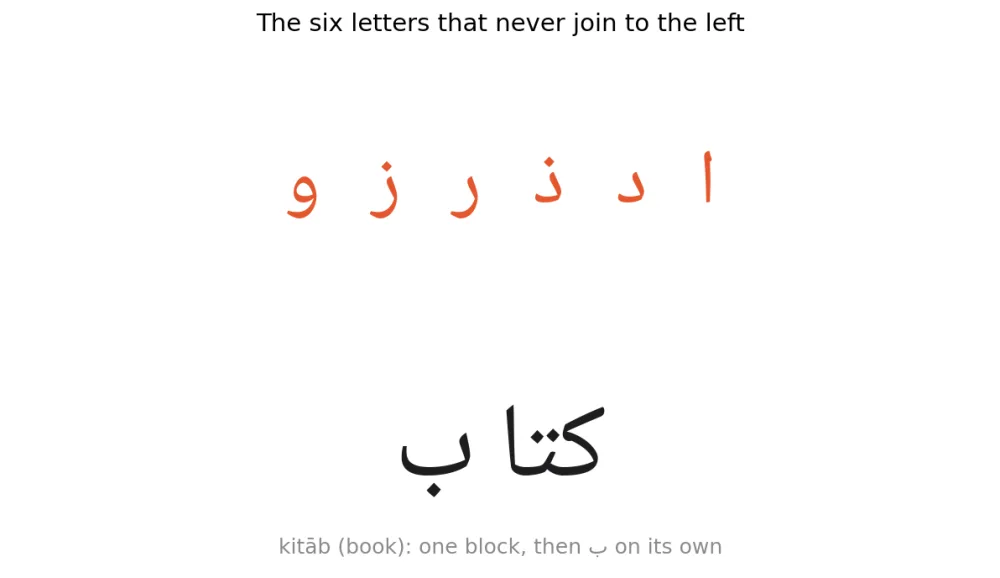
Six Arabic letters connect to the letter before them but never to the letter after them, no matter where they appear in a word. Learning them early saves you from the most common beginner mistake, and it makes any chart of the Arabic alphabet all positions much easier to read and remember.
The Six Non-Connecting Letters
The six non-connectors are ا (alif), د (dal), ذ (dhal), ر (raa), ز (zay), and و (waw). An easy way to remember them is in pairs: alif alone, the two dals, the two raas, and finally waw.
Because they never join forward, these letters have only two real shapes: standalone and attached from the right. That’s why their initial form looks identical to the isolated form, and their medial form matches the final form.
Try spotting them in the word دار (house). All three letters stand separately because د and ا refuse to connect forward. The word ورد (roses) behaves the same way, with و, ر, and د each standing on its own.
How Non-Connectors Affect The Next Letter
When a non-connector appears in the middle of a word, the letter after it must start fresh. In other words, it takes its initial or isolated form, even though it sits in the middle of the word.
Look at the word درس (lesson). The د stands alone, ر stands alone because it can’t connect to س, and س appears in its isolated form. This is why one Arabic word can contain several small “islands” of letters, and why the Arabic alphabet letter forms beginning middle and end depend on neighbors, not just position.
Spotting these islands is a powerful reading skill. When you see a gap inside a word, scan for a non-connector just before it, and you’ll know the word isn’t over yet. This habit alone speeds up beginner reading noticeably within days.
Special Shapes – Taa Marbuta, Alif Maqsura, And Lam-Alif
Taa marbuta (ة / ـة) appears only at the end of words, often marking feminine nouns like مدرسة (school). It looks like ه with two dots, and you’ll never find it at the start or middle of a word.
Alif maqsura (ى / ـى) also lives only at the end, as in على (on). It looks like ي without its two dots. Recognizing these end-only letters helps you see where a word stops in real texts.
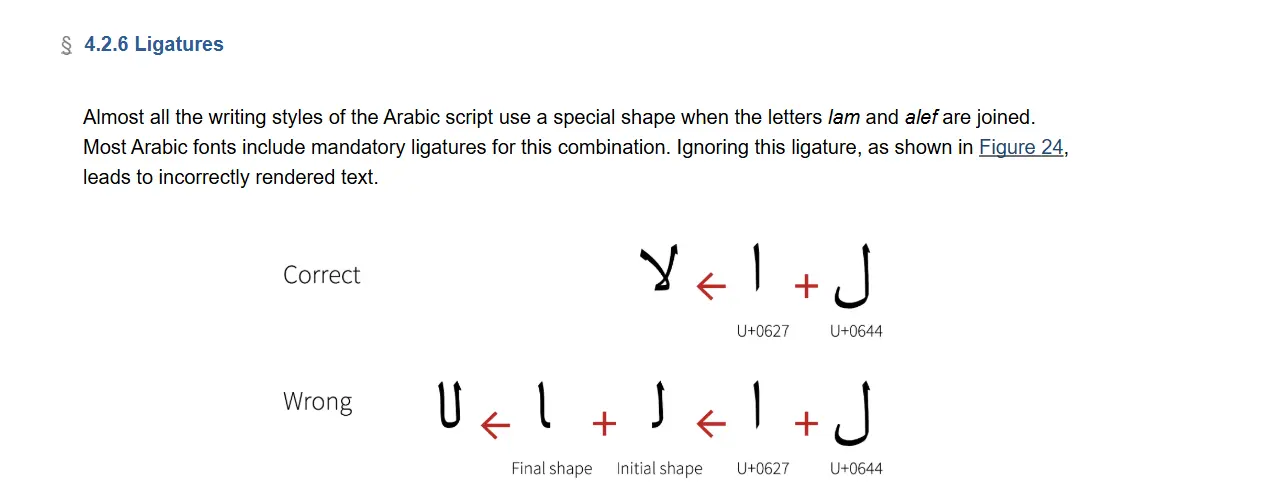
The lam-alif combination لا is a special joined shape that nearly all fonts use automatically. As highlighted in W3C’s section on Arabic ligatures, skipping this shape counts as incorrect writing, so learn لا as one unit.
Ready to read whole words, not just letters? Kalimah Centre’s Arabic Reading Course turns letter shapes, vowels, and joining rules into confident reading of real words and sentences, guided step by step by experienced native tutors.
Recommended reading: Arabic Connecting Letters – The Comprehensive Guide To Arabic Joining Letters
Inside Kalimah Center: Moments from Our Courses
Get a glimpse into the vibrant learning experience at Kalimah Center. These snapshots capture real moments from our live classes—where students engage deeply, connect with passionate instructors, and grow in a welcoming, supportive environment.
Master Arabic with Kalimah Center
Join our expert-led online classes and start your journey toward Arabic fluency today.
Book Your Free Trial3. Learn The Arabic Alphabet Beginning Middle End By Shape Families
Many Arabic letters share the same base shape and differ only in the number and position of their dots. Studying the Arabic alphabet beginning middle end in families means one new shape unlocks three or four letters at once, which makes the Arabic alphabet letter forms beginning middle and end far lighter to memorize.
A. The Baa Family And Its Dots
The letters ب, ت, and ث share the same bowl and differ only by dots: one below, two above, and three above. In the initial and medial forms, the bowl shrinks into a small “tooth” that rises from the line.
Here’s the bonus: ن and ي use the exact same tooth in their initial and medial forms, as in نـ and يـ. Only their final and isolated shapes differ, so five letters share one beginning and middle shape.
To lock this in, read the word بيت (house). You’ll see three teeth in a row, each identified only by its dots. For more letter groups and handy comparison tables, check out this resource on Wikibooks’ Arabic alphabet lessons.
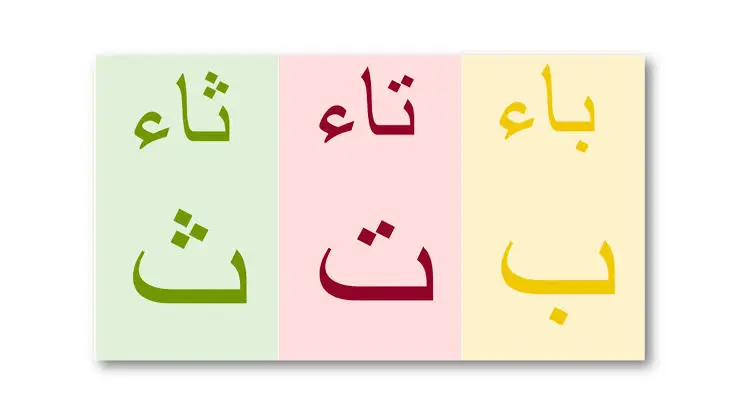
B. The Jeem, Seen, And Saad Families
The family ج, ح, and خ shares one shape: a dot below for ج, no dot for ح, and a dot above for خ. At the start or middle of a word, they lose their big curved tail.
The pairs س and ش, ص and ض, and ط and ظ follow the same idea. Each pair shares a body, and only the dots change. That’s six letters learned through three shapes, with no extra effort.
Also notice ف and ق. In the initial and medial forms, they look almost identical, apart from one dot versus two. At the end of a word, ق dips below the line with a deeper bowl, which makes it easy to spot.
C. Letters With The Biggest Shape Changes
A few letters change dramatically, so give them extra attention. ع becomes a small open hook at the start (عـ), then a closed triangle in the middle (ـعـ). Its twin غ follows the same pattern, adding a dot.
The soft ه is the trickiest. It looks like a small loop alone, becomes هـ at the start, looks like a figure eight in the middle (ـهـ), and turns into a small tail at the end (ـه).
Kaf also surprises learners. Alone or at the end, ك carries a small mark inside it, but at the start and middle it becomes a tall slanted stroke. Practicing these letters in short words like وجه or معلم builds confidence quickly.
Turn letter shapes into real conversation. The Online Arabic Course at Kalimah Centre starts with the full alphabet and builds through 16 levels, so every letter shape you learn today becomes a word you read, write, and speak tomorrow.
Further reading: Arabic Alphabet Cursive And Learn Arabic Cursive Writing With Examples And Worksheets
Here Are The Reviews On Our Courses:
Our students frequently commend the excellence of our courses and the commitment shown by our instructors. You can read their complete reviews on Trustpilot.
Read more reviews on Trustpilot

4. Practice Arabic Alphabet Connected Forms Through Writing And Reading
Knowing the rules is half the work. The other half is short, daily practice that moves the Arabic alphabet letter forms beginning middle and end from your notes into your eyes and hands, so recognition becomes automatic.
A. Trace Every Letter In All Positions
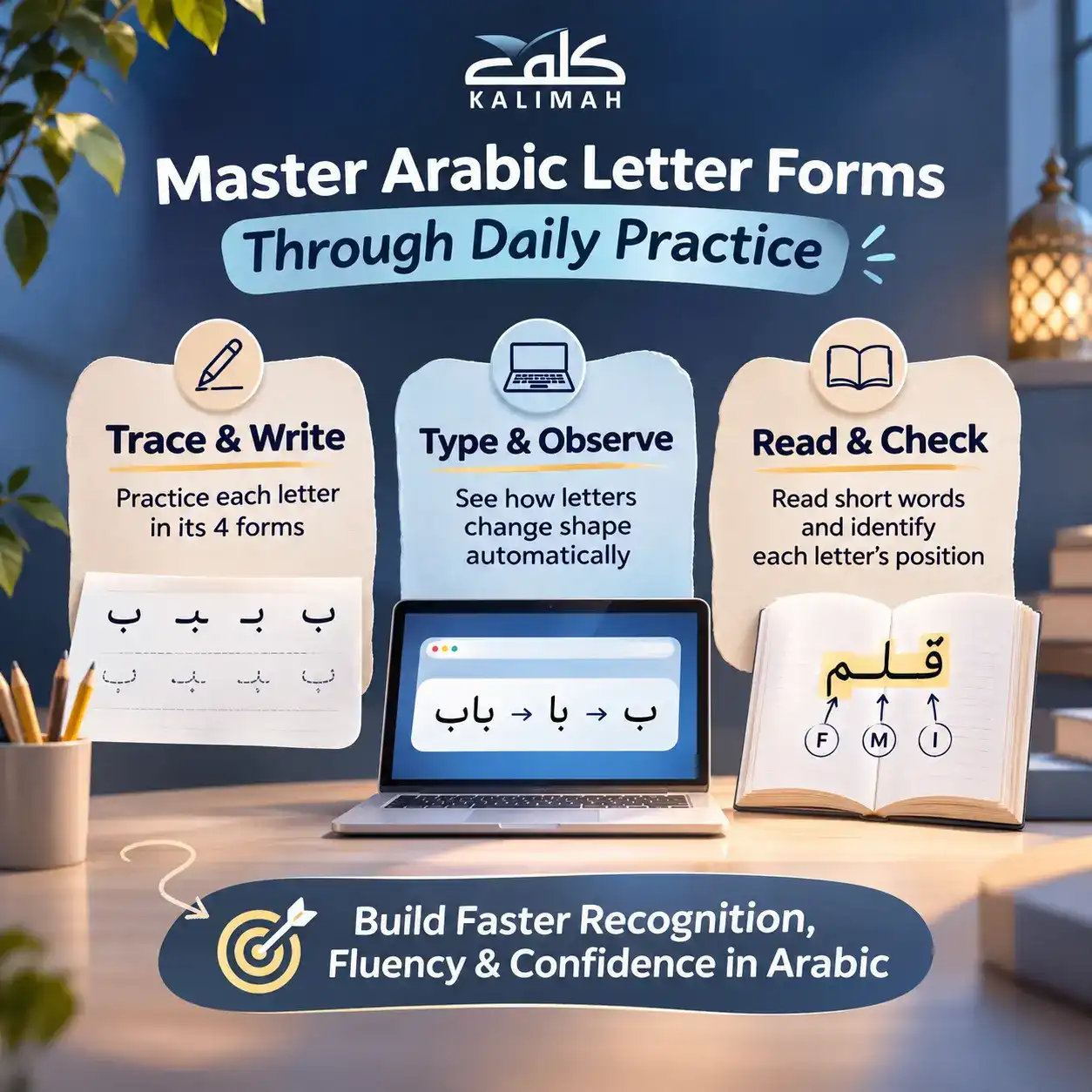
Start each session by writing one letter in its four forms, five times each. Say the position aloud as you write: “alone, start, middle, end.” This links the shape, the rule, and the sound in your memory.
Create your own tracing sheets for free by typing letters in a clear font such as Noto Naskh Arabic on Google Fonts, then printing them in light gray. Trace over each shape slowly before writing it on your own.
Keep your writing on a baseline, because Arabic letters sit on, rise above, or drop below the line in fixed ways. Following the baseline makes the Arabic alphabet beginning middle and end shapes look neat and readable.
B. Type Arabic To See Forms Change Automatically
Typing is a fun way to watch shapes change in real time. When you type Arabic, you press only the base letter, and the font picks the correct position form for you as the word grows.
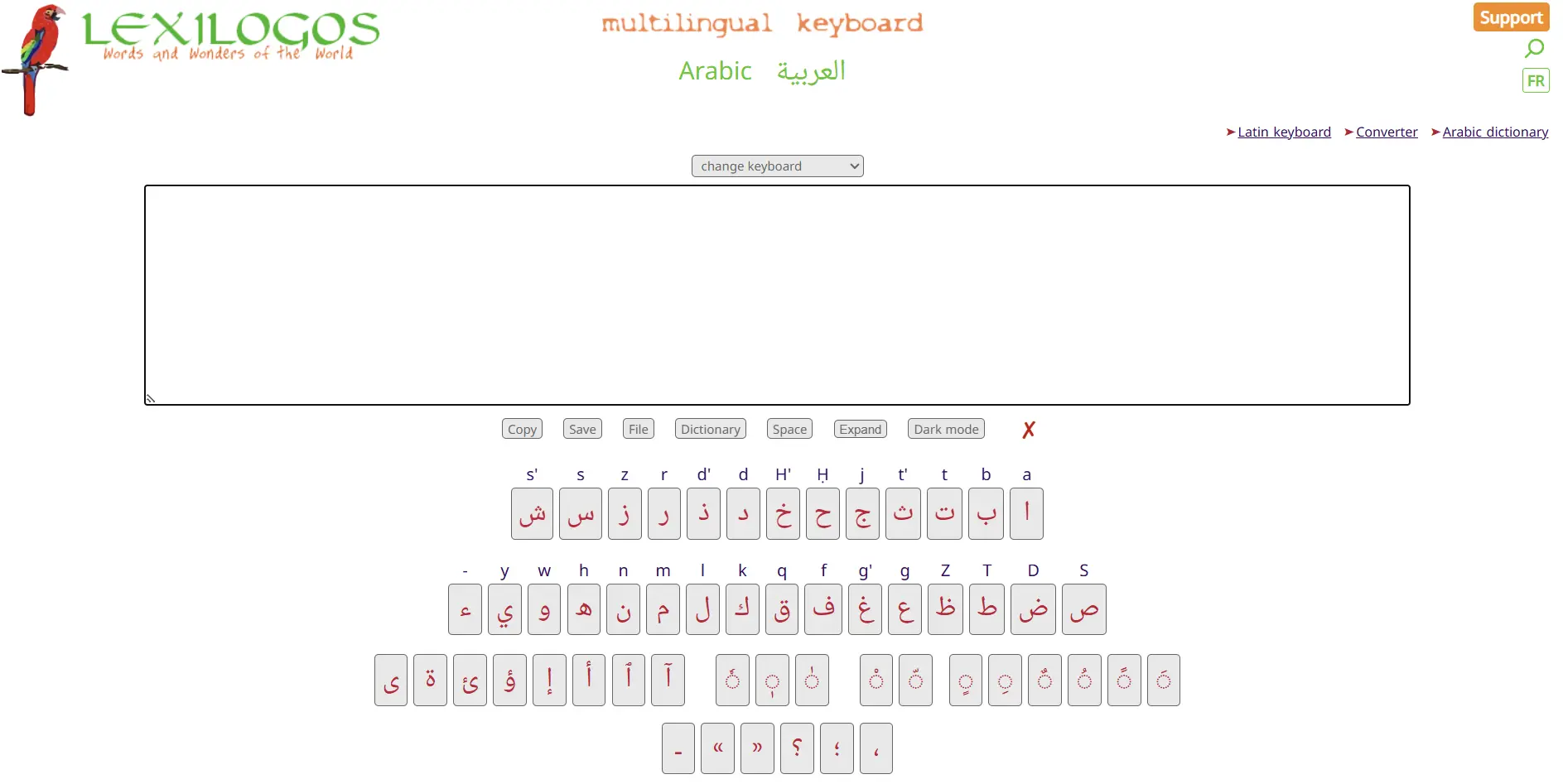
Try the free Lexilogos online Arabic keyboard on your computer. Type ب, then add ا, then ب again, and watch the first ب shrink into its initial form as soon as the next letter joins it.
On your phone, the free Gboard app from Google Play supports an Arabic keyboard. Type short words slowly, letter by letter, and predict each new shape before it appears. It’s a quick self-check you can do anywhere.
C. Read Short Words And Test Yourself
Begin with three-letter words, since they show the Arabic alphabet letters beginning middle end in one glance. Words like كتب (wrote), قلم (pen), and شمس (sun) each give you a clear initial, medial, and final form.
Next, play a simple game. Write a word, then circle each letter and label its position as I, M, F, or A for alone. This short exercise trains your brain to break any word into familiar pieces.
Finally, test yourself weekly by reading a short children’s story or a simple paragraph aloud. Note any letter you hesitated on, and add it to tomorrow’s tracing practice. Small, steady reviews make progress stick far better than long, tiring sessions once a week.
Is your child learning the letters too? Kalimah Centre’s Arabic Classes For Kids teach letter shapes through colorful, interactive lessons with patient native tutors, so children enjoy every new letter and remember its shapes in every position.
Master Arabic Letter Shapes Faster With Kalimah Centre
Learning letter shapes from a chart is useful, but having a real teacher watch you write and read changes everything. At Kalimah Centre, every lesson is live and one-on-one, so your tutor spots a wrong medial form or a misplaced dot the moment it happens and fixes it before it becomes a habit.
Our native, certified tutors have guided learners for more than 13 years, and they know where beginners struggle with the Arabic alphabet letter forms beginning middle and end. A placement test puts you at the right level, so you never repeat what you know or rush past what you don’t.
You also get 24/7 access to your learning materials, a choice of male or female teachers, and a certificate when you pass each level. From your first letter to reading full texts, Kalimah Centre gives you a clear path with a friendly expert beside you at every step.

Experience Kalimah Center Classes
Watch real excerpts from our live sessions at Kalimah Center and see how we bring learning to life. These clips highlight our interactive, student-centered teaching approach across all our courses—designed to keep learners engaged, motivated, and actively involved every step of the way.
Master Arabic with Kalimah Center
Join our expert-led online classes and start your journey toward Arabic fluency today.
Book Your Free TrialBook Your Free Trial Class With Kalimah Centre Today!
You’ve seen how the Arabic alphabet forms work, and now it’s time to put them into practice with a real tutor. One live session is often enough to clear up the confusion that charts alone can’t fix.
Book your free trial class at Kalimah Centre and meet a native tutor who will check your letter shapes, test your reading level, and build a personal plan around your goals, your level, and your weekly schedule.
Explore Our Courses:
Online Arabic Course: Tailored to your level, our comprehensive Arabic program includes 16 teaching levels and 400+ hours of personalized sessions.
Online Quran With Tajweed Course: Perfect for non-Arabic speakers, our course spans 13 levels and equips you with Tajweed mastery from beginner to advanced.
Online Arabic Course For Kids: Nurture your child’s love for Arabic with our engaging and structured program, available in 24 levels for primary, intermediate, and secondary stages.
There’s no pressure and no long commitment, just a friendly first lesson to show you how fast you can progress. Reserve your spot today, and start reading and writing connected Arabic with real confidence from your very first week.

Master Arabic with Kalimah Center
Join our expert-led online classes and start your journey toward Arabic fluency today.
Book Your Free TrialConclusion
Arabic letters change shape for one simple reason: they are built to connect. Each letter can appear isolated, initial, medial, or final, and its core body usually stays the same. Six letters never connect forward, and a few special shapes like ة, ى, and لا follow their own rules.
Shape families make the job much lighter, since one base shape often covers three or four letters with different dots. Daily tracing, typing with free tools, and reading short three-letter words turn these rules into real skills that you can use quickly in any Arabic text you meet.
The key takeaway is this: don’t memorize 112 separate shapes. Learn one core per letter, then train your eye on how it joins. Master the Arabic alphabet letter forms beginning middle and end this way, and reading Arabic stops being a puzzle and becomes a rewarding daily habit.
Frequently Asked Questions
How Many Forms Does Each Arabic Letter Have?
Most Arabic letters have four forms: isolated, initial, medial, and final, while six letters have only two real shapes. Kalimah Centre’s tutors teach every form with live practice and correction.
Which Arabic Letters Do Not Connect To The Next Letter?
The six non-connectors are ا, د, ذ, ر, ز, and و, which join only from the right. Kalimah Centre helps you spot them instantly through guided reading drills.
How Long Does It Take To Learn Arabic Letter Forms?
With about 20 minutes of daily practice, many beginners recognize all letter forms within a few weeks. One-on-one lessons at Kalimah Centre can shorten this time even further.
Can Kids Learn Arabic Letter Positions Easily?
Yes, children learn letter positions quickly through games, colors, and tracing activities. Kalimah Centre offers interactive kids’ classes with patient native tutors who make every lesson fun.