If you’re asking whether Arabic is a tonal language, you’ve probably noticed something odd: some Arabic sounds feel unfamiliar, almost musical, and different Arabic speakers seem to pronounce the same word in different ways. That’s a reasonable thing to wonder about. But the short answer is straightforward.
Arabic is not a tonal language. Pitch — whether a syllable rises or falls — does not change the meaning of an Arabic word. What actually shapes meaning in Arabic is vowel length, consonant sounds, and specific letters like the glottal stop, not musical tone.
This article breaks down exactly what a tonal language is, why Arabic gets mistaken for one, and what really makes Arabic pronunciation distinct.
What You’ll Learn in This Article
- What defines a tonal language, with real examples from Mandarin and Thai
- Why Arabic is not a tonal language, and what does change meaning in Arabic
- The specific sounds — vowel length and the glottal stop — that get mistaken for tone
- Why Arabic dialects and accents add to the confusion
- Whether Arabic is genuinely hard to learn, and what makes it manageable
A tonal language is one where the pitch used to pronounce a syllable changes the meaning of the word itself, not just its emotional tone. In these languages, the same combination of consonants and vowels can mean five completely different things depending on whether the pitch rises, falls, stays flat, or dips and rises again.
Is Arabic A Tonal Language?
No, Arabic does not use pitch to distinguish meaning. Two Arabic speakers can say the same word with a rising, falling, or flat pitch, and it still means the same thing.
What Arabic uses instead is vowel length and precise consonant articulation, which is a completely different mechanism from tone.
1. Vowel Length Does the Work That Tone Does Elsewhere
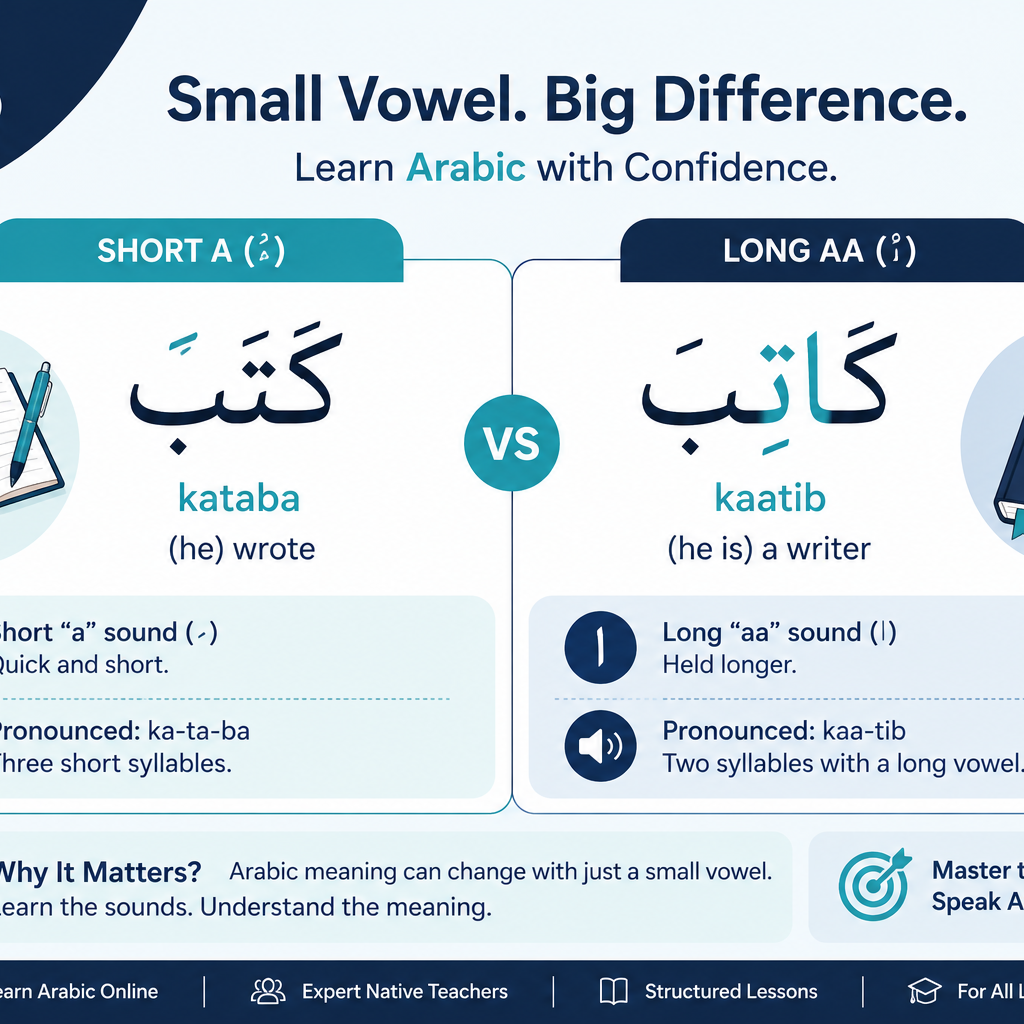
In Arabic, lengthening a vowel can change a word’s meaning entirely, but this is a duration difference, not a pitch difference.
“Kataba” (كتب) means “he wrote,” while “kaatib” (كاتب) means “writer” — the shift comes from holding the vowel longer, not from raising or lowering pitch. The same pattern shows up in “rakib” (ركب), meaning “he rode,” versus “raakib” (راكب), meaning “passenger” or “rider.” Say either word in a high pitch or a low pitch and the meaning stays exactly the same; shorten or lengthen the vowel, and the word changes.
2. The Glottal Stop and Other Sounds Mistaken for Tone
Arabic also makes heavy use of the glottal stop — a sudden closure of the vocal cords that produces an abrupt break in the sound, represented by the letter hamza (ء). The word “imra’a” (امرأة), meaning “woman,” contains this sound.
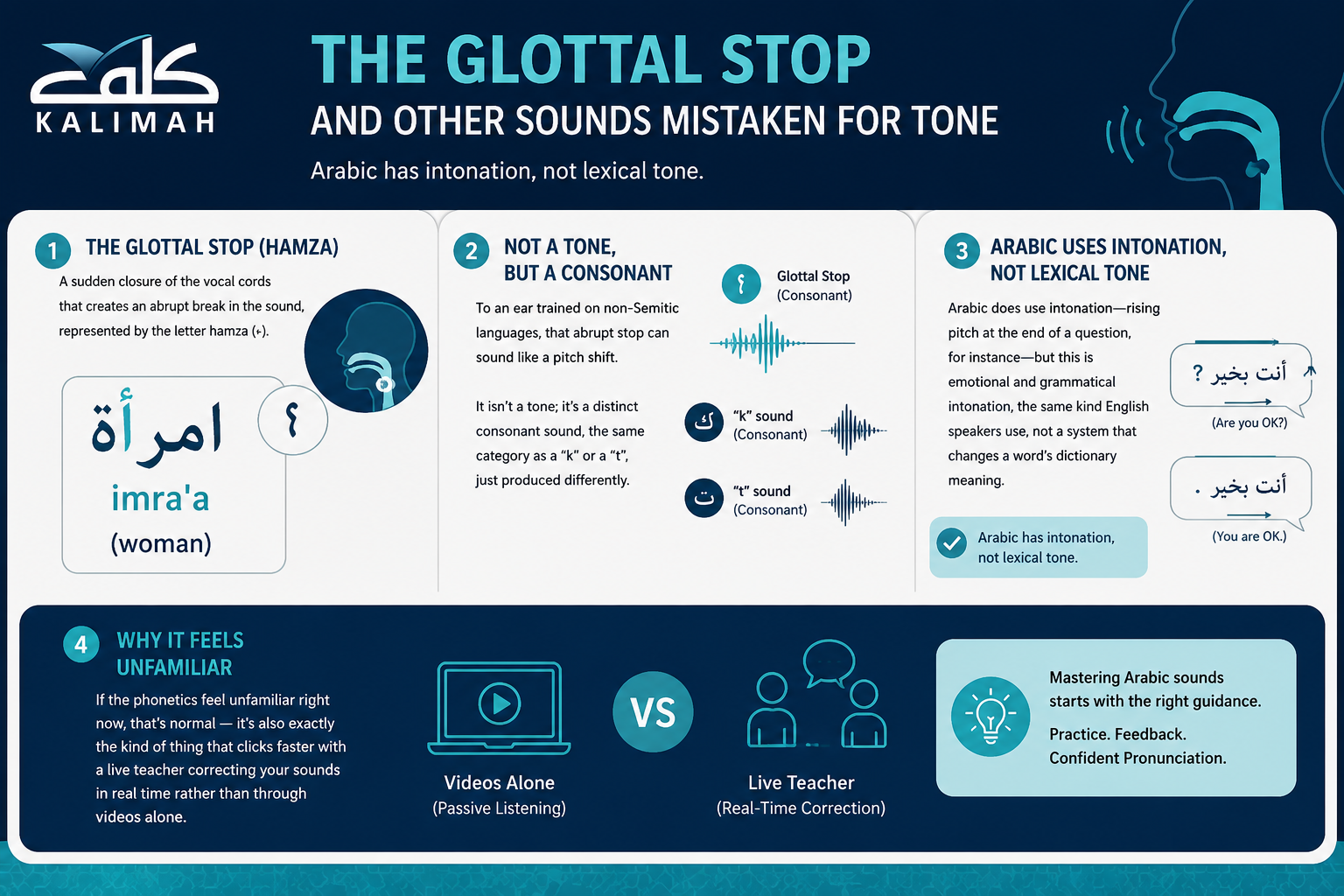
To an ear trained on non-Semitic languages, that abrupt stop can sound like a pitch shift, which is one of the main reasons Arabic gets mistaken for tonal. It isn’t a tone; it’s a distinct consonant sound, the same category as a “k” or a “t,” just produced differently.
Arabic does use intonation — rising pitch at the end of a question, for instance — but this is emotional and grammatical intonation, the same kind English speakers use, not a system that changes a word’s dictionary meaning.
That distinction is the entire answer to “does Arabic have tones”: Arabic has intonation, not lexical tone.
If the phonetics feel unfamiliar right now, that’s normal — it’s also exactly the kind of thing that clicks faster with a live teacher correcting your sounds in real time rather than through videos alone.
Kalimah Center‘s Learn Arabic Online classes are built around that kind of direct pronunciation feedback from the first lesson.
Read Also:Learn Arabic In Your Car
Why Arabic Sounds Complicated If It Isn’t Tonal?
Arabic feels complicated for reasons that have nothing to do with tone: an unfamiliar alphabet, throat-based consonant sounds that don’t exist in English, and multiple regional dialects layered on top of the standard language.
Each of these is a separate hurdle, and mixing them together is exactly what leads people to assume, incorrectly, that Arabic must be tonal.
Arabic script has 28 letters, written right to left, mostly connected in cursive form. Each letter can take a different shape depending on whether it appears at the start, middle, or end of a word, or stands alone.
This visual complexity has zero connection to pronunciation pitch — it’s purely a writing convention, similar to how English cursive letters connect differently than printed ones.
Dialects Add Variety, Not Tone
Arabic includes Classical Arabic (the language of the Quran, no longer spoken conversationally), Modern Standard Arabic (used in media, education, and formal speech across the Arab world), and dozens of regional dialects that can differ enough that a Moroccan speaker and an Iraqi speaker may struggle to follow each other.
This dialect variation explains why Arabic “sounds different” depending on the country — a Gulf accent and a Levantine accent genuinely sound distinct — but accent variation across dialects is not the same phenomenon as lexical tone.
Choosing which dialect to focus on first is a real decision, not a minor detail — Modern Standard Arabic is the practical starting point for most learners because it’s the base that every regional dialect builds on, and it’s the version used in the Quran-adjacent register, news, and formal writing.
Read Also: Learn Arabic In Your Sleep
Is Arabic Actually Hard to Learn?
Arabic is considered one of the more demanding languages for English speakers to learn, but the difficulty comes from specific, learnable obstacles — not from tone.
The main friction points are the new alphabet, throat-produced consonants that don’t exist in English, right-to-left reading direction, and grammar features like the dual form (a specific ending used for exactly two of something, distinct from singular and plural).
The Most Common Mistake New Learners Make
A pattern worth flagging directly: learners often try to “hear” Arabic the way they’d listen for tone in Mandarin, straining to catch pitch shifts that aren’t actually there.
That effort is misplaced. The better approach is to train the ear for vowel length and for the specific throat consonants (like the letters ع and ح), since those are the sounds that genuinely carry meaning.
Shifting attention from pitch to duration and articulation is usually the single biggest turning point for learners stuck on pronunciation.
Read Also: Diglossia in Arabic
Experience Kalimah Center Classes
Watch real excerpts from our live sessions at Kalimah Center and see how we bring learning to life. These clips highlight our interactive, student-centered teaching approach across all our courses—designed to keep learners engaged, motivated, and actively involved every step of the way.
Master Arabic with Kalimah Center
Join our expert-led online classes and start your journey toward Arabic fluency today.
Book Your Free TrialWhat Makes Arabic More Manageable Than It Looks?
The alphabet itself is only 28 letters — fewer symbols than English learners often expect, and far fewer than the thousands of characters in Mandarin.
Because Arabic is written phonetically, once you learn a letter’s sound, that sound stays consistent everywhere it appears, unlike English spelling.
Most learners can read basic connected script within a couple of weeks of focused practice, well before they’ve mastered grammar or vocabulary.
Structured practice with a teacher who corrects pronunciation early tends to shortcut months of guesswork. That’s the core idea behind Kalimah Center‘s course design — small, guided steps rather than an unstructured self-study path.
Read Also: Arabic Language Books for Children: The 7 Best Picks for Every Age and Level
Start Learning Arabic the Right Way Today
Stop guessing at pronunciation and start speaking with confidence. Kalimah Center‘s live, one-on-one and small-group Arabic classes are taught by qualified native instructors who correct your sounds — including the vowel lengths and throat letters covered in this article — from your very first session.
Here Are The Reviews On Our Courses:

Whether you’re an adult building fluency from scratch or looking for a program for your children, there’s a track built for your level:
- Best Online Arabic Classes for Adults: structured, flexible, one-on-one learning
- Intensive Arabic Group Classes With Affordable Fees: learn alongside others at a lower cost
- Learn Arabic Online for Kids: age-appropriate lessons for young learners

Inside Kalimah Center: Moments from Our Courses
Get a glimpse into the vibrant learning experience at Kalimah Center. These snapshots capture real moments from our live classes—where students engage deeply, connect with passionate instructors, and grow in a welcoming, supportive environment.
Explore Our Courses:
Online Arabic Course: Tailored to your level, our comprehensive Arabic program includes 16 teaching levels and 400+ hours of personalized sessions.
Online Quran With Tajweed Course: Perfect for non-Arabic speakers, our course spans 13 levels and equips you with Tajweed mastery from beginner to advanced.
Online Arabic Course For Kids: Nurture your child’s love for Arabic with our engaging and structured program, available in 24 levels for primary, intermediate, and secondary stages.
Master Arabic with Kalimah Center
Join our expert-led online classes and start your journey toward Arabic fluency today.
Book Your Free TrialConclusion
Arabic is not a tonal language — pitch never changes the dictionary meaning of an Arabic word the way it does in Mandarin or Thai.
What actually shapes meaning in Arabic is vowel length, precise consonant sounds like the glottal stop, and grammar structures like the dual form.
The confusion comes from unfamiliar sounds, an unfamiliar alphabet, and the real variety across Arabic dialects, not from tone. Once you separate “unfamiliar” from “tonal,” Arabic becomes a language you can approach with a clear, learnable plan rather than a mysterious one.
Frequently Asked Questions
Here are quick answers to the most common questions people ask about Arabic pronunciation, tone, and difficulty.
1. Does Arabic have tones?
No, Arabic does not have tones. Pitch does not change the meaning of a word in Arabic; instead, vowel length and consonant sounds like the glottal stop carry the meaning differences that tones handle in languages like Mandarin.
2. Why do people think Arabic is a tonal language?
People assume Arabic is tonal because of unfamiliar throat-based sounds and the glottal stop, which can sound pitch-like to an untrained ear. These are distinct consonant sounds, not tonal pitch shifts.
3. What is the difference between Classical and Modern Standard Arabic?
Classical Arabic is the language of the Quran and is used mainly for religious and classical texts today. Modern Standard Arabic is the version used in media, education, and formal conversation across the Arab world, and is what most new learners study first.
4. Is Arabic harder to learn than Mandarin Chinese?
Arabic and Mandarin are often ranked as similarly demanding for English speakers, but for different reasons — Mandarin’s difficulty centers on tone and thousands of characters, while Arabic’s difficulty centers on a new alphabet, throat consonants, and dialect variation. Neither language involves tone in the Arabic case.
5. Which Arabic dialect should a beginner start with?
Most beginners should start with Modern Standard Arabic, since it forms the shared base that regional dialects build on and is used in formal writing, media, and instruction. Learning it first makes picking up a regional dialect later noticeably easier.