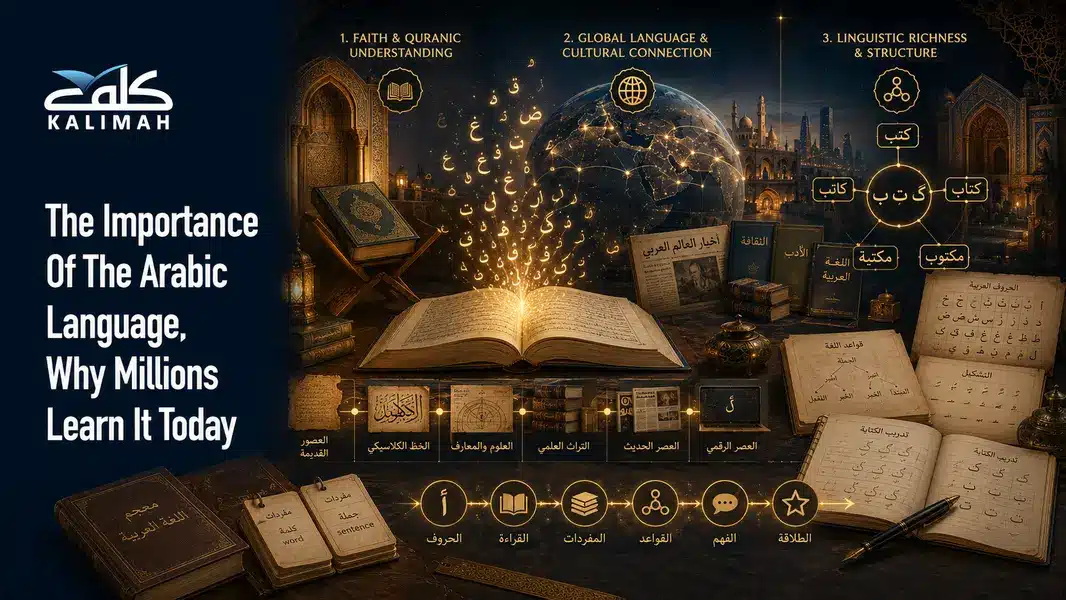
Arabic language importance goes far beyond grammar drills and vocabulary lists. For over 400 million speakers worldwide, Arabic is the language of the Quran, the key to a 1,600-year-old literary tradition, and a living link to Islamic identity.
If you’ve ever asked why Arabic is important compared to other languages, the answer sits at the intersection of religion, history, and structure. This article walks through each of those reasons directly, without padding.
What You’ll Learn in This Article
- Why Arabic is central to the Quran and Islamic practice
- How Arabic connects directly to religious independence, not just ritual
- What makes Arabic’s structure unusually rich compared to other languages
- Common mistakes people make when they skip learning Arabic and rely only on translations
- Where to start learning Arabic, whether you’re an adult beginner or enrolling your children
Arabic is the language in which the Quran was revealed, and it remains the primary language of Islamic worship, scholarship, and daily religious practice for Muslims around the world. That single fact shapes almost everything else about the language’s importance.
Beyond religion, Arabic functions as an official language across more than 20 countries and is spoken as a first or second language by hundreds of millions of people. It carries an literary tradition stretching back to pre-Islamic poetry and continuing through classical prose, science, and philosophy.
A. Arabic as the Language of the Quran
The Quran was revealed in Arabic, and Muslims consider this language choice deliberate and preserved. Because of this, understanding Quranic Arabic gives a reader direct access to the text rather than a translated interpretation of it.
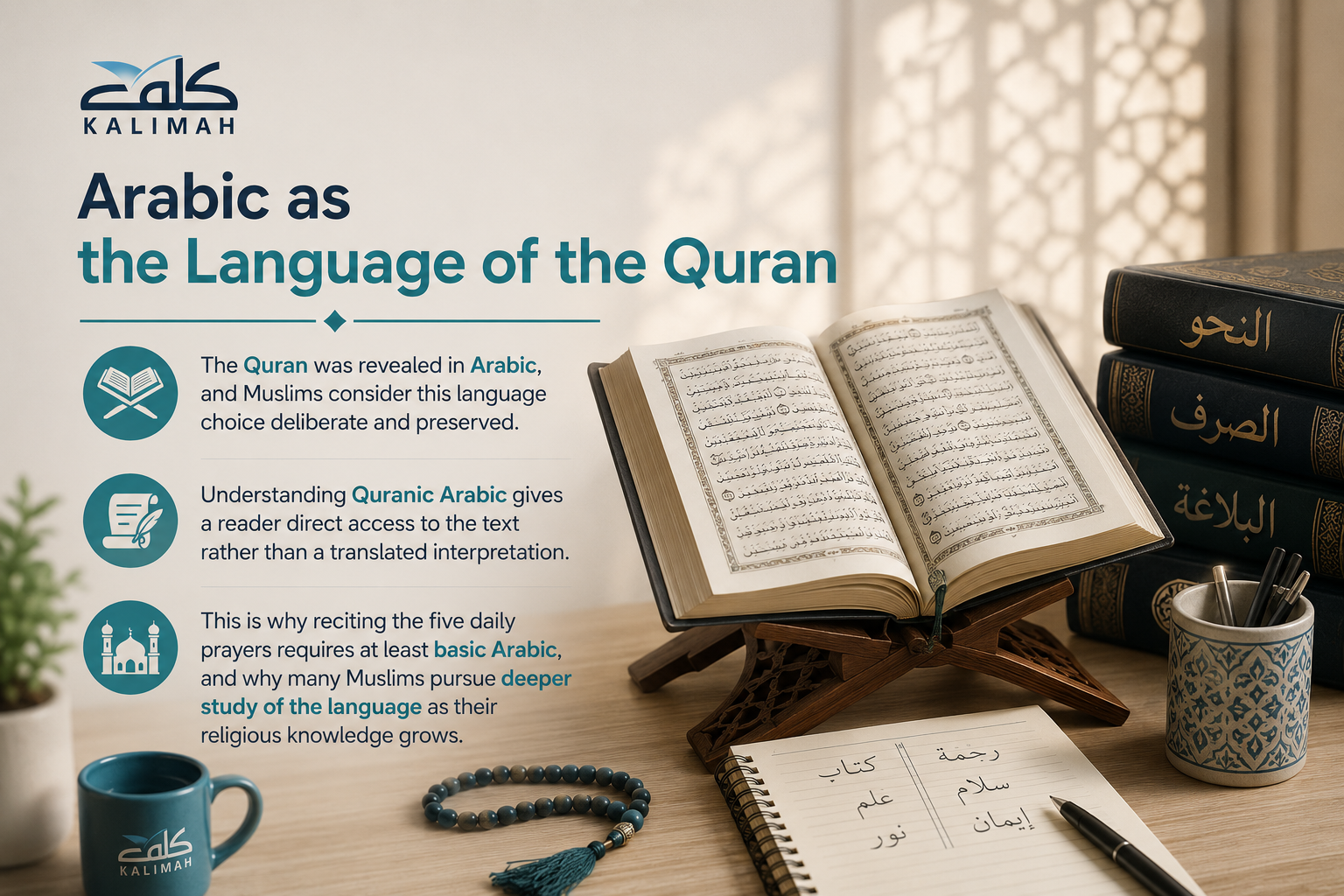
Translations convey meaning, but they cannot fully carry the grammatical nuance, word choice, or rhetorical structure of the original.
This is why reciting the five daily prayers requires at least basic Arabic, and why many Muslims pursue deeper study of the language as their religious knowledge grows.
B. Arabic Is The Language Spoken by Hundreds of Millions
Arabic is spoken by more than 400 million people globally and contains one of the largest vocabularies of any language, with linguists estimating well over 12 million words across its root-based system.
It functions as the language of media, education, law, and government across the Arab world, and demand for learning it continues to grow among both native speakers strengthening formal skills and non-native speakers approaching it for the first time.
At Kalimah Center, this global demand is exactly why structured, guided instruction matters — self-study rarely covers the grammar and pronunciation rules a learner needs to read confidently.
Read Also: Is Arabic A Tonal Language?
C. Arabic Skill Level Shapes Religious Understanding
Research on Arabic learners identifies four connected stages that describe how language ability shapes religious understanding: access, autonomy, agency, and authority. Each stage represents a deeper level of independence from relying on someone else’s interpretation.
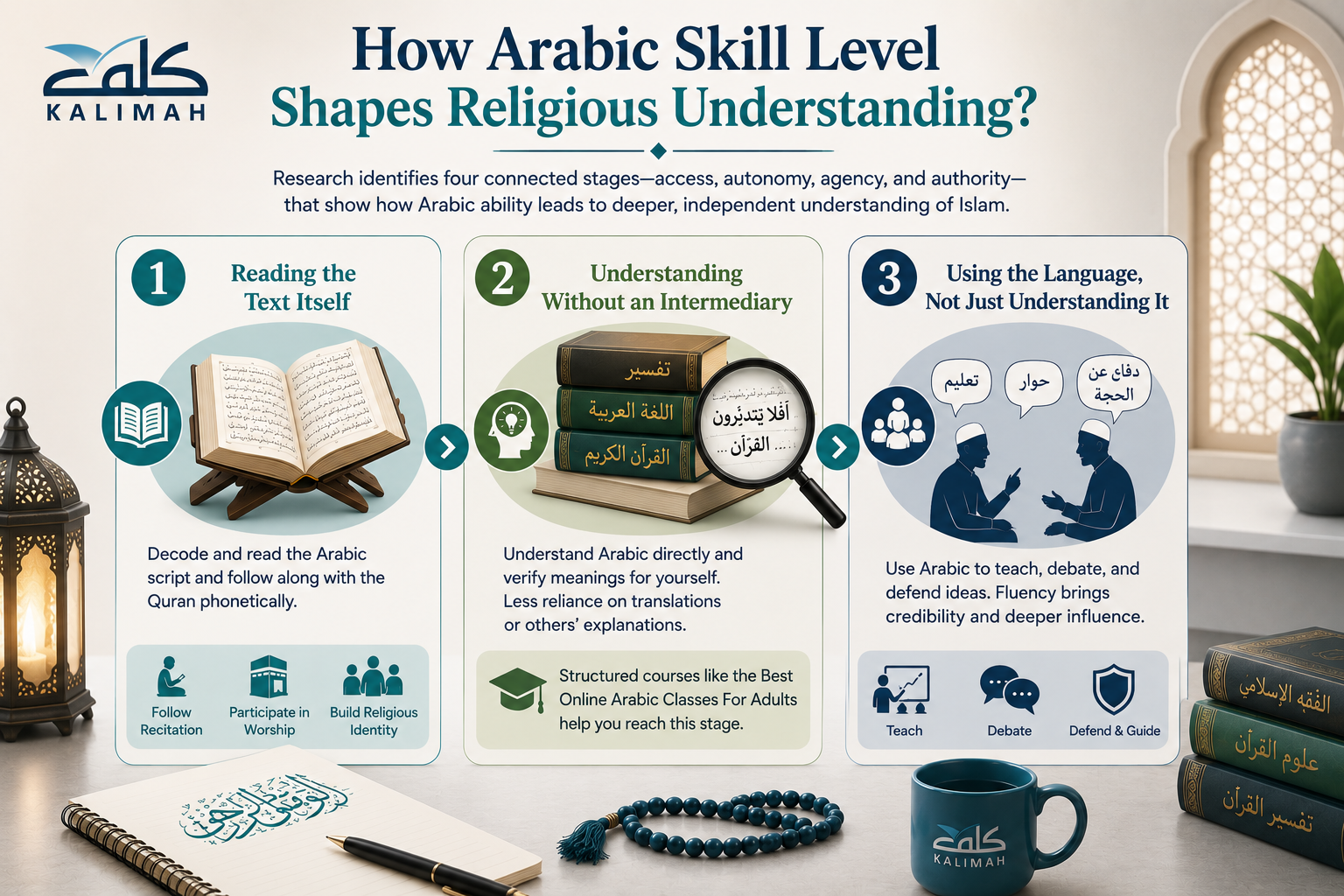
1. Reading the Text Itself
At this stage, a learner can decode the Arabic script and follow along with the Quran phonetically, even without full comprehension. This supports religious identity and participation in communal worship and rituals.
2. Understanding Without an Intermediary
Comprehension is the milestone that changes everything. Once a learner understands Arabic directly, they stop depending entirely on translations or teachers to know what a text says — they can verify it themselves.
Without this, as one common observation goes, a person has no way to check whether an explanation of “what the Quran says” is accurate.
Structured courses such as the Best Online Arabic Classes For Adults are designed specifically to move learners toward this stage of independent comprehension.
3. Using the Language, Not Just Understanding It
The final two stages involve producing Arabic, not just receiving it — teaching, debating, and defending religious positions using the language directly.
At this level, Arabic functions as a form of credibility: fluent speakers are often assumed, rightly or wrongly, to have deeper religious knowledge simply because of their language skill.
Read Also: Why Is Arabic Written Right to Left?
Experience Kalimah Center Classes
Watch real excerpts from our live sessions at Kalimah Center and see how we bring learning to life. These clips highlight our interactive, student-centered teaching approach across all our courses—designed to keep learners engaged, motivated, and actively involved every step of the way.
Master Arabic with Kalimah Center
Join our expert-led online classes and start your journey toward Arabic fluency today.
Book Your Free TrialD. The Arabic Structure Makes It Rich and Enduring
Arabic’s grammatical and lexical system is built differently from most languages you may have studied before, and that structure is a major part of why the language has stayed remarkably stable for over a millennium.
1. Root-Based Vocabulary And Derivation
Arabic vocabulary is built from three-letter roots, and each root can generate dozens of related words through fixed patterns.
The root k-t-b (write), for example, produces kataba (he wrote), yaktubu (he writes), kitab (book), maktaba (library), and kātib (writer) — all connected by the same underlying meaning.
Once you learn how a pattern works, you can often guess the meaning of an unfamiliar word just from its shape, something far less reliable in languages that don’t derive vocabulary this systematically.
Group settings tend to reinforce this kind of pattern recognition fastest, which is part of why Intensive Arabic Group Classes With Cheap Fees structure lessons around repeated root families rather than isolated vocabulary lists.
2. A Language That Has Barely Changed In 1,600 Years
Arabic has remained largely stable for more than 1,600 years, which is unusual. English from three centuries ago already reads like a different language to most modern speakers, while Quranic Arabic and Modern Standard Arabic share the same grammatical core today.
This stability is one reason Arabic has preserved such a large, continuous body of literature, law, and scholarship without major reinterpretation over time.
Starting children early, through a track like Learn Arabic Online For Kids, takes advantage of exactly this predictability — patterns learned young stay consistent for life.
Read Also: How to Pronounce Q in Arabic
Start Learning Arabic With Kalimah Center Today
Understanding why Arabic matters is one thing — actually building the skill is another. Kalimah Center offers guided, structured Arabic instruction for every stage of the journey, from your very first letters to full Quranic comprehension.
Inside Kalimah Center: Moments from Our Courses
Get a glimpse into the vibrant learning experience at Kalimah Center. These snapshots capture real moments from our live classes—where students engage deeply, connect with passionate instructors, and grow in a welcoming, supportive environment.
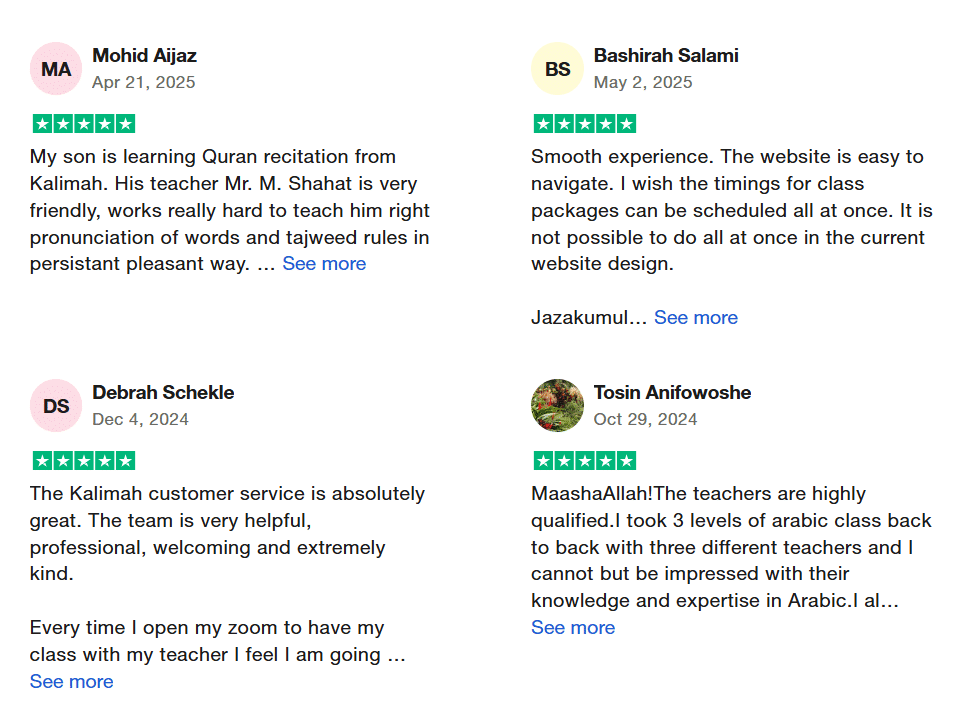
Here Are The Reviews On Our Courses:
Our students frequently commend the excellence of our courses and the commitment shown by our instructors. You can read their complete reviews on Trustpilot.
Read more reviews on Trustpilot
📚 Explore Our Courses:
Online Arabic Course: Tailored to your level, our comprehensive Arabic program includes 16 teaching levels and 400+ hours of personalized sessions.
Online Quran With Tajweed Course: Perfect for non-Arabic speakers, our course spans 13 levels and equips you with Tajweed mastery from beginner to advanced.
Online Arabic Course For Kids: Nurture your child’s love for Arabic with our engaging and structured program, available in 24 levels for primary, intermediate, and secondary stages.
🚀 Start Your Free Trial Today! 🚀
Don’t miss out on this life-changing opportunity to deepen your faith and knowledge. Sign up now for your free trial and take the first step towards becoming a better practicing Muslim with Kalimah Center!
Master Arabic with Kalimah Center
Join our expert-led online classes and start your journey toward Arabic fluency today.
Book Your Free TrialConclusion
Arabic language importance rests on three connected pillars: its role as the language of the Quran, its status as a living language spoken by hundreds of millions, and a grammatical structure that has kept it stable and rich for over sixteen centuries.
Whether your goal is religious independence, cultural connection, or simply mastering a language with an unmatched literary history, Arabic rewards structured, consistent study.
Kalimah Center exists to guide that process, whether you’re starting from the alphabet or working toward reading the Quran with real comprehension.
Frequently Asked Questions
The questions below cover what learners most often ask about Arabic’s role and value before they begin studying it.
1. Why is Arabic important in Islam?
Arabic is important in Islam because the Quran was revealed in Arabic, and Muslims use Arabic for the five daily prayers and core religious practices. Understanding Arabic allows a reader to access the Quran directly rather than through translation.
2. Is Arabic hard to learn for beginners?
Arabic has a learning curve, particularly with its script and root-based grammar, but it’s highly predictable once you understand its patterns. Structured lessons, like those at Kalimah Center, break the process into manageable stages.
3. How many people speak Arabic worldwide?
Arabic is spoken by more than 400 million people across over 20 countries, making it one of the most widely spoken languages globally. It also serves as a liturgical language for hundreds of millions of additional Muslims.
4. Why does Arabic have so many words for one thing?
Arabic’s root system allows a single three-letter root to generate dozens of related words through fixed derivational patterns. This is why Arabic vocabulary is often described as unusually rich compared to other languages.
5. Can I understand the Quran through translation alone?
Translation conveys general meaning but cannot fully capture Arabic’s grammatical nuance, rhetorical structure, or precise word choice. Many scholars and learners consider direct Arabic comprehension necessary for accurate, independent understanding.
6. Does Kalimah Center offer classes for children as well as adults?
Yes, Kalimah Center offers dedicated programs for both groups, including adult-focused courses and a separate track for children. Both are designed to build reading, comprehension, and pronunciation from the ground up.