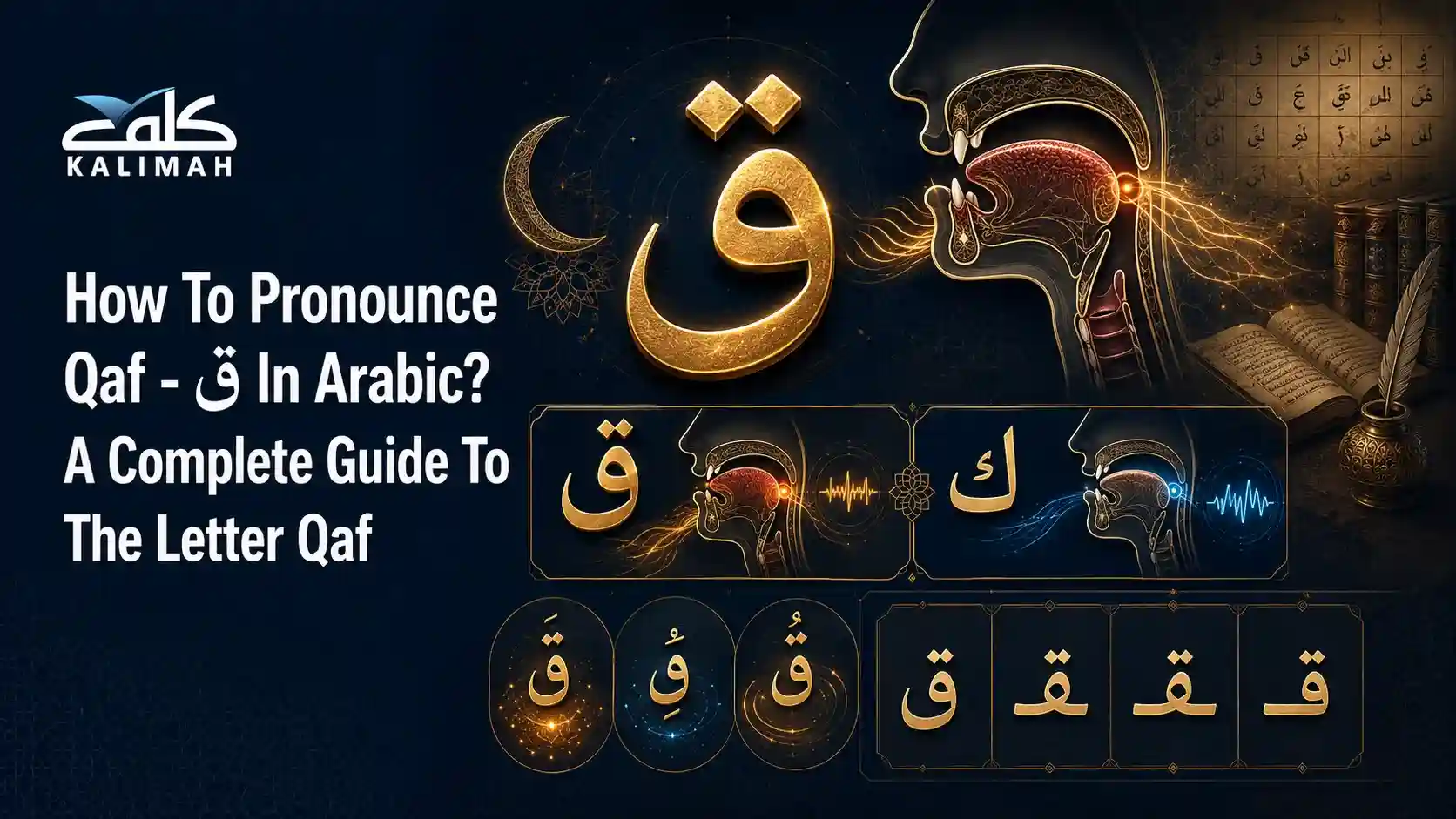
Arabic has a sound that doesn’t exist in English, and it trips up almost every beginner: the letter ق (qaf). If you’ve ever wondered how to pronounce q in Arabic correctly, you’re dealing with one of the seven “heavy” letters that give the language its deep, distinctive character.
This guide breaks down exactly how to pronounce q in Arabic, why it sounds so different from a normal k, and how it changes the vowels around it. At Kalimah Center, this is one of the first pronunciation challenges we work through with new students, because getting it right early prevents habits that are hard to unlearn later.
By the end of this article, you’ll know the mechanics of the sound, how it’s written in its four forms, and how to practice it so it becomes natural.
A. What Is the Letter Qaf and Why It’s Hard to Pronounce?
Qaf (ق) is an Arabic letter representing a voiceless sound produced far back in the throat, deeper than the English k.
It belongs to a small group of letters called emphatic or “heavy” letters, which together give Arabic its resonant, guttural character. On this guide, we write its pronunciation as q to distinguish it clearly from the regular Arabic k sound (ك, kaf).
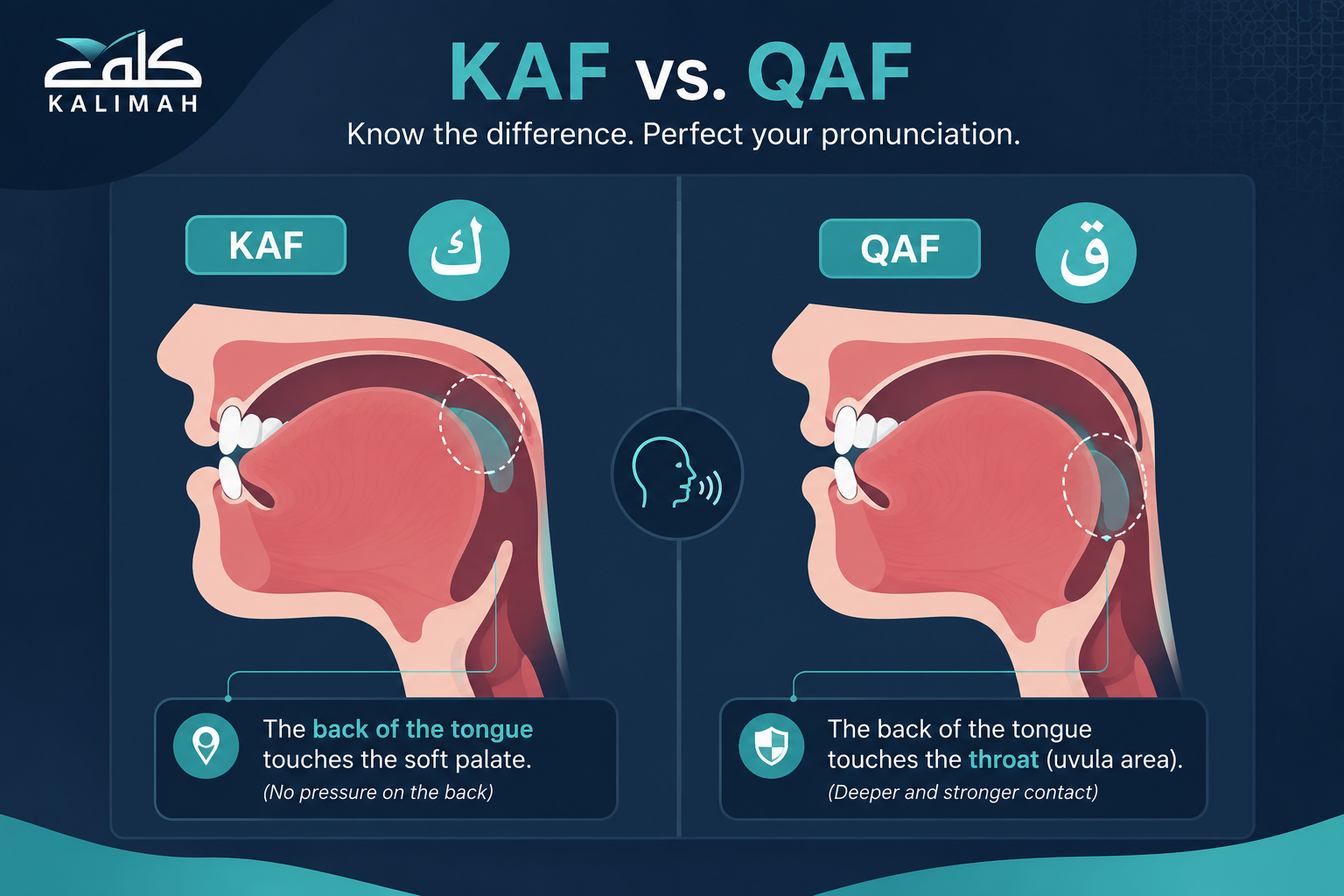
The gap between qaf and a normal k is the single biggest reason learners mispronounce it. A regular k is made with the middle of the tongue touching the roof of the mouth, close to where you’d say it in English. Qaf is made much further back, near the uvula, with a distinct clicking release of air.
If you want to sound like a fluent Arabic speaker rather than a beginner reading a transliteration, this distinction matters. Native listeners hear the difference instantly, and mixing up qaf and kaf can change the meaning of a word entirely.
Why Qaf Is Grouped With the “Heavy” Letters?
Qaf is one of seven emphatic consonants in Arabic, sometimes remembered through the mnemonic خص ضغط قظ. These letters share a physical trait: the back of the tongue presses down and back in the mouth, which thickens and darkens the sound. Think of it as pressing the tongue down as if a small object were resting on it — the tone that results is heavier than a plain consonant.
This isn’t just a technical detail. The heaviness of qaf carries over into surrounding vowels, which is the next thing to understand before you practice.
Read Also: How to Pronounce ح in Arabic
B. How Qaf Changes the Vowels Around It?
Yes. Emphatic letters like qaf pull nearby vowels toward a darker, deeper tone, especially the short vowel fatha (a). This is a real phonetic shift, not a stylistic choice, and it’s one of the clearest markers of accurate Arabic pronunciation.
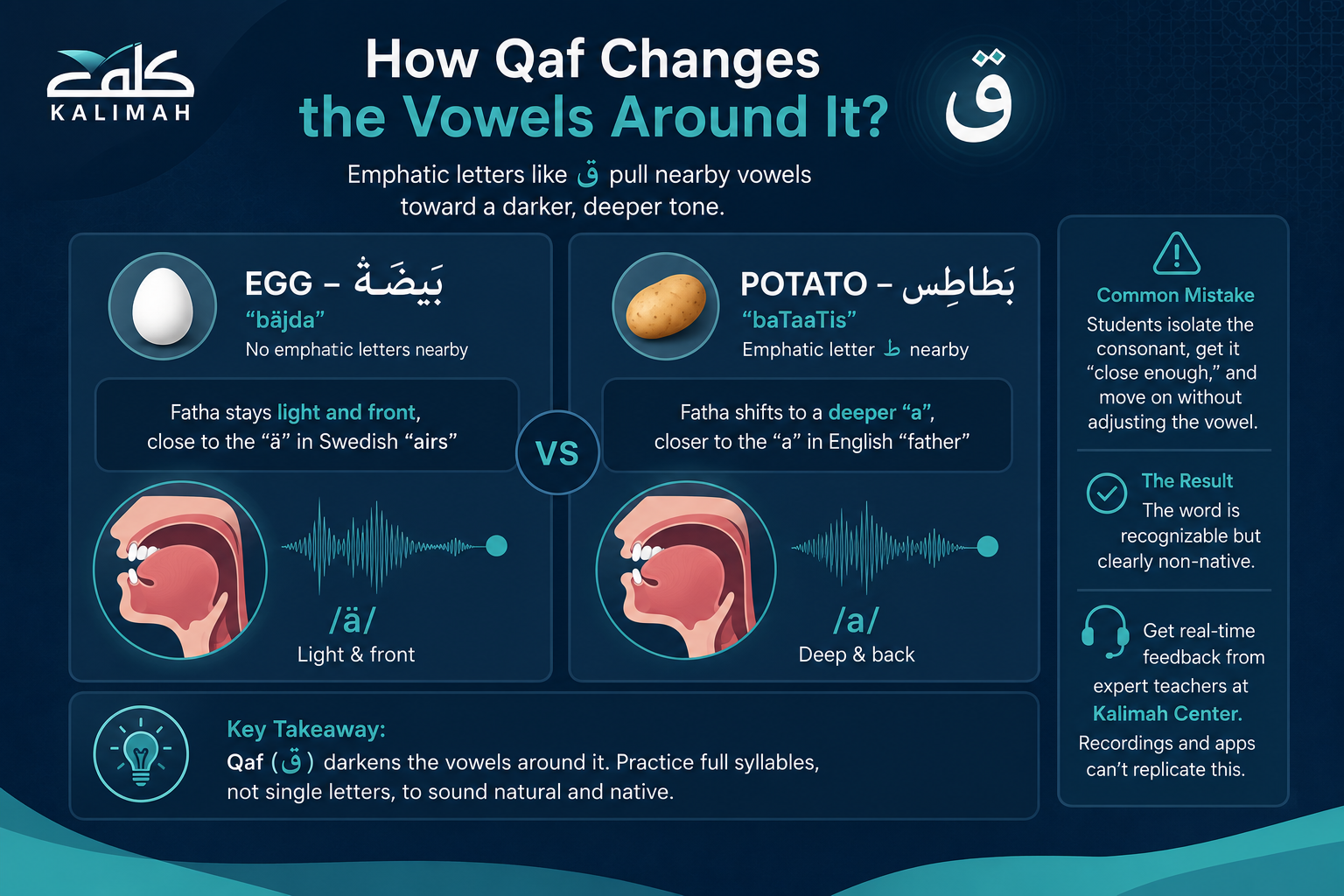
A useful comparison:
the Arabic word for egg, بَيضَة (pronounced “bäjda”), has no emphatic letters around its fatha, so the vowel stays light and front, close to the “ä” sound in the Swedish word for “airs.”
Compare that to the Arabic word for potato, بَطَاطِس (pronounced “baTaaTis”), where the emphatic letter ط sits next to the fatha. Both the short and long “a” sounds shift toward a deeper “a,” closer to the vowel in the English word “father.”
This kind of vowel shift applies the same way around qaf. Practicing q in Arabic in isolation isn’t enough — you need to hear and reproduce how it darkens the vowels beside it, or your pronunciation will sound flat and foreign even when the consonant itself is close.
A common mistake at this stage: students isolate the consonant, get it “close enough,” and move on without adjusting the vowel. The result is a word that’s technically recognizable but clearly non-native. Practicing full syllables, not single letters, fixes this.
If you’d rather work through these sound shifts with a teacher who can correct you in real time, Kalimah Center’s live classes are built around exactly this kind of feedback loop — something recordings and apps can’t replicate.
Read Also: How to pronounce ha in Arabic

C. How to Practice Pronouncing Qaf Correctly?
Start by exaggerating the sound rather than softening it. This might feel unnatural, but it’s the fastest way to train both your mouth and your ear.
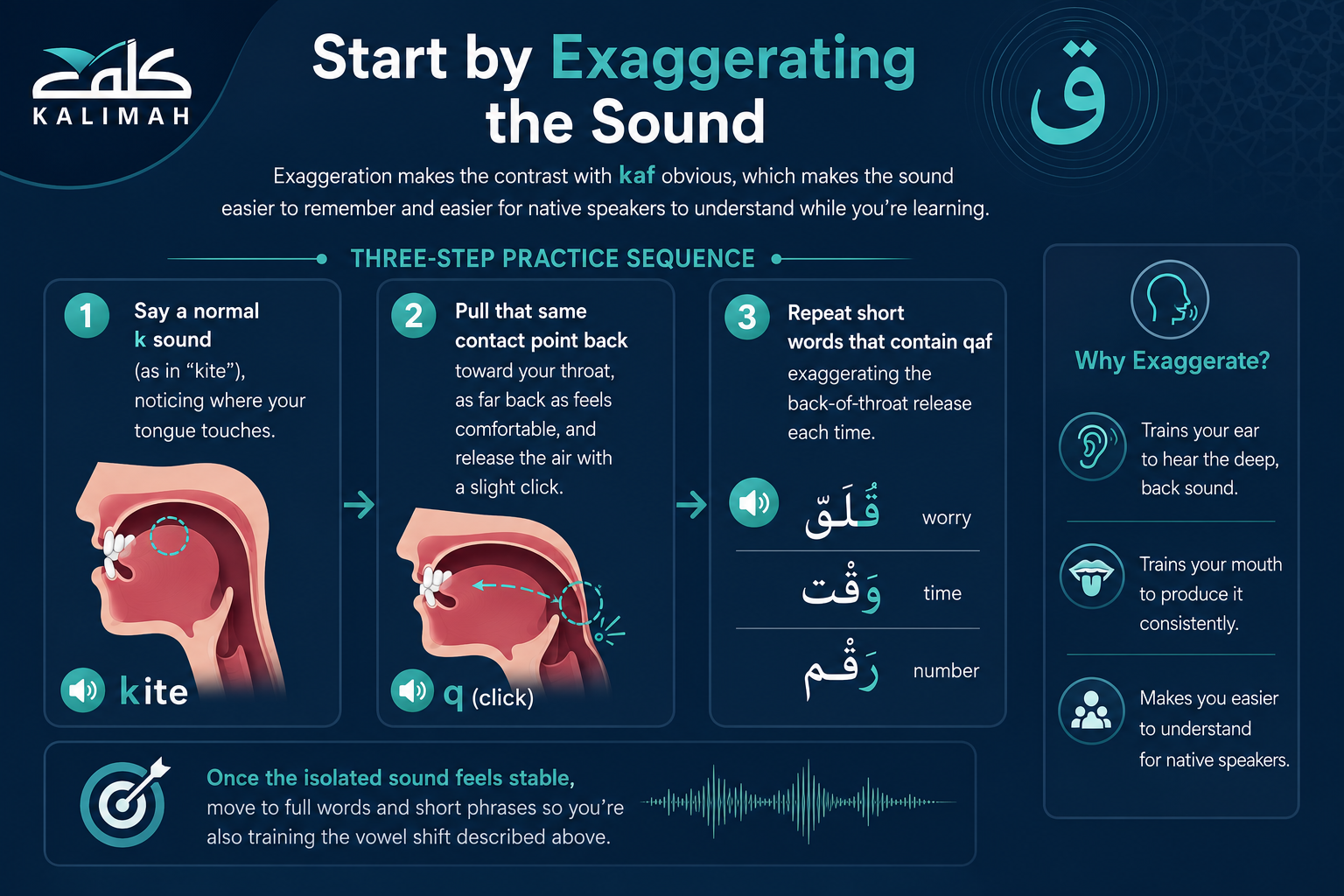
Exaggeration makes the contrast with kaf obvious, which makes the sound easier to remember and easier for native speakers to understand while you’re still learning.
Here’s a simple three-step practice sequence:
- Say a normal k sound (as in “kite”), noticing where your tongue touches.
- Pull that same contact point back toward your throat, as far back as feels comfortable, and release the air with a slight click.
- Repeat short words that contain qaf — قَلَق (worry), وَقْت (time), رَقْم (number) — exaggerating the back-of-throat release each time.
Once the isolated sound feels stable, move to full words and short phrases so you’re also training the vowel shift described above.
This is the same progression used inside Kalimah Center‘s structured pronunciation drills, where students move from single sounds to full words before attempting connected speech.
Read Also: Is Arabic Phonetic Language
Experience Kalimah Center Classes
Watch real excerpts from our live sessions at Kalimah Center and see how we bring learning to life. These clips highlight our interactive, student-centered teaching approach across all our courses—designed to keep learners engaged, motivated, and actively involved every step of the way.
Master Arabic with Kalimah Center
Join our expert-led online classes and start your journey toward Arabic fluency today.
Book Your Free TrialD. How the Letter Qaf Is Written in Arabic
Qaf has four written forms — isolated, initial, medial, and final — because it is a “dual-joining” letter that connects to both the letter before and after it.
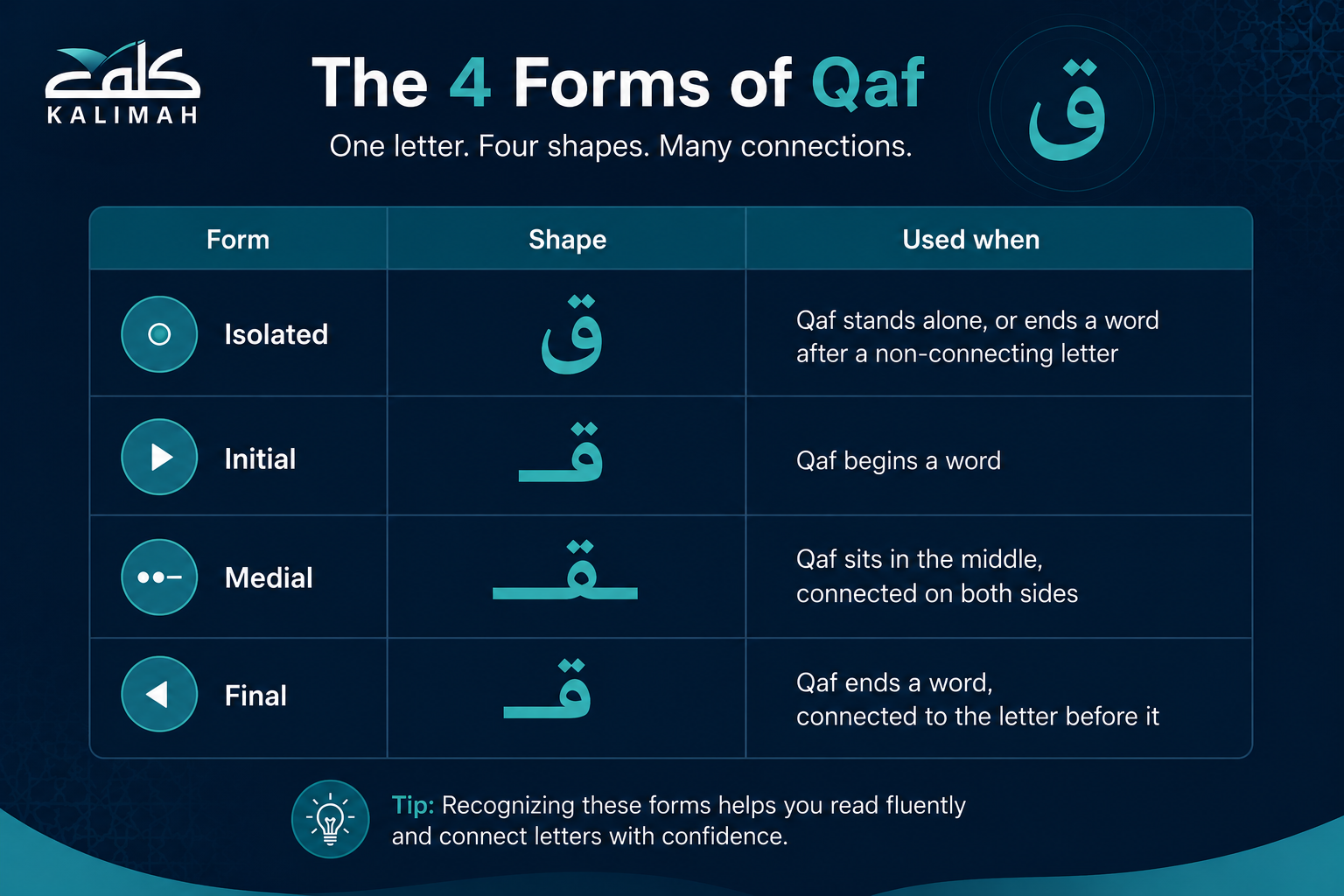
Recognizing these forms is part of learning to pronounce q in Arabic accurately, since reading the word correctly comes before saying it correctly.
| Form | Shape | Used when |
| Isolated | ق | Qaf stands alone, or ends a word after a non-connecting letter |
| Initial | قـ | Qaf begins a word |
| Medial | ـقـ | Qaf sits in the middle, connected on both sides |
| Final | ـق | Qaf ends a word, connected to the letter before it |
Reading the Rule in Plain Terms
The logic is simpler than it looks: if there’s no connecting letter before qaf and none after, use the isolated form.
If there’s nothing before but something after, use the initial form. If there’s a connecting letter before and after, use the medial form. If there’s a connecting letter before but nothing after, use the final form. This same rule applies to most Arabic letters, since qaf is one of many dual-joining letters.
Read Also: How to Pronounce ظ in Arabic
E. Qaf as a Moon Letter
Qaf is a moon letter, meaning the definite article اَل (al) is pronounced clearly in front of it, with no assimilation.
For example, قُطن (cotton) becomes اَلقُطن (al-qutn) — the “l” stays fully audible, unlike with sun letters, where it blends into the following consonant.
Knowing whether a letter is a moon or sun letter is a small detail that makes a large difference in sounding natural when reading Arabic aloud, since mispronounced definite articles are one of the more common giveaways of a non-native reader.
Start Speaking Real Arabic With Confidence
Reading about how to pronounce q in Arabic is a start — hearing it corrected in real time is what makes it stick.
Kalimah Center’s live online classes pair you with instructors who catch these small pronunciation errors before they become habits, whether you’re a complete beginner or refining your accent.

Explore Kalimah Center’s Best Online Arabic Classes for Adults for one-on-one and small-group instruction, or join Intensive Arabic Group Classes With Cheap Fees if you want structured, affordable progress with other learners.
If you’re guiding a child through the Arabic alphabet, Learn Arabic Online for Kids is built specifically for younger learners.

Inside Kalimah Center: Moments from Our Courses
Get a glimpse into the vibrant learning experience at Kalimah Center. These snapshots capture real moments from our live classes—where students engage deeply, connect with passionate instructors, and grow in a welcoming, supportive environment.
Here Are The Reviews On Our Courses:
Our students frequently commend the excellence of our courses and the commitment shown by our instructors. You can read their complete reviews on Trustpilot.
Read more reviews on Trustpilot

📚 Explore Our Courses:
Online Arabic Course: Tailored to your level, our comprehensive Arabic program includes 16 teaching levels and 400+ hours of personalized sessions.
Online Quran With Tajweed Course: Perfect for non-Arabic speakers, our course spans 13 levels and equips you with Tajweed mastery from beginner to advanced.
Online Arabic Course For Kids: Nurture your child’s love for Arabic with our engaging and structured program, available in 24 levels for primary, intermediate, and secondary stages.
🚀 Start Your Free Trial Today! 🚀
Don’t miss out on this life-changing opportunity to deepen your faith and knowledge. Sign up now for your free trial and take the first step towards becoming a better practicing Muslim with Kalimah Center!
Master Arabic with Kalimah Center
Join our expert-led online classes and start your journey toward Arabic fluency today.
Book Your Free TrialConclusion
Qaf is one of the letters that defines Arabic’s sound, and learning how to pronounce q in Arabic properly — deep in the throat, with a firm release, and with attention to how it darkens nearby vowels — is a marker of real progress as a learner.
It takes deliberate, even exaggerated practice at first, but the payoff is a noticeably more native-sounding accent.
Beyond the sound itself, recognizing qaf’s four written forms and its behavior as a moon letter rounds out a complete, practical understanding of the letter. With consistent practice — ideally with feedback from a teacher — pronouncing q in Arabic stops being a struggle and becomes second nature.
Frequently Asked Questions
Here are quick answers to the questions learners ask most often about the letter qaf and how to pronounce q in Arabic correctly.
1. Is qaf the same as the Arabic letter kaf?
No. Kaf (ك) is pronounced with the middle of the tongue touching the roof of the mouth, similar to the English k. Qaf (ق) is produced much further back in the throat, with a heavier, clicking release, making the two letters distinct in both sound and meaning.
2. Why do some Arabic speakers pronounce qaf as a “g” or a glottal stop?
In spoken dialects, qaf is often replaced with a hard “g” (common in Gulf and Bedouin dialects) or a glottal stop (common in Levantine dialects like Lebanese and Syrian). In Modern Standard Arabic, however, the formal q pronunciation is used consistently, especially in news, religious, and academic contexts.
3. Does qaf really change how vowels sound next to it?
Yes. As an emphatic letter, qaf darkens nearby vowels, particularly the short “a” (fatha), pulling it toward a deeper, back-of-mouth tone. This is a genuine phonetic effect, not just a regional accent variation.
4. What’s the fastest way to learn to pronounce qaf correctly?
Exaggerate the sound at first rather than trying to whisper it softly. Practice it in full words rather than in isolation, and get feedback from a native speaker or teacher, since self-correction is difficult with a sound that doesn’t exist in your native language.
5. Is qaf used the same way in every Arabic-speaking country?
The written letter and its Modern Standard Arabic pronunciation are consistent everywhere. In everyday dialect, however, pronunciation varies significantly by country, region, and even gender, so hearing “qaf” pronounced as “g” or a glottal stop in casual conversation is completely normal.