If you’ve ever studied Arabic and then landed in Cairo, Amman, or Riyadh only to realize the streets don’t sound anything like your textbook, you’ve experienced diglossia in Arabic firsthand. This isn’t a personal failure or a sign you studied the wrong material — it’s a defining structural feature of the language itself.
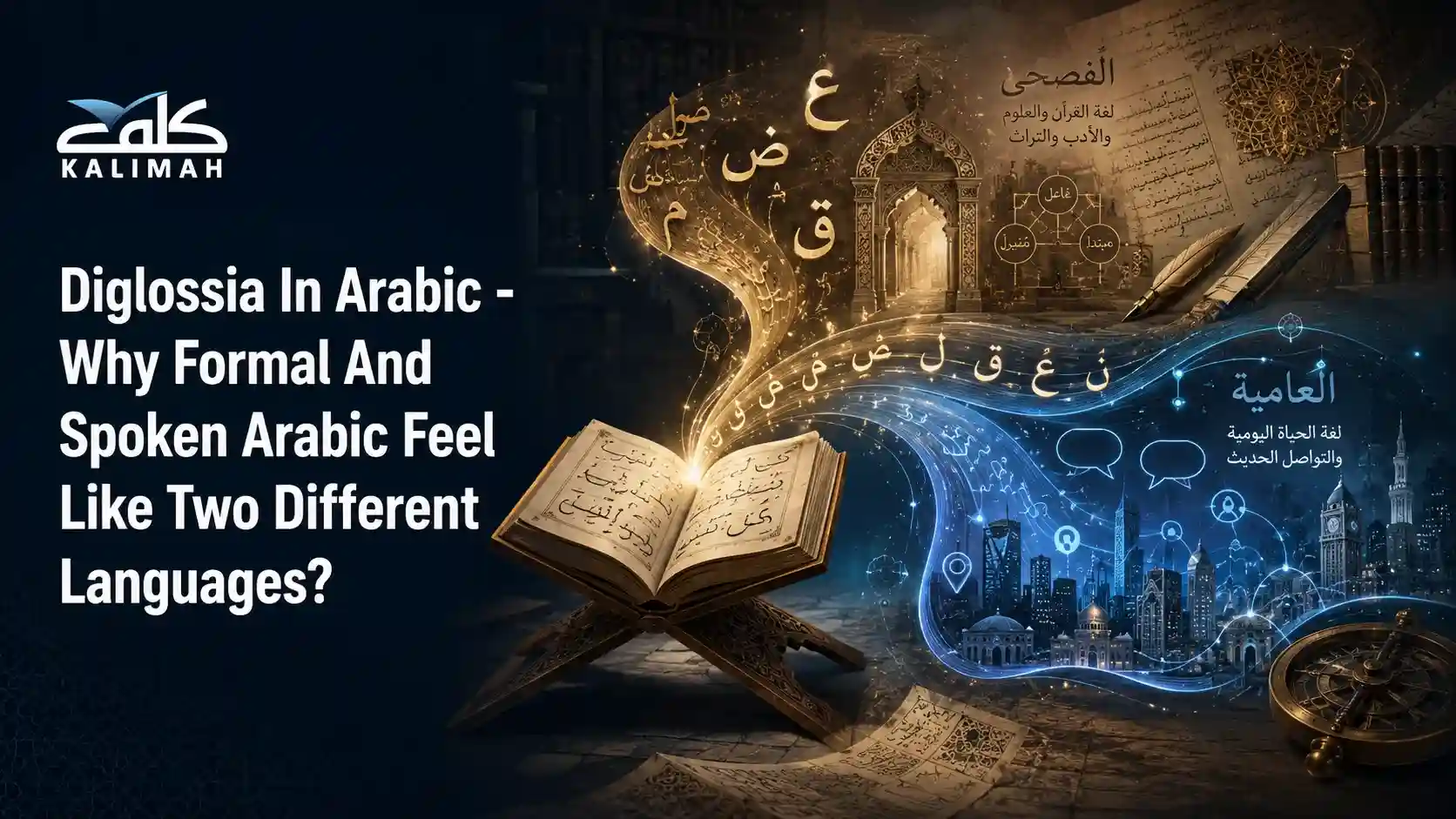
Diglossia in Arabic describes the coexistence of two distinct levels of the same language: a formal, standardized variety used for writing, education, and media, and a spoken, regional variety used in daily conversation. Every Arabic speaker lives inside this split, whether they’ve ever named it or not.
At Kalimah Center, this is one of the first concepts we walk new students through, because understanding it changes how you approach learning Arabic from day one.
What You’ll Learn in This Article
- What diglossia in Arabic actually means and where the term comes from
- The historical and modern reasons diglossia exists in Arabic specifically
- How diglossia in Arabic pronunciation shows up in everyday speech
- Why this matters practically for anyone learning the language
- Answers to the most common questions learners ask about Fusha and Ammiyah
What Is Diglossia in Arabic?
Diglossia is a sociolinguistic term for a situation where two varieties of one language exist side by side, each assigned to different social functions.
In Arabic, this means Modern Standard Arabic (Fusha) handles writing, broadcasting, religious instruction, and formal speech, while regional colloquial Arabic (Ammiyah) handles everyday conversation, family life, and the marketplace.
The term itself comes from the Greek roots for “two” and “tongue” — literally, a doubled or split language state. It was popularized in Western linguistics by Charles Ferguson in 1959, though Arab scholars had already been describing the Fusha–Ammiyah divide for centuries under different names.
The Two Levels of Arabic: Fusha and Ammiyah
Fusha is the fully case-inflected, grammatically regulated form of Arabic — the language of the Quran, classical poetry, news broadcasts, and official documents. Ammiyah refers to the dozens of regional dialects spoken across the Arab world, which differ enough that a speaker from Yemen may genuinely struggle to follow a speaker from Morocco in casual conversation.
Between these two poles, linguists also point to what’s often called “Educated Spoken Arabic” or Contemporary Arabic — a middle register educated speakers slide into during cross-dialect conversations, borrowing Fusha vocabulary and structure without full case-ending grammar.
If you’re building a study plan around these registers, our Best Online Arabic Classes for Adults are structured specifically to bridge Fusha grammar with practical spoken skills, rather than teaching one in isolation.
Read Also: Is Arabic a Tonal Language
Reasons for the Existence of Diglossia in Arabic
Diglossia exists to some degree in most languages with a long literary tradition — German, Greek, and Tamil all show similar patterns.
Arabic diglossia is unusually pronounced, though, and the reasons for the existence of diglossia in Arabic break down into three main causes: one rooted in pre-Islamic history, one tied to the early Islamic conquests, and one active in the language today.
1. Dialects Existed Before Islam
Dialectal variation in Arabic predates Islam. Pre-Islamic tribes already spoke distinct dialects, and the Quran itself was revealed in the dialect of Quraysh, which later became the reference point for classical Arabic grammar.
2. The Islamic Conquests Accelerated the Split
As Islamic conquests spread Arabic across non-Arab populations in the seventh and eighth centuries, large numbers of new speakers acquired Arabic as adults.
This accelerated grammatical simplification in everyday speech — particularly the gradual loss of case endings (i’rab) in spoken registers — while written Fusha preserved them intact.
Historical grammarians like Ibn Khaldun and Ibn Manzur wrote about this widening gap centuries ago, treating the spread of altered speech among non-native Arabic speakers as a serious concern for the language’s integrity — the same concern many linguists raise today, just in a different era.
3. Modern Media, Education, and National Fragmentation Sustain the Gap
In the contemporary period, three forces sustain — and in some views intensify — diglossia in Arabic.
Media saturation in colloquial dialects plays a major role: entertainment, social media, and satellite television increasingly favor dialect over Fusha, giving Ammiyah more daily airtime than the formal register receives.
A gap in how Fusha is taught adds to this, since formal instruction in many Arab countries focuses on grammar rules in isolation rather than functional use, so students can pass exams in Fusha without ever comfortably speaking it.
National fragmentation compounds both: with Arabic spoken across more than twenty countries, each with its own political and educational system, dialects have had room to diverge further from one another and from the standard.
A common mistake we see in new learners at Kalimah Center is assuming that once they’ve mastered Fusha grammar, spoken fluency will follow automatically. It doesn’t — the two skills need to be trained somewhat separately, because they draw on different vocabulary habits and pronunciation patterns.
Read Also: How to Pronounce Arabic R
Diglossia in Arabic Pronunciation
Diglossia in Arabic pronunciation shows up most clearly in case endings, vowel handling, and consonant shifts between the standard and spoken registers.
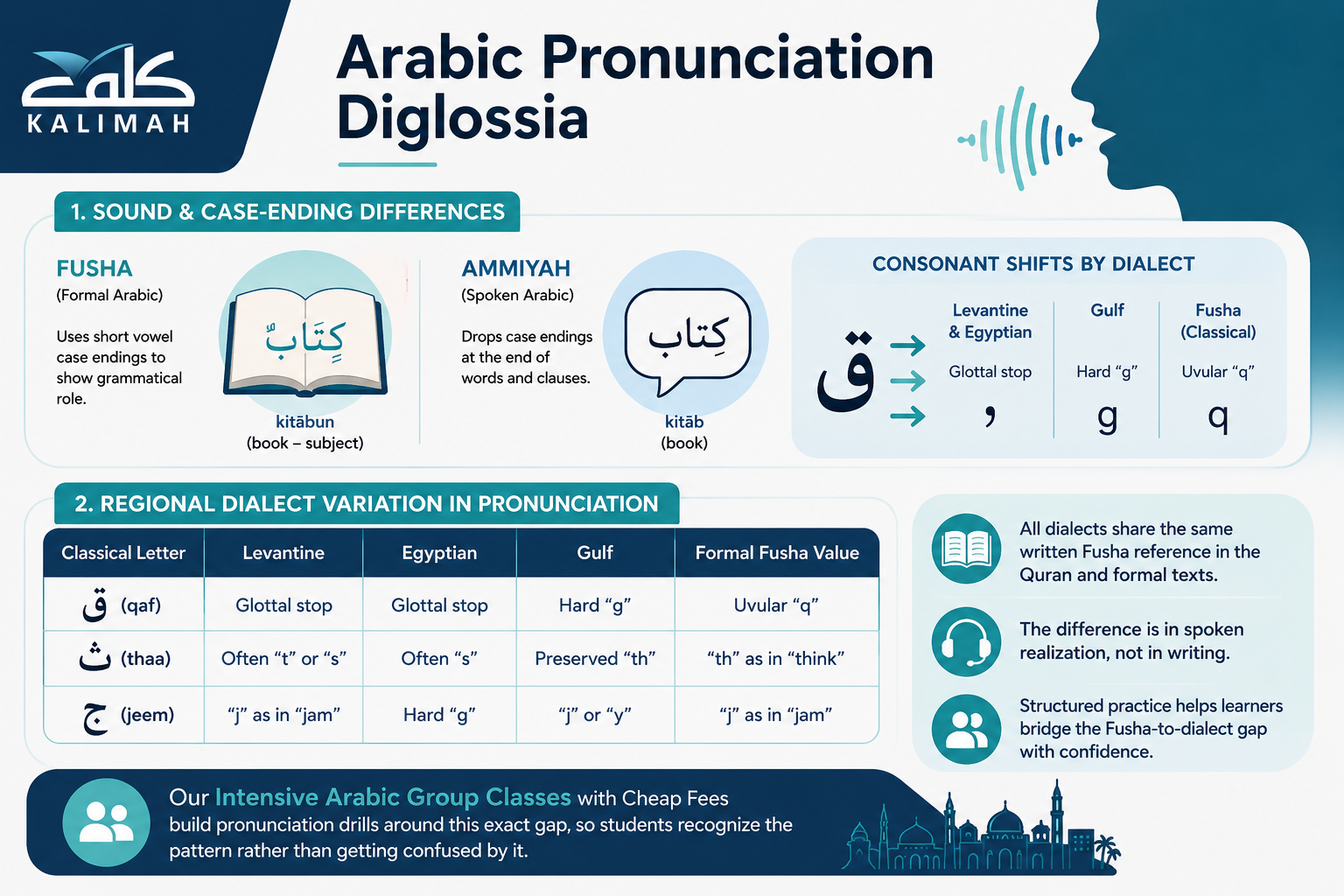
1. Sound and Case-Ending Differences Between Fusha and Ammiyah
In Fusha, nouns and verbs typically carry short vowel case endings that mark grammatical role — subject, object, possession. In spoken Ammiyah, these endings are almost universally dropped, especially at the end of a sentence or clause.
This isn’t sloppy speech; it reflects a consistent, rule-governed pattern that linguists have documented as far back as early grammarians describing certain tribal speech habits as naturally clipping final vowels rather than fully articulating them.
Consonant pronunciation also shifts by dialect. The classical ق (qaf) is pronounced as a glottal stop in much of Levantine and Egyptian speech, as a hard “g” in Gulf and Upper Egyptian dialects, and preserved close to its classical value in more conservative regional speech and in Quranic recitation.
2. Regional Dialect Variation in Pronunciation
Because Ammiyah isn’t one dialect but many, pronunciation diglossia compounds across regions. The table below shows how a single classical letter shifts across major dialect groups.
| Classical letter | Levantine | Egyptian | Gulf | Formal Fusha value |
| ق (qaf) | Glottal stop | Glottal stop | Hard “g” | Uvular “q” |
| ث (thaa) | Often “t” or “s” | Often “s” | Preserved “th” | “th” as in “think” |
| ج (jeem) | “j” as in “jam” | Hard “g” | “j” or “y” | “j” as in “jam” |
All of these dialects, in principle, share the same written Fusha reference point when reading a newspaper or the Quran — the divergence is almost entirely in spoken realization, not in the written form.
This is precisely why learners benefit from structured, guided pronunciation practice rather than picking up sounds passively from mixed media.
Our Intensive Arabic Group Classes with Cheap Fees build pronunciation drills around this exact Fusha-to-dialect gap, so students recognize the pattern rather than getting confused by it.
Read Also: Arabic Language Importance
Inside Kalimah Center: Moments from Our Courses
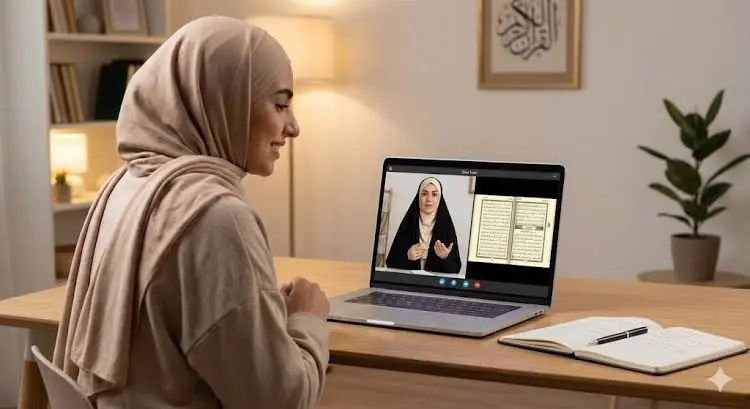
Get a glimpse into the vibrant learning experience at Kalimah Center. These snapshots capture real moments from our live classes—where students engage deeply, connect with passionate instructors, and grow in a welcoming, supportive environment.
Master Arabic with Kalimah Center
Join our expert-led online classes and start your journey toward Arabic fluency today.
Book Your Free TrialWhy Diglossia Matters for Arabic Learners?
Diglossia isn’t just an academic label — it directly shapes how fast you progress and where you get stuck. Learners who understand the split early adjust their study plan accordingly; learners who don’t often blame themselves for problems that are actually built into the language.
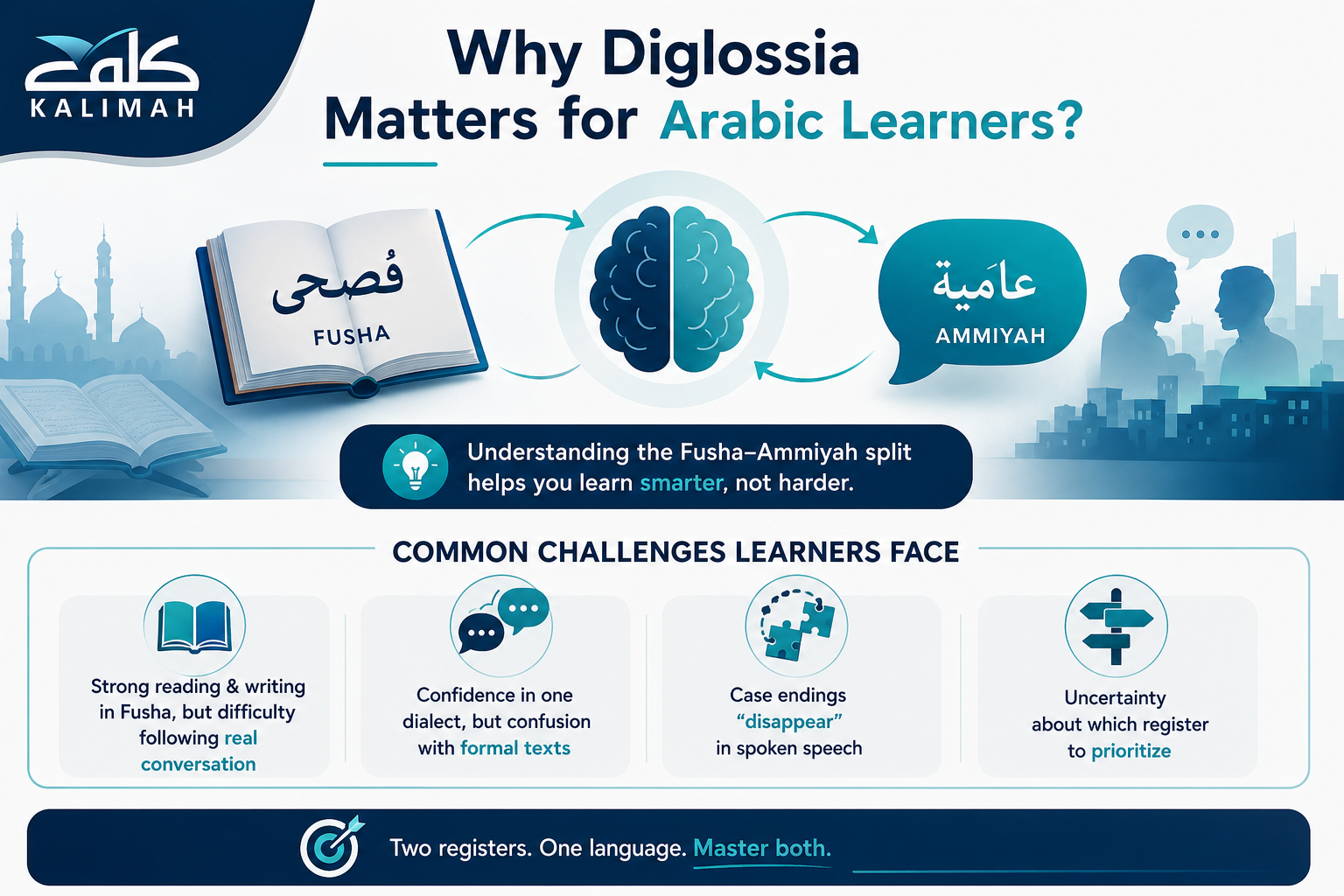
Common Challenges Learners Face
Most obstacles Arabic learners face trace back to treating Fusha and Ammiyah as one skill instead of two related ones.
- Strong reading and writing skills in Fusha, but difficulty following real conversation
- Confidence in one regional dialect, but confusion when reading news or formal texts
- Frustration when case endings they memorized “disappear” in spoken speech
- Uncertainty about which register to prioritize first
Read Also: Arabic Numbers Grammar
How to Navigate Both Registers Effectively
The most effective approach treats Fusha and a chosen dialect as complementary, not competing, skills — building solid Fusha grammar as the stable foundation, then layering in a specific regional dialect for conversational fluency.
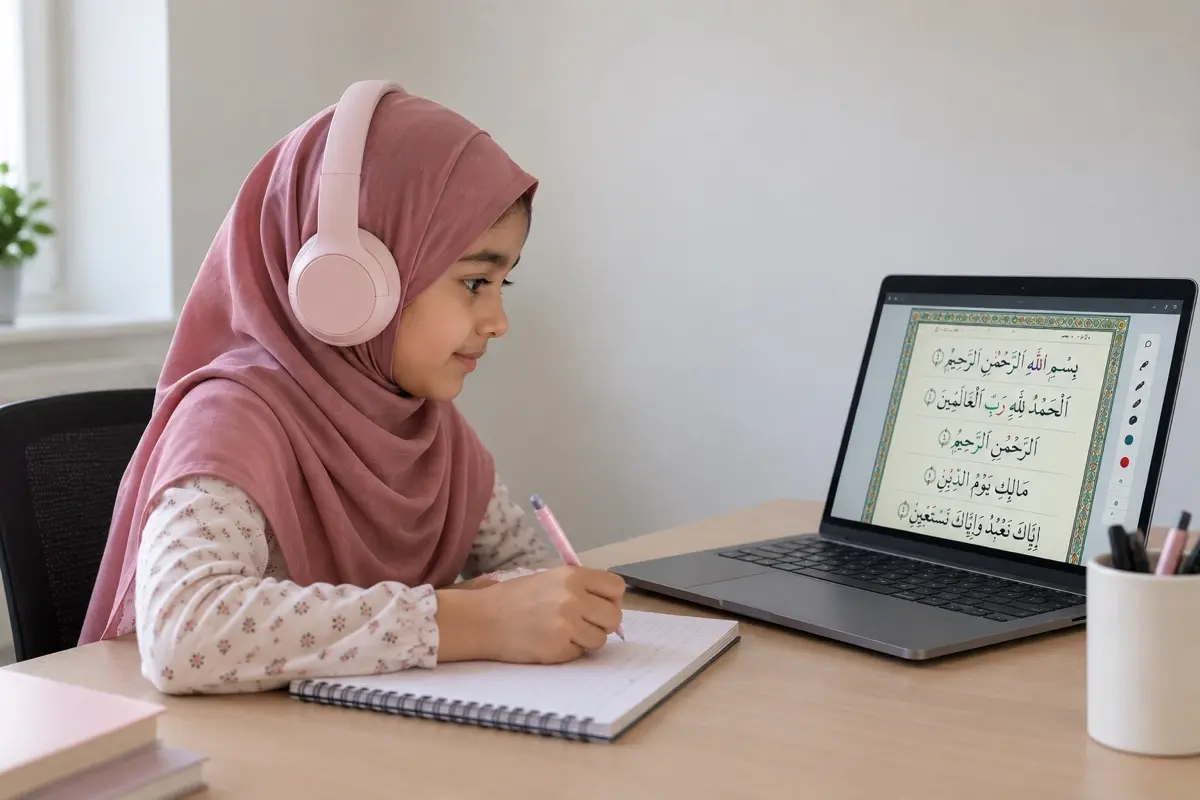
This is also why starting early matters: children who are exposed to structured Fusha alongside natural conversational practice tend to move between registers with far less friction as adults. Our Learn Arabic Online for Kids program is designed around exactly this dual-track approach from the beginning.
Speak Arabic With Confidence In Both Registers
Understanding diglossia is the easy part — building real fluency across Fusha and spoken Arabic takes structured, guided practice.
Kalimah Center‘s instructors design every course to bridge that exact gap, so you’re never stuck choosing between grammar and conversation.

Whether you’re starting from zero, want to strengthen your Fusha grammar, or need a dialect for real conversation, there’s a course built around that specific goal.
Our courses:
- Best Online Arabic Classes for Adults: structured, flexible, one-on-one learning
- Intensive Arabic Group Classes With Affordable Fees: learn alongside others at a lower cost
- Learn Arabic Online for Kids: age-appropriate lessons for young learners

Inside Kalimah Center: Moments from Our Courses
Get a glimpse into the vibrant learning experience at Kalimah Center. These snapshots capture real moments from our live classes—where students engage deeply, connect with passionate instructors, and grow in a welcoming, supportive environment.
Here Are The Reviews On Our Courses:
Our students frequently commend the excellence of our courses and the commitment shown by our instructors. You can read their complete reviews on Trustpilot.
Read more reviews on Trustpilot

📚 Explore Our Courses:
Online Arabic Course: Tailored to your level, our comprehensive Arabic program includes 16 teaching levels and 400+ hours of personalized sessions.
Online Quran With Tajweed Course: Perfect for non-Arabic speakers, our course spans 13 levels and equips you with Tajweed mastery from beginner to advanced.
Online Arabic Course For Kids: Nurture your child’s love for Arabic with our engaging and structured program, available in 24 levels for primary, intermediate, and secondary stages.
🚀 Start Your Free Trial Today! 🚀
Don’t miss out on this life-changing opportunity to deepen your faith and knowledge. Sign up now for your free trial and take the first step towards becoming a better practicing Muslim with Kalimah Center!
Master Arabic with Kalimah Center
Join our expert-led online classes and start your journey toward Arabic fluency today.
Book Your Free TrialConclusion
Diglossia in Arabic isn’t a flaw in the language — it’s a structural reality with deep historical roots and active modern drivers, from the early spread of Arabic among non-native speakers to today’s media landscape and fragmented educational systems.
Understanding this split, and specifically how it shapes diglossia in Arabic pronunciation, changes how you plan your learning: not as Fusha versus dialect, but as two registers that serve different purposes and deserve separate, deliberate practice.
That’s the exact approach Kalimah Center builds into every course, so you develop both registers together instead of getting stuck favoring one.

Frequently Asked Questions About Diglossia in Arabic
The questions below cover what learners most often ask once they understand that Fusha and spoken Arabic function as two related but distinct registers.
1. What Is the Main Difference Between Fusha and Ammiyah?
Fusha is the standardized, case-inflected form of Arabic used in writing, media, and formal speech, while Ammiyah refers to the regional spoken dialects used in daily conversation. The two share vocabulary and grammatical roots but differ significantly in pronunciation, case endings, and everyday usage.
2. Is Diglossia Unique to Arabic?
No — diglossia exists in many languages with long literary histories, including Greek and German. Arabic diglossia is unusually pronounced, though, because of the scale of regional dialect divergence across more than twenty countries.
3. Can You Learn Fusha Without Learning a Dialect?
Yes, and many learners do, particularly those focused on reading, writing, or Quranic study. However, Fusha alone will not prepare you for everyday spoken conversation in an Arab country, since native speakers use dialect in daily life.
4. Why Do Arabic Speakers Drop Case Endings When Speaking?
Case endings are largely dropped in spoken Ammiyah because everyday speech historically simplified the more complex grammatical markers preserved in written Fusha. This pattern goes back centuries and reflects natural spoken-language economy rather than incorrect usage.
5. Does Diglossia Make Arabic Harder to Learn?
It adds a layer of complexity, since learners often need to build skills in two related registers rather than one. With a structured approach that separates Fusha grammar training from dialect-specific conversation practice, this challenge becomes manageable rather than overwhelming.