Few topics intimidate Arabic learners quite like Arabic numbers grammar. Ask anyone who has studied the language: saying “three books” or “eleven students” correctly involves rules about gender, case, and word order that seem to change from one number to the next.
The good news? Once you see the system behind it, Arabic numbers grammar becomes far more logical than it first appears.
In Arabic, this topic is known as العدد والمعدود (al-ʿadad wal-maʿdūd) — “the number and the counted noun.” The number (العدد) is the word expressing quantity, while the counted noun (المعدود), also called the tamyīz (تمييز) or “specification,” is the noun being counted. In the phrase “seven books,” seven is the number and books is the counted noun.
There is no single rule that covers all Arabic numbers. Instead, the rules change depending on which group a number belongs to. In this guide from Kalimah Center, we break the system down into clear categories, each with examples, so you can master the grammar of numbers in Arabic step by step.
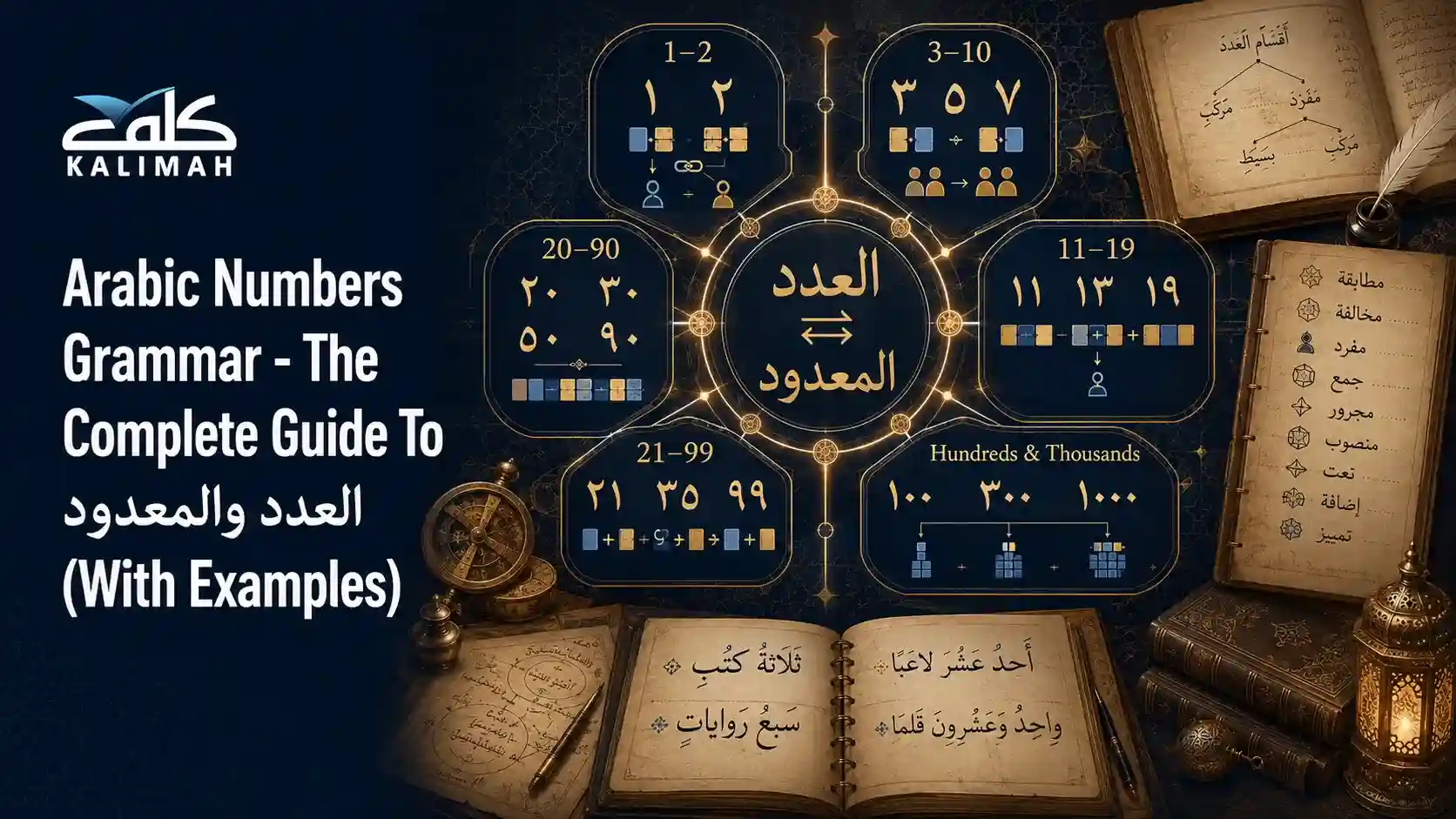
Arabic grammarians traditionally divide numbers into four groups:
- Singular numbers (الأعداد المفردة): 1 to 10, plus 100, 1000, and their multiples, and the “tens” words.
- Compound numbers (الأعداد المركبة): 11 to 19.
- The tens / decade words (ألفاظ العقود): 20, 30, 40 … up to 90.
- Conjoined numbers (الأعداد المعطوفة): 21 to 99 (e.g., “five and thirty” = 35).
1. The Numbers 1 and 2
The numbers wāḥid (واحد) “one” and ithnān (اثنان) “two” behave differently from all other numbers:
- They come after the counted noun, not before it.
- They always match the counted noun in gender (masculine with masculine, feminine with feminine).
- They function as an adjective (نعت/صفة) describing the noun, so they take the same case as the noun itself.
- No tamyīz is needed — the noun itself is simply singular (for 1) or dual (for 2).
Examples:
| Arabic | English | Note |
| جاءَ طالبٌ واحدٌ | One (male) student came | masculine noun → masculine number |
| رسمَتْ ليلى رسمةً واحدةً | Layla drew one drawing | feminine noun → feminine number |
| عندي كتابان اثنان | I have two books | dual noun, dual number |
| امرأتان اثنتان | Two women | feminine dual |
Grammar note: اثنان / اثنتان is declined like the dual — it takes ال ف (alif) in the nominative (اثنان) and ياء (yāʾ) in the accusative and genitive (اثنين / اثنتين).
2. The Numbers 3 to 10
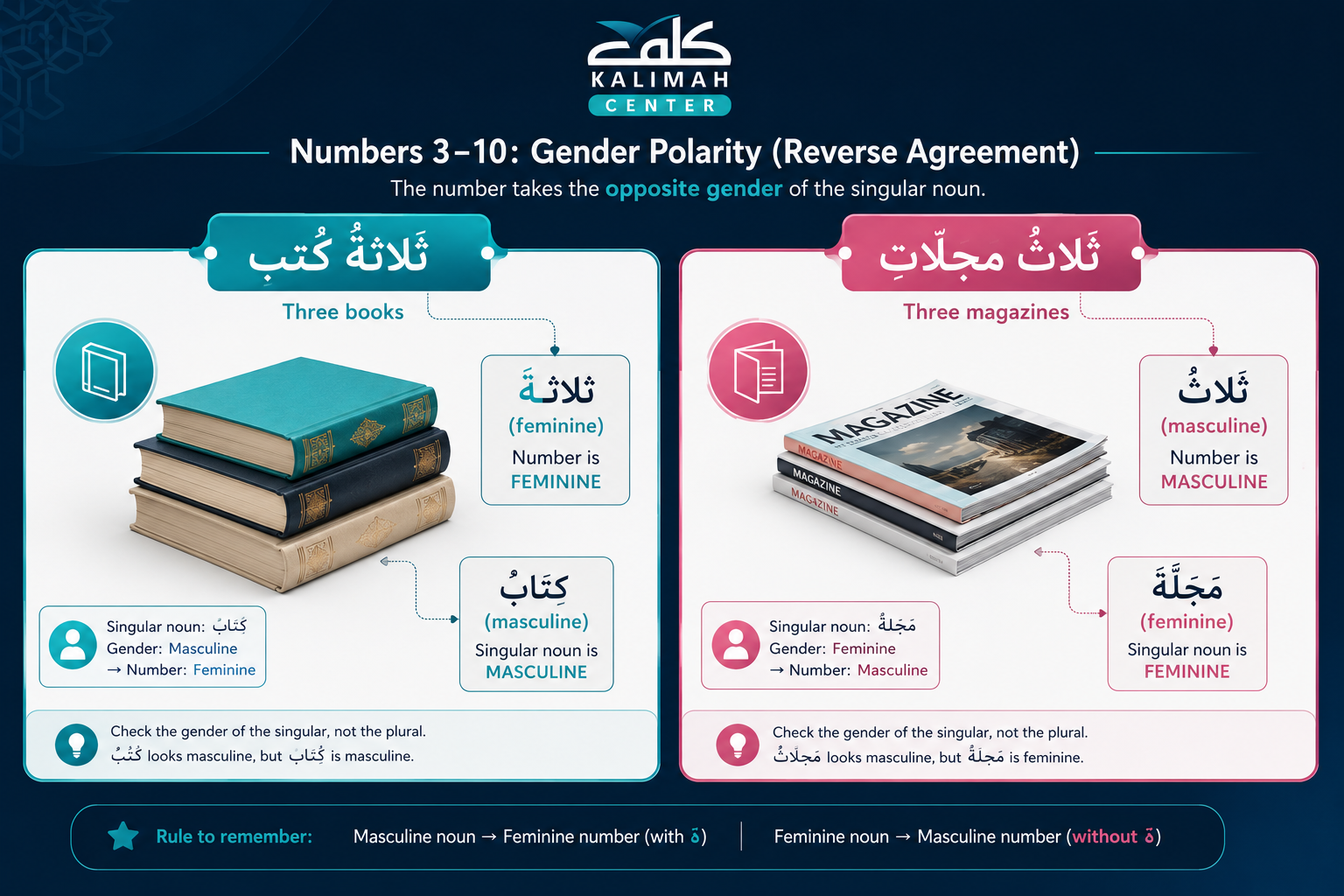
This is the group learners meet first, and it introduces the most famous rule in Arabic numbers grammar: gender polarity (reverse agreement).
- The number takes the opposite gender of the singular form of the counted noun. A masculine noun takes a feminine-looking number (with ة), and a feminine noun takes a masculine-looking number.
- The counted noun is plural and genitive (مجرور), because the number and noun form an iḍāfah (إضافة) construction. It is parsed as a muḍāf ilayhi (مضاف إليه).
- The number itself is fully declinable and takes its case from its position in the sentence.
Examples:
| Arabic | English | Why |
| ثلاثةُ كتبٍ | Three books | كتاب is masculine → number is feminine (ثلاثة) |
| سبعُ رواياتٍ | Seven novels | رواية is feminine → number is masculine (سبع) |
| نجحَ أربعةُ طلابٍ | Four students passed | طالب masculine → أربعة feminine |
| خمسُ أوراقٍ | Five sheets of paper | ورقة feminine → خمس masculine |
Tip: Always check the gender of the singular, not the plural. أوراق looks masculine, but its singular ورقة is feminine — so the number must be masculine (خمس).
Read Also: Numbers in Egyptian Arabic
3. The Numbers 11 and 12
From 11 to 99, the counted noun changes completely: it is now singular and accusative (منصوب), parsed as a tamyīz (specification).
For 11 and 12 specifically:
- Both parts of the number match the counted noun in gender.
- 11 (أحدَ عشرَ / إحدى عشرةَ) is indeclinable: both parts are fixed on the fatḥah, and the whole number takes its position’s case “in place” (في محل رفع / نصب / جر).
- 12 (اثنا عشرَ / اثنتا عشرةَ) is special: the first part declines like a dual (اثنا in nominative, اثني in accusative/genitive; the nūn is dropped), while the second part (عشر/عشرة) stays fixed on the fatḥah.
Examples:
| Arabic | English |
| وصلَ أحدَ عشرَ لاعبًا | Eleven players arrived |
| عندي إحدى عشرةَ قصةً | I have eleven stories |
| اثنا عشرَ نقيبًا | Twelve chiefs |
| حصلوا على اثنتي عشرةَ جائزةً | They received twelve prizes |
Note on the number 10: When عشرة stands alone (as in “ten books”), it opposes the noun’s gender like 3–9. But inside a compound number (11–19), it matches the noun’s gender.
4. The Numbers 13 to 19
The “teen” numbers combine two rules at once:
- The first part (3–9) opposes the counted noun in gender.
- The second part (عشر/عشرة) matches it.
- Both parts are indeclinable on the fatḥah (مبني على فتح الجزأين), and the whole number occupies the case of its position in the sentence.
- The counted noun is singular, accusative — a tamyīz.
Examples:
| Arabic | English | Breakdown |
| ثلاثَ عشرةَ طالبةً | Thirteen (female) students | ثلاث opposes (fem. noun → masc. unit), عشرة matches |
| سبعةَ عشرَ طالبًا | Seventeen (male) students | سبعة opposes, عشر matches |
| في الشجرةِ تسعةَ عشرَ غصنًا | The tree has nineteen branches | tamyīz: غصنًا singular accusative |
A beautiful Quranic example: إِنِّي رَأَيْتُ أَحَدَ عَشَرَ كَوْكَبًا — “Indeed, I saw eleven stars” (Yūsuf 12:4).
Read Also: Diglossia in Arabic
5. The Tens: 20 to 90 (ألفاظ العقود)
The decade words — عشرون، ثلاثون، أربعون … تسعون — are the easiest group:
- They have one fixed form for both masculine and feminine nouns. No gender agreement to worry about.
- They decline like the sound masculine plural: ـونَ in the nominative and ـينَ in the accusative and genitive.
- The counted noun is singular and accusative (tamyīz).
Examples:
| Arabic | English |
| جاءَ خمسونَ طالبًا وخمسونَ طالبةً | Fifty male students and fifty female students came |
| ادفعْ سبعينَ دينارًا | Pay seventy dinars |
| في الشهرِ ثلاثونَ يومًا | A month has thirty days |
Experience Kalimah Center Classes
Watch real excerpts from our live sessions at Kalimah Center and see how we bring learning to life. These clips highlight our interactive, student-centered teaching approach across all our courses—designed to keep learners engaged, motivated, and actively involved every step of the way.
Master Arabic with Kalimah Center
Join our expert-led online classes and start your journey toward Arabic fluency today.
Book Your Free Trial6. The Conjoined Numbers: 21 to 99
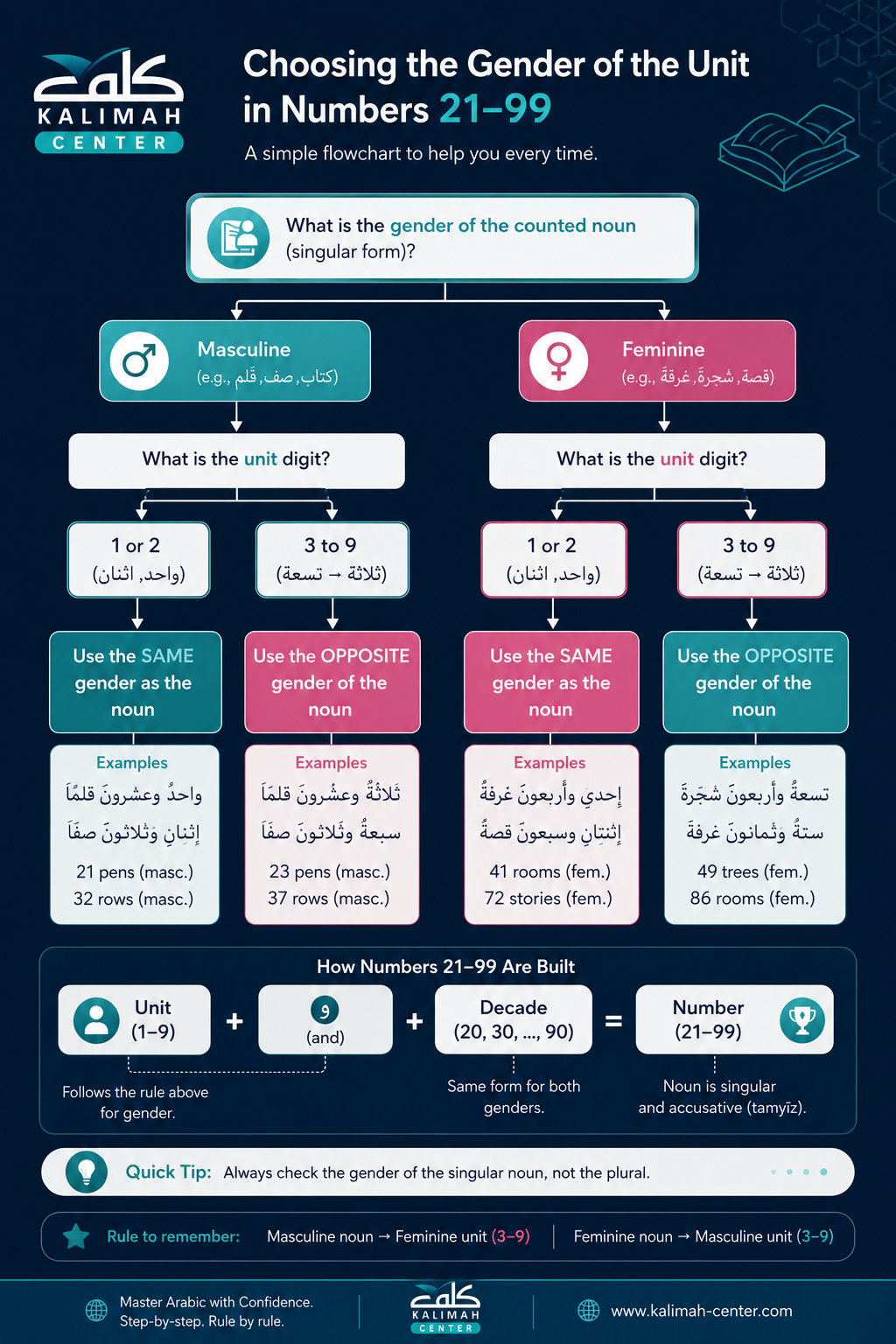
Numbers like 21, 35, and 99 are built with the conjunction و (“and”): “one and twenty,” “five and thirty.”
- Units 1 and 2 → match the counted noun in gender.
- Units 3 to 9 → oppose the counted noun in gender.
- The decade word never changes for gender and declines like a sound masculine plural.
- The counted noun is singular, accusative (tamyīz).
- The unit is fully declinable and the decade word follows its case, since it is joined by و.
Examples:
| Arabic | English | Why |
| واحدٌ وعشرونَ قلمًا | Twenty-one pens | واحد matches masculine قلم |
| إحدى وأربعونَ غرفةً | Forty-one rooms | إحدى matches feminine غرفة |
| تسعٌ وتسعونَ شجرةً | Ninety-nine trees | تسع opposes feminine شجرة |
| ستةٌ وثمانونَ صفًا | Eighty-six classrooms | ستة opposes masculine صف |
Read Also: Roman Numerals vs Arabic Numerals
7. The Hundreds, Thousands, and Their Multiples
The numbers مائة/مئة (100) and ألف (1000) and their multiples follow one simple pattern:
- They have one form for masculine and feminine counted nouns.
- The counted noun is singular and genitive (مجرور), because the number and noun form an iḍāfah. It is parsed as مضاف إليه.
- The number declines normally by case, except duals (مائتا / ألفا), which decline like the dual.
Examples:
| Arabic | English |
| معي مائةُ دينارٍ | I have one hundred dinars |
| جاء ألفُ طالبٍ وألفُ طالبةٍ | A thousand male students and a thousand female students came |
| نزلَ من السفينةِ ثلاثمائةُ راكبٍ | Three hundred passengers disembarked |
| حضرَ ألفا شخصٍ | Two thousand people attended |
Complex numbers rule: For a long number like 28,061, the counted noun follows the rules of the last number written. Since 61 ends the number, the noun is singular and accusative: ثمانيةٌ وعشرون ألفًا وواحدٌ وستونَ مترًا.
Read Also: Is Al Jazeera learning Arabic free?
Quick Reference: The Counted Noun at a Glance
Feeling overwhelmed by all the categories? Don’t worry — the table below condenses everything we’ve covered into one handy summary.
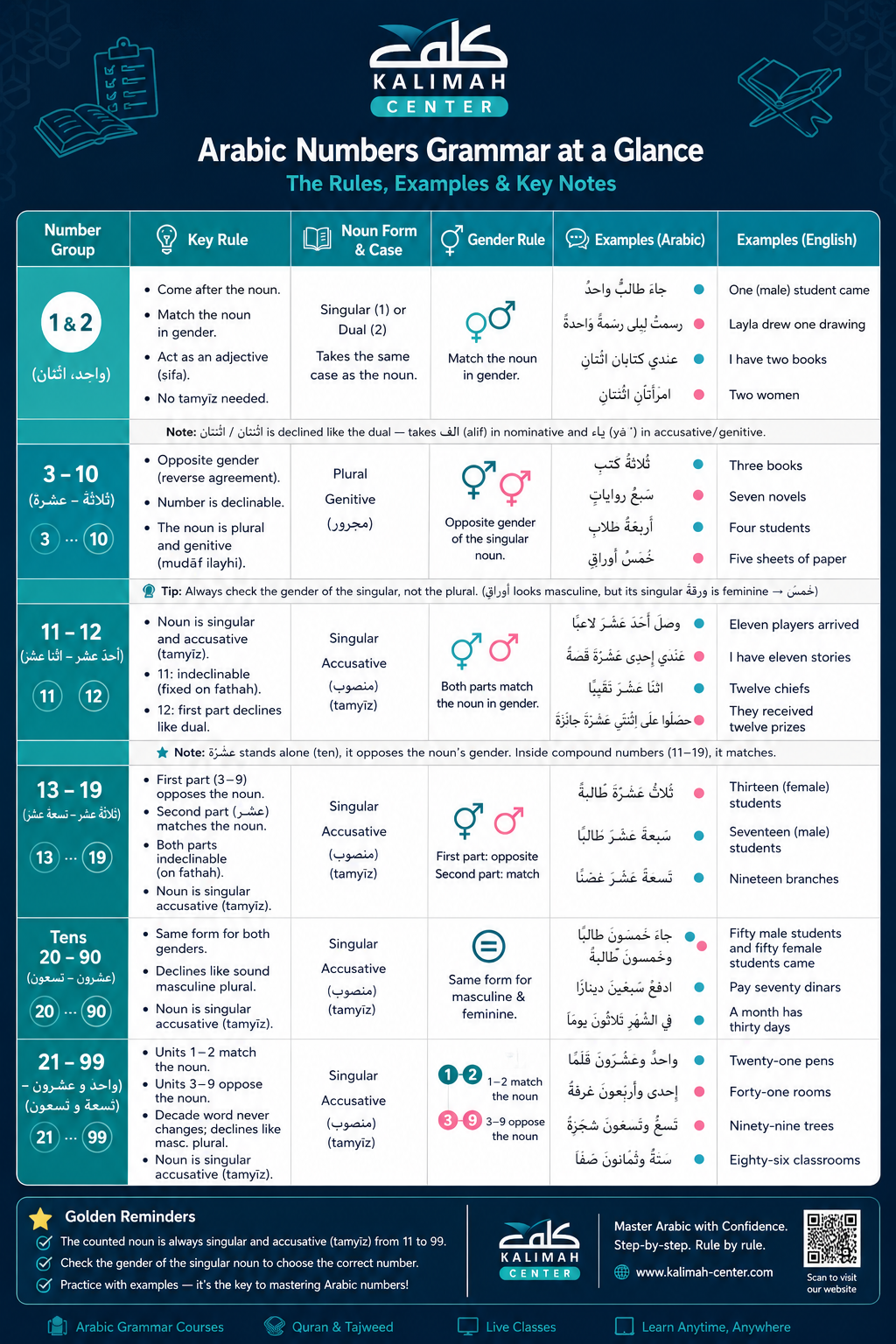
Whenever you’re unsure how a number should behave, check three things here: the gender rule for the unit, whether the counted noun is singular or plural, and which case it takes. Bookmark this section and return to it until the patterns become second nature.
| Numbers | Gender rule (unit) | Counted noun | Case |
| 1–2 | Matches | Noun itself (sing./dual), number follows as adjective | Same as noun |
| 3–10 | Opposes | Plural | Genitive (مجرور) |
| 11–12 | Both parts match | Singular | Accusative (منصوب) |
| 13–19 | Unit opposes, ten matches | Singular | Accusative (منصوب) |
| 20–90 | One fixed form | Singular | Accusative (منصوب) |
| 21–99 | 1–2 match; 3–9 oppose | Singular | Accusative (منصوب) |
| 100, 1000+ | One fixed form | Singular | Genitive (مجرور) |
The number 8 (ثمانٍ / ثماني): With a feminine noun, the yāʾ is dropped when the word is indefinite and nominative or genitive (بناتٌ ثمانٍ), but kept when definite, in iḍāfah, or accusative (الفتيات الثماني، ثمانيَ). With masculine nouns it is always ثمانية.
- بضع (“a few”): Follows the 3–9 rules — it opposes the counted noun in gender: بضعةُ رجالٍ، بضعُ سنينَ.
- كم الاستفهامية (interrogative “how many”): Its tamyīz is singular accusative: كم كتابًا قرأتَ؟
- كم الخبرية (exclamatory “how many!”): Its tamyīz is genitive, often with من: كم من فئةٍ قليلةٍ غلبت فئةً كثيرةً.
- Years: After عام and سنة, the number is genitive as muḍāf ilayhi: عامَ سبعةٍ، سنةَ سبعٍ.
Master Arabic Numbers Grammar Today with Kalimah Center
Numbers appear everywhere — prices, dates, ages, quantities, Quranic verses, and news reports.
Getting Arabic numbers grammar right instantly elevates both your written and spoken Arabic, and it trains you in three core grammar skills at once: gender agreement, the iḍāfah construction, and the tamyīz.
The fastest way to internalize these rules is guided practice with a teacher who corrects you in real time.
At Kalimah Center, our native-speaking instructors build number drills into every level, from beginner counting to advanced case endings.

You can join our Best Online Arabic Classes For Adults for one-on-one instruction, save on tuition with our Intensive Arabic Group Classes With Cheap Fees, or start your children early with our program to Learn Arabic Online For Kids.

Inside Kalimah Center: Moments from Our Courses
Get a glimpse into the vibrant learning experience at Kalimah Center. These snapshots capture real moments from our live classes—where students engage deeply, connect with passionate instructors, and grow in a welcoming, supportive environment.
Here Are The Reviews On Our Courses:
Our students frequently commend the excellence of our courses and the commitment shown by our instructors. You can read their complete reviews on Trustpilot.
Read more reviews on Trustpilot

📚 Explore Our Courses:
Online Arabic Course: Tailored to your level, our comprehensive Arabic program includes 16 teaching levels and 400+ hours of personalized sessions.
Online Quran With Tajweed Course: Perfect for non-Arabic speakers, our course spans 13 levels and equips you with Tajweed mastery from beginner to advanced.
Online Arabic Course For Kids: Nurture your child’s love for Arabic with our engaging and structured program, available in 24 levels for primary, intermediate, and secondary stages.
🚀 Start Your Free Trial Today! 🚀
Don’t miss out on this life-changing opportunity to deepen your faith and knowledge. Sign up now for your free trial and take the first step towards becoming a better practicing Muslim with Kalimah Center!
Master Arabic with Kalimah Center
Join our expert-led online classes and start your journey toward Arabic fluency today.
Book Your Free TrialFrequently Asked Questions About Arabic Numbers Grammar
Below are concise answers to the questions learners ask most often about Arabic numbers grammar — from gender polarity to the case of the counted noun. If your question isn’t covered here, the team at Kalimah Center is always happy to help in class.
1. Why do Arabic numbers 3–10 take the opposite gender of the noun?
This phenomenon, called gender polarity, is an ancient feature of Semitic languages. While there’s no simple “logic” behind it, the rule is consistent: check the gender of the noun’s singular form, then use the opposite-gender number. ثلاثة كتب (masculine noun, feminine number) and ثلاث مجلات (feminine noun, masculine number).
2. Is the counted noun singular or plural after Arabic numbers?
It depends on the number: after 1–2 the noun is simply singular or dual; after 3–10 it is plural and genitive; after 11–99 it is singular and accusative; after 100, 1000, and their multiples it is singular and genitive.
3. Which part of a long number determines the counted noun’s form?
The last number written. In 311 طالبًا, the noun follows the rules of 11 (singular accusative). In 300 راكبٍ, it follows the rules of the hundreds (singular genitive).
4. Are the numbers 11–19 declinable?
No — apart from the first part of 12 (اثنا/اثنتا), which declines like a dual, the compound numbers 11–19 are indeclinable, fixed on the fatḥah in both parts (مبني على فتح الجزأين), and take their case “in place” according to their position in the sentence.
5. What’s the difference between عشرة alone and عشرة in compound numbers?
Standing alone (10 books), عشرة opposes the noun’s gender like the numbers 3–9. Inside a compound (11–19), it matches the noun’s gender.
6. How can I practice Arabic numbers grammar effectively?
Drill in context: read prices, dates, and Quranic verses aloud; write out figures in words; and get corrective feedback from a teacher. Structured courses with live instructors — like those offered online — accelerate mastery far more than memorizing tables alone.