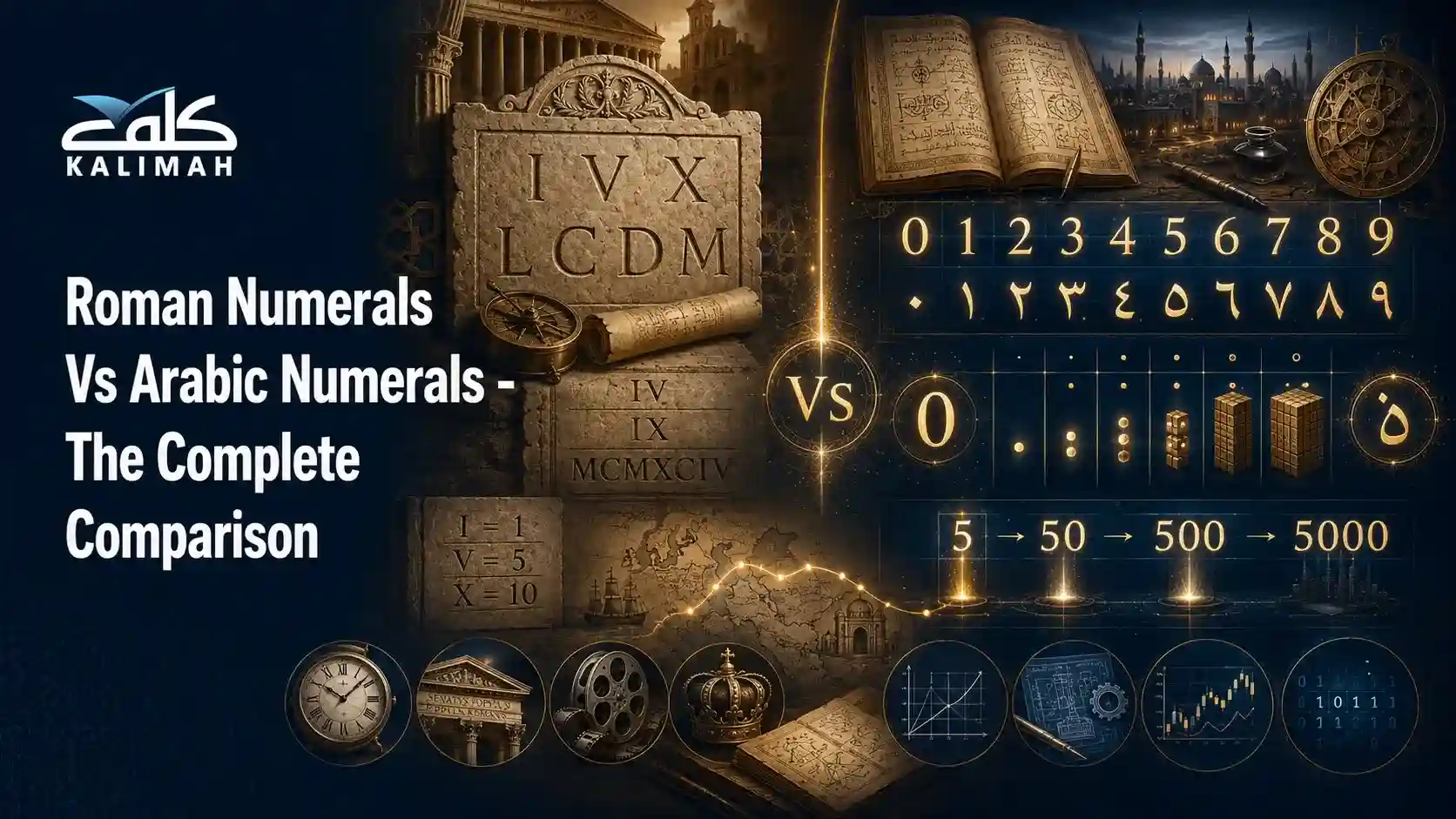
The difference between Roman numerals and Arabic numerals comes down to one core idea: position.
Arabic numerals (0–9) use a base-10, positional place-value system, where the position of a digit determines its value — the “1” in 10 means something different than the “1” in 100. Roman numerals (I, V, X, L, C, D, M) work the opposite way: each letter carries a fixed value no matter where it sits, and the system has no symbol for zero at all.
If you’ve ever tried to read a clock face, a movie’s copyright year, or the name of a king or pope and paused to work out the number, you’ve run into this exact contrast. Understanding roman numerals vs arabic numerals isn’t just trivia — it explains why one system runs the modern world’s math while the other survives mostly for style and tradition.
This article breaks down how each system works, why Arabic numerals became the global standard, and how to convert between the two.
1. What Are Arabic Numerals?
Arabic numerals are the ten digits 0 through 9, arranged in a positional decimal system where a digit’s place — units, tens, hundreds, thousands — determines its value.
This is why 234 works out to (2 × 100) + (3 × 10) + (4 × 1). Move the same three digits around and the value changes completely, even though the symbols themselves haven’t. That’s the entire mechanism behind place value, and it’s what lets Arabic numerals represent enormous numbers with just ten symbols.
The system originated in India, where mathematicians developed both the decimal structure and the concept of zero. Zero isn’t decorative here — it’s a placeholder that makes positional counting possible at all. Without it, there’s no way to distinguish 5 from 50 from 500 using the same digit.
A. Why Zero Changes Everything?
Zero lets a digit “hold a place” without adding value of its own.
Without zero, a positional system collapses — you’d have no way to write 105 without confusing it with 15. This single symbol is arguably the most important reason the Arabic system scaled to handle scientific notation, computing, and finance, while older additive systems couldn’t.
B. How Arab Scholars Spread The System?
Indian numerals reached the Arab world during the Islamic Golden Age, roughly the 7th to 13th centuries.
Scholars such as al-Khwarizmi and al-Kindi didn’t just adopt the Indian system — they formalized it in mathematical texts, which is why the West later called them “Arabic numerals” even though the digits themselves trace back to India.
From there, the system entered Europe through Arabic-speaking Spain and North Africa around the 10th century, and Italian mathematician Leonardo Fibonacci helped popularize it further in the 12th century through his writings on arithmetic.
At Kalimah Center, this exact history — how Arabic scholarship shaped mathematics, language, and science — is part of what makes learning Arabic more than a language exercise; it’s a window into a body of knowledge that still underpins daily life today.
Read Also: Arabic Numbers for Kids
2. What Are Roman Numerals?
Roman numerals are a numbering system developed in ancient Rome that uses seven letters — I, V, X, L, C, D, and M — combined additively or subtractively to represent values, with no zero and no place value.
Each letter has one fixed value: I=1, V=5, X=10, L=50, C=100, D=500, M=1000. There’s no “tens column” or “hundreds column” the way there is in Arabic numerals — instead, the system relies on two rules for combining letters.
The Two Rules Behind Every Roman Numeral
Addition rule: if a smaller symbol follows a larger one, add them. VI = 5 + 1 = 6.
Subtraction rule: if a smaller symbol comes before a larger one, subtract it. IV = 5 − 1 = 4, and IX = 10 − 1 = 9.
Because there’s no zero and no place value, every number has to be spelled out letter by letter using these two rules. That’s manageable for a date like MMXXV (2025), but it gets unwieldy fast for large or precise figures — which is exactly why Roman numerals were never built for calculation.
3. Roman Numerals vs Arabic Numerals: Key Differences
Laying the two systems side by side makes the contrast easier to see than describing them separately. The table below breaks down structure, math capability, and everyday use — the categories that matter most when comparing arabic and roman numerals.
| Feature | Arabic Numerals | Roman Numerals |
| Symbols | 0–9 | I, V, X, L, C, D, M |
| System type | Positional (place value) | Additive / subtractive |
| Zero | Included — essential to the system | No symbol for zero |
| Math operations | Straightforward multiplication, division, calculus | Very difficult; multiplication often needs doubling |
| Number range | Handles any magnitude efficiently | Impractical for very large or fractional numbers |
| Common use today | Global standard: math, science, finance, computing | Clocks, monuments, movie credits, monarch and pope names |
The practical takeaway from this table: reach for Arabic numerals whenever you need to calculate something, and expect Roman numerals whenever a number is meant to be read rather than computed — a date carved into a cornerstone, a chapter heading, or a name like Charles III.
If you’re learning Arabic and want the cultural and historical context behind these numeral systems firsthand, Kalimah Center’s Best Online Arabic Classes For Adults walk through exactly this kind of material as part of building real reading fluency, not just vocabulary lists.
Read Also: How to Pronounce KH in Arabic

4. Roman Numerals vs Arabic Numerals: What It Comes Down To
The comparison between roman numerals vs arabic numerals really comes down to what each system was built to do. Arabic numerals were built for calculation — a positional, zero-based structure that scales to any number and supports every operation from basic addition to advanced calculus.
Roman numerals were built for record-keeping and display, using fixed-value letters that are easy to read once you know the addition and subtraction rules, but impractical for real math.
That’s why one system runs global finance, science, and computing, while the other still shows up on watch faces, movie credits, and monument inscriptions.
Neither system is “wrong” — they simply solve different problems, and knowing how to read both means you’re never caught guessing at a date carved in stone or a name like Henry VIII.
Understanding the difference between arabic and roman numerals is also a small entry point into a much bigger subject: how number systems, alphabets, and scripts travel between cultures and get reshaped along the way which is exactly the kind of pattern-thinking that makes learning a new script, like Arabic, far less intimidating once you’ve seen it done before.
Read Also: Is Arabic Phonetic
How to Convert Roman to Arabic Numerals?
Converting roman to arabic numerals comes down to reading the symbols left to right and applying the addition and subtraction rules consistently.
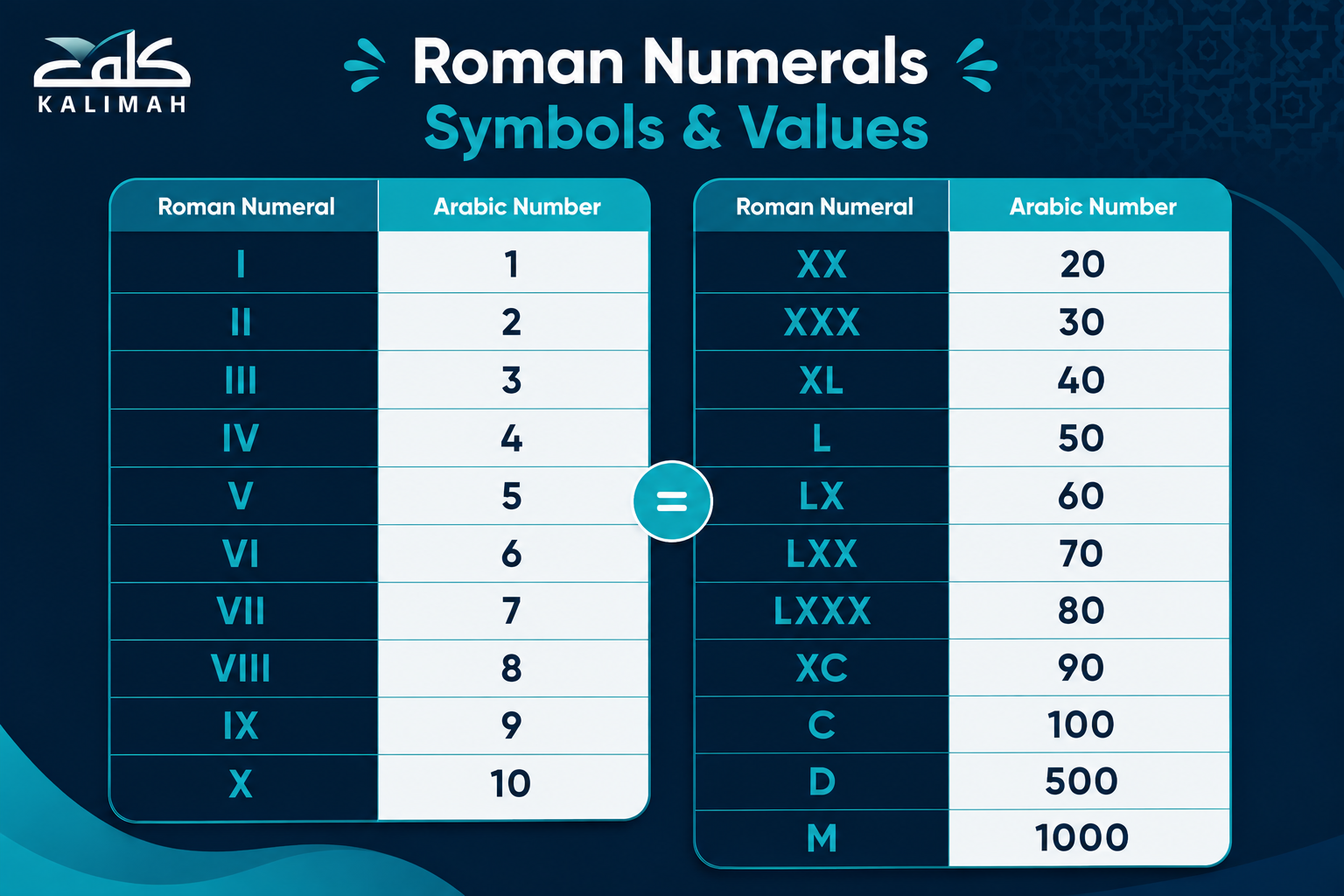
- Break the numeral into its symbols. For MCMXCIV, that’s M, CM, XC, IV.
- Convert each chunk using the subtraction/addition rule. M = 1000, CM = 900 (1000 − 100), XC = 90 (100 − 10), IV = 4 (5 − 1).
- Add the chunks together. 1000 + 900 + 90 + 4 = 1994.
A common mistake at this stage is trying to convert letter by letter instead of grouping subtractive pairs first — reading CM as “C then M” instead of as a single 900 unit throws the whole total off. Grouping the pairs before adding is the detail that prevents that error.
Experience Kalimah Center Classes
Watch real excerpts from our live sessions at Kalimah Center and see how we bring learning to life. These clips highlight our interactive, student-centered teaching approach across all our courses—designed to keep learners engaged, motivated, and actively involved every step of the way.
Master Arabic with Kalimah Center
Join our expert-led online classes and start your journey toward Arabic fluency today.
Book Your Free TrialConverting Arabic to Roman Numerals
Going the other direction works by matching the largest possible value repeatedly, from the highest denomination down.
Take 1994 apart by powers: 1000 (M), then 900 (CM), then 90 (XC), then 4 (IV). String them together: MCMXCIV.
This is the same logic used to write years on buildings, book copyrights, or Super Bowl numbering — which is why LVIII (58) shows up more often than most people expect once they know how to read it.
Learning to move fluidly between number systems is a small example of a bigger skill: pattern recognition across symbol systems, which is also exactly what’s required when learning to read Arabic script for the first time.
Kalimah Center’s Learn Arabic Online programs are built around that same step-by-step logic — breaking an unfamiliar writing system into recognizable, repeatable patterns.
Read Also: Numbers as Arabic Letters
Why Arabic Numerals Replaced Roman Numerals?
Arabic numerals didn’t replace Roman numerals overnight — the shift took centuries and was driven by practical necessity, not preference.
Efficiency: ten symbols can represent any number through position, while Roman numerals need new symbol combinations for every range.
Calculation: long division, multiplication, and later algebra and calculus all depend on place value. Roman numerals, without it, made anything beyond basic addition genuinely difficult — merchants and mathematicians in medieval Europe were doing arithmetic on counting boards specifically because the numeral system itself couldn’t support it on paper.
Trade and scholarship: as Arab scholarship spread through trade routes and translated texts, European mathematicians adopted the system because it solved a real problem their own numerals couldn’t.
Zero as a working tool: the concept of zero as a placeholder — not just “nothing,” but a functional part of a number — gave the Arabic system a structural advantage Roman numerals never had.
This is a good example of what a language and its writing system can carry beyond words: a whole mathematical worldview traveled from India through the Arab world into Europe, reshaping how people calculated for good.
Kalimah Center’s Learn Arabic Online For Kids program touches this kind of context early, so children see Arabic not just as letters to memorize but as a language tied to real historical contribution.
Where Roman Numerals Are Still Used Today?
Roman numerals never disappeared — they just moved into contexts where tradition, clarity of distinction, or design matter more than calculation.
- Clocks and watches: often chosen for a classic dial design.
- Monarchs and popes: distinguishing rulers sharing a name, like Charles III or John Paul II.
- Movie copyrights and Super Bowl numbering: MCMXCIV-style dates and games like Super Bowl LVIII.
- Monuments and cornerstones: construction dates carved in stone.
- Book chapters and outlines: where letters read more cleanly than a long string of digits.
None of these uses require arithmetic — they require a symbol that’s easy to distinguish visually and carries a sense of permanence. That’s precisely the gap Roman numerals still fill.
Start Learning the Language Behind the Numbers
If working through how Roman and Arabic numeral systems evolved sparked your curiosity about scripts and languages, the next step is learning to read and write Arabic with guidance from native, qualified instructors.
Kalimah Center offers structured, live online Arabic courses for adults and children, built around real conversation and reading fluency not rote memorization.

Whether you’re starting from the Arabic alphabet or want group practice at a manageable pace, there’s a path that fits your schedule and goals.
For those who prefer learning alongside others, Kalimah Center’s Intensive Arabic Group Classes With Cheap Fees offer an affordable, structured way to build fluency without one-on-one pricing.
Inside Kalimah Center: Moments from Our Courses
Get a glimpse into the vibrant learning experience at Kalimah Center. These snapshots capture real moments from our live classes—where students engage deeply, connect with passionate instructors, and grow in a welcoming, supportive environment.
Here Are The Reviews On Our Courses:
Our students frequently commend the excellence of our courses and the commitment shown by our instructors. You can read their complete reviews on Trustpilot.
Read more reviews on Trustpilot

📚 Explore Our Courses:
Online Arabic Course: Tailored to your level, our comprehensive Arabic program includes 16 teaching levels and 400+ hours of personalized sessions.
Online Quran With Tajweed Course: Perfect for non-Arabic speakers, our course spans 13 levels and equips you with Tajweed mastery from beginner to advanced.
Online Arabic Course For Kids: Nurture your child’s love for Arabic with our engaging and structured program, available in 24 levels for primary, intermediate, and secondary stages.
🚀 Start Your Free Trial Today! 🚀
Don’t miss out on this life-changing opportunity to deepen your faith and knowledge. Sign up now for your free trial and take the first step towards becoming a better practicing Muslim with Kalimah Center!
Master Arabic with Kalimah Center
Join our expert-led online classes and start your journey toward Arabic fluency today.
Book Your Free TrialFAQs About Roman Numerals vs Arabic Numerals
Here are quick answers to the most common questions people ask when comparing roman numerals vs arabic numerals.
1. How do Roman numerals differ from Arabic numbers in terms of representation?
Roman numerals use fixed-value letters combined additively or subtractively, while Arabic numbers use a positional, base-10 system where a digit’s location determines its value. Arabic numbers include zero; Roman numerals don’t.
2. What are the advantages of Arabic numbers over Roman numerals in modern math?
Arabic numbers support place value and zero, making multiplication, division, and complex calculations straightforward. Roman numerals lack both features, making advanced math impractical.
3. How do you convert Roman to Arabic numerals?
Break the Roman numeral into symbol groups, apply the addition/subtraction rule to each group (like CM = 900), then add the totals together to get the Arabic number.
4. Why are Roman numerals still used today?
Roman numerals persist in clocks, monuments, movie credits, and royal or papal names because they offer visual distinction and tradition, not because they’re used for calculation.
5. Does the Arabic numeral system include zero, and why does that matter?
Yes — zero acts as a placeholder that makes place value possible, letting the same ten digits represent numbers of any size. Roman numerals have no equivalent symbol.
6. Is one numeral system considered “better” than the other?
Not universally, Arabic numerals are better suited for calculation and scale, while Roman numerals remain preferred for formal, decorative, or traditional contexts like dates on monuments or distinguishing rulers.