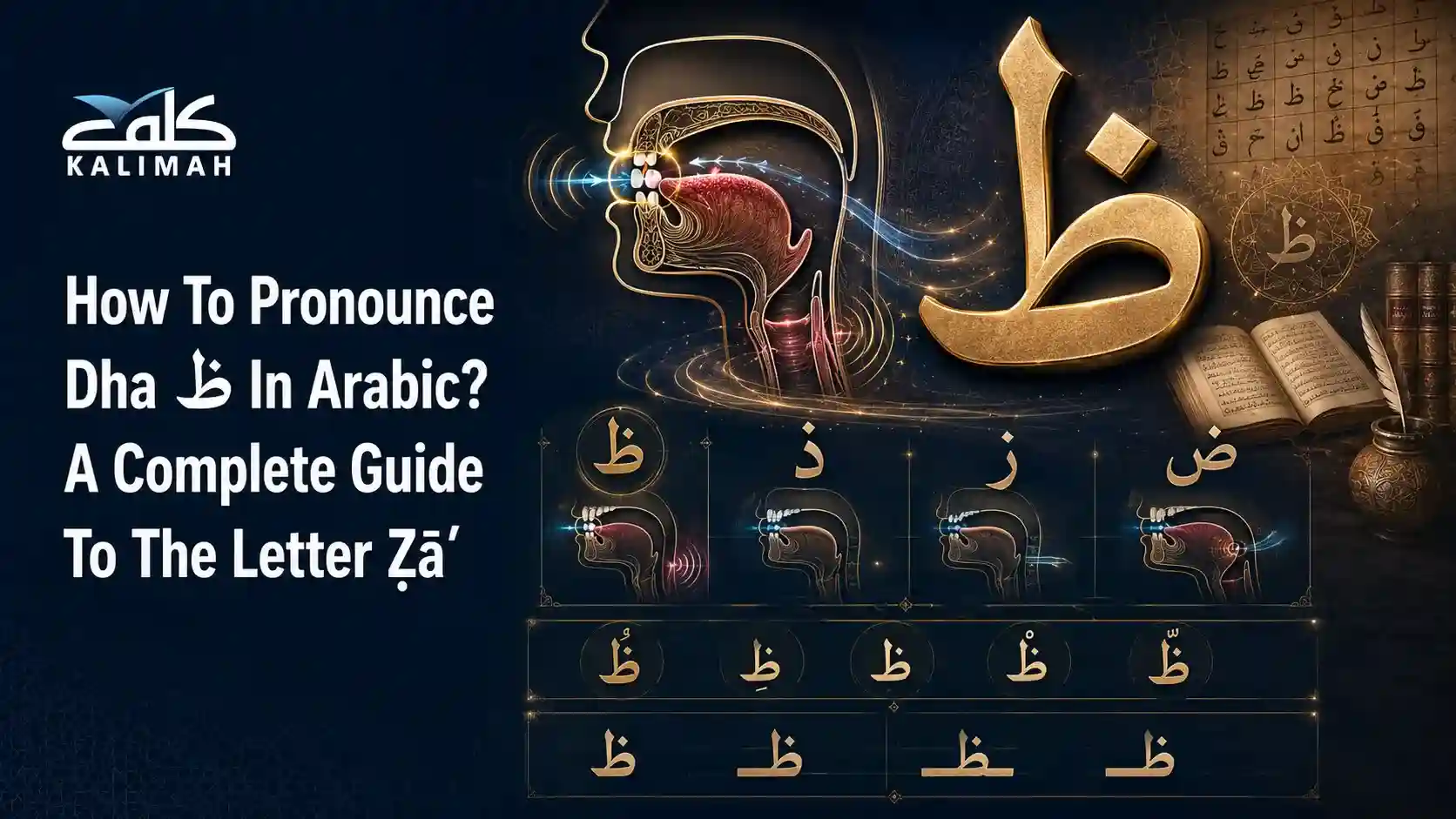
If you’ve ever stumbled over an Arabic word and had a native speaker gently correct your “z” sound, there’s a good chance the culprit was ظ. Learning how to pronounce ظ in Arabic is one of the most common hurdles for beginners, because English has no real equivalent for this sound.
At Kalimah Center, this is one of the first pronunciation challenges we walk new students through, since getting ظ wrong can change the entire meaning of a word. This guide breaks the sound down into simple, repeatable steps, shows you exactly how it differs from letters like ذ and ض, and gives you real words to practice with.
By the end, you’ll understand not just how to say ظ, but why it sounds the way it does.
What You’ll Learn in This Article
- What the letter ظ (ẓāʾ) is and where it sits in the Arabic alphabet
- The exact tongue and throat position needed to pronounce it correctly
- How to pronounce dh in Arabic and tell ظ apart from ذ, ز, and ض
- The most common mistakes learners make with this letter
- How to write ظ in its isolated, initial, medial, and final forms
- Real Arabic words and sentences to practice the sound
The letter ظ, called ẓāʾ, is one of the emphatic (“heavy”) consonants in the Arabic alphabet. It is the seventeenth letter and represents a sound that does not exist in English, French, or Spanish, which is exactly why it feels so unfamiliar at first.
Before you can produce the sound correctly, it helps to understand what makes it different from ordinary Arabic letters and from the similar-looking letters around it.
ظ is classified as one of Arabic’s emphatic or “heavy” letters (huruf mufakhkhama), a small group of consonants pronounced with extra weight from the back of the mouth and throat. In the International Phonetic Alphabet, ظ is transcribed as /ðˤ/, which marks it as the emphatic version of the regular /ð/ sound.
Because these emphatic letters appear in fewer words than lighter letters, learners often get less exposure to them early on. That’s exactly why targeted practice matters more here than with more common sounds.
A. How to Pronounce ظ in Arabic Step by Step
Most learners get stuck because they try to produce the whole sound at once. Breaking it into three separate physical steps makes it far easier to correct.
Follow this sequence slowly the first few times, then speed it up as it becomes natural.
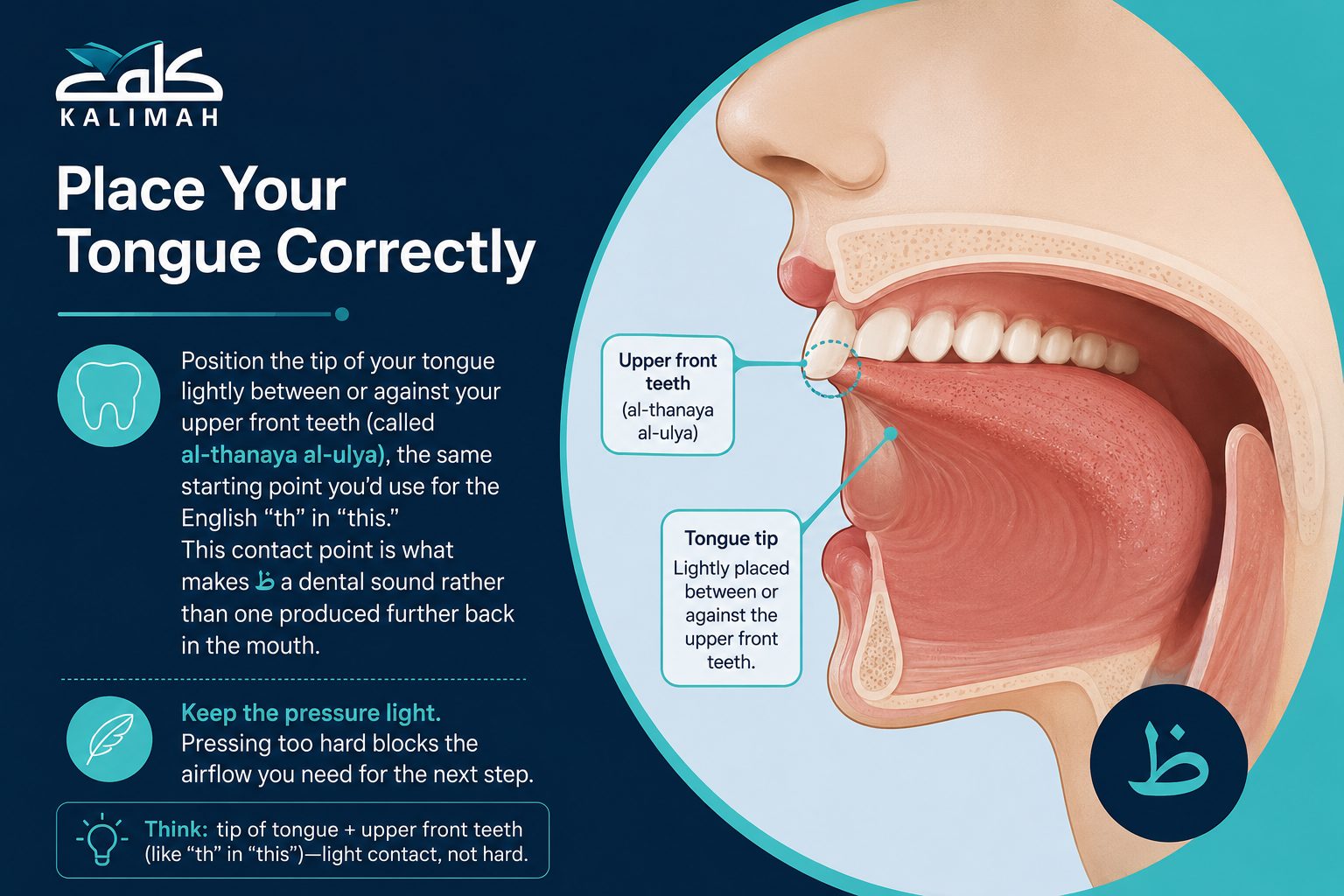
Step 1: Place Your Tongue Correctly
Position the tip of your tongue lightly between or against your upper front teeth (called al-thanaya al-ulya), the same starting point you’d use for the English “th” in “this.” This contact point is what makes ظ a dental sound rather than one produced further back in the mouth.
Keep the pressure light. Pressing too hard blocks the airflow you need for the next step.
Step 2: Add The Emphatic Quality (Tafkheem)
This is the step most guides skip, and it’s the one that actually makes ظ sound like ظ instead of ذ. Arabic speakers call this quality tafkheem, meaning “thickening” or “emphasis.”
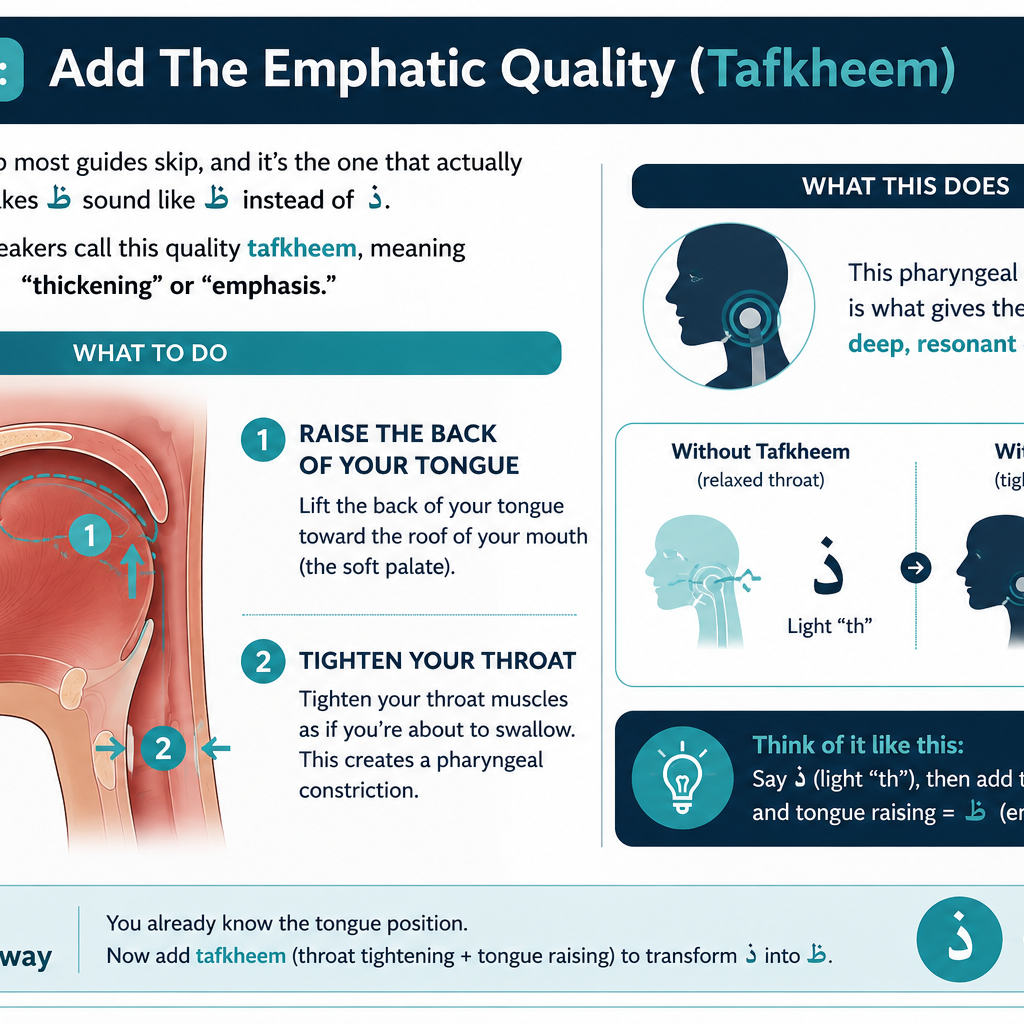
To add it, raise the back of your tongue toward the roof of your mouth while slightly hollowing its center, and tighten your throat muscles as if you’re about to swallow. This pharyngeal constriction is what gives the letter its deep, resonant quality.
Step 3: Voice The Sound
With your tongue and throat in position, push a steady stream of air through the small gap between your tongue and teeth while vibrating your vocal cords. You should feel a low, buzzing vibration, not a hiss.
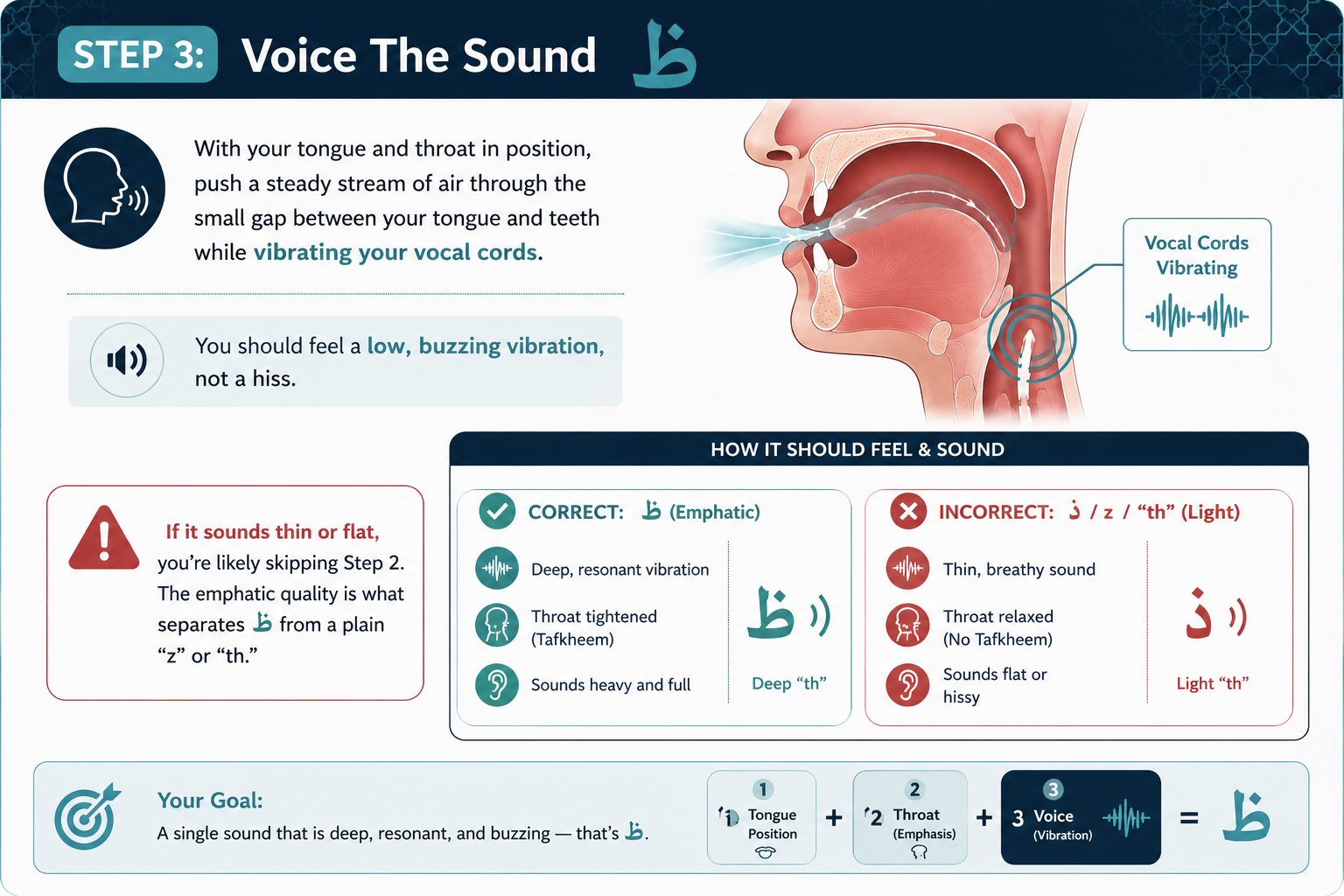
If it sounds thin or flat, you’re likely skipping Step 2. The emphatic quality is what separates ظ from a plain “z” or “th.”
Kalimah Center‘s live pronunciation sessions use real-time correction for exactly this reason — a teacher can hear within seconds whether the tafkheem is missing, which is much faster than trial and error on your own.

Read Also: How to Pronounce ح in Arabic
Inside Kalimah Center: Moments from Our Courses
Get a glimpse into the vibrant learning experience at Kalimah Center. These snapshots capture real moments from our live classes—where students engage deeply, connect with passionate instructors, and grow in a welcoming, supportive environment.
Master Arabic with Kalimah Center
Join our expert-led online classes and start your journey toward Arabic fluency today.
Book Your Free TrialB. How to Pronounce Dh in Arabic: Telling ظ Apart From Similar Letters
A large part of learning how to pronounce dh in Arabic correctly is knowing which “dh” you’re dealing with, since Arabic has more than one letter that gets transliterated this way. Confusing them is one of the most common sources of miscommunication for beginners.
Here’s how the three most commonly confused letters actually differ.
1. ظ vs. ذ (Dhāl)
ذ is the light, non-emphatic version of the same “th” sound found in the English word “this.” It uses the identical tongue position as ظ, but without the throat tightening from Step 2.
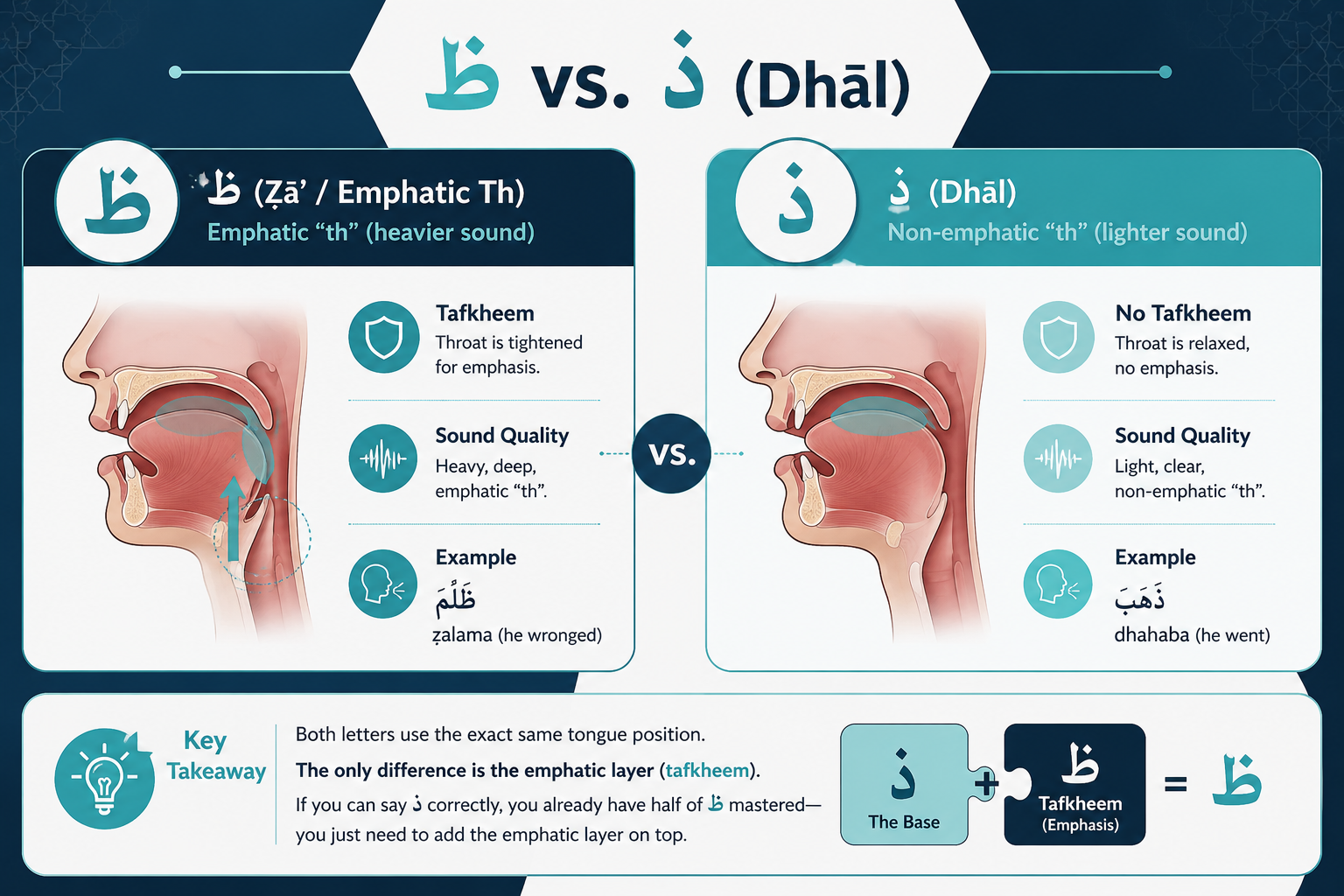
If you can say ذ correctly, you already have half of ظ mastered; you just need to add the emphatic layer on top.
2. ظ vs. ز (Zāy)
ز is a completely different sound: a simple “z” as in “zebra,” made without any tongue-to-teeth contact. Some transliterations render ظ loosely as “z,” which causes learners to drop the tongue position entirely and produce ز by mistake.
Remember: if your tongue isn’t touching your upper teeth, you’re not pronouncing ظ.
3. ظ vs. ض (Ḍād)
ض is also emphatic, which is why it’s frequently mixed up with ظ, but the articulation point is different. ض is produced by pressing the side of the tongue against the back molars, producing a heavy “d” rather than a heavy “th.”
Arabic is sometimes nicknamed “the language of the ḍād” because this sound is considered especially distinctive to the language, which makes the ظ/ض distinction worth practicing deliberately.
Read Also: Is Refold Good for Learning Arabic?
C. Common Mistakes to Avoid When Pronouncing ظ
Even learners who understand the theory often trip up in practice. Watch for these specific errors.
Flattening the sound into a plain “z” or “d” is the most frequent mistake, usually caused by skipping the tongue-to-teeth contact altogether. Another common error is forgetting the throat tension, which leaves the sound technically correct in tongue position but missing its signature depth.
A third mistake is rounding the lips too much or too little; keeping them slightly rounded helps preserve the sound’s fullness without distorting it.
If you want a simple way to check yourself, record a short clip of you saying a word with ظ and compare it against a native speaker’s recording. This is one of the fastest ways to catch a habit before it becomes fixed.
Read Also: The Arabic Letter (Ha) “ه” With Its Forms
How to Write the Letter ظ
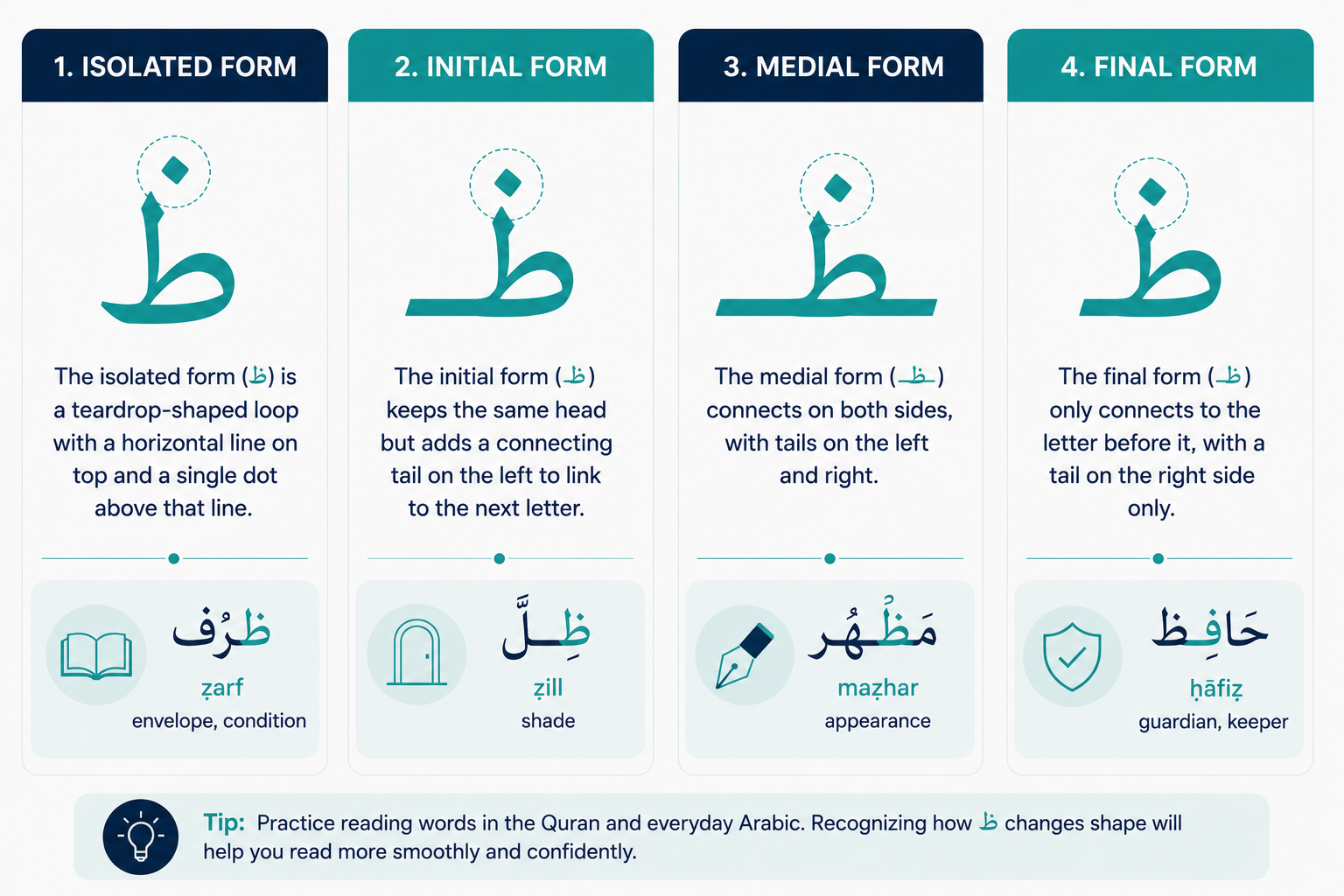
Like most Arabic letters, ظ changes shape depending on where it appears in a word. Visually, it’s identical to the letter ط (ṭāʾ) with one extra dot placed above it.
1. The Four Written Forms
The isolated form (ظ) is a teardrop-shaped loop with a horizontal line on top and a single dot above that line.
The initial form (ظـ) keeps the same head but adds a connecting tail on the left to link to the next letter. The medial form (ـظـ) connects on both sides, with tails on the left and right. The final form (ـظ) only connects to the letter before it, with a tail on the right side only.
Read Also: Is Glossika good for Arabic?
Experience Kalimah Center Classes
Watch real excerpts from our live sessions at Kalimah Center and see how we bring learning to life. These clips highlight our interactive, student-centered teaching approach across all our courses—designed to keep learners engaged, motivated, and actively involved every step of the way.
Master Arabic with Kalimah Center
Join our expert-led online classes and start your journey toward Arabic fluency today.
Book Your Free Trial2. Practicing ظ With Harakat (Vowel Marks)
Vowel marks, or harakat, change how ظ sounds without changing its emphatic quality. With fatḥa (a short diagonal line above the letter), ظَ is read as “ẓa.” With kasrah (a short line below the letter), ظِ is read as “ẓi.” With ḍammah (a small comma-like mark above the letter), ظُ is read as “ẓu.”
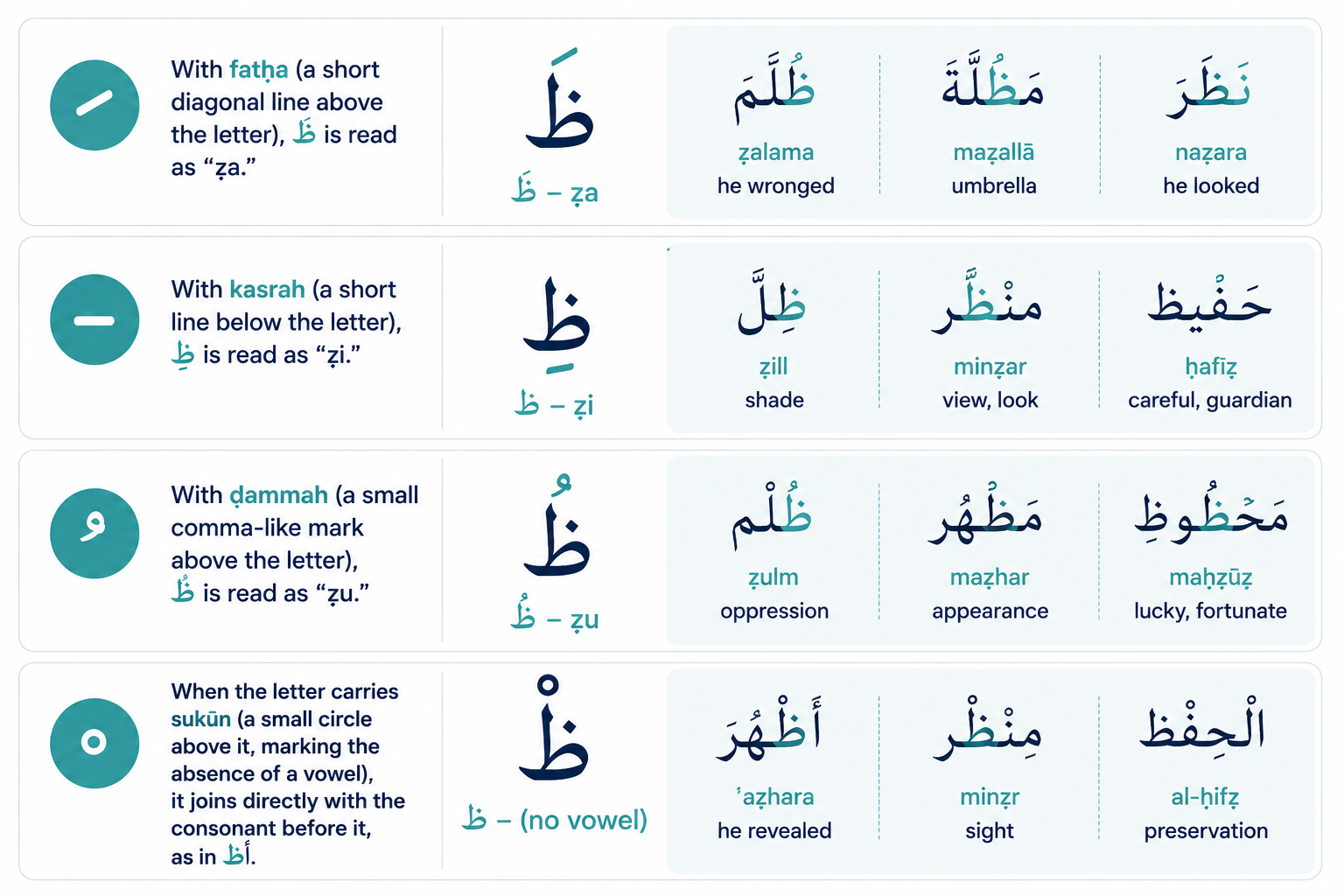
When the letter carries sukūn (a small circle above it, marking the absence of a vowel), it joins directly with the consonant before it, as in أَظْ.
Read Also: How to Pronounce Q in Arabic
3. Words to Practice ظ Pronunciation
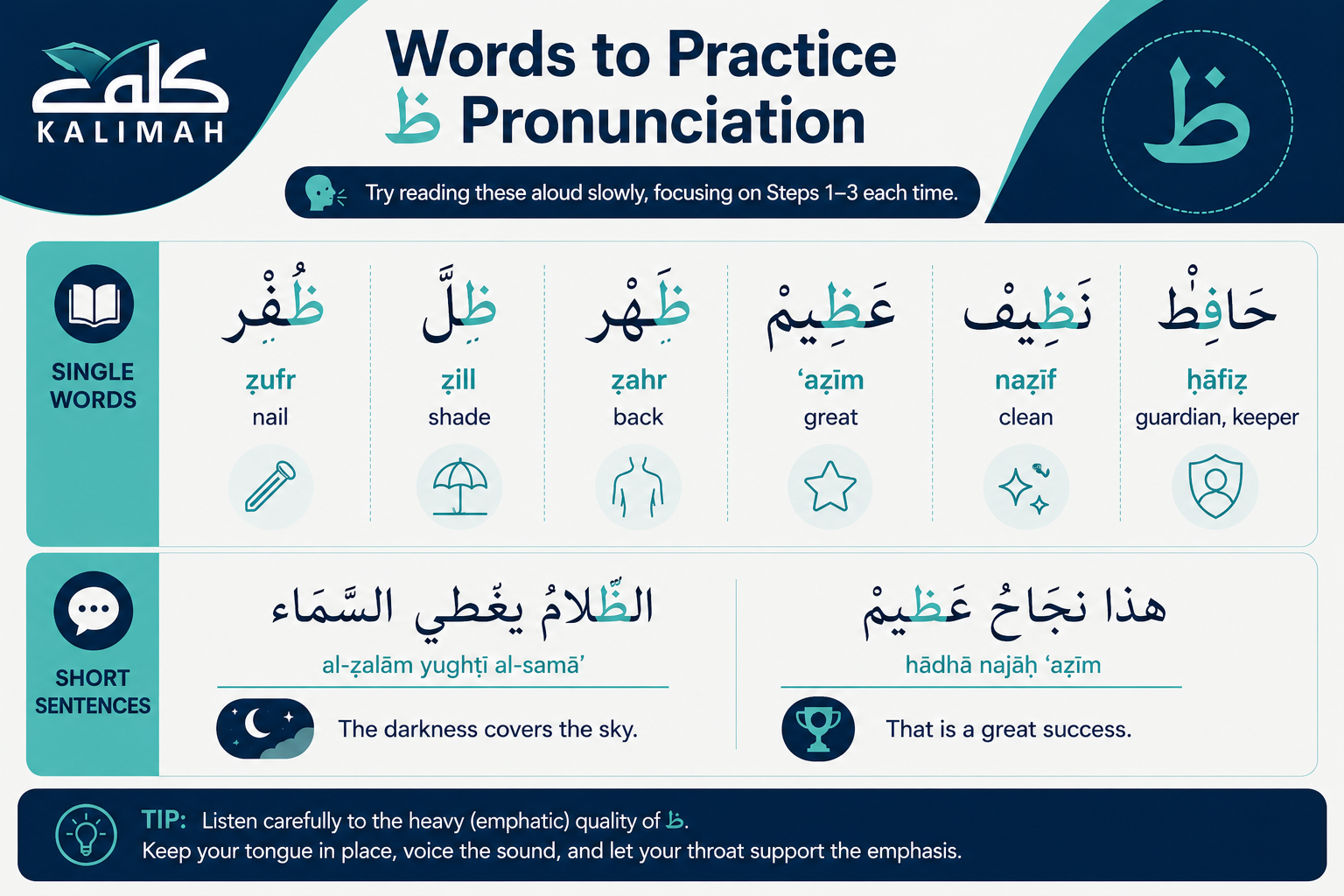
Try reading these aloud slowly, focusing on Steps 1–3 each time: ظُفْر (ẓufr – nail), ظِلّ (ẓill – shade), ظَهْر (ẓahr – back), عَظِيم (ʿaẓīm – great), نَظِيف (naẓīf – clean), and حَافِظ (ḥāfiẓ – guardian, keeper).
Once single words feel comfortable, move to short sentences such as “الظلام يغطي السماء” (“the darkness covers the sky”) or “هذا نجاح عظيم” (“that is a great success”) to hear how ظ behaves alongside other sounds.
Start Speaking Arabic With Confidence Today
Reading about tongue placement only gets you so far — correcting a sound like ظ really happens with live, real-time feedback from someone who can hear exactly what you’re doing wrong.
That’s the gap Kalimah Center‘s classes are built to close, whether you’re starting from zero or refining pronunciation you’ve been practicing on your own.

Explore Kalimah Center’s Best Online Arabic Classes For Adults for structured, one-on-one pronunciation coaching, or join the Intensive Arabic Group Classes With Cheap Fees to practice alongside other learners at an affordable rate.
If you’re guiding a child through the alphabet, the Learn Arabic Online For Kids program is built specifically around younger learners’ pace.

Inside Kalimah Center: Moments from Our Courses
Get a glimpse into the vibrant learning experience at Kalimah Center. These snapshots capture real moments from our live classes—where students engage deeply, connect with passionate instructors, and grow in a welcoming, supportive environment.
Here Are The Reviews On Our Courses:
Our students frequently commend the excellence of our courses and the commitment shown by our instructors. You can read their complete reviews on Trustpilot.
Read more reviews on Trustpilot

📚 Explore Our Courses:
Online Arabic Course: Tailored to your level, our comprehensive Arabic program includes 16 teaching levels and 400+ hours of personalized sessions.
Online Quran With Tajweed Course: Perfect for non-Arabic speakers, our course spans 13 levels and equips you with Tajweed mastery from beginner to advanced.
Online Arabic Course For Kids: Nurture your child’s love for Arabic with our engaging and structured program, available in 24 levels for primary, intermediate, and secondary stages.
🚀 Start Your Free Trial Today! 🚀
Don’t miss out on this life-changing opportunity to deepen your faith and knowledge. Sign up now for your free trial and take the first step towards becoming a better practicing Muslim with Kalimah Center!
Master Arabic with Kalimah Center
Join our expert-led online classes and start your journey toward Arabic fluency today.
Book Your Free TrialConclusion
Learning how to pronounce ظ in Arabic comes down to three repeatable steps: placing the tongue against the upper teeth, adding the emphatic tafkheem from the back of the tongue and throat, and voicing the sound with steady airflow.
The letter is easy to confuse with ذ, ز, and ض, but once you isolate what each one does differently, the confusion clears up quickly.
Mastering ظ is less about memorizing a rule and more about training the muscles in your tongue and throat to hold a new position, which is why repetition with real words and real feedback matters more than reading alone.
With consistent practice, this sound stops feeling foreign and becomes a natural part of how you speak Arabic.
Frequently Asked Questions
A few questions come up constantly when learners first encounter this letter — here are direct answers to the ones we hear most at Kalimah Center.
1. What is the easiest way to pronounce ظ?
The easiest way is to first master ذ (the plain “th” in “this”), since ظ uses the exact same tongue position with one addition: raise the back of your tongue and tighten your throat slightly to add the emphatic quality.
2. How do I pronounce dh in Arabic if there are multiple letters?
If the “dh” you’re seeing is ظ, add throat emphasis to a regular “th” sound; if it’s ذ, keep the sound light without any throat tightening. Checking the original Arabic spelling, not just the transliteration, is the only reliable way to know which letter you’re dealing with.
3. Why does ظ sound different from ذ if they look similar in transliteration?
Both letters share the same tongue-to-teeth articulation, but ظ adds pharyngealization — a tightening of the throat that deepens and thickens the sound. Transliteration systems often can’t capture this difference, which is why relying on Arabic script is more accurate than relying on the Latin spelling alone.
4. Is ظ a rare letter in Arabic?
Yes, ظ appears in fewer words than most other Arabic letters, but it still shows up in common vocabulary like نظيف (clean) and عظيم (great), so it’s worth learning properly rather than skipping.
5. What’s the biggest mistake beginners make with ظ?
The most common mistake is dropping the tongue-to-teeth contact entirely and pronouncing it as a plain “z,” which erases the distinct emphatic character of the letter.