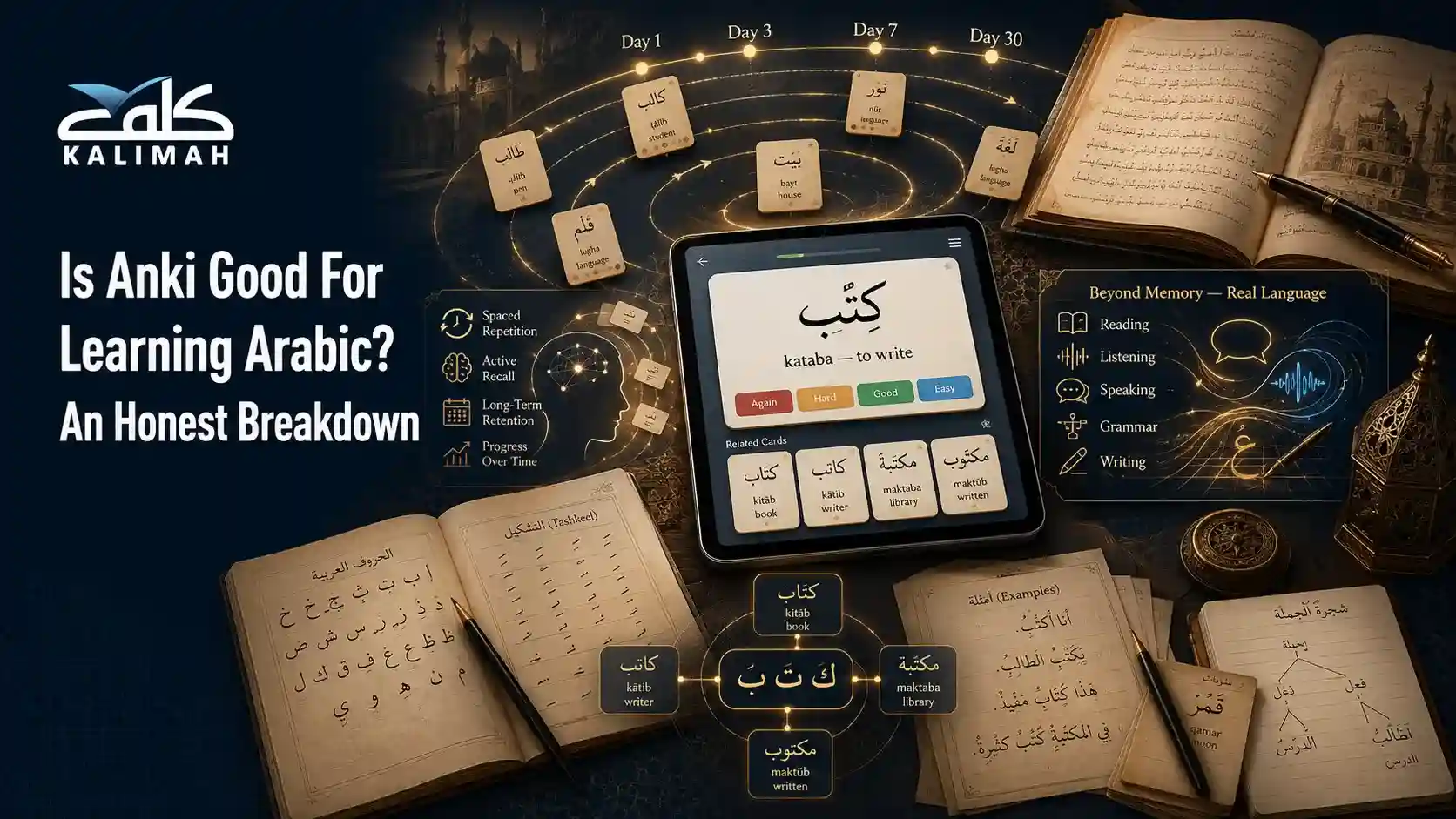
Is Anki good for learning Arabic? Yes — Anki is genuinely one of the most effective tools for memorizing Arabic vocabulary and script, thanks to its spaced-repetition system. But “effective for memorizing” and “enough to actually speak Arabic” are two different things, and that gap is where most learners get stuck.
This article gives you the straight answer. We’ll show you exactly what Anki does brilliantly, where it quietly fails Arabic learners, and how to combine it with structured instruction so the words you memorize turn into real reading, grammar, and conversation.
At Kalimah Center, we work with learners every week who arrive with thousands of Anki cards but still can’t hold a conversation — so this is written from what actually happens, not theory.
What you’ll learn in this article
- Whether Anki is good for learning Arabic, and the science behind why it works
- The specific Arabic features Anki drills better than any app
- Where Anki falls short — grammar, reading fluency, and speaking
- A simple decision rule for when Anki is enough and when it isn’t
- How to pair flashcards with a structured method so nothing gets wasted
Anki is a free flashcard program that schedules reviews using a spaced-repetition algorithm, showing you each card right before you’re likely to forget it.
That single mechanism is why Anki is good for learning Arabic. Arabic asks you to retain a huge volume of small, discrete items — root patterns, gendered nouns, plural forms, vocabulary — and spaced repetition is purpose-built for exactly that kind of memorization.
Modern Anki uses an algorithm called FSRS (Free Spaced Repetition Scheduler), which adapts review timing to how hard each specific card is for you. The idea traces back to Hermann Ebbinghaus and his 1885 “forgetting curve”: memory fades on a predictable slope, and a well-timed review resets it. Anki automates that timing so you’re not guessing when to revise.
So the honest verdict: Anki is excellent at one job — retention — and you should use it. Just don’t mistake that one job for the whole task of learning Arabic.
Why does Anki works so well for Arabic specifically?
Anki isn’t just “good for languages” in the abstract. When people ask whether Anki is good for learning Arabic, the real answer lives in the details — and several of its features line up unusually well with how Arabic is built.
1. Trilateral Roots And Pattern Recognition
Most Arabic words are built from three-letter roots that bend into predictable patterns. Anki lets you drill roots and their derived forms until you start recognizing the pattern rather than memorizing each word cold.
A common practitioner tip: put the root on one side and several derived words on the other, so you train the pattern, not just isolated entries.
2. Script, Tashkeel, And Right-To-Left Formatting
Because Anki gives you full control over card layout — font size, right-to-left alignment, audio — it handles the Arabic script far better than gamified apps that weren’t designed for it. You can drill the alphabet, then practice reading with vowel marks (Tashkeel/Harakat) to build a real reading foundation instead of guessing at unmarked text.
3. Gendered Nouns, Plurals, And Audio
Arabic nouns and adjectives carry gender, and plurals are famously irregular. Anki is strong for testing masculine/feminine pairs and singular-to-plural forms — especially when each card includes audio, so you learn the sound alongside the shape.
If you’re learning to read the alphabet from zero, structured guidance speeds this up dramatically — our Learn Arabic Online track walks you through script and Tashkeel in order, so your Anki drilling reinforces lessons instead of replacing them.
Read Also: How to Learn Arabic in 90 Days
Where Anki falls short for Arabic learners
Here’s the part most “Anki is amazing” articles skip. Anki is a memorization tool — and memorization is only one layer of a language.
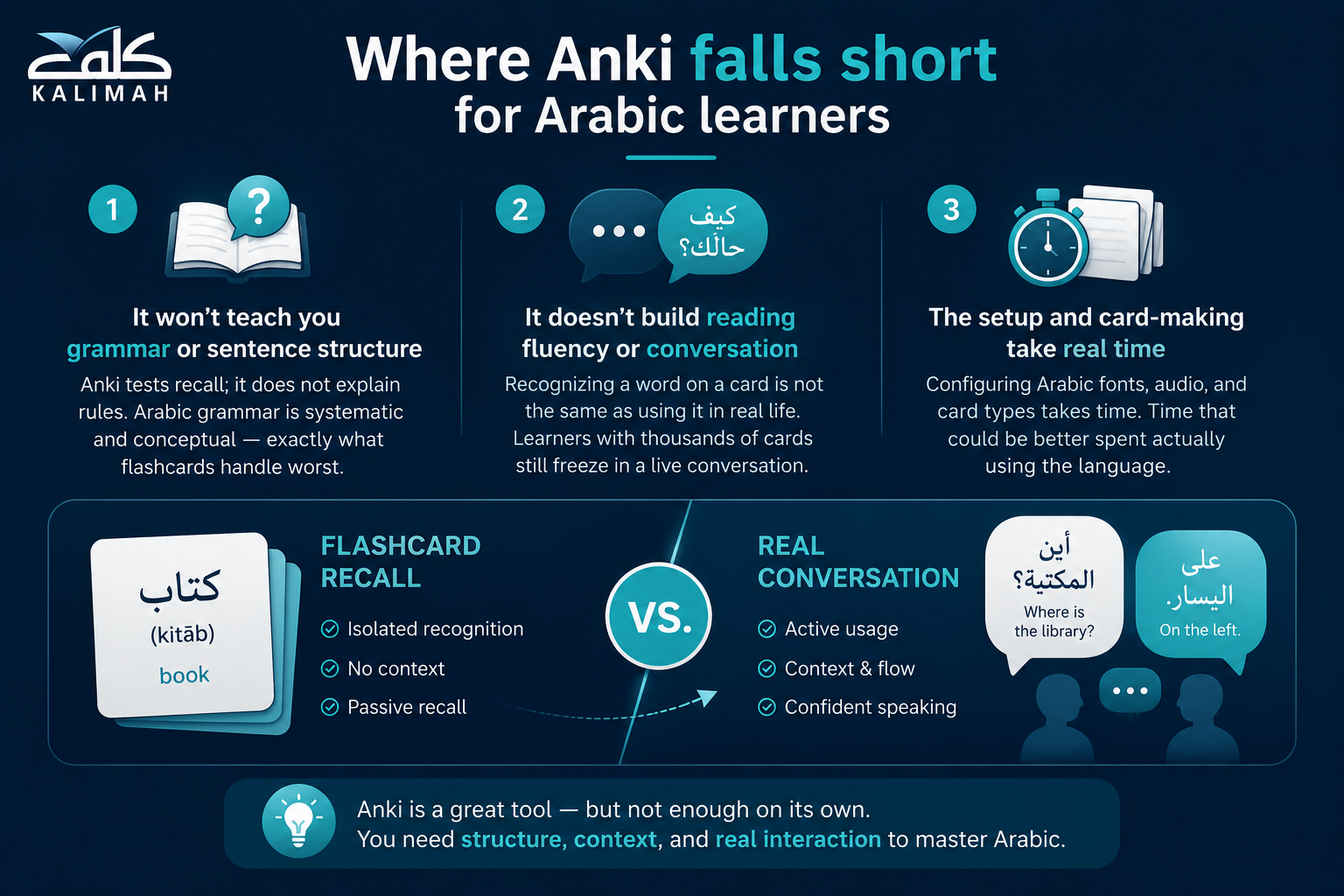
1. It Won’t Teach You Grammar Or Sentence Structure
Anki tests recall; it does not explain rules. It can hold a hundred verb conjugations, but it won’t teach you why the case ending changes or when to use the dual versus the plural. Arabic grammar is systematic and conceptual, and conceptual material is exactly what flashcards handle worst.
2. It Doesn’t Build Reading Fluency Or Conversation
Recognizing a word on a card is not the same as reading it inside a flowing sentence, or producing it in a live conversation.
A common mistake we see: learners with 5,000 mature cards who still freeze the moment someone speaks to them, because they trained recognition in isolation, never production in context.
3. The Setup And Card-Making Take Real Time
Anki’s interface is clunky, and configuring Arabic fonts, audio, and card types has a learning curve. Building good cards yourself is time you’re not spending actually using the language — which is fine as a supplement, but costly if Anki becomes the whole plan.
Read Also: Does Jumpspeak Teach Arabic?
Experience Kalimah Center Classes
Watch real excerpts from our live sessions at Kalimah Center and see how we bring learning to life. These clips highlight our interactive, student-centered teaching approach across all our courses—designed to keep learners engaged, motivated, and actively involved every step of the way.
Anki Alone Or Anki Plus A Structured Method?
Use this rule to decide how much to lean on Anki:
If your goal is retaining vocabulary you’re already learning elsewhere, Anki alone is superb — keep going. If your goal is actually reading, understanding grammar, and speaking Arabic, Anki is a support tool, not the engine.
| Learning need | Anki alone | Anki + structured teaching |
| Memorizing vocabulary | Excellent | Excellent |
| Alphabet & Tashkeel drilling | Strong | Strong |
| Understanding grammar rules | Weak | Explained + practiced |
| Reading full sentences fluently | Limited | Built through guided reading |
| Speaking & conversation | Not designed for it | Live practice with feedback |
This is also where a general tool and a specialist part ways. Anki is built for every subject and every language — medicine, history, French, Arabic, all at once. That generality is its strength as a memory engine and its limit as a teacher.
Kalimah Center does the opposite: one focus, Arabic, with a real curriculum, sequence, and live correction — so the vocabulary you drill in Anki lands inside grammar and conversation that a flashcard can’t provide.
Read Also: Learn Arabic in 15 Minutes a Day
How To Use Anki The Right Way For Arabic?
Anki is good for learning Arabic only if you use it correctly — the tool rewards a few specific habits and punishes others. These field-tested practices separate learners who benefit from those who spin their wheels.
Make your own cards. Avoid massive, clunky shared decks. “Ankify” the vocabulary from your own daily lessons — cards you made from material you studied stick far better.
Put words in context. Always embed the Arabic word in a short sentence with audio, rather than memorizing it in isolation. Context is what makes recall usable in real speech.
Pick your variety early. Decide up front whether you’re studying Modern Standard Arabic (Fusha) for reading, or a spoken dialect like Egyptian, Levantine, or Gulf. Mixing them randomly in one deck is a common way to slow yourself down.
If you want that structure without building it alone, Intensive Arabic Group Classes With Cheap Fees give you a guided sequence to feed your deck — and for younger learners, Learn Arabic Online For Kids keeps the material age-appropriate.
Start Learning Arabic The Complete Way
You already know Anki is good for learning Arabic vocabulary. The question is whether you want to spend months memorizing words in isolation — or turn them into reading, grammar, and real conversation.
Kalimah Center pairs the retention power of spaced repetition with a specialist Arabic curriculum and live teachers who correct you in real time. Keep your flashcards. Add the structure that makes them count.
Book your free trial lesson today and start turning memorized words into spoken Arabic.
Read Also: Does Lingopie teach Arabic?
Inside Kalimah Center: Moments from Our Courses
Get a glimpse into the vibrant learning experience at Kalimah Center. These snapshots capture real moments from our live classes—where students engage deeply, connect with passionate instructors, and grow in a welcoming, supportive environment.
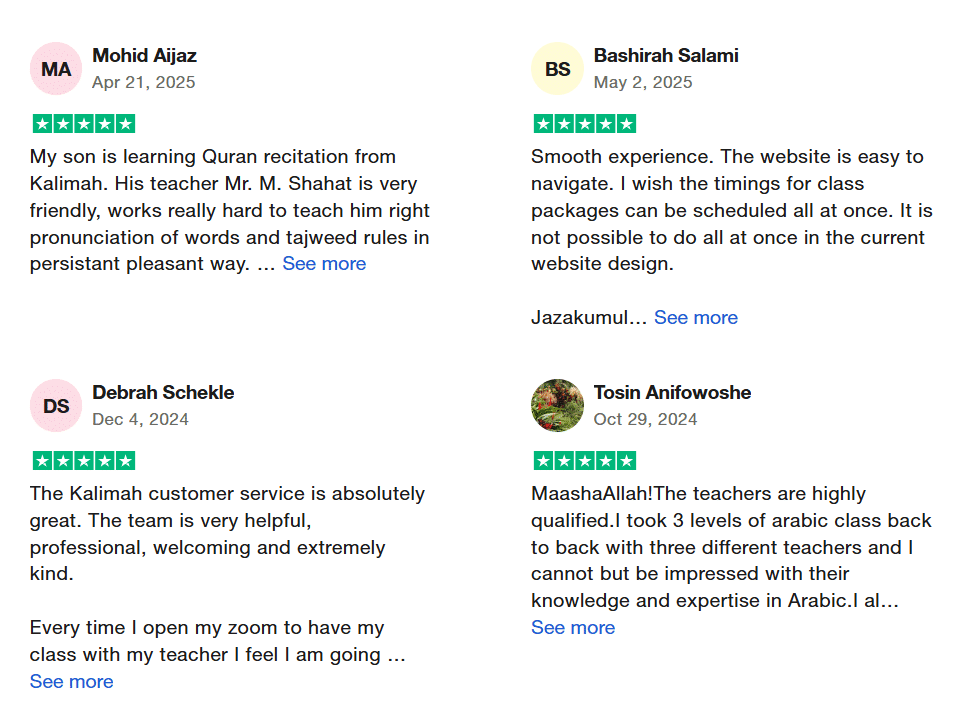
Here Are The Reviews On Our Courses:
Our students frequently commend the excellence of our courses and the commitment shown by our instructors. You can read their complete reviews on Trustpilot.
Read more reviews on Trustpilot
📚 Explore Our Courses:
Online Arabic Course: Tailored to your level, our comprehensive Arabic program includes 16 teaching levels and 400+ hours of personalized sessions.
Online Quran With Tajweed Course: Perfect for non-Arabic speakers, our course spans 13 levels and equips you with Tajweed mastery from beginner to advanced.
Online Arabic Course For Kids: Nurture your child’s love for Arabic with our engaging and structured program, available in 24 levels for primary, intermediate, and secondary stages.
🚀 Start Your Free Trial Today! 🚀
Don’t miss out on this life-changing opportunity to deepen your faith and knowledge. Sign up now for your free trial and take the first step towards becoming a better practicing Muslim with Kalimah Center!
Master Arabic with Kalimah Center
Join our expert-led online classes and start your journey toward Arabic fluency today.
Book Your Free TrialConclusion
So, is Anki good for learning Arabic? Yes — as a memory engine, it’s one of the best tools available, and its spaced-repetition algorithm is close to essential for retaining Arabic’s vocabulary and script.
But it was built to memorize, not to teach. It won’t explain grammar, build reading fluency, or give you conversation practice.
The learners who win use both: Anki to lock in what they study, and a structured, specialized program to make sure they’re studying the right things in the right order. That combination — retention plus real instruction — is how memorized cards become a language you actually speak.
Frequently Asked Questions
Below are the questions Arabic learners most often ask about using Anki, with direct answers you can act on right away.
1. Is Anki good for learning Arabic vocabulary specifically?
Yes, Anki is excellent for Arabic vocabulary because its spaced-repetition algorithm schedules reviews right before you forget a word. It’s especially strong for gendered nouns, irregular plurals, and root patterns when cards include audio and example sentences.
2. Is Anki free to use?
Anki is completely free on desktop (Windows, Mac, Linux) and Android (AnkiDroid). Only the iPhone app (AnkiMobile) is paid, which helps fund the servers. AnkiWeb sync is also free.
3. Can Anki replace an Arabic teacher or course?
No. Anki is a flashcard tool for memorization, not a complete course. It won’t teach grammar, reading fluency, or conversation on its own, so it works best alongside structured lessons rather than in place of them.
4. Should I use shared Anki decks or make my own?
Make your own whenever possible. Large pre-made decks often include cards that don’t match your level or lessons. Cards you build from your own study material are more relevant and far easier to remember.
5. Does Anki work for both Modern Standard Arabic and dialects?
Yes, Anki works for both, but you should choose one focus per deck. Use it for Modern Standard Arabic (Fusha) if your goal is reading, or for a specific dialect like Egyptian or Levantine if your goal is speaking — mixing them in one deck causes confusion.