If you’ve been waiting for a free hour to learn Arabic in 15 minutes a day, that hour was never the answer — and it was never coming. Work, kids, obligations. By the time you sit down, the energy is gone and you don’t know where to start, so you don’t.
You need a better system. Fifteen focused minutes a day — structured correctly and done consistently — will take you further than an occasional two-hour session every weekend.
What follows is a minute-level routine, a first-week blueprint, and a 3-month content roadmap — so every session starts with a clear answer to “what do I do today?
What You’ll Learn in This Article?
- Why 15 minutes a day works (the cognitive science behind it).
- The exact minute-by-minute Arabic lesson structure for each session.
- A day-by-day plan for your first week.
- A 3-month roadmap from zero to basic reading and listening.
- The three tools you actually need — and the mistakes that kill most beginners.
Why Learn Arabic in 15 Minutes a Day Works?
Most people assume more time equals more progress. In language learning, that assumption is wrong — and understanding why changes how you approach every session.
When you’re asking your brain to process an unfamiliar script, sounds it has never produced, and grammar logic it has never encountered — that cognitive load has a ceiling, and it arrives faster than most learners expect. This isn’t a motivational claim; it’s how the prefrontal cortex manages cognitive load.
Arabic specifically demands more from working memory than most languages because it introduces:
- An unfamiliar writing direction.
- Phonemes absent in English (like ق and ح).
- A root-based vocabulary system with no English parallel.
15 Minutes Hits the Optimal Window Because It Is:
- Long enough to acquire something new.
- Short enough that your brain doesn’t start filtering information as noise.
Daily Exposure vs Weekly Sessions The Numbers
| Frequency | Session Length | Encoding Opportunities Per Year |
| Daily | 15 minutes | 365 |
| Weekly | 2 hours | 52 |
The daily exposure wins — not because of total hours, but because:
- Memory consolidation happens during sleep.
- Daily sessions mean your brain processes Arabic every single night.
Read also about: How To Learn Arabic In 10 Days
Why Short Arabic Lessons Beat Long Study Sessions?
Spaced repetition is the most evidence-supported method for vocabulary retention in language learning. The mechanism is simple:
- you review a word or concept right before your brain would naturally forget it.
- Tools like Anki are built on this model, and they outperform traditional flashcard study by 200–300% in retention at the 30-day mark.
- Every daily session retrieves the last — your schedule becomes the spaced repetition system. Each session begins by retrieving what you learned yesterday — which is exactly when the memory needs to be reinforced.
- A long Saturday session with nothing in between doesn’t replicate this. You can’t hack your way around how memory works.
The Exact 15-Minute Arabic Study Routine
This is the core of the system. Every minute has a purpose. Follow it in order — the sequence matters.
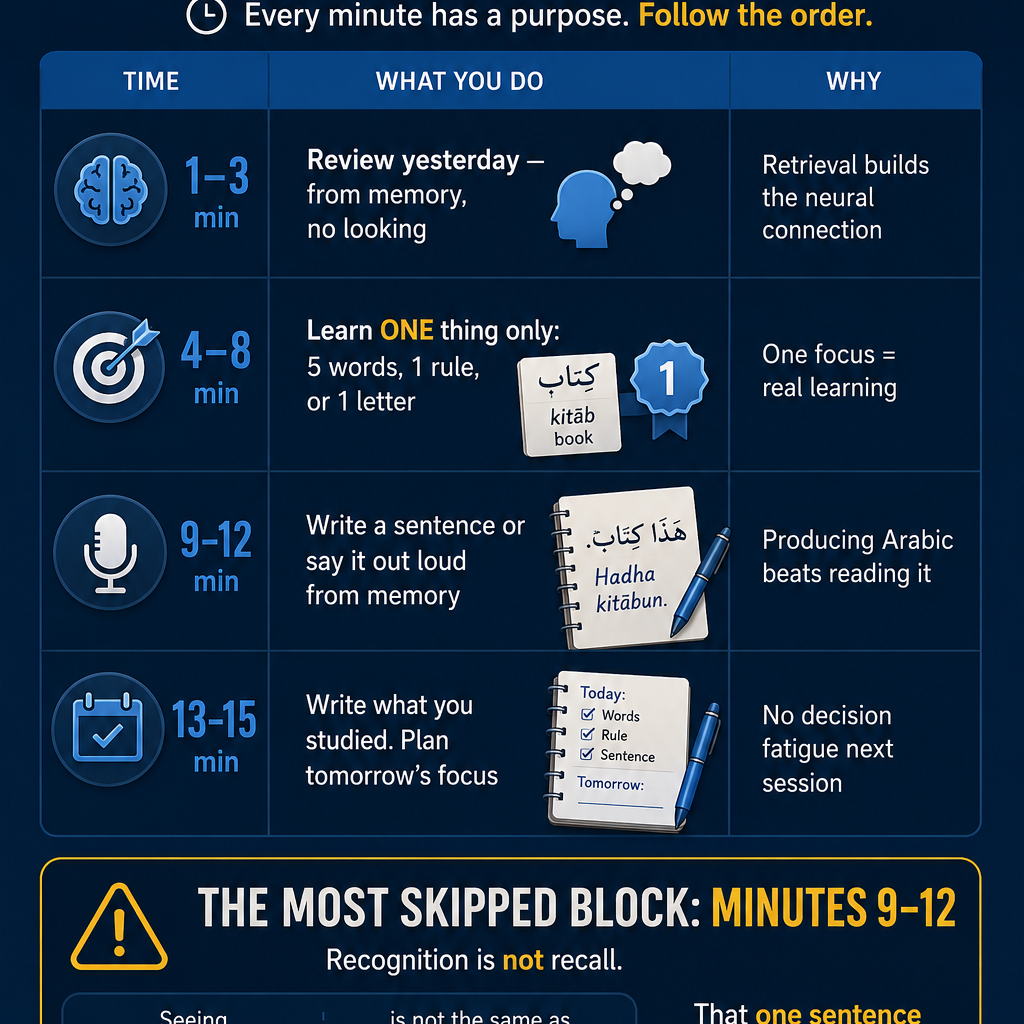
The Minute-by-Minute Breakdown for Each Arabic Lesson
| Minutes | What You Do | Why It Works |
| 1–3 | Review yesterday’s words, letters, or sentence — from memory, no looking | Retrieval strengthens the neural connection every single time |
| 4–8 | Learn ONE new thing only: 5 words, 1 grammar rule, or 1 letter form | One focus = real learning. Multiple topics = nothing sticks |
| 9–12 | Active output: write a sentence, say it out loud, write from memory | Passive reading doesn’t teach Arabic. Producing it does |
| 13–15 | Write what you studied. Plan tomorrow’s single focus | Zero decision fatigue — you open your notebook and immediately know what to do |
The most commonly skipped phase is minutes 9–12. Most beginners look at vocabulary and think they’ve learned it. They haven’t — recognition is not recall.
If you learned the word كِتَاب (kitāb — book) today, active output means writing: هَذَا كِتَابٌ (This is a book) from memory. That one act is worth more than five more minutes of looking at the word.
Read More About: Where To Learn Arabic?
How to Make the 15-Minute Arabic Short Lesson Actually Happen Every Day?
The routine above only works if you actually open your notebook — and the most reliable way to do that is the anchor habit.
Attach your 15 minutes to something you already do every day without thinking:
- Morning coffee
- The commute
- Right after Fajr
- The moment after your kids leave for school
Pick one anchor and hold it for 21 days. After that, the sequence becomes automatic — the anchor triggers the Arabic session without any willpower required. This is the step most guides skip, and it’s the reason most people’s routines collapse in week two.
What happens when you miss a day?
Follow the one-day reset rule:
| Step | What to do |
| Next session | Do minutes 1–3 only — pure retrieval from the last completed session |
| New material | Do not add anything new |
| Day after | Return to your normal routine |
One missed session handled this way costs you nothing. Trying to “catch up” with a longer session costs you your streak and your confidence.
At Kalimah Center, our teachers work with beginners who have exactly this constraint — limited time, busy lives, and no prior Arabic background. Our one-on-one online sessions are designed to slot into your daily routine, not replace it.
Experience Kalimah Center Classes
Watch real excerpts from our live sessions at Kalimah Center and see how we bring learning to life. These clips highlight our interactive, student-centered teaching approach across all our courses—designed to keep learners engaged, motivated, and actively involved every step of the way.
Master Arabic with Kalimah Center
Join our expert-led online classes and start your journey toward Arabic fluency today.
Book Your Free TrialYour First Week A Day by Day 15 Minute Arabic Plan
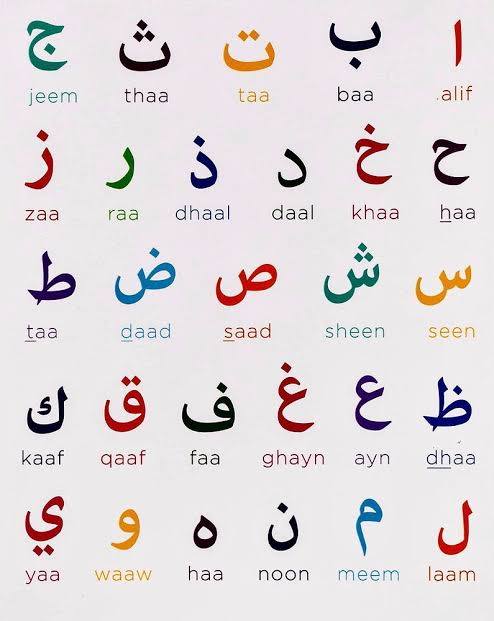
The first week is the most important — it builds the habit and gives you your first real win: the Arabic alphabet.
| Day | Focus | Goal |
| Day 1 | Arabic letters 1–7 (ا ب ت ث ج ح خ) | Write each letter. Say it out loud. |
| Day 2 | Arabic letters 8–14 (د ذ ر ز س ش ص) | Review Day 1 letters first (3 min) |
| Day 3 | Arabic letters 15–22 (ض ط ظ ع غ ف ق) | Quiz yourself on letters 1–14 |
| Day 4 | Arabic letters 23–28 (ك ل م ن ه و ي) | Focus on the ones you keep forgetting |
| Day 5 | Full alphabet review | Write all 28 from memory. Fix mistakes. |
| Day 6 | 5 basic Arabic words using letters you know | كِتَاب، بَيْت، مَاء، نُور، بَاب |
| Day 7 | Free review day | Return to whatever felt hardest this week |
By the end of Day 7, you know the Arabic alphabet. Not perfectly — but enough to begin reading. Reaching this stage is a real achievement—many people who keep saying they’ll learn Arabic one day never actually make it this far.
Read also: Learn Arabic in 60 Days – Real Daily Routine That Actually Works
Your 3-Month Arabic Roadmap
The 15-minute session structure stays identical throughout. What changes is the content.
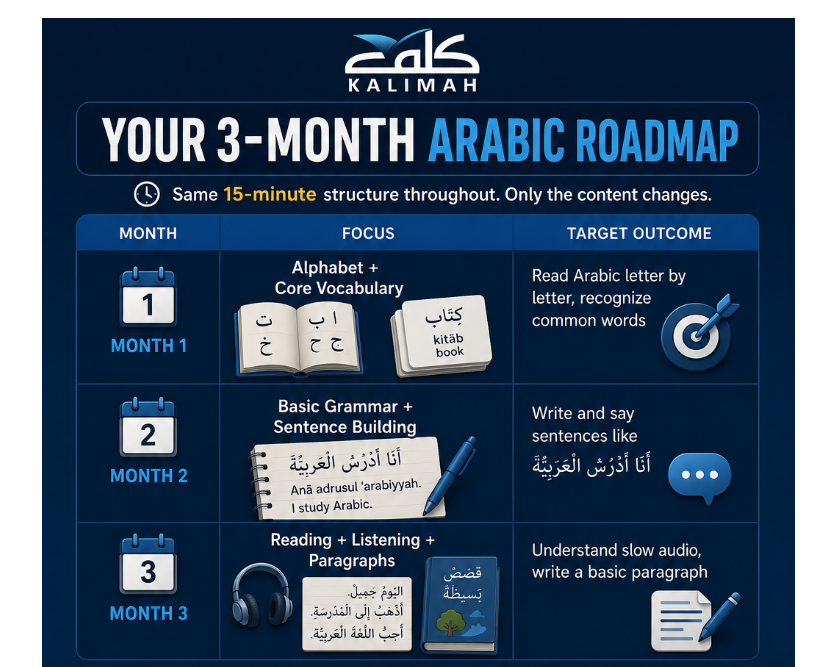
Month 1: Alphabet and Core Vocabulary
Focus on all 28 letters and building a vocabulary base of 50–100 high-frequency words. Greetings, numbers 1–10, days of the week, colors, and basic nouns. Don’t go deep. Go wide.
You can slowly read Arabic text letter by letter, and you recognize common words when you see them.

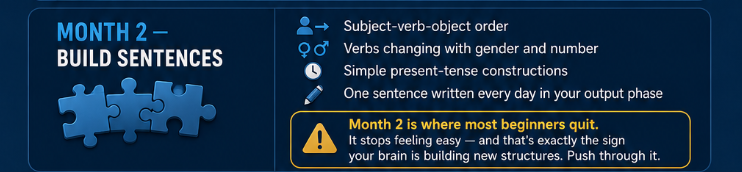
Month 2: Basic Grammar and Sentence Building
Learn how Modern Standard Arabic (MSA) sentences are built:
- Subject-verb-object order.
- And how verbs change with gender and number.
- And how to use simple present-tense constructions.
At this point, you are able to create and speak simple sentences such as أَنَا أَدْرُسُ الْعَرَبِيَّةَ (I am studying Arabic).
Month 2 is where most beginners quit — because it stops feeling like beginner-level material and starts feeling hard. That difficulty is not a sign you’re failing. It’s a sign your brain is actually building new structures. Push through it.
Month 3: Short Reading, Listening, and Paragraphs
Begin reading short Arabic texts — signs, simple sentences, children’s books. Add 5–10 minutes of slow Arabic audio (podcasts made for learners, news with transcripts). For your practice stage, try writing short paragraphs of three to five sentences about easy, everyday subjects.
You understand slow Arabic audio and can write a basic paragraph about yourself or your day.
If you want structured teacher support alongside this self-study plan, Kalimah Center’s live one-on-one online Arabic classes can slot directly into this roadmap — one session per week is enough to get pronunciation correction and grammar feedback that months of self-study alone can’t provide.

Inside Kalimah Center: Moments from Our Courses
Get a glimpse into the vibrant learning experience at Kalimah Center. These snapshots capture real moments from our live classes—where students engage deeply, connect with passionate instructors, and grow in a welcoming, supportive environment.
Here Are The Reviews On Our Courses:
Our students frequently commend the excellence of our courses and the commitment shown by our instructors. You can read their complete reviews on Trustpilot.
Read more reviews on Trustpilot

The 15 Minutes You’re Already Doing — Imagine Doing Them Right
You’ve read the plan. You know the structure. Now picture the same 15 minutes — but instead of guessing whether your pronunciation is correct, a teacher tells you in real time.
Instead of wondering if you’re focusing on the right thing this week, someone who’s done this with hundreds of learners tells you exactly what comes next.
That’s not a longer commitment. It’s the same 15 minutes, working harder.
Kalimah learners consistently report one thing: the moment they added one weekly session to their daily routine, months of confusion collapsed into weeks of clarity.
Before You Book Anything — Watch This First
Two free lessons that will change how you use your 15 minutes tomorrow:
- Learn Arabic Verbs and Vocabulary Slowly 🐢 — 4 minutes that show you exactly how to slow down and see Arabic the way your brain needs to process it at this stage
- Arabic Conversation for Beginners | 70 Basic Phrases — the sentences you’ll be producing in Month 2, spoken at a pace you can actually follow
Watch one. If the teaching style clicks — that’s your sign.
One Course for Every Starting Point
The Online Arabic Course (16 levels) for adults building from scratch or picking up where they left off. The Quran with Tajweed Course (13 levels) for learners whose goal is Quranic reading and recitation. The Arabic Course for Kids (24 levels) for children at any school stage — all one-on-one, all flexible, all taught by instructors who have done this for 9+ years.
Master Arabic with Kalimah Center
Join our expert-led online classes and start your journey toward Arabic fluency today.
Book Your Free TrialWhat Makes Kalimah Different From Every Other Platform
| Generic platforms | Kalimah | |
| Tutor quality | Assigned randomly | Rated by real students at your level |
| Materials | Extra cost or none | Affordable course books included |
| Scheduling | Fixed class times | Fits around your 15-minute habit |
| Feedback | Delayed or automated | Real-time, one-on-one, every session |
Start with a free trial — no commitment, just 15 minutes

Conclusion
Learning Arabic in 15 minutes a day works not because it’s fast — it works because it’s consistent. Every session retrieves yesterday’s material, adds one new thing, and produces active output. Repeated daily, that structure compounds into real ability: you read the alphabet in week one, form sentences in month two, and understand basic spoken Arabic by month three.
The biggest difference between people who learn Arabic and people who say they want to is not talent or time. It’s showing up for 15 minutes every day — even when it’s inconvenient, even when progress feels invisible. The progress is happening; it just happens during sleep, not during the session.
Start with Day 1 of the first-week plan. Fifteen minutes. That’s the whole commitment.
Read also: How to Learn Arabic in 90 Days with a Daily Routine That Actually Works
Frequently Asked Questions
Can you really learn Arabic in 15 minutes a day?
Yes — with the right structure. Fifteen minutes of daily focused practice covering retrieval, new input, and active output is neurologically more effective than longer irregular sessions.
In 15 minutes a day over 3 months, most beginners reach basic reading ability and foundational vocabulary. Fluency requires more time, but genuine progress begins immediately.
What is the best 15-minute Arabic short lesson structure for beginners?
Spend the first 3 minutes reviewing yesterday’s material from memory. Use minutes 4–8 to learn one new thing only — five words, one letter form, or one grammar rule.
Minutes 9–12 are active output: write a sentence or say the new words aloud without looking. Use the final 2 minutes to plan tomorrow’s single focus so there’s no decision fatigue.
How long does it take to learn the Arabic alphabet with 15 minutes a day?
One week. Learning 4–7 letters per day over 5 days, reviewing on day 6, and doing a free review on day 7 is enough to know all 28 letters. This is not a shortcut — it’s what happens when each session builds directly on the previous one without gaps.
Do Arabic learners benefit more from studying Modern Standard Arabic before learning a dialect?
Start with Modern Standard Arabic (MSA). MSA gives you the reading, writing, and grammar foundation that makes every dialect easier to pick up afterward.
Dialects are regional and spoken; MSA is universal and written. Learning a dialect first without MSA is like learning to speak a language without ever learning to read or write it.
What should I do if I miss a day of Arabic study?
Follow the one-day reset rule: spend the next session’s first 3 minutes doing pure retrieval of everything from your last completed session, and do not add new material that day. Resume the normal routine the following session.
Missing one day costs nothing if you handle it correctly. Trying to compensate with a longer session is counter-productive and breaks the spaced repetition rhythm.
Is a teacher necessary if I follow this routine?
The daily routine alone produces real progress in reading, vocabulary, and basic grammar. What it cannot provide is pronunciation correction, real-time feedback, and answers to your specific grammar questions.
Even one structured lesson per week dramatically accelerates the routine’s effectiveness — because you know exactly what to focus on, and you fix errors before they become habits.