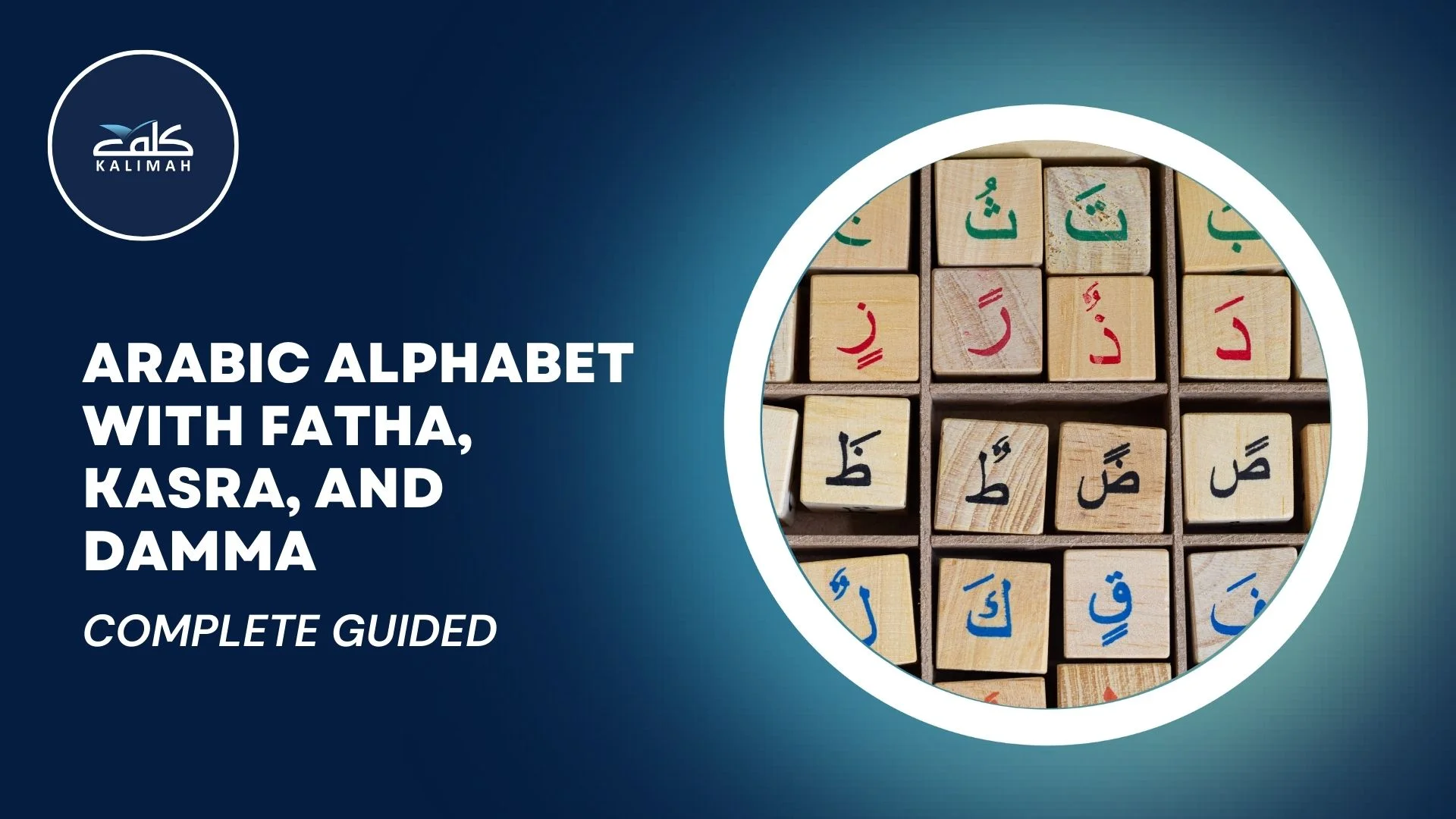
Learning the Arabic alphabet with Fatha, Kasra, and Damma is essential for anyone aiming to master Arabic pronunciation and grammar. These diacritical marks, or “harakat,” represent the short vowel sounds that bring clarity and precision to Arabic words.
In this article, we will explore the Arabic alphabet with Fatha, Kasra, and Damma, providing explanations and examples for each.
Whether you’re looking to understand the Arabic Alphabet with Fatha Kasra and Damma in English or need a clear guide to the use of these vital short vowels in Arabic, this article provides the perfect starting point for learning the Arabic alphabet with harakat.
Quick Reference Table:
| Haraka | Arabic Name | Mark | Sound | English Equivalent | Example |
|---|---|---|---|---|---|
| Fatha | فَتْحَة | ـَ | Short “a” | “a” in “cat” | بَ = “ba” |
| Kasra | كَسْرَة | ـِ | Short “i” | “i” in “sit” | بِ = “bi” |
| Damma | ضَمَّة | ـُ | Short “u” | “u” in “put” | بُ = “bu” |
What Are Fatha, Kasra, and Damma? Arabic Short Vowels Explained
Fatha (فَتْحَة), Kasra (كَسْرَة), and Damma (ضَمَّة) are the three short vowels of the Arabic language. Together, they are part of a system called harakat (حَرَكَات) — diacritical marks placed above or below Arabic letters to indicate how they should be pronounced.
Without harakat, Arabic text shows only consonants — like reading English without any vowels: “wthrt vwls, Nglsh s dffclt t rd.” Arabic adds this layer optionally, with harakat appearing in the Quran, children’s books, and language learning texts, but omitted in everyday writing.
The three short vowels:
- Fatha (ـَ) — a small diagonal stroke above the letter → short “a” sound → بَ = “ba”
- Kasra (ـِ) — a small diagonal stroke below the letter → short “i” sound → بِ = “bi”
- Damma (ـُ) — a small hook above the letter (resembling miniature و) → short “u” sound → بُ = “bu”
Arabic also has three long vowels:
- Alif (ا) — long “aa” sound (as in “father”)
- Waw (و) — long “uu” sound (as in “moon”)
- Yaa (ي) — long “ii” sound (as in “see”)
Together, the three short vowels (harakat) and three long vowels give Arabic six vowel sounds — all essential for correct pronunciation.
Why Learn Arabic Letters With Harakat?
Harakat show you exactly how to pronounce each Arabic letter in a word. Without them, beginner readers must guess which vowel sound to use — leading to mispronunciation that can be difficult to correct later.
For Quranic recitation specifically, every haraka must be precise — the Quran is fully vowelled throughout, and a wrong haraka can change the meaning of a verse.
For a complete guide to all harakat including Sukoon, Shadda, and their grammar functions:
Arabic Harakat, Tashkeel, and Diacritics — Complete Guide
All 28 Arabic Letters With Fatha, Kasra, and Damma
Here is a clear reference for how each Arabic letter changes with the three short vowels:
| Arabic Letter | Fatha (ـَ) | Kasra (ـِ) | Damma (ـُ) |
| أ | أَ | إِ | أُ |
| ب | بَ | بِ | بُ |
| ت | تَ | تِ | تُ |
| ث | ثَ | ثِ | ثُ |
| ج | جَ | جِ | جُ |
| ح | حَ | حِ | حُ |
| خ | خَ | خِ | خُ |
| د | دَ | دِ | دُ |
| ذ | ذَ | ذِ | ذُ |
| ر | رَ | رِ | رُ |
| ز | زَ | زِ | زُ |
| س | سَ | سِ | سُ |
| ش | شَ | شِ | شُ |
| ص | صَ | صِ | صُ |
| ض | ضَ | ضِ | ضُ |
| ط | طَ | طِ | طُ |
| ظ | ظَ | ظِ | ظُ |
| ع | عَ | عِ | عُ |
| غ | غَ | غِ | غُ |
| ف | فَ | فِ | فُ |
| ق | قَ | قِ | قُ |
| ك | كَ | كِ | كُ |
| ل | لَ | لِ | لُ |
| م | مَ | مِ | مُ |
| ن | نَ | نِ | نُ |
| هـ | هـَ | هـِ | هـُ |
| و | وَ | وِ | ـ |
| ي | يَ | يِ | يُ |
Why does و (Waw) not appear with Damma?
و (Waw) with Damma (وُ) is technically possible but extremely rare in natural Arabic. More importantly, و itself already represents the long vowel sound “uu” (like in “moon”) — the same sound that Damma points toward. Using Damma on Waw would create a phonological redundancy. In practice, Damma on Waw is virtually never seen in standard Arabic texts, which is why it is shown here without a Damma form.
Fatha (ـَ) — The Short ‘A’ Sound: Pronunciation, Words, and Examples
The Fatha is a fundamental diacritic mark in the Arabic alphabet that indicates a short “a” sound. It appears as a small diagonal line placed above a letter, and it significantly influences the pronunciation and meaning of Arabic words. For example, the letter ب (Ba) with a Fatha becomes بَ (Ba), similar to the “ba” in the English word bat.
Examples of Fatha Pronunciation
Here are some more examples of how the Arabic alphabet with Fatha is pronounced:
- بَ (Ba) – like the “ba” in bat.
- تَ (Ta) – like the “ta” in tap.
- دَ (Da) – like the “da” in dad.
- فَ (Fa) – like the “fa” in fat.
- كَ (Ka) – like the “ka” in cat.
- سَ (Sa) – like the “sa” in sat.
These examples show how the Fatha creates a short vowel sound, transforming the letters of the Arabic alphabet with Fatha into distinct syllables.
You can explore the Arabic letters with Fatha here.
Examples of Fatha in Words and Sentences
Mastering the Fatha is essential for achieving accurate pronunciation and comprehension in Arabic, particularly in both conversational and literary contexts. Here are examples that illustrate the significance of the Fatha in words and sentences, highlighting how it clarifies the subject and action:
Word Examples:
- قَلْبٌ (Qalb) – meaning “heart”
- مَكْتَبٌ (Maktab) – meaning “desk” or “office”
- حَمَامٌ (Hamām) – meaning “pigeon” or “bath”
- بَحْرٌ (Baḥr) – meaning “sea”
- فَضْلٌ (Faḍl) – meaning “virtue” or “grace”
Sentence Examples:
- أَكَلَ الْوَلَدُ الْفَاكِهَةَ (Akala al-waladu al-fākihata) – “The boy ate the fruit.”
- فَازَ الْفَرِيقُ بِالْمُبَارَاةِ (Fāza al-farīqu bil-mubārāt) – “The team won the match.”
- جَلَسَتِ الْبِنْتُ فِي الْمَكَانِ (Jalasat al-bintu fī al-makān) – “The girl sat in the place.”
What is Double Fatha (Tanween Fatha)?
In Arabic, a double Fatha indicates Tanween, which represents an additional نْ sound at the end of an indefinite noun. This is known as Tanween Fatha or تنوين فتا, marked by two Fatha signs above the final letter, pronounced as “an.”
Examples of Words with Tanween Fatha:
- كِتَابٌ (Kitābun) – means “book”
- مَدْرَسَةٌ (Madrasatun) – means “school”
- مُعَلِّمَةٌ (Mu’allimatun) – means “teacher” (female)
The Arabic alphabet Fatha and its applications are crucial for beginners, as it opens up the pronunciation of letters, giving them a clear, open vowel sound. Without the Fatha, many Arabic words would lack clarity, making it difficult to understand or pronounce them properly.
Master Arabic with Kalimah Center
Join our expert-led online classes and start your journey toward Arabic fluency today.
Book Your Free TrialKasra (ـِ) — The Short ‘I’ Sound: Pronunciation, Words, and Examples
The Kasra is another critical diacritical mark (Haraka) in the Arabic alphabet, represented by a small diagonal line placed beneath the letter. It signals a short “i” sound and plays a crucial role in shaping the pronunciation and meaning of Arabic words.
For instance, the letter ب (Ba) with a Kasra becomes بِ (Bi), akin to the “bi” in the English word bit. In comparison to the Fatha (which adds a short “a” sound), the Kasra creates a more closed, subtle sound. Understanding how to use the Arabic Alphabet With Kasra is crucial for mastering Arabic letters with Harakat and improving fluency in reading Arabic texts.
Examples of Kasra Pronunciation
Here are some examples of how to pronounce Kasra in the Arabic alphabet:
- بِ (Bi) – like the “bi” in bit.
- تِ (Ti) – like the “ti” in tip.
- شِ (Shi) – like the “shi” in ship.
- كِ (Ki) – like the “ki” in kit.
- سِ (Si) – like the “si” in sit.
Watch this video to listen to the Arabic Alphabet with Kasra: Listen here.
Examples of Kasra in Words and Sentences
Mastering the Kasra is essential for achieving accurate pronunciation and comprehension in Arabic, particularly in conversational and literary contexts. Here are examples that illustrate the significance of the Kasra in words and sentences, highlighting how it clarifies the subject and action:
Word Examples:
- حِصَانٌ (Ḥiṣān) – meaning “horse”
- جِبَالٌ (Jibāl) – meaning “mountains”
- حِكْمَةٌ (Hikma) – meaning “wisdom”
- رِسَالَةٌ (Risālah) – meaning “message”
- مِفْتَاحٌ (Miftāh) – meaning “key”
Sentence Examples:
- ذَهَبَ الْطَالِبُ إِلَى الْمَكْتَبَةِ (Dhahaba al-ṭālibu ilā al-maktabati) – “The student went to the library.”
- شَرِبَتِ الْبِنْتُ الْحَلِيبَ (Sharibat al-bintu al-ḥalība) – “The girl drank the milk.”
- كَتَبَ الْمُعَلِّمُ (Kataba al-mu’allimu) – “The teacher wrote.”
What is Double Kasra (Tanween Kasra)?
In Arabic, a double Kasra indicates Tanween, which represents an additional نْ sound at the end of an indefinite noun. This is referred to as Tanween Kasra or تنوين كسرة, marked by two Kasra signs beneath the final letter, pronounced as “in.”
Examples of Words with Tanween Kasra:
- كِتَابٍ (Kitābin) – means “book”
- مَدْرَسَةٍ (Madrasatin) – means “school”
- مَعْلَمَةٍ (Mu’allimatin) – means “teacher” (female)
Overall, understanding the Arabic Alphabet Kasra and its applications is essential for anyone learning Arabic. Mastery of this diacritic not only aids in proper pronunciation but also enriches comprehension, making it a foundational aspect of the Arabic language.
Damma (ـُ) — The Short ‘U’ Sound: Pronunciation, Words, and Examples
The Damma is a crucial diacritic mark used in the Arabic alphabet to signify a short “u” sound. It resembles a small و (waaw) and is written above a letter, adding significant meaning and pronunciation variations to Arabic words. For example, the letter ب (Ba) becomes بُ (Bu), similar to the “bu” in the English word pull.
It also plays a vital role in the Arabic language because it changes the meaning and pronunciation of words. For instance, the verb كَتَبَ (kataba) means he wrote, but by replacing the Fatha with Damma, it becomes كُتِبَ (kutiba), meaning was written.
This example highlights how mastering the use of Damma is essential for understanding and accurately using the Arabic alphabet.
Examples of Damma Pronunciation
Here are some examples of how to pronounce Damma in Arabic Alphabet:
- بُ (Bu) – like the “bu” in boot.
- تُ (Tu) – like the “tu” in tune.
- شُ (Shu) – like the “shu” in shoe.
- كُ (Ku) – like the “ku” in cool.
- سُ (Su) – like the “su” in super.
Check the sounds of the Arabic Alphabet with Damma Here.
Examples of Damma in Words and Sentences:
Mastering the Arabic Alphabet with Damma helps achieve accurate pronunciation and comprehension in Arabic, particularly in conversational and literary contexts. Here are some examples that illustrate the significance of the Damma in words and sentences, highlighting how it clarifies the subject and action:
Word Examples:
- قُرْآنٌ (Qur’ān) – Meaning the Quran
- جُمِعَ – Was collected – Jume’a
- حُكْمٌ (Hukm) – Meaning judgment
- رُسُلٌ (Rusul) – Meaning messengers
- جَزَاءٌ (Jazā’) – Meaning reward
Sentence Examples:
- قَالَ الْنَّبِيُّ (Qāla an-Nabiyyu) – “The Prophet said.”
- شَرِبَ الْوَلَدُ الْمَاءَ (Shariba al-waladu al-mā’a) – “The boy drank the water.”
- جَلَسَ الطَّالِب (Jalasa at-ṭālibu) – “The student sat.”
What is Double Damma (Tanween Damma)?
In Arabic, a double Damma indicates Tanween, which represents an additional نْ sound at the end of an indefinite noun. This is called Tanween Damma or تنوين ضمة, marked by two Damma signs above the final letter, pronounced as “un”.
Examples of Words with Tanween Damma:
- كِتَابٌ (Kitabun) means book
- مَدْرَسَةٌ (Madrasatun) means school
- مَعْلَمَةٌ (Mu’allimatun) means Teacher (female)
Ultimately, understanding the Arabic Alphabet with Damma and its applications is essential for anyone learning Arabic. Mastery of this diacritic not only aids in proper pronunciation but also enriches comprehension, making it a foundational aspect of the Arabic language.
Arabic Keyboard Shortcuts for Fatha, Kasra, and Damma
| Haraka | Mark | Windows Shortcut | What It Sounds Like |
|---|---|---|---|
| Fatha | ـَ | Shift + Q | Short “a” |
| Kasra | ـِ | Shift + A | Short “i” |
| Damma | ـُ | Shift + E | Short “u” |
How to use: Enable Arabic keyboard first (Settings → Language → Add Arabic), then type your letter and immediately press the shortcut to add the haraka.
Experience Kalimah Center Classes
Watch real excerpts from our live sessions at Kalimah Center and see how we bring learning to life. These clips highlight our interactive, student-centered teaching approach across all our courses—designed to keep learners engaged, motivated, and actively involved every step of the way.
Arabic Alphabet with Fatha Kasra and Damma in English Pronunciation
Learning the Arabic alphabet with Fatha, Kasra, and Damma in English is an essential foundation for anyone beginning their journey in the Arabic language. Understanding the letters and how these diacritical marks modify their sounds is crucial for accurate pronunciation and reading.
Fatha (ـَ) adds an “a” sound, Kasra (ـِ) introduces an “i” sound, and Damma (ـُ) provides a “u” sound. This knowledge allows learners to form words correctly and communicate effectively in Arabic.
Here’s a table of the Arabic Alphabet with the diacritical marks (Fatha Kasra and Damma) in English transliteration, providing a helpful resource for beginners:
| Arabic Letter | Fatha (ـَ) | Kasra (ـِ) | Damma (ـُ) |
| ب (B) | بَ (Ba) | بِ (Bi) | بُ (Bu) |
| ت (T) | تَ (Ta) | تِ (Ti) | تُ (Tu) |
| ث (Th) | ثَ (Tha) | ثِ (Thi) | ثُ (Thu) |
| ج (J) | جَ (Ja) | جِ (Ji) | جُ (Ju) |
| ح (H) | حَ (Ha) | حِ (Hi) | حُ (Hu) |
| خ (Kh) | خَ (Kha) | خِ (Khi) | خُ (Khu) |
| د (D) | دَ (Da) | دِ (Di) | دُ (Du) |
| ذ (Dh) | ذَ (Dha) | ذِ (Dhi) | ذُ (Dhu) |
| ر (R) | رَ (Ra) | رِ (Ri) | رُ (Ru) |
| ز (Z) | زَ (Za) | زِ (Zi) | زُ (Zu) |
| س (S) | سَ (Sa) | سِ (Si) | سُ (Su) |
| ش (Sh) | شَ (Sha) | شِ (Shi) | شُ (Shu) |
| ص (S) | صَ (Sa) | صِ (Si) | صُ (Su) |
| ض (D) | ضَ (Da) | ضِ (Di) | ضُ (Du) |
| ط (T) | طَ (Ta) | طِ (Ti) | طُ (Tu) |
| ظ (Dh) | ظَ (Dha) | ظِ (Dhi) | ظُ (Dhu) |
| ع (A) | عَ (A) | عِ (I) | عُ (U) |
| غ (Gh) | غَ (Gha) | غِ (Ghi) | غُ (Ghu) |
| ف (F) | فَ (Fa) | فِ (Fi) | فُ (Fu) |
| ق (Q) | قَ (Qa) | قِ (Qi) | قُ (Qu) |
| ك (K) | كَ (Ka) | كِ (Ki) | كُ (Ku) |
| ل (L) | لَ (La) | لِ (Li) | لُ (Lu) |
| م (M) | مَ (Ma) | مِ (Mi) | مُ (Mu) |
| ن (N) | نَ (Na) | نِ (Ni) | نُ (Nu) |
| هـ (H) | هـَ (Ha) | هـِ (Hi) | هـُ (Hu) |
| و (W) | وَ (Wa) | وِ (Wi) | ـ |
| ي (Y) | يَ (Ya) | يِ (Yi) | يُ (Yu) |
Watch this YouTube video to Familiarize yourself with the Arabic alphabet with Fatha, Kasra, and Damma in English.
Practice Reading Arabic Letters With Harakat
Now that you have seen all 28 letters with Fatha, Kasra, and Damma, practice reading these syllable combinations. Cover the transliteration and try to read the Arabic first.
Exercise 1: Read the Fatha Syllables
| Arabic | Transliteration | Read It Like |
|---|---|---|
| بَ تَ جَ | ba, ta, ja | “ba” as in bat, “ta” as in tap, “ja” as in jar |
| دَ رَ سَ | da, ra, sa | “da” as in dad, “ra” rolled, “sa” as in sat |
| عَ غَ فَ | ‘a, gha, fa | ‘a is deep voiced, gha is throaty, fa as in far |
Exercise 2: Read the Kasra Syllables
| Arabic | Transliteration | Read It Like |
|---|---|---|
| بِ تِ جِ | bi, ti, ji | “bi” as in bit, “ti” as in tip, “ji” as in jib |
| دِ رِ سِ | di, ri, si | “di” as in dip, “ri” rolled, “si” as in sit |
| كِ لِ مِ | ki, li, mi | “ki” as in kit, “li” as in lip, “mi” as in mit |
Exercise 3: Read the Damma Syllables
| Arabic | Transliteration | Read It Like |
|---|---|---|
| بُ تُ جُ | bu, tu, ju | “bu” as in bull, “tu” as in tune, “ju” as in juice |
| دُ رُ سُ | du, ru, su | “du” as in dune, “ru” rolled, “su” as in suit |
| كُ لُ مُ | ku, lu, mu | “ku” as in cool, “lu” as in lure, “mu” as in moon |
Exercise 4: Read Simple Vowelled Words
Try reading these common Arabic words — all fully vowelled:
| Arabic Word | Read As | Meaning |
|---|---|---|
| بَيْت | bayt | house |
| كِتَاب | kitaab | book |
| قُرْآن | Qur’an | the Quran |
| مَدْرَسَة | madrasa | school |
| سَلَام | salaam | peace |
| رَحِيم | raheem | merciful |
| قَلَم | qalam | pen |
| جَمِيل | jameel | beautiful |
Master Arabic with Kalimah Center
Join our expert-led online classes and start your journey toward Arabic fluency today.
Book Your Free TrialInside Kalimah Center: Moments from Our Courses
Get a glimpse into the vibrant learning experience at Kalimah Center. These snapshots capture real moments from our live classes—where students engage deeply, connect with passionate instructors, and grow in a welcoming, supportive environment.
Here Are The Reviews On Our Courses:
Our students frequently commend the excellence of our courses and the commitment shown by our instructors. You can read their complete reviews on Trustpilot.

Master the Arabic Alphabet At Kalimah Center!
Unlock the secrets of the Arabic language by mastering its short vowels – Fatha, Kasra, and Damma – with Kalimah Center’s professional tutors. Whether you’re just beginning or looking to enhance your Quran recitation skills, our expert-guided courses provide a personalized learning experience.
Start your Arabic journey today through engaging, interactive lessons tailored to your pace.
Explore our comprehensive courses:
- Online Arabic Course: Improve your Arabic pronunciation and comprehension with 400+ hours of interactive sessions across 16 levels. Perfect for learners seeking a personalized approach to mastering Arabic.
- Online Quran With Tajweed Course: Learn to recite the Quran with proper Tajweed from introductory to advanced levels, guided by certified teachers to enhance your Quranic understanding and recitation.
- Online Arabic Course For Kids: Engage your child in a fun, structured learning environment with 24 levels of Arabic instruction tailored for young learners.
Sign up now for a free trial and see how our proven methods can help you achieve fluency. Explore our courses and join the Kalimah community!
Conclusion
In conclusion, committing to understanding and practicing the Arabic alphabet with Fatha, Kasra, and Damma is a crucial step toward mastering the language. By mastering the Arabic letters with harakat, learners can confidently engage with both written and spoken Arabic, ensuring clear communication and a deep understanding of the language.
Incorporating these diacritical marks into your studies will not only improve your pronunciation but also enhance your overall language skills, making Arabic learning more intuitive and effective.
FAQs about Arabic Alphabet With Fatha, Kasra & Damma
Q1: What does the Arabic alphabet look like with Fatha, Kasra, and Damma?
Every Arabic letter changes its vowel sound depending on which haraka is above or below it. With Fatha (ـَ) the letter produces a short “a” sound. With Kasra (ـِ) it produces a short “i” sound. With Damma (ـُ) it produces a short “u” sound. The complete reference table above shows all 28 Arabic letters with each of the three marks — use it as a pronunciation reference when reading vowelled Arabic text.
Q2: How do you pronounce Arabic letters with Fatha?
A letter with Fatha is pronounced with a short open “a” sound — like the “a” in “cat” or “bat.” For example: بَ = “ba,” تَ = “ta,” كَ = “ka,” سَ = “sa.” The Fatha mark is a small diagonal stroke placed above the letter. It is the most common of the three short vowels in Arabic and the one most teachers recommend learning first.
Q3: How do you pronounce Arabic letters with Kasra?
A letter with Kasra is pronounced with a short “i” sound — like the “i” in “sit” or “bit.” For example: بِ = “bi,” تِ = “ti,” كِ = “ki,” سِ = “si.” The Kasra mark is a small diagonal stroke placed below the letter — it is the only haraka that goes beneath the letter rather than above it.
Q4: How do you pronounce Arabic letters with Damma?
A letter with Damma is pronounced with a short “u” sound — like the “u” in “put” or “bull.” For example: بُ = “bu,” تُ = “tu,” كُ = “ku,” سُ = “su.” The Damma mark resembles a small و (Waw) placed above the letter. In Arabic grammar, Damma also marks the subject of a sentence (nominative case).
Q5: Why doesn’t و (Waw) take a Damma in the reference table?
و (Waw) with Damma (وُ) is technically possible but extremely rare in natural Arabic. Waw itself already represents the long vowel “uu” sound — adding Damma creates a phonological near-redundancy. In practice, Damma on Waw is virtually never seen in standard Arabic texts.
Q6: What is the difference between Fatha and Tanwin Fatha?
Fatha (ـَ) is a single mark producing a short “a” sound on any letter. Tanwin Fatha (ـً) is a double Fatha mark appearing at the end of indefinite nouns — producing an “an” sound. For example: كِتَاب (kitab — “book” when definite) vs كِتَابًا (kitaban — “a book” in accusative case).