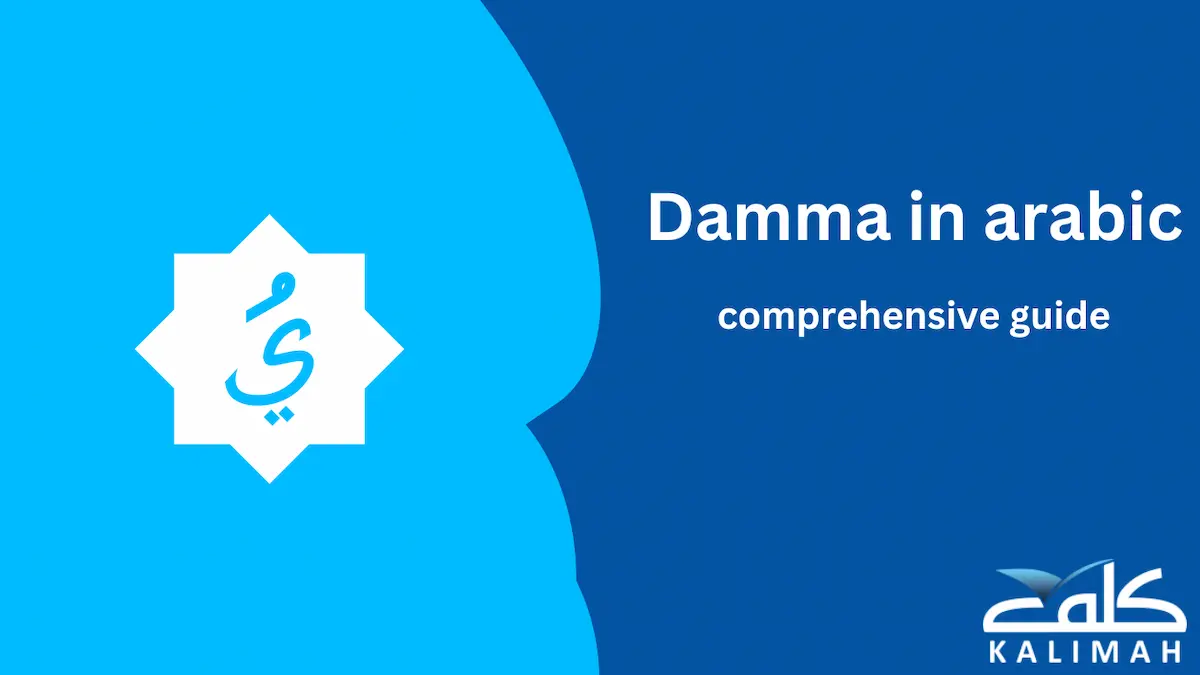
Damma ( -ُ ) is a vital Arabic diacritic that represents the short vowel sound “u” and can alter meanings of words. It also indicates Tanween, adding a pronounced “n” ending to indefinite nouns, making it essential for clear communication in Arabic.
Arabic diacritical marks introduction
Arabic is a rich language. One of the reasons for its richness is its diacritical marks and diacritical marks mean any mark or sign we add above letter. In Arabic, we have many diacritical marks such as Fattah ( -َ ) Damma ( -ُ ), or Kasrah ( -ِ ). Today, we will talk about Damma ( -ُ ). Damma is one of the main three vowels. It is very important to know how to pronounce Damma ( -ُ ).
Damma Meaning:
Damma or Dammah ( -ُ ) is an essential Arabic diacritical mark that appears as a small apostrophe above a letter, representing the short vowel sound “u,” like the “oo” in “food.” This mark is crucial for pronunciation, as it can change word meanings—e.g., كَتَبَ (kataba, “he wrote”) becomes كُتِبَ (kutiba, “was written”) with Damma.
Damma also indicates Tanween, adding a pronounced “n” ending in indefinite nouns, as seen in كِتَابٌ (kitabun, “a book”). Mastering Damma is vital for effective Arabic communication, and Kalimah Center offers courses to enhance your understanding of this rich language.
What is Damma in Arabic vowels?
Damma is a diacritic mark used in the Arabic language. It’s a small sign that looks like an apostrophe. Damma is written above letter. Damma represents a short vowel (u). It looks like a small و waaw. For example, look at the following table:
| تِجارَةُ | بِحارُ | بَشَرُ |
| شَجُرَ | الكُفَّارُ | نُهِبَ |
Why Damma is important?
Damma plays an important role in the Arabic language because it can change the meaning and pronunciation of the word. For example, the word كَتَبَ kataba means (he wrote) but if I add Damma instead of Fattah will be كُتِبَ kutiba. So, the meaning of the word will be changed to be (was written).
How to pronounce Damma?
Damma is a short vowel. It is pronounced as a short vowel (u). It is like the (u) sound in the English word “food”. The following table will help you to pronounce the letter with Damma:
| bu | بُ |
| nu | نُ |
| shu | شُ |
| ku | كُ |
| su | سُ |
How do you write Damma in Arabic letters?
Damma is a small و waaw . Unlike Kasrah, we add Damma above the letter. So, the word رَبنَا , if I want to add Damma above ب will be as following, رَبُنَا rabuna.
If you want to write it in the keyboard, ensure that your keyboard input is set to Arabic. Then, write the letter you add Damma above it. Then, press shift +E.
Experience Kalimah Center Classes
Watch real excerpts from our live sessions at Kalimah Center and see how we bring learning to life. These clips highlight our interactive, student-centered teaching approach across all our courses—designed to keep learners engaged, motivated, and actively involved every step of the way.
Master Arabic with Kalimah Center
Join our expert-led online classes and start your journey toward Arabic fluency today.
Book Your Free TrialExamples of Damma in words and sentence
To make it clear, let’s read some examples for words and sentences.
Words examples:
| Word | Meaning | Pronunciation guide |
| جُمِعَ | was collected | jumeaa |
| شُرِبَ | was drunk | shuriba |
| هُوَ | he | huwa |
| رُفِعَ | was lifted | rufia |
| بَشَرُ | human | basharu |
| ذَكَرُ | man | dhakkar |
Sentence examples:
| Sentence | Meaning | Pronunciation guide |
| دَخَلَ الْمُدَرِسُ الْفَصْلَ | The teacher entered the class. | dakhala l-mudarrisu al fasla |
| خَرَجَ الْوَلَدُ | The boy went out. | karga al- waladu |
| نَامَتْ الْبِنْتُ | The girl slept. | namat al bentu |
What does double Damma mean?
In the Arabic language, double Damma means Tanween. Tanween is a nunation and stands for an extra نْ at the end of a noun, which you pronounce but do not write. It practically means that you add a pronounced “n”-ending to an indefinite noun if you mark it with case endings. We have three types of Tanween, Tanween al-fathah, Tanween Addhamma, and Tanween Al-kasrah.
Tanween Damma (تنوين ضمة) is marked with two Damma at the end of the word. It’s pronounced as “un”. For example, ولدٌ waldun. You can see Tanween Damma as two Damma with each other or
| Words with Tanween Damma | Meaning | Pronunciation guide |
| كِتَابٌ | book | ketabun |
| جُمُعَةٌ | Friday | jumahtun |
| جَمِيلَةٌ | beautiful | jamilatun |
Test yourself.
- Here are some of the words with Damma. Underline each letter has Damma.
| Word without Damma | Word with Damma |
| مُدَرِّسٌ | |
| شُدَّ | |
| عُلِمَ |
- Write Damma above the first letter in every word.
| Word | Letter that has Damma |
| ذكِر | |
| مدَرِسُ | |
| بشِّرَّ |
- Add Tanween Dammah at the following words:
| Word | Letter that Tanween Damma |
| جَمِيل | |
| بَيْت | |
| رَجُل |
Master Arabic with Kalimah Center
Join our expert-led online classes and start your journey toward Arabic fluency today.
Book Your Free TrialInside Kalimah Center: Moments from Our Courses
Get a glimpse into the vibrant learning experience at Kalimah Center. These snapshots capture real moments from our live classes—where students engage deeply, connect with passionate instructors, and grow in a welcoming, supportive environment.
Here Are The Reviews On Our Courses:
Our students frequently commend the excellence of our courses and the commitment shown by our instructors. You can read their complete reviews on Trustpilot.

Unlock the World of the Arabic language with Kalimah Center
By joining Kalimah Center’s courses, you’re opening doors to a world of comprehensive Arabic learning. Our courses cover everything from Arabic grammar to pronunciation and writing, with special attention to diacritical marks like the Damma. Our experienced instructors will be your guides, helping you navigate the intricacies of the language and boosting your confidence to read, write, and converse fluently in Arabic.
What sets us apart is our user-friendly online platform. It’s designed to give you the flexibility to progress at your own pace while actively applying what you’ve learned. Plus, you’ll become part of a close-knit community of fellow learners who, like you, share a passion for mastering Arabic.
So, whether your goal is to delve into classical Arabic texts, hold conversations with native speakers, or simply deepen your appreciation for this rich language, Kalimah Center’s online Arabic courses are your pathway to success. Join us today, and let us empower you on your journey to becoming a confident Arabic language enthusiast. Discover the beauty of Arabic script, including the Damma, with Kalimah Center by your side!
📚 Explore Our Courses:
Online Arabic Course: Tailored to your level, our comprehensive Arabic program includes 16 teaching levels and 400+ hours of personalized sessions.
Online Quran With Tajweed Course: Perfect for non-Arabic speakers, our course spans 13 levels and equips you with Tajweed mastery from beginner to advanced.
Online Arabic Course For Kids: Nurture your child’s love for Arabic with our engaging and structured program, available in 24 levels for primary, intermediate, and secondary stages.
🚀 Start Your Free Trial Today! 🚀
Don’t miss out on this life-changing opportunity to deepen your faith and knowledge. Sign up now for your free trial and take the first step towards becoming a better practicing Muslim with Kalimah Center!
Conclusion:
In conclusion, understanding Damma is essential for mastering the Arabic language, as it significantly influences pronunciation and meaning. By recognizing its role as a diacritical mark and its function in indicating Tanween, learners can enhance their reading and speaking skills, ensuring effective communication.
Engaging with resources like Kalimah Center’s courses can further deepen your knowledge and confidence in using Arabic, making the language more accessible and enjoyable to explore. Whether you aim to read classical texts or converse fluently, grasping the intricacies of Damma will undoubtedly enrich your journey in learning Arabic.
FAQs about Damma in Arabic
Q1: What is Damma in Arabic?
A: Damma ( -ُ ) is an essential Arabic diacritical mark written as a small apostrophe-like symbol above a letter. It represents the short vowel sound “u”, similar to the “oo” sound in the English word “food”. It plays a crucial role in correct Arabic pronunciation and grammar.
Q2: Why is the Damma diacritic important in the Arabic language?
A: Damma is critical because changing a diacritical mark can completely alter a word’s meaning. For example, changing the vowel sounds in the word كَتَبَ (kataba, meaning “he wrote”) by adding a Damma transforms it into كُتِبَ (kutiba, meaning “was written”), shifting the verb from active to passive voice.
Q3: How do you write Damma on an Arabic keyboard?
A: To write a Damma using a digital keyboard, first ensure your system keyboard input language is set to Arabic. Type the specific Arabic letter you want to modify, and then press the Shift + E keyboard shortcut to place the Damma symbol above that letter.
Q4: What does a double Damma mean in Arabic?
A: A double Damma at the end of a word indicates Tanween Addhamma (nunation). It adds a pronounced but unwritten “n” sound to the end of an indefinite noun, making it sound like “un”. An example provided in the text is the word waldun (ولدٌ).
Q5: What is the difference between Damma and Kasrah?
A: Damma and Kasrah are both short vowel diacritics, but they differ in placement and sound. Damma is shaped like a small waaw (و) and is written above a letter to make a “u” sound. Conversely, Kasrah is written below a letter to create an “i” sound.