If you’ve stumbled across Loecsen while searching for a way to learn Arabic, you’re not alone. It’s free, it loads instantly, and it promises conversational phrases in minutes. But the real question — especially if you’re serious about Arabic — is whether it can actually take you somewhere, or whether it’s a useful pit stop on a much longer road.
This article gives you a straight answer, based on what Loecsen actually does well and where it genuinely falls short. No hype, no vague praise.
What You’ll Learn in This Article
- What Loecsen is and what kind of Arabic it teaches
- Where Loecsen performs well — and where it hits a hard ceiling
- The specific gaps that free tools like Loecsen can’t fill
- How to use Loecsen strategically if you choose to
- Why structured instruction from Kalimah Center fills what Loecsen leaves behind
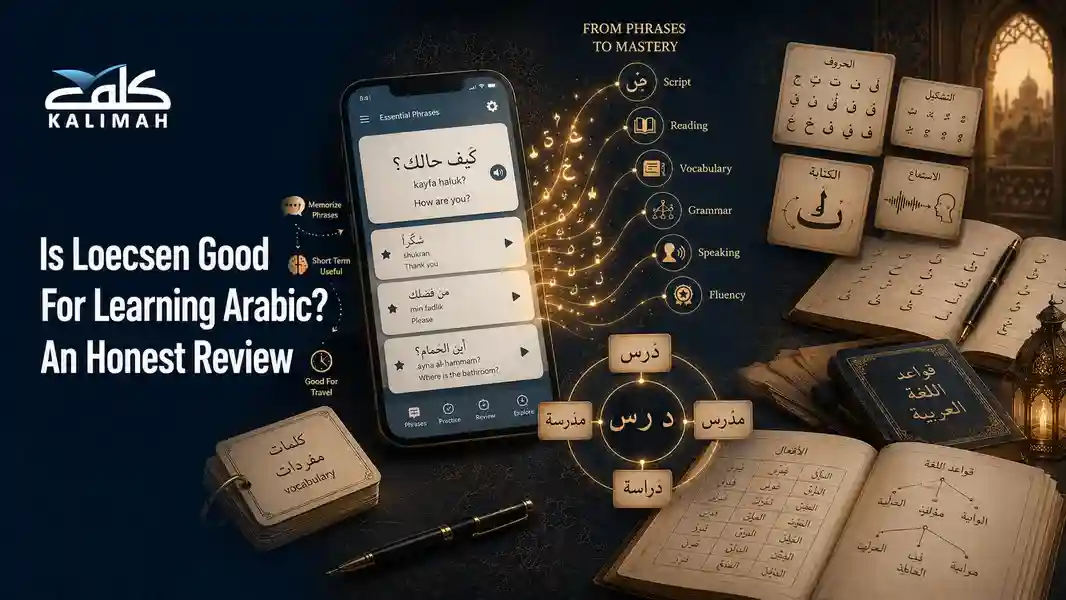
Loecsen is a free, browser-based language learning site that teaches everyday phrases through audio recordings, transliteration, and short situational modules. It covers over 50 languages — Arabic included — and its Arabic content spans both Modern Standard Arabic (MSA) and some dialectal options such as Moroccan Arabic (Darija).
For a complete beginner who wants to greet someone, order food, or ask for directions in Arabic before a trip, Loecsen is genuinely useful. It delivers what it promises: quick, practical phrases with clear native-speaker audio.
For anyone aiming at real fluency, Quranic comprehension, or grammatical accuracy, Loecsen is not enough — and this article will explain exactly why.
A. Loecsen’s Strengths For Arabic Learners
Loecsen’s strengths are real, and they’re worth naming clearly before discussing the limits.
1. High-Quality Pronunciation Audio
Loecsen uses native-speaker recordings throughout, which is a meaningful advantage over AI-generated audio. You hear genuine pronunciation — including vowel length, stress, and natural rhythm — without robotic distortion. For a beginner training their ear to Arabic sounds, this is a legitimate head start.
Each phrase comes with audio you can replay as many times as you need, and the interface lets you switch between the Arabic script, transliteration, and the English translation in one click.
2. , Daily-Use Content
The content is organized around real-life scenarios: greetings, transportation, restaurants, shopping, hotels, and emergencies. This situational structure means you’re not memorizing abstract vocabulary lists — you’re learning phrases in the context where you’ll actually need them.
For travelers or people in the first two weeks of Arabic learning, this structure reduces the overwhelm of starting from nothing.
3. Free and Instantly Accessible
There’s no account required, no paywall, and no app to download. You open a browser and start. For a learner who isn’t yet ready to commit to a structured course, this zero-friction entry point has real value as a first exposure to Arabic.
Read Also: Does Lingopie Teach Arabic?
B. Where Loecsen Falls Short for Serious Arabic Learners?
Understanding Loecsen’s limits is the more important part of this review — because most learners discover them only after investing weeks of time. Many people ask is Loecsen good for learning Arabic precisely because they’ve hit a wall and aren’t sure whether to keep going or switch to something better.
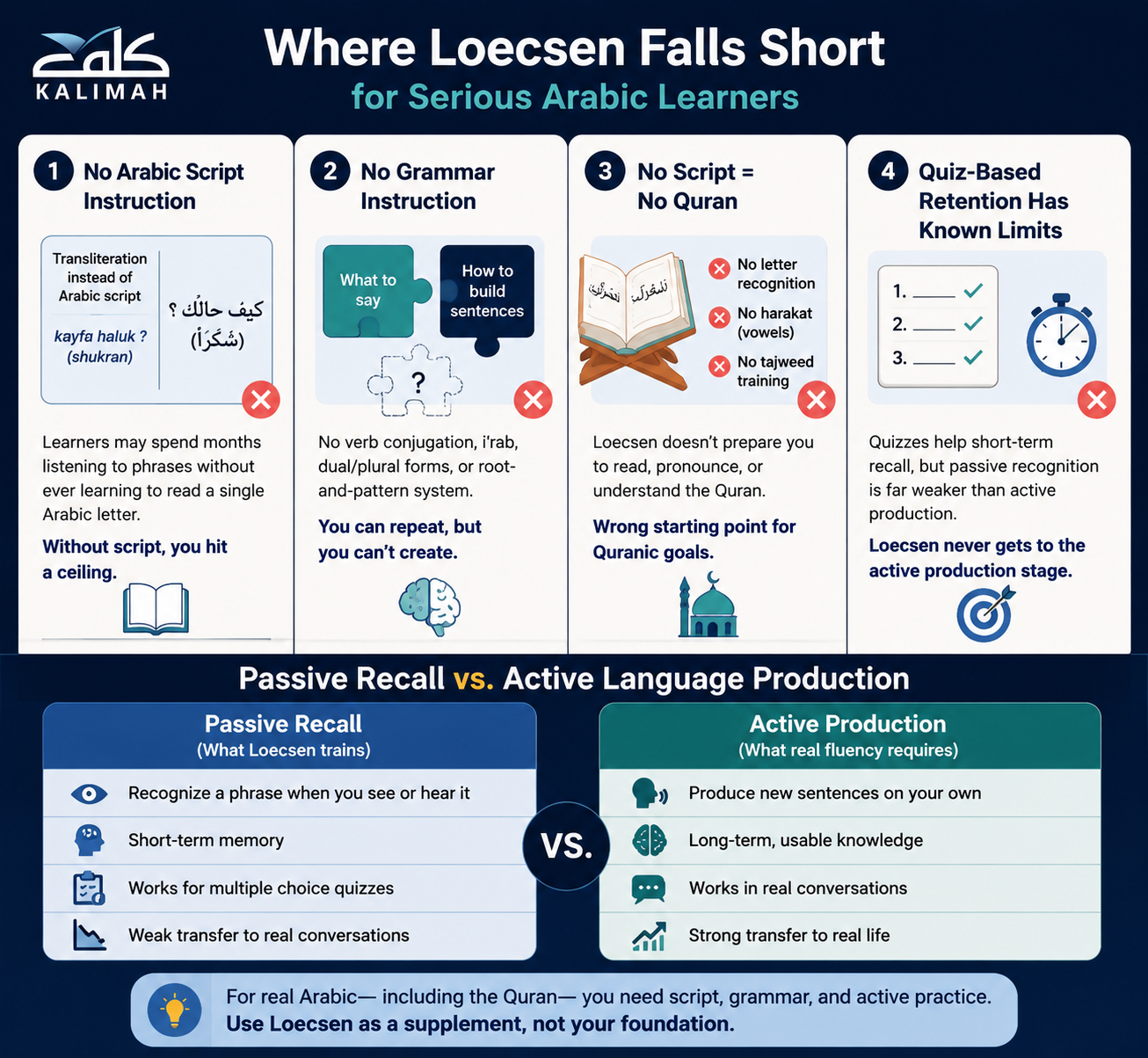
1. No Arabic Script Instruction
This is Loecsen’s most significant gap. The platform frequently defaults to transliteration — writing Arabic words in Latin characters — rather than teaching you to read Arabic script. A learner who only uses Loecsen may spend months listening to phrases without ever learning to read a single Arabic letter.
Arabic script is not optional. It is the entry point to the Quran, to Arabic literature, to every sign, menu, and text message in the Arab world. A tool that sidesteps it is a tool with a built-in ceiling.
2. No Grammar Instruction
Loecsen teaches you what to say, not how to build sentences. There is no explanation of verb conjugation, noun cases (i’rab), dual and plural forms, or the root-and-pattern system that Arabic is built on.
This matters practically: if you hear a phrase you didn’t memorize and need to understand it, you have no tools. You can repeat what you’ve heard; you cannot produce anything new. This is the difference between a phrase book and a language.
3. No Script = No Quran
For Muslim learners — a significant portion of people searching for Arabic learning tools — Loecsen provides essentially nothing for Quranic goals.
The Quran is in Arabic script, and reading it requires not just letter recognition but mastery of vowel markings (harakat), tajweed rules, and Quranic pronunciation. Loecsen addresses none of these. If Quranic comprehension is your goal, Loecsen is the wrong starting point entirely.
4. Quiz-Based Retention Has Known Limits
After each phrase module, Loecsen offers a short quiz. This is useful for immediate recall — but passive recognition (matching a word to a translation) is far weaker than active production (forming a sentence yourself). Loecsen never gets to the active production stage.
Read Also: Arabic Numbers Grammar
C. Who Should Actually Use Loecsen?
Before deciding whether is Loecsen good for learning Arabic applies to your situation, it helps to be honest about your actual goal. Loecsen is appropriate for a specific, narrow use case:
- A traveler who needs 50–100 phrases before a trip to an Arabic-speaking country and has no time to learn the script
- A complete beginner in their first week, using Loecsen purely to build familiarity with Arabic sounds before starting a structured course
- A learner using it as supplementary audio alongside a structured Arabic program — not as their primary resource
If you fall outside these three categories, your time is better invested in a learning path that includes script, grammar, and structured progression from day one.
This is exactly where Kalimah Center operates — and where the difference between a tool and a curriculum becomes clear.
Read Also: Arabic Language Books for Children: The 7 Best Picks for Every Age and Level
Loecsen Vs. Kalimah Center: Tool Or Curriculum?
Most learners who search “is Loecsen good for learning Arabic” are really asking a deeper question: am I using the right kind of tool for my goal? The table below makes the difference concrete.
| Feature | Loecsen | Kalimah Center |
| Arabic script instruction | Relies on transliteration | Full script from day one |
| Grammar instruction | None | Structured Nahw & Sarf |
| Quranic Arabic preparation | Not addressed | Dedicated curriculum track |
| Live instructor feedback | No | Qualified native-speaking teachers |
| Languages covered | 50+ (generalist) | Arabic only (specialist) |
| Content type | Phrase memorization | Full curriculum: script → grammar → fluency |
| Suitable for children | Not designed for kids | Dedicated kids’ Arabic course |
| Group class option | No | Intensive group classes available |
| Pronunciation correction | Audio only, no feedback | Real-time correction per session |
| Progress tracking | None | Structured level progression |
| Cost | Free | Paid — structured investment |
| Best for | Travelers, first-week exposure | Anyone serious about Arabic |
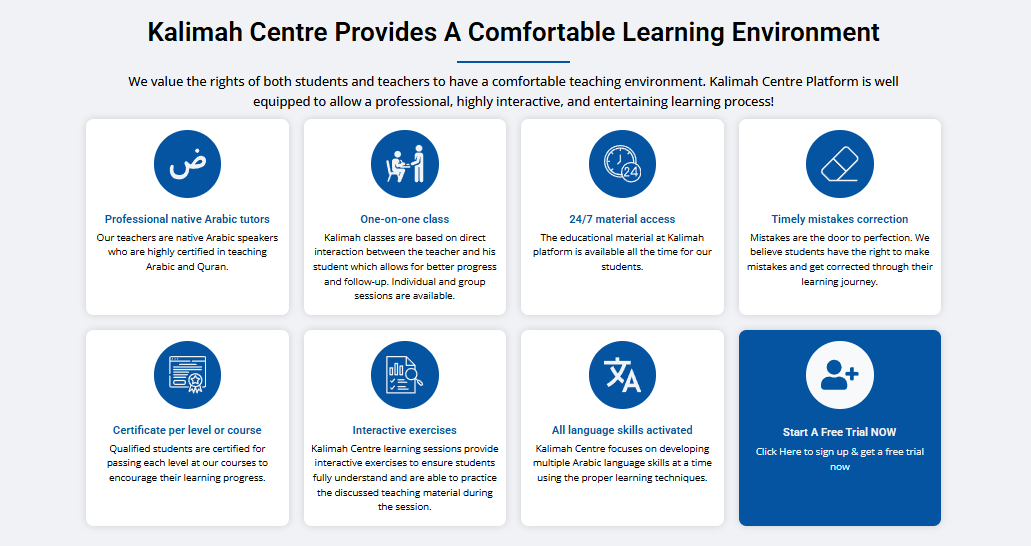
The core distinction: Loecsen is a tool — it performs one limited function. Kalimah Center is a curriculum — it takes you from zero to a defined, measurable outcome. Tools are useful when your goal is limited. A curriculum is what you need when your goal is real Arabic.
Read Also: Does Jumpspeak Teach Arabic?
Experience Kalimah Center Classes
Watch real excerpts from our live sessions at Kalimah Center and see how we bring learning to life. These clips highlight our interactive, student-centered teaching approach across all our courses—designed to keep learners engaged, motivated, and actively involved every step of the way.
Master Arabic with Kalimah Center
Join our expert-led online classes and start your journey toward Arabic fluency today.
Book Your Free TrialUsing Loecsen Effectively as a Supplement
If you decide to use Loecsen as a supplement, here is the most effective approach.
1. Use it after, not before, learning the Arabic script
Start with a structured course or dedicated alphabet resource. Once you can read Arabic letters, use Loecsen’s audio alongside the Arabic script — not the transliteration.
2. Focus on the audio, not the quizzes
The value in Loecsen is the native-speaker pronunciation. Use it to train your ear. Ignore the matching quizzes as a measure of progress — they test recognition, not usable knowledge.
3. Limit your time on it to one session per day, maximum
Loecsen is easy and satisfying in a way that can feel like productive study without actually being it. Cap your time there and put your primary effort into a structured class.
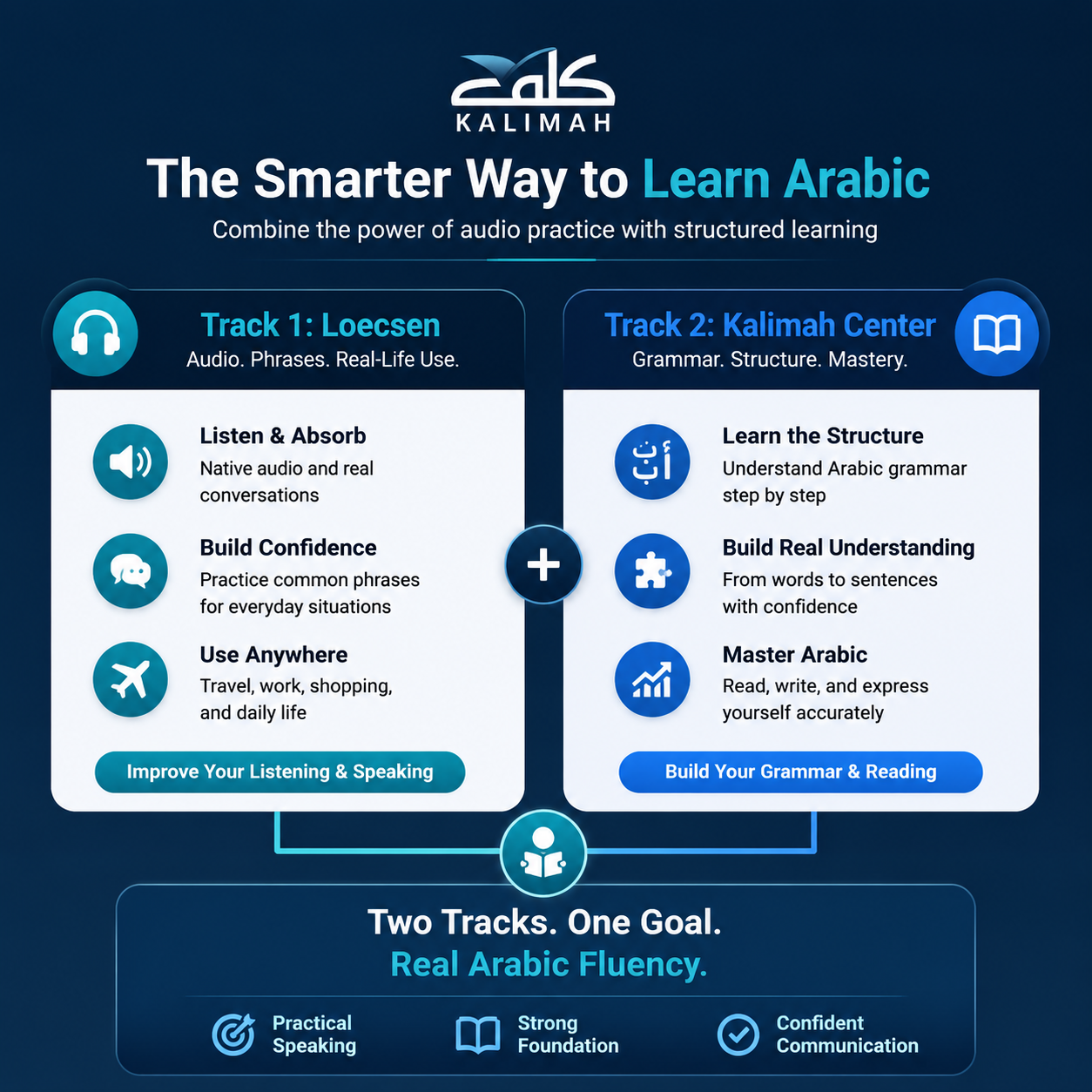
Pair it with real grammar instruction from Kalimah Center. Phrases make sense only when you understand the grammatical structures underneath them. Kalimah Center’s Arabic courses for adults give those phrases a foundation.
Read Also: How to Pronounce Arabic Letter Daad
Start Learning Arabic The Right Way With Kalimah Center
Free tools like Loecsen are a starting point, not a destination. If you’re ready to move beyond phrase repetition into real Arabic — reading the script, understanding the Quran, building sentences from scratch — Kalimah Center offers structured online Arabic instruction designed for exactly that.
Kalimah Center isn’t a multi-language app that skips across 50 languages with surface-level content. It’s a specialized Arabic academy with a focused curriculum for non-native speakers — adults and children, beginners and advanced learners alike.
Explore Our Courses:
- Best Online Arabic Classes for Adults: for adults who want intensive, structured progress.
- Intensive Arabic Group Classes: for learners who want affordable group learning.
- Learn Arabic Online for Kids: for children beginning their Arabic journey.
Inside Kalimah Center: Moments from Our Courses
Get a glimpse into the vibrant learning experience at Kalimah Center. These snapshots capture real moments from our live classes—where students engage deeply, connect with passionate instructors, and grow in a welcoming, supportive environment.
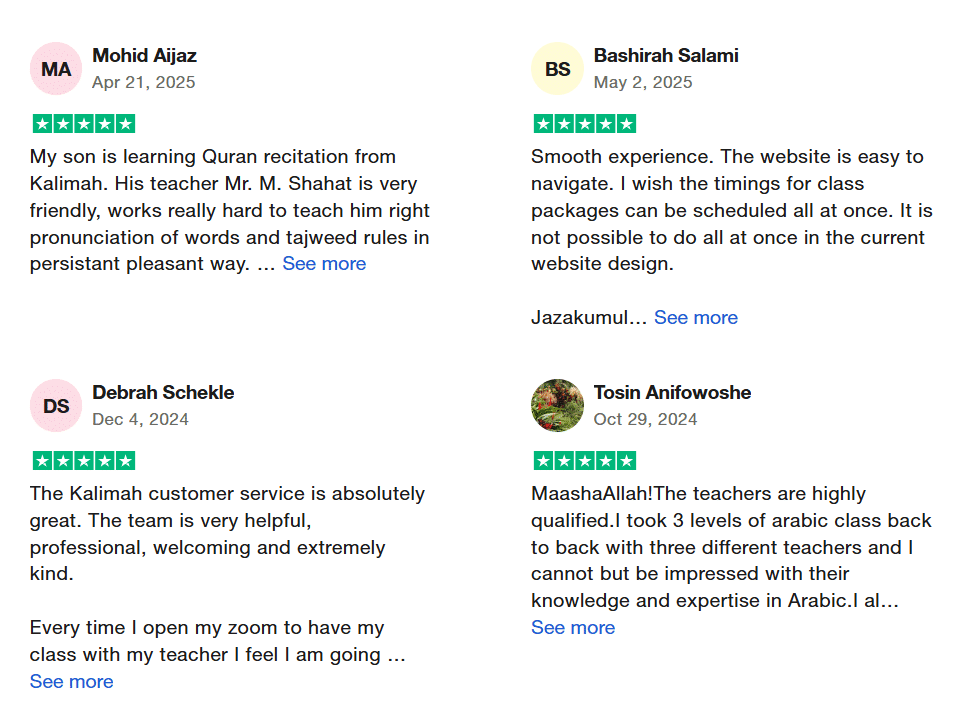
Here Are The Reviews On Our Courses:
Our students frequently commend the excellence of our courses and the commitment shown by our instructors. You can read their complete reviews on Trustpilot.
Read more reviews on Trustpilot
🚀 Start Your Free Trial Today! 🚀
Don’t miss out on this life-changing opportunity to deepen your faith and knowledge. Sign up now for your free trial and take the first step towards becoming a better practicing Muslim with Kalimah Center!
Master Arabic with Kalimah Center
Join our expert-led online classes and start your journey toward Arabic fluency today.
Book Your Free TrialConclusion
Loecsen is a legitimate free tool for a narrow use case: phrase memorization, travel preparation, and first-exposure to Arabic sounds.
It does those things reasonably well. What it cannot do is teach you Arabic — not the script, not the grammar, not the Quran, not the ability to form a sentence you’ve never heard before.
The question “is Loecsen good for learning Arabic?” has a nuanced answer: good for the first week, insufficient for anything beyond it. Most learners who rely on it alone plateau within a month and wonder why their Arabic isn’t progressing.
The solution is a structured curriculum built specifically for Arabic — and that is precisely what Kalimah Center provides.
Frequently Asked Questions About Loecsen and Learning Arabic Online
Here are the most common questions learners ask when evaluating Loecsen and deciding whether it’s the right tool for their Arabic learning goals.
1. Is Loecsen free to use for Arabic?
Yes, Loecsen is entirely free. No account or payment is required. However, free access means limited scope — the content covers basic phrases and daily vocabulary only, with no grammar instruction, no script teaching, and no structured progression toward fluency.
2. Does Loecsen teach Modern Standard Arabic or a dialect?
Loecsen offers both Modern Standard Arabic (MSA) and certain dialects, including Moroccan Arabic (Darija). However, the platform does not explain the difference between them clearly, which can confuse beginners who don’t yet know which variety they need for their goal — MSA for formal, Quranic, or academic Arabic, or a dialect for regional conversation.
3. Can I learn to read Arabic script with Loecsen?
No. Loecsen frequently uses transliteration — Arabic words written in Latin characters — rather than teaching you to read Arabic letters. Learners who want to read the Quran, Arabic texts, or any written Arabic must learn the script through a dedicated course. Kalimah Center’s Arabic courses include full script instruction as a foundational component.
4. Is Loecsen suitable for children learning Arabic?
Loecsen is not designed for children. It has no pedagogical structure for young learners, no age-appropriate content, and no progression system. For children, a purpose-built program like Kalimah Center’s Arabic for Kids course provides age-appropriate instruction, qualified teachers, and a curriculum designed around how children actually acquire language.
5. What is the best alternative to Loecsen for serious Arabic learners?
The most effective alternative to Loecsen for learners who want real Arabic proficiency is a structured course with a qualified instructor. Kalimah Center offers online Arabic classes for adults and children, with curriculum built specifically for non-native Arabic speakers — covering script, grammar, vocabulary, and Quranic Arabic in a sequenced, instructor-led format.
6. How long does it take to learn Arabic with Loecsen alone?
Loecsen alone will not teach you Arabic to any functional level of fluency. It can give a beginner 100–200 useful phrases over a few weeks, but without grammar and script instruction, progress stops there. Learners who want to reach reading fluency typically do so in 6–12 months with structured daily instruction — a timeline Loecsen cannot support on its own.