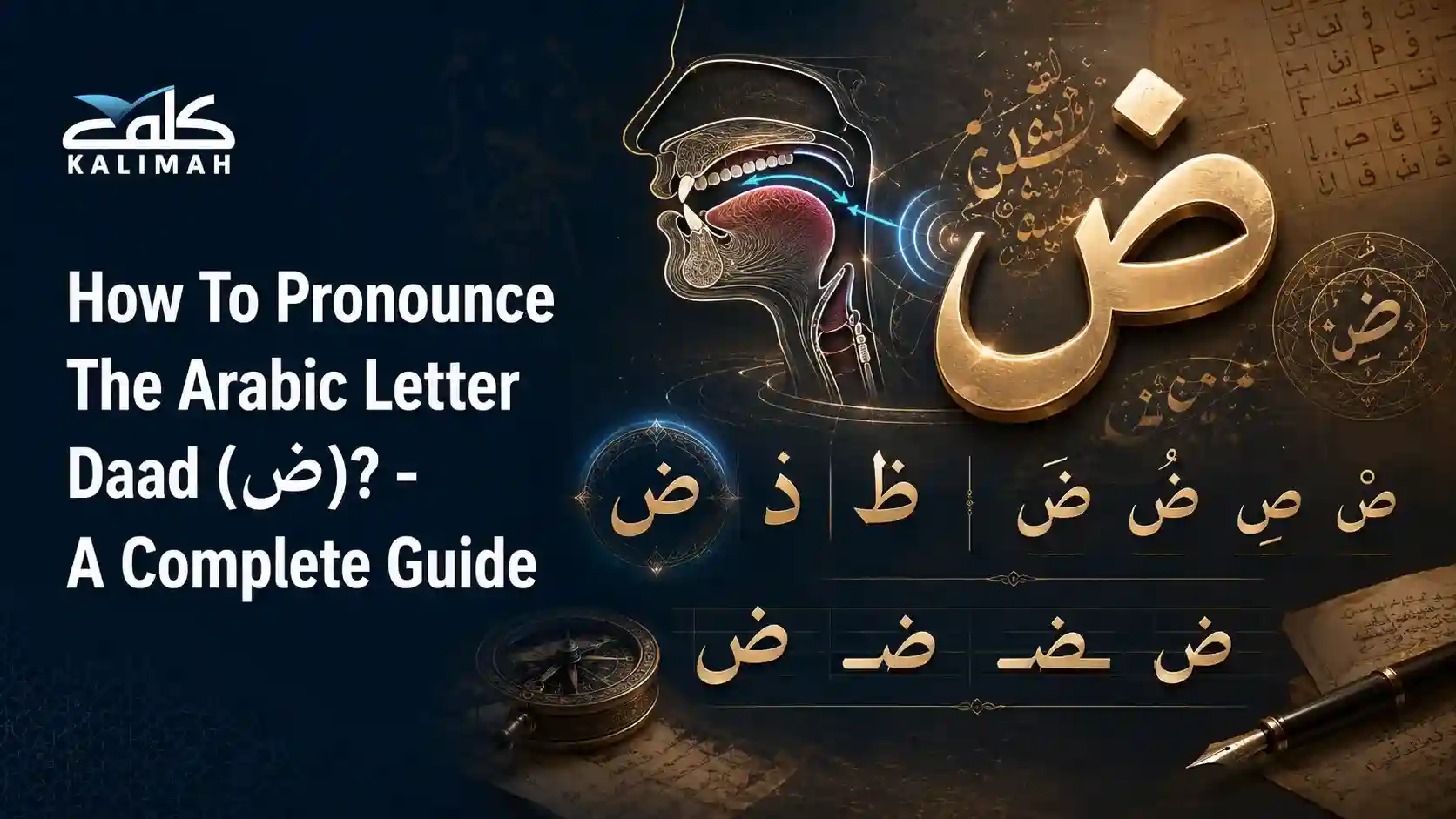
Arabic has one sound that trips up almost every new learner: the letter ض, known as Daad. If you’ve ever wondered how to pronounce Arabic letter Daad correctly, you’re dealing with a sound that doesn’t exist in English, French, or most other languages learners come from.
Daad is the fifteenth letter of the Arabic alphabet and one of the four “emphatic” letters. Because this sound is considered unique to Arabic, the language itself is sometimes called “لغة الضاد” (Lughat al-Daad) — “the language of Daad.”
This guide breaks down exactly how to pronounce ض in Arabic: the tongue position, the difference between static and moving Daad, how it’s written, and the mistakes that trip up most beginners.
At Kalimah Center, this is one of the letters our instructors spend the most one-on-one time on, because getting it right changes how understandable your Arabic sounds overall.
What You’ll Learn in This Article
- How Daad is classified phonetically and why it’s called an “emphatic” letter
- The exact tongue and mouth position needed to produce Daad correctly
- The difference between static (sakinah) and moving (mutaharrika) Daad
- How to tell Daad apart from the similar-sounding Daal (د) and Zaa (ظ)
- The most common mistakes learners make and how to fix them
Daad is a voiced, pharyngealized alveolar plosive. In plain terms: it’s a “d” sound made heavier and deeper by raising the back of the tongue toward the throat while the tongue’s edge presses against the upper molars.
This combination — throat constriction plus tongue pressure — is what Arabic phonetics calls “tafkheem,” or emphasis. It’s the same quality found in letters like ص (Saad) and ط (Taa), but Daad is considered the most distinctive of the group.
Arabic earned the nickname “the language of Daad” because no other widely spoken language produces this exact sound. It functions as a marker of linguistic identity, not just a phonetic detail.
For learners, this means Daad isn’t a minor pronunciation quirk to skip past. Getting it right is treated, culturally and linguistically, as a sign that you’ve truly grasped Arabic sounds.
A. Learn To Pronounce Daad in Arabic
Getting this right comes down to three coordinated movements happening almost simultaneously. Kalimah Center instructors often teach it as a simple internal checklist rather than a single “trick.”
Use this framework every time you practice the letter:
- Side contact: press one side of your tongue (right or left is fine — both together is harder) firmly against the upper molars.
- Tip position: rest the tip of your tongue lightly just behind your upper front teeth, without pressing hard.
- Back lift: raise the back of your tongue toward the roof of the mouth to create the deep, resonant quality.
Once those three points are in place, build up air pressure behind the tongue and release it. The sound should come out heavier and rounder than an English “d” — never sharp or clipped.
A common mistake we see in lessons: students release the tongue too early, which produces a short, flat “d” instead of the full emphatic Daad. Holding the position for a fraction longer than feels natural usually fixes this.
Static Daad vs. Moving Daad (Sakinah vs. Mutaharrika)
Daad behaves differently depending on whether it carries a vowel or not, and this distinction matters for correct tajweed.
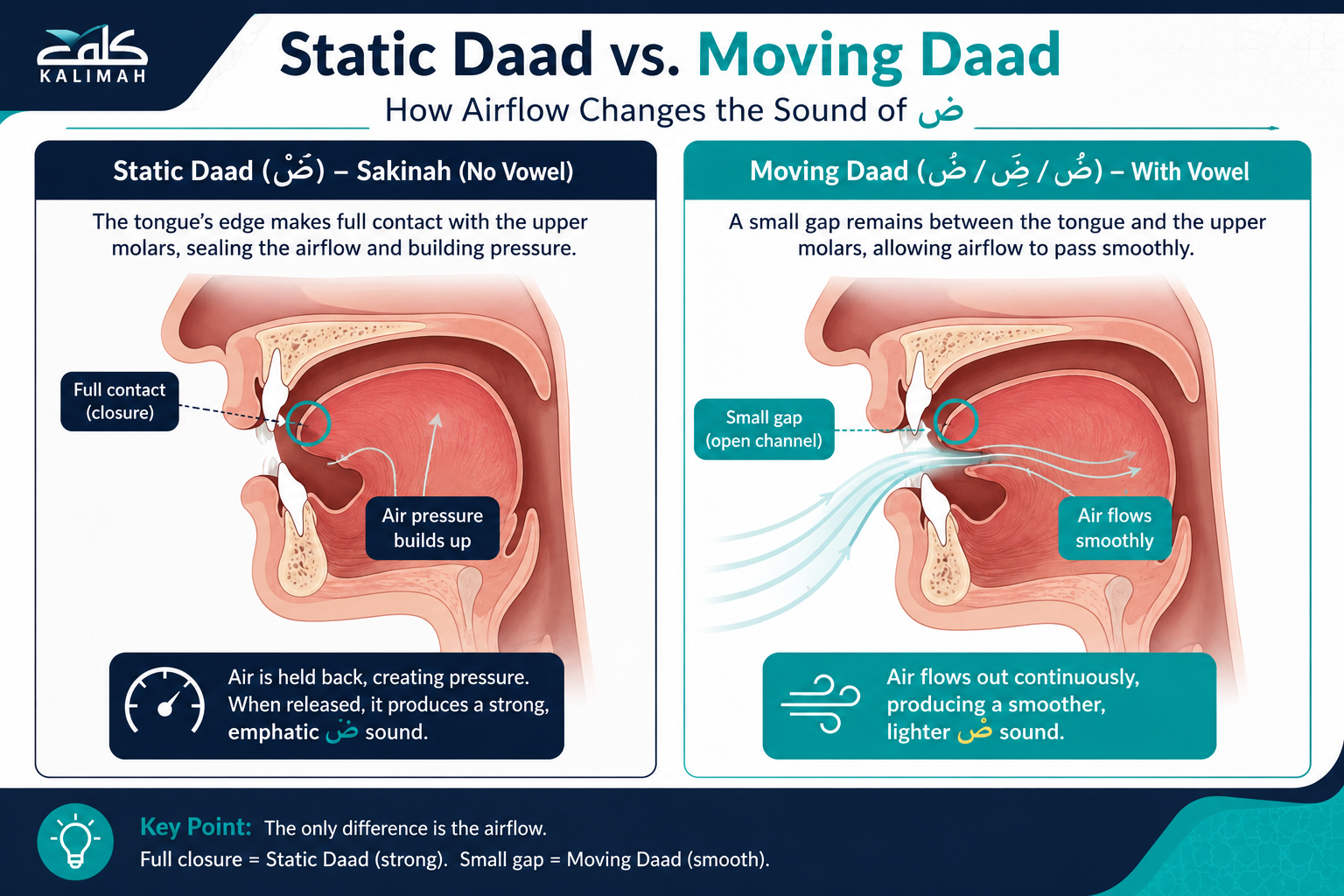
Static Daad (ضْ), with no vowel, is produced by full contact — the tongue’s edge seals completely against the gum ridge, air pressure builds up, and the tongue releases forward by a few millimeters as it opens.
Moving Daad (ضَ / ضُ / ضِ), with a vowel attached, works in reverse — the tongue separates from the palate to let the sound open into the vowel, starting with the molar side first before the rest of the tongue releases.
Understanding this mechanism — rather than just memorizing “it sounds heavy” — is what separates learners who can produce Daad consistently from those who only get it right sometimes.
Read Also: Arabic Alphabet with Fatha, Kasraa, Damma
B. Practicing Daad With Vowels and Letter Shapes
Once the tongue position feels stable, the next step is drilling Daad across every vowel combination and every written form it can take.
This is where structured practice — ideally with a teacher who can hear your output in real time — makes the biggest difference. Reading the mechanics is only half the work.
1. Daad With Short and Long Vowels
Practice Daad with all three short vowels (harakat) and the equivalent long vowels:
- Fatha: ضَ (da)
- Damma: ضُ (du)
- Kasra: ضِ (di)
- Long vowels: ضا (daa), ضو (doo), ضي (dee)
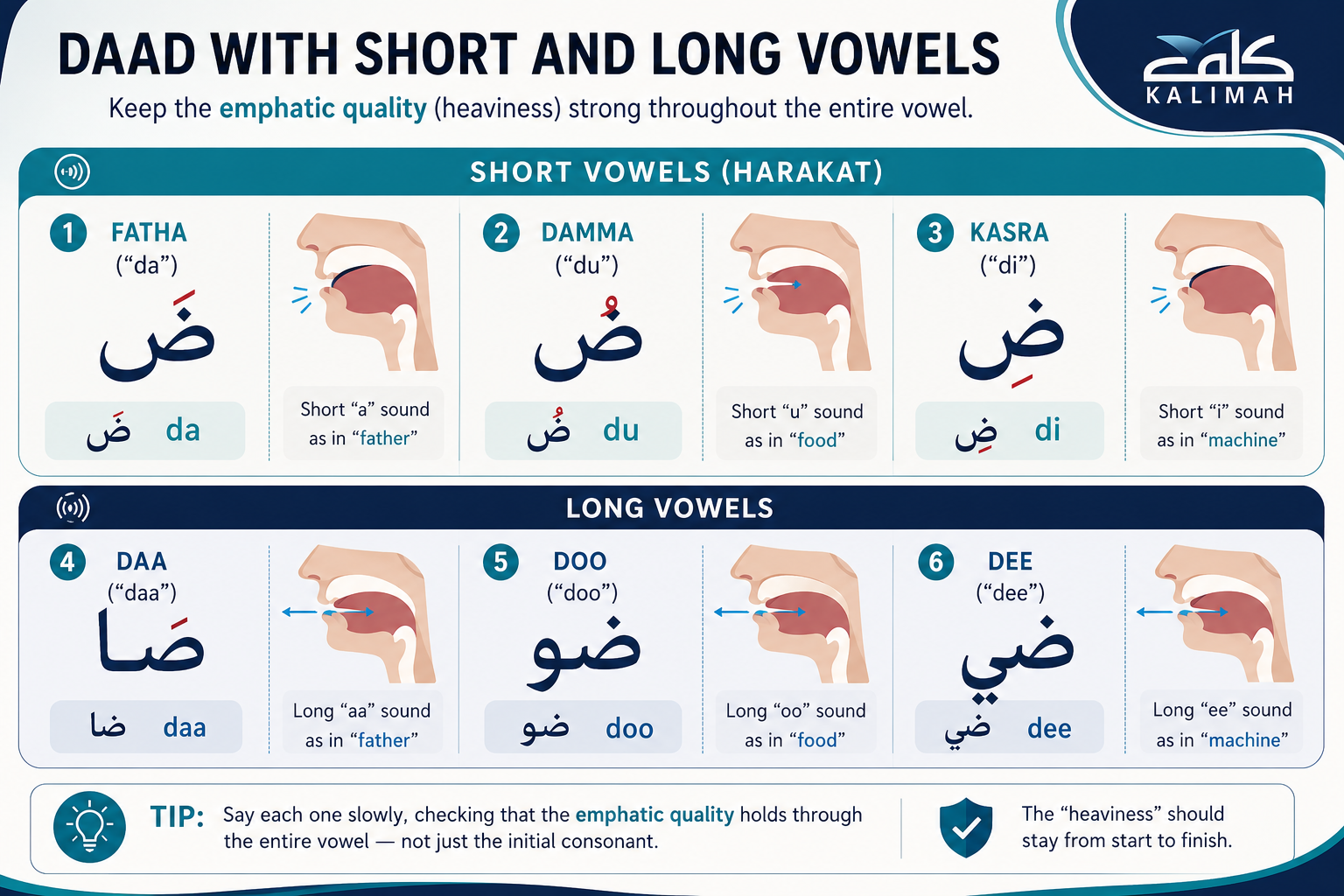
Say each one slowly, checking that the emphatic quality holds through the entire vowel — not just the initial consonant. This is where many learners lose the “heaviness” partway through the sound.
If you’re serious about correcting this, live feedback from a native-speaking instructor is far more reliable than self-checking in a mirror.
This is exactly the kind of correction built into Kalimah Center’s Best Online Arabic Classes for Adults, where lessons are one-on-one and focused on exactly these sound distinctions.
Read Also: Is Anki good for learning Arabic?
2. Writing Daad in Its Four Forms
Like most Arabic letters, ض changes shape depending on its position in a word. It’s written the same way as ص, with one dot added above it.
| Isolated | Initial | Medial | Final |
| ض | ضـ | ـضـ | ـض |
Recognizing these shapes quickly is part of reading fluency, not just pronunciation — a learner who can say Daad correctly but hesitates over its written form still isn’t reading at full speed.
Read Also: How To Pronounce Arabic Letter Ayn?
Experience Kalimah Center Classes
Watch real excerpts from our live sessions at Kalimah Center and see how we bring learning to life. These clips highlight our interactive, student-centered teaching approach across all our courses—designed to keep learners engaged, motivated, and actively involved every step of the way.
Master Arabic with Kalimah Center
Join our expert-led online classes and start your journey toward Arabic fluency today.
Book Your Free TrialC. Common Mistakes When Pronouncing Daad and How to Fix Them
Most Daad mistakes fall into two categories: under-emphasizing it so it sounds like Daal, or over-correcting it into Zaa.
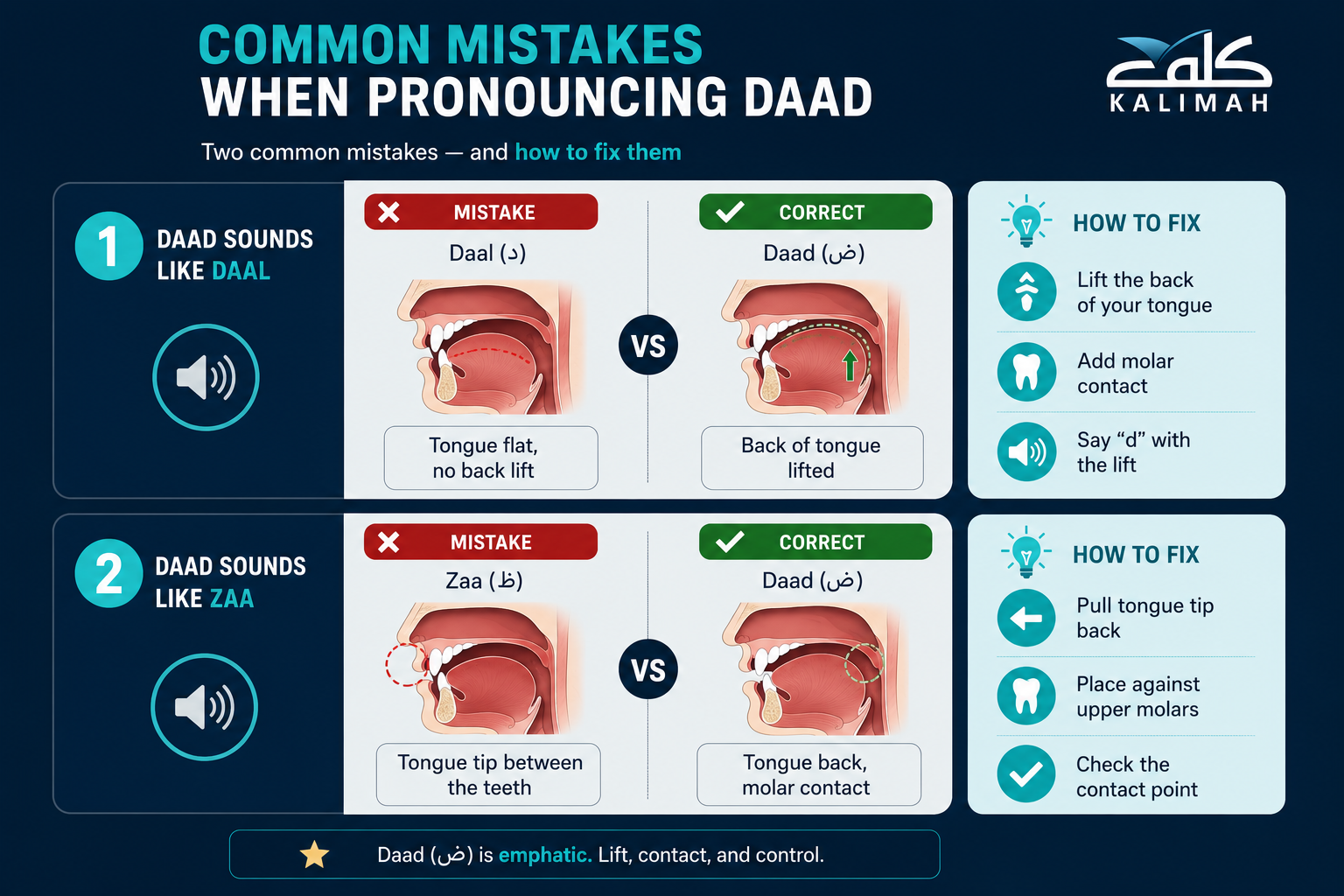
1. Confusing Daad With Daal
If your Daad sounds identical to a regular “d,” you’re likely skipping the back-of-tongue lift that creates the emphatic quality. The fix is isolating that motion first — practice raising the back of your tongue on its own, then add the molar contact.
2. Confusing Daad With Zaa
Zaa (ظ) is articulated with the tongue tip between the teeth, while Daad is articulated further back, against the alveolar ridge. If your tongue tip is poking out between your teeth, you’ve drifted into Zaa territory — pull the tip back and check contact against your upper molars instead.
Group practice helps here, because hearing other learners make — and correct — the same mistakes speeds up recognition. That’s the structure behind Kalimah Center’s Intensive Arabic Group Classes With Cheap Fees, where pronunciation drills are done together and corrected in real time.
Read Also: Is Loecsen Good for Learning Arabic
Start Pronouncing Daad Correctly Today
Reading about tongue position only gets you partway there. Daad is a physical skill, and physical skills need a real speaker checking your output, session after session — not another article.

Kalimah Center offers structured Arabic pronunciation coaching, with instructors who correct tongue placement in real time rather than leaving you to self-check in a mirror.
Adults can Learn Arabic Online with lessons built around exactly this kind of sound correction, while families can start their kids early with a dedicated Learn Arabic Online for Kids track.
The sooner you get feedback on your Daad, the sooner it stops being the one letter that gives away a non-native accent.

Inside Kalimah Center: Moments from Our Courses
Get a glimpse into the vibrant learning experience at Kalimah Center. These snapshots capture real moments from our live classes—where students engage deeply, connect with passionate instructors, and grow in a welcoming, supportive environment.
Here Are The Reviews On Our Courses:
Our students frequently commend the excellence of our courses and the commitment shown by our instructors. You can read their complete reviews on Trustpilot.
Read more reviews on Trustpilot

📚 Explore Our Courses:
Online Arabic Course: Tailored to your level, our comprehensive Arabic program includes 16 teaching levels and 400+ hours of personalized sessions.
Online Quran With Tajweed Course: Perfect for non-Arabic speakers, our course spans 13 levels and equips you with Tajweed mastery from beginner to advanced.
Online Arabic Course For Kids: Nurture your child’s love for Arabic with our engaging and structured program, available in 24 levels for primary, intermediate, and secondary stages.
🚀 Start Your Free Trial Today! 🚀
Don’t miss out on this life-changing opportunity to deepen your faith and knowledge. Sign up now for your free trial and take the first step towards becoming a better practicing Muslim with Kalimah Center!
Master Arabic with Kalimah Center
Join our expert-led online classes and start your journey toward Arabic fluency today.
Book Your Free TrialConclusion
Learning how to pronounce the Arabic letter Daad comes down to three things: correct tongue placement against the upper molars, a raised tongue back for the emphatic quality, and enough repetition to hold that quality through every vowel. It’s a physical habit before it’s a linguistic one.
Daad is what gives Arabic its nickname, “the language of Daad,” and mastering it is one of the clearest signs that your pronunciation has moved past the beginner stage.
Whether you’re working through static Daad, moving Daad, or the letter’s four written shapes, consistent, corrected practice is what closes the gap — not more reading about it.
Frequently Asked Questions
The questions below cover what learners most often ask after starting to work on this letter.
1. What makes Daad different from other Arabic letters?
Daad is one of Arabic’s four emphatic letters, produced with a pharyngealized, heavier sound created by pressing the tongue against the upper molars while raising the tongue’s back. This combination of throat constriction and tongue pressure doesn’t exist in English or most other languages.
2. Is Daad the hardest letter in Arabic to pronounce?
Daad is widely considered one of the hardest Arabic letters for non-native speakers because its exact articulation point and pharyngealized quality have no equivalent sound to compare it to. Most learners need dedicated, corrected practice rather than self-study alone.
3. How can I tell if I’m pronouncing Daad correctly?
Correct Daad sounds heavier and more resonant than an English “d,” with the emphatic quality holding through the entire vowel that follows it. The most reliable check is feedback from a native-speaking instructor, since self-assessment often misses subtle tongue-position errors.
4. What is the difference between Daad (ض) and Zaa (ظ)?
Daad is articulated with the tongue’s edge against the alveolar ridge and upper molars, while Zaa is articulated with the tongue tip between the teeth. Learners who let the tongue tip slip forward often produce Zaa when they mean to say Daad.
5. How long does it take to learn to pronounce Daad correctly?
There’s no fixed timeline, since it depends on how much corrected practice you get rather than passive listening alone. Learners working with a live instructor in regular sessions typically notice consistent improvement faster than those practicing without feedback.