Learning Arabic in 90 days is not about intensity — it’s about sequence. The right material, in the right order, practiced daily, takes a complete beginner to real conversational ability in three months. Not perfection. Not fluency.
A foundation solid enough to hold a conversation, read basic text, and keep building on your own. This guide maps that sequence phase by phase, with a daily schedule built around the reality of a busy adult’s life.
What You’ll Learn in This Article?
- What “learn Arabic in 90 days” realistically means — and what it doesn’t.
- A three-phase routine with exact daily time splits for each stage.
- The three mistakes that derail most 90-day plans.
- How to use what you already know to learn faster.
- How structured instruction accelerates everything.
What Can You Realistically learn Arabic in 90 days?
By Day 90, a dedicated learner following a structured daily routine can expect to:
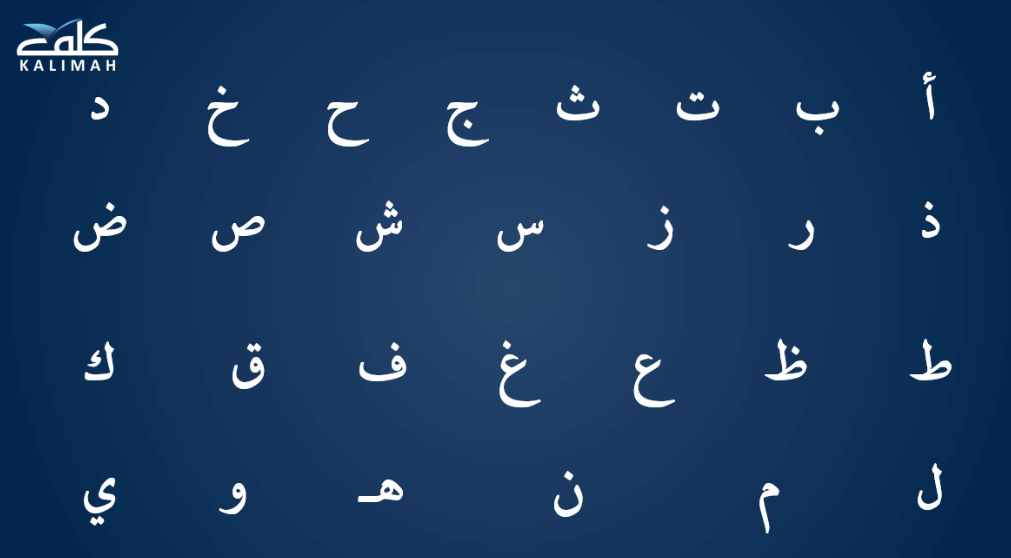
- Read all 28 Arabic letters.
- Recognize 300–500 vocabulary words.
- Hold short basic conversations.
- Understand simple Arabic sentences without a dictionary.
What you will not have: native-level fluency, full Quranic comprehension, or the ability to follow fast-paced Arabic audio without support.
That is an honest A2-level outcome — and it is a genuinely strong starting point that most unstructured learners take years to reach.
Read Also: Learn Arabic In 30 Days
What “Learn Arabic in 90 Days” Actually Means for Daily Commitment?
The fastest learners share one habit: short daily sessions over long occasional ones. Thirty to forty-five focused minutes every day outperforms a three-hour session on weekends.
The brain consolidates language during sleep — so daily exposure gives memory more opportunities to lock in new patterns. This is the core principle the entire routine is built on.
What “Learn Arabic Fast” Requires You to Prioritize?
All Students search for the fastest way to learn Arabic. Not all Arabic skills are equal in the early stages. Script and pronunciation must come before vocabulary, and vocabulary must come before grammar.
Students who reverse this order — jumping to grammar before their ears are comfortable with Arabic sounds — consistently plateau within the first month.
The three-phase routine below enforces the correct sequence so you build on a solid base at every stage.
Phase 1 Build the Foundation Days 1 to 30
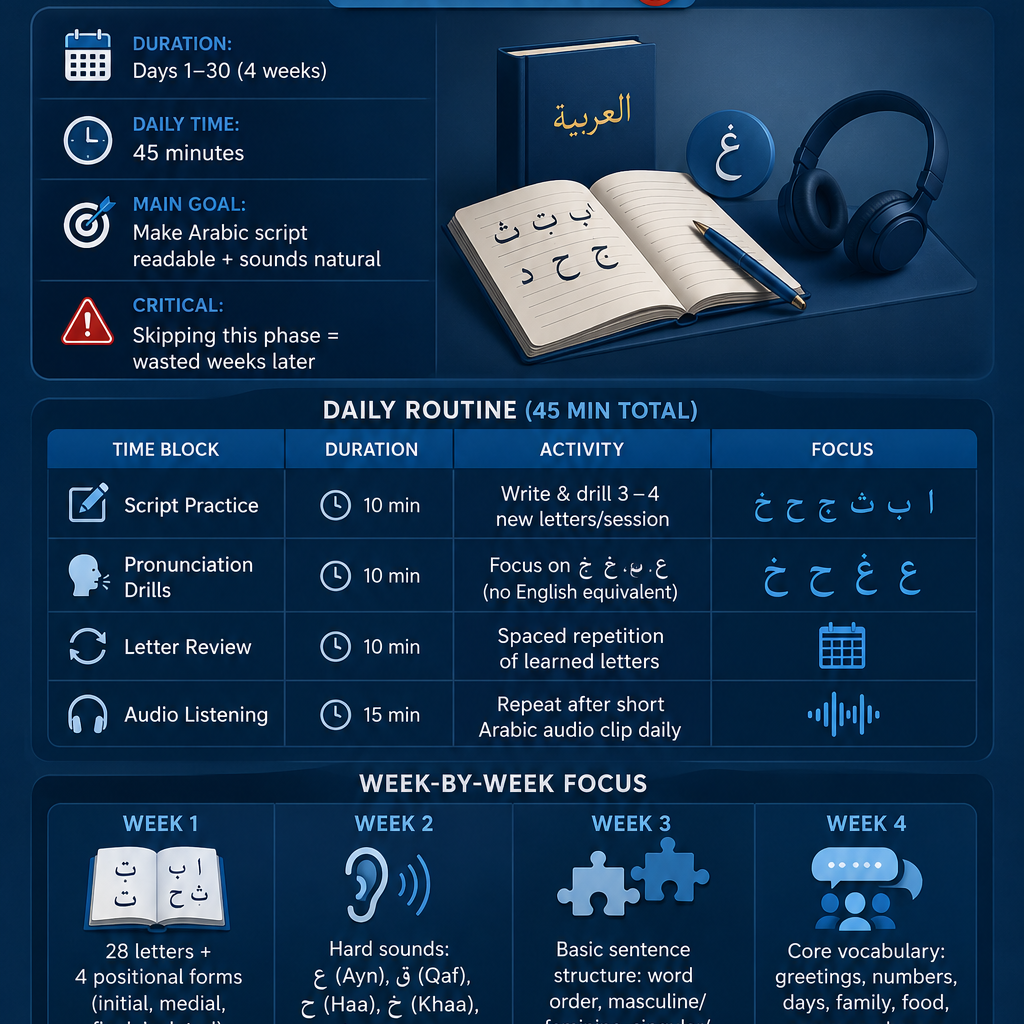
This phase has one job: make the Arabic script readable and the sounds natural before anything else.
Every student who skips this phase comes back to it later, having wasted weeks building on an unstable base. Forty-five minutes a day is enough — split across four focused blocks.
Your Daily Routine in Phase 1
Here is exactly how to spend your 45 minutes each day in the first month:
| Time Block | Duration | Activity |
| Script practice | 10 min | Write and drill 3–4 new letters per session (all 28 covered by Day 10) |
| Pronunciation drills | 10 min | Focus on ع، غ، ح، خ — sounds with no English equivalent |
| Letter review | 10 min | Spaced repetition of letters already learned |
| Audio listening | 15 min | Repeat after the same short Arabic audio clip daily |
Week-by-Week Focus in Phase 1
The four weeks of this phase each have a single clear target — working through script, sounds, structure, and core vocabulary in sequence:
- Week 1 — The 28 letters and their four positional forms (initial, medial, final, isolated).
- Week 2 — Pronunciation drills on the hardest sounds: ع (Ayn), ق (Qaf), ح (Haa), خ (Khaa), غ (Ghayn).
- Week 3 — Basic sentence structure: word order, masculine/feminine, singular/plural.
- Week 4 — Core vocabulary: greetings, numbers, days, family, food, common phrases.
Phase 2 Speak and Apply Days 31 to 60
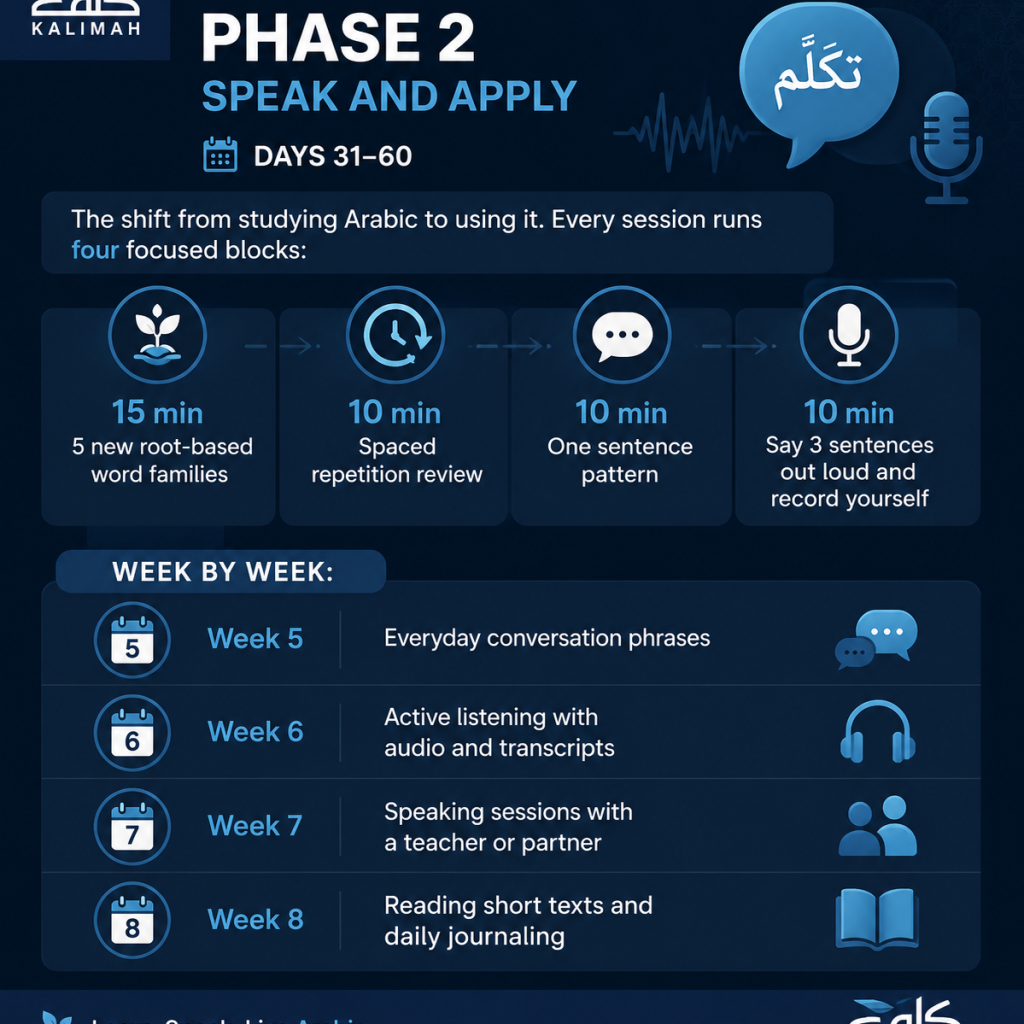
Phase 2 is where passive knowledge becomes active use. You stop studying Arabic and start using it — in short, real sentences, every day.
The milestone that marks readiness to enter this phase is simple: you can sound out any Arabic word you have never seen before, letter by letter, slowly but correctly. If you cannot do that yet, stay in Phase 1 for one more week.
Your Daily Routine in Phase 2
Every session in Phase 2 has four blocks, balancing new input with active production:
| Time Block | Duration | Activity |
| Vocabulary roots | 15 min | Learn 5 new root-based word families per session |
| Spaced repetition review | 10 min | Review previous vocabulary; retire cards you know solidly |
| Sentence patterns | 10 min | One sentence structure per session (nominal sentence, verb agreement) |
| Speaking practice | 10 min | Say 3 sentences out loud and record yourself |
Week-by-Week Focus in Phase 2
The four weeks of this phase follow a deliberate progression — you start by absorbing the language passively, and finish by using it on your own terms:
- Week 5 — Conversation sentences: “كيف حالك؟” / “أين الحمام؟” / “كم الثمن؟”.
- Week 6 — Active listening: short Arabic audio with transcripts; repeat after the speaker.
- Week 7 — Speaking sessions: daily practice with a teacher or language partner.
- Week 8 — Reading and writing: short Arabic texts; journaling 2–3 sentences daily.
At Kalimah Center, the Online Arabic Course is structured around exactly this kind of sequenced, level-by-level progression — 16 teaching levels covering 400+ hours of one-on-one sessions, so you always know what comes next and never waste time guessing what to study.
Read also: Subjunctive and Jussive in Arabic – A Complete Grammar Guide
Experience Kalimah Center Classes
Watch real excerpts from our live sessions at Kalimah Center and see how we bring learning to life. These clips highlight our interactive, student-centered teaching approach across all our courses—designed to keep learners engaged, motivated, and actively involved every step of the way.
Master Arabic with Kalimah Center
Join our expert-led online classes and start your journey toward Arabic fluency today.
Book Your Free TrialPhase 3 Immerse and Consolidate Days 61 to 90
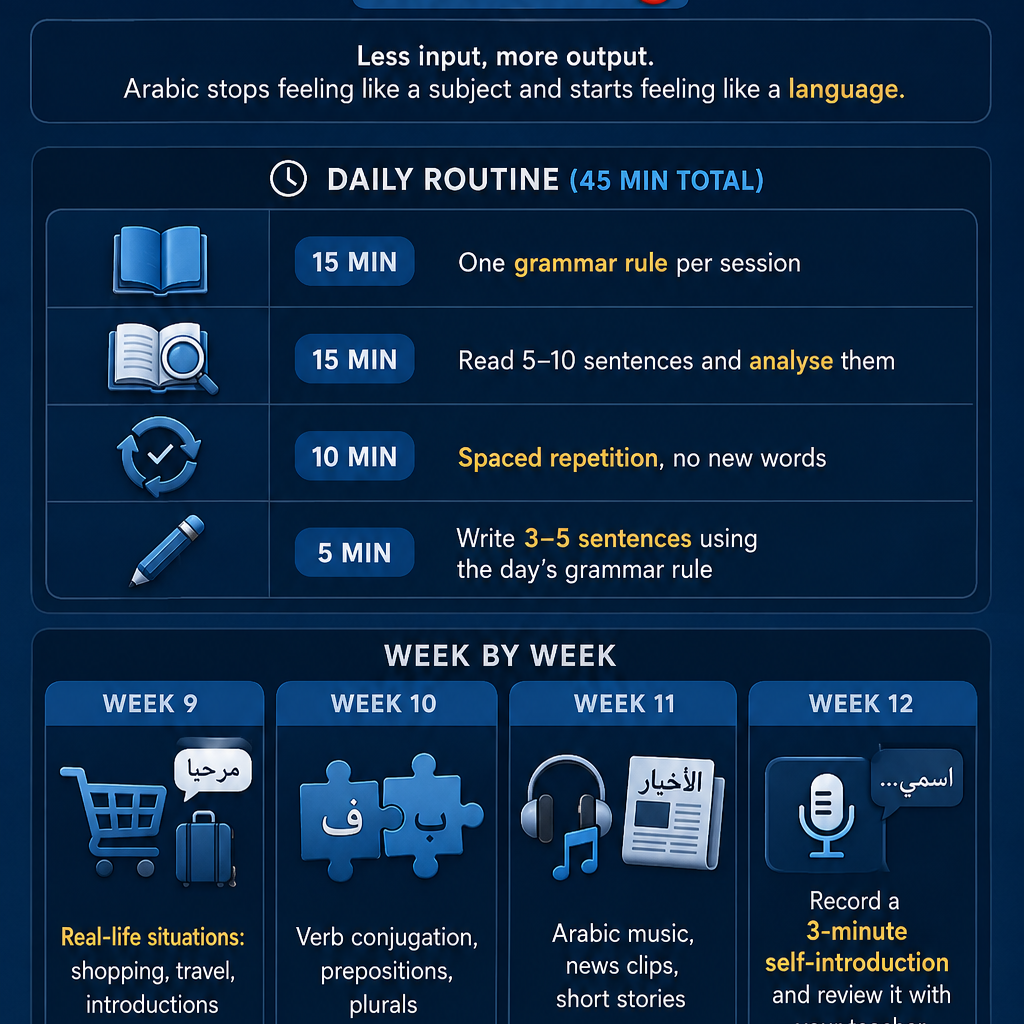
Phase 3 is where Arabic stops feeling like a subject and starts feeling like a language.
You consolidate what you have built and push it into real-world use — reading short texts, writing sentences from memory, and holding basic conversations without notes.
The daily routine shifts slightly to reflect this: less new input, more active production and consolidation.
Your Daily Routine in Phase 3
Phase 3 is where passive learning steps aside — what you’ve absorbed over 60 days now has to prove itself in real conversation:
| Time Block | Duration | Activity |
| Grammar focus | 15 min | One rule per session: definiteness, case markers, verb conjugation |
| Reading with analysis | 15 min | Read 5–10 Arabic sentences; identify grammatical elements |
| Vocabulary consolidation | 10 min | Spaced repetition — no new words, solidify Phase 2 roots only |
| Writing practice | 5 min | Write 3–5 sentences applying the grammar rule of the day |
Week-by-Week Focus in Phase 3
The final four weeks move from structured Arabic Grammar practice to open, real-world use of everything you have built:
- Week 9 — Real-life situations: shopping, restaurants, travel, introductions.
- Week 10 — Intermediate grammar: past/present verb conjugation, prepositions, plurals.
- Week 11 — Cultural immersion: Arabic music, news clips, short stories.
- Week 12 — Final assessment: record a 3-minute self-introduction in Arabic and review it with your teacher.
The 3 Mistakes That Collapse Most 90-Day Arabic Plans
Most 90-day attempts do not fail because Arabic is too hard. They fail because of three avoidable mistakes that derail progress before momentum builds.
Knowing them in advance is the simplest way to make sure your plan survives past Day 30.
Mistake 1: Trying to Learn Everything at Once in Week 1
The most common failure is cramming grammar, vocabulary, pronunciation, and script all simultaneously from Day 1.
The cognitive overload causes burnout before the end of the first month.
The three-phase routine exists to prevent exactly this — one clear focus per phase, each one building on the one before it.
Mistake 2: Moving to Phase 2 Before Phase 1 Is Solid
Vocabulary built without a solid phonetic foundation has nowhere to anchor. Words become guesswork rather than something you can read, say, and remember.
If you cannot sound out an Arabic word you have never seen before — even slowly — Phase 1 is not complete. Stay there until that milestone is real, not approximate.
Mistake 3: Measuring Hours Instead of Milestones
Forty-five minutes of distracted study is not the same as 45 focused minutes, and logging hours tells you nothing about actual progress.
Track milestones instead: “I can read all 28 letters without hesitation” — “I know 100 root-based vocabulary families” — “I can introduce myself in five full sentences without notes.”
Milestone-based tracking is the only honest measure of where you actually are.
How to Use What You Already Know to Learn Arabic Faster?
One underused accelerator in any Arabic learning plan is your existing knowledge.
- If you speak Urdu, Farsi, or Turkish, you already recognize thousands of Arabic loanwords — that head start in vocabulary is real and should be used deliberately.
- If you have successfully learned any other second language before, your brain already understands how language acquisition works; research consistently shows prior language learners progress through early Arabic stages 20–30% faster than first-time learners.
Even English speakers can exploit patterns. Arabic auxiliary verbs cover 80–90% of sentences in everyday conversation — just as English modal verbs do.
Learning those auxiliary structures first gives you a grammatical scaffold that makes new sentences easier to construct from Day 1.
Read also: Quran Verses About Forgiveness in Arabic And English
Inside Kalimah Center: Moments from Our Courses
Get a glimpse into the vibrant learning experience at Kalimah Center. These snapshots capture real moments from our live classes—where students engage deeply, connect with passionate instructors, and grow in a welcoming, supportive environment.
Here Are The Reviews On Our Courses:
Our students frequently commend the excellence of our courses and the commitment shown by our instructors. You can read their complete reviews on Trustpilot.
Read more reviews on Trustpilot

Start Learning Arabic Today — See Real Progress in 90 Days With Kalimah Center
Most people who want to learn Arabic don’t lack motivation — they lack a clear starting point and a structure that actually moves them forward.
90 days is enough time to build a real foundation: recognize patterns, form sentences, and begin reading Arabic the way it was meant to be read.
What Makes the Difference in 90 Days?
Not all learning methods get you there at the same speed. Three things consistently separate learners who progress from those who plateau, which are found at Kalimah:
- One-on-one sessions — no waiting for a class to catch up, no falling behind a fixed pace.
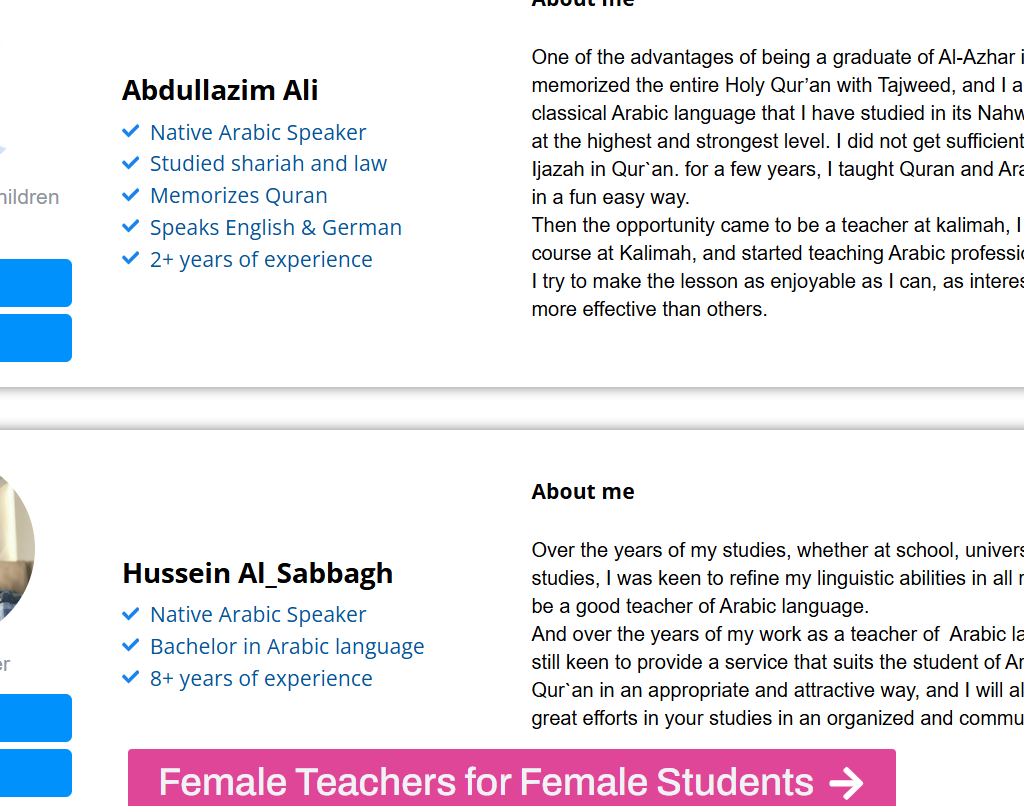
- A tutor matched to your level — chosen based on real student reviews, not assigned at random.
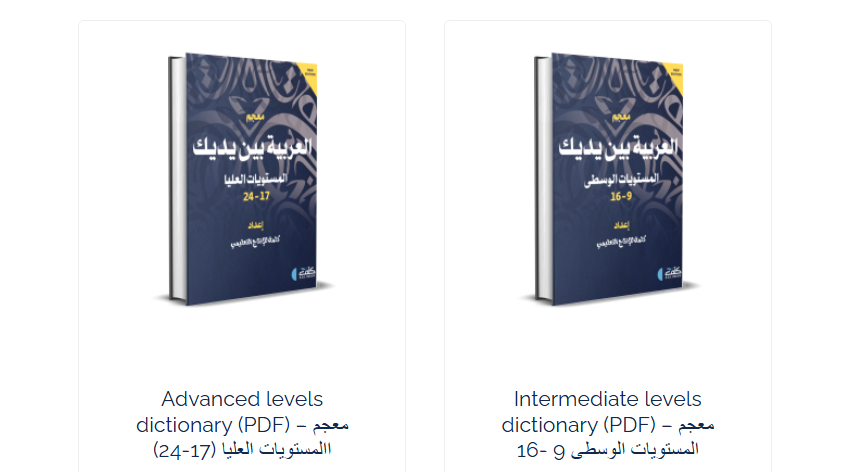
- Structured course books — so every session builds on the last, and nothing falls through the gaps
See How It Works Before You Start
Kalimah’s free YouTube lessons give you a real look at the teaching style — not a highlight reel, but actual lessons:
Why is the US hosting the World Cup?
Three Courses One Path Forward
The Online Arabic Course (16 levels) for adults building from any starting point. The Quran with Tajweed Course (13 levels) for learners focused on Quranic reading and recitation. The Arabic Course for Kids (24 levels) for children at every school stage — all taught one-on-one by qualified tutors.

Book your free trial and start your 90 days
Master Arabic with Kalimah Center
Join our expert-led online classes and start your journey toward Arabic fluency today.
Book Your Free TrialConclusion
Learning Arabic in 90 days is not a marketing promise — it is a realistic outcome when you follow a sequenced daily routine and measure the right milestones.
Phase 1 builds your script and sounds. Phase 2 moves you into speaking and vocabulary. Phase 3 consolidates everything into real, usable Arabic. Forty-five minutes a day, six days a week, in the right order — that is the plan.
What separates learners who reach Day 90 with a real foundation from those who quit at Day 30 is not talent or time. It is structure, daily consistency, and getting pronunciation corrected before bad habits take hold. Kalimah Center’s Online Arabic Course gives you all three — with expert instructors who know exactly how to get you there.
Frequently Asked Questions
Can you really learn Arabic in 90 days?
You can reach a solid A2-level foundation in 90 days with a structured routine of 45 minutes daily — including full alphabet reading, 300–500 vocabulary words, and basic conversational ability.
Full fluency takes longer, but 90 days produces a real, usable starting point that most learners take years to reach without a proper plan.
How many minutes a day do you need to learn Arabic in 90 days?
Forty-five minutes of focused, structured daily practice is sufficient for meaningful progress in 90 days.
Daily sessions are far more effective than longer sessions a few times per week because the brain consolidates language during sleep — more daily exposures means more consolidation cycles.
What is the best daily routine to learn Arabic fast?
The most effective routine is phase-based: script and sounds first (Days 1–30), vocabulary and speaking second (Days 31–60), and grammar with consolidation third (Days 61–90). Each phase has a clear daily time split and a milestone that marks readiness to advance.
Trying to cover all skills simultaneously from Day 1 is the most common cause of burnout and plateau.
Is Arabic hard to learn for English speakers?
Arabic is classified as one of the more challenging languages for English speakers — primarily because of the script, the sounds, and the grammar structure.
However, the alphabet is learnable in two to three weeks, the root system makes vocabulary acquisition faster than it first appears, and the hardest sounds become manageable with real-time pronunciation correction. Difficulty is real but consistently overstated.
Do I need a teacher to learn Arabic in 90 days?
A teacher is not strictly required for Phase 1 (script and self-study vocabulary), but pronunciation correction from a qualified instructor makes a critical difference — especially for sounds like ع (Ayn) and ح (Haa) that have no English equivalent.
By Phase 2, speaking practice with a teacher or language partner is strongly recommended. Students who add even one weekly session with a qualified instructor consistently reach their 90-day milestones faster and with fewer errors to correct later.
What Arabic should I learn first — Modern Standard Arabic or a dialect?
For most beginners, Modern Standard Arabic (MSA) is the better starting point if your goals include the Quran, formal communication, or broad cross-regional understanding.
Egyptian Arabic is the most widely understood dialect if your goal is everyday conversation. The script and core sounds are shared — so Phase 1 applies equally to both, and you can make the dialect choice at the end of Phase 1 once the foundation is in place.